Neuralink Human Trials Timeline 2024–2026: Patients, Telepathy, Blindsight & Global Expansion
Neuralink went from one human implant in January 2024 to 20 official surgeries by end-2025 and 21 Neuralnauts enrolled worldwide by January 2026, with
Latest Story
In January 2024, one person had a Neuralink brain implant. Noland Arbaugh, paralyzed below the shoulders by a spinal-cord injury, learned to move a computer cursor by thinking about moving his hand. By the end of 2025, Neuralink’s own published surgery timeline showed 20 implantation procedures. By mid-2026, public reporting and participant tracking indicated at least 26 implant recipients. But the numbers are only part of the story. Participants have demonstrated computer cursor control, gaming, computer-aided design, digital communication and assistive robotic-arm interaction, and Neuralink has expanded its clinical research beyond the United States to Canada, the United Arab Emirates and Great Britain. The devices remain, in every legal and clinical sense, investigational medical technology — and this Neuralink human trials timeline tracks exactly how far that experiment has actually gone.
Data last verified: 2 September 2026. This article separates what Neuralink has officially reported, what independent regulators and hospitals have confirmed, what public/community trackers report, and what Elon Musk has predicted but not yet demonstrated. Nothing here is medical advice, and no claim about vision or paralysis being “cured” is made anywhere in this article.
🧠 AI Overview Summary
Neuralink implanted its first human brain-computer interface in Noland Arbaugh in January 2024. By its own January 2026 “Two Years of Telepathy” update, the company reported 20 implantation surgeries through the end of 2025 and a growing crew of 21 Neuralnauts enrolled worldwide, across trial sites in the United States, Canada, the United Arab Emirates and Great Britain. Public reporting and participant tracking put the total at at least 26 by mid-2026. Participants have controlled computer cursors, played games, used CAD software, operated an assistive robotic arm and taken part in early speech-decoding research. Neuralink’s Blindsight vision-restoration program received FDA Breakthrough Device Designation in September 2024 but had not begun human implantation as of September 2026. None of Neuralink’s devices are FDA-approved for commercial sale — all human use remains under investigational clinical trial authorization.
How Far Has Neuralink Actually Got?
What actually changed between 2024 and 2026
- Neuralink went from one participant to an international clinical program in two years. Noland Arbaugh’s January 2024 implant was followed by expansion to Canada (November 2024), the UAE (May 2025) and Great Britain (July 2025).
- Neuralink’s own numbers are the strongest anchor. 20 surgeries through end-2025, and 21 Neuralnauts enrolled worldwide as of the company’s 28 January 2026 update — both company-reported, not third-party estimates.
- The 26+ figure circulating by mid-2026 is public/community tracking, not an official Neuralink total — it should be treated and timestamped as such until Neuralink itself publishes a newer number.
- The first major technical problem was physical, not electronic. Some of Noland’s implanted threads retracted from brain tissue in spring 2024, reducing usable signal; software changes helped performance recover.
- Capability has broadened beyond cursor control. Participants have played games, used CAD software, controlled an assistive robotic arm, and begun testing communication/speech-decoding research through Neuralink’s VOICE trial.
- Blindsight is real but still experimental. It has FDA Breakthrough Device Designation (September 2024) but had not begun human implantation as of September 2026 — Elon Musk said in August 2026 that first human implants were still 6–12 months away.
- Nothing here is FDA-approved for commercial sale. Every device remains under investigational clinical trial authorization; Neuralink is not a consumer product.
- The central open question isn’t whether it works once. It’s whether Neuralink can turn a promising experiment into a safe, durable, repeatable medical technology at scale.
🔴 Reading the labels used throughout this article
🟢 NEURALINK-OFFICIAL — reported directly by the company, in its own updates or regulatory filings. 🟡 COMMUNITY/MEDIA TRACKING — aggregated from public reporting and participant trackers, not confirmed by Neuralink itself. 🟠 MUSK/COMPANY FORECAST — a stated goal or prediction, not an accomplished fact. ⚪ DEBATED/UNCERTAIN — genuinely unresolved among independent observers.
Hype vs Reality: Neuralink in 2026
What the loudest claims about Neuralink actually mean once verified
| Claim you’ll hear | Verified reality |
|---|---|
| “Neuralink reads minds” | It decodes specific, trained neural patterns tied to intended movement or speech — not arbitrary thoughts |
| “Neuralink cured paralysis” | Participants control external devices despite paralysis; the underlying spinal-cord or nerve damage is not repaired |
| “Blindsight cured blindness” | Blindsight has FDA Breakthrough status but has not yet been implanted in a human as of September 2026 |
| “Neuralink is available soon” | Still investigational clinical research; no commercial product, no consumer purchase path |
| “The robot does everything” | R1 inserts the implant’s threads; a neurosurgeon performs exposure, craniectomy and closure |
| “26 patients proves it’s ready to scale” | 26 is a community-tracked count of an early-stage trial — not evidence of commercial-scale readiness |
Neuralink’s first chapter was can it work? Its next chapter is can it work safely, repeatedly and at scale?
January 2024: Noland Arbaugh Becomes Neuralink’s First Human Recipient
Ten years ago, Noland Arbaugh sustained a paralyzing spinal-cord injury just before his final year of college, leaving him unable to move his arms or legs. In January 2024, he became the first person implanted with Neuralink’s N1 device, in a study called PRIME (Precise Robotically Implanted Brain-Computer Interface). The initial goal was narrow and concrete: let Noland control a computer cursor and digital devices using decoded neural activity, without moving his hands.
What actually happens is not “reading his mind.” When Noland thinks about moving his hand, his motor cortex produces electrical activity. N1’s electrodes record that activity, software decodes the pattern associated with intended movement, and a computer converts it into cursor motion. Neuralink is decoding specific, trained neural patterns for a defined task — not reading arbitrary private thoughts.
This is a digital bypass, not a repair: Brain → N1 → computer, instead of Brain → damaged spinal pathway → muscle. The implant does not physically restore the underlying nerve connection.
Spring 2024: The Thread-Retraction Problem
After Noland’s surgery, some of the implant’s threads retracted from brain tissue — a physical, mechanical problem, not a software bug. Fewer effective threads meant fewer usable electrode signals, and his initial BCI performance declined. Neuralink did not hide this: the company disclosed it publicly and responded by modifying its decoding algorithms and how signals were interpreted. Performance subsequently recovered, and on some measures improved beyond earlier levels.
Software did not physically reinsert the threads. It extracted more useful information from the signal that remained. That distinction matters: the first Neuralink problem was physical; part of the solution was software, working around reduced hardware, not fixing it.
July 2024: Alex Becomes the Second Participant
From Thinking About Movement to Designing in 3D
In July 2024, a second PRIME Study participant — referred to publicly as Alex, living with a spinal-cord injury — received his implant at the Barrow Neurological Institute, going home the following day. Neuralink published a progress update on 21 August 2024. By his second day of use, Alex was using Autodesk Fusion 360 CAD software to design a mount for his own Neuralink charger, which was 3D-printed and attached to his laptop stand. He also returned to playing Counter-Strike 2, a game he had previously played using a mouth-operated controller.
CAD use matters because it moves BCI demonstrations beyond simple cursor tests toward genuinely productive computer work. Neuralink reported that Alex had no thread-retraction issue at the time of its update — that is a snapshot from August 2024, not a claim of permanent, all-patient stability.
November 2024: Brad Becomes the Third Participant — and the First With ALS
Brad Smith received his implant in November 2024, becoming Neuralink’s third participant and its first with amyotrophic lateral sclerosis (ALS) — and its first non-verbal recipient, relying on a ventilator and able to move only his eyes before the implant. Using Neuralink, Brad began communicating with an AI-generated voice and controlling a swiveling camera mounted to his wheelchair, letting him look around a room freely for the first time in years. By the end of 2024, Neuralink had implanted three participants — the baseline the company’s own 2026 retrospective measures growth against.
Neuralink Goes International: Canada, UAE, Great Britain
Clinical research expanded to more trial sites and eligible participants — not “regulatory arbitrage”
Starting in November 2024, Neuralink’s clinical research expanded beyond the United States. Health Canada approved CAN-PRIME on 20 November 2024, Neuralink’s first international study, based at Toronto Western Hospital (University Health Network), targeting people with limited or no hand use due to ALS or cervical spinal-cord injury.
Neuralink announced UAE-PRIME on 14 May 2025, its first Middle East clinical trial, at Cleveland Clinic Abu Dhabi in partnership with the Department of Health Abu Dhabi — evaluating the N1 implant and R1 robot in adults with severe motor and speech impairment from spinal-cord injury, ALS, stroke or other qualifying neurological conditions.
Neuralink launched GB-PRIME on 31 July 2025 across two sites, University College London Hospitals (UCLH) and Newcastle Hospitals, approved by the UK’s MHRA, HRA and Health and Care Research Wales. The study was designed to enroll up to seven participants; UCLH reported that all seven had received surgery between October and December 2025.
| Country | Study | Key site(s) | Launch/approval |
|---|---|---|---|
| United States | PRIME / VOICE | Multiple US hospital sites | PRIME study underway since 2023 |
| Canada | CAN-PRIME | Toronto Western Hospital (UHN) | Approved 20 Nov 2024 |
| United Arab Emirates | UAE-PRIME | Cleveland Clinic Abu Dhabi | Announced 14 May 2025 |
| Great Britain | GB-PRIME | UCLH; Newcastle Hospitals | Launched 31 Jul 2025; 7/7 enrolled by Dec 2025 |
These are clinical-trial sites, not markets where Neuralink is commercially available. No claim here should be read as “countries where you can buy a Neuralink.”
2025: From One Surgery to Multiple Per Month
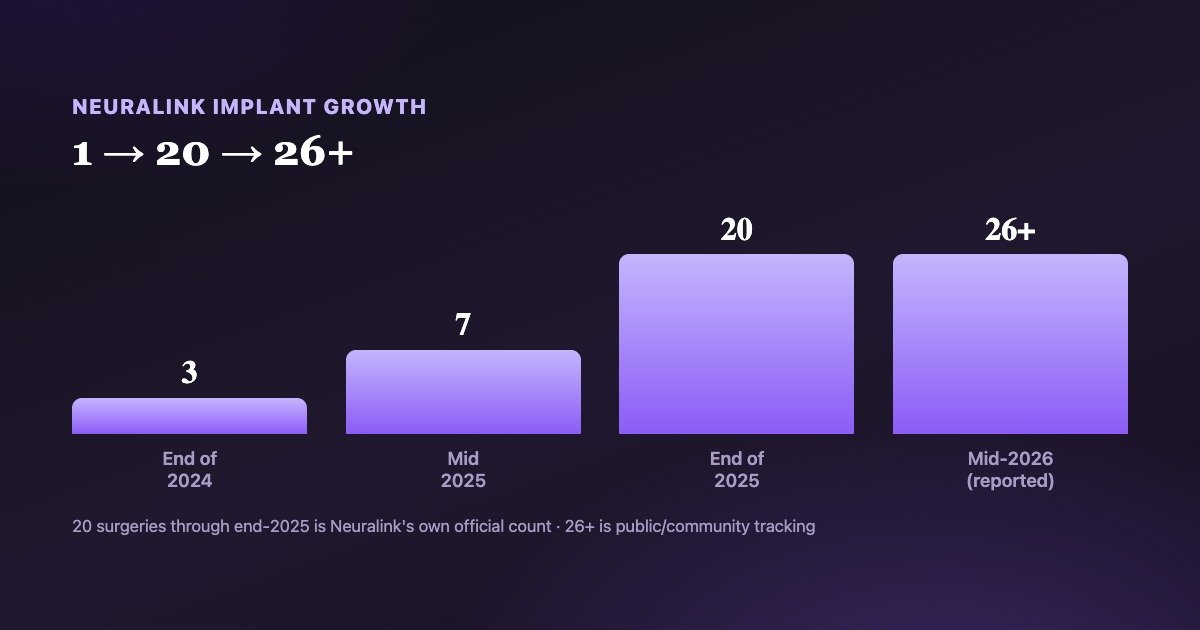
Neuralink’s own 28 January 2026 update published an implantation timeline covering every clinical-trial surgery across 2024 and 2025: one in the first half of 2024, two in the second half of 2024, four in the first half of 2025, and thirteen in the second half of 2025 — a cumulative 20 surgeries through the end of 2025. 🟢
| Period | Surgeries | Cumulative |
|---|---|---|
| H1 2024 | 1 | 1 |
| H2 2024 | 2 | 3 |
| H1 2025 | 4 | 7 |
| H2 2025 | 13 | 20 |
Source: Neuralink, “Two Years of Telepathy,” 28 January 2026. This is the strongest verified scaling record Neuralink has published — company-reported, not a third-party estimate.
January 2026: “Two Years of Telepathy” — 21 Neuralnauts
On 28 January 2026, exactly two years after Noland’s implant, Neuralink published a retrospective titled “Two Years of Telepathy,” announcing a growing crew of 21 Neuralnauts enrolled in trials worldwide. 🟢 The company said it maintained its record of zero serious device-related adverse events at that point — a company-reported figure worth taking seriously, but one that a small, closely monitored early-feasibility cohort cannot extend into a claim of long-term, population-scale safety.
The update also reported: after implementing surgical and postoperative mitigations learned from Noland’s thread retraction, Neuralink observed higher signal quality in 18 of the subsequent 20 participants. 🟢 The company said it plans to increase electrode count from roughly 1,000 to 3,000 electrodes in future hardware, and is investigating inserting threads directly through the dura mater to reduce surgical invasiveness — both labelled as planned, not yet deployed. 🟠
Beyond the cursor: robotic arm, education, art, communication
Nick, unable to move his limbs for four years, used Neuralink to telepathically control an assistive robotic arm to feed himself and scratch an itch — a documented step beyond screen-based cursor control into physical-world assistance. Noland returned to college to study neuroscience. Sebastian, a 23-year-old medical student, uses his implant for up to 17 hours a day for coursework. Audrey, Neuralink’s first female participant, uses her implant to create original digital art after two decades without directly controlling a computer.
For communication, Neuralink reported that despite the implant being placed on only one side of the brain, it can still receive signals related to both hands from some participants, enabling a “ten-finger keyboard for the mind” — participant Jake, who has ALS, reached typing speeds of up to 40 words per minute this way. Building on that, Neuralink has launched a dedicated clinical trial called VOICE (ClinicalTrials.gov NCT07224256), aiming to decode speech-related neural activity directly, with a longer-term goal of conversational speeds around 140 words per minute for people with severe speech impairment from ALS or stroke. 🟠
Mid-2026: Reported Participant Count Reaches At Least 26
By mid-2026, public reporting and participant tracking indicated Neuralink had implanted at least 26 participants — up from the 21 the company itself announced on 28 January 2026. 🟡 One widely circulated tracking account identifies patient 26 as Lee Marten, a Vancouver police sergeant implanted on 20 May 2026, reported to be the first participant to receive Neuralink’s newer through-the-dura surgical approach. This account has not been confirmed directly by a Neuralink press update as of this writing, so it is presented here as community/media tracking, not an official company total.
Do not treat “26” as a Neuralink-confirmed figure unless the company itself publishes a matching total. The most defensible framing: Neuralink’s own last confirmed count was 21 (28 January 2026); public tracking suggests continued enrollment brought the total to at least 26 by mid-2026; replace this figure the moment a newer official Neuralink total is published.
How the N1 Implant and R1 Robot Actually Work
Neuralink’s N1 implant is fully implanted, wireless and rechargeable, originally specified with 1,024 electrodes distributed across 64 flexible threads — each thinner than a human hair. (As above, Neuralink said in January 2026 that it plans to increase this to 3,000 electrodes in future hardware; that upgrade had not shipped as of September 2026.)
Those threads are too fine and flexible to place manually with the precision required, so Neuralink built the R1 surgical robot specifically to insert them — avoiding visible blood vessels and targeting precise cortical locations repeatably. R1 does not perform the whole surgery. A neurosurgeon still carries out exposure, craniectomy, implant mounting and closure; R1’s role is the precise thread insertion step within that procedure. Surgery is not fully automated, and Neuralink has not demonstrated it is routinely performed as outpatient care.
Scaling a BCI means scaling far more than chip manufacturing: implant hardware, robotic placement, neurosurgery, hospital workflow, patient selection, software calibration, long-term monitoring and regulatory evidence all have to scale together. 26 participants across four countries is meaningful progress on that stack — it is not evidence of commercial-scale surgery.
Telepathy, Communication and Blindsight: Three Different Programs
| Program | Goal | Neural approach | September 2026 status |
|---|---|---|---|
| Telepathy / device control | Control computers, phones, robotic limbs | Reads motor-intention signals | Active human trials |
| Communication / VOICE | Decode intended words/speech | Reads speech-related neural activity | Active trial (NCT07224256) |
| Blindsight | Create visual perception | Stimulates visual cortex | Upcoming — no human implant yet |
N1 and “Telepathy” are related but not interchangeable terms: N1 is the implant hardware; Telepathy is Neuralink’s first application built on it.
Blindsight: Neuralink’s Vision-Restoration Program
On 17 September 2024, the FDA granted Blindsight Breakthrough Device Designation — not early 2026, and not FDA approval for commercial use. Breakthrough status can provide a more interactive, expedited FDA development and review pathway for a qualifying device. It does not mean the device is FDA-approved, does not mean it has been proven effective in humans, and does not mean anyone’s blindness has been treated or cured.
Blindsight’s concept: bypass damaged eyes or optic nerves entirely by implanting a microelectrode array into the visual cortex and electrically stimulating it to create perceived visual patterns — the opposite data direction from Telepathy. Telepathy mainly reads neural activity out of the brain; Blindsight would write electrical stimulation into it to create an artificial sensory perception. Decoding movement intentions and creating useful visual perception are different neuroscience problems — success with one does not automatically prove the other.
Elon Musk has said Blindsight could eventually restore vision even to people blind since birth, and that high-resolution or extended-spectrum (infrared/ultraviolet) vision might eventually be possible. These are Musk/company goals and predictions, not independently demonstrated outcomes. In early August 2026, Musk said Neuralink expected to begin its first human Blindsight implants within roughly 6 to 12 months — meaning Blindsight remained an upcoming, not active, human trial as of September 2026.
✅ What’s confirmed about Blindsight
- FDA Breakthrough Device Designation granted 17 September 2024
- Concept: electrical stimulation of the visual cortex to create artificial vision
- Intended for people with damage to the eyes or optic nerve but an intact visual cortex
❌ What’s not yet demonstrated
- No human Blindsight implant as of September 2026
- No restored human vision reported
- No FDA approval for commercial use
- No confirmation of high-resolution or infrared/ultraviolet vision in humans
Safety, Risk and Long-Term Durability
Neuralink’s implant surgery carries the same category of risks as any neurosurgical procedure: infection, bleeding, tissue response, device failure and signal degradation over time, alongside the thread-retraction pattern already seen in Noland’s case. Neuralink reported maintaining zero serious device-related adverse events as of its January 2026 update — a genuinely positive early signal, but one drawn from a small, closely monitored cohort. It does not establish population-scale, long-term safety, and should not be read as “Neuralink has proven its device is safe” in any broader sense.
The most important unanswered scientific question may be durability: can electrodes remain safe, stable and useful for years or decades? Human Neuralink implant history began in January 2024 — under two years old as of this update — so long-term durability is genuinely unknown, not merely under-discussed.
Who owns your brain data?
A connected implantable medical device raises real questions about neural-data privacy, cybersecurity, informed consent, long-term device support, what happens if the company changes hands or shuts down, software updates and data portability. These are legitimate open questions for BCI technology generally, not evidence of any specific breach or vulnerability at Neuralink. This article does not describe attack methods and makes no claim that anyone’s neural data has been compromised.
Is Neuralink FDA Approved?
Not for general commercial sale or use. Neuralink’s PRIME study operates under FDA investigational human-study authorization; Blindsight holds Breakthrough Device Designation. Neither of those is the same as FDA premarket approval for routine clinical use. In plain terms: the FDA has allowed Neuralink to test its device in humans under controlled trial conditions — it has not approved Neuralink as a commercially available medical treatment, and there is no path today for a member of the public to simply buy one.
Patient, Country and Product Matrix
| Participant | Implant | Condition | Documented capability |
|---|---|---|---|
| Noland Arbaugh | Jan 2024 (1st) | Spinal-cord injury | Cursor control; returned to college for neuroscience |
| Alex | Jul 2024 (2nd) | Spinal-cord injury | CAD design (Fusion 360); Counter-Strike 2 |
| Brad Smith | Nov 2024 (3rd) | ALS (first ALS participant) | AI-voice communication; camera control |
| Nick | 2025 | Paralysis (4 years) | Assistive robotic-arm control (feeding, gesturing) |
| Audrey | 2025 | Spinal-cord injury (20 yrs) | First female participant; digital art |
| Jake | 2025 | ALS | Ten-finger imagined-typing, up to 40 wpm |
| Sebastian | 2025/26 | Spinal-cord injury | Medical-school coursework, up to 17 hrs/day use |
Only publicly identified participants and publicly disclosed capabilities are listed; no private medical detail beyond what participants or Neuralink have themselves made public.
What Can Neuralink Patients Actually Do? September 2026
✅ Demonstrated
- Move a computer cursor
- Play video games (Counter-Strike 2, Webgrid)
- Use CAD/3D design software
- Control an assistive robotic arm
- Imagined ten-finger typing (up to 40 wpm)
❌ Not demonstrated / not current capability
- Restore normal eyesight
- Make a paralyzed person walk
- Read arbitrary private thoughts
- Commercial availability / consumer purchase
- Conversational-speed (140 wpm) speech decoding
Neuralink Isn’t Alone: Other Brain-Computer Interfaces
Neuralink did not invent brain-computer interfaces. Other research groups and companies — including Synchron, Precision Neuroscience and Paradromics — have implanted BCIs in humans and demonstrated cursor control, communication or movement-related capabilities using different hardware approaches. Neuralink’s distinguishing features are its high electrode density, its fully implanted wireless design, and its purpose-built surgical robot — not sole ownership of the underlying science.
Why a Cursor Click Can Mean Independence
For most people, moving a computer cursor is so ordinary it barely registers as an action. For someone who cannot reliably move their hands because of a spinal-cord injury or ALS, the same action can represent something much larger: independence. That is why Neuralink’s most consequential demonstrations are not necessarily its most futuristic ones. A participant playing a game is interesting. A participant studying for a medical degree, making art, or looking around a room on their own for the first time in years is arguably more consequential.
The first Neuralink implant also showed why early human trials matter in the first place. The device worked. Then some threads moved. Performance declined. Engineers changed the software. Performance recovered. That sequence is less spectacular than a science-fiction headline, but it may be more important — experimental medicine advances by discovering what works, what fails, and whether the failure can be understood and addressed safely.
Neuralink Human Trials: Full Timeline
Noland Arbaugh Receives the First Human Neuralink Implant
What happened: Noland Arbaugh, paralyzed by a spinal-cord injury, became the first human recipient of Neuralink’s N1 implant.
Why it matters: It marked the start of human BCI trials that, within two years, expanded to four countries.
2024
Thread Retraction Disclosed, Software Mitigates
What happened: Some of Noland’s implanted threads retracted, reducing usable signal and BCI performance.
Why it matters: Neuralink’s public response — software/decoding changes that helped performance recover — became the template for later surgical improvements.
Alex Becomes Second Participant
What happened: Second PRIME participant implanted; by day two, using CAD software and returning to gaming.
Why it matters: Demonstrated productive computer use, not just cursor demos, and no thread-retraction issue reported at the time.
17 ’24
Blindsight Receives FDA Breakthrough Device Designation
What happened: FDA granted Blindsight Breakthrough Device Designation, enabling a more interactive review pathway.
Why it matters: Not FDA approval, and not the start of human trials — those had not begun as of September 2026.
Brad Implanted; Canada Approves CAN-PRIME
What happened: Brad Smith, Neuralink’s first ALS participant, was implanted; Health Canada approved CAN-PRIME on 20 November 2024.
Why it matters: Closed out 2024 with three participants and opened Neuralink’s international expansion.
Implantation Pace Accelerates
What happened: Surgeries rose from 3 total in 2024 to 17 more across 2025, reaching 20 cumulative by year-end.
UAE-PRIME Begins
What happened: Neuralink’s first Middle East clinical trial, targeting severe motor and speech impairment.
GB-PRIME Launches
What happened: UK trial launched with MHRA/HRA/HCRW approval; all 7 planned participants received surgery by December 2025.
28 ’26
“Two Years of Telepathy” Published
What happened: Neuralink announced 21 Neuralnauts enrolled worldwide, the VOICE speech trial, robotic-arm success (Nick), and plans to triple electrode count.
2026
Reported Count Reaches At Least 26
What happened: Public tracking, not an official Neuralink figure, put the participant count at 26 or more, including a reported first through-the-dura surgery in May 2026.
An Active, Multi-Country Trial Ecosystem
What happened: Neuralink’s clinical program now spans device control, communication research and a still-upcoming Blindsight vision program across four countries.
Why it matters: The central question shifts from “can it work in one human?” to “can it work repeatedly, safely and at scale?”
📝 Update History
- 2 September 2026 — 2026 clinical status, participant counts and Blindsight status reviewed.
- Mid-2026 — 26+ participant community-tracking figure added.
- 28 January 2026 — Neuralink’s “Two Years of Telepathy” retrospective added (21 Neuralnauts, VOICE trial, robotic-arm milestone).
- 31 July 2025 — GB-PRIME added.
- 14 May 2025 — UAE-PRIME added.
- 20 November 2024 — CAN-PRIME added.
- 17 September 2024 — Blindsight Breakthrough Device Designation added.
- 21 August 2024 — Second-participant (Alex) progress added.
- January 2024 — First human implant (Noland Arbaugh).
Explore More Timelines
People Also Ask
Frequently Asked Questions
Related AiTimeline Coverage
⚠️ Editorial & Medical Disclaimer
This article is editorial coverage of publicly reported clinical-trial information, not medical advice. Every device and program described remains investigational; nothing here should be used to make a medical decision. Figures were verified against Neuralink’s own published updates, the FDA, ClinicalTrials.gov, Health Canada, the MHRA/HRA, UCLH, Cleveland Clinic Abu Dhabi and Reuters reporting as of 2 September 2026. Community/media-tracked figures (such as the 26+ mid-2026 participant count) are labelled as such and will be replaced by newer official Neuralink totals as they are published.
Sources & further reading
Every dated entry above was checked against these references. Last reviewed 15 September 2026.
- Neuralink — Two Years of Telepathy (28 Jan 2026)
- Neuralink — PRIME Study Progress Update, Second Participant
- Neuralink — Breakthrough Device Designation for Blindsight
- Neuralink — CAN-PRIME Study Launch
- Neuralink — GB-PRIME Study Launch
- UCLH — Seven GB-PRIME Patients Now Participating in Neuralink Trial
- ClinicalTrials.gov — GB-PRIME Study (NCT07127172)
- ClinicalTrials.gov — VOICE Study (NCT07224256)
- Cleveland Clinic Abu Dhabi — UAE-PRIME Trial