Fuel Price Dynamics in India: The Complete Timeline of How Petrol and Diesel Prices Are Really Set
How India's petrol and diesel prices are really set - crude oil, the rupee, refining and taxes - explained through a complete timeline from 1889 to 2026.
Latest Story
Somewhere in India right now, a delivery rider is doing quick mental arithmetic at a fuel pump — how much petrol, for how many rupees, to make it through the day. That single number on the dispenser looks simple, but it is one of the most politically charged figures in the country. Hidden inside it are global crude oil markets, the rupee–dollar exchange rate, refinery economics, a dealer’s cut, and layers of central and state tax that together often make up around half the price. This is the complete story of how India’s fuel prices came to work the way they do — from a fixed, subsidised system to a daily, market-linked one — and why the pump price reflects far more than the cost of oil.
📌 In One Minute
India’s retail petrol and diesel prices are built up from the cost of imported crude oil, refining, freight and a dealer’s commission, on top of which sit a fixed central excise duty and a percentage state VAT. Because the country imports roughly 85% of its crude, the rupee–dollar rate and Brent crude both feed directly into the pump. Taxes frequently account for around half the final figure, which is why prices differ from state to state.
The system was not always like this. For decades the government fixed prices and absorbed losses. The Administered Pricing Mechanism ended in 2002, petrol was deregulated in 2010, diesel in 2014, and since 16 June 2017 prices have been revised every single day. Understanding this build-up explains why fuel prices move, why they vary, and why cutting the cost of a litre is never as simple as crude oil falling.
The Essentials
What to Remember
- India’s pump price is a build-up: crude and refining, freight, dealer commission, central excise duty and state VAT, with tax often near half.
- The system evolved from fixed, subsidised prices to a market-linked one: APM dismantled in 2002, petrol deregulated in 2010, diesel in 2014.
- Since 16 June 2017, prices change daily, so global crude and the rupee pass through quickly, though taxes smooth the effect in rupee terms.
- Because VAT is set by each state, the same litre of petrol can cost very different amounts across India, sometimes differing by ten rupees or more.
- Fuel prices ripple through the whole economy, shaping inflation, transport, farming and aviation, which is why they are studied and debated so closely.
The Fuel Price Formula
How a litre of petrol is built up, layer by layer.
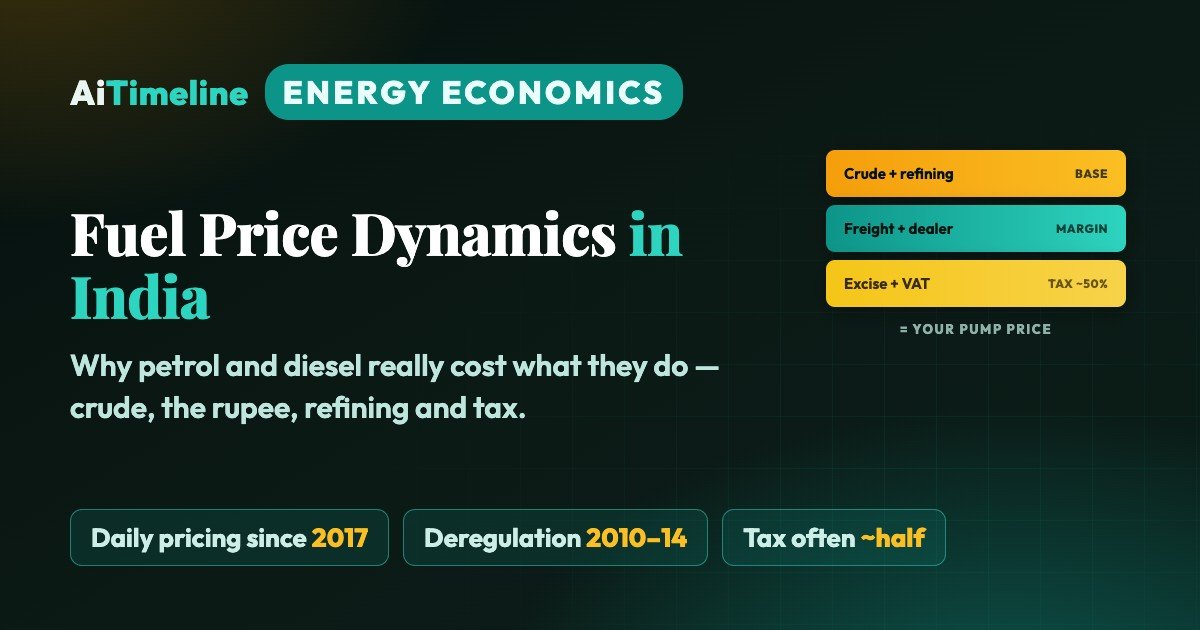
Two features of this formula do most of the explaining. First, the base price is not simply the cost of crude; refineries are paid on a trade-parity price that references international product prices, so what matters is the global price of petrol and diesel, not just crude. Second, the taxes stack in a specific order: the fixed central excise duty is added first, and then state VAT, a percentage, is charged on the amount that already includes excise — a tax on a tax that quietly magnifies every rupee.
How Petrol Prices Are Calculated
The journey from a barrel of crude to the number on the pump.
Start with crude oil
India imports about 85% of its crude, priced in US dollars against benchmarks like Brent. The rupee-dollar exchange rate converts that cost into rupees, so a weaker rupee raises the input price even if crude is flat.
Refine into products
Refineries turn crude into petrol, diesel and other products. Under trade-parity pricing, the refinery gate price references international product prices, blending import and export parity, rather than the crude price alone.
Add freight and marketing
The fuel is moved by pipeline, rail and tanker to depots and pumps. Freight, storage and the oil marketing company’s own costs and margin are added to reach the price charged to dealers.
Add the dealer commission
Retail outlets earn a commission per litre for running the pump. It is a relatively small, fixed part of the price, but it is the dealer’s income from every sale.
Add central excise duty
The central government levies a fixed excise duty per litre. Because it is a set rupee amount rather than a percentage, it does not shrink when crude falls, which is why pump prices can stay high in cheap-oil periods.
Add state VAT
Each state adds Value Added Tax, usually a percentage, calculated on the price that already includes excise. Because states set their own rates, this is the single biggest reason fuel costs differ across India.
Arrive at the retail price
The sum is the price shown at 6 a.m. each day. Add up the base, freight, dealer commission, excise and VAT, and taxes alone often come to around half the total the consumer pays.
💵 Illustrative Price Build-Up (approximate, varies by state and date)
For a litre of petrol retailing near ₹95 in a metro, a rough build-up might look like: base price plus freight around ₹55, dealer commission about ₹4, central excise duty roughly ₹20, and state VAT around ₹16. The exact split shifts daily with crude, the rupee and each state’s VAT rate — these figures are for illustration, not a quotation. The pattern, however, is stable: a large tax slice sitting on top of a market-driven base.
Economic Insight
Here is the counter-intuitive truth at the heart of India’s fuel debate: crude oil prices alone do not determine what you pay. When global crude tumbled during the 2020 pandemic, Indian pump prices barely fell, because the government raised excise duty to capture the difference and shore up its budget. When crude spikes, the same fixed taxes mean retail prices rise by less, in percentage terms, than crude does. Fuel is therefore a shock absorber for public finances as much as a commodity — which is exactly why its price is a political decision, not just a market one.
The Complete Fuel-Pricing Timeline: 1889 to 2026
Newest first. Use the filters to focus on oil shocks, policy, tax changes, fuel standards or alternative fuels.
2026 — The Pricing Framework Today
Where things stand. Petrol and diesel are priced daily by the oil marketing companies, built up from a trade-parity base plus freight, dealer commission, central excise and state VAT. Petrol is now sold as BS-VI-grade E20, and the forecourt increasingly shares space with CNG, electric charging and early hydrogen pilots.
Economic context. Fuel remains a major swing factor for inflation and a significant source of government revenue. The core tension is unchanged — keep prices affordable, protect tax income, and cut import dependence — and pricing sits right in the middle of it.
2025 — E20 Blending Reached, and a Quiet Excise Move
What happened. India’s average ethanol blend in petrol reached the 20% (E20) target in 2025, five years ahead of the original schedule, cutting crude imports and supporting farm incomes. In April 2025, with global oil soft, the centre raised excise duty on petrol and diesel by about ₹2 a litre, stating it would not change retail prices — the tax absorbed the fall instead of passing it on.
Consumer and business impact. Blending trims the import bill and emissions, though some owners debated its effect on mileage. The excise move showed, again, how fixed central taxes let the government convert cheaper crude into revenue rather than lower pump prices.
2024 — An Election-Year Cut and the End of the Windfall Tax
What happened. On 14–15 March 2024, ahead of the general election, petrol and diesel were cut by ₹2 a litre nationwide — the first retail reduction since May 2022. Later, on 2 December 2024, the government scrapped the windfall tax (a special additional excise on domestic crude and fuel exports) that had been introduced in July 2022, as global prices normalised.
Economic context. Both moves underline that fuel taxation is actively managed. The windfall tax had captured oil producers’ extraordinary profits during the price surge; retiring it once conditions eased removed an industry burden without touching the retail formula directly.
2023 — Crude Cools and Discounted Russian Oil Cushions India
What happened. After the 2022 shock, global crude eased and steadied through 2023. India leaned heavily on discounted Russian crude, which helped contain the import bill and keep retail prices largely stable even as the rest of the world adjusted.
Business impact. Stable fuel prices gave transport, logistics and manufacturing a calmer year for cost planning. For oil marketing companies, the gap between falling input costs and unchanged retail prices helped repair margins dented during the 2022 spike.
2022 — The Global Energy Crisis
What happened. Russia’s invasion of Ukraine in February 2022 sent Brent crude above $120 a barrel, its highest in years. To shield consumers, the centre cut excise duty in May 2022 — by about ₹8 a litre on petrol and ₹6 on diesel — and in July 2022 imposed a new windfall tax on domestic producers’ excess profits.
Consumer impact. The shock fed straight into inflation, raising transport, food and manufacturing costs. The excise cut and heavy reliance on discounted imports were the main tools used to stop the full force of global prices reaching Indian pumps.
2020 — A Demand Collapse and Record Taxes
What happened. The COVID-19 pandemic crushed global fuel demand, and crude briefly collapsed — US benchmark prices even turned negative in April 2020. Rather than pass the windfall to drivers, the government raised excise duty sharply across March and May 2020, by roughly ₹13 on petrol and ₹16 on diesel cumulatively, lifting central taxes to record levels near ₹32.90 (petrol) and ₹31.80 (diesel) per litre.
Consumer and fiscal impact. With economic activity frozen, the extra fuel revenue helped fund pandemic spending. Later, as prices climbed, the centre partly reversed course, cutting excise by ₹5 on petrol and ₹10 on diesel in November 2021.
2018 — Excise Adjustments and a Squeeze on Consumers
What happened. With crude climbing and the rupee weak, pump prices reached uncomfortable highs through 2018. In October 2018 the centre trimmed excise duty by about ₹1.50 a litre and asked oil companies to absorb a further ₹1, offering limited relief.
Consumer impact. The episode sharpened public awareness that taxes, not just crude, drove the pain — and that adjusting excise was the fastest way for the government to influence the pump, for better or worse.
2017 — Daily Dynamic Fuel Pricing Begins
What happened. After a pilot in five cities from 1 May 2017, India moved to daily dynamic fuel pricing nationwide on 16 June 2017. Prices are now updated every day at 6 a.m., replacing the old fortnightly revisions on the 1st and 16th of each month.
Why it matters. Daily pricing made the system far more transparent and responsive: even small moves in international product prices or the rupee reach consumers quickly. It also ended the political drama of large, infrequent price shocks, spreading changes into small daily steps.
2014 — Diesel Deregulated
What happened. In October 2014, with global crude falling, the government fully deregulated diesel, letting oil companies set its price by the market. Diesel is India’s most-consumed fuel, powering trucks, buses, tractors and generators, so this was the more consequential reform.
Economic context. Deregulating diesel when crude was low softened the blow and removed a huge subsidy burden that had strained public finances and oil-company balance sheets for years. It completed the market-linking of India’s two main road fuels.
2013 — The Slow Unwinding of Diesel Subsidy
What happened. From January 2013, the government allowed oil companies to raise diesel prices in small increments of about ₹0.50 a litre each month, gradually shrinking the gap between the subsidised price and the market price rather than removing it in one shock.
Why it mattered. This staged approach was politically pragmatic: it reduced the ballooning subsidy bill quietly, month by month, and paved the way for full diesel deregulation in 2014 once the gap had narrowed and crude had fallen.
2010 — Petrol Price Deregulation
What happened. In June 2010, the government deregulated petrol, freeing oil marketing companies to set its retail price in line with the market instead of a fixed, subsidised rate. It was the decisive first step toward today’s system.
Economic context. Deregulation linked Indian pumps directly to global crude and the rupee, ending years of costly subsidies on petrol. It shifted price risk from the government’s books toward consumers, making the pump price move with world markets for the first time in decades.
2008 — The $147 Spike and a Subsidy Strain
What happened. In mid-2008, Brent crude spiked to a record near $147 a barrel before the global financial crisis sent it crashing. With prices still administered, Indian oil companies absorbed enormous under-recoveries, partly covered by government oil bonds.
Why it mattered. The episode exposed how unsustainable fixed pricing had become when crude was volatile. The financial stress of 2008 strengthened the case for deregulation that arrived for petrol in 2010.
2005 — Global Crude Markets Expand
What happened. Through the mid-2000s, surging demand from fast-growing economies pushed global crude steadily higher. For import-dependent India, still administering prices, this widened the gap between world costs and controlled domestic rates.
Economic context. The rising trend made the old system increasingly expensive to maintain, feeding the under-recovery problem and building pressure for the market-linking reforms that followed later in the decade.
2002 — The Administered Pricing Mechanism Is Dismantled
What happened. In 2002, India dismantled the decades-old Administered Pricing Mechanism (APM), under which the government had set fuel prices and cross-subsidised products through a central pool. It was the formal end of the fully controlled era.
Why it mattered. Dismantling the APM was the doorway to market pricing. Although the state kept intervening for years afterwards, the principle had changed: prices were meant to track the market, not a government formula insulated from it.
1998–2002 — Oil Sector Reforms Take Shape
What happened. Following liberalisation, India phased in reforms to open its petroleum sector — loosening controls on refining and marketing and preparing to dismantle the APM. The groundwork of this period made market pricing administratively possible.
Business impact. Reform allowed private players to re-enter refining and, in time, retail, and pushed state oil companies toward commercial discipline. It reframed fuel from a purely administered good into a traded commodity.
1991 — Economic Liberalisation
What happened. India’s 1991 balance-of-payments crisis — itself worsened by an oil-price spike during the Gulf War — triggered sweeping economic liberalisation. The old model of pervasive state control began to give way to markets across the economy, energy included.
Why it mattered. Liberalisation created the intellectual and political conditions for later fuel reform. It is no coincidence that the dismantling of administered fuel pricing followed in the decade after 1991.
1979 — The Second Oil Shock
What happened. The 1979 oil shock, triggered by the Iranian Revolution, roughly doubled crude prices. For an import-dependent India that fixed retail prices, the gap between world costs and controlled rates widened painfully, stoking inflation and pressuring the balance of payments.
Economic context. The 1970s shocks entrenched fuel subsidies and a protective, state-led energy policy — the very framework that reforms would later have to unwind.
1973 — The First Global Oil Crisis
What happened. The 1973 OPEC oil embargo, following the Arab–Israeli war, roughly quadrupled crude prices within months. For India, which imported most of its oil, it brought sharp inflation and a foreign-exchange crunch, and pushed energy security to the centre of policy.
Why it mattered. The crisis accelerated the nationalisation of foreign oil firms and the build-out of state control, cementing a subsidised, administered pricing culture that would last for decades.
1959 — Indian Oil Is Established
What happened. The Indian Oil Company was set up in 1959 to market petroleum products, later merging with Indian Refineries to form the Indian Oil Corporation. It grew into the country’s largest oil company and a pillar of a state-run fuel distribution system.
Why it mattered. Public-sector oil companies became the instruments through which the government administered prices and delivered subsidies — the machinery that later reforms would repurpose for market pricing.
1947 — Energy Planning After Independence
What happened. After independence in 1947, India treated energy as strategic infrastructure, planning refineries, distribution and eventually state oil companies within a broader model of economic self-reliance.
Economic context. This era set the assumption that fuel supply and pricing were state responsibilities to be managed for stability and equity — a philosophy that shaped decades of administered prices.
1901 — The Digboi Refinery Opens
What happened. The Digboi refinery in Assam, commissioned in 1901, was Asia’s first and remains one of the oldest operating refineries in the world. It gave India a domestic source of refined products at the very dawn of the automobile age.
Why it mattered. Refining capacity is the second link in the price chain after crude. Digboi marked the beginning of an industry that would one day set daily petrol and diesel prices for a billion-plus people.
1889 — Oil Is Struck at Digboi
What happened. Engineers building a railway through Assam struck oil at Digboi in 1889, the birth of India’s petroleum industry. A commercial oilfield and, soon after, a refinery grew up around the discovery.
Why it matters. Every rupee of every pump price traces back to moments like this — the discovery of crude, the raw material whose global price still sits at the base of the formula more than a century later.
Timeline Summary
Every milestone at a glance, with its economic importance.
| Year | Event | Economic importance |
|---|---|---|
| 2026 | Daily market-linked pricing, E20, alt fuels | Fuel still a key inflation and revenue lever |
| 2025 | E20 blending reached; excise +₹2 (April) | Import savings; tax absorbs cheaper crude |
| 2024 | ₹2 price cut (March); windfall tax scrapped (Dec) | Tax used to ease prices, then retire a levy |
| 2023 | Crude stabilises; discounted Russian oil | Cheaper sourcing steadies the import bill |
| 2022 | Energy crisis; Brent > $120; excise cut | Fuel drives inflation; tax cushions the spike |
| 2020 | Demand collapse; record excise hikes | Cheap crude, high tax; revenue over relief |
| 2018 | Excise trim amid high prices | Tax shown as the fastest price lever |
| 2017 | Daily dynamic pricing begins (16 June) | Transparent, responsive, market-linked pump |
| 2014 | Diesel deregulated (October) | India’s main fuel linked to the market |
| 2013 | Diesel subsidy unwound ₹0.50/month | Glide path cuts the subsidy bill |
| 2010 | Petrol deregulated (June) | Modern market pricing truly begins |
| 2008 | Brent ~$147; under-recoveries, oil bonds | Fixed pricing shown to be unsustainable |
| 2005 | Global crude rises on demand | Pressure builds on administered prices |
| 2002 | APM dismantled | Formal end of the fully controlled era |
| 1998–02 | Oil-sector reforms | Groundwork for market pricing |
| 1991 | Economic liberalisation | Reset that enabled later fuel reform |
| 1979 | Second oil shock | Deepens subsidy and import-dependence traps |
| 1973 | First oil crisis (OPEC embargo) | Energy security becomes central to policy |
| 1959 | Indian Oil established | State machinery for fuel distribution built |
| 1947 | Energy planning after Independence | Fuel framed as a state responsibility |
| 1901 | Digboi Refinery opens | Domestic refining, the second price link |
| 1889 | Oil struck at Digboi | Crude, the base of every pump price |
Consumer Insight
The most useful thing a driver can understand is this: a large part of what you pay is tax, and taxes behave differently from crude. Central excise is a fixed number of rupees per litre, so it does not shrink when oil is cheap; state VAT is a percentage, so it rises automatically when the pre-tax price climbs. That combination means pump prices tend to fall slowly and rise quickly, and it explains why two neighbours in different states can pay very different amounts for the identical fuel on the same morning.
Running Costs: Petrol vs Diesel vs CNG vs Electric vs Hydrogen
A like-for-like comparison. Figures are illustrative for 2026 with assumptions stated, not a quotation.
| Fuel | Typical running cost | Upfront cost | Notes & assumptions |
|---|---|---|---|
| Petrol | Higher (per km) | Lowest | ~15 km/litre at ~₹95/litre; cheapest vehicle, dearest fuel |
| Diesel | Moderate | Higher than petrol | Better economy and torque; suits high-mileage and heavy use |
| CNG | Lower | Moderate | Cheaper per km where CNG is available; limited refuelling network |
| Electric (EV) | Lowest (home charging) | Highest | Very low energy cost per km; higher purchase price, charging time |
| Hydrogen (FCEV) | High today | Very high | Early pilot stage in India; scarce fuelling, costly vehicles |
The pattern is consistent even if the exact numbers move: petrol vehicles are the cheapest to buy and the dearest to run per kilometre; electric is the reverse. CNG sits comfortably in between where infrastructure exists, and hydrogen remains a promising but early option for road transport. Any honest comparison has to state its assumptions — mileage, electricity tariff, usage pattern — because the right choice depends heavily on how much, and where, a vehicle is driven.
💡 Did You Know?
India moved to daily dynamic fuel pricing on 16 June 2017, replacing periodic revisions so that pump prices better reflect international crude and product movements. Before that, prices changed only twice a month, which meant large, headline-grabbing jumps; the daily system spreads the same changes into small, less visible steps — a shift as much about political management as about market efficiency.
Before and After Deregulation
How the system changed when prices were freed from government control.
| Feature | Pre-deregulation (before ~2010) | Post-deregulation (today) |
|---|---|---|
| Who sets the price | Government (administered) | Oil marketing companies, market-linked |
| Price revision system | Periodic, often fortnightly | Daily, at 6 a.m. |
| Government role | Fixes price, funds subsidy | Sets taxes and policy, not the base price |
| Market linkage | Weak; insulated from world prices | Direct; tracks crude and the rupee |
| Who bears price risk | Government and oil companies | Largely the consumer |
| Hidden costs | Under-recoveries, oil bonds | Transparent build-up, visible taxes |
Why Fuel Costs Different Amounts Across States
The role of state VAT, in plain terms.
Two drivers filling identical cars on the same morning can pay noticeably different prices simply because they are in different states. The reason is state VAT. Central excise duty is uniform across the country, but each state adds its own Value Added Tax, usually a percentage, on top of a price that already includes that excise. States with higher VAT rates — or that add extra cesses — end up with dearer fuel, and because VAT is a percentage, its rupee value rises automatically whenever the pre-tax price climbs.
This is also why calls to bring fuel under a single nationwide tax, such as GST, recur so often: it would smooth out the state-by-state differences. For now, fuel sits outside GST, taxed instead by this dual excise-plus-VAT structure, and the result is a patchwork of prices that can differ by ten rupees a litre or more across the country.
Timeline Takeaway
Across more than a century, one lesson repeats: fuel prices are shaped by global markets, domestic taxation and energy policy together, never by a single factor. Crude sets the base, the rupee scales it, refining and freight add to it, and taxes — central and state — often double it. Layer on decades of policy, from the APM to daily pricing, and the number on the pump becomes a compact summary of India’s entire relationship with energy, money and the state.
Separating Fact From Interpretation
What is official, and what is analysis, on this page.
✓ Official (PPAC / MoPNG / RBI / notifications)
- Daily dynamic pricing from 16 June 2017; 6 a.m. revision.
- Petrol deregulated June 2010; diesel October 2014; APM dismantled 2002.
- Excise changes: 2020 hikes, Nov 2021 and May 2022 cuts, March 2024 ₹2 cut.
- Windfall tax introduced July 2022, scrapped 2 December 2024.
- Retail price components: base, freight, dealer commission, excise, VAT.
- India imports roughly 85% of its crude oil.
⚠ Analysis & interpretation (not official fact)
- Illustrative price build-up and per-km running costs (assumptions stated).
- Judgements about why taxes were raised or cut in a given year.
- Forecasts about EVs, ethanol, hydrogen and the fuel mix.
- Any claim about political motive is commentary, not economic fact.
- The exact mileage effect of E20 varies and is debated.
- State-by-state price gaps are directional, not precise quotations.
The Road Ahead: How Fuel Pricing May Evolve
Trends to watch, without assuming petrol vanishes soon.
India’s pump price will keep evolving with the energy transition, but gradually. Ethanol blending has already reached E20 and could deepen, trimming crude imports at the margin. Electric mobility is growing fastest in two-wheelers and city cars, slowly shifting some demand off liquid fuel. Sustainable aviation fuel, green hydrogen and continued refinery modernisation all point toward a more diversified energy base over time.
None of this means petrol and diesel disappear quickly. They remain the backbone of road transport, and the pricing system that governs them — daily, market-linked, tax-heavy — is likely to persist even as the fuels themselves slowly change. The open questions are about taxation: whether fuel eventually moves under GST, how governments balance revenue against affordability, and how the tax structure adapts as EVs erode the fuel-tax base that currently funds a large share of public spending.
Future Watch
Watch four things, without predicting outcomes: the pace of EV adoption and what it does to fuel-tax revenue; deeper ethanol blending beyond E20; any move to bring fuel under GST, which would reshape the excise-plus-VAT structure; and refinery and green-fuel investment that changes the supply base. Each would alter the pricing formula in a different way — but the core logic, a market-linked base carrying a heavy layer of tax, is likely to endure for years.
Key Entities in India’s Fuel-Pricing System
The institutions, benchmarks and terms that set the pump price.
Ministry of Petroleum & Natural Gas
The central ministry that frames petroleum policy, oversees the oil sector and shapes the framework within which fuel prices and taxes are set.
Petroleum Planning & Analysis Cell (PPAC)
The official body that compiles and publishes India’s petroleum data, including prices, consumption and the pricing methodology used across the sector.
Oil Marketing Companies
State-owned Indian Oil, Bharat Petroleum and Hindustan Petroleum refine and retail most fuel, and set daily retail prices within the market-linked framework.
Brent Crude
A leading international crude oil benchmark. Movements in Brent, converted by the rupee-dollar rate, feed into the base cost of Indian petrol and diesel.
Excise Duty & State VAT
Central excise is a fixed per-litre tax; state VAT is a percentage set by each state. Together they often make up around half the retail price.
WPI & CPI Inflation
The Wholesale and Consumer Price Indices track inflation. Fuel prices influence both directly and indirectly, which is why the RBI watches them closely.
Explore More Timelines
Related energy, mobility and economy histories from AiTimeline.
Explore More Timelines
Frequently Asked Questions
Forty answers on how India’s petrol and diesel prices work.
Why Fuel Prices Reflect More Than the Cost of Oil
Return, finally, to that delivery rider at the pump. The price on the dispenser feels like a single fact, but it is really a stack of decisions and forces. At the bottom sits global crude, priced in dollars and scaled by the rupee. On top of that comes refining, freight and a dealer’s cut. And over all of it lies a thick layer of central excise and state VAT that often doubles the pre-tax price and varies from one state to the next.
India’s pricing system took decades to reach this form — from the fixed, subsidised world of the Administered Pricing Mechanism, through the deregulation of petrol in 2010 and diesel in 2014, to the daily, market-linked pump of today. Each step traded a little insulation for a little more transparency, moving price risk from the government’s books toward the consumer while making the machinery of pricing easier to see.
As the country expands ethanol blending, electric mobility and cleaner fuels, that machinery will keep evolving alongside broader economic and energy-transition goals rather than being driven by any single variable. Petrol and diesel will not vanish overnight, but the way they are priced, taxed and gradually supplemented tells a bigger story — about a nation balancing affordability, revenue and energy security, one 6 a.m. price revision at a time. Understand that build-up, and the number on the pump stops being a mystery and starts being a map of India’s energy economy.
Sources & further reading
Every dated entry above was checked against these references. Last reviewed 15 September 2026.