Can AI Cause a Recession? What the Evidence Actually Shows
The finance team at a mid-sized auto-parts manufacturer used to spend the first week of every month reconciling invoices by hand. In early 2025 the company rolled out an AI tool that read, matched and flagged invoices automatically, cutting that week down to an afternoon. Nobody in the finance team lost their job. Two people moved into a new role auditing the AI’s flagged exceptions and chasing suppliers on payment terms — work the company had wanted done for years but never had the hours for. A third employee, closer to retirement, took a buyout the company had already been planning before the software arrived.
Ask the plant’s general manager and she’ll tell you productivity is up and costs are down. Ask the employee who spent fifteen years mastering invoice reconciliation, and he’ll tell you the skill he built a career on no longer matters much, and that he is not fully certain what his job looks like in five years. Both things are true at once, and that tension — real efficiency gains sitting next to real worker uncertainty — is the honest starting point for any serious discussion of what artificial intelligence means for the wider economy. It is also why this guide does not open with a prediction.
An evidence-based guide to AI, productivity, jobs and recession risk: IMF, OECD and World Bank research, no predictions, just what the data actually shows.
Latest Story
Headlines asking whether AI will cause a recession tend to skip past the actual economics. A recession is a specific, measurable thing: a broad, sustained decline in economic activity, not a mood or a headline. Productivity — output per hour worked — is the main channel through which any technology, AI included, affects growth, wages and employment over time. This guide draws on research from the International Monetary Fund (IMF), the OECD, the World Bank, the International Labour Organization (ILO), the Bank for International Settlements (BIS), the U.S. Federal Reserve, the European Central Bank, the Reserve Bank of India and the Stanford AI Index to lay out what is actually known, what is genuinely contested among economists, and what remains, honestly, a matter of scenario analysis rather than fact.
🧠 AI Overview Summary
Whether AI causes a recession is not something economists can answer with certainty. AI is a general-purpose technology that raises productivity in some tasks and displaces some jobs while creating others, similar to past technology waves. Recessions are driven by broader macroeconomic conditions — monetary policy, demand shocks, financial instability — not by productivity-enhancing technology alone. The IMF, OECD and World Bank treat AI’s economic effects as an evolving research area with a wide range of plausible outcomes, not a settled forecast.
AI and the Economy: Who, What, Why, When, Where, How
What This Guide Covers
- A recession is a broad, sustained decline in economic activity — not a synonym for “job losses” or “technological disruption.”
- Productivity, output per hour worked, is the primary channel through which AI could affect long-term growth and wages.
- Historically, general-purpose technologies (steam power, electricity, computers, the internet) displaced specific jobs while creating new industries, often over decades, not months.
- AI’s labour-market effects vary sharply by occupation, industry and skill level — there is no single “AI effect” on jobs.
- Recessions are typically driven by demand shocks, financial instability or monetary policy, not directly by productivity-enhancing technology.
- The IMF, OECD and World Bank treat AI’s net economic effect as genuinely uncertain, not as a settled forecast in either direction.
- Short-term labour disruption and long-term productivity gains can coexist — they are not contradictory findings.
- Education, retraining and labour-market policy materially influence how economies adjust to any technological transition, AI included.
- Enterprise AI adoption accelerated sharply after 2022, but measurable, economy-wide productivity effects take years to show up in official statistics.
- Claims that AI “will certainly” cause mass unemployment or “will certainly” boost growth both overstate what the evidence currently supports.
What “Recession,” “Growth” and “Productivity” Actually Mean
Precise definitions matter more than usual in a debate this prone to loose language.
A recession is a broad, sustained decline in economic activity, visible across employment, income, industrial production and sales, typically identified by economists after the fact using several indicators together rather than a single number. In the United States, the National Bureau of Economic Research (NBER) makes this determination retrospectively, not in real time. A recession is not simply “the stock market fell” or “a company had layoffs” — it is an economy-wide, sustained contraction.
Economic growth is typically measured as the change in Gross Domestic Product (GDP), the total value of goods and services produced in an economy over a period. Growth can come from more people working, more capital invested, or higher productivity — getting more output from the same hours of work and capital. Of the three, productivity growth is the one most directly tied to technology, because it measures efficiency gains rather than simply adding more workers or machines.
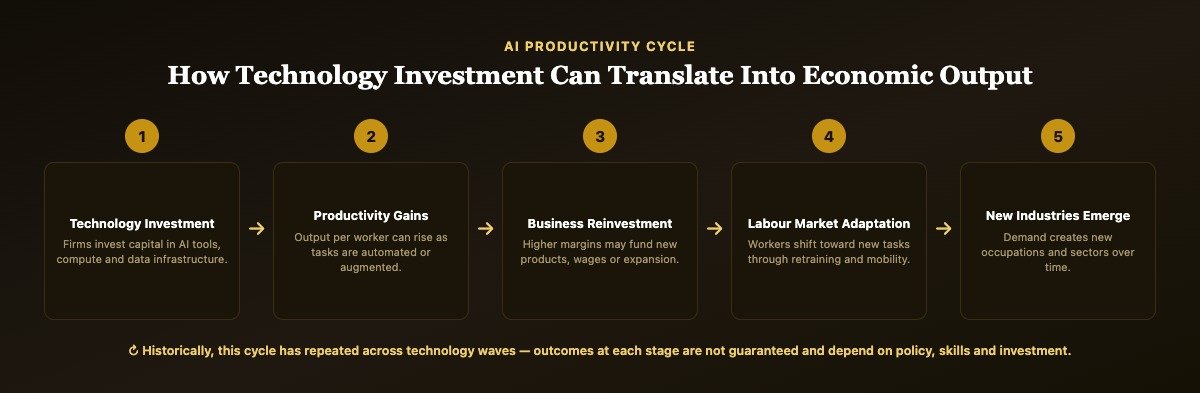
This distinction matters for the AI debate specifically: a technology that raises productivity increases the economy’s underlying capacity to produce goods and services. That is generally treated by economists as a positive, growth-supportive force over the long run — the disagreement is about the transition path, not the destination. The transition involves labour markets reallocating workers between shrinking and growing occupations, business investment in new tools and infrastructure, and sometimes short-term friction as skills, wages and job openings temporarily fail to match up.
📈 Economic Insight
Technological change has historically created both disruption and new industries, often at the same time, in the same economy. The disruption tends to be visible and concentrated (a specific factory, a specific occupation); the new industries tend to be diffuse and to emerge gradually, which is part of why they are easy to underweight in real-time public debate.
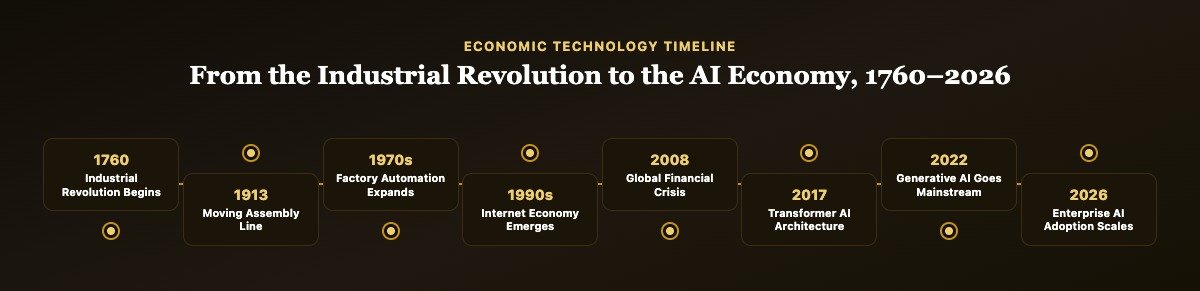
A Complete Timeline: Technology, Productivity and the Economy
From the Industrial Revolution to 2026 — historical milestones, technical developments, and where independent research fits in.
The Industrial Revolution Begins
Historical background: Beginning in Britain around 1760, mechanised manufacturing, steam power and new production methods began replacing hand-based artisanal work, first in textiles and iron production.
Technology development: Innovations such as the spinning jenny, the power loom and, later, James Watt’s improved steam engine (1776) mechanised tasks that had previously required skilled manual labour.
Economic significance: Economic historians widely treat this period as the starting point of sustained, compounding productivity growth in Western economies, a break from the near-stagnant per-capita output of previous centuries.
Employment impact and current relevance: Hand-loom weavers and artisanal textile workers saw sustained job losses over decades, famously prompting the Luddite protests of the 1810s, while factory, engineering and eventually entirely new industries expanded over generations.
The Moving Assembly Line
Historical background: Henry Ford’s Highland Park plant introduced the moving assembly line for automobile production in 1913, building on earlier factory-line concepts used in meatpacking and other industries.
Technology development: Standardising parts and breaking production into simple, repeatable steps performed along a moving line cut the time to build a Model T from about 12 hours to roughly 90 minutes.
Economic significance: Mass production sharply lowered per-unit costs, enabling Ford to cut prices and raise wages (the famous “five-dollar day” of 1914) simultaneously — an early, well-documented example of productivity gains funding both lower prices and higher pay.
Employment impact and current relevance: Assembly-line work deskilled some craft-based auto production roles while creating large numbers of new factory jobs, and the model spread across manufacturing industries throughout the 20th century.
Early Computing Emerges
Historical background: Machines such as Colossus (Britain, 1943) and ENIAC (United States, 1945) were built initially for wartime code-breaking and ballistics calculations, marking the start of programmable electronic computing.
Technology development: These early computers were room-sized, expensive and operated by specialist teams, with no direct consumer or small-business application for decades afterward.
Economic significance: Their economic impact in the 1940s was negligible outside specialist government and research use; the productivity effects of computing would not become measurable in broad economic statistics until decades later.
Employment impact and current relevance: This gap between invention and measurable economic effect is a recurring pattern economists cite when cautioning against reading too much into any single year of a new technology’s development.
Industrial Automation Expands
Historical background: Programmable industrial robots, building on Unimate’s 1961 factory debut, spread more widely through automotive and heavy manufacturing during the 1970s, alongside early computerised numerical control (CNC) machining.
Technology development: Robots and CNC systems could perform welding, painting and repetitive assembly tasks with greater precision and consistency than manual labour, and without fatigue-related quality variation.
Economic significance: Manufacturing productivity rose measurably in economies that adopted industrial automation quickly, though the 1970s also saw the “productivity paradox” of the era — a broader economic slowdown coinciding with early automation, which researchers attribute mainly to the 1973 and 1979 oil shocks rather than to automation itself.
Employment impact and current relevance: Certain manual assembly and welding roles declined in automated plants, while demand grew for machine operators, maintenance technicians and, later, robotics engineers.
The Personal Computer Enters the Office
Historical background: The IBM Personal Computer (1981) and the rise of spreadsheet software such as VisiCalc and Lotus 1-2-3 brought computing directly into offices, small businesses and eventually homes.
Technology development: Spreadsheets, word processors and databases automated calculation and record-keeping tasks that had previously required teams of clerks and bookkeepers.
Economic significance: Economist Robert Solow famously observed in 1987 that “you can see the computer age everywhere but in the productivity statistics” — official productivity growth remained sluggish through most of the 1980s despite widespread PC adoption, a puzzle later termed the productivity paradox.
Employment impact and current relevance: Clerical and bookkeeping roles gradually declined through the 1980s and 1990s, while demand grew for roles able to use the new software tools, a shift that took roughly a decade to show up clearly in aggregate statistics.
The Internet Economy Emerges
Historical background: The commercialisation of the World Wide Web from 1993 onward, following Tim Berners-Lee’s 1989 invention, created an entirely new channel for commerce, communication and information access.
Technology development: E-commerce, email and networked business software reduced transaction and search costs across many industries, from retail to finance to publishing.
Economic significance: U.S. productivity growth did accelerate measurably in the second half of the 1990s, and many economists credit information-technology investment, including internet infrastructure, as a significant contributor — this time the productivity paradox largely resolved.
Employment impact and current relevance: Travel agents, classified-ad sales roles and some retail and print-publishing jobs declined over the following decade, while web development, digital marketing, logistics and e-commerce created large new categories of employment.
Globalisation and Offshoring Accelerate
Historical background: China’s accession to the World Trade Organization (2001) and falling communication and shipping costs accelerated the offshoring of manufacturing and, later, some service-sector work to lower-cost economies.
Technology development: Improved logistics, standardised shipping containers and networked communication made coordinating globally distributed production practical at large scale for the first time.
Economic significance: Global trade expansion is credited by mainstream economic research with lowering consumer prices and raising output in many economies, though the distribution of gains and losses across regions and income groups became a significant, and contested, area of study.
Employment impact and current relevance: Manufacturing employment declined in several higher-income economies’ specific regions, a well-studied effect (the “China shock” research by economists including David Autor), while lower-income manufacturing economies saw substantial job growth.
The Global Financial Crisis
Historical background: A crisis in mortgage-backed securities and financial-sector leverage triggered a severe global recession beginning in 2008, the deepest downturn since the Great Depression by most measures.
Technology development: Financial engineering and risk-modelling software played a role in the crisis’s mechanics, but the crisis’s root causes were financial-sector leverage, regulation and housing-market dynamics, not productivity-enhancing technology.
Economic significance: The IMF and World Bank both classify 2008 as a demand-and-financial-stability shock, a fundamentally different category of economic event from a technology-driven productivity or labour-market shift.
Employment impact and current relevance: Global unemployment rose sharply and took years to recover in many economies, illustrating what an actual, broad-based recession looks like in labour statistics — a useful contrast case for evaluating more targeted, sector-specific technology disruption.
Cloud Computing Scales
Historical background: Cloud platforms from Amazon Web Services (launched 2006), Microsoft Azure and Google Cloud matured through the early 2010s, letting businesses rent computing power instead of buying and maintaining their own servers.
Technology development: Cloud infrastructure dramatically lowered the fixed cost of starting a technology business and later became the foundational infrastructure that large-scale AI model training and deployment would depend on.
Economic significance: Lower IT infrastructure costs are credited with supporting a wave of startup formation and digital business-model innovation through the 2010s, an enabling rather than directly disruptive economic effect.
Employment impact and current relevance: Some in-house IT and server-administration roles shifted toward cloud-specific skills, while cloud computing directly enabled the compute-intensive AI research that would produce the breakthroughs of the mid-2010s onward.
Modern Deep-Learning Breakthroughs
Historical background: Deep-learning systems achieved landmark results in this period, including DeepMind’s AlphaGo defeating world champion Lee Sedol at Go in 2016, demonstrating machine learning could master tasks long considered to require human intuition.
Technology development: Advances in neural-network architectures, larger datasets and cheaper compute (much of it cloud-based) drove rapid improvement in image recognition, language processing and game-playing AI systems.
Economic significance: Business investment in AI research and specialised hardware (GPUs, later custom AI chips) accelerated, though at this stage AI’s economic footprint remained concentrated in technology-sector research and a handful of specific applications.
Employment impact and current relevance: Direct labour-market effects were still minimal in 2016; the period is better understood as building the research and infrastructure base that later, more general-purpose AI tools would draw on.
The Transformer Architecture
Historical background: Google researchers published the transformer neural-network architecture in a 2017 paper, introducing an “attention mechanism” that processed language far more efficiently than prior approaches.
Technology development: The transformer architecture became the technical foundation for nearly all major large language models developed afterward, including the GPT, BERT and later generative AI model families.
Economic significance: This is a pure technology-development milestone with no immediate, direct economic effect in 2017 itself; its economic significance is retrospective, as the enabling breakthrough behind the generative AI products that reached mass adoption from 2022.
Employment impact and current relevance: None measurable at the time; included here because most public “AI economy” debate from 2022 onward is, technically, a debate about applications built on this specific 2017 research architecture.
Pandemic-Driven Digital Transformation
Historical background: The COVID-19 pandemic caused a sharp, globally synchronised recession in 2020, followed by an unusually rapid recovery in many economies, alongside a compressed, forced adoption of remote work and digital tools.
Technology development: Video conferencing, cloud collaboration tools and e-commerce infrastructure saw years’ worth of adoption compressed into months, according to McKinsey Global Institute research published during the period.
Economic significance: The 2020 recession is a textbook example of a public-health and demand shock, not a technology-driven one, even though it coincided with, and accelerated, significant digital-technology adoption.
Employment impact and current relevance: In-person retail, hospitality and travel employment collapsed sharply and temporarily; e-commerce, logistics and remote-collaboration-adjacent roles grew, with some of these shifts proving durable after the acute crisis passed.
Generative AI Reaches Mass Adoption
Historical background: OpenAI’s public release of ChatGPT in November 2022 brought large language model technology to mainstream consumer and business awareness, reportedly reaching 100 million users within two months, among the fastest consumer-technology adoption curves on record.
Technology development: Generative AI tools could draft text, summarise documents, write code and answer questions in natural language, extending AI capability well beyond the narrow, task-specific applications common before 2022.
Economic significance: Business investment in AI tools and infrastructure rose sharply from 2022 onward; the Stanford AI Index and McKinsey Global Institute both documented rapid growth in enterprise AI experimentation, though formal productivity statistics take years to reflect new technology adoption, per the historical pattern above.
Employment impact and current relevance: Early, sector-specific studies (customer support, copywriting, software assistance) found productivity gains for workers using generative AI tools, particularly for less-experienced workers, according to academic research published in this period; broad labour-market effects remained an active, unsettled research question.
Enterprise AI Adoption Expands
Historical background: Through 2023, enterprises moved from experimenting with generative AI to deploying it in production workflows, particularly in software development, customer service, marketing content and data analysis.
Technology development: Enterprise-focused AI products, API access, and retrieval-augmented tools that connected AI models to company-specific data matured significantly during this period.
Economic significance: McKinsey Global Institute’s 2023 research estimated substantial potential long-term global economic value from generative AI, explicitly framed as a range of scenarios dependent on adoption speed and implementation quality, not a guaranteed outcome.
Employment impact and current relevance: Job postings began explicitly requesting AI-tool proficiency in a growing range of roles; some routine content and coding-assistance tasks saw measurable time savings in company-level case studies, while economy-wide employment statistics showed no sudden, broad-based disruption.
Governments Publish National AI Strategies
Historical background: Through 2024, a growing number of governments, including the European Union (with the EU AI Act’s phased implementation), the United States, the United Kingdom and India, published or advanced formal national AI strategies addressing economic, labour-market and regulatory dimensions.
Technology development: Policy focus shifted from purely research-oriented AI funding toward workforce-transition programmes, AI safety frameworks and sector-specific deployment guidance.
Economic significance: The OECD’s AI Policy Observatory and ILO both published guidance in this period emphasising that policy choices, not the technology alone, would substantially determine labour-market outcomes — a recurring theme across official international-organisation research.
Employment impact and current relevance: Several governments announced retraining and workforce-adaptation funding explicitly tied to AI adoption, reflecting official recognition that labour-market transition support, not just innovation policy, was a necessary complement to AI’s economic integration.
Productivity Research Matures
Historical background: Through 2025, a larger body of empirical research on generative AI’s actual (not projected) productivity effects accumulated, drawing on real-world usage data from call centres, software teams, consulting firms and other early-adopter settings.
Technology development: AI models continued improving in reliability and task range, while enterprises developed more mature measurement frameworks for tracking AI’s effect on specific workflows.
Economic significance: Central bank researchers, including studies published via the BIS and several national central banks, examined AI’s potential effects on inflation, wage-setting and monetary policy transmission, generally describing effects as plausible but not yet clearly visible in aggregate economic data.
Employment impact and current relevance: Occupation-level studies found meaningfully different exposure to AI-driven task automation depending on job content, with roles combining routine cognitive tasks showing the highest exposure, and studies consistently distinguished “task exposure” from “job elimination,” which are not the same thing.
Where the Evidence Stands Today
Historical background: Entering 2026, enterprise AI adoption continues to broaden across sectors and geographies, with growing but still incomplete integration into core business processes, per the latest Stanford AI Index and OECD reporting.
Technology development: AI systems have continued to improve in reliability, cost-efficiency and the range of tasks they can perform, while remaining prone to errors on tasks requiring nuanced judgement, up-to-date factual knowledge or accountability.
Economic significance: No major central bank, the IMF or the World Bank has, as of this writing, attributed an actual recession to AI adoption; official research continues to treat AI’s net macroeconomic effect as an open, actively studied question rather than a resolved one.
Employment impact and current relevance: Labour-market data in most major economies continues to show gradual occupational shifts rather than sudden, economy-wide disruption, consistent with the pace of prior general-purpose technology transitions described earlier in this timeline.
💡 Did You Know?
- Many historical technological revolutions initially displaced certain jobs while creating demand for new skills and industries over time — a pattern documented across the Industrial Revolution, computerisation and the internet era.
- Economist Robert Solow’s 1987 observation that computers were “everywhere but in the productivity statistics” took roughly a decade to resolve, as broad IT adoption eventually did show up clearly in 1990s growth data.
- The transformer architecture underlying most of today’s generative AI tools was published as an academic research paper in 2017, five years before ChatGPT’s public release made the technology widely known.
Key Economic and AI Terms, Defined
Precise definitions for the vocabulary used throughout this guide.
Artificial Intelligence (AI)
Computer systems designed to perform tasks that typically require human intelligence, such as language understanding, pattern recognition and decision-making, using statistical and machine-learning methods.
Machine Learning
A subset of AI in which systems improve at a task by learning patterns from data, rather than following explicitly hand-coded rules for every situation.
Generative AI
AI systems, typically built on transformer architectures, that can produce new text, images, code or other content in response to a prompt, rather than only classifying or analysing existing data.
Productivity
Output produced per unit of input, most commonly measured as output per hour worked. Productivity growth is the main long-run driver of rising living standards in economic theory.
Creative Destruction
Economist Joseph Schumpeter’s term for the process by which new technologies and business models displace older ones, destroying some jobs and firms while creating new ones, often unevenly in time and place.
Labour Market
The system through which employers and workers interact, matching job openings, wages and skills across an economy. Labour markets adjust to technological change through hiring, retraining, wage shifts and occupational mobility.
Automation
The use of technology to perform tasks previously done by humans, ranging from mechanical automation (assembly lines) to software and AI-driven automation of cognitive or administrative tasks.
GDP (Gross Domestic Product)
The total monetary value of goods and services produced within an economy over a given period, the standard headline measure of economic output and growth.
Inflation
The rate at which the general price level of goods and services rises over time, reducing the purchasing power of money, tracked by central banks as a key policy target.
Unemployment
The share of the labour force that is without work but actively seeking employment, a key indicator of labour-market health tracked monthly by national statistical agencies.
Recession
A broad, sustained decline in economic activity across multiple indicators (employment, output, income, sales), typically identified retrospectively by economic bodies rather than declared in real time.
Economic Cycles
The recurring pattern of expansion and contraction in economic activity over time, driven by factors including demand, investment, credit conditions and, occasionally, major shocks or structural shifts.
Capital Investment
Spending by businesses or governments on long-term assets such as equipment, infrastructure or technology (including AI systems), intended to increase future productive capacity.
Five Things Worth Understanding Properly
Evergreen explainers that go one level deeper than the glossary above.
How AI Affects Productivity
AI can affect productivity through two main channels economists distinguish carefully. The first is task automation: AI performs a specific task (drafting a first version of a document, sorting data, answering routine customer queries) faster or more cheaply than a human would alone, freeing that person’s time for other work. The second is augmentation: AI makes a human worker better or faster at a task they still perform themselves, such as a programmer using an AI coding assistant to catch errors or generate boilerplate code.
Early academic field studies, several published through 2023 and 2024 and cited in subsequent Stanford AI Index reports, found generative AI tools produced measurable task-completion time savings in specific, well-defined settings such as customer support and software development, with somewhat larger relative gains for less-experienced workers in some studies. These are workplace-level, task-specific findings; translating them into economy-wide productivity statistics requires broad adoption sustained over years, which is why official productivity data has not yet fully reflected generative AI’s introduction as of this writing.
Automation vs Artificial Intelligence
The terms are often used interchangeably in casual conversation, but economists and technologists draw a meaningful distinction. Traditional automation typically follows explicit, pre-programmed rules to perform a well-defined, repetitive task (a robotic arm on an assembly line, a spreadsheet macro). It is highly reliable within its defined scope but cannot adapt to tasks it wasn’t explicitly built for.
AI, particularly modern machine-learning systems, learns patterns from data and can generalise, to varying degrees, to situations it was not explicitly programmed to handle — understanding a novel sentence, summarising an unfamiliar document. This makes AI applicable to a broader range of cognitive and administrative tasks than traditional automation, which is part of why its potential labour-market footprint is debated more broadly than earlier waves of purely mechanical automation. It also makes AI less predictably reliable in some respects, since it operates probabilistically rather than by fixed rule.
Can Technology Cause Recessions?
Historically, mainstream economic research does not identify productivity-enhancing technology adoption itself as a typical direct cause of recessions. Recessions are more commonly linked to demand shocks (a sudden drop in spending), financial-sector instability (as in 2008), monetary-policy tightening, or external shocks (a pandemic, an energy-price spike). Technology adoption can, in theory, contribute to a downturn if it caused a sudden, severe drop in aggregate household income or spending faster than new jobs and industries could absorb displaced workers — but no major historical technology transition, including the Industrial Revolution, computerisation or the internet, is identified by mainstream economic research as having directly triggered a recession on its own.
This does not mean technology-driven disruption carries no economic risk; it means the risk operates differently than “the technology directly causes a recession.” A poorly managed transition, concentrated in specific regions or industries without adequate retraining or safety-net support, can cause serious localised economic hardship, as documented in “China shock” research on manufacturing-region unemployment — a real cost, distinct from a national or global recession.
How Economists Measure Economic Growth
Economic growth is primarily tracked through GDP and GDP per capita, alongside supporting indicators: employment and unemployment rates, wage growth, business investment levels, productivity growth (output per hour worked), and consumer spending. National statistical agencies (such as the U.S. Bureau of Economic Analysis, India’s Ministry of Statistics, or Eurostat) collect and publish this data on regular schedules, and international bodies including the IMF, OECD and World Bank compile and analyse it comparatively across countries.
Productivity growth specifically is measured by comparing output (typically GDP) to a measure of input (hours worked, or a combined measure of labour and capital called total factor productivity). Because this data is collected with a lag and revised over time, meaningfully attributing a shift in productivity statistics to a specific technology, including AI, requires multiple years of consistent data and careful statistical controls for other factors — which is why definitive, economy-wide conclusions about AI’s productivity effect remain premature as of 2026.
Why Labour Markets Adapt Over Time
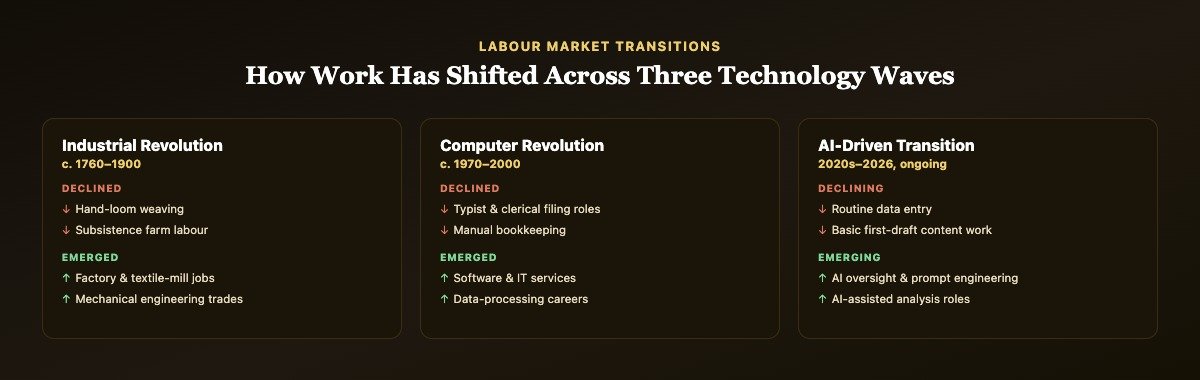
Labour markets adapt to technological change through several mechanisms operating simultaneously: workers retrain or move into growing occupations; wages adjust to reflect changed supply and demand for specific skills; businesses reorganise workflows around new tools; and, over longer periods, entirely new job categories emerge that did not previously exist (social media manager and AI prompt engineer are recent examples; textile-mill supervisor and computer programmer are historical ones).
This adaptation is not automatic, instantaneous or guaranteed to be smooth. ILO and OECD research consistently finds that the speed and fairness of labour-market adaptation depends heavily on active policy support — education systems, retraining programmes, unemployment insurance, and labour-market information services that help workers find new opportunities. Economies and regions with stronger adaptation infrastructure tend to experience technology transitions with less prolonged hardship for displaced workers, according to comparative OECD analysis.
📊 Productivity Insight
Higher productivity can increase long-term economic output but may require workforce adaptation. The two effects are not automatically simultaneous: productivity gains can appear in a company’s output figures well before the broader labour market has finished adjusting to the underlying change, which is part of why short-term disruption and long-term benefit can both be accurate descriptions of the same technology transition.
AI and the Economy: Head-to-Head Comparisons
How the current AI transition compares with prior technology waves and adjustment patterns.
| Factor | Industrial Revolution (from 1760) | AI Revolution (from 2016 onward) |
|---|---|---|
| Primary mechanism | Mechanised physical labour (textiles, manufacturing) | Automates and augments cognitive & administrative tasks |
| Diffusion speed | Decades, limited by physical infrastructure build-out | Faster software distribution, but enterprise integration still takes years |
| Most-affected worker group | Artisanal & manual textile and farm labour | Varies by task-exposure; routine cognitive roles most studied |
| New industries created | Factory manufacturing, mechanical engineering, later services | AI development, data, oversight and AI-augmented professional roles (still emerging) |
| Documented recession trigger | Not identified as a direct recession cause | Not identified as a direct recession cause, as of 2026 |
| Factor | Traditional Automation | AI |
|---|---|---|
| How it works | Follows explicit, pre-programmed rules | Learns patterns from data; generalises to new situations |
| Typical task scope | Narrow, well-defined, repetitive tasks | Broader range of cognitive & language-based tasks |
| Reliability within scope | Very high, predictable | Improving, but can make context-dependent errors |
| Historical example | Assembly-line robotics, spreadsheet macros | Generative AI drafting, coding assistants, AI analysis tools |
| Factor | Short-Term Labour Effects | Long-Term Labour Effects |
|---|---|---|
| Typical timeframe | Months to a few years | A decade or more |
| Visibility | Concentrated, visible (specific layoffs, specific roles) | Diffuse, harder to attribute to one cause |
| Dominant effect observed historically | Displacement in exposed occupations | Net new job creation across the wider economy |
| Policy relevance | Retraining, unemployment support, transition assistance | Education systems, innovation policy, long-run competitiveness |
| Factor | AI Productivity Benefits | Adjustment Costs |
|---|---|---|
| Nature of the effect | Higher output per hour; potential wage & growth gains | Retraining time, transitional unemployment, wage disruption |
| Who documents it | IMF, OECD, McKinsey, academic field studies | ILO, OECD labour-market research, regional economic studies |
| Timeframe | Builds gradually, compounds over years | Often concentrated in the early years of adoption |
| Distribution | Broad, economy-wide, over the long run | Concentrated in specific occupations, regions or firms |
| Factor | Historical Recessions | Technology Adoption Cycles |
|---|---|---|
| Typical trigger | Demand shocks, financial instability, monetary tightening, external shocks | Gradual diffusion of a new capability across firms |
| Duration | Months to a few years | A decade or more from invention to broad economic effect |
| Example | 2008 Global Financial Crisis, 2020 COVID-19 recession | 1990s internet adoption, 2016-onward AI development |
| Historical overlap | Recessions and technology cycles can coincide but are not shown by research to share the same root cause | |
👥 Labour Insight
The impact of AI differs across occupations, industries and skill levels. Research consistently finds no single, uniform “AI effect” on employment — task exposure varies enormously between, for example, a radiologist, a warehouse worker and a customer-service representative, making economy-wide generalisations about “AI and jobs” less useful than occupation-specific analysis.
Timeline Summary
Every milestone from this guide’s history section, condensed into one table.
| Year | Event | Economic Impact |
|---|---|---|
| 1760 | Industrial Revolution begins | Starts sustained, compounding productivity growth |
| 1913 | Moving assembly line | Mass production lowers costs, funds higher wages |
| 1940s | Early electronic computing | Negligible near-term impact; decades-long lag to relevance |
| 1970s | Industrial automation expands | Manufacturing productivity rises; oil shocks dominate the decade’s slowdown |
| 1980s | Personal computers enter offices | Solow’s productivity paradox: adoption visible, statistics lag |
| 1990s | Internet economy emerges | U.S. productivity growth accelerates measurably |
| 2000 | Globalisation & offshoring accelerate | Lower consumer prices; concentrated regional job losses |
| 2008 | Global Financial Crisis | Demand/financial shock, not a technology-driven recession |
| 2010 | Cloud computing scales | Lowers startup costs; enables later AI compute needs |
| 2016 | Modern deep-learning breakthroughs | Builds AI research base; minimal direct economic effect yet |
| 2017 | Transformer architecture published | Technical foundation for later generative AI products |
| 2020 | Pandemic-driven digital transformation | Health/demand shock; compresses years of digital adoption |
| 2022 | Generative AI reaches mass adoption | Fastest consumer adoption on record; investment surges |
| 2023 | Enterprise AI adoption expands | Deployment intent rises; economy-wide effects not yet confirmed |
| 2024 | Government AI strategies published | Policy shifts toward managing labour-market transition |
| 2025 | Productivity research matures | Occupation-level, nuanced findings replace broad speculation |
| 2026 | Current state of evidence | No confirmed AI-driven recession; effects remain uneven and studied |
🎯 Policy Insight
Education, retraining and labour-market policies influence how economies respond to technological change. Comparative OECD research finds economies that invest earlier in retraining infrastructure and portable safety nets tend to show less prolonged unemployment and wage disruption following major technology transitions than those that respond only after displacement has already occurred.
Practical Analysis: What AI-Driven Change Looks Like in Practice
Educational examples of how businesses and workers are navigating this transition — not predictions of what will happen next.
Business Productivity
Companies adopting AI tools for well-defined, repetitive tasks — document review, customer-query triage, first-draft content generation, code debugging — commonly report time savings on those specific tasks in case studies and enterprise surveys. Translating task-level time savings into company-wide productivity gains typically requires redesigning workflows around the new capability, not simply inserting a tool into an unchanged process, according to McKinsey Global Institute implementation research.
Job Transformation
Rather than eliminating entire occupations outright, AI adoption more commonly changes the mix of tasks within a job, automating the most routine components and shifting a worker’s time toward judgement, oversight, exception-handling and interpersonal aspects of the role. The opening manufacturing-company example in this guide illustrates this pattern: fewer hours on manual invoice matching, more hours on supplier relationships and exception review.
Labour Re-skilling
Re-skilling programmes, whether run by employers, governments or educational institutions, generally focus on building either AI-adjacent technical skills (data literacy, tool proficiency) or on strengthening the judgement, communication and problem-solving skills that remain comparatively hard to automate. The ILO’s research on effective transition programmes emphasises early intervention (before displacement occurs) and close alignment with actual local labour-market demand, rather than generic training disconnected from hiring needs.
Economic Output
At an economy-wide level, output effects from a new general-purpose technology accumulate gradually as adoption spreads across firms and sectors, historically over a period of years to a couple of decades, as this guide’s timeline illustrates for computing and the internet. Economists studying AI adoption generally expect a similar multi-year diffusion pattern rather than an immediate, economy-wide output jump, based on both the historical pattern and early observed enterprise-adoption rates.
Investment Cycles
Business investment in AI infrastructure, including data centres, specialised chips and enterprise software, rose substantially from 2022 onward, a pattern documented in Federal Reserve and BIS research on capital-expenditure trends. Investment cycles in general-purpose technologies have historically included periods of rapid capital deployment followed by consolidation phases as the technology’s practical applications and limitations become clearer through real-world use.
Technology Adoption
Enterprise AI adoption in 2026 shows the classic technology-diffusion pattern researchers have documented for prior general-purpose technologies: earlier and faster adoption among larger firms and technology-intensive sectors, slower and more cautious adoption among smaller firms and more heavily regulated industries, according to OECD and Stanford AI Index survey data. This uneven pattern is typical of past technology transitions and is not, by itself, evidence for or against any particular economic outcome.
Who’s Researching AI’s Economic Impact
The institutions producing the primary research this guide draws on.
International Monetary Fund (IMF)
Publishes research and country-level analysis on AI’s potential effects on growth, employment and macroeconomic stability, generally framing outcomes as scenario-dependent rather than certain.
Organisation for Economic Co-operation and Development (OECD)
Runs the AI Policy Observatory and publishes comparative labour-market and productivity research across member economies, with a strong focus on policy responses to technological change.
World Bank
Publishes development-focused research on AI’s implications for labour markets and growth in emerging and developing economies specifically, alongside its global economic outlook reporting.
International Labour Organization (ILO)
Focuses specifically on labour-market and worker-welfare dimensions of technological change, including occupational task-exposure research and workforce-transition policy guidance.
Bank for International Settlements (BIS)
Publishes central-bank-focused research on AI’s implications for monetary policy, financial stability and inflation dynamics, aimed primarily at central bank policymakers.
U.S. Federal Reserve
Researches AI’s effects on U.S. labour markets, productivity and monetary policy transmission as part of its ongoing economic analysis supporting interest-rate decisions.
European Central Bank (ECB)
Publishes euro-area-focused research on AI’s implications for productivity, wage-setting and inflation across EU member economies.
Reserve Bank of India (RBI)
Analyses AI’s implications for the Indian economy specifically, including productivity, financial-sector applications and labour-market considerations in a large, developing-economy context.
Stanford AI Index
An annual, widely cited report tracking AI research output, investment trends, enterprise adoption rates and, increasingly, economic and labour-market indicators.
McKinsey Global Institute
Publishes widely referenced industry research on AI’s potential economic value and enterprise adoption patterns, explicitly framed as scenario ranges rather than forecasts.
🔎 Future Watch
Ongoing research worth watching comes directly from primary sources: IMF World Economic Outlook updates and working papers on AI, OECD Employment Outlook and AI Policy Observatory reports, World Bank development research, ILO labour-market studies, and central bank research from the Federal Reserve, ECB and RBI. This article avoids speculating beyond what these official sources have actually published or projected as scenario ranges.
Separating Evidence From Misconception
What official research actually supports, versus what’s commonly assumed but overstated in either direction.
✅ Evidence-Based
- AI adoption is a genuine, ongoing driver of business investment and workflow change across many sectors since 2022.
- Task-level productivity gains from AI tools have been documented in specific, well-studied workplace settings.
- Historical technology transitions took years to decades to show clear, economy-wide effects — AI is following a broadly similar pattern so far.
- Labour-market effects vary significantly by occupation, and policy support meaningfully shapes transition outcomes.
❌ Overstated Claims
- “AI will certainly cause a recession.” No major economic institution has made this a confirmed prediction; it remains one scenario among several discussed in research.
- “AI will replace most jobs within a few years.” Historical technology diffusion and current adoption data both suggest a slower, more uneven transition.
- “Productivity data already proves AI is transforming the economy.” Aggregate productivity statistics had not, as of this writing, shown a clear, broad-based AI effect distinguishable from other factors.
- “Past technology waves prove AI is nothing to plan for.” Past transitions caused real, sometimes prolonged hardship for specific workers and regions, even though they did not cause recessions outright.
💡 Interesting Facts
- ChatGPT’s reported climb to 100 million users within roughly two months of its November 2022 launch is frequently cited as the fastest consumer-application adoption curve on record, faster than TikTok or Instagram’s early growth.
- Robert Solow’s 1987 “productivity paradox” observation was made a full 13 years before U.S. productivity statistics clearly accelerated in the late 1990s — a widely cited historical precedent in AI-economics discussions.
- The 2017 “Attention Is All You Need” transformer paper that underlies most modern generative AI was authored by a team of eight researchers at Google, several of whom later left to found their own AI companies.
Explore More Timelines
People Also Ask
Frequently Asked Questions
Eighty questions covering the economics, the AI technology, the labour-market research and the policy debate.
Why AI’s Economic Impact Depends on How Societies Adapt
Artificial intelligence is one of many forces shaping future economic performance, alongside monetary policy, demographic change, energy prices, geopolitics and ordinary business cycles. Treating it as the single deciding factor, in either a doom or a boom direction, overstates what any individual technology has ever determined on its own. The historical record assembled in this guide, from the Industrial Revolution’s textile mills to the internet’s productivity revival, shows technology shaping economic outcomes together with policy, investment and workforce adaptation, never in isolation.
What the evidence does support is more modest and more useful: AI is likely to keep raising productivity in specific, well-defined tasks, keep changing the composition of many jobs rather than eliminating them wholesale, and keep requiring active workforce adaptation, education investment and thoughtful policy to manage the transition well. None of that guarantees a smooth outcome. The manufacturing-company story that opened this guide had both a genuine productivity win and a genuine, unresolved worry sitting side by side — and that is a more accurate picture of what AI-driven change looks like in practice than either a confident recession warning or a confident boom prediction.
Readers who want to track where this actually goes should follow the official sources this guide has drawn on throughout — the IMF, OECD, World Bank, ILO, Federal Reserve, ECB, RBI and Stanford AI Index — rather than relying on sensational headlines in either direction. Those institutions will keep publishing updated data and research as the picture becomes clearer, and that evolving evidence base, not any single prediction, is the most reliable guide to what actually happens next.
⚠️ Editorial Note: Sources & E-E-A-T
Official statistics: GDP, employment and productivity data from national statistical agencies, the IMF and OECD. Academic research: peer-reviewed labour-economics and productivity studies, including task-exposure and “China shock” research. Central bank research: Federal Reserve, ECB, RBI and BIS publications on AI, productivity and monetary policy. Industry reports: Stanford AI Index and McKinsey Global Institute data, clearly framed as scenario estimates. Independent commentary: journalism and analysis, kept distinct from official data throughout this guide. This article is educational content, not financial, investment or policy advice; consult qualified professionals and primary sources for decisions specific to your circumstances.
Sources & further reading
Every dated entry above was checked against these references. Last reviewed 15 September 2026.