SaaS vs AI Agents Timeline 2024–2030: Is Enterprise Software Being Rewritten?
Track how AI agents are changing SaaS in 2026: per-seat subscriptions, point solutions, usage-based pricing, agentic workflows and headless software.
Latest Story
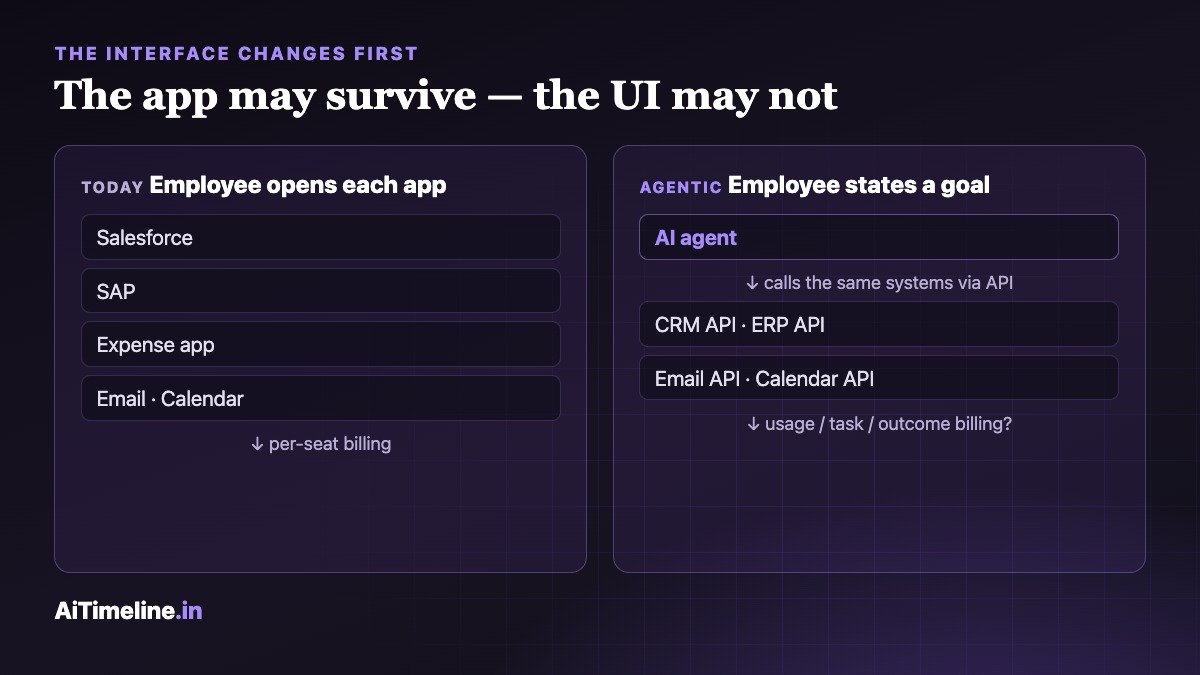
For fifteen years, enterprise software followed one formula: build an application, give every employee an account, charge the company per seat, repeat. AI agents challenge that model in a deceptively simple way — what happens if the employee stops opening the software? The database, the CRM and the identity system may all still exist. But if a worker asks an agent to “find the unpaid invoices, contact the customers and update the CRM,” the dashboards — and some of the subscriptions — may not. This is the SaaS vs AI agents shift: not software disappearing, but the interface, the pricing and the per-seat licence coming under pressure as agents begin operating across systems.
Data last verified: 1 September 2026. Every claim below carries a trust label — 🟢 VERIFIED / CURRENT, 🟡 INDUSTRY DATA, 🟠 FORECAST, 🔵 HISTORICAL CONTEXT, ⚫ FUTURE WATCHPOINT. Forecasts name who made them, when, and for what horizon. This is analysis of an enterprise-software shift, not investment advice about any software company or stock.
🧠 AI Overview Summary
SaaS is not going extinct. But AI agents are starting to change how enterprise software is used and priced. Gartner estimates up to $234 billion of enterprise application spending — roughly 20% of that market — is exposed to “agentic arbitrage” through 2030, while separately calling large-scale app replacement unlikely before 2030. The bigger shift is from users opening individual applications to agents interacting with those systems on their behalf — putting the per-seat licence, not the software itself, at risk.
SaaS vs AI agents: key questions
What the 2026 evidence actually shows
- SaaS revenue is still large and was still growing. Gartner put enterprise application SaaS revenue at $218.5 billion in 2024, up 16.7% — the market was not shrinking before agents arrived.
- Agent adoption is rising fast, from a low base. Gartner forecasts up to 40% of enterprise apps will include task-specific agents by end-2026, up from under 5% in 2025 — a forecast, not a measured result.
- $234 billion is “exposed,” not “gone.” That is spending Gartner sees as vulnerable to agentic disruption through 2030, roughly 20% of enterprise application SaaS spend — not revenue that disappears.
- Gartner’s own counterpoint is explicit. Its March 2026 research says large-scale replacement of enterprise applications is very unlikely through 2030.
- The per-seat model is the real pressure point. If ten people using agents do the work of twenty, seat growth slows even as software gets used more intensively.
- Point solutions face more exposure than systems of record. A narrow app whose whole value is one repeatable workflow is easier for a general agent to absorb than an ERP or identity system.
- Agents can make some platforms more important. An agent still needs reliable customer data, a payment system, identity and audit trails — so systems of record may gain value even as their dashboards lose it.
- The hype has a credibility problem. Gartner forecasts more than 40% of agentic AI projects cancelled by end-2027, and 40% of enterprises demoting or decommissioning agents by 2027 over governance gaps.
- Pricing is experimenting, not settled. In 2026 most monitored AI agents are still bundled into existing subscription plans; usage- and outcome-based pricing are growing but not dominant.
- Best framing: AI may not kill enterprise software. It may make much of it invisible — the app survives, the human just stops opening it.
SaaS extinction — or SaaS evolution?
🟢 Verified positions from Gartner research, 2025–2026.
The provocative version of this story is short: AI agents will kill SaaS. The evidence supports something more specific and more interesting. Traditional software interfaces, per-seat pricing, single-purpose workflow apps and application-by-application user experiences are increasingly under pressure — because AI agents are beginning to operate across multiple systems at once. The biggest threat to SaaS may not be that AI replaces every application. It may be that humans stop opening many of those applications directly.
AI doesn’t need to delete the software. It only needs to delete the click.
An ERP, a database, a CRM, an identity system, a payment network or a cloud platform may all remain essential. But the human user may increasingly interact with an AI agent instead of the underlying application dashboard. That is the shift this timeline tracks — and it is why “SaaS-pocalypse,” a phrase Gartner itself now uses in a report title, is better read as a business-model question than an obituary.
What is agentic arbitrage?
🟡 Concept defined by Gartner, July 2026.
Gartner’s term for the mechanism is agentic arbitrage: an AI agent completes work across several enterprise applications without a human interacting with each one. The software can stay necessary while its visible interface — and its per-user seat — become less valuable.
$234 billion is exposed — not deleted
Gartner estimates that up to $234 billion of enterprise application spending could be exposed to agentic arbitrage between now and 2030 — about 20% of enterprise application SaaS spending. This does not mean $234 billion of revenue disappears. It means traditional software revenue could be pressured as agents perform work across applications without requiring an equivalent number of human seats. Gartner frames the response as shifting from interface-based value to outcome-based value.
The paradigm-shift matrix
🟡 Editorial synthesis of Gartner and Deloitte research — direction of travel, not a finished state.
| Feature | SaaS era | Agentic shift |
|---|---|---|
| Interface | Dashboards, forms, menus | Conversational / agentic front ends plus APIs |
| Human interaction | User works inside each application | Agent may act across applications |
| Pricing | Predominantly seat / subscription | Seat + usage + credits + outcome experimentation |
| Workflow | Application-centric | Goal / workflow-centric |
| App architecture | User-facing UI is central | Some software may become increasingly “headless” |
| Value proposition | Help the employee perform a task | Complete part or all of the task |
| Procurement | Buy a software tool | Buy software + agent capability + compute |
| Success metric | Seats / users | Usage, tasks, outcomes, productivity |
| Enterprise risk | SaaS sprawl | Agent sprawl + governance + access control |
One caution: as of 2026 this is a direction, not a destination. Enterprise software has not already shifted to outcome pricing or headless architecture — most of the right-hand column is early.
SaaS sprawl: how the stack got so big
🟡 Zylo 2025 SaaS Management Index · 🔵 historical context.
Enterprise software multiplied one purchase at a time. Sales bought a CRM. Marketing bought campaign tools. Finance bought expense software. HR bought recruiting platforms. Engineering bought developer tools. Zylo’s 2025 SaaS Management Index found an average portfolio of 275 SaaS applications among organisations in its dataset, up from 269 previously, with average annual SaaS spend of about $49 million and roughly $4,830 per employee. Organisations with 10,000+ employees ran significantly larger portfolios. That is the benchmark’s average — not a universal “the average enterprise” figure.
Counterpoint: agents did not invent consolidation
SaaS-management vendors including BetterCloud reported that enterprises were already consolidating redundant applications and facing stronger pressure to cut SaaS spend before agentic AI matured. AI agents did not create SaaS consolidation. They may accelerate a trend that was already underway.
Chatbot vs copilot vs agent — and “agentwashing”
🟡 Definitions and warning per Gartner.
The words are used loosely, and the difference matters for every claim in this article.
Gartner explicitly warns about “agentwashing” — vendors relabelling assistants, chatbots and rules-based automation as “AI agents” even where autonomous capability is limited. Gartner has estimated only around 130 vendors offer genuinely agentic features out of thousands claiming them.
Is it really an agent?
- Can it observe the state of a system?
- Can it reason about what to do next?
- Can it choose among tools?
- Can it take actions, not just suggest them?
- Can it continue across multiple steps and handle exceptions?
- Does it request human approval when it should?
If the answer to most of these is no, it is probably an assistant or automation — not an agent.
SaaS vs AI agents timeline, 2023–2030
Newest first. 🟢 verified · 🟡 industry data · 🟠 forecast · 🔵 historical context · ⚫ watchpoint.
The open questions for 2030
What to track: Does seat pricing decline? Does usage pricing dominate? Do SaaS portfolios shrink? Do interfaces move to agents? Do systems of record gain importance as agents consume them?
Named forecast: Gartner and Deloitte research suggests at least 40% of enterprise SaaS spend could shift toward usage-, agent- or outcome-oriented pricing by 2030. That is a projection with a stated horizon, not a measurement.
The interface may move before the apps do
Forecast: Gartner estimates that by 2028, roughly one-third of user experiences will shift from native applications to agentic front ends — and that agent ecosystems could begin collaborating across applications and business functions.
Why the framing matters: “one-third of user experiences move to agentic front ends” is a much narrower claim than “one-third of apps disappear.” The application may survive; the UI in front of it may not.
Agents move from recommending to transacting
What happened: Reuters reported that India’s NPCI is preparing a framework — a “Unified Agent Protocol,” slated for the Global Fintech Fest in Mumbai in early September 2026 — to let AI agents make small-value UPI payments within pre-set limits, with spending caps, audit trails and identity checks.
Why it belongs here: It is concrete evidence that agents are being built as an action layer, not just an answer layer — the same shift that pressures software interfaces also lets agents take real economic actions.
Agents move inside established enterprise platforms
What happened: Socure announced a strategic growth investment at a $5.2 billion valuation and the acquisition of Fravity, an agentic platform founded in 2024 that automates fraud, risk and compliance workflows. Fravity’s capability is to be delivered through Socure’s RiskOS platform as “RiskOS Agents.”
Why it belongs here: This is the evolution pattern in practice — agents being embedded into an incumbent enterprise platform that already holds the data and the customer relationships, rather than replacing it.
The SaaS model gets a dollar figure
What happened: Gartner said up to $234 billion of enterprise application software spend is at risk from agentic AI through 2030 — about 20% of enterprise application SaaS spending — via “agentic arbitrage,” where agents do work across apps and fewer human seats are required.
Important correction: Gartner frames this as spending exposed to disruption, not revenue that vanishes. Same release: about one-third of user experiences could move from native apps to agentic front ends by 2028.
The governance warnings land
Forecast: In June 2025 Gartner predicted more than 40% of agentic AI projects would be cancelled by end-2027 over escalating costs, unclear business value or inadequate risk controls, based on a poll of more than 3,400 organisations. In May 2026 it added that 40% of enterprises would demote or decommission autonomous agents by 2027 because governance gaps surface only after production incidents.
Why it belongs here: These are the strongest counterweights to SaaS-extinction hype. Agents are hard to run safely at scale.
Gartner: mass app replacement is unlikely
What happened: Gartner published “Enterprise Applications 2030: How to Respond to the ‘SaaS-pocalypse’.” Its core finding: while enterprise-application leaders are pressured to use agentic AI to replace incumbent applications, large-scale replacement is very unlikely through 2030.
Why it matters: The same firm producing the $234 billion exposure figure is explicit that the software itself mostly stays. The disruption is to interface, pricing and workflow — not to the existence of the applications.
Every software vendor adds AI
What happened: Assistants, copilots and early agentic features became a standard product feature across enterprise software. Gartner’s August 2025 forecast set the baseline: fewer than 5% of enterprise apps had integrated task-specific agents in 2025.
Reality check: An embedded assistant is not the same as an autonomous agent — and it is not application replacement.
The commercial agent narrative arrives: Devin
What happened: Cognition introduced Devin, which it described as “the first AI software engineer.” Devin could plan, write code, use tools, execute tasks and iterate on results, and it posted a then-state-of-the-art 13.9% on the SWE-bench coding benchmark.
Attribution note: “First AI software engineer” is Cognition’s own marketing designation, not an independent fact. Devin did not replace software engineers; it made the commercial idea of an autonomous agent visible.
Agents before the agent boom
What happened: Generative AI went mainstream, and autonomous-agent experimentation became prominent — AutoGPT, BabyAGI and tool-use experiments showed a model chaining steps toward a goal.
Chronology note: AutoGPT became prominent in 2023, not 2024. It was a proof of concept, not a production system.
Extinction theory vs the more likely story
🟡 Editorial synthesis of Gartner positions.
The extinction theory
- AI agents replace enterprise applications wholesale
- Per-seat SaaS collapses within a few years
- A large share of point-solution SaaS is “already” gone
- Outcome pricing has already won
What the evidence supports
- Software mostly remains; Gartner calls mass replacement unlikely through 2030
- The interface, the seat and the single-purpose app are what is pressured
- Pricing is experimenting — most agents still bundled in 2026
- Far fewer direct human interactions with each app over time
There is no verified evidence that a fixed percentage of SaaS products has been replaced, or that mass SaaS extinction is underway. What 2026 confirms is pressure on the traditional seat-licence and interface model — not confirmation of extinction.
Headless software, systems of record, systems of action
🟡 Concept highlighted in 2026 reporting including the Financial Times.
Headless software is the idea that an application’s value can sit in its data, logic and API rather than its user interface. Traditional SaaS runs database → business logic → dashboard → human user. The agentic version runs database → business logic → API / agent access → AI agent → human request or outcome. The application can remain extremely valuable even if its UI becomes less important.
This is why some software is harder to replace. CRM databases, ERP systems, identity infrastructure, cloud platforms, data warehouses, payment systems and security infrastructure hold authoritative data, permissions, transactions and compliance records. Agents generally need these systems rather than replacing them — and an agent that can build a similar-looking UI still cannot easily reproduce trusted enterprise data. Analogy: most people never touch AWS, a database or a payment rail directly, yet those systems are enormously valuable. Agentic enterprise software could follow the same pattern — more important, less visible.
Which SaaS products are most exposed?
🟡 Relative editorial assessment — not factual certainty. Nothing here is automatically “safe.”
| Software type | Agent disruption risk | Why |
|---|---|---|
| Meeting summariser | High | General agents can increasingly summarise and contextualise |
| Simple scheduler | High | Narrow, repeatable workflow |
| Basic invoice extraction | High | Structured, verifiable AI task |
| Basic QA / test generation | Medium–High | Coding agents can absorb parts of the task |
| CRM | Medium | Interface is vulnerable; underlying data and workflow stay valuable |
| Cybersecurity platform | Medium | Agents may consolidate the interface; underlying controls remain |
| ERP | Low–Medium | Deep system of record plus complex processes |
| Identity / IAM | Low | Trust and authorisation infrastructure |
| Database | Low | Agents require a reliable data layer |
| Cloud infrastructure | Low | Agents consume compute |
Why point solutions face more pressure
AI agents do not have to replace every enterprise platform to change the software market. The most exposed products are narrow applications whose primary value is helping a user complete one repeatable workflow. If a general-purpose or domain-specific agent can perform that same task by connecting directly to underlying systems, a separate user-facing application becomes harder to justify. By contrast, databases, identity systems, cloud platforms and core systems of record may become even more important, because agents still require authoritative data, permissions and infrastructure.
A point solution can still survive if it has unique data, deep workflow, strong integration, compliance advantages, superior execution, distribution or network effects. AI can also strengthen a point solution rather than replace it.
Why per-seat pricing is the pressure point
🔵 How the model worked · 🟡 how agents strain it.
Why per-seat worked: ten employees meant ten licences; grow to twenty and buy twenty; vendor revenue grew with headcount. Simple, predictable, and easy to explain to investors. Why agents break it: if five agents automate work so ten employees do what previously took twenty, the company may not add the equivalent headcount — seat growth slows — even while the software is used more intensively by the agents. Seat count becomes a weaker measure of value.
Current reality check: the subscription isn’t dead yet
Deloitte expects enterprise software pricing to go through significant experimentation in 2026 and beyond, across usage-based, outcome- or value-based, and hybrid models. But PricingSaaS’s Q2 2026 tracking shows the transition is early: seat-only pricing fell from roughly 21% to about 15% of monitored SaaS companies in a year, hybrid seat-plus-credit models rose from about 27% to roughly 41%, around one in five companies made an AI pricing change in the quarter — and most AI agents are still bundled into existing subscription plans rather than separately metered, with credits the most common metering unit where explicit metering exists. Do not read this as “per-seat pricing is already dead.”
One company example, not universal proof: the Financial Times has reported that the AI note-taking tool Granola has moved from passive transcription toward action-taking features and usage-based pricing — the same direction of travel, at the scale of a single product.
Venture capital, moats and the protocol layer
🟡 Directional, not absolute.
The VC picture: investors increasingly favour AI-native applications, agent platforms, infrastructure and vertical agents. But traditional SaaS still raises capital. The market is repricing growth expectations and AI exposure — not banning subscription businesses. Claims that “VCs stopped funding per-seat SaaS” or that “billions now go strictly to agentic infrastructure” are too absolute.
“Wrapper” risk: “AI wrapper” is an informal industry term for software whose differentiation depends heavily on third-party foundation-model APIs without unique data, workflow, distribution, integration or defensibility. Such products may face pressure as underlying models improve. That does not make every AI SaaS startup a wrapper.
The moat shifts. The old SaaS moat was features, UI and workflow. The expanded moat adds proprietary data, system-of-record status, workflow depth, security, trust, distribution, integrations, domain expertise and agent permissions. If many agents can build similar interfaces, the harder-to-replicate asset becomes trusted enterprise data — which is why data-platform and application vendors are competing to be the context layer for agents.
The protocol layer. The Model Context Protocol (MCP) is a standardised way for AI systems to connect to tools, data and services. It is not a universal standard — other agent-interoperability protocols also exist, and agent-to-agent communication and orchestration are still emerging. Gartner expects agent ecosystems to begin collaborating across applications toward 2028; that is a forecast, not current reality.
Incumbents are adapting, not disappearing
🟡 Examples of the evolution pattern. No vendor predictions, no stock views.
Salesforce
Positioning Agentforce as an agent layer on top of an existing CRM platform — an incumbent becoming an agent platform rather than being displaced by one.
ServiceNow
Integrating agents into enterprise workflow automation, and experimenting with pricing tied to agent-completed work rather than only human logins.
Microsoft
Copilot and agents across Microsoft 365, Dynamics and Azure. Microsoft has a strong incentive to protect its existing software ecosystem while introducing agent interfaces.
Gemini Enterprise across Workspace and Google Cloud, plus agent infrastructure — the interface shifts while the underlying platform is consumed by agents.
SAP
Joule and embedded agents on top of ERP. A clear example of underlying software becoming agent-accessible rather than being replaced.
OpenAI & Anthropic
Moving up the stack toward enterprise workflows, coding and research agents — while also partnering with SaaS companies. Partner and competitor at the same time.
Who owns the enterprise agent? An unresolved market map
Model provider (OpenAI / Anthropic / Google) → cloud (AWS / Azure / Google Cloud) → system of record (Salesforce / SAP / ServiceNow / Workday) → agent platform (many vendors) → workflow (finance, sales, support, coding). Which layer captures the value is genuinely open — this article does not predict an answer. What is clear is that “just replace SaaS with one agent” ignores the identity, permissions, data, tools, observability and human-approval layers a production agent stack actually needs.
The reality check: governance, cost and a cautionary case
🟠 Forecasts · 🟢 a verified 2026 example.
Access is not the same as a chatbot. A chatbot suggests. An agent can send email, modify a CRM, approve a payment, run code, delete a file or change a database. That makes identity, authorisation, audit logs and human checkpoints far more important — and it is why Gartner expects 40% of enterprises to demote or decommission autonomous agents by 2027 after governance gaps surface in production, and more than 40% of agentic AI projects to be cancelled by end-2027 over cost, value and controls.
Agents can cost more than chatbots. An agent may reason repeatedly, call tools, hit APIs, use multiple model calls and retry failed operations, so a single task’s cost is higher and less predictable than one chatbot reply. That is part of why usage pricing, FinOps and budget controls — the kind of enterprise AI cost governance Google and others now offer — are becoming important. It does not mean agents are uneconomic.
Cautionary case: Meta’s “Project OT”
Reuters reported that Meta explored an “AI-native” restructuring, code-named Project OT (Organization Transformation), that would have shrunk some product teams by as much as 60% and shifted work to AI agents and small teams of “builders.” The effort ran into employee resistance, disappointing productivity gains, and reliability and security problems as AI tool use rose; Meta scrapped a planned second wave of cuts. The takeaway is not that Meta abandoned AI — it is that AI can change workflows while large-scale autonomy remains hard to implement.
Is SaaS actually dying? A scorecard
🟡 Editorial reading of the 2026 evidence.
| Signal | State in 2026 | Read |
|---|---|---|
| SaaS revenue | Still large ($218.5B enterprise app SaaS in 2024) | 🟢 Not shrinking |
| AI agent adoption | Rising quickly from a low base | 🟢 Real, early |
| Per-seat model | Under pressure; seat-only pricing declining | 🟢 Confirmed pressure |
| Usage / hybrid pricing | Growing but not dominant; most agents bundled | 🟡 In transition |
| Application replacement | Some point-solution cases | 🟡 Selective |
| Mass SaaS extinction | No verified evidence | 🔴 Not confirmed |
Explore More Timelines
Discover: the smaller facts that make the shift concrete
Worth knowing
- CRM alone made up about 51% of 2024 enterprise application SaaS revenue, with ERP around 20% — the categories with the deepest system-of-record roots.
- Gartner’s “SaaS-pocalypse” is a report title, not a market verdict — the same report concludes mass replacement is unlikely.
- The 2028 forecast is about user experiences moving to agentic front ends, not about a third of applications shutting down.
- Fravity, the agentic platform Socure acquired in 2026, was founded only in 2024 — the category is that young.
- India’s Unified Agent Protocol pairs agent autonomy with hard spending caps and audit trails — a template for “agents can act, within limits.”
- Gartner has estimated only ~130 vendors offer genuinely agentic features out of thousands that market them.
SaaS vs AI agents: frequently asked questions
Related AiTimeline reading
⚠️ Editorial note
This article separates verified facts (labelled 🟢), industry benchmark data (🟡), analyst forecasts with a named source and horizon (🟠), historical context (🔵) and open watchpoints (⚫). Forecasts from Gartner, Deloitte and others are projections, not measured outcomes, and analysts revise them. Vendor examples describe how companies are positioning agent capability; they are not endorsements or predictions about any company, product or share price. Nothing here is investment advice. Sources: Gartner newsroom releases (Aug 2025, Jun 2025, Mar 2026, May 2026, Jul 2026), Zylo 2025 SaaS Management Index, Deloitte 2026 tech-trends research, PricingSaaS Q2 2026 trends report, and reporting by Reuters and the Financial Times.
Sources & further reading
Every dated entry above was checked against these references. Last reviewed 15 September 2026.
- Gartner — 40% of enterprise apps will feature task-specific AI agents by 2026
- Gartner — $234 billion in enterprise application software spend is at risk from agentic AI
- Gartner — Over 40% of agentic AI projects will be canceled by end of 2027
- Gartner — Applying uniform governance across AI agents will lead to enterprise AI agent failure
- Zylo — 2025 SaaS Management Index
- Cognition — Introducing Devin, the first AI software engineer
- Reuters — India preparing rollout of agentic payments on UPI
- Socure — Strategic growth investment and Fravity acquisition