Saudi East–West Pipeline Timeline 1981–2026: The Oil Route Built to Bypass Hormuz—Now Under Attack
Saudi Arabia built the East-West Pipeline in 1981 to move crude to Yanbu without transiting the Strait of Hormuz. See the 1981-2026 timeline, the
Latest Story
Saudi Arabia pumps most of its crude near the Persian Gulf. Normally, a large share of that oil reaches world markets by sea through one narrow passage: the Strait of Hormuz. That geography has always carried an obvious risk — one country’s coastline, one strip of water, one point of failure. So in 1981, Saudi Arabia built another option: a pipeline carrying crude more than 1,200 kilometres across the Arabian Peninsula to Yanbu on the Red Sea, letting oil reach tankers without ever entering Hormuz. For decades that made the East–West Pipeline — also called Petroline — one of the kingdom’s most important pieces of energy-security infrastructure. In 2026, as fighting around Hormuz cut shipping there to a trickle, that backup route became more valuable than ever, reportedly carrying 4–5 million barrels a day. Then, on 10–11 September, drones hit it. Saudi Arabia shut it down. And the question this timeline exists to answer became unavoidable: what happens when the backup route needs a backup?
🧠 AI Overview Summary
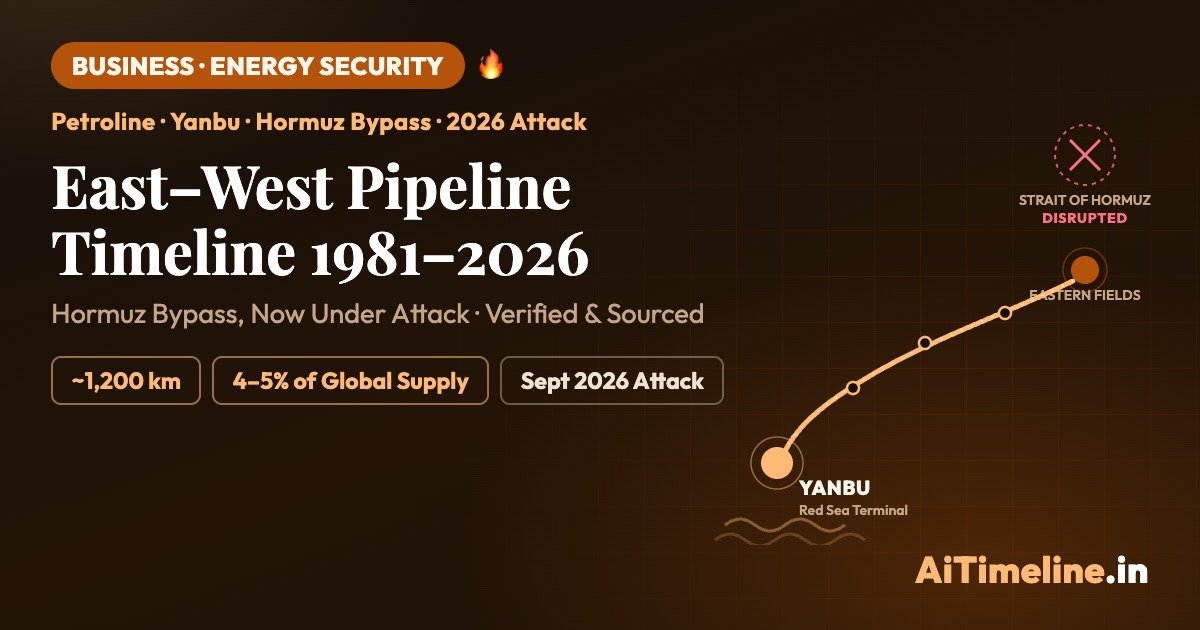
The Saudi East–West Pipeline (Petroline) is a roughly 1,200 km crude-oil pipeline, commissioned in 1981, that carries oil from Saudi Arabia’s eastern producing region across the country to the Yanbu export and refining complex on the Red Sea — letting Saudi crude reach world markets without transiting the Strait of Hormuz. Its design capacity was long cited around 5 million barrels per day (b/d); Saudi Aramco says it converted parallel gas-liquids lines to crude service in 2026, raising nameplate capacity to about 7 million b/d, though Yanbu’s terminals sustain closer to 4 million b/d in practice. As of the latest verified reporting (12 September 2026), the pipeline is temporarily shut: Saudi Arabia says several drones launched from Iraq’s Maysan province struck pipeline infrastructure near Riyadh and Medina on 10–11 September, causing fires, injuries and damage. No group has claimed responsibility; Iraq has dismissed a regional military commander and opened an investigation; U.S. President Donald Trump said on 12 September he believes Iran is “probably” responsible, which is a political assessment, not a confirmed attribution. The pipeline matters in 2026 specifically because Hormuz shipping has been severely disrupted since February 2026, making this Red Sea route one of Saudi Arabia’s few remaining ways to move large oil volumes to market.
Sources: Saudi Ministry of Foreign Affairs statements, Al Jazeera, CNN, CNBC, Iraqi government statements, IEA oil market reporting, Reuters-sourced wire coverage, 10–12 September 2026. This tracker is updated when the pipeline’s operating status, attribution findings, or major flow/price figures materially change — see Methodology below.
Is the East–West Pipeline shut right now?
Saudi Arabia’s Two Main Directions
One geography, two very different ways for the same oil to reach a customer.
Almost everything about this story comes down to one map. Saudi Arabia’s main oil-producing region sits in the east, near the Persian Gulf coast. From there, crude has two broad ways out to the sea — and only one of them was there by default.
🟠 EAST (the default route)
🏘 WEST (the built alternative)
This is the entire strategic logic of the pipeline in one picture: the East route depends on one strait. The West route was built so Saudi Arabia would not have to depend on it exclusively.
🔥 Can You Get Saudi Oil Out?
You have 1 million barrels of Saudi crude and one job: get it to a customer. Work through the routes below and see what happens at each step.
This is a recent, attributed estimate for September 2026 — not the pipeline’s permanent normal throughput, and not its full nameplate capacity. Flow through this pipeline has varied significantly across 2026 alone.
What Is the East–West Pipeline, and What Do People Call It?
One pipeline, several names — and several things it is often confused with.
The East–West Pipeline is Saudi Aramco’s overland crude-oil corridor running from the kingdom’s Eastern Province — near the Abqaiq processing hub — roughly 1,200 km across the peninsula to the Yanbu export and refining complex on the Red Sea coast. It is most often called by its operating name, Petroline, and sometimes written out fully as the East–West Crude Oil Pipeline. All three names refer to the same asset.
It is easy to confuse this pipeline with other Saudi infrastructure that shares a region or a purpose. It is not:
- An NGL (natural gas liquids) pipeline — though in 2026 Aramco converted parallel gas-liquids lines to crude service to push total capacity higher, a genuine change to the system’s configuration, not a renaming of the original crude line.
- Yanbu’s natural-gas infrastructure — Yanbu also hosts gas-processing and petrochemical facilities that are separate systems.
- A refined-product pipeline — Saudi Arabia operates separate networks for moving refined fuels, distinct from crude.
- IPSA, the Iraqi Pipeline through Saudi Arabia — a different, long-dormant pipeline built in the 1980s to move Iraqi crude to the Red Sea, not currently in active commercial use and unrelated to Petroline’s ownership or operations.
What this timeline actually shows
- The pipeline was built to remove a single point of failure, not to replace Hormuz. Saudi Arabia still moves most of its oil through the Gulf in normal times.
- 2026 is the second time this year the pipeline itself has been attacked. A single-pumping-station strike in April briefly cut ~700,000 b/d; the September attack hit multiple pumping stations and forced a full precautionary shutdown.
- Capacity, flow and production are three different numbers. ~7 million b/d nameplate capacity, ~4–5 million b/d recent flow, and Saudi’s own reported ~6.238 million b/d August production are not interchangeable.
- Attribution is still developing, not settled. Iraq has confirmed the drones launched from its territory; no group has claimed the attack; a U.S. presidential opinion that Iran is “probably” responsible is not the same as an independent, proven finding.
- Bypassing Hormuz does not remove all maritime risk. Oil that reaches Yanbu bound for Asia can still need to pass Bab el-Mandeb, a chokepoint under its own separate pressure in September 2026.
- Saudi Arabia’s own reported oil numbers and the IEA’s independent estimate genuinely differ in 2026 — by design, not because either side is lying, for methodological reasons explained below.
- Every backup route has a capacity limit. The pipeline’s ~7 million b/d nameplate has never had to substitute for the Gulf’s full historical Hormuz-linked flows on its own.
Saudi East–West Pipeline Timeline: 1970s–2026
Chronological, oldest first — from a planning decision to a live security story.
Saudi planners start worrying about Hormuz dependence
What happened: Through the 1970s, as Saudi Arabia’s oil exports grew, so did its reliance on a single maritime exit from the Gulf. Regional instability and the memory of earlier Middle East wars affecting oil routes pushed Saudi and Aramco planners toward the idea of a west-facing export corridor that did not depend on the Strait of Hormuz at all.
Why it matters: The pipeline that opened in 1981 did not appear out of nowhere — it was the product of a decade of energy-security planning, not a sudden reaction to a single event.
The East–West Pipeline (Petroline) opens
What happened: Saudi Aramco commissioned the roughly 1,200 km Petroline, connecting eastern producing fields near Abqaiq to the new Yanbu export and refining complex on the Red Sea, with an original design capacity cited around 5 million b/d.
Why it matters: For the first time, Saudi crude could reach a coastline — and tankers — without transiting the Strait of Hormuz at all. This is the pipeline’s core strategic purpose, unchanged for 45 years.
Iran–Iraq War and the “Tanker War”
What happened: Iran and Iraq attacked hundreds of merchant and oil tankers in the Gulf during their eight-year war, an episode that became known as the Tanker War. Not every attack occurred inside the Strait of Hormuz itself, but the sustained threat to Gulf shipping made regional exporters acutely aware of chokepoint risk throughout the 1980s.
Why it matters: Petroline’s 1981 opening meant Saudi Arabia entered this dangerous period for Gulf shipping already holding a working alternative export route — a genuinely fortunate, if planned, piece of timing.
Gulf War intensifies regional energy-security concerns
What happened: Iraq’s 1990 invasion of Kuwait and the subsequent Gulf War again put Persian Gulf oil infrastructure and shipping lanes at the centre of a major international crisis.
Why it matters: The war reinforced, without needing to prove again, why alternative export infrastructure mattered to Gulf producers. No verified, sourced change to specific East–West Pipeline flow volumes from this period is claimed here.
Saudi Arabia’s spare-capacity role grows — a different kind of buffer
What happened: Saudi Arabia became widely recognised as the oil market’s main holder of spare production capacity — the ability to raise output quickly during a supply shock elsewhere in the world.
Why it matters: Spare production capacity and pipeline transport capacity are not the same buffer. A producer can theoretically pump more oil while still facing a transport bottleneck getting that oil to a ship — a distinction that becomes directly relevant in 2026.
Renewed Iran tensions revive Hormuz-bypass discussion
What happened: Escalating tension between Iran and Western powers over Iran’s nuclear programme, including Iranian threats to close the Strait of Hormuz, again drew attention to Saudi Arabia’s alternative export routes, Petroline included.
Why it matters: This is one of several points across the pipeline’s history where a Hormuz scare — not necessarily a Hormuz closure — increased the strategic profile of the East–West route, well before the pipeline itself was ever directly attacked.
Drone strikes hit two East–West Pipeline pumping stations
What happened: Armed drones struck two pumping stations along the pipeline, causing a fire and minor damage at Pump Station No. 8. Yemen’s Houthi movement said it carried out the attack; Saudi officials did not publicly assign blame at the time. Aramco briefly halted the affected section, then restored full operations within days.
Why it matters: This is the pipeline’s first confirmed direct attack — establishing, seven years before 2026, that the route built to avoid one kind of risk (a maritime chokepoint) was itself vulnerable to a different kind (an overland drone strike).
Abqaiq and Khurais attacks — a separate, larger shock
What happened: Drone and missile strikes on Saudi Arabia’s Abqaiq processing complex and Khurais oilfield knocked out roughly half of the kingdom’s crude output for a period, before production was restored. Houthi forces claimed responsibility; the United States and Saudi Arabia said the attack’s sophistication pointed to Iran, which Iran denied.
Why it matters: Keep this separate from the pipeline attacks above and below — Abqaiq is a processing facility, not the East–West Pipeline itself. Together, the two 2019 events taught the same lesson: energy security depends on pumping stations, processing plants and terminals, not export routes alone.
Resilience investment, where verified
What happened: Following 2019, Saudi Arabia and Aramco pursued various investments broadly aimed at infrastructure and air-defence resilience, alongside continued expansion of storage and Red Sea terminal capacity at Yanbu.
Why it matters: This context matters, but should not be read as making the system attack-proof — a claim the events of 2026 directly contradict.
U.S.–Iran conflict begins; Hormuz shipping collapses
What happened: The United States and Israel launched military action against Iran, opening a conflict that has repeatedly disrupted commercial shipping through the Strait of Hormuz. A brief reopening under a mid-2026 ceasefire broke down in early July after attacks on vessels; by September, daily transits were running around 10 vessels versus a pre-crisis baseline of roughly 88 to 130.
Why it matters: This is the backdrop that turned the East–West Pipeline from a useful backup into one of Saudi Arabia’s most important remaining export options.
Aramco pushes pipeline throughput to a record 7 million b/d
What happened: With Hormuz shipping severely curtailed, Aramco carried out an emergency conversion of parallel natural-gas-liquids pipelines to crude service, using existing pump stations, and reported pushing East–West throughput to an all-time operating record of about 7 million b/d.
Why it matters: This is nameplate/operating capacity, achieved under emergency conditions — not the same figure as day-to-day sustained flow, which Yanbu’s terminal infrastructure keeps closer to 4 million b/d in practice.
First 2026 attack on the pipeline; restored within days
What happened: A strike on one pumping station cut pipeline flow by roughly 700,000 b/d. Saudi Arabia announced by 12 April that the pipeline had been restored to full capacity, around 7 million b/d.
Why it matters: This is the direct historical precedent for the September attack below — and evidence that a partial strike does not automatically mean a prolonged shutdown.
Multiple drones from Iraq strike the pipeline; Saudi Arabia shuts it down
What happened: The Saudi Ministry of Foreign Affairs said several drones launched from Iraq’s Maysan province struck pipeline infrastructure in the Riyadh and Medina areas on the morning of 10 September, hitting at least two pumping stations. Satellite imagery reviewed by CNN showed fire damage near Al Mesba’ah and thick black smoke near Al Dhekra. The ministry reported injuries and material damage and said Saudi Arabia would not retaliate immediately, at Iraq’s request, while “reserving the right to take all measures necessary.”
Why it matters: Unlike April’s single-station strike, this attack forced a full precautionary shutdown of the pipeline — hitting Saudi Arabia’s Hormuz bypass at precisely the moment Hormuz itself was least available.
Iraq dismisses commander, opens investigation, closes border crossing
What happened: Iraq’s government confirmed the drones had launched from a location within Maysan province, dismissed the military commander leading Maysan Operations Command, opened a formal investigation, and closed the Shalamcheh border crossing with Iran. Iraq condemned use of its territory as “a launchpad for attacks” and welcomed Saudi Arabia’s decision to defer retaliation.
Why it matters: This confirms where the drones physically originated — a fact distinct from who built, armed or directed them, which remains under investigation.
Trump says Iran “probably” responsible; no independent confirmation
What happened: Asked by reporters in Dublin whether Iran was responsible for the pipeline attack, U.S. President Donald Trump said, “I think they are, probably they are.” He said he had spoken with Saudi Crown Prince Mohammed bin Salman, and that Yemen’s Houthi movement had told his administration it did not want the U.S. directly involved in the conflict.
Why it matters: A presidential opinion offered to reporters is a political assessment, not a confirmed intelligence finding or judicial attribution. This timeline treats it as exactly that — alleged, not established.
Why Yanbu?
The Red Sea end of the pipeline — and why it was the obvious choice.
Yanbu sits on Saudi Arabia’s western coast, directly on the Red Sea, making it the natural landing point for any pipeline built to move crude away from the Gulf. Aramco developed it into a major export and refining hub specifically to receive Petroline’s flow: the complex today comprises two main terminal areas, Yanbu North (roughly 1.5 million b/d nameplate) and Yanbu South (roughly 3 million b/d nameplate), across seven berths capable of handling deep-water VLCCs up to 500,000 deadweight tonnes. In sustained day-to-day practice, terminal and logistics constraints keep actual loadings closer to 4 million b/d even when the pipeline itself can deliver more.
The Route in One Line
Two terminal areas, seven berths, VLCC-capable — the physical bottleneck every barrel from this pipeline must pass through before it reaches open water.
Pipeline vs. Tanker
Two very different ways to move the same barrel — each with its own failure mode.
| Pipeline (East–West) | Tanker (via Hormuz or Red Sea) | |
|---|---|---|
| Advantages | Land route; continuous flow; bypasses maritime chokepoint | Route flexibility; large cargo per voyage; multiple possible destinations |
| Main risks | Fixed infrastructure; pumping stations; drone/sabotage exposure; maintenance; a hard capacity ceiling | Chokepoints; war-risk insurance; naval conflict; missile/drone threats at sea; port access |
| 2026 exposure | Attacked twice (April, September) | Hormuz severely disrupted since February; Red Sea shipping under separate Houthi-related pressure |
A pipeline is designed to avoid one geographic bottleneck — a strait. But it creates a different kind of bottleneck: an infrastructure one. Oil may travel 1,200 km overland, yet still depend entirely on a handful of specific pumping stations, control systems and one terminal complex at the far end.
Three Doors
Saudi Arabia’s oil has three main ways out to sea right now. Here is the status of each.
🚪 Persian Gulf
🚪 East–West Pipeline
🚪 Red Sea
Where Are You Shipping? Europe vs. Asia
Oil loaded at Yanbu does not automatically need Bab el-Mandeb — it depends entirely on where it’s going.
This is a distinction the pipeline’s own geography makes easy to miss. Yanbu sits on the Red Sea, which has an exit at both ends. Crude loaded there for Europe can move north, through the Suez Canal or the SUMED pipeline system, into the Mediterranean — never going near Bab el-Mandeb at all. Crude bound for Asia normally has to move south, through Bab el-Mandeb, into the Gulf of Aden and the Indian Ocean. Saying “all Yanbu oil must pass Bab el-Mandeb” is simply wrong; saying “all Yanbu oil goes to Europe” is equally wrong. Destination decides the route.
YANBU → Red Sea northbound → Suez / SUMED system → Mediterranean
Depending on vessel size and cargo, this leg can move through the Suez Canal directly, or via the SUMED pipeline for the largest tankers that cannot transit the canal loaded. Either way, this path does not require passing Bab el-Mandeb.
YANBU → Red Sea southbound → Bab el-Mandeb → Indian Ocean
This is the path that puts Asia-bound Yanbu cargo directly in the path of the same Red Sea security risk covered in AiTimeline’s Bab el-Mandeb timeline — Houthi territorial advances near the strait as of September 2026, though the strait itself remains open to shipping.
The September 2026 Attack: What’s Confirmed, What’s Alleged
Attribution discipline — keeping facts, allegations and denials in separate boxes.
| Claim | Status | Source |
|---|---|---|
| Drones struck East–West Pipeline infrastructure on 10–11 Sept 2026 | CONFIRMED | Saudi Ministry of Foreign Affairs |
| Drones launched from Maysan province, Iraq | CONFIRMED | Saudi & Iraqi government statements |
| Iraqi military commander in Maysan dismissed; investigation opened | CONFIRMED | Iraqi government |
| A specific group has claimed responsibility | NOT TRUE — no claim as of 12 Sept | Multiple outlets |
| Iran ordered or directed the attack | ALLEGED, UNPROVEN | President Trump’s stated opinion; some analysts |
| Iraqi government itself is responsible for the attack | NOT ESTABLISHED | Iraq says its territory was used without its direction |
Drones launching from Iraqi soil does not, by itself, mean the Iraqi government carried out or directed the attack — Baghdad’s own response (dismissing a commander, opening an investigation, closing a border crossing) is consistent with Iraq treating this as a violation of its own territory, not an act of state policy. Equally, a U.S. president’s public opinion that Iran is “probably” responsible is a political assessment offered to reporters, not a confirmed intelligence or judicial finding. This page will update this table, not delete it, as attribution develops.
Saudi Oil Supply: A 30-Year Low, By One Measure
Two credible sources, two different numbers — and neither one is wrong.
The International Energy Agency estimated Saudi Arabia’s crude supply fell to about 6 million b/d in August 2026, a drop of roughly 2.3 million b/d and the lowest level in more than three decades, citing Houthi-linked strikes on vessels transiting Bab el-Mandeb, on the Jazan refinery and on shipping near Yanbu, alongside Iraq-launched drone strikes on the Abqaiq processing complex. Saudi Arabia’s own figures reported to OPEC for the same month were higher: supply of about 7.122 million b/d and production of about 6.238 million b/d.
Not a contradiction — a methodology gap
What If the Pipeline Stays Closed?
Possible consequences — not predictions.
- Saudi export flexibility may fall — fewer ways to route the same barrels.
- Yanbu loadings can decline if the pipeline feeding it stays offline for an extended period.
- Storage pressure may rise as unsold or unmoved crude accumulates domestically.
- Reliance on Gulf terminals may increase, adding pressure precisely to the route already constrained by Hormuz disruption.
- Saudi supply to market may fall further, and global oil-market risk premiums may rise.
None of this is automatic, and none of it implies a specific price outcome — each depends on how long the shutdown lasts and how much of it Saudi Arabia can offset through the levers above.
A quick restart does not erase the incident
Even a fast physical restart — consistent with April 2026’s few-day timeline — can still raise insurance and security assessments, trigger inspections, and slow flows temporarily below nameplate capacity. A resumed pipeline is not automatically a pipeline back at pre-attack throughput on day one.
Both main export routes constrained at once
Eastern route (Hormuz) impaired, plus the cross-country pipeline impaired, adds up to reduced Saudi export flexibility overall. Saudi Arabia may still have storage, remaining Gulf-side terminal capacity, and inventory-management options — but specifying an exact remaining capacity figure here would be a guess this page will not make.
Asia-bound cargo becomes especially exposed
If Bab el-Mandeb also deteriorates, Asia-bound Red Sea cargo from Yanbu faces the most direct exposure, since that route has no alternative besides the much longer Cape of Good Hope detour. Europe-bound traffic via Suez/SUMED has a different routing option and is not automatically affected the same way. Saudi Arabia does not become “landlocked for oil” in this scenario — that would be false — but its remaining flexibility narrows further.
How a Pipeline Attack Actually Reaches the Pump
Two different things happen, on two different timelines.
Physical lost barrels and a risk premium are different things. Brent moved to roughly $104/barrel around this attack — markets reprice expected risk before a single barrel is confirmed physically lost, which is exactly why a price move on the day of an attack is not proof of a specific supply shortfall.
What Would Make This Network More Resilient?
Trade-offs, not a scorecard — every option below has a real cost.
More storage buys time during a short disruption but doesn’t fix a transport bottleneck. A hardened Yanbu doesn’t help if the pipeline feeding it is down. A larger tanker fleet doesn’t help if the chokepoint the tankers need is the one under threat. This is the real trade-off behind “energy security”: no single upgrade removes the need for a genuine network of independent backups. We do not put a cost figure on any of these — no official project-cost estimate for this specific scenario has been published.
East–West Pipeline: Key Questions
📊 Methodology: How We Measure Saudi Oil Movement
This page keeps seven distinct measures separate, because conflating any two of them produces a false claim: pipeline nameplate capacity (the maximum a system can theoretically carry, ~7m b/d for the East–West Pipeline since its 2026 NGL-line conversion), pipeline throughput (what is actually flowing on a given day, recently 4–5m b/d), crude production (barrels pumped from the ground, ~6.238m b/d per Saudi’s August OPEC submission), oil supply (IEA’s broader measure of exports plus storage draws plus domestic use, ~6.0m b/d for August), export loadings (barrels actually leaving a terminal on a tanker), storage changes (inventory drawn down or built up rather than moved), and global oil supply (the entire world total, against which the 4–5% figure in this article is measured). A pipeline carrying 4–5 million b/d does not mean Saudi Arabia produced only 4–5 million b/d that day — other volumes can move via Gulf terminals, be held in storage, or supply domestic refining. Every figure on this page is labelled with its measure, period and source; where a number could not be independently verified, this page says so rather than estimating one.
2027 Outlook: Scenarios, Not Forecasts
What could plausibly happen next — none of this is a prediction.
A. Rapid Repair
Pipeline restarts, Yanbu flows recover, Saudi export flexibility improves relatively quickly — consistent with the April 2026 precedent.
B. Repeated Attacks
If infrastructure attacks recur, security costs rise and pipeline utilisation stays constrained, reducing export flexibility over a longer period.
C. Hormuz Stays Disrupted
If Hormuz shipping remains severely limited, the East–West route stays strategically essential regardless of its own repair timeline.
D. Triple Pressure
Hormuz, the pipeline, and Bab el-Mandeb risk all elevated together would meaningfully constrain Saudi logistics — a real possibility, not a forecast.
Explore More Timelines
Frequently Asked Questions
32 questions, each answered independently of the sections above.
💬 People Also Ask
What is Saudi Arabia’s spare oil capacity? The kingdom’s ability to raise crude output relatively quickly during a global supply shock — a production-side buffer, separate from transport infrastructure.
Is spare production capacity the same as export capacity? No. A producer can theoretically pump more oil while still facing a pipeline, terminal or shipping-route constraint on actually moving it to market.
Why are pipelines vulnerable to drones? Long overland routes cross hundreds of kilometres of open terrain, and fixed above-ground pumping stations are identifiable, stationary targets that cannot be relocated the way a ship can reroute.
How are oil pipelines protected? Through a mix of physical security patrols, monitoring systems, and in some cases air-defence coverage — none of which has been described by any party as making the system fully attack-proof.
Why does the East–West Pipeline matter globally? Because it is one of the few routes currently able to move several million barrels a day of Saudi crude while the Strait of Hormuz remains severely disrupted — its condition has a direct bearing on global oil-supply risk in 2026.
Related Middle East Energy Chokepoints
This story connects directly to several other AiTimeline trackers.
Sources & References
- Al Jazeera — Saudi Arabia says East-West pipeline hit by drones from Iraq, 11 Sept 2026
- Al Jazeera — What the pipeline shutdown means, 12 Sept 2026
- CNN — Satellite imagery of pipeline fire damage, 11 Sept 2026
- CNBC — Saudi Arabia shuts down East-West pipeline, 11 Sept 2026
- Times of Israel — Pipeline shutdown coverage
- CNN — Trump says Iran probably responsible, 12 Sept 2026
- BOE Report / IEA — Saudi oil supply three-decade low, 11 Sept 2026
- Bloomberg — East-West pipeline restored to full capacity, 12 Apr 2026
- Saudi Press Agency (via GlobalSecurity.org) — May 2019 pipeline drone attack
- U.S. EIA — World Oil Transit Chokepoints
- U.S. EIA — Short-Term Energy Outlook
- International Energy Agency (IEA)
- OPEC — Monthly Oil Market Report
- Wikipedia — 2026 Strait of Hormuz crisis (background reference)
- AiTimeline — Bab el-Mandeb Timeline 1869–2026
Saudi Arabia built the East–West Pipeline because geography made relying on one maritime exit too risky. The pipeline did exactly what redundancy is supposed to do: it created another route. But redundancy is not the same as invulnerability. A tanker route can be threatened at sea. A pipeline can be hit on land. A Red Sea terminal can still depend on another maritime passage after the crude reaches the coast. That is why the East–West Pipeline matters far beyond Saudi Arabia — it reveals a basic truth about modern energy security: having oil is not enough. Producing oil is not enough. The barrel only reaches the global market if there is still a route to move it.