Samsung Biologics and PolyPeptide: The Complete Timeline of a $1.8 Billion Peptide Acquisition
Samsung Biologics' $1.8 billion all-cash bid for Swiss peptide maker PolyPeptide, explained: the full timeline, confirmed deal terms and CDMO context.
Latest Story
For most of its short history, Samsung Biologics was known for one thing: making other companies’ antibodies at enormous scale, faster and cheaper than almost anyone else. Then, on 20 July 2026, the Korean manufacturer put roughly 1.8 billion US dollars on the table for a Swiss company few outside the industry had heard of — PolyPeptide Group — and signalled that the quiet business of making peptides had become a strategic battleground. This is the complete, sourced story of that deal: what each company is, how the acquisition came together, why peptides suddenly matter so much, and what still has to happen before it closes.
📌 In One Minute
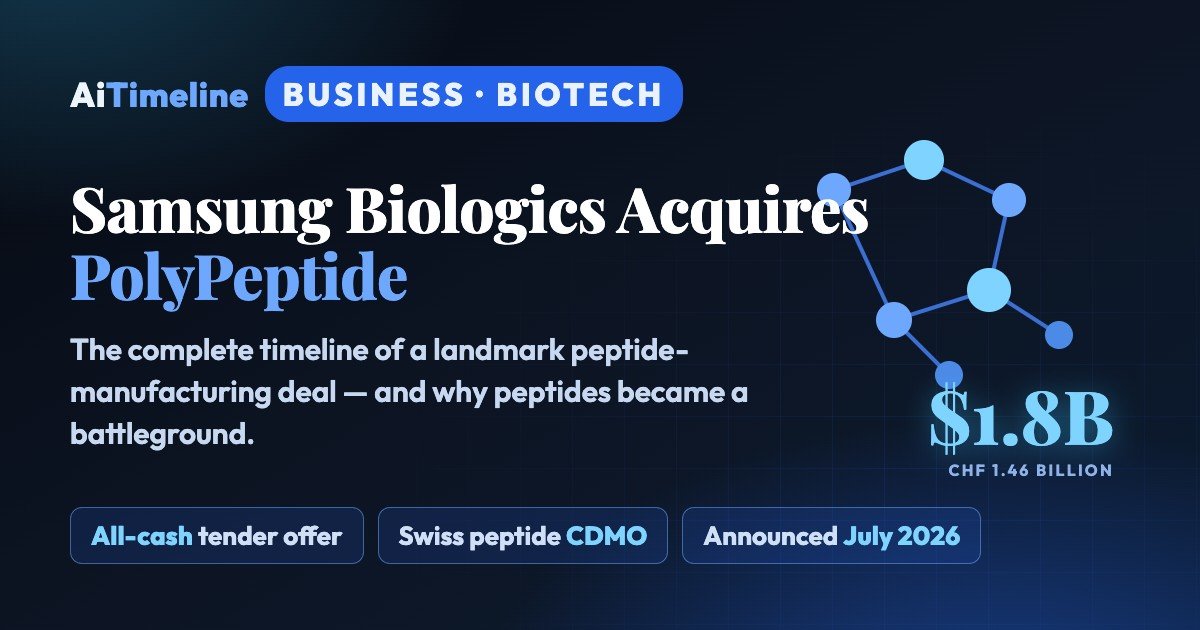
Samsung Biologics, the world’s largest contract biomanufacturer by capacity, agreed to acquire PolyPeptide Group, one of the biggest independent peptide makers, in an all-cash public tender offer valuing PolyPeptide at about CHF 1.46 billion (roughly US$1.8 billion). Shareholders are offered CHF 44.31 per share, a 40% premium. PolyPeptide’s largest owner, Draupnir Holding, has committed its 55.65% stake, and the board unanimously backs the deal.
The move takes Samsung Biologics beyond its antibody roots into peptides — the drug class behind blockbuster obesity and diabetes medicines like the GLP-1 therapies. It is the largest acquisition ever by a Korean pharmaceutical or biotech company. The tender offer is expected to launch by the end of August 2026 and complete by year-end, subject to a two-thirds minimum acceptance and regulatory clearances.
The Essentials
What to Remember
- Samsung Biologics offered about US$1.8 billion (CHF 1.46 billion) in cash for PolyPeptide, at CHF 44.31 per share, a 40% premium to the undisturbed price.
- The deal is the largest acquisition ever by a Korean pharmaceutical or biotech company and pushes Samsung Biologics beyond antibodies into peptides.
- Peptides power today’s biggest medicines, from insulin to the GLP-1 obesity and diabetes drugs, and demand has outrun global manufacturing capacity.
- PolyPeptide brings more than 70 years of heritage, over 1,000 peptides produced, and plants in Europe, the US and India — capability that is hard to build quickly.
- Nothing is final: closing needs two-thirds shareholder acceptance and regulatory approvals, and the real test is integration, not the announcement.
Peptides, CDMOs and Why This Deal Happened
The science and business terms behind the headline, in plain language.
To understand why a Korean antibody manufacturer would spend nearly two billion dollars on a Swiss company, you first need three ideas: what a peptide is, what a CDMO does, and why the two have collided in 2026.
What are peptide therapeutics?
A peptide is a short chain of amino acids — the same building blocks that make up proteins, just far smaller. If a small-molecule drug like aspirin is a single Lego brick and an antibody is a sprawling castle, a peptide sits in between: typically a chain of a few dozen amino acids. That middle size gives peptides a useful combination of traits. They can be precise and powerful like biologics, yet small enough to be made by chemical synthesis rather than grown in living cells. Insulin, the century-old diabetes medicine, is the archetype. The modern superstars are the GLP-1 drugs — semaglutide and tirzepatide — that have reshaped the treatment of type-2 diabetes and obesity.
What is a CDMO?
A CDMO, or contract development and manufacturing organisation, is a company that develops and manufactures medicines on behalf of others. Pharmaceutical firms invent and market drugs; CDMOs increasingly make them. Outsourcing lets drug companies avoid the cost and risk of building specialised factories, and it lets a manufacturer like Samsung Biologics run enormous plants at high utilisation across many clients. The CDMO industry has grown from a convenience into critical infrastructure for the whole pharmaceutical supply chain.
How peptide manufacturing differs from biologics
This is the crux of the deal. Samsung Biologics made its name in biologics — large protein drugs and antibodies grown inside living cells in giant steel bioreactors, sometimes 15,000 litres at a time. Peptides are made differently. Most are built by solid-phase peptide synthesis (SPPS), a chemical process that adds one amino acid at a time onto a growing chain anchored to a resin bead, or increasingly by hybrid and recombinant routes. The equipment, the chemistry, the purification and the regulatory know-how are genuinely different disciplines. A company brilliant at growing antibodies does not automatically know how to synthesise, purify and scale a peptide to commercial volumes under strict quality rules. That expertise is exactly what PolyPeptide has spent decades accumulating — and what Samsung Biologics is buying.
Biotech Insight
Peptides are one of the fastest-growing categories in medicine because they hit a sweet spot: more selective than small molecules, easier and cheaper to make than large biologics. The GLP-1 wave turned that scientific advantage into staggering commercial demand almost overnight. When a single class of injectable peptides can generate tens of billions of dollars a year, the ability to actually manufacture those molecules at scale becomes a strategic asset in its own right — which is why manufacturers, not just drug inventors, are now the ones doing the acquiring.
The Complete Timeline: From Insulin to a $1.8 Billion Deal
Newest first, from the 2026 acquisition back to the origins of peptide medicine. Colours mark the type of milestone.
Late 2026 — The Road to Completion
What is happening. After the announcement, Samsung Biologics is expected to formally launch its Swiss public tender offer by the end of August 2026, following a customary cooling-off period, with a minimum offer period of around 20 trading days. The transaction is expected to complete towards the end of 2026.
The conditions. Closing hinges on a minimum acceptance threshold of 66⅔% of shares, applicable regulatory approvals in the relevant jurisdictions, and other customary conditions. Because Draupnir Holding’s 55.65% is already committed, the acceptance hurdle looks reachable, but regulatory review and integration planning are the real work ahead.
20 July 2026 — Samsung Biologics Announces the $1.8 Billion Offer
What happened. Samsung Biologics announced an all-cash public tender offer for all publicly held shares of PolyPeptide Group at CHF 44.31 per share, implying an equity value of about CHF 1.46 billion — roughly US$1.8 billion, or about ₩2.7 trillion. The price is a 40% premium to PolyPeptide’s undisturbed share price of CHF 31.65 on 10 April 2026, and about an 11.6% premium to the 60-day volume-weighted average.
Why it matters. It is the largest acquisition ever by a Korean pharmaceutical or biotech company, and it marks Samsung Biologics’ entry into peptides. PolyPeptide’s board, through its independent members, unanimously recommended the offer, and largest shareholder Draupnir Holding (about 55.65%) gave an irrevocable undertaking to tender. Chief executive John Rim framed it as broadening the service portfolio “with modality expansion into peptides including GLP-1” while deepening reach in the US, Europe and India.
2024–2025 — The GLP-1 Crunch Reshapes Peptide Manufacturing
What happened. The explosive success of GLP-1 medicines turned peptide manufacturing into one of the tightest bottlenecks in pharma. Industry reporting put 2024 sales of semaglutide (Ozempic and Wegovy) above US$21 billion and tirzepatide (Mounjaro and Zepbound) above US$11 billion. Making enough active ingredient became the limiting factor, not demand.
The response. Manufacturers poured money into capacity. Swiss peptide specialist Bachem committed hundreds of millions of francs to new facilities, and drug owners such as Eli Lilly announced multi-billion-dollar plants. For a capacity-focused CDMO like Samsung Biologics, the message was clear: peptides had become a place where scale and speed were worth paying for.
2024 — A Wave of CDMO Consolidation
What happened. The manufacturing arms race spilled into mergers and acquisitions. In a landmark move, Novo Holdings — the investment arm behind Novo Nordisk — completed its roughly US$16.5 billion acquisition of US CDMO Catalent in December 2024, partly to secure fill-finish capacity for its own GLP-1 franchise.
Why it matters. Consolidation reframed how the industry thought about manufacturing: no longer a back-office cost, but a strategic asset worth owning outright. Samsung Biologics’ move on PolyPeptide two years later fits squarely in this pattern — buying specialised capability rather than trying to build it internally from a standing start.
2023 — Samsung Biologics Goes Multimodal
What happened. Having grown up as an antibody manufacturer, Samsung Biologics pushed a multimodality strategy — expanding into newer drug formats such as antibody-drug conjugates (ADCs) and building out its second campus, Bio Campus II, in Songdo. Successive mega-plants made it the industry leader in sheer bioreactor volume.
Why it matters. Multimodality was the strategic runway for the PolyPeptide deal. A company already broadening from antibodies into ADCs and other formats had a logical next step: peptides, the one high-demand modality it did not yet manufacture at scale.
2021 — PolyPeptide Lists on the SIX Swiss Exchange
What happened. On 30 April 2021, PolyPeptide Group AG completed an initial public offering and listed on the SIX Swiss Exchange. Going public gave the long-established peptide maker a market valuation, public disclosure and the currency to invest in capacity — and, ultimately, made it a company whose shares Samsung Biologics could tender for.
Why it matters. A listed company with a clear share price and a controlling shareholder is far easier to acquire cleanly than a privately held one. The 2021 IPO set the stage for the 2026 offer, and the CHF 31.65 “undisturbed” price used to calculate the premium is a direct product of that public listing.
2021 — The Obesity Era Begins
What happened. Regulators cleared higher-dose semaglutide for chronic weight management, and the GLP-1 class broke out of diabetes clinics into a mass market for obesity. Demand for a small family of injectable peptides exploded beyond anything the supply chain had planned for.
Why it matters. This is the single trend that made peptides strategically irresistible. A drug class that had existed for years suddenly became one of the biggest commercial stories in medicine, and every part of the value chain — including the humble business of synthesising the molecules — was pulled along with it.
2020 — Samsung Biologics Becomes the World’s Largest Biomanufacturer
What happened. Samsung Biologics pressed ahead with its fourth “super plant” and, on the strength of its expanding Songdo campuses, became the CDMO with the largest biomanufacturing capacity in the world. During the COVID-19 pandemic it also took on high-profile contract work for antibody therapies and vaccines, cementing its reputation for speed at scale.
Why it matters. Capacity leadership is Samsung Biologics’ core identity. That same playbook — win by being biggest and fastest — is exactly what it now intends to bring to peptides through PolyPeptide.
2016 — Samsung Biologics Lists on the KOSPI
What happened. On 10 November 2016, Samsung Biologics completed one of Korea’s largest-ever IPOs and listed on the KOSPI in Seoul. The listing raised the capital that funded successive mega-plants and turned a five-year-old subsidiary into a national biotech champion.
Why it matters. Public capital is what allowed Samsung Biologics to grow faster than its rivals. A decade later, that financial firepower is what makes a US$1.8 billion all-cash deal feasible without diluting shareholders.
2011 — Samsung Biologics Is Founded in Songdo
What happened. In April 2011, the Samsung Group established Samsung Biologics in Songdo, Incheon, betting that the discipline it had honed in electronics — large-scale, high-quality manufacturing — could be applied to biologic medicines. It began as a contract manufacturer for other companies’ antibodies.
Why it matters. Everything that follows — the IPO, the mega-plants, the multimodality push, and now the PolyPeptide offer — grows from this founding bet that manufacturing itself could be a world-class business.
2005 — The Modern Peptide Drug Arrives
What happened. The mid-2000s brought the first GLP-1 receptor agonist to market for type-2 diabetes, proving that a synthetic peptide could safely mimic a natural gut hormone. It was a modest commercial start, but a scientific turning point that pointed toward the obesity blockbusters to come.
Why it matters. This is where the demand that drives the 2026 deal was seeded. The science validated in the 2000s became the market that made peptides a strategic priority two decades later.
1996 — PolyPeptide Group Is Founded
What happened. PolyPeptide Group was formed in 1996 around the acquisition of a peptide facility in Malmö, Sweden, and expanded to the United States with a site in Torrance, California, the following year. Over the following decades it grew — organically and by acquisition — into one of the largest independent peptide CDMOs, spanning Europe, the US and India.
Why it matters. The company Samsung is buying is not a start-up. It is a specialist assembled over 30 years, with more than 1,000 peptides produced and deep GMP experience — precisely the kind of accumulated capability that money can buy faster than time.
1952 — Peptide Manufacturing Begins in Malmö
What happened. Commercial manufacturing of therapeutic peptides traces back to Malmö, Sweden, in 1952 — the deep root of the heritage PolyPeptide describes today as more than 70 years of active-ingredient manufacturing. Long before peptides were fashionable, a small industrial base was learning how to make them reliably.
Why it matters. Manufacturing know-how compounds slowly. The processes, quality systems and institutional memory built up from 1952 onward are a large part of what gives PolyPeptide — and now Samsung Biologics — credibility with drug developers.
1980s–1990s — The CDMO Model Takes Shape
What happened. Through the 1980s and 1990s, pharmaceutical companies increasingly outsourced development and manufacturing to specialist partners rather than doing everything in-house. What began as contract manufacturing matured into full-service CDMOs that could take a molecule from process development to commercial supply.
Why it matters. This is the business model that both Samsung Biologics and PolyPeptide inhabit. Without the rise of the CDMO, neither company would exist in its present form, and an acquisition between two contract manufacturers would make no sense.
1921–1922 — Insulin: The First Peptide-Class Medicine
What happened. The isolation of insulin in 1921 and its first therapeutic use in 1922 gave the world its first great peptide-class medicine — a life-saving hormone that transformed diabetes from a death sentence into a manageable condition.
Why it matters. Insulin proved that peptides and small proteins could be made into medicines and manufactured at scale. Every peptide drug since, including the GLP-1 therapies at the heart of this deal, stands on that foundation. The 2026 acquisition is, in a sense, the industrial descendant of a discovery made a century earlier.
Timeline Summary
Every milestone at a glance, with why it mattered.
| Date | Event | Why it mattered |
|---|---|---|
| Late 2026 | Tender offer and regulatory path | Deal must clear 66⅔% acceptance and approvals to close by year-end |
| 20 Jul 2026 | Samsung Biologics announces $1.8bn offer for PolyPeptide | Largest-ever Korean pharma acquisition; entry into peptides |
| 2024–2025 | GLP-1 supply crunch | Peptide capacity becomes the industry’s scarce resource |
| 2024 | Novo Holdings buys Catalent (~$16.5bn) | Signals a wave of manufacturing consolidation |
| 2023 | Samsung Biologics goes multimodal (ADCs, Bio Campus II) | Builds the runway toward a new modality: peptides |
| 2021 | PolyPeptide IPOs on the SIX Swiss Exchange | Turns a specialist into a public, acquirable company |
| 2021 | GLP-1 breaks into obesity treatment | Makes peptides one of medicine’s biggest markets |
| 2020 | Samsung Biologics becomes largest biomanufacturer | Cements the “win by scale” strategy |
| 2016 | Samsung Biologics lists on the KOSPI | Raises capital for its mega-plant build-out |
| 2011 | Samsung Biologics founded in Songdo | A conglomerate bets on biomanufacturing |
| 2005 | First modern GLP-1 drug reaches patients | Validates engineered peptides in the clinic |
| 1996 | PolyPeptide Group founded (Malmö) | Creates the specialist Samsung would later buy |
| 1952 | Peptide manufacturing begins in Malmö | Roots of PolyPeptide’s 70-year heritage |
| 1980s–90s | The CDMO model matures | Creates the outsourcing industry both firms inhabit |
| 1921–22 | Insulin becomes a medicine | The first peptide-class drug; foundation of the field |
Business Insight
Why buy instead of build? Because in a supply-constrained market, time is the scarcest resource of all. Samsung Biologics could have spent years constructing peptide plants, hiring specialists and qualifying processes with regulators — or it could acquire seven decades of that work in a single transaction. When customers need capacity now and rivals are expanding fast, paying a 40% premium to skip the queue can be cheaper than the opportunity cost of arriving late. This is the core logic behind most CDMO acquisitions: you are buying qualified capability and customer relationships, not just factories.
Biologics vs Peptides vs Small Molecules
Three broad classes of medicine, and why peptides sit in a valuable middle ground.
| Feature | Small molecules | Peptides | Biologics |
|---|---|---|---|
| Size | Tiny (single molecule) | Short amino-acid chains | Large proteins / antibodies |
| How they are made | Chemical synthesis | Chemical synthesis (SPPS) or recombinant | Grown in living cells |
| Typical delivery | Usually oral (pills) | Mostly injection; some oral | Injection or infusion |
| Example | Aspirin, statins | Insulin, GLP-1 drugs | Monoclonal antibodies |
| Manufacturing base | Fine-chemical plants | Peptide-synthesis facilities | Large bioreactors |
| Samsung Biologics’ position | Limited focus | Entering via PolyPeptide | Core strength (antibodies) |
🧪 Did You Know?
Peptide medicines are increasingly central to metabolic diseases, oncology and rare diseases — but making them at commercial scale is a specialised craft. A single therapeutic peptide can require dozens of precise chemical steps, extensive purification and rigorous quality control before a milligram ever reaches a patient. That is why owning proven peptide-manufacturing expertise, rather than simply having empty factory space, is what makes a company like PolyPeptide so valuable.
The Global CDMO Landscape
How Samsung Biologics compares with other major contract manufacturers. Publicly documented positioning only.
| CDMO | Base | Manufacturing focus | Notable point |
|---|---|---|---|
| Samsung Biologics | South Korea (Songdo) | Antibodies / biologics, ADCs; peptides via PolyPeptide | World’s largest biomanufacturing capacity |
| Lonza | Switzerland | Biologics, small molecules, cell & gene, peptides | One of the largest CDMOs by revenue |
| Catalent | United States | Biologics, oral, cell & gene, fill-finish | Acquired by Novo Holdings (2024) |
| WuXi Biologics | China | Biologics, discovery-to-commercial | Major integrated biologics platform |
| Bachem | Switzerland | Peptides and oligonucleotides (pure-play) | PolyPeptide’s closest peptide peer |
| PolyPeptide | Switzerland | Peptides (CDMO) | The target — 70+ years, 1,000+ peptides |
How a Peptide Drug Is Made
From development to the vial, the manufacturing journey a CDMO manages.
Process development
Chemists design a route to synthesise the target peptide reliably and reproducibly, choosing protecting groups, coupling reagents and conditions — the recipe that everything downstream depends on.
Solid-phase synthesis
The peptide is built one amino acid at a time on a resin bead using solid-phase peptide synthesis (SPPS), or via hybrid and recombinant routes for longer or more complex sequences.
Cleavage and purification
The finished chain is cleaved from the resin and purified — often by high-performance liquid chromatography — to strip out closely related impurities and reach pharmaceutical-grade quality.
Clinical manufacturing
Smaller GMP batches are made to supply clinical trials, where the drug’s safety and efficacy are tested. Consistency here is essential: the trial material must match what will later be sold.
Commercial manufacturing
Once approved, the process is scaled up for commercial supply — larger batches, tighter economics and relentless reliability, all under the same strict quality regime.
Quality control and GMP
Every stage runs under Good Manufacturing Practice (GMP): documented procedures, validated equipment, tested batches and regulatory inspections that together guarantee each dose is safe, pure and identical.
Why the drug-development context matters. A CDMO does not usually invent the medicine; it makes it. But its role stretches across the whole pipeline — from early process development, through clinical manufacturing for trials, to full-scale commercial manufacturing once a drug is approved. Along the way, quality standards and GMP compliance are non-negotiable: regulators inspect facilities, and a single quality failure can halt supply of a life-saving medicine. This is the world Samsung Biologics is buying into — one where reputation and regulatory track record, the things PolyPeptide has spent decades building, are worth as much as the equipment itself.
Market Context: Why Peptides, Why Now
The demand behind the deal — presented as industry analysis, not confirmed company guidance.
✓ Confirmed (official)
- Offer of CHF 44.31 per share, all cash, for PolyPeptide.
- Implied equity value about CHF 1.46 billion (~US$1.8 billion).
- 40% premium to the undisturbed price of CHF 31.65 (10 April 2026).
- Draupnir Holding (55.65%) committed; board unanimously recommends.
- Minimum acceptance 66⅔%; completion targeted for end of 2026.
- Samsung Biologics states total capacity around 784,000 litres.
⚠ Analysis & estimates (not guaranteed)
- Peptide and GLP-1 market forecasts vary widely by research firm.
- 2024 sales: semaglutide >$21bn, tirzepatide >$11bn (industry trackers).
- Whether the deal delivers synergies depends on integration.
- Future peptide demand beyond GLP-1 is projected, not certain.
- Competitor responses and pricing are commentary, not fact.
- Regulatory timing could shift the expected close.
The demand story is real, but it belongs in the “analysis” column. Independent market researchers describe peptide therapeutics as one of the fastest-growing drug categories, driven above all by metabolic and endocrine diseases — type-2 diabetes and obesity — with expanding interest in oncology and rare diseases. The GLP-1 phenomenon is the clearest evidence: by 2024, a handful of injectable peptides were generating tens of billions of dollars a year, and the constraint on growth had shifted from demand to the ability to manufacture enough active ingredient.
That is the backdrop against which Samsung Biologics acted. Analysts’ growth forecasts differ, and none of them are promises — but the direction of travel is hard to dispute. When the world cannot make enough of a class of medicine, the companies that can make it become strategically important. The PolyPeptide acquisition is Samsung Biologics’ bid to be one of them.
Future Watch
What to track from here, without predicting outcomes: the tender offer’s formal launch and acceptance level; regulatory approvals in the jurisdictions where both firms operate; any officially announced plans for integrating PolyPeptide’s sites in Sweden, Belgium, France, the US and India; and disclosed capacity expansions in peptides. Samsung Biologics has been explicit that this is about broadening its modality and geographic reach — not about a single product. The honest measure of success will be steady integration and regulatory compliance over the coming years, not the size of the headline.
Key Entities in the Deal
The companies, terms and concepts at the centre of the story.
Samsung Biologics
South Korean CDMO founded in 2011, headquartered in Songdo, Incheon. The world’s largest biomanufacturer by capacity, historically focused on antibodies and now expanding into peptides.
PolyPeptide Group
Switzerland-based peptide CDMO with over 70 years of heritage and more than 1,000 peptides produced. Listed on the SIX Swiss Exchange in 2021; sites in Europe, the US and India.
CDMO
A contract development and manufacturing organisation that develops and makes medicines for other companies — increasingly critical infrastructure for the global pharmaceutical supply chain.
Peptide therapeutics
Medicines built from short amino-acid chains, sitting between small molecules and biologics. Includes insulin and the GLP-1 obesity and diabetes drugs.
Draupnir Holding
PolyPeptide’s largest shareholder, holding about 55.65%. It gave an irrevocable undertaking to tender its stake into Samsung Biologics’ offer, greatly improving the deal’s odds.
GMP
Good Manufacturing Practice — the enforced system of procedures, validation and inspection that ensures every batch of a medicine is safe, pure and consistent.
Explore More Timelines
Related histories in biotech, medicine and the business of health from AiTimeline.
Explore More Timelines
Frequently Asked Questions
Thirty answers on the acquisition, the companies, peptides and the CDMO industry.
Why This Acquisition Matters Beyond One Deal
Strip away the numbers and the Samsung Biologics–PolyPeptide deal tells a larger story about where medicine is going. For most of the past two decades, the glamour in biotech belonged to the companies that invented drugs. This acquisition is a reminder that, increasingly, power is shifting to the companies that can make them — reliably, at scale, under intense regulatory scrutiny. When the world cannot produce enough of a class of medicine, manufacturing stops being a back-office function and becomes a strategic asset worth billions.
It also captures three trends at once: the rise of peptide therapeutics, propelled by the GLP-1 revolution; the consolidation of the CDMO industry, as firms buy capability rather than build it; and the globalisation of drug manufacturing, with a Korean company buying a Swiss firm to gain footholds across Europe, the United States and India. None of these trends began with this deal, and none will end with it.
That is why the honest conclusion is a cautious one. The announcement is significant, but its real meaning will be written over years, not weeks. Success will depend on clearing regulatory approvals, integrating PolyPeptide’s people and plants without disruption, maintaining an unblemished quality record, and sustaining growth in peptide-based medicines. If those things come together, a $1.8 billion cheque will look like a bargain for a seat at the centre of one of medicine’s most important markets. If they do not, it will be remembered as an expensive lesson in how much harder integration is than acquisition. Either way, the deal marks the moment peptides stopped being a niche and became a battleground.
Sources & further reading
Every dated entry above was checked against these references. Last reviewed 15 September 2026.