National Doctors’ Day India History Timeline (1882–2026): Dr. B. C. Roy’s Legacy & Healthcare Milestones
National Doctors' Day India history timeline: Dr B.C. Roy's legacy, why India celebrates on July 1, key milestones and how doctors are honoured.
Latest Story
National Doctors’ Day India is observed every 1 July to honour the country’s physicians and the memory of Dr. Bidhan Chandra Roy (B. C. Roy) — legendary doctor, freedom fighter and Chief Minister of West Bengal — who was born on 1 July 1882 and died on the same date in 1962. This National Doctors’ Day India history timeline traces the day’s origins from the Government of India’s 1991 recognition back through Dr. B. C. Roy’s life and forward across India’s healthcare milestones, clearly separating verified government and historical facts from commentary and forecasts.
🧠 AI Overview Summary
National Doctors’ Day in India is celebrated on 1 July, instituted by the Government of India in 1991 to honour physicians and the legacy of Dr. B. C. Roy, who was both born (1882) and died (1962) on that date. Dr. Roy was a celebrated physician, the second Chief Minister of West Bengal, and a Bharat Ratna awardee (1961). The day recognises doctors’ role in public health, and annual themes are announced by the Indian Medical Association.
Latest Update — October 2026
The National Medical Commission’s revised MBBS seat matrix for 2026-27, stated as on 18 September 2026, lists 1,40,664 MBBS seats across 839 medical colleges (excluding Institutes of National Importance such as AIIMS), up from about 1.24 lakh in 2025-26. Of these, 64,121 seats are in 447 government colleges and 76,543 in 392 private colleges, with 13,636 seats added this year. The expansion matters for the doctor shortage that National Doctors’ Day highlights, though rural access remains uneven. Separately, the widely quoted Doctors’ Day theme “Behind the Mask: Who Heals the Healers?” was first reported for 2025 and repeated in 2026 coverage; the themes table below now reflects that.
National Doctors’ Day: Key Questions
National Doctors’ Day — What to Know
- National Doctors’ Day India is observed on 1 July, instituted by the Government of India in 1991.
- It honours Dr. B. C. Roy, who was born on 1 July 1882 and died on 1 July 1962 — the same date.
- Dr. Roy was a physician, freedom fighter and second Chief Minister of West Bengal (1948–1962).
- He received the Bharat Ratna, India’s highest civilian award, in 1961.
- Annual themes are announced by the Indian Medical Association (IMA); they are not maintained in a single official public archive.
- The day spotlights doctors’ role in public health, prevention, research and emergency care, beyond treating illness.
- India’s healthcare has evolved from a handful of colleges at independence to Ayushman Bharat, digital health and telemedicine today.
- This timeline separates verified government and historical facts from commentary, current statistics and forecasts.
Who Was Dr. B. C. Roy?
The physician-statesman at the heart of National Doctors’ Day.
Dr. Bidhan Chandra Roy (1 July 1882 – 1 July 1962) is remembered as one of India’s greatest physicians and public servants. Born in Bankipore, Patna, he studied medicine at Calcutta Medical College, then travelled to London, where he was admitted to St Bartholomew’s Hospital and earned the rare distinction of becoming both a Member of the Royal College of Physicians (MRCP) and a Fellow of the Royal College of Surgeons (FRCS) in a remarkably short time.
Returning to India, Dr. Roy became a legendary clinician and teacher, and joined the freedom movement under the Indian National Congress. He served as the second Chief Minister of West Bengal from 1948 until his death in 1962, earning renown as the “maker of modern West Bengal” for developing cities and institutions. He played a leading role in Indian medical bodies and helped establish major hospitals and colleges. In 1961 he received the Bharat Ratna. National Doctors’ Day, the Dr. B. C. Roy National Award for medical excellence, and numerous institutions carry his legacy forward.
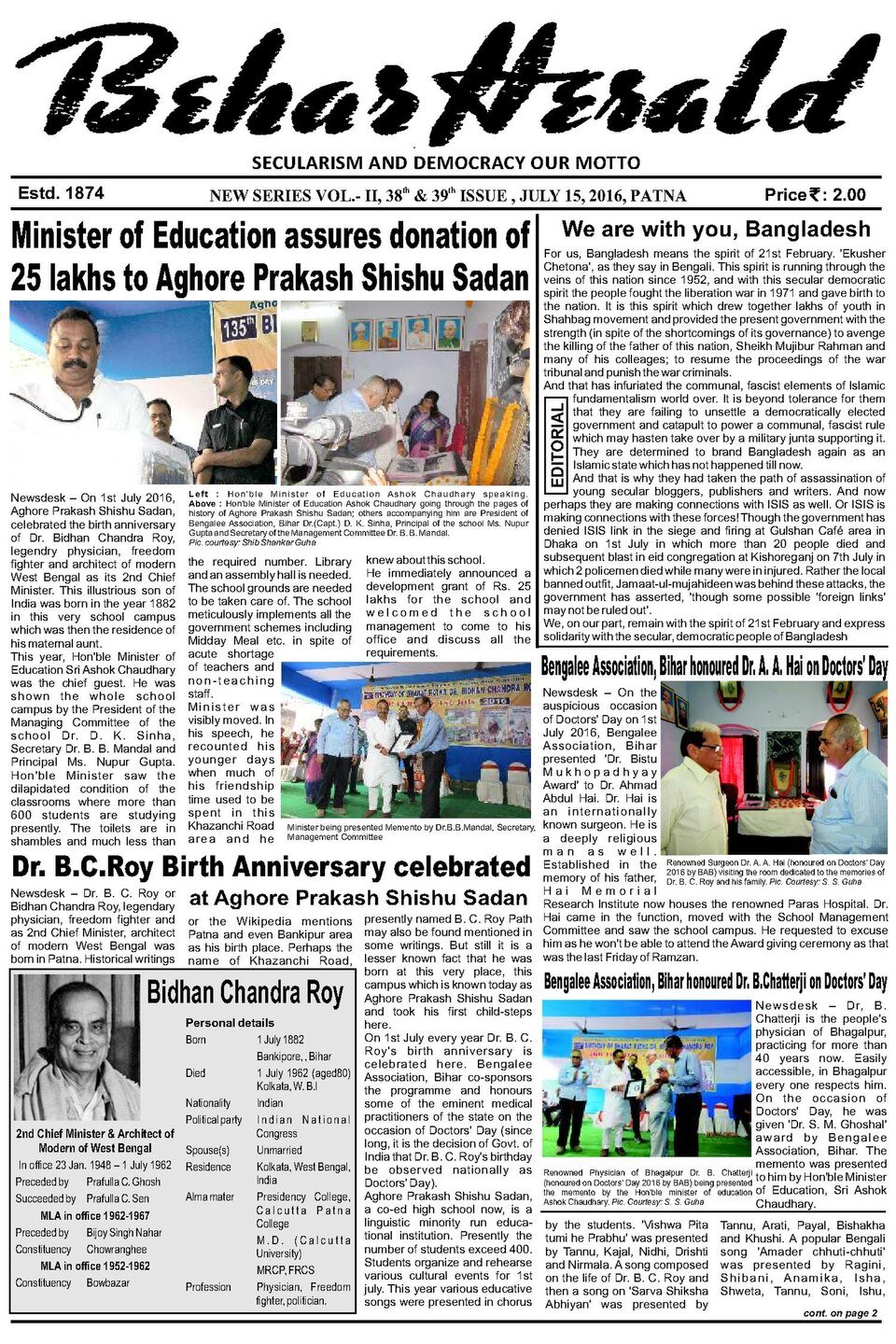
A commemorative Indian newspaper tribute to Dr. B. C. Roy — the kind of remembrance that surrounds his 1 July birth and death anniversary each year.
Why Is National Doctors’ Day Celebrated on 1 July?
A single date that marks a beginning and an end.
National Doctors’ Day is held on 1 July because it is both the birth and death anniversary of Dr. B. C. Roy. He was born on 1 July 1882 and died on 1 July 1962, on his 80th birthday. The Government of India instituted the observance in 1991, choosing this poignant date to honour a physician whose life came to symbolise medical excellence and selfless service.
India’s date differs from other countries: the United States marks National Doctors’ Day on 30 March, and Iran on 23 August. India’s 1 July date is uniquely tied to Dr. Roy, making the day as much a tribute to his memory as a celebration of all doctors.
Milestones That Define National Doctors’ Day
The pivotal moments behind the day and India’s medical history.
Government
Historical Record
Government
Government
National Doctors’ Day & Indian Healthcare Timeline (Reverse Chronological)
Newest first. Each entry lists the event, context, key person, organisation, healthcare impact, relevance and source type.
National Doctors’ Day 2026
Event: India observed National Doctors’ Day on 1 July 2026 with coverage again centred on “Behind the Mask: Who Heals the Healers?” — wording first widely reported for 2025 — spotlighting doctors’ own mental and physical wellbeing, amid a wider wave of AI-assisted diagnostics, digital hospitals and expanded telemedicine.
Historical Context: The 2020s accelerated India’s shift toward digital and preventive healthcare after the COVID-19 pandemic.
Key Person: Frontline doctors and specialists, in the enduring spirit of Dr. B. C. Roy.
Government / Organisation: Indian Medical Association and Ministry of Health and Family Welfare lead observances and campaigns.
Healthcare Impact: Growing use of AI triage, tele-ICUs and electronic health records is reshaping how care is delivered.
Why It Matters Today: The day reaffirms the human core of medicine even as technology transforms diagnosis and treatment.
World’s Largest Vaccination Drive & Digital Health Mission
Event: India launched its nationwide COVID-19 vaccination drive on 16 January 2021 and advanced the Ayushman Bharat Digital Mission (ABDM) with digital health IDs.
Historical Context: The pandemic’s deadly second wave in 2021 tested India’s health system and its doctors like never before.
Key Person: Millions of doctors, nurses and health workers; policymakers at the Health Ministry.
Government / Organisation: Ministry of Health and Family Welfare, ICMR and state governments.
Healthcare Impact: One of the largest vaccination campaigns in history, administering billions of doses, alongside a national digital health framework.
Why It Matters Today: It demonstrated India’s capacity for massive, technology-enabled public health delivery.
COVID-19 & Doctors on the Front Line
Event: The COVID-19 pandemic reached India in early 2020, triggering a nationwide lockdown in March and a surge in telemedicine as doctors led the response.
Historical Context: A once-in-a-century pandemic placed doctors at the centre of national survival, at great personal risk.
Key Person: Frontline physicians and healthcare workers, many of whom lost their lives serving patients.
Government / Organisation: Government of India issued telemedicine practice guidelines in March 2020, and scaled the eSanjeevani platform.
Healthcare Impact: Telemedicine went mainstream, and public respect for doctors reached new heights.
Why It Matters Today: The crisis permanently expanded digital care and highlighted the need to protect health workers.
Ayushman Bharat Launched
Event: India launched Ayushman Bharat in 2018, combining Health and Wellness Centres with the PM-JAY health insurance scheme.
Historical Context: The reform aimed to move India toward universal health coverage for its poorest citizens.
Key Person: Union health leadership and the National Health Authority.
Government / Organisation: Government of India / National Health Authority.
Healthcare Impact: Often described as the world’s largest government-funded health assurance scheme, offering hospital cover to hundreds of millions.
Why It Matters Today: It reshaped access to secondary and tertiary care for low-income families.
Government of India Institutes National Doctors’ Day
Event: The Government of India designated 1 July as National Doctors’ Day in 1991, honouring doctors and Dr. B. C. Roy.
Historical Context: The date was chosen to coincide with Dr. Roy’s shared birth and death anniversary.
Key Person: Dr. B. C. Roy, commemorated as the day’s inspiration.
Government / Organisation: Government of India, with the Indian Medical Association observing it nationally.
Healthcare Impact: Created a formal annual occasion to recognise medical service and raise health awareness.
Why It Matters Today: It remains India’s central day for honouring the medical profession.
Death of Dr. B. C. Roy
Event: Dr. B. C. Roy died on 1 July 1962, on his 80th birthday, while still serving as Chief Minister of West Bengal.
Historical Context: He had worked tirelessly as both physician and administrator until his final days.
Key Person: Dr. Bidhan Chandra Roy.
Government / Organisation: Government of West Bengal; national mourning followed.
Healthcare Impact: His death marked the end of an era, but his institution-building shaped Indian medicine for decades.
Why It Matters Today: The date of his passing became, decades later, the date of National Doctors’ Day.
Bharat Ratna Awarded to Dr. Roy
Event: Dr. B. C. Roy was conferred the Bharat Ratna, India’s highest civilian award, in 1961.
Historical Context: The honour recognised a lifetime of medical excellence and nation-building service.
Key Person: Dr. Bidhan Chandra Roy.
Government / Organisation: Government of India.
Healthcare Impact: Elevated the standing of the medical profession in public life.
Why It Matters Today: He remains a benchmark for physicians who serve both patients and society.
AIIMS New Delhi Established
Event: The All India Institute of Medical Sciences (AIIMS), New Delhi, was established in 1956 as an institution of national importance.
Historical Context: Post-independence India invested in flagship institutions to build medical self-reliance.
Key Person: Health Minister Rajkumari Amrit Kaur championed its creation.
Government / Organisation: Government of India, via the AIIMS Act, 1956.
Healthcare Impact: AIIMS became a gold standard for medical education, research and tertiary care.
Why It Matters Today: A national network of AIIMS institutions now anchors advanced healthcare across India.
Roy as Chief Minister; WHO Founded
Event: Dr. B. C. Roy served as Chief Minister of West Bengal from 1948 to 1962, the same era in which the World Health Organization was founded (1948).
Historical Context: Newly independent India was building health systems while resettling millions after Partition.
Key Person: Dr. Roy, guiding West Bengal’s reconstruction and healthcare.
Government / Organisation: Government of West Bengal; WHO as the new global health authority.
Healthcare Impact: Roy helped develop hospitals, medical colleges and planned townships.
Why It Matters Today: His model of the physician-administrator still inspires health leadership.
Indian Medical Association & Medical Council
Event: The Indian Medical Association was founded in 1928, and the Medical Council of India was established under the Indian Medical Council Act, 1933.
Historical Context: Indian physicians organised to set standards and represent the profession under colonial rule.
Key Person: Dr. B. C. Roy was a leading figure in Indian medical organisation of this era.
Government / Organisation: Indian Medical Association; Medical Council of India.
Healthcare Impact: Created national frameworks for medical ethics, education and registration.
Why It Matters Today: The IMA still leads the profession, and medical regulation continues under the National Medical Commission.
Dr. Roy Qualifies MRCP & FRCS in London
Event: Around 1911, B. C. Roy earned both the MRCP and FRCS in London within an extraordinarily short period, then returned to serve in India.
Historical Context: Few physicians achieved both prestigious qualifications, and rarely so quickly.
Key Person: Dr. Bidhan Chandra Roy.
Government / Organisation: Royal College of Physicians; Royal College of Surgeons (UK).
Healthcare Impact: He brought world-class clinical standards to Indian medicine and teaching.
Why It Matters Today: His scholarship set a lasting benchmark for Indian medical education.
Birth of Dr. B. C. Roy
Event: Bidhan Chandra Roy was born on 1 July 1882 in Bankipore, Patna, then part of the Bengal Presidency.
Historical Context: He grew up in a public-spirited family during the late colonial era.
Key Person: Dr. Bidhan Chandra Roy.
Government / Organisation: Not applicable (birth); later shaped by Calcutta Medical College.
Healthcare Impact: The birth of a figure who would transform Indian medicine and public life.
Why It Matters Today: This date, 1 July, is now National Doctors’ Day.
Dr. B. C. Roy: A Life in Brief
From clinic to Chief Minister — the milestones of a physician-statesman.
Early life: Born 1 July 1882 in Bankipore, Patna, into a family with a strong sense of public duty.
Education: Studied at Presidency College, Calcutta, and medicine at Calcutta Medical College, before training in London.
Medical qualifications: Earned both the MRCP and FRCS in Britain in a remarkably short time — a rare double distinction.
Career: Became a celebrated physician and medical teacher in Bengal, admired for his clinical acumen.
Public service & political leadership: Joined the Indian National Congress and freedom movement; served as the second Chief Minister of West Bengal from 1948 until 1962.
Institutions: Played a leading role in building hospitals, medical colleges and planned townships, earning the title “maker of modern West Bengal.”
Awards & legacy: Received the Bharat Ratna in 1961. Today National Doctors’ Day, the Dr. B. C. Roy National Award and numerous institutions honour his memory.
Timeline of Indian Healthcare Milestones
Key verified events in India’s medical and public health history.
| Year | Event | Impact | Current Relevance |
|---|---|---|---|
| 1835 | Calcutta Medical College founded | Early Western medical education in India | Model for modern colleges |
| 1928 | Indian Medical Association founded | National body for doctors | Leads the profession, sets themes |
| 1946 | Bhore Committee report | Blueprint for public health | Basis of primary healthcare |
| 1948 | WHO founded; Roy becomes CM | Global and state health leadership | India a WHO founding member |
| 1952 | National family planning programme | Early population health policy | Foundation of family welfare |
| 1956 | AIIMS New Delhi established | Flagship medical institution | National AIIMS network today |
| 1985 | Universal Immunization Programme | Mass childhood vaccination | Backbone of child health |
| 1991 | National Doctors’ Day instituted | Formal recognition of doctors | Observed every 1 July |
| 2005 | National Rural Health Mission | Expanded rural healthcare | Core of public health delivery |
| 2014 | India declared polio-free | Major disease-control success | Model for eradication efforts |
| 2018 | Ayushman Bharat launched | Large-scale health assurance | Expanding coverage nationwide |
| 2020–21 | COVID-19 response & vaccination | Massive public health mobilisation | Boosted digital and tele-health |
Official Doctors’ Day Themes by Year
An accuracy-first approach: only confirmed themes, never invented ones.
| Year | Official National Theme | Announcing Body |
|---|---|---|
| 2026 | No separate officially confirmed theme; many 2026 reports repeated “Behind the Mask: Who Heals the Healers?”, the wording first widely reported in 2025 | Indian Medical Association |
| 2025 | “Behind the Mask: Who Heals the Healers?” — focused on doctors’ mental and emotional wellbeing, as widely reported around 1 July 2025 (no official IMA archive copy located) | Indian Medical Association |
| 2024 | No officially confirmed national theme available | Indian Medical Association |
| 2023 | No officially confirmed national theme available | Indian Medical Association |
| 2022 | No officially confirmed national theme available | Indian Medical Association |
| 2021 | No officially confirmed national theme available | Indian Medical Association |
Science & Public Health: What Doctors Really Do
Beyond treating illness — the full role of physicians.
Role of physicians: Doctors diagnose and treat disease, but they also counsel, coordinate care, and guide patients through prevention and recovery.
Preventive medicine: Much of medicine is stopping illness before it starts — screenings, lifestyle advice and early detection.
Public health: Physicians shape immunisation, sanitation, maternal care and disease surveillance that protect whole populations.
Vaccination: Doctors drive immunisation programmes that have controlled polio, smallpox and childhood diseases in India.
Emergency medicine: From trauma to cardiac arrest, doctors deliver time-critical care that saves lives every day.
Primary care: Family physicians and rural health teams form the first, most accessible layer of the health system.
Medical research: Clinical research and innovation, from new drugs to AI diagnostics, continually expand what medicine can do.
India’s Medical Statistics at a Glance
Current figures are estimates from government and international sources and vary by methodology.
| Indicator | Around 1947 | Mid-2020s (est.) | Note |
|---|---|---|---|
| Life expectancy | ~32 years | ~70 years | Major public-health gain |
| Medical colleges | ~30 | 839 (2026-27) | NMC seat matrix, Sep 2026; excl. INIs |
| MBBS seats (approx.) | Few thousand | ~1.41 lakh (2026-27) | NMC seat matrix, Sep 2026; excl. INIs |
| Doctor-population ratio | Very low | Near WHO 1:1000* | *Incl. AYUSH; varies by source |
| Public health spending | Minimal | ~1.9–2.1% of GDP | Policy target ~2.5% |
Doctors’ Day Around the World
India is one of many countries that honours physicians — on different dates.
| Country | Date | Honours / Origin |
|---|---|---|
| India | 1 July | Dr. B. C. Roy’s birth and death anniversary |
| United States | 30 March | First use of ether anaesthesia (1842) |
| Iran | 23 August | Birthday of Avicenna (Ibn Sina) |
| Brazil | 18 October | Feast of St Luke, patron of physicians |
| Vietnam | 27 February | Vietnamese Doctors’ Day |
Key Institutions Behind Indian Medicine
The organisations that shape doctors, policy and public health.
Bidhan Chandra Roy
India’s most celebrated physician-administrator (1882–1962), Chief Minister of West Bengal and Bharat Ratna awardee. National Doctors’ Day is held on his birth and death anniversary, 1 July, and awards and institutions bear his name.
Indian Medical Association
The largest association of modern-medicine doctors in India, founded in 1928. It represents the profession, promotes medical ethics and education, and announces the annual National Doctors’ Day theme and observances.
Ministry of Health & Family Welfare
The Government of India ministry responsible for national health policy, programmes and institutions — from immunisation and Ayushman Bharat to digital health and pandemic response.
World Health Organization
The United Nations’ health agency, founded in 1948, of which India is a founding member. WHO sets global health standards, supports disease control, and defines benchmarks such as the doctor-population ratio.
National Medical Commission
India’s medical education and profession regulator, which replaced the Medical Council of India in 2020. It oversees medical colleges, standards, the licensing exam and the national medical register.
AIIMS
The All India Institute of Medical Sciences, established in New Delhi in 1956 and now a national network, is India’s benchmark for medical education, research and specialised tertiary care.
Case Studies
Five deep looks at doctors and Indian healthcare, past and future.
Case Study 1 — The Legacy of Dr. B. C. Roy
Dr. Roy showed that a doctor could heal individuals and build institutions. As Chief Minister he developed hospitals, medical colleges and planned cities, proving that medical values — care, discipline, service — could scale to public administration. National Doctors’ Day keeps this dual legacy of clinical excellence and public service alive.
Case Study 2 — Doctors During COVID-19
The 2020–2021 pandemic placed Indian doctors under unprecedented strain. Working through equipment shortages and deadly waves, many gave their lives. Their response accelerated telemedicine, strengthened critical-care capacity, and deepened public gratitude, reframing National Doctors’ Day as a tribute to frontline courage.
Case Study 3 — Telemedicine in India
Government telemedicine guidelines in 2020 and platforms such as eSanjeevani turned remote consultation from a novelty into a mainstream service, connecting rural patients with doctors. Telemedicine now extends specialist care far beyond big-city hospitals, a lasting structural change in Indian healthcare.
Case Study 4 — Public Healthcare Evolution
From the 1946 Bhore Committee to the 1985 Universal Immunization Programme, the 2005 National Rural Health Mission and 2018’s Ayushman Bharat, India has steadily expanded access. Life expectancy has more than doubled since independence, and diseases such as polio have been eliminated — a public-health arc doctors helped drive.
Case Study 5 — The Future of AI-Assisted Healthcare
AI is beginning to support Indian doctors with faster diagnostics, imaging analysis and triage, especially where specialists are scarce. Used well, it can extend reach without replacing clinical judgement. The promise is real but should be treated as an emerging tool, not a finished solution — a forecast, not a guarantee.
Science vs Myth: Do Doctors Only Treat Illness?
Separating a common assumption from the fuller reality.
Myth: Doctors only treat illness. In reality, medicine spans far more than curing the sick.
Role in prevention: Doctors prevent disease through vaccination, screening, counselling and early diagnosis — often their most valuable work.
Role in research: Physicians advance medicine through clinical trials, public-health studies and innovation, from new treatments to AI tools.
Role in public health: Doctors shape policy, outbreak response and health education that protect entire communities, not just individual patients.
Discover: Inspiring Facts & Rare Records
- One date, two milestones: Dr. B. C. Roy was born and died on 1 July, eighty years apart.
- Double distinction: He earned both the MRCP and FRCS in Britain in an unusually short time.
- City-builder: He is credited with helping plan Durgapur, Kalyani and Salt Lake (Bidhannagar).
- Highest honour: He received the Bharat Ratna in 1961 for medicine and public service.
- Living tribute: The Dr. B. C. Roy National Award recognises outstanding medical work.
- Record drive: India delivered over a billion COVID-19 vaccine doses within about ten months from January 2021.
Explore More Timelines
People Also Ask
National Doctors’ Day & Indian Healthcare FAQ
Forty of the most-searched questions, answered with verified facts.
Explore More Timelines
⚠️ Editorial Note, Sources & Accuracy
This article separates verified government and historical facts (the 1991 institution of National Doctors’ Day; Dr. B. C. Roy’s birth in 1882, death in 1962, and 1961 Bharat Ratna; AIIMS 1956; Ayushman Bharat 2018) from current statistics (doctor ratios, college counts, spending — all approximate estimates that vary by source) and forecasts (the future of AI and digital health, clearly labelled). Doctors’ Day themes are announced by the Indian Medical Association and are not maintained in a single official archive, so this article does not invent themes; verify the current year’s theme with the IMA. Historical details align with mainstream records; content is editorial and AI-assisted, compiled from publicly available sources, and is not medical advice.
Sources & further reading
Every dated entry above was checked against these references. Last reviewed 18 October 2026.