Invest in US Stocks From India: The Complete Guide to LRS, Taxes and Cross-Border Investing
A complete guide to investing in US stocks from India: RBI LRS limits, US dividend withholding, capital gains tax, DTAA credit and Schedule FA rules.
Latest Story
Aarav is 27, works as a software engineer in Bengaluru, and has just watched his monthly SIPs in Indian mutual funds cross a milestone he’s proud of. He also owns an iPhone, uses a laptop running an American operating system, and spends half his workday inside tools built by companies whose shares he has never owned. One weekend, a colleague mentions casually that she buys Nasdaq-listed stocks every month, the same way Aarav buys Nifty index funds. It sounds simple. It is not quite that simple, and it is not that complicated either. Investing in US stocks from India means opening a route to companies that don’t list in Mumbai at all, moving money across a border under a specific Reserve Bank of India framework, paying tax in two systems instead of one, and doing all of this while a currency you don’t control quietly changes what your money is worth. None of it is exotic. All of it has rules. This guide is a plain-English, source-by-source map of those rules — what US stock investing actually is, how the money legally leaves India and arrives at a US brokerage, what tax applies on both sides, and what a first-time investor like Aarav genuinely needs to understand before wiring a single dollar.
🧠 AI Overview Summary
Indian residents can legally invest in US-listed stocks and ETFs under the Reserve Bank of India’s Liberalised Remittance Scheme (LRS), which currently permits remitting up to USD 250,000 per financial year for permitted purposes including overseas investment, subject to RBI regulations and bank compliance checks. Investors typically use either a direct international brokerage account, an Indian fintech/broker’s US tie-up, or the newer GIFT City (IFSC) route. US dividends are taxed at source (30% statutory, reduced to 25% for most investors under the India-US tax treaty via Form W-8BEN), while capital gains are generally not taxed by the US for non-resident individual investors. In India, that same dividend and capital gains income must be reported, dividend tax credit can be claimed via Form 67 under the DTAA, and any foreign equity holding must be disclosed in Schedule FA of the income tax return regardless of profit or loss. Currency movement, brokerage costs and these tax and disclosure obligations are as important to understand as stock selection itself.
Investing in US stocks from India, in six direct answers
What matters most before you remit a single dollar
- The legal route is the Liberalised Remittance Scheme (LRS). RBI currently permits Indian resident individuals to remit up to USD 250,000 per financial year for permitted purposes, including overseas portfolio investment, subject to bank compliance and applicable Tax Collected at Source (TCS).
- Tax applies twice, but not twice-over. The US withholds tax on dividends at source; India taxes the same income again as a resident’s global income, but the India-US Double Taxation Avoidance Agreement (DTAA) lets you claim credit for tax already paid abroad, via Form 67.
- Capital gains work differently across the two systems. The US generally does not tax capital gains earned by non-resident individual investors on stock sales; India does, as part of the investor’s global income, under India’s own capital gains rules for foreign assets.
- Currency risk is not optional and cuts both ways. A stock can rise in USD terms and still disappoint in INR terms if the rupee strengthens against the dollar during the holding period — and vice versa, a weaker rupee can flatter USD returns once converted back.
- Disclosure is mandatory even without profit. Any resident holding foreign equity must report it in Schedule FA of their Indian income tax return, regardless of gain, loss, or even if the position is still open — non-disclosure carries penalties under the Black Money Act, 2015.
- You have three broad routes in, not one. A direct account with a US-licensed broker, an Indian fintech or broker’s US tie-up that routes your LRS remittance for you, or the newer GIFT City (IFSC) route that some investors can access without a traditional LRS transfer.
- Fractional shares lowered the entry barrier significantly. Many platforms now let investors buy a fraction of a high-priced share (say, $50 of a $3,000 stock) rather than requiring the full share price upfront — though not every India-linked platform supports this for every stock.
- US settlement is now T+1. Since 28 May 2024, most US securities transactions settle one business day after the trade, faster than the T+2 cycle used for years before, which matters for how quickly funds become available after a sale.
- Diversification reduces concentration risk; it does not eliminate market risk. Holding both Indian and US equities spreads exposure across economies and currencies, but a global downturn, sector correction or company-specific event can still reduce the value of US holdings.
- This is a framework, not investment advice. Every rate, limit and threshold on this page is sourced and dated because these figures move with each Union Budget and RBI/IRS update — verify the current numbers before you act, and consult a qualified professional for anything specific to your situation.
Executive Summary & One-Minute Read
📋 Executive Summary
Indian residents have been able to legally invest abroad, including in US-listed stocks, since the RBI introduced the Liberalised Remittance Scheme in February 2004. The scheme’s remittance ceiling has been raised repeatedly since then and has stood at USD 250,000 per financial year since February 2015, though a Tax Collected at Source (TCS) applies to remittances above a threshold set by the Finance Act. Three practical routes exist: a direct account with an internationally licensed broker, an Indian platform’s tie-up with a US broker that handles the LRS transfer on the investor’s behalf, and a newer route through India’s GIFT City International Financial Services Centre (IFSC). Once invested, income splits into two very different tax treatments: US dividends are withheld at source (typically 25% under the India-US tax treaty), while capital gains on stock sales are generally untaxed by the US for individual non-resident investors. India then taxes both categories as part of the investor’s global income, with a foreign tax credit available for dividend withholding already paid, and a separate, mandatory disclosure requirement for any foreign asset holding regardless of whether it made or lost money. None of this guarantees a return; it is simply the rulebook a diversified, cross-border portfolio has to operate inside.
⏳ One-Minute Summary
Buying US stocks from India means moving money out under RBI’s LRS (up to $250,000/year), choosing a brokerage route, and accepting two layers of tax paperwork instead of one. The US usually taxes only your dividends (not your gains); India taxes both, but gives credit for US dividend tax already paid. Currency movement affects your real return independent of how the stock itself performs. And every foreign holding, profitable or not, must be disclosed on your Indian tax return. Get the paperwork and the route right first — the stock-picking decisions matter far less than most new investors assume.
Why Indian Investors Look Beyond Domestic Markets
Diversification, sector exposure, and the risks that come with both.
Indian equity markets have delivered strong long-term growth and give investors direct access to the country’s own economic expansion — that case for staying invested at home hasn’t weakened. What has changed is that a growing share of global corporate value now sits in a set of industries — large-scale cloud computing, semiconductor design, consumer internet platforms, biotechnology and specialty pharmaceuticals — that are dominated by companies listed on US exchanges and only lightly represented, if at all, on the NSE or BSE. An investor whose entire portfolio sits in Indian equity is, by construction, making a concentrated bet on one country’s currency, one set of regulatory cycles and a narrower slice of global industry than exists in aggregate.
International diversification addresses this by spreading exposure across economies that don’t move in lockstep. When Indian markets are weighed down by a domestic factor — a monsoon shortfall, a local rate cycle, a sector-specific regulatory change — US markets may be responding to an entirely different set of inputs, and the reverse is equally true. This doesn’t mean US markets are “safer”; it means the two markets’ risks are not perfectly correlated, which is the entire mathematical basis for what diversification is supposed to achieve. Currency diversification is a related but distinct benefit: holding assets denominated in US dollars gives an Indian investor some exposure to a currency that has, over long historical periods, been less volatile against a broad basket of currencies than the rupee, though this is a two-way exposure, not a one-way hedge — discussed in detail later in this guide.
Sector and technology exposure is often the single biggest practical reason Indian investors cite for going abroad. A large share of the world’s most valuable technology, artificial intelligence infrastructure, cloud platform and biotechnology companies are headquartered in the United States and list exclusively or primarily on US exchanges. An investor who wants direct equity exposure to that specific slice of the global economy, rather than exposure through an Indian company that merely uses or resells US technology, generally has to buy the US-listed shares directly.
None of this comes free of risk. Volatility in US markets is real and, at times, sharper than in Indian markets during specific episodes (the 2008 financial crisis and the 2000 dot-com collapse, both covered in the timeline below, are the clearest historical examples). Exchange-rate risk means returns that look strong in dollar terms can shrink, or losses can deepen, once converted back to rupees, and the reverse is equally possible. Regulatory risk means the rules governing how much you can remit, and how it’s taxed, are set by the RBI, SEBI and the Income Tax Department on the Indian side and by the SEC, IRS and FINRA on the US side — and all of them can and do change. Taxation adds a genuine layer of complexity that a purely domestic portfolio doesn’t carry. Every section that follows is built around explaining these four risk categories precisely, not glossing over them.
📈 Investor Insight
Global diversification can reduce concentration risk — the danger of having too much riding on one country, currency or sector — but it does not eliminate market risk itself. A globally diversified portfolio can still lose value in a broad-based downturn; what changes is that the loss is less likely to be driven entirely by one country’s domestic conditions. Diversification is a risk-management tool, not a return guarantee, and it works best as part of a long-term allocation decided in advance, not as a reaction to a single headline.
The Complete Timeline: US Markets and Cross-Border Investing for Indians, 1792-2026
Historical background, investment significance, regulatory developments and current relevance are separated in every entry, newest first. Historical fact, current regulation and forecast are never blended into one unqualified claim.
A mature, multi-route ecosystem for Indian investors, still governed by the 2004 LRS framework
Current relevance: as of 2026, the RBI’s Liberalised Remittance Scheme remains the primary legal channel for Indian residents investing in US stocks, with the USD 250,000 per financial year ceiling unchanged since 2015. Indian fintech platforms with US brokerage tie-ups, direct international brokerage access, and the GIFT City IFSC route now coexist as three distinct, officially recognised paths into US equities, each with different cost, tax-reporting and settlement characteristics.
Brokerage landscape and settlement: US equity trades settle on a T+1 cycle (one business day after the trade), a change that took effect 28 May 2024 and remains the standard as of 2026, shortening how long funds and shares take to become available compared with the T+2 cycle used for the prior several years.
Tax reporting: mandatory disclosure of foreign equity holdings in Schedule FA of the Indian income tax return, foreign tax credit claims via Form 67 for US dividend withholding, and Tax Collected at Source on LRS remittances above the applicable threshold remain the core compliance obligations for Indian investors in US stocks.
A Union Budget year brings fresh scrutiny of LRS taxation and reporting
Regulatory developments: the Union Budget presented in February 2025 continued a multi-year pattern of adjustments to how remittances under LRS — including those for overseas investment — are taxed and reported, following the sharp increase in the Tax Collected at Source rate that took effect in October 2023 (see the 2023 entry below). Exact thresholds and rates are revised periodically; investors should always confirm the current TCS threshold and rate directly from the applicable Finance Act and RBI/Income Tax Department circulars in force at the time they remit, rather than relying on a figure from a prior year.
Current relevance: 2025 reinforced a pattern that has held since LRS began: the remittance ceiling itself moves rarely, but the tax treatment of remittances — TCS rates, thresholds and reporting requirements — is revised far more frequently and deserves a fresh check before every large transfer.
An AI-driven mega-cap rally concentrates US market gains, and settlement speeds up
Investment significance: 2024 saw US equity indices, particularly the Nasdaq Composite and S&P 500, driven heavily by a small number of large technology and semiconductor companies benefiting from surging demand for artificial intelligence infrastructure. This kind of narrow, mega-cap-led rally is a recurring pattern in US market history (echoed in the dot-com run-up of the late 1990s, covered later in this timeline) and is a specific, well-documented form of concentration risk for investors who assume “the US market” always means broad diversification.
Regulatory developments: the SEC’s shortened settlement cycle, moving most US securities trades from T+2 to T+1, took effect on 28 May 2024 — a structural change affecting how quickly a sold position converts to available cash, relevant to any Indian investor timing a withdrawal back to India.
India sharply raises Tax Collected at Source on LRS remittances
Regulatory developments: the Finance Act, 2023 raised the Tax Collected at Source (TCS) rate on LRS remittances for most purposes — including overseas portfolio investment — from 5% to 20%, effective 1 October 2023, applicable to remittances above a specified annual threshold. Remittances for education (where funded by a loan) and medical treatment retained lower, separate rates. This was the single largest tax-compliance change affecting Indian investors in US stocks since the LRS scheme’s 2004 launch.
Investment significance: TCS is not an additional tax in the final sense — it is adjustable against the investor’s total income tax liability when filing their return, or refundable if it exceeds that liability — but it is a significant upfront cash-flow cost: an investor remitting funds above the threshold has to fund the TCS amount in addition to the investment amount at the time of transfer, and wait until tax filing to recover any excess.
Cross-border investing growth: even with the higher TCS rate, 2023 and the years following saw continued growth in Indian retail participation in US markets through fintech platforms, reflecting sustained investor interest despite the added upfront cost.
The US Federal Reserve begins an aggressive interest-rate hiking cycle
Historical background: facing multi-decade-high inflation, the US Federal Reserve began raising its benchmark interest rate in March 2022, moving from near-zero to well above 5% over the following roughly 18 months — one of the fastest tightening cycles in the Fed’s modern history.
Investment significance: rising US interest rates typically pressure the valuations of growth and technology stocks (which are more sensitive to future-cash-flow discounting), while also generally strengthening the US dollar against many currencies, including at times the rupee. For an Indian investor, this created two simultaneous, partially offsetting effects: US equity valuations came under pressure in dollar terms, while a stronger dollar could cushion (or, if the rupee strengthened later, erode) the same position’s value once converted back to rupees.
Fractional shares go mainstream, alongside a bout of extreme retail-driven volatility
Investment significance: fractional-share investing — buying a portion of a single share rather than needing the full share price upfront — became widely available across US and India-facing platforms during 2021, meaningfully lowering the entry barrier for high-priced stocks. An investor no longer needed several hundred or several thousand dollars to gain exposure to a single expensive stock; a much smaller allocation could buy a proportional slice.
Current relevance: January 2021’s “meme stock” episode, in which shares of a small number of companies moved dramatically based on coordinated retail trading activity rather than underlying business fundamentals, became a widely cited real-world example of extreme short-term volatility risk — a useful, factual cautionary reference for new investors, not a comment on any specific security today.
A pandemic-driven surge in retail participation reaches Indian cross-border investors
Historical background: the COVID-19 pandemic triggered a sharp but short global equity sell-off in early 2020, followed by a rapid recovery aided by near-zero US interest rates and large-scale central bank asset purchases, drawing a wave of new retail investors into equity markets worldwide.
Investment significance: Indian fintech platforms offering LRS-linked access to US stocks saw a marked rise in new users during 2020 and 2021, as pandemic-era savings, more time at home, and easier digital onboarding combined to make cross-border investing more accessible to first-time Indian retail investors than in any prior period.
RBI raises the LRS ceiling to its current USD 250,000 level
Regulatory developments: in February 2015, the RBI raised the Liberalised Remittance Scheme’s annual ceiling to USD 250,000 per financial year per resident individual, the level that (subject to periodic RBI review) has remained in place through 2026. This followed a period of tightening: the limit had been temporarily reduced to USD 75,000 in August 2013 amid rupee volatility (see the 2013 entry below), then gradually restored and raised beyond its pre-2013 level.
Investment significance: the higher, now-stable ceiling gave Indian investors substantially more room to build a meaningful international allocation without needing special RBI approval, and coincided with the early growth of digital brokerage platforms offering easier account opening and lower minimums (covered further in the “digital brokerage expansion” theme of this period).
A rupee crisis briefly tightens the LRS limit, even as early cross-border platforms emerge
Historical background: facing sharp rupee depreciation and capital outflow pressure during the 2013 “taper tantrum” period, the RBI temporarily reduced the LRS annual limit from USD 200,000 to USD 75,000 in August 2013, before gradually raising it again over the following two years.
Investment significance: despite the temporary tightening, the mid-2010s saw the first meaningful growth of platforms and brokerage tie-ups specifically built to help Indian retail investors access US markets, laying groundwork that the wider fintech-driven expansion of the following decade would build on.
The Global Financial Crisis delivers the sharpest modern lesson in US market volatility
Historical background: triggered by a collapse in the US subprime mortgage market, the Global Financial Crisis intensified sharply after the bankruptcy of Lehman Brothers on 15 September 2008. US equity markets fell steeply through late 2008 and into early 2009, with the S&P 500 index recording its worst calendar-year decline since 1937 in 2008.
Investment significance: the 2008 crisis remains the clearest historical case study, cited throughout this guide’s risk sections, for why “US stocks” and “safe” are not synonyms, and why volatility risk applies to developed markets exactly as it applies to emerging ones — just not always at the same time or for the same underlying reasons.
RBI launches the Liberalised Remittance Scheme, the legal foundation for this entire guide
Regulatory developments: in February 2004, the RBI introduced the Liberalised Remittance Scheme under the Foreign Exchange Management Act (FEMA), initially permitting resident individuals to remit up to USD 25,000 per financial year for a defined set of permitted current and capital account transactions, including investment in shares and debt instruments abroad.
Current relevance: every subsequent development in this timeline — the ceiling increases, the 2013 reduction, the 2023 TCS change — is an amendment to this single 2004 framework, not a separate scheme. LRS is, functionally, the legal doorway through which essentially all individual Indian investment in US stocks has passed since 2004.
The dot-com collapse becomes the defining lesson in sector-concentration risk
Historical background: the Nasdaq Composite index, heavily weighted toward internet and technology companies, peaked in March 2000 before entering a prolonged, steep decline through 2001-2002 as many richly valued, often unprofitable internet-era companies saw their share prices collapse.
Investment significance: the dot-com era is the standard historical reference for explaining why sector concentration — even in an exchange as large and liquid as the Nasdaq — carries distinct risk from broad market exposure, a lesson directly relevant to any investor today assembling a US portfolio weighted heavily toward a single sector, including artificial intelligence and technology stocks.
Online investing expands access to US markets ahead of India’s own reforms
Historical background: through the second half of the 1990s, electronic and online brokerage platforms in the US progressively lowered the cost and complexity of buying individual stocks, moving retail investing away from phone-based, full-service-broker models toward self-directed, screen-based trading.
Investment significance: this shift, which predates any India-specific route into US markets, is the structural foundation that later digital, India-facing brokerage platforms (covered in the 2013-2015 and 2020 entries) would build on decades later — the underlying technology for low-cost, self-directed equity trading was proven in the US market first.
India’s economic liberalisation opens the door to later capital-account reform
Historical background: facing a severe balance-of-payments crisis, India’s government initiated sweeping economic reforms in July 1991, including currency devaluation, industrial delicensing, and the beginning of a gradual opening to foreign trade and investment — a structural break from the more closed, tightly controlled economic policy of the preceding decades.
Investment significance: 1991’s reforms were focused primarily on inbound investment and domestic deregulation, not outbound individual investment — the LRS scheme that lets Indians invest in US stocks was still 13 years away. Its significance to this guide is foundational rather than direct: it began the broader shift in India’s approach to its capital account that would eventually make a scheme like LRS politically and economically feasible.
Nasdaq launches as the world’s first electronic stock market
Historical background: the Nasdaq (National Association of Securities Dealers Automated Quotations) began operating on 8 February 1971, created by the National Association of Securities Dealers as an electronic quotation system, replacing a fragmented, phone-based “pink sheet” market-making process for over-the-counter stocks with a unified, screen-based one.
Investment significance: Nasdaq’s electronic-first design made it the natural listing venue for many technology companies as the sector grew from the 1980s onward, which is why it carries a heavier technology-sector weighting today than the NYSE — a structural, historical difference explained further in the NYSE vs Nasdaq comparison table below.
The New York Stock & Exchange Board formally organises
Historical background: in 1817, the group of brokers operating under the 1792 Buttonwood Agreement (see below) formally adopted a written constitution and organised as the New York Stock & Exchange Board, establishing formal governance, membership rules and trading procedures — the direct institutional predecessor of today’s New York Stock Exchange.
Investment significance: 1817 marks the shift from an informal broker agreement to a governed exchange with enforceable rules, a structural template that, in modified form, still underpins how regulated stock exchanges (including the NYSE today) operate.
The Buttonwood Agreement lays the foundation of US stock markets
Historical background: on 17 May 1792, 24 New York City stockbrokers signed the Buttonwood Agreement, reportedly under a buttonwood (sycamore) tree on Wall Street, agreeing to trade securities only among themselves at set commission rates and to give each other priority in transactions — a foundational governance step for organised securities trading in the United States.
Investment significance: nearly 234 years later, this short, informal agreement is still cited as the origin point of the exchange that today lists many of the world’s largest companies by market value — the same NYSE an Indian investor’s brokerage order can reach in seconds.
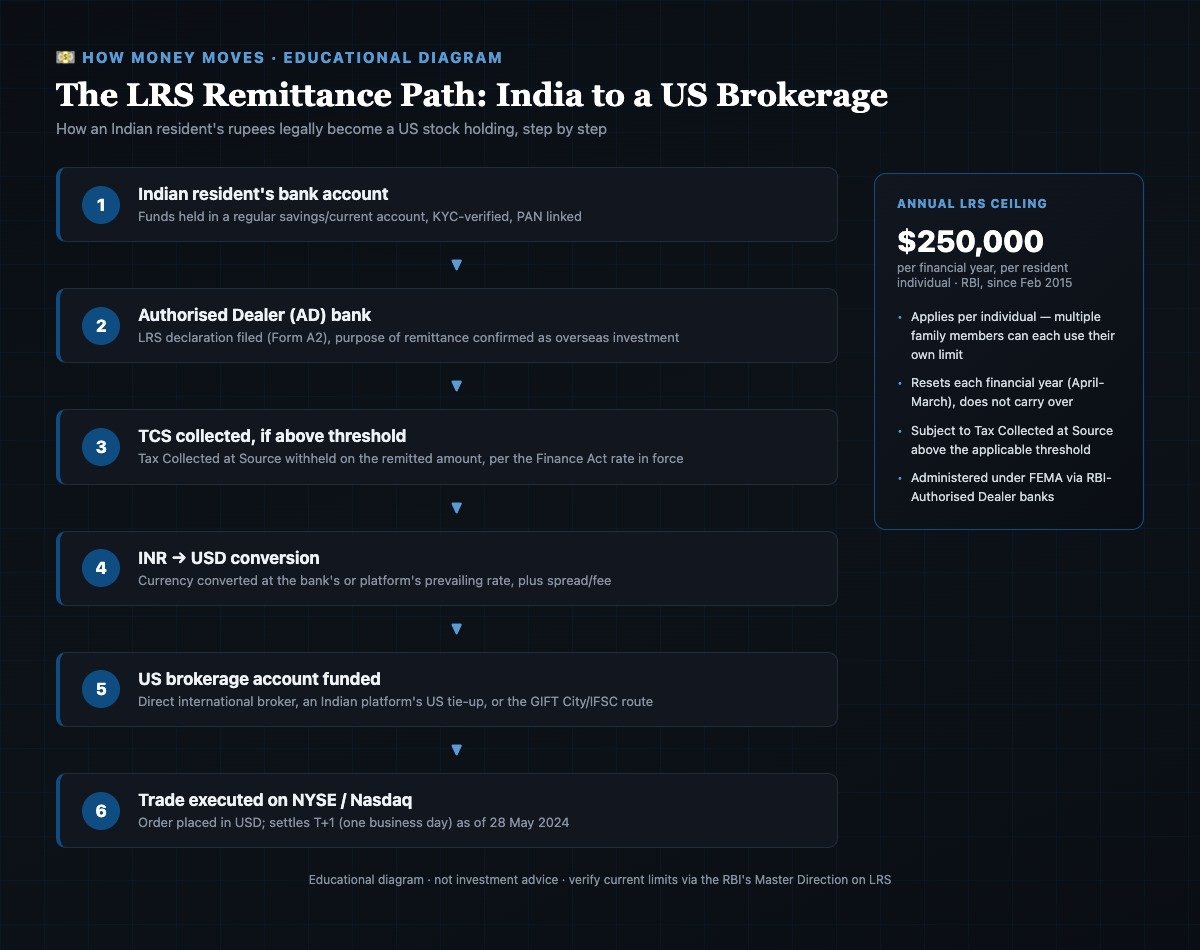
The path a rupee takes to become a US stock holding: bank, Authorised Dealer, LRS declaration, currency conversion, then a brokerage account.
💰 Currency Insight
Exchange-rate movements can increase or reduce investment returns independent of how the underlying stock performs. If the rupee weakens against the dollar while you hold a US stock, your INR-converted return improves even if the stock price is flat; if the rupee strengthens, the same flat stock price produces a lower INR return. This works identically in reverse for losses. Currency movement is not something a cross-border investor can eliminate without using hedging instruments (which carry their own cost and complexity) — it is simply a second, independent variable layered on top of the stock’s own performance, and it should be understood, not ignored, before investing.
The Vocabulary: Terms Every Cross-Border Investor Needs
Twelve terms this guide relies on, defined plainly and without jargon.
Cross-border investing brings together market-structure terms, product terms and tax terms that don’t all appear in a typical domestic-investing conversation. Understanding them precisely is what separates a confident reading of a brokerage statement from a vague sense of “I think I made money.”
NYSE
The New York Stock Exchange, the world’s largest stock exchange by market capitalisation of listed companies, tracing its institutional roots to the 1792 Buttonwood Agreement and its 1817 formal organisation.
Nasdaq
An electronic stock exchange launched in 1971, historically home to a heavier concentration of technology companies than the NYSE, operating on a dealer/market-maker model distinct from the NYSE’s structure.
ETF (Exchange-Traded Fund)
A fund holding a basket of securities (stocks, bonds or other assets) that itself trades on an exchange like an individual stock, typically tracking an index, sector or theme, and usually carrying lower costs than actively managed funds.
Index Fund
A fund (mutual fund or ETF structure) designed to replicate the performance of a specific market index, such as the S&P 500, rather than having a manager pick individual securities.
Fractional Shares
The ability to buy a portion of a single share — for example, $50 worth of a $2,000 stock — rather than being required to purchase at least one full share, widely available on US and India-linked platforms since around 2021.
Dividend
A portion of a company’s profit distributed to shareholders, typically in cash, usually paid quarterly by US companies; dividend income from US stocks is subject to US withholding tax at source before it reaches an Indian investor.
Capital Gains
The profit from selling an investment for more than its purchase price; for Indian residents, US stock capital gains are generally taxed only in India, not by the US, for individual non-resident investors.
Withholding Tax
Tax deducted at source by the payer (in this case, before a US dividend reaches the investor) rather than paid separately by the recipient afterward; the India-US treaty rate for portfolio dividends is 25% with a valid Form W-8BEN on file.
DTAA (Double Taxation Avoidance Agreement)
A treaty between two countries — India and the US have one — that prevents the same income from being fully taxed twice, typically by allowing a tax credit in one country for tax already paid in the other on the same income.
LRS (Liberalised Remittance Scheme)
The RBI framework, introduced in 2004, under which resident Indian individuals can remit up to a specified annual limit (USD 250,000 as of 2026) abroad for permitted purposes, including buying foreign securities.
Foreign Exchange Conversion
The process of converting INR to USD (when remitting funds to invest) and USD back to INR (when withdrawing proceeds), typically carried out by an Authorised Dealer bank or the brokerage platform, at a rate and spread that affects the investor’s real, rupee-denominated return.
Portfolio Diversification
Spreading investments across different assets, sectors, countries or currencies so that no single factor drives the portfolio’s overall outcome — a risk-management principle, not a guarantee against loss.
💰 Tax Insight
US dividend income earned by an Indian resident investor is generally withheld at source by the US payer — 30% under the default statutory rate for non-resident aliens, reduced to 25% for most Indian investors under Article 10 of the India-US DTAA, provided a valid Form W-8BEN is on file with the broker establishing the investor’s non-US tax residency. India then taxes the same dividend again as part of the investor’s global income at applicable slab rates, but allows a Foreign Tax Credit for the US tax already withheld, claimed by filing Form 67 (under Rule 128 of the Income Tax Rules) before filing the income tax return. This explanation is general and educational — it is not personalised tax advice, and current thresholds, forms and procedures should always be confirmed with the Income Tax Department or a qualified chartered accountant.
📱 Technology Insight
Digital brokerages and Indian fintech platforms have made cross-border investing dramatically more accessible over the past decade — account opening that once required physical paperwork and, often, a trip to a bank branch can now typically be completed online with digital KYC, and LRS remittances that once required manual bank coordination can be initiated from within an app. This convenience has real benefits (lower minimums, fractional shares, faster onboarding) but does not remove the underlying regulatory and tax obligations described throughout this guide — a faster app experience does not mean fewer rules, only an easier interface for following them.
How Indians Can Invest in US Stocks
The practical process, step by step.
- Decide your route. Choose between a direct account with an internationally licensed broker, an Indian fintech or broker’s US tie-up (which typically handles the LRS remittance and currency conversion for you), or the GIFT City / IFSC route (compared in the tables below). Each has different minimums, fees and reporting mechanics.
- Complete KYC and account opening, including submitting a Form W-8BEN to the US broker or its Indian partner, which establishes your status as a non-US person for US tax withholding purposes and secures the reduced treaty withholding rate on dividends rather than the higher default statutory rate.
- Remit funds under the RBI’s Liberalised Remittance Scheme, through an RBI-Authorised Dealer bank, which requires an LRS declaration (commonly on Form A2) confirming the purpose of remittance and applies any Tax Collected at Source due above the applicable threshold.
- Fund the brokerage account and convert currency, either as a distinct step (direct international broker) or automatically as part of the platform’s transfer process (Indian fintech tie-up), noting the conversion rate and any spread or fee charged.
- Place trades in US dollars during NYSE/Nasdaq market hours (accounting for the time difference with India), using either whole or fractional shares depending on what the platform supports for a given security.
- Track and report for tax purposes: maintain records of every transaction, dividend and currency conversion; disclose the holding in Schedule FA of your Indian income tax return regardless of gain or loss; and file Form 67 if claiming foreign tax credit for US dividend withholding, before your ITR filing deadline.
What Is the Liberalised Remittance Scheme?
The regulatory backbone of every route into US stocks covered in this guide.
The Liberalised Remittance Scheme is an RBI framework, operating under the Foreign Exchange Management Act (FEMA), that allows resident individuals to remit money abroad, up to a specified annual limit, for a defined list of permitted current and capital account purposes — overseas investment in shares and debt instruments being one of them, alongside purposes like education, travel, medical treatment and maintenance of close relatives abroad. It is the single legal channel underlying essentially all individual, non-institutional Indian investment in US stocks.
The limit is per financial year (April to March) and per resident individual — meaning a family of four adults could, in principle, collectively remit up to four times the individual limit, each under their own name and PAN, subject to each remittance meeting the scheme’s own compliance requirements. The limit is not automatically renewed mid-year if exhausted; it resets only at the start of the next financial year. Remittances are made through an RBI-Authorised Dealer bank (typically the investor’s own bank), which is responsible for verifying the purpose of remittance, collecting any applicable Tax Collected at Source, and filing the required regulatory declarations — the investor does not deal directly with the RBI for an individual transaction.
It’s worth being precise about what LRS is not: it is not a tax scheme, an investment product, or a guarantee of any kind — it is strictly a foreign-exchange remittance framework that happens to be the gateway most individual Indian investors use before their money ever reaches a US brokerage account. What happens to that money afterward — which stocks it buys, how it’s taxed, how it’s reported — is governed by an entirely separate set of rules covered throughout the rest of this guide.
💡 Did You Know?
Resident individuals in India may remit up to the RBI’s prescribed annual LRS limit — USD 250,000 per financial year as of 2026 — for eligible overseas investments, subject to applicable regulations and compliance requirements. That figure has been unchanged since a February 2015 RBI notification, even though the tax treatment of remittances under that same limit has been revised multiple times since, most significantly in October 2023.
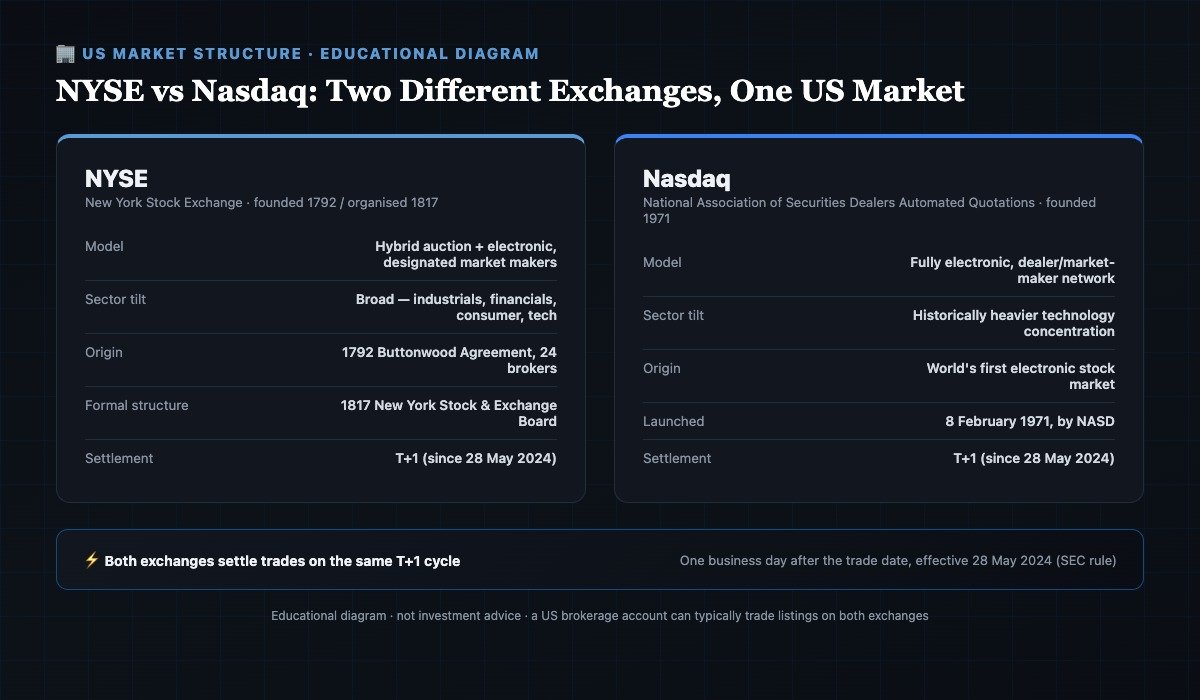
The NYSE and Nasdaq operate differently under the hood, but both settle trades on the same T+1 cycle as of May 2024.
How Exchange Rates Affect Returns
The second variable in every cross-border investment, alongside the stock’s own performance.
Every rupee an Indian investor puts into a US stock crosses the currency boundary twice — once going in (INR to USD at the time of remittance) and once coming out (USD to INR at the time of withdrawal, whenever that happens). The stock’s price movement in dollar terms and the rupee’s movement against the dollar over the same period are two separate, independent variables that combine to produce the investor’s real, rupee-denominated return.
A simplified, purely educational example (not a forecast or recommendation): suppose an investor converts ₹83,000 into $1,000 and buys a US stock. If that stock later doubles to $2,000, and the exchange rate is unchanged at ₹83/$1, the investor’s rupee-value gain is a clean 100%, matching the dollar gain exactly. But if the rupee has weakened over the same period to, say, ₹88/$1, that same $2,000 position converts to a larger rupee amount — a currency tailwind on top of the stock gain. If instead the rupee had strengthened to ₹78/$1, the same $2,000 position would convert to fewer rupees than the unchanged-rate scenario — a currency headwind reducing, though in this example not eliminating, the gain. The reverse dynamic applies symmetrically to a loss.
This is why comparing a US stock’s dollar-denominated performance directly against an Indian stock’s rupee-denominated performance, without adjusting for the currency, is a common but meaningfully misleading exercise. A disciplined cross-border investor tracks total return in rupee terms — stock performance and currency movement combined — not dollar-denominated performance alone.
Direct Stocks vs US ETFs
Two different ways to gain the same broad exposure.
Buying individual US stocks and buying a US-domiciled ETF both give an Indian investor exposure to the US market, but they represent meaningfully different decisions. A single stock’s return depends entirely on that one company’s performance — concentrated upside if the company does well, concentrated downside if it doesn’t. An ETF tracking a broad index like the S&P 500 spreads that same investment across hundreds of companies at once, trading concentrated potential upside for reduced single-company risk.
Costs also differ. Direct stock ownership typically involves per-trade brokerage commissions (which vary widely by platform) and no ongoing management fee. ETFs carry an “expense ratio” — a small annual percentage fee deducted from the fund’s assets to cover its operating costs — which is usually low for broad index-tracking ETFs but is nonetheless a recurring cost that direct stock ownership doesn’t carry. Neither structure is inherently “better”; they suit different goals, and many diversified portfolios use both — ETFs for broad, low-cost core exposure, and individual stocks for a smaller, higher-conviction allocation.
Comparison Tables
Six tables covering the core distinctions this guide relies on.
1. Direct US Stocks vs International Mutual Funds
| Feature | Direct US Stocks (via LRS) | International/US-focused Mutual Funds (India-domiciled) |
|---|---|---|
| Regulated by | SEC/FINRA (US) for the security; RBI/FEMA for the remittance | SEBI (India), investing in underlying foreign securities |
| Currency exposure | Direct USD exposure and conversion | Currency handled within the fund structure; investor transacts in INR |
| LRS limit applies? | Yes — counts against the annual USD 250,000 ceiling | No — bought in rupees, no individual LRS remittance needed |
| Stock selection | Investor chooses individual securities | Fund manager selects and rebalances the underlying portfolio |
| Typical minimum | Cost of one share (or a fraction, if supported) | Standard mutual fund minimum investment, usually low |
2. Stocks vs ETFs
| Feature | Individual Stock | ETF |
|---|---|---|
| Diversification | Single company | Basket of securities in one trade |
| Ongoing cost | No management fee; per-trade brokerage only | Expense ratio (annual, usually low for broad index ETFs) |
| Risk profile | Concentrated, company-specific | Diversified across the fund’s holdings |
| Best suited for | Higher-conviction, smaller allocations | Core, broad-market exposure |
3. NYSE vs Nasdaq
| Feature | NYSE | Nasdaq |
|---|---|---|
| Founded | 1792 (Buttonwood Agreement); formally organised 1817 | 1971, as the first electronic stock market |
| Market model | Hybrid auction/electronic, with designated market makers | Fully electronic, dealer/market-maker network |
| Sector tilt | Broad, including many established industrial and financial names | Historically heavier technology-sector concentration |
| Settlement cycle | T+1 (since 28 May 2024) | T+1 (since 28 May 2024) |
4. Indian Stocks vs US Stocks
| Feature | Indian Stocks | US Stocks |
|---|---|---|
| Currency | INR, no conversion needed | USD, requires currency conversion both ways |
| Capital gains tax (individual investor) | Taxed in India under Indian equity capital gains rules | Generally not taxed by the US for non-resident individuals; taxed in India as a foreign asset |
| Dividend tax | Taxed in India at applicable slab rate | Withheld at source in the US (25% treaty rate typical), then taxed again in India with foreign tax credit available |
| Regulatory access route | Direct, no remittance limit involved | Requires LRS remittance (subject to the annual ceiling and TCS) |
| Mandatory disclosure | Standard Indian equity reporting | Additional Schedule FA foreign asset disclosure required |
5. Direct Investing vs the GIFT City (IFSC) Route
| Feature | Direct International Broker / Indian Platform Tie-up | GIFT City / IFSC Route |
|---|---|---|
| Regulatory home | RBI’s LRS framework; broker regulated by SEC/FINRA or an Indian entity | International Financial Services Centres Authority (IFSCA), India’s dedicated financial-services regulator for GIFT City |
| Remittance mechanism | Traditional LRS bank remittance, subject to the annual ceiling and TCS | Access through an IFSC-registered broker/exchange under IFSCA-permitted structures, which some investors can use as an alternative channel |
| Maturity of the route | Established since 2004 (LRS) with a mature platform ecosystem | Newer, developed since GIFT City’s international exchanges began operating; framework and permitted products continue to evolve |
| Where to verify current rules | RBI Master Direction on LRS; your bank’s compliance desk | IFSCA circulars and the specific IFSC-registered broker’s current permitted product list |
6. Timeline Summary
| Year | Event | Importance |
|---|---|---|
| 1792 | Buttonwood Agreement | Foundational origin of organised US stock trading |
| 1817 | NYSE formally organised | Formal exchange governance established |
| 1971 | Nasdaq founded | First electronic stock market; tech-sector foundation |
| 1991 | India’s economic liberalisation | Foundational shift enabling later capital-account reform |
| 1999 | Online investing expands (US) | Self-directed brokerage technology matures |
| 2000 | Dot-com collapse | Defining lesson in sector-concentration risk |
| 2004 | RBI launches LRS | Legal foundation for Indian retail investment abroad |
| 2008 | Global Financial Crisis | Sharpest modern lesson in market-wide volatility |
| 2013 | LRS temporarily reduced; early platforms emerge | Shows the ceiling moves in both directions |
| 2015 | LRS raised to USD 250,000 | Current remittance ceiling established |
| 2020 | Pandemic investing boom | Retail cross-border investing goes mainstream in India |
| 2021 | Fractional shares gain popularity | Lowers entry barrier for high-priced stocks |
| 2022 | US rates rise sharply | Valuation and currency effects, simultaneously |
| 2023 | LRS TCS raised to 20% | Largest tax-compliance change since 2004 |
| 2024 | AI rally; T+1 settlement begins | Concentration risk and faster settlement, together |
| 2025 | Continued regulatory/tax revisions | Reinforces the need to check current rates every year |
| 2026 | Mature, multi-route ecosystem | Current state of Indian access to US markets |
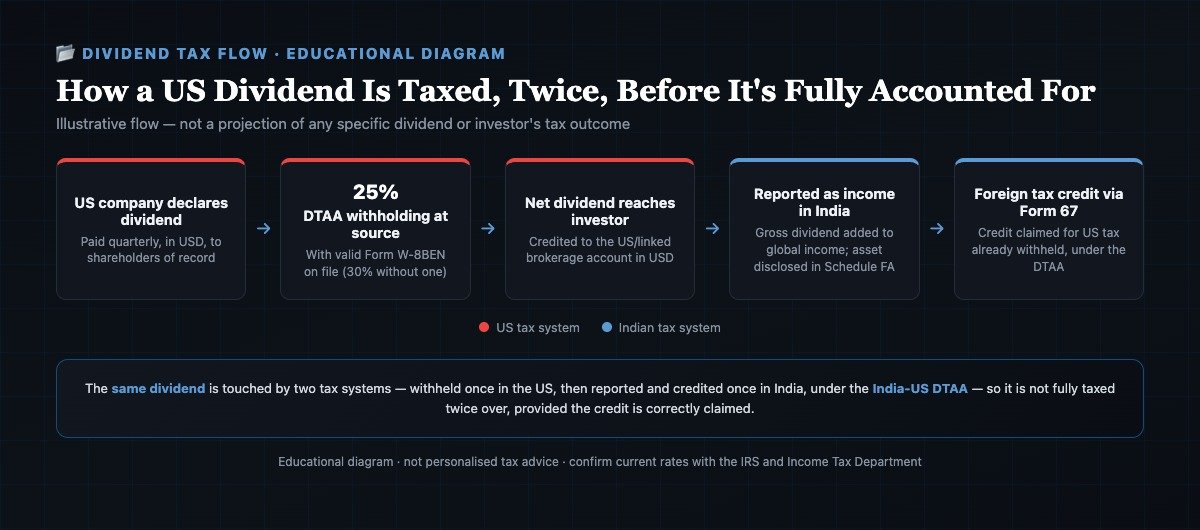
A US dividend crosses two tax systems before it’s fully accounted for — withheld once in the US, reported and credited once in India.
Practical Worked Examples
Educational illustrations only — not personalised advice, and not a projection of any real security’s future performance.
Currency conversion (illustrative): converting ₹2,00,000 at an example rate of ₹83/$1 yields approximately $2,409, before accounting for the bank’s conversion spread and any remittance fee — both of which reduce the amount that actually reaches the brokerage account and should be checked against your specific bank’s published rates.
Diversification allocation (illustrative, not a recommendation): a hypothetical investor building a globally diversified portfolio might choose to allocate a portion to domestic Indian equity, a portion to US or other international equity, and the remainder to debt or other asset classes, with the exact split depending entirely on their own goals, timeline and risk tolerance — there is no single “correct” percentage, and this guide does not suggest one.
Dividend taxation (illustrative): a $100 dividend, taxed at the 25% treaty withholding rate, arrives as $75 after US withholding. In India, the full $100 (converted to INR at the prevailing rate) is added to the investor’s taxable income, but the $25 already withheld in the US can generally be claimed as a foreign tax credit against the resulting Indian tax liability, via Form 67, so the same income is not fully taxed twice over.
Capital gains reporting (illustrative): an investor who buys a US stock for $1,000 and sells it for $1,300 has a $300 gain, generally untaxed by the US for an individual non-resident investor, but reportable and taxable in India as part of that investor’s global income under India’s capital gains rules for foreign assets, converted to INR at the applicable exchange rates for the purchase and sale dates.
Brokerage fee comparison (illustrative): platforms vary meaningfully in what they charge — some combine a percentage-based fee on the remittance itself with a separate per-trade brokerage commission, while others bundle these differently; comparing the all-in cost (remittance fee, FX spread, brokerage commission, any account maintenance charge) across platforms, not just the headline commission figure, gives a more accurate cost picture.
Long-term investing scenario (illustrative): an investor contributing a fixed amount regularly over many years, rather than attempting to time a single large investment, is a widely discussed long-term investing approach in financial education generally — this guide describes the concept for educational purposes and does not recommend it, or any other specific strategy, as suitable for any individual reader.
What LRS Permits vs Common Misconceptions
Kept deliberately separate, per this page’s editorial policy.
What LRS actually permits
- Remitting up to USD 250,000 per financial year, per resident individual, for permitted purposes including overseas share investment.
- Multiple family members can each remit up to the individual limit, under their own name and PAN.
- The limit resets each financial year (April-March) and does not carry over unused amounts.
- TCS collected on a remittance is adjustable against total tax liability or refundable, not a final, additional tax by itself.
Common misconceptions
- “US capital gains are tax-free for Indians” — the US generally doesn’t tax them for non-resident individuals, but India does, as part of global income.
- “The LRS limit is a lifetime cap” — it is an annual, per-financial-year limit, not a one-time total.
- “I only need to report foreign holdings if I made a profit” — Schedule FA disclosure is required regardless of profit, loss, or even an open position.
- “TCS is a tax I permanently lose” — it is collected upfront but is creditable against your final tax liability or refundable, subject to correctly claiming it.
Explore More Timelines
Who’s Involved: The Regulators Behind These Rules
Reserve Bank of India (RBI)
Administers the Liberalised Remittance Scheme under FEMA, sets and revises the annual remittance ceiling, and regulates the Authorised Dealer banks that process outbound investment remittances.
Securities and Exchange Board of India (SEBI)
India’s securities market regulator, overseeing Indian brokers and platforms facilitating access to foreign securities, and, alongside IFSCA, the regulatory framework for India-domiciled international investment products.
Income Tax Department
Administers Indian tax law as it applies to foreign investment income and capital gains, including Schedule FA disclosure requirements and the Form 67 foreign tax credit process.
Securities and Exchange Commission (SEC)
The primary US federal regulator of securities markets, responsible for rules including the 2024 shift to T+1 settlement and broader investor-protection regulation of US exchanges and brokers.
Internal Revenue Service (IRS)
Administers US federal tax law, including the withholding tax rules that apply to dividends paid to non-resident alien investors and the Form W-8BEN treaty-benefit process.
Financial Industry Regulatory Authority (FINRA)
A self-regulatory organisation overseeing US brokerage firms and registered representatives, setting conduct rules that apply to the brokers Indian investors use to access US markets.
New York Stock Exchange (NYSE)
The world’s largest stock exchange by market capitalisation of listed companies, tracing its roots to the 1792 Buttonwood Agreement and formal 1817 organisation.
Nasdaq
A fully electronic US stock exchange founded in 1971, historically carrying a heavier concentration of technology-sector listings than the NYSE.
⚠️ Common Mistakes New Cross-Border Investors Make
- Assuming US capital gains are automatically tax-free everywhere, when they are typically only untaxed by the US itself — India still taxes them.
- Forgetting to file Form W-8BEN, which leaves an investor paying the higher 30% default withholding rate instead of the 25% treaty rate on dividends.
- Not disclosing foreign holdings in Schedule FA because there was no profit yet, or the position wasn’t sold — disclosure applies regardless of gain, loss or open status.
- Treating the LRS limit as a lifetime cap rather than an annual, per-financial-year allowance that resets each April.
- Comparing a US stock’s dollar return directly to an Indian stock’s rupee return without adjusting for the currency movement between the two.
- Overlooking the all-in cost of a platform — remittance fee, FX spread and brokerage commission together — by focusing only on the headline trading commission.
- Not budgeting for the upfront cash-flow cost of TCS on a large remittance, then being short of funds to actually invest the full intended amount.
- Assuming every India-linked platform supports fractional shares or every US stock — product availability varies meaningfully by provider.
👀 Future Watch
Officially tracked, not speculated: this guide will be updated when the RBI issues a new Master Direction or circular revising the LRS limit or its conditions, when the Union Budget or Finance Act changes TCS rates or thresholds on outward remittances, when SEBI or IFSCA issue new circulars affecting the GIFT City route or India-domiciled international funds, when the IRS or US Treasury revise non-resident withholding guidance, or when the SEC or the exchanges announce further changes to US market structure or settlement rules. It does not speculate about future stock prices, interest-rate decisions or currency movements.
💡 Interesting Facts, Neutrally Stated
- The Buttonwood Agreement that founded what became the NYSE was signed by just 24 brokers under a single tree on Wall Street in 1792.
- Nasdaq was the world’s first electronic stock market when it launched in 1971 — decades before “electronic trading” became the industry standard.
- India’s LRS scheme and the modern Nasdaq are separated by 33 years — the exchange existed long before Indians had a simple, RBI-sanctioned way to invest in it.
- US securities have settled on a T+1 (one business day) cycle only since 28 May 2024 — for years before that, the standard was T+2.
- The RBI’s USD 250,000 LRS ceiling has been unchanged since February 2015, even as the tax rules governing its use have been revised multiple times since.
People Also Ask
70 Frequently Asked Questions
Grouped by getting started, the LRS route, taxation, currency, brokerages, ETFs and risk.
Related Reading on AiTimeline
Fuel Price Dynamics and Their Economic Impact
Artificial Intelligence Development & Ethics Timeline
Google Pixel 11 Pro: The Complete Pixel Pro Timeline
India-UK Free Trade Agreement Timeline
Buy or Rent a Home in India: The 2026 Decision Guide
Why Global Investing Begins With Understanding the Rules
Aarav, the engineer from this guide’s opening, doesn’t need to become a tax lawyer or a currency trader to invest in US stocks from India — but he does need to know, before he moves a single rupee, that the RBI’s LRS scheme is the legal route, that the US and India will each tax parts of his return differently, and that his rupee-denominated outcome depends on the exchange rate as much as on the stock he picks. That is the entire argument of this guide, restated plainly: investing in US stocks from India can help diversify a portfolio, but it also introduces currency, tax and regulatory considerations that a purely domestic Indian portfolio does not carry, and none of them are optional extras to learn later.
None of the mechanics covered here — the LRS ceiling, the DTAA credit, the Schedule FA disclosure, the NYSE and Nasdaq’s different structures — are difficult individually. What trips up first-time cross-border investors is treating them as afterthoughts to the more exciting question of which stock to buy, rather than as the framework the entire decision sits inside. Informed investors understand RBI rules, tax obligations, investment costs and long-term diversification principles before investing, not after receiving their first dividend and wondering why it arrived smaller than expected, or after their first tax filing season with an undisclosed foreign holding.
This page is maintained as a living reference specifically because the numbers in it — the LRS limit, the TCS rate, the withholding percentages — are set by institutions that revise them on their own schedules, not once and permanently. Readers are encouraged to consult the official regulations cited throughout — the RBI’s Master Direction on LRS, the Income Tax Department’s guidance on foreign asset disclosure, the IRS’s guidance for non-resident investors — directly, and to seek professional financial or tax advice for anything specific to their own circumstances, before acting on anything described here.
✉ Editorial note, sources and limitations
Last reviewed: 1 August 2026. This page separates official RBI/SEBI/Income Tax Department regulation, US IRS/SEC/FINRA guidance, historical market facts, and educational examples throughout; illustrative figures are explicitly marked as such and are not a projection of any security’s future performance. Rates, limits and thresholds cited here change with each Union Budget, RBI circular and IRS update — this is not personalised investment, tax or legal advice, and readers should confirm current figures with official sources or a qualified professional before acting.
Primary and official sources used:
- Reserve Bank of India — Master Direction on Liberalised Remittance Scheme (LRS)
- Reserve Bank of India — FAQs on the Liberalised Remittance Scheme
- Securities and Exchange Board of India — SEBI circulars
- Income Tax Department, Government of India — Official e-filing portal
- Internal Revenue Service (US) — Nonresident aliens: tax guidance
- Internal Revenue Service (US) — About Form W-8BEN
- Financial Industry Regulatory Authority (FINRA) — Official site
- New York Stock Exchange — History of the NYSE
Sources & further reading
Every dated entry above was checked against these references. Last reviewed 15 September 2026.