India’s New Stock Market Timings: The Closing Auction Session Explained
At 3:07 PM, Rohan is watching four screens at once. Three open positions, none of them large, all of them due to close before the market shuts. He has done this most trading days for six years, and the last twenty minutes have always been the loudest part of the day — the point where mutual funds true up their index-tracking baskets, arbitrage desks unwind overnight trades, hedgers square off derivative exposure against the cash market, and retail traders like him decide, in the space of a few candles, whether to hold or exit. Today the routine is different. A red banner on his terminal reminds him that his largest holding, a stock with active futures and options contracts, will stop taking fresh continuous orders at 3:15 PM instead of 3:30 — and that what happens to its closing price for the next twenty minutes will not look like a normal trade at all.
What Rohan is looking at is the most significant change to the mechanics of India’s stock market close in over two decades. From 3 August 2026, the Securities and Exchange Board of India has introduced a Closing Auction Session for stocks that carry active futures and options contracts, replacing the volume-weighted average price method that has quietly set official closing prices for years. Index funds worth trillions of rupees, foreign portfolio investors rebalancing at month-end, and ordinary investors checking a stock’s closing value all rely on that one number being calculated fairly. This guide explains exactly what changed, why SEBI made the change, how the new auction actually works minute by minute, and what it does and does not mean for the different kinds of people who trade in Indian markets.
From 3 August 2026, SEBI's Closing Auction Session replaces VWAP closing for F&O stocks and extends derivatives trading to 3:40 PM. The complete guide.
Latest Story
On 3 August 2026, India’s stock exchanges introduced the Closing Auction Session (CAS) for equity cash-market stocks that have active Futures & Options (F&O) contracts, replacing the VWAP-based closing-price method for those stocks with a dedicated auction that pools buy and sell orders to discover a single closing price. Continuous trading in F&O-eligible stocks now ends at 3:15 PM instead of 3:30 PM, followed by a structured auction running to roughly 3:35 PM. Stocks without derivative contracts are unaffected in this initial phase and continue trading until 3:30 PM as before. Separately, trading in equity derivatives — stock and index futures and options — has been extended by ten minutes, to 3:40 PM. SEBI introduced these changes, developed through public consultation papers in December 2024 and August 2025 and formalised in a circular issued on 16 January 2026, to improve transparency and price discovery at the single moment of the trading day when the most capital changes hands relative to the number of trades executed.
🧠 AI Overview Summary
From 3 August 2026, SEBI’s Closing Auction Session (CAS) replaced VWAP-based closing prices with a live auction for stocks that have active F&O contracts. Continuous trading for these stocks now ends at 3:15 PM, followed by a roughly 20-minute auction that discovers a single closing price by 3:35 PM. Non-F&O stocks are unaffected and still close at 3:30 PM. Equity derivatives trading was separately extended to 3:40 PM. The change affects how the closing price is calculated, not overall market risk or direction.
Who, What, Why, When, Where and How
What to Understand Before Reading Further
- This is a market-structure change, not a market-direction signal. The reform changes how a closing price is calculated for certain stocks; it says nothing about whether prices should rise or fall.
- Only stocks with active F&O contracts are affected in this initial phase — a subset of listed companies, not the entire market. Non-F&O stocks keep their existing 3:30 PM VWAP-based close.
- The Closing Auction Session runs roughly 3:15 PM to 3:35 PM, replacing the final minutes of continuous trading for F&O-eligible stocks with a structured, phased auction.
- Equity derivatives trading was separately extended to 3:40 PM, ten minutes later than before, giving F&O traders more time after the cash-market auction concludes.
- The auction uses a static price band of roughly ±3% around a reference price, and closes order entry at a randomised moment specifically to prevent participants from gaming a known cutoff time.
- SEBI developed CAS through public consultation, issuing papers in December 2024 and August 2025 before a final circular in January 2026 — this was not an overnight decision.
- The reform is being phased, starting with liquid F&O stocks; SEBI and the exchanges have indicated it may extend to a wider set of stocks based on how this phase performs.
- A post-close session (3:50–4:00 PM) continues to allow limited trading at the newly discovered closing price, similar to the post-close window that already existed.
- This guide is not investment advice. It explains a regulatory and operational change; decisions about what or when to trade are for readers to make with their own advisers.
- For the most current details, always check official SEBI, NSE and BSE circulars directly — exchange operating procedures can be refined even after a framework’s effective date.
Executive Summary
The whole change in about 150 words
From 3 August 2026, India’s stock exchanges introduced a Closing Auction Session (CAS) for cash-market stocks that have active futures and options contracts, replacing the volume-weighted average price (VWAP) method previously used to set their official closing price. Continuous trading in these F&O-eligible stocks now ends at 3:15 PM rather than 3:30 PM, followed by a phased auction — a reference-price window, a transition halt, order entry within a price band, a randomised closure, and algorithmic matching — that discovers a single closing price by around 3:35 PM. Stocks without derivative contracts are unaffected for now and continue trading to 3:30 PM. Separately, equity derivatives trading was extended by ten minutes, to 3:40 PM. SEBI developed the framework through consultation papers in December 2024 and August 2025 before finalising it in January 2026, aiming to improve transparency and price discovery at the market’s highest-volume moment.
⏱️ One-Minute Summary
- F&O-eligible stocks stop continuous trading at 3:15 PM, ten minutes earlier than before.
- A structured auction (3:15–3:35 PM) replaces VWAP to set their closing price.
- Non-F&O stocks are unchanged: continuous trading still ends 3:30 PM.
- Equity derivatives trading extended by ten minutes, to 3:40 PM.
- A short post-close session (3:50–4:00 PM) still follows, as before.
- SEBI’s circular finalising this was issued 16 January 2026, effective 3 August 2026.
Why the Market Close Matters More Than It Looks
Understanding the problem CAS was built to solve
To most people checking a stock price once a day, “the close” is just the last number on the screen. To the market itself, the closing price is one of the most heavily used numbers in the entire financial system. It is the price index funds use to value their portfolios and calculate net asset value. It is the reference price for a huge share of derivative contract settlements. It is what mutual funds, pension funds and insurers use to mark their holdings at the end of every trading day. And it is the number that appears in every newspaper, every app, every historical chart — the single figure a stock is remembered by for that day.
That outsized importance creates an equally outsized concentration of trading activity in the market’s final minutes. Index funds and exchange-traded funds that track a benchmark must trade at or near the close to minimise tracking error against that benchmark. Foreign portfolio investors rebalancing at month-end or quarter-end often prefer to execute large orders at the closing price precisely because it is the reference point their own reporting is built around. Arbitrageurs and hedgers squaring off positions between the cash and derivatives markets need a reliable, hard-to-manipulate closing print to settle against. When all of that volume compresses into the last few minutes of ordinary continuous trading, the resulting price can become more sensitive to the order flow of a few large participants than to the broader balance of buying and selling interest across the whole day.
This is not a uniquely Indian problem, and it is not a new one. Major exchanges elsewhere in the world — including the London Stock Exchange, Euronext and several Asian markets — have long used a dedicated closing auction mechanism rather than relying on the final continuous trades or a volume-weighted average. SEBI’s introduction of CAS brings India’s most liquid, derivative-linked stocks into that same structural approach: pooling buy and sell interest deliberately, rather than incidentally, to set the number the rest of the financial system depends on.
📈 Market Insight
The closing auction pools buy and sell interest to determine a single closing price rather than relying on trades executed during the final minutes of continuous trading. Under the old method, a stock’s closing price was typically calculated as the volume-weighted average of trades in a defined final window — a method sensitive to whatever trades happened to occur in that window. An auction instead collects fresh orders specifically for the purpose of setting one price, discovered through matching, which is a structurally different and more deliberate process.
The Complete Timeline: From a Statutory Regulator to the Closing Auction
Each entry labelled: regulatory development, exchange procedure, market event or current reporting
SEBI Becomes a Statutory Regulator
Background. The Securities and Exchange Board of India had existed in a non-statutory capacity since 1988, with limited enforcement power over a market still recovering from the 1992 securities scam, which exposed serious gaps in settlement and surveillance systems.
Regulatory development. The SEBI Act, 1992 gave the regulator statutory powers to register and regulate stockbrokers, protect investors, and oversee the securities market as a whole — the legal foundation every reform since, including the 2026 Closing Auction Session, rests upon.
Current relevance. Every circular discussed in this guide, including the one introducing CAS, is issued under authority this Act created.
NSE Begins Operations With Screen-Based Trading
Background. Indian exchanges, including the more-than-century-old Bombay Stock Exchange, had operated through open-outcry floor trading, a system prone to opacity and limited geographic access.
Market impact. The National Stock Exchange launched its wholesale debt market segment in June 1994 and its capital market (equity) segment that November, introducing fully electronic, screen-based trading to India for the first time. The BSE followed with its own electronic system shortly after.
Current relevance. Electronic order-matching is the foundation every later reform, including the automated Closing Auction Session algorithm, depends on.
Equity Index Derivatives Are Introduced
Background. Until 2000, Indian investors had no exchange-traded way to hedge broad market exposure or take a leveraged view on the index itself.
Regulatory development. With SEBI’s approval, the NSE launched index futures on the Nifty and the BSE launched index futures on the Sensex in June 2000, followed by index options in 2001.
Current relevance. This is the origin of the “F&O” category that now determines, twenty-six years later, which stocks use the Closing Auction Session and which do not.
Stock-Level Derivatives Follow
Regulatory development. Options on individual stocks were introduced in July 2001, followed by single-stock futures in November 2001, extending derivatives trading beyond the index level to individual companies.
Current relevance. The specific list of stocks eligible for the Closing Auction Session today is, at its core, the list of stocks that carry these individual F&O contracts.
Rolling Settlement Moves to T+2
Background. Earlier settlement cycles left longer gaps between a trade and its final settlement, carrying more counterparty and market risk than a shorter cycle.
Regulatory development. SEBI progressively shortened the settlement cycle, moving the market to T+2 rolling settlement in the early 2000s — trades settling two working days after execution, well ahead of most global peers at the time.
Current relevance. This era established the pattern of India moving faster than global norms on settlement infrastructure, a pattern that continued through T+1 in 2023 and optional T+0 from 2024.
Algorithmic Trading and Direct Market Access Arrive
Regulatory development. SEBI permitted Direct Market Access (DMA) for institutional investors in 2008, allowing them to place orders directly into the exchange system through algorithms rather than routing every order through a human broker.
Market impact. This opened the door to the algorithmic and systematic trading that now represents a substantial share of daily volume on Indian exchanges.
Current relevance. The Closing Auction Session’s own matching mechanism — an automated equilibrium-price algorithm — is a direct descendant of this era’s shift toward algorithm-driven market infrastructure.
Circuit Breakers and Risk Management Mature
Background. As trading speed and volume increased, regulators worldwide, including SEBI, worked to build safeguards against disorderly price moves and system-level risk.
Regulatory development. This decade saw index-based market-wide circuit breakers refined, colocation services introduced under strict surveillance, and progressively tighter margin and risk-management frameworks for both cash and derivative segments.
Current relevance. CAS’s own static price band and randomised closure are part of this same risk-management lineage — safeguards designed into the market’s structure rather than applied after a problem occurs.
Pandemic Volatility Tests the System
Background. The COVID-19 pandemic triggered exceptional volatility across global markets in early 2020, including in India, with sharp single-day moves and record trading volumes.
Market impact. Existing circuit breaker and margin frameworks were tested under genuine stress, informing subsequent refinements to risk-management rules through the following years.
Current relevance. Periods of stress like this are part of the evidence base regulators point to when arguing that closing-price mechanisms, not just intraday circuit breakers, need to be resilient to concentrated, high-volume moments.
T+1 Settlement Is Fully Rolled Out
Regulatory development. SEBI completed the phased transition to T+1 rolling settlement across Indian equities by March 2023, having phased it in by market-cap category from January 2022. India became one of the first major global equity markets to settle trades in a single day.
Current relevance. This reform sits in the same broader push as CAS: reducing risk and improving efficiency in how India’s markets process the mechanics of trading, not just how trades are placed.
Optional T+0 Settlement Launches in Beta
Regulatory development. SEBI introduced a beta version of optional same-day (T+0) settlement for a small initial group of stocks on 28 March 2024, running in parallel with the existing T+1 cycle rather than replacing it.
Market impact. Coverage has since expanded; by 2026 optional T+0 settlement is available for a much wider set of NSE- and BSE-listed stocks on an opt-in basis.
Current relevance. Like CAS, T+0 is deliberately optional and phased rather than an immediate, market-wide mandate — a consistent SEBI approach to major structural change.
SEBI Issues Its First Consultation Paper on a Closing Auction
Regulatory development. SEBI published a consultation paper dated 5 December 2024 proposing the introduction of a closing auction session in the equity cash segment, opening the proposal to public and industry comment.
Process. This is the formal starting point of the reform documented in this guide — not the January 2026 circular, and not the August 2026 go-live date, but this initial public paper more than a year and a half earlier.
A Revised Consultation Paper Follows Industry Feedback
Process. SEBI issued a second, revised consultation paper on 22 August 2025, incorporating feedback gathered since December 2024 from recognised stock exchanges, clearing corporations, mutual funds, foreign portfolio investors and other market participants, and following deliberation by SEBI’s Secondary Market Advisory Committee (SMAC).
Independent analysis. Industry bodies representing derivatives traders raised specific concerns during this period about auction mechanics and timing, some of which are reflected in the final framework’s phased, F&O-first rollout.
SEBI Issues the Final Circular
Official regulation. SEBI issued the governing circular — “Introduction of Closing Auction Session (CAS) in the Equity Cash Segment and certain modifications in the Pre-Open Auction Session,” reference number HO/47/11/11(3)2025-MRD-POD2/I/2765/2026, dated 16 January 2026 — formally mandating the framework and setting its effective date.
Exchange procedure. NSE, BSE and MSEI subsequently issued their own operating notices translating the circular into exchange-level implementation specifics, including the exact phase timings this guide details below.
The Closing Auction Session Goes Live
Exchange procedure. From 3 August 2026, F&O-eligible cash-market stocks moved to the Closing Auction Session, continuous trading in those stocks began ending at 3:15 PM, and equity derivatives trading was extended to 3:40 PM, exactly as set out in the January 2026 circular and subsequent exchange notices.
Current relevance. This is where this guide’s “current” section picks up — the framework is now live, and this page will be updated as SEBI, NSE and BSE issue further operational notices or any phased extension to additional stocks.
⚖️ Regulation Insight
SEBI introduced the changes to improve transparency, market efficiency and closing-price discovery. The reform followed the standard path for a major Indian market-structure change: a first consultation paper, industry and public feedback, a revised consultation paper, committee deliberation, a final circular, and only then a live effective date — more than twenty months from first proposal to implementation.
A Market-Structure Glossary
The terms this reform cannot be explained without
- Closing Auction Session (CAS)
- The new structured auction, roughly 3:15–3:35 PM, that determines the official closing price for F&O-eligible cash-market stocks.
- Continuous Trading Session (CTS)
- The normal trading mode, from market open until the relevant cutoff, where orders match immediately against the order book as they arrive.
- VWAP
- Volume-Weighted Average Price — the average trade price over a period, weighted by the volume of each trade; the method CAS replaces for F&O stocks.
- Price Discovery
- The market process by which buyers’ and sellers’ orders interact to determine what a security is actually worth at a given moment.
- Equilibrium Price
- The single price, calculated by the auction-matching algorithm, at which the maximum volume of buy and sell orders can be matched.
- F&O Stock
- A cash-market stock that also has actively traded futures and/or options contracts listed on it — the eligibility criterion for CAS in this initial phase.
- Cash Market
- The segment where shares are bought and sold for delivery, as distinct from the derivatives segment, where contracts derive their value from an underlying asset.
- Equity Derivatives
- Futures and options contracts on individual stocks or indices, settled based on the underlying equity’s price rather than involving delivery of shares themselves (for most contracts).
- Market Order
- An order to buy or sell immediately at the best available price, with no price limit specified.
- Limit Order
- An order to buy or sell at a specified price or better, which may not execute immediately if the market has not reached that price.
- Random Order Closure
- A system-triggered mechanism that ends an auction’s order-entry window at an unpredictable moment within a defined range, preventing participants from timing orders to a known cutoff.
- Post-Close Session
- A brief window (3:50–4:00 PM) after the official close where limited trading continues at the newly discovered closing price.
The New Market Timings, Stage by Stage
Exactly what happens, and when, with a worked example
The clearest way to understand the reform is to walk through an ordinary trading day exactly as it now unfolds for a stock like a large private bank, which carries active F&O contracts and is therefore CAS-eligible.
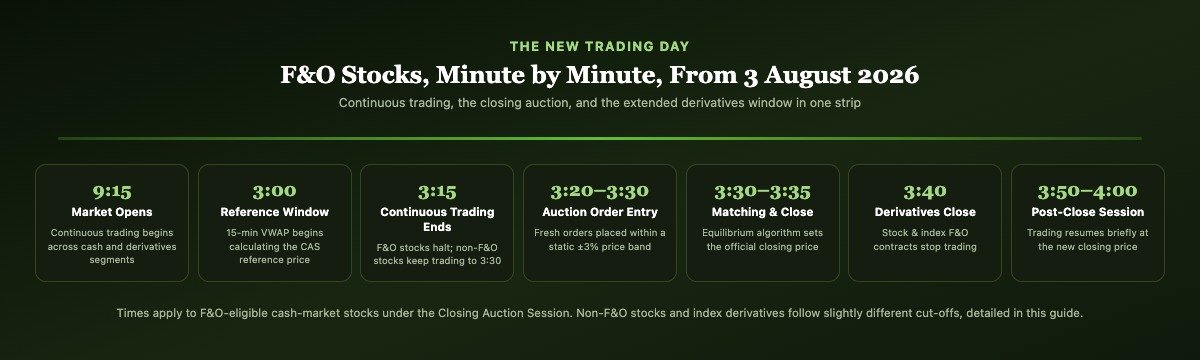
9:15 AM – 3:00 PM: Normal Continuous Trading
Nothing changes here. Orders match immediately against the order book, prices move continuously through the day, and the stock behaves exactly as it always has.
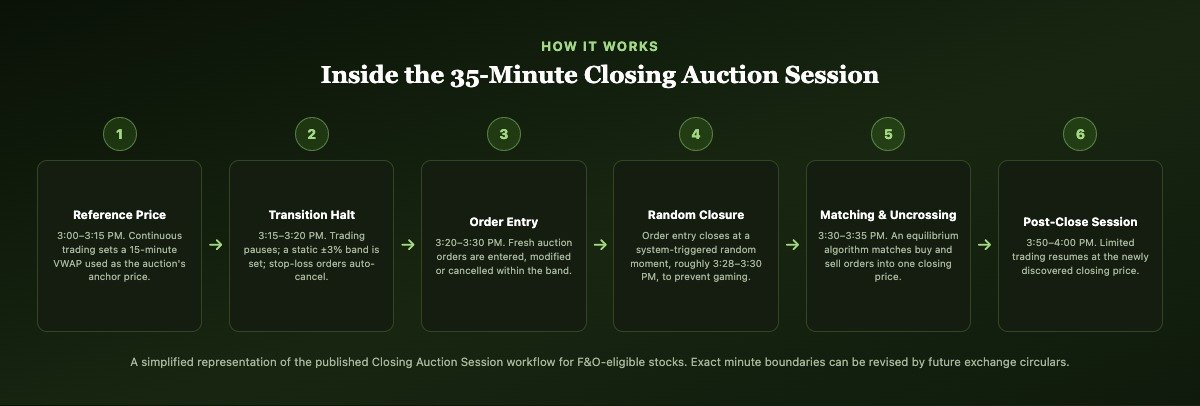
3:00 PM – 3:15 PM: The Reference Price Window
Continuous trading continues, but this fifteen-minute window now carries an additional purpose: the exchange calculates a volume-weighted average price across these fifteen minutes, which becomes the auction’s reference price — the anchor the entire closing auction is built around.
3:15 PM: Continuous Trading Ends for F&O Stocks
This is the headline change. For a CAS-eligible stock, ordinary continuous trading now stops fifteen minutes before the old 3:30 PM close. Non-F&O stocks are unaffected and continue continuous trading to 3:30 PM exactly as before.
3:15 PM – 3:20 PM: Transition Halt
Trading pauses briefly. The exchange sets a static price band — reported at roughly ±3% around the reference price — within which auction orders can be placed, and pending stop-loss and iceberg orders for the stock are automatically cancelled, since they were designed for continuous trading conditions that no longer apply.
3:20 PM – 3:30 PM: Auction Order Entry
Fresh orders for the auction can now be entered, modified or cancelled within the price band. In the first half of this window, both limit and market orders can be freely entered and changed; in roughly the second half, market orders lock in place and only limit-order modifications remain possible, narrowing the scope for last-second manoeuvring as the auction approaches its close.
Order Entry Ends: Random Closure
Rather than closing order entry at a fixed, publicly known second, the system closes it at a randomised moment within a short window near the end of the entry period. This is a deliberate design choice: a fixed, predictable cutoff would let sophisticated participants time last-instant orders to influence the price with reduced risk of being matched against; a random cutoff removes that certainty.
3:30 PM – 3:35 PM: Matching and Uncrossing
Once order entry closes, the exchange’s matching engine runs an equilibrium-price algorithm across every order in the auction book, calculating the single price at which the largest volume of buy and sell orders can be matched, then executes trades at that price. That price becomes the stock’s official closing price for the day.
3:35 PM – 3:50 PM: Buffer and Preparation
The exchange finalises auction outcomes and prepares systems for the brief post-close window.
3:40 PM: Equity Derivatives Trading Ends
Separately from the cash-market auction, trading in stock and index futures and options — which had continued through the cash-market auction — ends at 3:40 PM, ten minutes later than the previous 3:30 PM derivatives close.
3:50 PM – 4:00 PM: Post-Close Session
A short post-close trading window follows, as it did before the reform, allowing limited further trading at the closing price the auction has just discovered.
💡 Did You Know?
The previous closing price for many securities relied on VWAP, whereas the new framework uses an auction process for eligible F&O stocks. The two methods can, in principle, produce different closing prices for the same stock on the same trading pattern — which is precisely why the reform matters: it is a genuine change in how a heavily relied-upon number is calculated, not a cosmetic relabelling of the existing process.
Five Things Worth Understanding in More Depth
Evergreen explainers that answer the questions behind the headlines
What Is the Closing Auction Session (CAS)?
CAS is a dedicated, roughly 20-minute auction — 3:15 PM to about 3:35 PM — that determines the official closing price of cash-market stocks with active F&O contracts. Instead of the closing price emerging from whatever trades happened to occur in the final minutes of ordinary trading, CAS deliberately collects fresh buy and sell orders specifically for the purpose of setting one price, then matches them through an equilibrium algorithm. It replaces the VWAP-based method for eligible stocks and mirrors closing-auction mechanisms already used on several major global exchanges.
How the Closing Price Is Calculated
For CAS-eligible stocks, the process runs in stages: a reference price is set from continuous trading between 3:00 and 3:15 PM; a brief halt establishes a static price band around that reference; fresh auction orders are collected between 3:20 and 3:30 PM; order entry ends at a randomised moment to prevent gaming; and an equilibrium-matching algorithm then calculates the single price that matches the maximum volume of buy and sell orders, which becomes the official close. For non-F&O stocks, the closing price is still calculated using the existing VWAP method over the final trading window before 3:30 PM.
VWAP vs Auction-Based Closing
VWAP averages the prices of trades that already happened during a defined window, weighted by their size — it describes what did happen. An auction is forward-looking within its own window: it specifically solicits fresh orders for the purpose of setting a price, then calculates the price that clears the largest matched volume. VWAP can be skewed by a handful of large trades landing in the measurement window; an auction is designed so that outcome depends on the full pool of orders entered specifically for that purpose, within a controlled price band.
Who Is Affected by the New Timings?
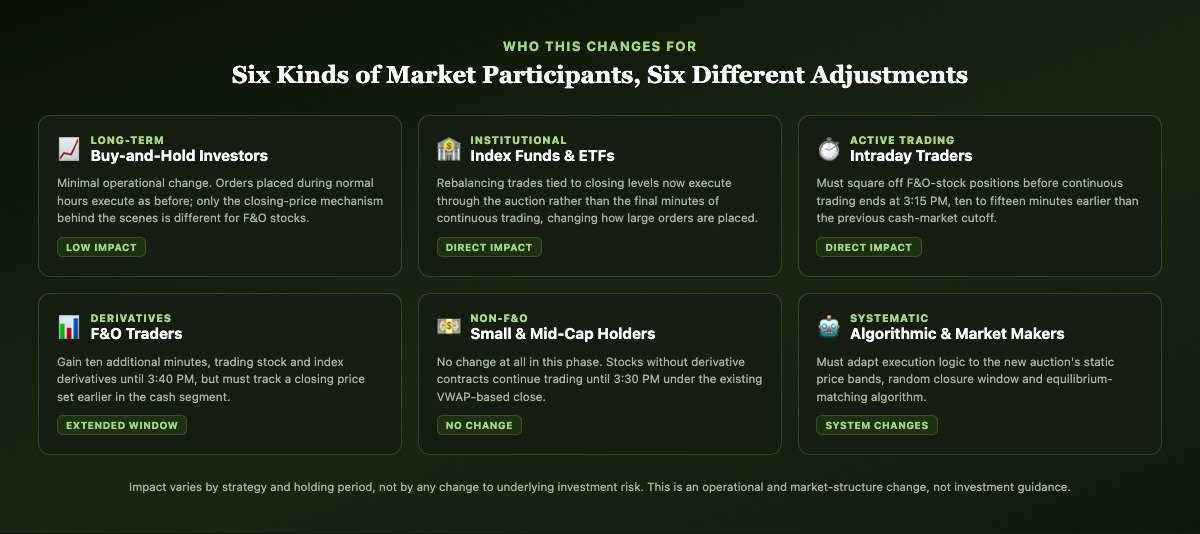
Most directly: traders and institutions active in F&O-eligible stocks near the close, and anyone trading equity derivatives, who now have until 3:40 PM instead of 3:30 PM. Index funds, ETFs and foreign portfolio investors rebalancing at the close are affected because their execution now routes through the auction rather than continuous trading. Long-term investors holding non-F&O stocks, or F&O stocks but not trading near the close, see essentially no operational change in this initial phase.
How Institutional Investors Use the Closing Auction
Index funds and ETFs that must track a benchmark’s official closing values now place their rebalancing and creation/redemption-related orders into the auction window rather than at the tail end of continuous trading, since the auction price is what the benchmark itself will use. Foreign portfolio investors and large domestic institutions executing significant orders around month-end or quarter-end similarly route through the auction, where the deliberately pooled order book is designed to absorb size with less price impact than the same order might have caused in the thinner final minutes of ordinary continuous trading.
Comparison Tables: The Reform Side by Side
Eight reference tables covering timings, mechanisms and market segments
Old vs New Market Timings
| Segment | Before 3 August 2026 | From 3 August 2026 |
|---|---|---|
| F&O-eligible stocks: continuous trading ends | 3:30 PM | 3:15 PM |
| F&O-eligible stocks: closing price method | VWAP (final window) | Closing Auction Session (auction) |
| Non-F&O stocks: continuous trading ends | 3:30 PM | 3:30 PM (unchanged) |
| Equity derivatives: trading ends | 3:30 PM | 3:40 PM |
| Post-close session | 3:40–4:00 PM (approx.) | 3:50–4:00 PM |
VWAP vs Closing Auction
| Aspect | VWAP-Based Closing | Closing Auction Session |
|---|---|---|
| Basis | Average of trades already executed in a window | Fresh orders collected specifically to set one price |
| Sensitivity | Sensitive to whichever trades occurred in the window | Reflects pooled buy/sell interest at auction time |
| Price control | No dedicated price band for the closing calculation | Static price band (approx. ±3%) around a reference price |
| Gaming resistance | Orders can target the known measurement window | Randomised order-entry closure resists timed gaming |
| Used for | Non-F&O stocks (unchanged) | F&O-eligible stocks (from 3 Aug 2026) |
Continuous Trading Session (CTS) vs Closing Auction Session (CAS)
| Aspect | CTS | CAS |
|---|---|---|
| Order matching | Immediate, as orders arrive | Batched, at one matching moment |
| Duration | 9:15 AM to 3:15 or 3:30 PM | Roughly 3:15 PM to 3:35 PM |
| Price movement | Continuous, trade by trade | Single equilibrium price at the end |
| Order types | Full range, throughout | Restricted window; market orders lock early |
| Applies to | All stocks, all day | F&O-eligible stocks, closing period only |
Cash Market vs Equity Derivatives
| Aspect | Cash Market (F&O Stocks) | Equity Derivatives |
|---|---|---|
| What’s traded | Actual shares, for delivery | Futures/options contracts on stocks or indices |
| New closing mechanism | Closing Auction Session | Continuous trading, no auction |
| New end time | 3:15 PM (continuous) / ~3:35 PM (auction) | 3:40 PM |
| Reference for settlement | Sets the closing price other instruments reference | Many contracts settle against the cash-market close |
F&O vs Non-F&O Stocks
| Aspect | F&O-Eligible Stocks | Non-F&O Stocks |
|---|---|---|
| Definition | Has active listed futures/options contracts | No active derivative contracts |
| Continuous trading ends | 3:15 PM | 3:30 PM (unchanged) |
| Closing-price method | Closing Auction Session | VWAP (existing method) |
| Phase-1 status | Included from 3 Aug 2026 | Not yet included; may be added later |
Order Types During the Auction Window
| Order Type | 3:20–3:25 PM | 3:25 PM–Random Closure |
|---|---|---|
| Market order | Entry, modification and cancellation allowed | Locked — no new entry or modification |
| Limit order (within band) | Entry, modification and cancellation allowed | Modification and cancellation still allowed |
| Stop-loss / iceberg | Auto-cancelled at 3:15 PM transition | Not applicable during auction |
Complete Auction Timeline and Closing-Price Mechanism
| Time | Phase | What Happens |
|---|---|---|
| 3:00–3:15 PM | Reference price window | Continuous trading; 15-min VWAP sets the auction’s reference price |
| 3:15–3:20 PM | Transition halt | Trading pauses; ±3% static band set; stop-loss/iceberg orders cancelled |
| 3:20–3:30 PM | Order entry | Fresh auction orders entered, modified or cancelled within the band |
| ~3:28–3:30 PM | Random closure | System closes order entry at an unpredictable moment |
| 3:30–3:35 PM | Matching & uncrossing | Equilibrium algorithm sets the official closing price |
| 3:35–3:40 PM | Derivatives continue | Stock/index F&O contracts keep trading to 3:40 PM |
| 3:50–4:00 PM | Post-close session | Limited trading resumes at the new closing price |
Timeline Summary
| Year | Reform | Importance |
|---|---|---|
| 1992 | SEBI Act passed | Creates the statutory authority behind every later reform |
| 1994 | NSE begins electronic trading | Makes automated mechanisms like CAS technically possible |
| 2000–01 | Index and stock derivatives launched | Creates the F&O category CAS eligibility depends on |
| 2002–03 | T+2 rolling settlement | Establishes India’s pattern of fast-moving settlement reform |
| 2008 | Algorithmic trading & DMA permitted | Normalises algorithm-driven price formation |
| 2023 | T+1 settlement completed | India becomes a global settlement-speed leader |
| 2024 | T+0 optional settlement (beta) | Establishes the phased-rollout template CAS also follows |
| 2024–25 | CAS consultation papers | Public and industry input shapes the final framework |
| 2026 (Jan) | Final SEBI circular issued | Formal legal basis and effective date set |
| 2026 (Aug 3) | CAS & derivatives extension live | Reform takes effect across NSE, BSE and MSEI |
Who’s Who: The Institutions Behind This Reform
The organisations named throughout this guide, in one place
Securities and Exchange Board of India (SEBI)
India’s capital markets regulator, established as a statutory body under the SEBI Act, 1992, and the author of the January 2026 circular introducing CAS.
National Stock Exchange (NSE)
India’s largest stock exchange by trading volume, operational since 1994, and one of the three exchanges implementing CAS from 3 August 2026.
Bombay Stock Exchange (BSE)
Asia’s oldest stock exchange, established in 1875, and a co-implementer of the Closing Auction Session framework.
Metropolitan Stock Exchange (MSEI)
India’s third recognised stock exchange, also covered by the CAS framework alongside NSE and BSE.
National Securities Clearing Corporation (NSCCL)
NSE’s clearing corporation, responsible for settling trades and managing counterparty risk for transactions executed on the exchange, including those from the closing auction.
Indian Clearing Corporation (ICCL)
BSE’s clearing corporation, performing the equivalent settlement and risk-management role for BSE-executed trades.
Futures & Options (F&O)
The derivatives segment whose contract eligibility on a given stock determines whether that stock now uses the Closing Auction Session.
NIFTY 50
NSE’s benchmark index; NIFTY-linked index funds and derivatives are among the most directly affected by the new closing mechanism.
SENSEX
BSE’s benchmark index, similarly referenced by index-tracking funds and derivative contracts affected by the reform.
Secondary Market Advisory Committee (SMAC)
The SEBI advisory committee that deliberated on the CAS proposal between its two public consultation papers.
📈 Investor Insight
Long-term investors may notice minimal operational changes, while institutional investors and derivatives traders are more directly affected. If you hold shares for months or years and rarely trade in the final twenty minutes of the day, the practical difference this reform makes to you is close to zero. If you actively trade near the close, hold index-tracking products, or trade F&O contracts, the mechanism you are interacting with has genuinely changed.
Myth vs Fact
Common misconceptions, checked against the official framework
✓ Verified Facts
- CAS applies only to cash-market stocks with active F&O contracts, in this initial phase — not to every listed stock.
- Continuous trading for CAS-eligible stocks now ends at 3:15 PM, fifteen minutes earlier than before.
- Equity derivatives trading was separately extended to 3:40 PM, ten minutes later than before.
- The auction’s order-entry window closes at a randomised moment specifically to resist gaming.
- The reform followed two public consultation papers (December 2024 and August 2025) before a January 2026 final circular.
✗ Common Myths
- Myth: “All stocks now close at a different time.” Fact: Non-F&O stocks are unaffected in this phase and still close at 3:30 PM.
- Myth: “The market closes earlier now.” Fact: Continuous trading for F&O stocks starts winding down earlier, but the auction, plus the post-close session, means the trading day’s full mechanism still runs to 4:00 PM.
- Myth: “CAS makes the market riskier.” Fact: CAS changes how the closing price is calculated; it does not change underlying market risk, volatility, or the value of any investment.
- Myth: “This was a sudden, unexpected rule change.” Fact: SEBI ran two rounds of public consultation over more than a year before finalising the framework.
- Myth: “The new closing price will always differ meaningfully from the old VWAP price.” Fact: On most trading days for most stocks, the two methods are likely to produce closely similar prices; the difference matters most in unusual, high-volume closing conditions.
💡 Interesting Facts
- India’s move to a closing auction mirrors mechanisms long used by the London Stock Exchange, Euronext and several major Asian exchanges, rather than being a wholly novel design.
- The Bombay Stock Exchange, one of the three exchanges implementing CAS, was founded in 1875 — making it Asia’s oldest stock exchange, now running one of its newest closing mechanisms.
- SEBI’s consultation process for CAS ran for more than twenty months, from the first paper in December 2024 to the live effective date in August 2026.
- The auction’s random-closure window is a design feature borrowed from the same risk-management logic behind circuit breakers: removing predictability where predictability could be exploited.
- India completed its transition to T+1 settlement in 2023, faster than most G20 markets, and began piloting optional T+0 settlement the following year — CAS extends the same reform momentum to price discovery rather than settlement speed.
⚠️ Risk Insight
New timings do not reduce market risk; they change how the closing price is determined. Nothing about CAS makes any stock inherently safer or riskier to hold, and nothing about the extended derivatives window changes the leverage or risk profile of any contract. Readers should not interpret this reform as a signal about market conditions, and should continue to assess risk based on their own financial situation and, where appropriate, independent professional advice.
👀 Future Watch
What to monitor going forward, from official sources only: further SEBI circulars refining or extending the CAS framework; NSE and BSE operational notices on exact phase timings, which exchanges have signalled may be fine-tuned after initial experience; any announcement of a phased extension of CAS to non-F&O stocks; and market infrastructure upgrades exchanges may introduce to support the auction mechanism at scale. This section deliberately excludes speculation about market direction or trading strategy; it tracks only documented institutional developments.
Explore More Timelines
People Also Ask
Frequently Asked Questions
90 questions on the timings, mechanics and impact of India’s Closing Auction Session
Why India’s New Closing Auction Matters for Modern Markets
Return to Rohan, watching his screens at 3:07 PM. The reform that changed his last twenty minutes did not change what he owns, what it is worth in any fundamental sense, or how much risk he is carrying. What changed is more specific and, in its own way, more consequential: the process by which a single number — the closing price — is calculated for the stocks that matter most to how modern portfolios, index funds and derivative contracts are valued.
The 3 August 2026 reforms represent a structural improvement in how closing prices are discovered for eligible F&O stocks, not a signal about where those prices should go next. Replacing an averaging method with a deliberate auction, adding a price band and a randomised closure specifically designed to resist gaming, and giving the derivatives market ten additional minutes to react to a cash-market close it depends on — each of these is a piece of market infrastructure, built the way infrastructure usually is: through years of consultation, incremental precedent, and a final circular that most market participants will only notice through a changed number on their trading screen.
That is, in the end, the right way to judge a reform like this. Its objective is to improve transparency, efficiency and price discovery, not to influence market direction, and its success will be measured in unglamorous terms: whether closing prices for India’s most actively traded stocks become measurably less sensitive to the specific trades that happen to land in the final minutes of the day, and whether the institutions relying on those prices — index funds, pension funds, hedgers, everyday investors checking a portfolio’s value — find them a more faithful reflection of the market’s actual, pooled judgement. As with every operational detail in this guide, the definitive answer to how well it is working will come from SEBI, NSE and BSE’s own official notices over the months ahead, not from any single day’s headlines.
Related Reading on AiTimeline
Invest in US Stocks From India: The Complete Guide
The AI Boom: How AI Reshaped Markets and the Economy
The U.S. Economy: 250 Years of Growth, Slowdown and Inflation
The 5 Best Short-Term Investments in India (2026)
Sources & further reading
Every dated entry above was checked against these references. Last reviewed 15 September 2026.