The 5 Best Short-Term Investments in India (2026): A Complete Decision Guide
Compare FDs, Treasury Bills, liquid funds and ultra-short debt funds on safety, liquidity and tax to pick the right short-term investment for your goal.
Latest Story
Priya is 29, works in product management in Pune, and has just done something that feels like a milestone: she has ₹5 lakh sitting in her savings account, earmarked for a house down payment she plans to make in roughly two years. It is, by a wide margin, the largest sum of money she has ever held at one time. Her first instinct is the same one most people have — find something that pays more than her savings account’s 3% and put the money there. Her second instinct, a more useful one, is to pause. A relative suggests equity mutual funds, pointing to strong recent returns. A colleague swears by a corporate fixed deposit paying a full two percentage points more than her bank. Neither answer is wrong in isolation, and neither answer accounts for the one thing that actually matters here: Priya needs this exact amount of money, roughly on this exact date, with as little uncertainty as possible. That single constraint — a known amount, needed at a known time, for a purpose that cannot be delayed if markets have a bad quarter — is what separates a short-term investment decision from a long-term one, and it is the decision this guide is built to help with. Choosing the wrong instrument here would not just cost Priya a percentage point of return; a sharp equity drawdown eighteen months in could shrink her down payment by lakhs at exactly the moment she needs it most. This is a plain-English, source-grounded map of the instruments built for exactly this kind of money: safe, accessible, and productive over a horizon of months rather than decades.
🧠 AI Overview Summary
The best short-term investments in India for a horizon of three months to three years generally include high-yield savings accounts, bank fixed deposits (FDs), Treasury Bills (T-Bills), liquid mutual funds and ultra-short duration debt funds, each trading off safety, liquidity, taxation and return differently. Bank deposits and T-Bills offer high certainty of return with modest yield; liquid and ultra-short debt funds offer daily or near-daily liquidity with market-linked, non-guaranteed returns that move with RBI’s policy repo rate. Since the Finance Act, 2023, gains from most debt mutual funds (including liquid and ultra-short funds) are taxed at the investor’s income-tax slab rate regardless of holding period, while FD interest is also taxed at slab rate with TDS deducted by the bank — making post-tax return, not headline return, the number that actually matters. No single option is “best” for every investor; the right choice depends on the exact time horizon, liquidity need, tax bracket and risk tolerance of the person choosing it.
Short-term investing in India, in six direct answers
What matters most before you park a single rupee
- Match the instrument to the date, not the headline rate. A product paying 0.5% more that can’t be accessed without penalty on the exact day you need the money is a worse choice than a slightly lower-yielding, fully liquid one — liquidity risk is a real cost, even when it never shows up in an advertised rate.
- Post-tax return is the only return that counts. A 7.5% FD and a 6.8% liquid fund can land at very different after-tax numbers depending on your slab rate; comparing headline yields without adjusting for tax is one of the most common mistakes short-term investors make.
- “Safe” does not mean “risk-free.” Bank deposits carry credit risk beyond the ₹5 lakh DICGC insurance limit per bank; debt mutual funds carry interest-rate and credit risk and are not capital-guaranteed; even cash in a savings account loses real value to inflation over time.
- Debt fund taxation changed materially in April 2023. Units of most debt-oriented mutual funds bought on or after 1 April 2023 no longer qualify for long-term capital gains treatment or indexation — all gains are now taxed at your slab rate, regardless of how long you hold the units.
- Treasury Bills carry effectively zero credit risk. Because they are direct, short-tenor borrowings of the Government of India, T-Bills are considered among the safest rupee-denominated instruments available to a retail investor — the trade-off is a fixed tenor and a slightly less convenient buying process than a bank FD.
- Arbitrage funds are taxed like equity, even though they behave like debt. Because they hold a large equity-plus-hedge allocation, arbitrage funds get equity-fund tax treatment, which can make them meaningfully more tax-efficient than a debt fund for an investor in a high tax bracket, over horizons above one year.
- An emergency fund and a goal-based investment are not the same bucket. An emergency fund’s only job is to be there instantly when something goes wrong; a house-down-payment fund can tolerate a fixed 91-day or 1-year lock-in if the date is known well in advance. Conflating the two leads to either too little liquidity or too little return.
- Laddering reduces reinvestment-rate risk. Splitting a lump sum across FDs or T-Bills of staggered maturities, rather than one single date, means you’re never forced to reinvest your entire corpus at whatever rate happens to be available on one particular day.
- Rate cycles move the entire category together. When the RBI cuts or raises the repo rate, FD rates, T-Bill yields and liquid-fund returns all tend to move in the same direction over time — the “best” instrument today can look different from the “best” instrument eighteen months from now, purely because of where the rate cycle stands.
- This is a framework, not a recommendation. Every rate and threshold on this page is sourced and dated because these figures move with each RBI policy review, AMFI data update and Finance Act amendment — verify current numbers before you act, and consult a qualified professional for anything specific to your situation.
Executive Summary & One-Minute Read
📋 Executive Summary
Short-term investing in India sits on a foundation that goes back to the Reserve Bank of India’s establishment in 1935 and has been reshaped repeatedly since — through bank nationalisation in 1969, money-market reforms in the late 1980s, the 1991 liberalisation that opened India’s financial sector to reform, the growth of mutual funds through the 2000s, and a wave of digital-payments and fintech-driven access after 2016. Today, an investor with a horizon of three months to three years has five instruments that dominate the category: high-yield savings accounts, bank fixed deposits, Treasury Bills, liquid mutual funds and ultra-short duration debt funds, alongside adjacent options like recurring deposits, corporate FDs, money market funds, arbitrage funds and bank sweep accounts. Each trades safety, liquidity, tax efficiency and return against the others in a different way, and none of them is capital-guaranteed to beat inflation in every period. The single most important shift in the last few years is tax-related, not product-related: the Finance Act, 2023 removed long-term capital gains treatment and indexation for most debt mutual funds, meaning gains are now taxed at slab rate exactly like FD interest — which changes the comparison math for anyone in a higher tax bracket. The right choice for any given reader depends on their specific horizon, liquidity need, tax bracket and risk tolerance, checked against the current RBI repo rate, AMFI category yields and official scheme documents at the time of investing.
⏳ One-Minute Summary
If you need money in three to six months, keep it in a high-yield savings account or a liquid fund — both are near-instantly accessible. If you have six months to two years and a known date, a bank FD, a Treasury Bill or an ultra-short duration fund can offer a better locked-in or near-locked-in return. Corporate FDs and arbitrage funds are worth knowing about but come with extra due diligence (credit rating, issuer strength) or extra structure (hedged equity positions) that a first-time short-term investor should understand before using. Whatever you choose, run the numbers after tax, keep your emergency fund fully separate from your goal-based savings, and never chase the highest advertised rate without first checking who is promising it and what happens if you need the money early.
What Is a Short-Term Investment?
Definition, typical time horizons, and the five things every short-term decision has to balance.
A short-term investment is money placed in an instrument for a defined, relatively brief period — typically anywhere from a few weeks to about three years — with the primary goals of preserving capital and maintaining ready access to funds, rather than maximising long-term growth. This is a functional definition, not a regulatory one: no single law in India draws a hard line at exactly one year or exactly three years. What matters in practice is the purpose of the money. Funds needed for a specific, near-dated goal — a down payment, a wedding, a tax payment, a planned large purchase, or simply an emergency reserve — are short-term money by definition, regardless of which exact instrument eventually holds them.
Financial planners commonly break short-term horizons into a few working bands, useful because different instruments suit each one differently:
- 3 months: the classic “emergency buffer” horizon — liquidity matters more than return; savings accounts and liquid funds dominate here.
- 6 months: still liquidity-first, but a small, fixed-tenor allocation (a short FD, a 182-day T-Bill) becomes reasonable if the date is genuinely known.
- 1 year: FDs, 364-day T-Bills and ultra-short duration funds become directly comparable; tax treatment starts to matter more as absolute amounts grow.
- 2 years: longer FDs, laddered T-Bills and short-duration debt funds enter the comparison; some investors begin weighing a modest allocation to arbitrage funds for their tax treatment.
- 3 years: the outer edge of what most planners still call “short-term” — beyond this, growth-oriented and longer-duration debt options typically enter the conversation, which is outside the scope of this guide.
Every short-term decision, across every one of these horizons, is really a balancing act between five factors:
Capital preservation is the priority of not losing the principal amount — the defining difference between short-term and long-term investing, where a temporary drawdown is usually considered acceptable because there’s time to recover. Liquidity is how quickly and cheaply the money can be converted back to cash without a meaningful loss; an instrument that is technically “safe” but locked for a fixed period longer than the goal’s timeline is not actually a safe choice for that goal. Inflation is the quiet risk that a nominally safe instrument still loses purchasing power if its return trails the rate at which prices rise — a 3% savings account return during a period of 5% inflation is a real loss in economic terms, even though the rupee balance itself never falls. Tax efficiency determines how much of the headline return an investor actually keeps, and differs meaningfully across instruments, as later sections of this guide detail. Risk management covers everything from credit risk (will the borrower repay) to interest-rate risk (will rates move against you before you can reinvest) to concentration risk (is too much of the corpus with one bank or one issuer). Getting the balance among these five right, for the specific goal the money is meant for, is the entire exercise of short-term investing — and it is a different exercise from picking a long-term investment, not a smaller version of the same one.
🛡️ Safety Insight
Higher returns usually require accepting higher risk or lower liquidity. When an instrument offers a return meaningfully above the prevailing repo rate and comparable bank FD rates, that gap is compensating an investor for something — credit risk on a lesser-rated issuer, a longer or less flexible lock-in, or exposure to market price movements. There is no reliable way to get a materially higher return with identical safety and identical liquidity to a bank deposit; if an offer appears to promise exactly that, the safety or liquidity claim usually deserves closer scrutiny before the return claim does.
The Complete Timeline: Short-Term Investing and India’s Money Markets, 1935-2026
Historical background, investment significance, regulatory developments and current relevance are separated in every entry, newest first. Historical fact, current regulation and forecast are never blended into one unqualified claim.
A mature, multi-instrument short-term market, with the repo rate at 5.25%
Current relevance: as of 2026, RBI’s latest published monetary policy data places the policy repo rate at 5.25%, following a rate-cutting phase through 2025 (see the 2025 entry below). Bank deposit rates, Treasury Bill cut-off yields and liquid/ultra-short debt fund category returns all move in relation to this repo rate, with the exact numbers shifting after each RBI Monetary Policy Committee review.
Debt fund landscape: the post-April-2023 tax regime for debt mutual funds (slab-rate taxation, no indexation, covered in the 2023 entry) remains in force, continuing to shape how short-term investors compare FDs against debt funds on a post-tax basis.
Short-term investing trends shift as the RBI moves into a rate-cutting phase
Regulatory developments: after the tightening cycle of 2022–2023 (see below), 2025 saw the RBI’s Monetary Policy Committee shift toward a more accommodative stance as inflation eased from its earlier peaks, a pattern reported through successive policy reviews during the year.
Investment significance: a rate-cutting phase typically means newly issued FDs, T-Bills and debt-fund category yields trend gradually lower over time, while investors already locked into earlier, higher-rate FDs benefit from having fixed their rate before the decline — a timing dynamic that is easier to see in hindsight than to predict in advance.
Retail participation in mutual funds, including short-duration debt schemes, keeps growing
Investment significance: industry data reported through 2024 pointed to continued growth in retail mutual fund participation in India, with systematic investment plans (SIPs) and short-duration debt schemes both cited as contributors, as digital onboarding and fintech distribution kept lowering the practical barrier to entry for first-time investors.
Current relevance: this growth extended into liquid and ultra-short duration categories as more retail investors began using them as a savings-account alternative rather than as an institutional treasury tool alone, which had historically been the dominant use case for these categories.
Fixed income “revives” as rates rise and debt-fund taxation changes fundamentally
Regulatory developments: the Finance Act, 2023 removed the long-term capital gains benefit and indexation for units of most debt-oriented mutual funds (technically, “specified mutual funds” with no more than 35% domestic equity allocation) acquired on or after 1 April 2023 — all subsequent gains on those units are taxed as short-term capital gains at the investor’s income-tax slab rate, regardless of how long the units are held. This was the single largest tax-related change to short-term debt investing in India in over a decade.
Investment significance: at the same time, the interest-rate hikes of 2022 (see below) had pushed bank FD rates meaningfully higher than they had been for several years, prompting many commentators to describe 2023 as a “revival” of interest in traditional fixed-income products even as debt mutual funds lost a distinct tax advantage they had previously held for long-term holdings.
The RBI begins a sharp interest-rate hiking cycle to fight inflation
Historical background: facing elevated inflation, the RBI’s Monetary Policy Committee began raising the repo rate in May 2022, moving it from a pandemic-era low of 4% to above 6% over the following year — one of the more rapid tightening cycles in the RBI’s recent history.
Investment significance: the hiking cycle pushed bank FD rates, T-Bill yields and liquid/ultra-short fund category returns all meaningfully higher through 2022 and 2023, reversing several years of unusually low short-term yields that had followed the 2020 rate cuts (see below).
Pandemic-era rate cuts compress yields, and a debt-fund liquidity event tests investor understanding of risk
Historical background: as COVID-19 disrupted the economy, the RBI cut the repo rate to a then-record low of 4% by May 2020, part of a broader set of measures aimed at supporting liquidity and growth during the pandemic. FD rates, T-Bill yields and debt-fund category returns across the industry compressed sharply as a direct result.
Investment significance: in April 2020, a set of debt mutual fund schemes at one major fund house were wound up following redemption pressure and liquidity strain in their underlying lower-rated corporate bond holdings — an episode widely reported at the time and subsequently reviewed by SEBI, which went on to tighten several debt-fund risk-management and liquidity norms in its aftermath. It remains a frequently cited, factual reference point for why “debt fund” does not automatically mean “risk-free,” particularly for schemes holding lower-rated credit.
Digital payments infrastructure accelerates, reshaping how Indians access short-term instruments
Historical background: the National Payments Corporation of India launched the Unified Payments Interface (UPI) in April 2016, and the government’s November 2016 demonetisation of high-value currency notes accelerated a broader shift toward digital banking and digital payments across the country in the years that followed.
Investment significance: this digital infrastructure shift made it substantially easier for retail investors to open accounts, complete e-KYC and move money into bank FDs, mutual fund folios and other short-term instruments without visiting a branch — a structural enabler for the fintech-driven investment-platform growth of the years that followed.
Debt mutual funds expand as advisors and investors look beyond bank deposits
Investment significance: through the early-to-mid 2010s, assets under management in debt-oriented mutual fund categories, including liquid and short-duration funds, grew significantly as financial advisors increasingly positioned them as a more tax-efficient (at the time) and often higher-yielding alternative to plain bank fixed deposits for parking short-term corporate and, gradually, retail money.
Current relevance: 2013 also saw a period of currency and market volatility (the “taper tantrum,” discussed in AiTimeline’s guide to investing in US stocks from India) that indirectly reinforced investor interest in rupee-denominated, short-duration debt instruments as a comparatively stable domestic option.
Online investing broadens retail access to India’s short-term instruments
Historical background: through the early-to-mid 2000s, online trading and investment platforms in India expanded meaningfully, building on the electronic-trading infrastructure the NSE had introduced in the mid-1990s, and gradually made it easier for retail investors to open FDs, buy government securities and invest in mutual funds without relying solely on in-branch, paper-based processes.
Investment significance: this period laid groundwork for the far more comprehensive digital access that followed after 2016, and coincided with continued growth in the mutual fund industry as a channel for retail short-term savings.
India’s mutual fund industry enters a growth phase following 1990s reform
Historical background: after the mutual fund sector was opened to private and foreign players in 1993, and SEBI issued the unified SEBI (Mutual Funds) Regulations in 1996 to govern all fund houses under one framework, the number of mutual fund schemes and the range of fixed-income and money-market-oriented options available to Indian investors expanded significantly through the late 1990s and into the 2000s.
Investment significance: this period is when liquid and short-duration debt fund categories, as retail investors would come to recognise them, began to take their modern shape — regulated, pooled, professionally managed vehicles investing in money-market instruments, distinct from both individual bank deposits and direct government securities.
Economic liberalisation opens the door to India’s modern financial markets
Historical background: facing a severe balance-of-payments crisis, India’s government initiated sweeping economic reforms from July 1991 onward, including industrial delicensing, trade liberalisation and the beginning of a broader opening of the country’s financial sector — a structural break from the more closed, tightly regulated economic policy of the preceding decades.
Investment significance: 1991’s reforms set the stage for the establishment of SEBI as a statutory regulator (1992), the opening of the mutual fund industry to private players (1993), and the broader modernisation of India’s money and capital markets that the rest of this timeline traces — without which today’s range of short-term instruments would not exist in their current form.
Early money-market reform and the founding of SEBI as a regulatory body
Historical background: the Securities and Exchange Board of India was established in 1988 as a non-statutory body under a resolution of the Government of India (it would gain full statutory powers only in 1992, under the SEBI Act). Around the same period, RBI-led reforms began introducing formal money-market instruments — including Certificates of Deposit (1989) and Commercial Paper (1990) — that would later become core building blocks of liquid and money-market mutual fund portfolios.
Investment significance: these late-1980s reforms mark the earliest regulatory groundwork for a formally structured Indian money market, separate from the informal or bank-only short-term lending arrangements that had existed before.
Bank nationalisation reshapes India’s deposit-taking landscape
Historical background: on 19 July 1969, the Government of India nationalised 14 major commercial banks, followed by six more in 1980, bringing the bulk of India’s banking system under public-sector ownership for the following decades until liberalisation-era reforms gradually reopened the sector to private banking licences.
Investment significance: nationalisation dramatically expanded formal banking’s reach into rural and semi-urban India, extending access to bank deposits — still, decades later, the single most widely used short-term investment instrument in the country — to a far larger share of the population than had existed before.
The Reserve Bank of India is established, the foundation of everything that follows
Historical background: the Reserve Bank of India was established under the Reserve Bank of India Act, 1934, and commenced operations on 1 April 1935 as the country’s central bank, initially as a privately held institution before being nationalised in 1949.
Investment significance: the RBI’s role as regulator of banks, manager of monetary policy (including the repo rate that anchors every FD, T-Bill and liquid-fund yield discussed in this guide) and issuer of Treasury Bills on behalf of the Government of India makes 1935 the true starting point of India’s formal short-term money market — every instrument covered later in this guide operates within a framework the RBI administers.
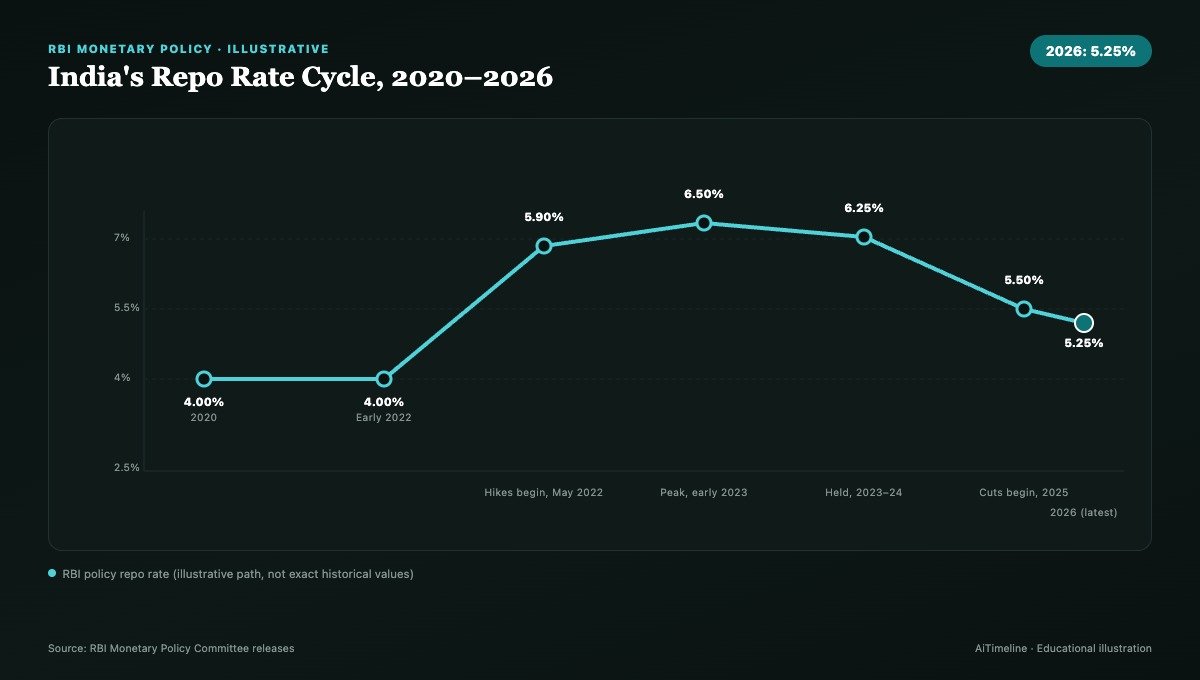
RBI’s repo rate cycle, 2020–2026 — the single biggest driver of every short-term instrument’s yield covered in this guide.
The Top 5 Short-Term Investment Options, Explained
Purpose, risk, liquidity, taxation, suitable holding period, advantages, limitations and who may benefit — for each of the five instruments Indian short-term investors compare most often.
1. High-Yield Savings Accounts
Purpose: the default holding place for money that may be needed at any moment, with zero notice and zero penalty. Risk: very low from a capital-safety standpoint — deposits are insured up to ₹5 lakh per depositor per bank by the Deposit Insurance and Credit Guarantee Corporation (DICGC), though amounts above that limit at a single bank carry the bank’s own credit risk. Liquidity: the highest of any instrument in this guide — funds are available instantly, any time, with no exit penalty. Taxation: interest is added to total income and taxed at the investor’s slab rate; a deduction of up to ₹10,000 on savings account interest is available under Section 80TTA for individuals below 60, and up to ₹50,000 under Section 80TTB for senior citizens (covering both savings and deposit interest). Suitable holding period: open-ended — ideal for money that might be needed on any given day. Advantages: total liquidity, no lock-in, simple to open and operate, often bundled with a debit card and payment rails. Limitations: among the lowest returns of any option here; several private and small finance banks advertise “high-yield” savings rates (commonly quoted in the 6%–7% p.a. range on specific balance slabs) that are meaningfully higher than large public-sector bank savings rates (often 2.5%–3.5% p.a.) — but these higher rates typically come from smaller banks, where checking the bank’s credit profile before parking a large sum is a reasonable precaution given the DICGC limit. Who may benefit: anyone who needs true, instant liquidity — an emergency fund is the clearest use case.
2. Fixed Deposits (FDs)
Purpose: a fixed sum locked in for a chosen tenor at a fixed, guaranteed interest rate, known in full at the time of booking. Risk: low, and DICGC-insured up to ₹5 lakh per depositor per bank (principal plus interest, combined across all deposits at that bank) — amounts above this at one bank carry that bank’s credit risk, which matters more for smaller private or cooperative banks than for large public-sector ones. Liquidity: moderate — most banks allow premature withdrawal, but typically with a penalty (commonly 0.5%–1% off the applicable rate) and sometimes with restrictions on tax-saver or special-tenor FDs. Taxation: interest is fully taxable at slab rate; banks deduct TDS at 10% (20% without a valid PAN) once interest from that bank in a financial year crosses ₹40,000 (₹50,000 for senior citizens) under Section 194A — TDS is not the final tax, it is adjusted against actual liability at filing. Suitable holding period: 7 days to 10 years technically, but for short-term goals, 3 months to 3 years is the relevant band. Advantages: rate is locked and known upfront regardless of what happens to market rates afterward; universally available; simple to understand; senior citizens typically get a rate premium (commonly 0.25%–0.75% above the standard rate). Limitations: premature exit costs a penalty; interest is fully taxable with no indexation benefit ever available on FDs; the locked rate becomes a disadvantage if market rates rise sharply after booking. Who may benefit: investors who know their exact time horizon and want certainty over the exact return they will receive, without market-linked variability.
3. Treasury Bills (T-Bills)
Purpose: short-term borrowing instruments issued by the Government of India through the RBI, sold at a discount to face value and redeemed at face value on maturity — the difference is the investor’s return. Risk: among the lowest of any rupee-denominated instrument available to retail investors, since they are a direct sovereign obligation, carrying effectively no credit risk. Liquidity: fixed tenor (91, 182 or 364 days) with no premature-withdrawal option in the way an FD has one, though T-Bills can be sold in the secondary market before maturity, subject to prevailing prices. Taxation: the discount (effectively the “interest”) is taxed as short-term capital gains at slab rate for a retail investor holding to maturity; no TDS is deducted at source on T-Bills, unlike bank FDs. Suitable holding period: exactly 91, 182 or 364 days — T-Bills only come in these three fixed tenors. Advantages: effectively zero credit risk; can be bought directly through the RBI’s retail direct scheme or through a bank/broker; no TDS complexity. Limitations: fixed tenors only, so they don’t fit every exact horizon; buying directly requires opening an RBI Retail Direct account or going through an intermediary, a slightly less familiar process than opening a bank FD; secondary-market sale before maturity is possible but not as simple as an FD’s premature-withdrawal request. Who may benefit: investors who want the lowest possible credit risk for a known, fixed-tenor need, and are comfortable with a slightly less familiar buying process than a bank FD.
4. Liquid Mutual Funds
Purpose: open-ended debt mutual fund schemes that invest in money-market instruments (Treasury Bills, Commercial Paper, Certificates of Deposit and similar) with a residual maturity of up to 91 days, designed for very short-term parking of funds with high liquidity. Risk: low but not zero — returns are market-linked and not guaranteed; the underlying portfolio carries some credit risk depending on the specific instruments held, and NAV can, in rare stress scenarios, decline (the 2020 episode discussed in the timeline above is the standard cautionary reference). Liquidity: very high — most liquid funds process redemptions the next business day, and many platforms offer an “instant redemption” facility (commonly capped at ₹50,000 or 90% of the folio value, whichever is lower, per SEBI norms) that credits funds within minutes. Taxation: since 1 April 2023, gains are taxed as short-term capital gains at the investor’s slab rate, regardless of holding period, with no indexation benefit. Suitable holding period: a few days up to about 3 months, though many investors hold longer for convenience. Advantages: better liquidity than an FD in most cases (especially with instant redemption), no premature-withdrawal penalty in the FD sense, and returns that adjust relatively quickly to the prevailing rate environment since the underlying portfolio matures and rolls over rapidly. Limitations: returns are not guaranteed or fixed in advance; still carries fund-level credit and liquidity risk; post-2023 tax treatment is now the same slab-rate basis as an FD, removing what was once a distinct tax advantage for longer holdings. Who may benefit: investors who want FD-like safety with materially better liquidity, particularly for money that might need to move on short notice but isn’t a true instant-access emergency fund.
5. Ultra-Short Duration Debt Funds
Purpose: open-ended debt schemes investing in instruments with a portfolio Macaulay duration of 3 to 6 months (slightly longer than a liquid fund’s very short maturity band), aiming for a modest yield pickup over liquid funds in exchange for slightly more interest-rate sensitivity. Risk: low-to-moderate — marginally higher interest-rate and credit risk than a liquid fund because of the longer average maturity and, in some schemes, allocation to slightly lower-rated instruments for extra yield. Liquidity: high, though typically without the instant-redemption facility liquid funds offer — redemptions usually settle in 1 business day. Taxation: identical to liquid funds since April 2023 — slab-rate taxation on all gains, no indexation. Suitable holding period: roughly 3 months to 1 year. Advantages: historically has offered a modest yield premium over liquid funds for a relatively small increase in risk, useful for money with a slightly longer but still short horizon. Limitations: more NAV variability than a liquid fund, particularly during periods of sharp rate movement; the yield premium over liquid funds is not guaranteed and can compress or invert depending on the shape of the yield curve at any given time. Who may benefit: investors with a 3–12 month horizon who are comfortable with slightly more variability than a liquid fund in exchange for a potentially better return, without extending into longer-duration debt fund categories.
💧 Liquidity Insight
Emergency funds should prioritise access over maximum returns. The entire purpose of an emergency fund is to be available on the single worst day it might be needed — a medical emergency, a sudden job loss, an urgent repair — and that day rarely arrives on a schedule that matches an FD’s maturity date. A slightly lower-yielding, fully liquid instrument (a savings account or a liquid fund with instant redemption) is structurally the correct choice for this specific bucket of money, even though it will almost never top a “best returns” comparison table.
Also Worth Knowing: Six More Short-Term Options
Not every short-term investor’s toolkit stops at the top five — these six show up often enough to deserve a clear, factual explanation.
Recurring Deposits (RDs)
A fixed monthly instalment locked in for a chosen tenor at a fixed rate, similar in structure and taxation to an FD but built for building a corpus through regular contributions rather than depositing a lump sum upfront. Useful for a known future expense funded through monthly savings rather than a single windfall.
Corporate Fixed Deposits
Fixed deposits issued by non-banking finance companies (NBFCs) and corporates rather than banks, often at a rate 0.5–1.5 percentage points above comparable bank FDs. Critically, corporate FDs are not covered by DICGC insurance — the extra yield is compensation for taking on the specific issuer’s credit risk, which makes checking the credit rating (from agencies like CRISIL, ICRA or CARE) a genuinely important step, not a formality.
Money Market Funds
A SEBI-defined debt fund category investing in money-market instruments with maturities up to one year, sitting between liquid funds and ultra-short duration funds on the maturity spectrum. Taxed identically to liquid and ultra-short funds since April 2023 — slab rate, no indexation.
Arbitrage Funds
Hybrid schemes that profit from small, low-risk price differences between a stock’s cash-market and futures-market price, while maintaining a large equity-plus-hedge allocation. Because of that equity classification, arbitrage funds get equity-fund tax treatment (short-term gains taxed at 20% if held under a year, long-term gains above ₹1.25 lakh/year taxed at 12.5% if held over a year, per current capital gains rules) — often more tax-efficient than a debt fund for investors in higher tax brackets, over a one-year-plus horizon.
Bank Sweep Accounts
A linked savings-and-FD facility where balances above a set threshold are automatically “swept” into a short-tenor FD earning a higher rate, and swept back to savings automatically if the account is drawn down — a way to earn FD-like returns on idle balances without manually managing separate deposits.
Cash Management Accounts
Offered by some brokerages and wealth platforms, these automatically deploy idle cash sitting in a trading or demat-linked account into overnight or very short-term instruments (often liquid funds or T-Bills), rather than letting the balance sit completely idle between trades or withdrawals.
💰 Tax Insight
Post-tax returns matter more than advertised returns. A 7.5% FD held by an investor in the 30% tax bracket delivers roughly 5.25% after tax; the same investor in the 5% bracket keeps close to 7.1%. Because most short-term instruments in this guide are now taxed at slab rate, the single biggest lever an investor has over their real, take-home return is not which product they choose, but their own tax bracket — which is exactly why two people comparing the same two products can reasonably reach different conclusions about which one is “better” for them.
Evergreen Explainers
Four short, standalone explainers covering the mechanics behind the instruments above.
How Liquid Funds Work
A liquid mutual fund pools money from many investors and uses it to buy a portfolio of money-market instruments — Treasury Bills, Commercial Paper, Certificates of Deposit and similar short-tenor debt — each maturing within 91 days. Because the underlying holdings mature and roll over so quickly, the fund’s yield adjusts to prevailing short-term rates faster than a fixed-rate instrument like an FD would. Every unit of the fund has a Net Asset Value (NAV) that moves daily, generally trending gently upward as the underlying instruments accrue interest, though it can occasionally dip if a portfolio holding faces credit stress. SEBI regulations cap a liquid fund’s exposure to any single issuer and mandate minimum liquid-asset holdings specifically to manage the kind of redemption-pressure scenario the industry saw in April 2020.
Treasury Bills Explained
A Treasury Bill is the simplest financial instrument the Government of India issues: it is sold at a discount to its face value (say, ₹98 for a bill that will be worth ₹100 at maturity) and redeemed at full face value when the fixed tenor — 91, 182 or 364 days — ends. The difference between the purchase price and the redemption value is the investor’s entire return; there are no periodic interest payments. T-Bills are auctioned weekly by the RBI on behalf of the government, and the “cut-off yield” from each auction is widely reported and serves as a real-time benchmark for where short-term rupee interest rates stand. Retail investors can bid non-competitively through the RBI’s Retail Direct portal or invest indirectly through a T-Bill-focused mutual fund scheme.
FD vs Debt Mutual Funds
Before April 2023, debt mutual funds held for over three years enjoyed long-term capital gains tax treatment with indexation, often making them more tax-efficient than an FD’s fully-taxable interest for long-term holders. That distinct advantage is now gone for units bought after that date — both FD interest and most debt-fund gains are taxed at slab rate. What remains genuinely different between the two: an FD’s rate is locked and guaranteed the day you book it, while a debt fund’s return is market-linked and can vary; a debt fund (especially a liquid one) is typically more liquid than an FD, without the FD’s premature-withdrawal penalty; and an FD carries DICGC insurance up to ₹5 lakh per bank, while a debt fund carries no deposit insurance at all, only the underlying portfolio’s credit quality.
How Inflation Affects Short-Term Savings
Inflation is the rate at which the general price level rises, eroding the purchasing power of a fixed amount of money over time. A short-term investment’s nominal return (the percentage shown on the statement) is not the same as its real return (the nominal return minus the inflation rate over the same period). A savings account paying 3% during a period when consumer price inflation runs at 5% is delivering a real return of roughly negative 2% — the rupee balance grows, but what it can buy shrinks. This is why “safe” and “growing your money in real terms” are not automatically the same thing, and why comparing a short-term instrument’s return against the prevailing inflation rate, not just against zero, is a more meaningful benchmark for whether it is truly preserving value.
📈 Inflation Insight
A product earning less than inflation may reduce purchasing power over time, even while the account balance itself only ever goes up. This is the most commonly overlooked risk in short-term investing precisely because it never shows up as a negative number on a bank statement — it only shows up when you compare what the money could buy at the start of the period against what it can buy at the end.
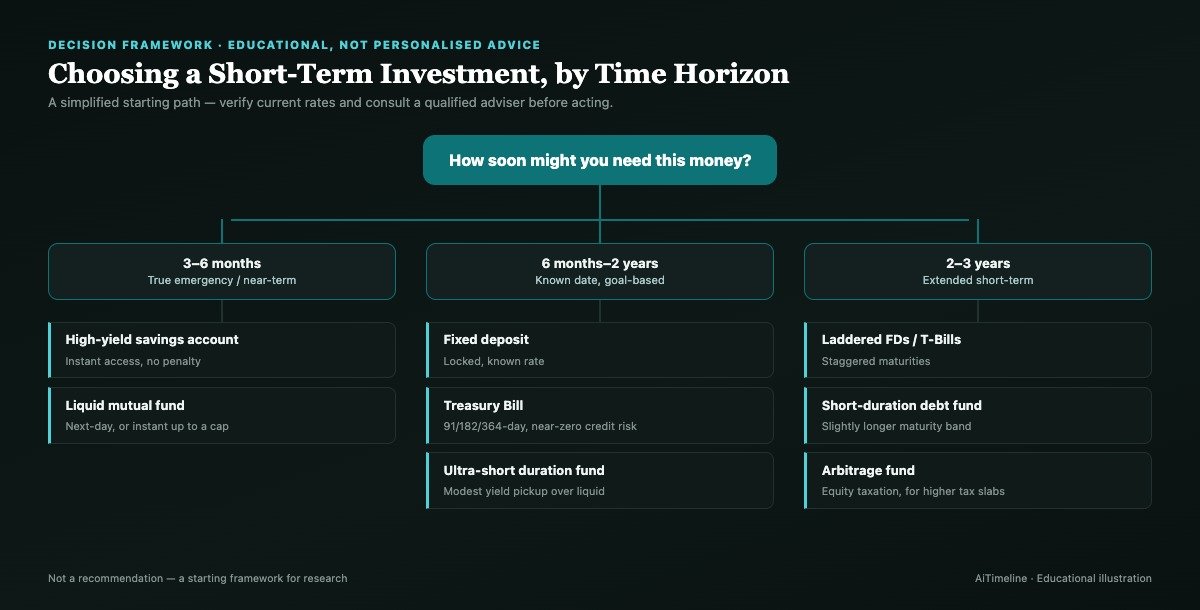
A simplified decision path by horizon and liquidity need — a starting point for research, not a substitute for individual advice.
Side-by-Side Comparisons
Five head-to-head tables plus a full timeline summary, all figures illustrative ranges only — confirm current numbers before acting.
Fixed Deposits vs Liquid Funds
| Factor | Fixed Deposit | Liquid Fund |
|---|---|---|
| Return | Fixed, locked at booking | Market-linked, variable daily |
| Liquidity | Fixed tenor; penalty on early exit | Next-day (or instant, up to a cap) |
| Safety net | DICGC-insured to ₹5 lakh/bank | No deposit insurance; portfolio credit risk |
| Taxation | Slab rate; TDS above threshold | Slab rate since April 2023; no TDS |
| Best suited for | Known date, wants certainty | Uncertain date, wants flexibility |
Treasury Bills vs Fixed Deposits
| Factor | Treasury Bill | Fixed Deposit |
|---|---|---|
| Issuer | Government of India (via RBI) | Bank or NBFC |
| Credit risk | Effectively nil (sovereign) | DICGC-insured to ₹5 lakh; issuer risk beyond that |
| Tenor options | 91, 182 or 364 days only | 7 days to 10 years, flexible |
| Buying process | RBI Retail Direct or intermediary | Any bank branch or net-banking |
| Premature exit | Secondary-market sale only | Direct withdrawal, with penalty |
Liquid Fund vs Savings Account
| Factor | Liquid Fund | Savings Account |
|---|---|---|
| Typical return | Tracks short-term market rates | Fixed, usually lower (higher at some small finance banks) |
| Access speed | Next business day; instant up to a cap | Immediate, no cap |
| Insurance | None — market-linked NAV | DICGC-insured to ₹5 lakh |
| Ideal use | Money with slight liquidity buffer, seeking better yield | True instant-access emergency reserve |
Short Duration vs Ultra-Short Duration Funds
| Factor | Ultra-Short Duration | Short Duration |
|---|---|---|
| Portfolio maturity | 3–6 months (Macaulay duration) | 1–3 years (Macaulay duration) |
| Interest-rate sensitivity | Low | Moderate |
| Typical horizon fit | 3–12 months | 1–3 years |
| Note | Covered in depth in this guide’s Top 5 | Outside this guide’s core short-term scope for horizons under 1 year |
Taxable vs Tax-Efficient Options (Illustrative)
| Instrument | Tax treatment | Notes |
|---|---|---|
| FD / RD interest | Slab rate; TDS above threshold | No indexation, ever |
| Liquid / ultra-short / money market funds | Slab rate (post-April 2023) | No TDS; investor self-reports |
| Treasury Bills | Slab rate on discount earned | No TDS deducted |
| Arbitrage funds | Equity taxation (STCG 20%, LTCG 12.5% above ₹1.25L/yr) | Often more tax-efficient above 1 year, for higher slabs |
| Savings account interest | Slab rate, with 80TTA/80TTB deduction | Up to ₹10,000 (₹50,000 for seniors) deduction |
Timeline Summary
| Year | Event | Importance |
|---|---|---|
| 1935 | RBI established | Foundation of India’s monetary and money-market system |
| 1969 | Bank nationalisation | Expanded deposit access nationwide |
| 1988 | SEBI founded; money-market reforms begin | Formal regulation of a structured money market begins |
| 1991 | Economic liberalisation | Enabled all subsequent financial-market reform |
| 2000 | Mutual fund growth phase | Liquid/debt fund categories take modern shape |
| 2004 | Online investing expands | Broadens retail access to short-term instruments |
| 2013 | Debt mutual fund expansion | AUM growth as an FD alternative |
| 2016 | Digital payments (UPI) launch | Enables app-based, branch-free investing |
| 2020 | Pandemic rate cuts; debt-fund liquidity event | Compresses yields; highlights real debt-fund risk |
| 2022 | RBI rate-hiking cycle begins | FD/T-Bill/fund yields rise meaningfully |
| 2023 | Debt fund tax law changes; fixed income “revives” | Slab-rate taxation removes debt-fund tax edge |
| 2024 | Retail investing growth continues | Liquid/ultra-short funds go mainstream retail |
| 2025 | RBI shifts to rate cuts | Yields trend gradually lower |
| 2026 | Repo rate at 5.25% | Current anchor for all short-term yields |
🧠 Did You Know?
Short-duration debt funds generally invest in instruments such as Treasury Bills, commercial paper, certificates of deposit and short-term government or corporate securities. This is exactly why their category returns tend to move so closely with the RBI’s policy repo rate — the underlying instruments they hold are priced directly off it, or off benchmarks that move in the same direction.
Practical Worked Examples
Six illustrative, generic calculations to show how the maths works — not personalised investment recommendations, and not a projection of any specific product’s future return.
1. Emergency fund size. A common starting rule used by financial planners is 3–6 months of essential monthly expenses. Illustration: if essential monthly expenses are ₹40,000, a 3-month buffer is ₹1,20,000 and a 6-month buffer is ₹2,40,000 — the exact multiple depends on job stability, dependents and existing insurance cover, which is a personal decision, not a fixed formula.
2. FD maturity (illustrative, not a quoted rate). A ₹1,00,000 FD at an illustrative 7% p.a. simple annual rate for 1 year would accrue roughly ₹7,000 in interest before tax, for a maturity value near ₹1,07,000 — the actual amount depends on the bank’s specific rate and compounding frequency at the time of booking, which must be confirmed directly with the bank.
3. Treasury Bill return (illustrative). A 364-day T-Bill bought at an illustrative discounted price of ₹94.50 per ₹100 face value returns ₹5.50 per ₹100 invested over the year before tax, an annualised yield of roughly 5.8% — actual auction cut-off prices vary weekly and must be checked against the RBI’s published results.
4. Post-tax return. An illustrative 7% FD for an investor in the 30% tax slab (plus applicable cess) nets a post-tax return of roughly 4.9%–5.0%; the same 7% for an investor in the 5% slab nets roughly 6.6%–6.7%. The formula is simply: post-tax return = pre-tax return × (1 − effective tax rate).
5. Inflation-adjusted return. If a liquid fund delivers an illustrative 6.5% return over a year during which consumer price inflation runs at 5%, the approximate real return is 1.5 percentage points (6.5% minus 5%) — a simplified subtraction commonly used for short periods, rather than the more precise compounding “Fisher equation” used for longer horizons.
6. Investment laddering. Instead of placing ₹3,00,000 into a single 1-year FD, an investor could split it into three ₹1,00,000 FDs maturing 4, 8 and 12 months out. As each matures, it can be reinvested at whatever rate is then available, reducing the risk of locking the entire sum at a single day’s rate — a structural technique for managing reinvestment-rate risk, not a way to increase guaranteed return.
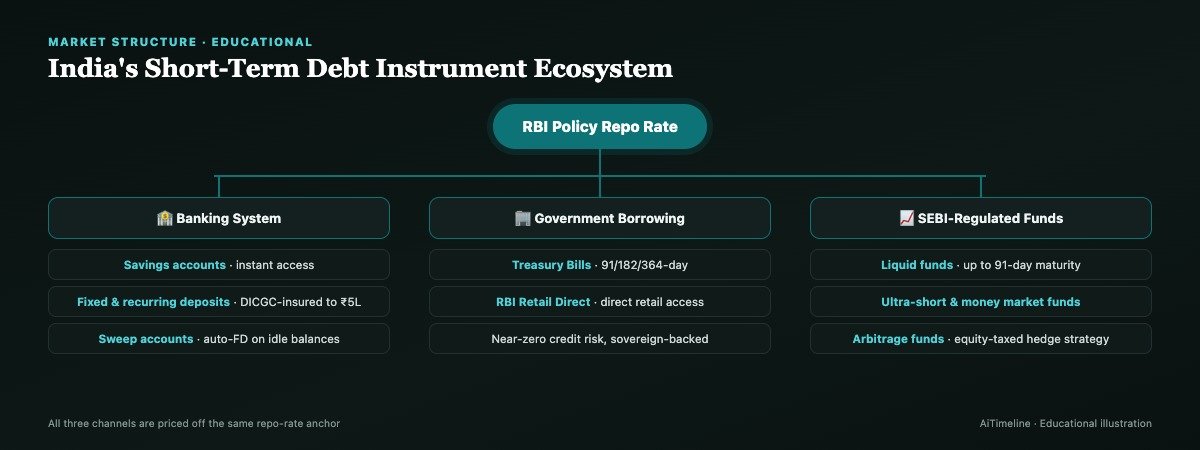
How India’s short-term debt instruments connect back to the RBI’s repo rate and the government’s borrowing programme.
✅ What the Rules Actually Say
- DICGC insures bank deposits up to ₹5 lakh per depositor, per bank — combined across all accounts and deposits at that bank.
- Debt mutual fund units bought on/after 1 April 2023 get slab-rate taxation only, no LTCG or indexation, regardless of holding period.
- Banks deduct TDS on FD interest above ₹40,000/yr (₹50,000 for seniors) if PAN is on file.
- T-Bills are issued only in three fixed tenors: 91, 182 and 364 days.
⚠️ Common Misconceptions
- “My deposit is fully safe no matter the amount” — only true up to ₹5 lakh per bank; larger sums carry that bank’s credit risk.
- “Debt funds are basically FDs with better tax” — the tax advantage debt funds once had for long holdings no longer exists post-April 2023.
- “A liquid fund can never lose value” — NAV is market-linked and has, in rare stress events, declined.
- “The advertised rate is what I’ll actually earn” — ignores tax, and for FDs, ignores any premature-exit penalty if plans change.
Who Regulates and Issues These Instruments
The official bodies referenced throughout this guide.
Reserve Bank of India (RBI)
Sets the repo rate, regulates banks and NBFCs, issues Treasury Bills on behalf of the Government of India, and oversees DICGC deposit insurance.
SEBI
Regulates mutual funds, brokerages and the securities market, including risk-management and liquidity norms for debt-oriented mutual fund schemes.
AMFI
The Association of Mutual Funds in India publishes category-wise mutual fund data, investor-education material and industry AUM statistics.
National Stock Exchange (NSE)
India’s largest exchange by trading volume; where arbitrage fund strategies execute their equity-and-derivative hedge positions.
Bombay Stock Exchange (BSE)
Asia’s oldest stock exchange, also used for mutual fund unit transactions and, alongside NSE, for arbitrage strategies.
Income Tax Department
Administers taxation of FD interest, mutual fund gains and Treasury Bill returns, and processes Section 80TTA/80TTB deductions.
Government of India Treasury Bills
Direct sovereign short-term borrowings, auctioned weekly by the RBI, considered to carry effectively no credit risk.
Common Mistakes Short-Term Investors Make
- Comparing pre-tax rates only. A higher headline rate can still lose to a lower one after accounting for your actual tax slab.
- Treating an emergency fund like a goal-based investment. Locking emergency money in a fixed-tenor product defeats its entire purpose.
- Chasing the highest advertised rate without checking the issuer. A corporate FD paying well above bank rates is compensating for credit risk, not offering a free lunch.
- Assuming all bank deposits are unlimited-safe. DICGC insurance caps at ₹5 lakh per bank; large sums are safer spread across multiple banks.
- Forgetting the premature-withdrawal penalty exists. An FD “locked” for a horizon that later changes usually costs something to exit early.
- Assuming pre-2023 debt-fund tax rules still apply. The long-term, indexed tax treatment for debt funds is gone for units bought after 1 April 2023.
- Ignoring inflation entirely. A “safe” 3% return during 5%-plus inflation is a real loss in purchasing power, even though the balance never falls.
- Putting the entire corpus into one maturity date. This maximises reinvestment-rate risk instead of spreading it through laddering.
👀 Future Watch
What could reasonably change the picture in this guide going forward: further RBI Monetary Policy Committee decisions on the repo rate; SEBI regulatory updates affecting debt mutual fund risk-management or liquidity norms; the size and pattern of the government’s borrowing calendar, which influences Treasury Bill supply and yields; and any Union Budget or Finance Act change to how FD interest, debt-fund gains or arbitrage-fund gains are taxed. This guide does not forecast where any of these will go — only that all four are the specific, official channels worth watching, rather than market commentary or rate predictions.
Interesting Facts
- The RBI’s repo rate — the rate at which it lends short-term funds to banks — is the single anchor point that FD rates, T-Bill yields and liquid-fund returns all move around, even though none of them equal the repo rate exactly.
- A Treasury Bill pays no periodic interest at all — its entire return comes from being sold below face value and redeemed at full face value.
- Arbitrage mutual funds are classified as “equity” for tax purposes despite behaving, in risk terms, much closer to a debt fund — a quirk of how Indian tax law defines an equity-oriented scheme.
- DICGC’s ₹5 lakh insurance limit applies per depositor, per bank — not per account, so multiple FDs and a savings account at the same bank are all added together against that single limit.
Explore More Timelines
People Also Ask
Frequently Asked Questions
70 questions on short-term investing in India, grouped by theme.
Related Reading on AiTimeline
Invest in US Stocks From India
US Economy: Growth, Slowdown & Inflation Timeline
Electric Car Sales & Fuel Price Dynamics
Why the Best Short-Term Investment Depends on Your Goal
There is no single “best” short-term investment in India, and any guide that claims otherwise is selling a headline rather than describing reality. What exists instead is a set of well-understood, well-regulated instruments — savings accounts, fixed deposits, Treasury Bills, liquid funds, ultra-short duration funds, and the handful of adjacent options covered in this guide — each built around a different trade-off between safety, liquidity, tax treatment and return. The right one for Priya, saving toward a house down payment two years out, is not automatically the right one for someone building a six-month emergency buffer, or for a retiree drawing regular income from savings, or for an investor in the top tax bracket weighing an arbitrage fund against a liquid fund.
What ties every section of this guide together is a simple discipline: start with the goal, not the rate. Define the exact horizon and how firm that date really is. Separate true emergency money, which needs instant access, from goal-based money, which can tolerate a fixed tenor if the date is genuinely known. Run the comparison after tax, using your own slab rate, not the advertised headline figure. Check who is actually promising the return — a DICGC-insured bank, the Government of India, or a specific NBFC’s own balance sheet — before comparing what they’re promising. And revisit the decision periodically, because RBI’s rate cycle, SEBI’s regulations and the Finance Act’s tax rules all move over time, and the “best fit” instrument for a given goal can genuinely change between the year you start saving and the year you need the money.
Before acting on anything in this guide, review the current official RBI and SEBI guidance directly, compare the exact product features and current rates offered by your own bank or fund house, and, where the decision is significant, speak with a qualified, SEBI-registered financial adviser or chartered accountant. This page will continue to be updated after major RBI monetary policy announcements, SEBI regulatory changes, government borrowing calendar updates and Finance Act amendments that affect the instruments discussed here.
Editorial Note & Sources
This guide separates Official regulatory facts (RBI, SEBI, AMFI, Income Tax Department publications), Reported market data and industry commentary, and Analysis educational framing and worked examples, throughout. Figures for interest rates, fund yields and tax thresholds are illustrative ranges based on the sources below and general market observation at the time of writing; always confirm the current, exact figure with the official source before acting.
- Official Reserve Bank of India — Monetary Policy, DICGC & Retail Direct: rbi.org.in
- Official Securities and Exchange Board of India: sebi.gov.in
- Official Association of Mutual Funds in India: amfiindia.com
- Official Income Tax Department, Government of India: incometax.gov.in
- Official National Stock Exchange of India: nseindia.com
- Official BSE Ltd: bseindia.com
- Official Deposit Insurance and Credit Guarantee Corporation: dicgc.org.in
- Reported Union Budget documents & Finance Act text, Ministry of Finance: indiabudget.gov.in
Sources & further reading
Every dated entry above was checked against these references. Last reviewed 15 September 2026.
- RBI: Monetary Policy Committee Resolutions
- RBI: Deposit Insurance and Credit Guarantee Corporation (DICGC)
- RBI Retail Direct - Treasury Bills
- SEBI: Mutual Fund Regulations and Circulars
- AMFI: Mutual Fund Industry Data
- Income Tax Department: Official Portal
- Union Budget and Finance Act Documents, Ministry of Finance
- National Stock Exchange of India (NSE)