Buy or Rent a Home in India: The Complete 2026 Decision Framework
Should you buy or rent in India? A complete RBI, NHB and RERA-sourced framework with EMI vs rent calculators, tax rules, hidden costs and a full timeline.
Latest Story
Ankit got the offer letter first — a product role in Bengaluru, forty percent more than what he was making in Pune. Meera’s offer, at a fintech twelve minutes down the road, landed three days later. Within a month they were apartment-hunting in Sarjapur, and within a month of that they were arguing about something neither of them had expected to become an argument: a builder-floor unit near her office was going for ₹90 lakh, EMI-eligible, ready in eight months. Ankit wanted to sign. Meera wanted to rent the identical layout two floors down for ₹32,000 a month and put the down payment — roughly ₹18 lakh — into index funds and PPF instead. Neither of them was wrong, which is exactly the point of this guide. The buy-or-rent decision that Ankit and Meera are having in their kitchen over cold filter coffee is the same one playing out in lakhs of Indian households every year, and it almost never has a single correct answer — it has a correct answer for a specific person’s income, timeline and life plan. This page is built to help you find yours, using RBI, NHB, RERA and Income Tax Department rules rather than opinion, and it is written to stay useful in 2027 and 2030, not just this year.
🧠 AI Overview Summary
There is no universal answer to buy-or-rent in India — it depends on income stability, how long you’ll stay in a city, EMI affordability and your comparison of rental yield against home loan rates. As of August 2026, the RBI repo rate stands at 5.25%, home loan rates from public-sector banks start near 7.10–7.25%, and average gross rental yields are around 5.16% nationally, higher in Bengaluru (~4.4–4.5%) and lower in Mumbai (~2–2.6%). Buying tends to make sense for a 7+ year horizon with stable income; renting-and-investing tends to suit shorter horizons, career mobility, or when local rents are cheap relative to EMIs.
The buy-or-rent decision in six direct answers
What this guide actually shows
- There is no universally correct answer. The right call depends on your income stability, expected years in the city, EMI affordability and the local rent-to-price ratio — not on market sentiment or a headline rule of thumb.
- Home loan rates have eased from their 2023–24 peak while urban rents in several cities have risen sharply, which is why the comparison is more nuanced in 2026 than it was two years ago.
- EMI is not the same as rent — an EMI also repays principal (building equity), while rent buys only the right to occupy, with nothing returned at the end.
- Renting preserves liquidity and mobility; buying builds a forced-savings equity position but locks up capital in one illiquid, one-city asset.
- Under the new tax regime (now the default), the Section 24(b) home loan interest deduction on a self-occupied property is not available — a fact many first-time buyers still don’t realise, per Income Tax Department rules.
- Total upfront buying cost is rarely just the down payment. Stamp duty, registration, brokerage, interiors and shifting costs typically add another 8–15% of the property price on top of the loan-linked down payment.
- Rental yields vary enormously by city — roughly 4.4–4.5% in Bengaluru versus 2–2.6% in Mumbai — and a lower yield generally strengthens the case for renting-and-investing rather than buying in that specific market.
- RERA (2016) and the Pradhan Mantri Awas Yojana are consumer-protection and affordability tools, not investment guarantees — they reduce specific risks (delivery delay, fraud, interest cost for eligible buyers) without changing the underlying buy-vs-rent maths.
- A 7-year-plus horizon is the most commonly cited threshold beyond which ownership costs (stamp duty, brokerage) are more easily absorbed by loan paydown and any property appreciation — below that horizon, transaction costs alone often erase the case for buying.
- This page is a framework, not a forecast. Rates, rents and tax rules will change after future RBI policy reviews and Union Budgets; the decision method here is built to still apply when they do.
Why This Isn’t a One-Size-Fits-All Decision
The eight variables that actually decide it, before a single rupee is calculated.
Every “should I buy or rent” headline eventually collapses into the same eight variables, and almost none of them are purely financial. Income stability matters more than income level: a household with a fluctuating consulting income carries very different EMI risk than a household with two stable salaried incomes, even at the same take-home pay. Career mobility matters just as much — Ankit and Meera moved cities once already for better offers; a homeowner who gets a better offer in another city either commutes, rents out the flat and manages a landlord’s headaches remotely, or sells at short notice into whatever the local market happens to be doing that month. A renter simply serves notice and leaves.
Family plans reshape the calculation too: a couple expecting children in the next two years weighs school catchment areas and space differently from a couple with no such plans, and a joint family expecting ageing parents to move in has space requirements a rental market may not serve well in every city. Interest rates set the cost of the loan itself — the same ₹72 lakh loan costs meaningfully more in total interest at 9% than at 7.25%, which is why the rate environment at the time of purchase, not just the property price, belongs in the decision. Property appreciation is the return a buyer is betting on beyond rent-equivalent savings, and it is the least predictable variable on this list — it varies by micro-market, not just by city, and past appreciation in one project or locality is not a guarantee for the next.
Inflation cuts both ways: it erodes the real value of a fixed EMI over a 20-year loan (a fixed EMI feels smaller in real terms every year), but it also usually pushes rental inflation upward, since landlords revise rent to keep pace with costs and market rates. And finally, plain lifestyle preference belongs on this list as a legitimate input, not a rationalisation: some households value the certainty and customisation of ownership enough to accept a lower expected financial return, and some value the flexibility of renting enough to forgo the equity-building of a loan. Both are rational choices once the trade-off is understood — which is the entire purpose of the framework below.
💰 Financial Insight · Equity versus flexibility, not right versus wrong
The cleanest way to frame this decision is not “which is smarter” but “which trade-off do you want.” Buying builds equity while renting preserves flexibility. Every EMI payment splits into interest (a cost, gone forever) and principal (a forced saving that becomes home equity); every rent payment is a pure cost with no equity component, but it comes with the ability to relocate, resize, or exit with 30–90 days’ notice instead of a property sale process that can take months. Neither trade-off is objectively better — it depends entirely on whether your household values the certainty of an owned asset or the flexibility of an unlocked balance sheet more, at this specific stage of life.
Executive Summary & One-Minute Read
📋 Executive Summary
India’s home loan rates have eased from their 2023–24 highs — the RBI repo rate has held at 5.25% since February 2026 — while rents in several large cities, especially Bengaluru, have climbed faster than property prices. That combination makes 2026 a genuinely closer call than it has been in years: cheaper EMIs improve the arithmetic for buying, but higher rents also mean a renter investing the down-payment gap has more incentive to invest well, not just save. This guide separates official RBI/NHB/RERA/Income Tax data from market trend reporting and financial-planning judgment throughout, and ends in a decision checklist rather than a verdict, because the correct answer genuinely differs by household income, city and time horizon.
⏳ One-Minute Summary
Buy if: you’ll stay 7+ years, have stable income, an emergency fund, and the EMI-to-rent gap in your city is small. Rent if: your horizon is under 5 years, your income is variable, local rental yields are low (making renting cheap relative to buying), or you’d rather invest the down payment than lock it into one property. Everyone should run their own numbers using the calculators further down this page rather than following either rule blindly.
The Complete Timeline: India’s Housing & Home Loan Market, 1950s–2026
Eighteen milestones, newest first. Historical fact, official data and market trend are kept separate in every entry.
Rates hold steady while metro rents keep climbing faster than home prices
Official data: the RBI’s Monetary Policy Committee held the repo rate at 5.25% through its February, April and June 2026 reviews (61st MPC), with home loan rates at public-sector banks starting near 7.10–7.25% for well-rated borrowers. PMAY-Urban 2.0’s Central Sanctioning Committee approved a further 2.88 lakh houses in its February 2026 meeting, taking total units sanctioned under the scheme past 13.61 lakh.
Market trend: gross rental yields nationally averaged around 5.16% in Q2 2026, with Bengaluru leading large cities near 4.4–4.5% after rents there rose roughly 12.5% over the year, while Mumbai’s yield stayed lower at 2–2.6% on account of high capital values.
Current significance: this is the first year since the 2022–23 rate-hike cycle that EMI affordability and rental cost have both been live pressures at once — cheaper loans on one side, pricier rent on the other — which is exactly why a mechanical “buy is always better” or “rent is always better” rule breaks down in 2026.
RBI bans prepayment penalties on floating-rate retail loans
Official policy: the RBI’s Prepayment Charges on Loans Directions, 2025 barred banks and NBFCs from levying prepayment or foreclosure charges on floating-rate loans taken by individual borrowers for non-business purposes, applying to loans sanctioned or renewed on or after 1 January 2026.
Housing market: the change directly affects home loan borrowers, who make up the largest single category of floating-rate retail credit, removing a cost that previously discouraged switching lenders for a better rate or paying down a loan early with a bonus or windfall.
Consumer behaviour: mortgage brokers reported an uptick in balance-transfer enquiries once the rule took effect, as borrowers on older, higher-rate loans could finally move lenders without a foreclosure fee eating into the savings.
The Union Budget rewrites property capital gains tax
Policy change: Budget 2024 cut long-term capital gains tax on property sales to 12.5% but removed indexation benefit, with a transitional rule letting owners of property bought on or before 22 July 2024 choose whichever is lower — 12.5% without indexation or 20% with it. Budget 2026 left this regime unchanged.
Housing market: affordability continued to diverge by city through 2024, with home price growth in several top metros reported to be outpacing income growth, even as overall national home loan disbursals stayed strong on the back of moderate rates.
Consumer behaviour: sellers holding property bought before mid-2024 began consulting accountants specifically to compare the two capital-gains options before a sale — a new, non-trivial calculation that did not exist before this Budget.
Post-pandemic return-to-office triggers a rental market surge
Housing market: as employers pulled back from fully remote work, rental demand surged in IT-heavy micro-markets — Bengaluru’s Outer Ring Road corridor, Gurugram, Pune’s Hinjewadi — while new rental supply lagged, pushing rents up sharply in the very belts that had seen tenants leave during 2020–21.
Interest rates: home loan rates stayed elevated through 2023 after the RBI’s 2022 hiking cycle, keeping EMIs high even as rental costs rose — a rare period where both sides of the buy-vs-rent comparison got more expensive at once.
Consumer behaviour: many tenants who had moved to smaller towns during the pandemic returned to metro rental markets on short notice, absorbing steep rent increases because relocating employers gave little lead time.
The RBI’s fastest rate-hiking cycle in over a decade repriced every EMI
Official data: the RBI raised the repo rate from 4% in April 2022 to 6.25% by December 2022 in response to inflation that followed the Russia-Ukraine war and its effect on global commodity and fuel prices, one of the sharpest tightening cycles in RBI history.
Housing market: floating-rate home loan rates, which had fallen below 6.5% during the pandemic, rose to roughly 8.5–9% within the same year, lifting EMIs on existing floating-rate loans and raising the qualifying income needed for a new one.
Consumer behaviour: many existing borrowers saw loan tenures extended automatically by their lender rather than EMI amounts rising, a common floating-rate mechanism that keeps monthly cash flow stable but quietly lengthens total interest paid over the loan’s life.
Work-from-home reshapes what Indian buyers look for in a home
Housing market: with home loan rates still near record lows, demand shifted visibly toward larger configurations (3BHK over 2BHK), homes with a dedicated work corner or balcony, and a wave of interest in plotted developments and tier-2 cities as remote work loosened the tie between home and office location.
Government policy: several states extended pandemic-era stamp duty concessions into 2021 to keep registrations moving, and the extended Credit-Linked Subsidy Scheme component of PMAY continued supporting eligible middle-income borrowers.
Consumer behaviour: renters with flexible employers used the moment to test living in a different, often cheaper, city before committing to buy there — a low-risk way of resolving the “will I actually stay here 7 years” uncertainty that sits at the heart of this whole decision.
COVID-19 triggers record-low rates and a scramble for stamp duty relief
Official data: the RBI cut the repo rate to 4% in 2020, its lowest level in the modern policy-rate era, pulling floating home loan rates down toward 6.5–6.7% at several banks — among the cheapest home loans India had ever seen.
Government policy: Maharashtra temporarily cut stamp duty (from 5% to 2%, later 3%) between September 2020 and March 2021 specifically to revive stalled property registrations during the pandemic, a policy several other states studied and partly replicated.
Consumer behaviour: reverse migration out of expensive metros during lockdowns, combined with the cheapest EMIs in a generation, pulled some renters who had been on the fence for years into buying — while others, uncertain about job security, held off entirely.
GST arrives on under-construction property as RERA rules go live nationally
Policy: the Goods and Services Tax, effective 1 July 2017, applied to under-construction property (later set at 5% standard and 1% for affordable housing, without input tax credit, from April 2019), while completed properties with an occupancy certificate remained outside GST entirely — a meaningful, permanent cost difference between ready and under-construction homes.
Regulatory milestone: most states notified their Real Estate Regulatory Authority rules through 2017, operationalising the 2016 RERA Act on the ground — project registration, the 70% escrow requirement for buyer funds, and state-level buyer grievance forums all became functional this year rather than just legislated.
Consumer behaviour: buyers began asking developers for RERA registration numbers before booking, and under-construction sales in some markets briefly slowed as buyers weighed the new GST cost against ready-to-move inventory.
RERA becomes law, giving homebuyers a statutory regulator for the first time
Confirmed history: the Real Estate (Regulation and Development) Act, 2016 came into effect on 1 May 2016, creating a Real Estate Regulatory Authority in every state, mandating project registration, carpet-area-based pricing (replacing the older, buyer-unfriendly super built-up area quoting), and a 70% escrow requirement so developer funds collected for one project can’t be diverted to another.
Consumer behaviour: for the first time, a delayed or misrepresented project gave buyers a dedicated adjudicating forum rather than only a slow civil court process — directly addressing the developer-delay risk that had built up visibly after the 2008 slowdown.
“Housing for All” is announced, leading to the Pradhan Mantri Awas Yojana
Confirmed history: the incoming government set a “Housing for All by 2022” mission in 2014–15, which became the Pradhan Mantri Awas Yojana — Urban, formally launched on 25 June 2015, combining beneficiary-led construction, affordable-housing-in-partnership, slum redevelopment and a Credit-Linked Subsidy Scheme (interest subsidy) into one national mission for EWS, LIG and MIG households.
Government policy: the scheme explicitly targeted first-time, lower- and middle-income buyers rather than the market broadly, using an interest subsidy (reducing effective EMI) rather than a price control on property itself.
The global financial crisis exposes developer over-leverage and buyer risk
Confirmed history: the 2008 global financial crisis hit Indian real estate through a sudden credit crunch — developers who had taken on debt during the 2005–07 boom faced a funding squeeze, project timelines slipped across the sector, and several high-profile launches from that era took years longer to deliver than promised.
Interest rates: the RBI cut rates sharply to support growth, and home loan rates eased through 2009, but buyer confidence in under-construction property took considerably longer to recover than the rate cuts themselves.
Current significance: the buyer grievances that piled up from 2008-era project delays were a direct precursor to the political and consumer pressure that produced RERA eight years later.
FDI reforms and listed developers professionalise Indian real estate
Confirmed history: 2005 reforms allowed 100% foreign direct investment in townships, housing and built-up infrastructure under the automatic route (subject to conditions), drawing institutional capital into a sector that had been dominated by small, regional builders. Large organised developers scaled up construction and, in several cases, moved toward public listings in the years that followed.
Housing market: the mid-2000s saw a genuine construction and price boom in NCR, Mumbai and Bengaluru, fuelled by the IT/ITES hiring wave, cheaper credit than the 1990s, and the first large gated-community townships built at scale.
A low-rate era triggers India’s first real retail home loan boom
Housing market: home loan interest rates fell through the early 2000s to levels around 7–8% — historically low for the time — and banks, competing hard with housing finance companies for the first time, marketed home loans directly to salaried retail customers at a scale India hadn’t seen before.
Government policy: income tax incentives for housing loan interest and principal repayment, expanded through the late 1990s and early 2000s, meaningfully improved the after-tax cost of a home loan and were widely credited with pulling middle-class demand toward ownership.
Consumer behaviour: home loans went from a product mostly used by senior salaried professionals to a mainstream product marketed to any household with a verifiable salary slip — the start of India’s modern retail mortgage market.
Economic liberalisation opens the door to private housing finance competition
Confirmed history: the 1991 balance-of-payments crisis forced sweeping liberalisation — industrial delicensing, opening to foreign investment, and financial-sector reform that, over the following decade, allowed new private banks (including HDFC Bank in 1994 and ICICI Bank around the same period) to enter retail lending, eventually including home loans, alongside HDFC Ltd and the public-sector banks that had dominated housing finance until then.
Housing market: real estate in the immediate post-1991 years remained a largely cash-heavy, undocumented market by today’s standards, even as the financial-sector reforms that would eventually professionalise home loan lending were being put in place.
HDFC is founded, launching India’s dedicated housing finance industry
Confirmed history: Housing Development Finance Corporation was founded in 1977 by H.T. Parekh as India’s first specialised housing finance company, at a time when the public-sector Housing and Urban Development Corporation (HUDCO, established 1970) was the dominant institutional financier of state and urban-board housing but not of individual retail home loans.
Housing market: before HDFC, an individual buying a home in India relied overwhelmingly on personal savings, employer housing loans, or informal family lending — a dedicated, retail-facing home loan product from a specialised lender simply did not exist at any real scale.
The National Housing Bank is established as the sector’s apex institution
Confirmed history: the National Housing Bank was set up in 1988 under the National Housing Bank Act, 1987, as a wholly RBI-owned apex institution to regulate and refinance housing finance companies, standardise lending practices, and expand institutional credit flow into housing. NHB later launched RESIDEX, India’s official residential housing price index, in 2007, and its regulatory authority over HFCs was transferred to the RBI directly in 2019 while NHB retained its refinancing and promotional role.
Housing market: NHB’s refinancing support through the late 1980s and 1990s helped smaller housing finance companies scale lending outside the largest metros, widening access to formal home loans beyond the handful of cities HDFC and public banks had focused on first.
State Housing Boards take over public housing delivery at scale
Historical background: through the 1960s, state governments established or expanded dedicated Housing Boards and Development Authorities (building on earlier city Improvement Trusts) to plan and construct housing directly, as urban migration accelerated faster than the private and informal housing stock could absorb it.
Housing market: housing remained overwhelmingly a state-delivered or self-built product; there was still no organised private mortgage market, and most urban households either rented from private landlords, lived in employer-provided quarters, or waited years on Housing Board allotment lists.
Independence-era India confronts an acute urban housing shortage
Historical background: the 1950s began with a severe housing shortage in Indian cities, worsened by Partition-driven refugee resettlement in cities like Delhi and Kolkata and by early industrial-era migration into urban centres. Government responded mainly through direct construction and resettlement colonies rather than any home-loan mechanism, since no organised housing finance sector existed yet.
Consumer behaviour: home “ownership” for most urban families in this decade meant either inherited property, self-built housing on owned land, or long-term tenancy — the buy-vs-rent question as this page frames it, with a mortgage on one side, simply did not exist for the average household.
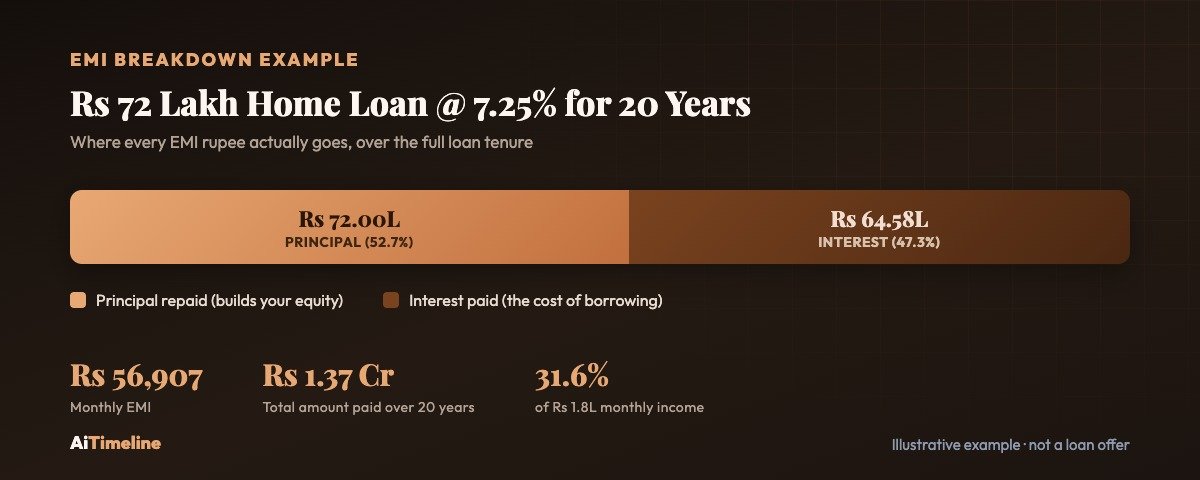
On a typical Rs 72 lakh loan at 7.25% for 20 years, roughly 47% of every rupee paid over the full tenure is interest, not equity — a cost renting never carries, but ownership does.
📈 Housing Insight · Property values and rents can move independently
It’s tempting to assume rising rents mean rising property prices, or that falling home loan rates mean rising prices too — neither is guaranteed. Rents respond mainly to local job creation, migration and rental-supply constraints in a specific micro-market; property prices respond to a wider mix of buyer credit availability, developer supply pipeline, and investor sentiment. 2026 is a live example: home loan rates have eased while rents in Bengaluru specifically have risen sharply — the two lines are not moving together, and treating them as if they must is a common, avoidable modelling mistake.
The Vocabulary: What Every Buyer and Renter Should Know
Sixteen terms that recur throughout home loan and rental decisions, defined plainly.
Most buy-or-rent confusion isn’t really about judgement — it’s about vocabulary. Bank websites, RERA notices and tax forms use precise terms that rarely get explained in one place. Here’s the full glossary this guide relies on, defined once so every later section can use these words without re-explaining them.
EMI (Equated Monthly Instalment)
The fixed monthly payment on a home loan, calculated from principal, interest rate and tenure, that combines a shrinking interest portion and a growing principal (equity-building) portion over the loan’s life.
Down Payment
The upfront portion of the property price paid from your own funds, not financed by the loan. RBI’s loan-to-value rules cap financing at 90% for loans up to ₹30 lakh, 80% for ₹30–75 lakh, and 75% above ₹75 lakh — setting the minimum down payment in each slab.
Home Loan
A secured loan from a bank or housing finance company to purchase, construct or renovate residential property, with the property itself mortgaged to the lender until the loan is repaid in full.
Floating vs. Fixed Rate
A floating rate moves with an external benchmark (banks must link retail loans to an External Benchmark Lending Rate, usually the repo rate, per RBI rules) so EMIs or tenure change when the RBI moves rates. A fixed rate stays constant for an agreed period, usually at a slightly higher starting rate as the price of that certainty.
Rental Yield
Annual rent divided by the property’s purchase price, expressed as a percentage — the standard measure of how much a property “earns” in rent relative to its cost, separate from any price appreciation.
Property Appreciation
The increase in a property’s market value over time. It is unrealised (only a paper gain) until the property is actually sold, and it varies enormously by micro-market — a citywide average tells you little about one specific building or street.
Stamp Duty
A state government tax on the property transfer document, typically 3–7% of the property’s value, calculated on whichever is higher: the actual transaction price or the government’s circle rate/guidance value for that locality.
Registration Charges
The fee paid to register the sale deed with the local sub-registrar, making the transfer legally recorded; typically around 1% of property value on top of stamp duty, though some states cap it at a fixed amount.
Maintenance / Society Charges
Recurring monthly or annual payments to a Resident Welfare Association or housing society covering common-area upkeep, security, amenities and a sinking fund for major repairs — a cost renters typically don’t pay directly, since it’s usually built into rent.
Opportunity Cost
The return you give up on money used for a down payment or extra EMI prepayment, if that same money could instead have been invested elsewhere. It’s the core reason a renter’s invested savings can sometimes outpace a buyer’s home equity.
Liquidity
How quickly an asset can be converted to cash without a forced discount. Property is highly illiquid (a sale can take months); mutual funds, fixed deposits and most listed investments are far more liquid, which matters most in an emergency.
Tax Deductions (Home Loan)
Under the old tax regime, Section 24(b) allows up to ₹2 lakh a year in home loan interest deduction on a self-occupied property, and Section 80C covers principal repayment within its overall ₹1.5 lakh limit. Neither is available for a self-occupied home under the new tax regime, per Income Tax Department rules.
Capital Gains (on Sale)
Profit from selling property held over 24 months is a long-term capital gain, currently taxed at 12.5% without indexation (or, for property bought on or before 22 July 2024, optionally 20% with indexation if that works out lower).
Inflation
The general rise in prices over time. It erodes the real burden of a fixed EMI on a long-tenure loan year after year, while typically also pushing rents upward as landlords revise rates to match rising costs.
Affordability
Commonly assessed via the EMI-to-income ratio (many planners suggest keeping it under 35–40% of monthly take-home pay) or the price-to-annual-income ratio, alongside whether a household still has liquid savings left after the down payment.
Credit Score (CIBIL)
A three-digit score reflecting repayment history; a score of 750 or higher is generally what unlocks the lowest advertised home loan interest rates from most lenders, while lower scores mean higher rates or loan rejection.
💰 Tax Insight · What the rules actually say in 2026 — and why your tax regime choice matters
Home loan tax benefits are real, but they are not automatic for every borrower. Under the old tax regime, Section 24(b) permits up to ₹2 lakh a year in interest deduction on a self-occupied home, and Section 80C allows principal repayment within its combined ₹1.5 lakh annual limit (which also covers PF, insurance and other eligible investments, so home loan principal competes for that same room). Under the new tax regime — the default since FY 2023-24 — neither deduction is available for a self-occupied property, though interest on a loan for a let-out (rented-out) property can still be claimed against the rental income received, per Income Tax Department guidance. A now-closed incentive, Section 80EEA’s additional ₹1.5 lakh interest deduction for affordable homes, only applied to loans sanctioned between April 2019 and March 2022 and is not available on new loans today. Whether the old regime’s tax savings outweigh the new regime’s lower slab rates depends on your income level and loan size — this is a calculation worth doing with a chartered accountant before assuming either regime is automatically better, and it can change with future Budgets.
🏠 Lifestyle Insight · Where you live is a life decision before it’s a financial one
Every spreadsheet in this guide assumes a household can cleanly separate the financial case from the personal one — in practice, most can’t, and shouldn’t try to. Meera’s preference to rent isn’t just about the numbers working out marginally better on paper; it’s also about not wanting to commit to Bengaluru if either of their employers offers a transfer in three years. Ankit’s preference to buy isn’t just about equity; it’s about wanting a settled base before they think about starting a family. Career mobility, family plans, proximity to ageing parents, and simple comfort with commitment are legitimate inputs, not soft factors to be overridden by a bigger spreadsheet number — a financially “optimal” choice that makes a household miserable for the next decade isn’t actually optimal.
💡 Did You Know?
In several Indian cities, rental demand has remained strong even as home loan rates have become more competitive than they were in 2023–24 — Bengaluru rents rose roughly 12.5% over the past year while its gross rental yield still leads major metros at around 4.4–4.5%, according to market rental-yield reporting. That combination means buyers should compare EMI, rent and long-term ownership costs specifically for their own city before deciding, rather than relying on a national average.
👀 Future Watch
Officially tracked, not guaranteed: the RBI’s next Monetary Policy Committee review (early August 2026) will confirm whether the repo rate stays at 5.25% or moves; NHB’s RESIDEX and quarterly housing price data will update official price trends city by city; and PMAY-Urban 2.0’s Central Sanctioning Committee continues approving new units in its periodic meetings. This page will be updated after each confirmed RBI policy decision, each new Union Budget affecting property tax rules, and each fresh NHB or RERA data release — not on a fixed schedule, but whenever the underlying official data actually changes.
Quick Decision Calculators
Four interactive tools, pre-filled with a worked example close to Ankit and Meera’s own numbers. Change any field and recalculate — nothing here is sent anywhere; it runs entirely in your browser.
📊 EMI Affordability Calculator
How big an EMI a given loan actually produces, and whether it fits your income.
Illustrative calculation using the standard EMI formula. Your actual lender’s rate, processing fees and exact terms will vary.
🏢 Rent vs Buy Calculator
Projects net worth under buying versus renting-and-investing, at a horizon you choose.
Assumes constant annual growth rates for simplicity; real markets move unevenly. Property appreciation and investment returns are illustrative inputs, not forecasts or guarantees — this tool does not predict future prices or returns.
💰 Down Payment Planner
How long it takes to save your target down payment at a given monthly saving rate.
Also budget separately for stamp duty, registration and moving costs (see the upfront-cost table below) — this planner covers only the down payment itself.
📈 Net Worth Comparison (5 / 10 / 15 / 20 Years)
The same buy-vs-rent maths as above, laid out across four horizons at once, using the Rent vs Buy fields above.
| Year | Buying net worth | Renting + investing net worth | Difference |
|---|---|---|---|
| 5 | ₹58,10,118 | ₹45,98,412 | +₹12,11,706 (buy) |
| 10 | ₹1,12,70,392 | ₹80,75,208 | +₹31,95,184 (buy) |
| 15 | ₹1,87,12,151 | ₹1,36,07,194 | +₹51,04,957 (buy) |
| 20 | ₹2,88,64,219 | ₹2,29,28,914 | +₹59,35,306 (buy) |
Uses the Rent vs Buy Calculator’s fields above — edit those, then click Generate Table again. The gap narrowing or widening over time depends entirely on your appreciation and investment-return assumptions, both of which are uncertain by nature.
When Renting Is Financially Smarter
Renting tends to win the arithmetic in a few specific, recurring situations. The clearest is a short or uncertain time horizon: stamp duty, registration and brokerage alone typically consume 8–15% of a property’s price, and that cost has to be earned back through appreciation and loan paydown before buying beats renting at all — on most realistic assumptions, that break-even point lands somewhere around 5–7 years. Sell before then, in a flat or slow-appreciating market, and those transaction costs alone can wipe out any advantage. Renting also tends to win in low-rental-yield cities — Mumbai’s roughly 2–2.6% gross yield, for instance, means the rent on a given property is a small fraction of what an equivalent EMI would cost, so a disciplined renter investing the EMI-rent gap has real room to build wealth without ever owning the flat.
It also tends to win when a household’s income is variable or early-career, since a 20-year EMI commitment against an uncertain income stream concentrates risk in exactly the wrong place, and when a household simply values flexibility — the freedom to take a better job in another city, downsize after children move out, or upsize quickly without a sale process. None of this means renting is “wasting money,” a phrase that ignores what a renter is actually buying: optionality, liquidity, and freedom from maintenance, property tax and the resale risk of one specific illiquid asset.
When Buying Builds Long-Term Wealth
Buying tends to be the stronger financial path in the mirror-image situations. A long, confident time horizon — 7 years or more in the same city, for a stable dual-income household — gives loan paydown and any property appreciation enough time to absorb the upfront transaction costs and then compound past them. It also tends to work well in high-rental-yield cities relative to loan rates: when the rent you’d otherwise pay is close to what an EMI would cost, the “cost” of buying versus renting narrows sharply, and the equity you build along the way becomes close to free relative to the alternative. Buying additionally suits households that value the forced-savings discipline of an EMI — not everyone reliably invests a rent-EMI gap every month for a decade; a mortgage does that saving automatically, whether or not the household would have done so on its own.
Finally, buying can make sense for genuinely non-financial reasons that are still rational: certainty for a family with school-age children, the ability to renovate and customise without a landlord’s permission, or simply the psychological value some households place on ownership. The financial case and the emotional case don’t have to agree for a decision to be sound — they just both need to be looked at honestly, rather than one masquerading as the other.
Hidden Costs of Home Ownership
The costs that don’t show up on the sale brochure.
The price quoted by a developer or seller is rarely the full cost of owning a home. Stamp duty and registration alone typically add 4–8% of the property’s value, calculated on whichever is higher: the transaction price or the government’s circle rate for that locality. Brokerage, where a broker is involved, commonly runs 1–2% of the deal value. GST applies to under-construction property (5% standard, 1% for qualifying affordable housing, without input tax credit) but not to a completed property with an occupancy certificate — a real, permanent cost difference worth factoring into a ready-vs-under-construction choice. Interiors, fittings and shifting for an unfurnished flat typically run into several more lakh rupees that a rental almost never requires upfront.
After possession, the costs continue: monthly maintenance or society charges, annual property tax to the municipal body, homeowner’s insurance if taken (often mandatory for the loan’s tenure), and a sinking fund contribution in many societies for eventual major repairs like repainting, lift overhaul or waterproofing. None of these costs are hidden in the sense of being secret — they’re simply easy to underestimate when a buyer’s attention is fixed on the price tag and the EMI alone.
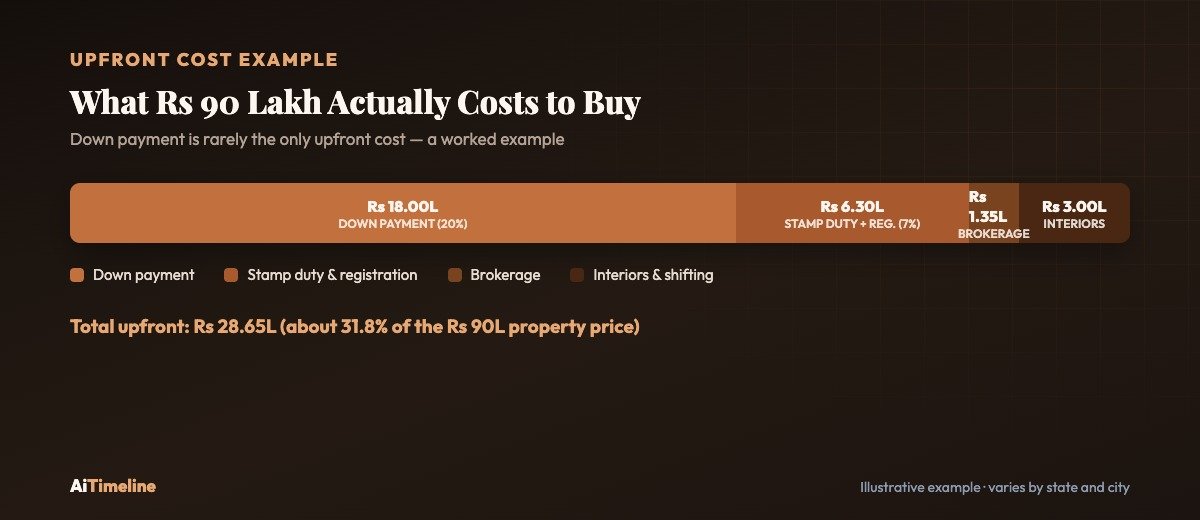
On a Rs 90 lakh property, the down payment alone is rarely the whole upfront bill — stamp duty, registration, brokerage and interiors typically add another 10-12%.
How to Evaluate a Property Before Buying
- Confirm RERA registration. Every project above the Act’s size threshold must carry a state RERA registration number — check it on the state RERA portal, which also shows the promised possession date and any recorded delays or complaints.
- Verify title and approvals independently. A lawyer’s title search, not just the builder’s assurance, confirms clear ownership history and that the land use and building plan are properly sanctioned.
- Distinguish carpet area from super built-up area. RERA mandates carpet-area-based pricing — know exactly what usable floor area you’re paying for, not just the larger, less meaningful super built-up figure.
- Check the occupancy/completion certificate for ready properties — its absence can affect both loan disbursal and your GST liability.
- Research the builder’s delivery track record on past projects, not just the marketing for this one, including any RERA complaint history.
- Visit at different times of day to check water pressure, noise, sunlight and traffic — a weekday-morning visit alone hides most of what a home actually feels like to live in.
- Get a home loan pre-approval or eligibility check before you fall in love with a specific unit, so your budget is grounded in what a lender will actually finance, not just what you’d like to spend.
First-Time Buyer’s Step-by-Step Guide
- Assess affordability first, property second. Work out a comfortable EMI (commonly under 35–40% of monthly take-home pay) before you start browsing listings — it prevents falling for a home outside your realistic budget.
- Build or confirm your emergency fund. Most planners recommend 6–12 months of household expenses set aside before taking on a 15–20 year loan commitment, kept separate from the down payment.
- Save the down payment and upfront costs separately. Budget for the down payment (10–25% depending on RBI’s LTV slab) plus stamp duty, registration, brokerage and interiors as one combined upfront-cost target, not just the down payment alone.
- Check your credit score and clear any high-interest debt first — a CIBIL score of 750-plus generally unlocks the lowest advertised home loan rates.
- Compare loan offers across at least 3–4 lenders, including both public-sector banks and housing finance companies, on interest rate, processing fee, and prepayment terms — note that prepayment charges on floating-rate individual loans are now banned by RBI rule for loans sanctioned or renewed from 1 January 2026.
- Shortlist RERA-registered projects or verified resale properties using the property-evaluation checklist above.
- Get the sale agreement and loan documents reviewed by a lawyer before signing, not after.
- Complete registration, paying stamp duty and registration charges at the sub-registrar’s office, and collect the registered sale deed.
- Set up EMI auto-debit and confirm your tax regime choice with an accountant, since it determines whether you can claim Section 24(b)/80C benefits at all.
Property Buying Checklist
A shorter, print-friendly version for the day you actually visit a shortlisted property.
✅ Before You Sign Anything
- RERA registration number verified on the state RERA portal
- Title deed and chain of ownership checked by an independent lawyer
- Occupancy/completion certificate available (for ready properties)
- Carpet area confirmed in writing, not just super built-up area
- Builder’s past project delivery timeline checked, not just this project’s brochure
- Home loan pre-approval or in-principle sanction obtained
- Total upfront cost calculated: down payment + stamp duty + registration + brokerage + interiors
- Society/RWA maintenance charges and any pending dues on the unit confirmed
- Locality visited at more than one time of day
- Resale/exit liquidity of the specific micro-market considered, not assumed
Tax Benefit Guide: Home Loans in 2026
Tax treatment of a home loan depends entirely on which regime you file under, and whether the property is self-occupied or let out. The table below separates what applies where, per Income Tax Department rules current as of 2026.
| Provision | Old Tax Regime | New Tax Regime (default) |
|---|---|---|
| Section 24(b) — interest, self-occupied home | Up to ₹2 lakh/year | Not available |
| Section 24(b) — interest, let-out property | Full interest deductible against rental income | Full interest deductible against rental income |
| Section 80C — principal repayment | Within overall ₹1.5 lakh/year limit | Not available |
| Section 80EEA — additional affordable-housing interest | Only for loans sanctioned Apr 2019–Mar 2022 (closed to new loans) | Not available |
| Stamp duty/registration (as part of 80C) | Eligible, within the same ₹1.5 lakh cap | Not available |
The practical takeaway: a buyer with a large loan and meaningful interest outgo may still find the old regime’s deductions worth more than the new regime’s lower slab rates, while a buyer with a small loan, or one who has already repaid most of the principal, may find the new regime’s simpler, lower rates come out ahead. This is a household-specific calculation, best run with an accountant each filing year rather than assumed once and forgotten — especially since regime rules have already changed once in recent years and can change again in a future Budget.
⚠️ Common Mistakes
- Assuming EMI equals rent for comparison purposes. EMI includes a principal (equity) component; rent does not — comparing raw EMI to raw rent overstates buying’s true cost.
- Ignoring upfront costs beyond the down payment. Stamp duty, registration, brokerage and interiors can add 8–15% on top of the down payment itself.
- Assuming the old-regime tax deductions apply automatically. Under the new tax regime, Section 24(b) and 80C benefits on a self-occupied home simply aren’t available.
- Treating a citywide rental-yield or appreciation average as true for one specific building. Micro-market performance varies far more than city averages suggest.
- Skipping RERA verification on an under-construction project because the price or the sales pitch looks attractive.
- Not stress-testing EMI against a higher interest rate. A floating-rate loan can reprice upward, as it did sharply in 2022 — affordability should be checked at rates above today’s, not only at today’s rate.
- Depleting the entire emergency fund for the down payment. A home loan does not pause for a job loss or medical emergency; a separate liquid cushion still matters after buying.
Decision Checklist
Not a verdict — a way to see which list your own situation matches more closely.

A simplified decision tree — the two checklists below unpack each of these questions in more depth.
✅ Lean Toward Buying If
- You expect to stay in this city for 7+ years
- Your household income is stable and salaried, or reliably diversified
- You have 6–12 months of expenses saved separately from the down payment
- Your EMI would sit comfortably under 35–40% of monthly take-home pay
- Local rent is close to what the EMI on an equivalent property would cost
- You value customisation, stability and forced-savings discipline over flexibility
🏠 Lean Toward Renting (and Investing the Difference) If
- Your horizon in this city is under 5–7 years, or genuinely uncertain
- Your income is variable, early-career, or you lack an emergency fund yet
- Local rental yield is low relative to home loan rates (a wide EMI-rent gap)
- You’d need to liquidate long-term investments to fund the down payment
- Career mobility or family circumstances could require relocating on short notice
- You’re disciplined enough to actually invest the rent-EMI gap monthly, not just spend it
Comparison Tables
Seven tables covering the core trade-offs this guide is built around.
1. Buying versus Renting
| Factor | Buying | Renting |
|---|---|---|
| Monthly outflow | EMI + maintenance + property tax | Rent (usually all-inclusive of upkeep) |
| Equity built | Yes, via principal repayment | None |
| Upfront cost | Down payment + stamp duty + registration + brokerage | Security deposit (typically 2–10 months’ rent) + brokerage |
| Liquidity | Low — sale can take months | High — move out with 30–90 days’ notice |
| Exposure to price/rent inflation | Insulated after purchase, at that price | Exposed to rent revisions at each renewal |
| Customisation | Full control, subject to society rules | Limited, subject to landlord permission |
| Tax treatment (old regime) | Interest + principal deductions available | HRA exemption may apply for salaried tenants |
2. EMI versus Rent
| Feature | EMI | Rent |
|---|---|---|
| Composition | Principal (equity) + interest (cost) | 100% cost, no equity component |
| Changes over loan/tenancy | Fixed EMI (fixed-rate) or resets with repo rate (floating) | Typically revised annually, often 5–10%+ in high-demand cities |
| What happens if you stop paying | Risk of default and loan foreclosure on the asset | Risk of eviction per rental agreement terms |
| Ends with | Full ownership of the property | Nothing retained; move-out |
3. Own-House Equity versus Rent-and-Invest Difference
| Path | What accumulates | Main risk |
|---|---|---|
| Buying (equity) | Property value minus outstanding loan, growing as principal is repaid and (if it happens) the property appreciates | Concentrated in one illiquid asset in one city/micro-market |
| Renting + investing the EMI-rent gap | A diversified investment portfolio, growing at the market’s return, plus the invested down payment | Requires genuine monthly investing discipline; market returns aren’t guaranteed either |
4. Fixed-Rate versus Floating-Rate Home Loans
| Feature | Fixed Rate | Floating Rate |
|---|---|---|
| Rate movement | Locked for an agreed period | Moves with the External Benchmark Lending Rate (usually repo-linked) |
| Starting rate | Usually somewhat higher | Usually lower at the outset |
| Best suited to | Borrowers who want certainty and rate-hike protection | Borrowers comfortable with EMI/tenure changes as rates move |
| Prepayment charges (from 1 Jan 2026 sanctions) | May still apply, per lender terms | Banned for individual, non-business floating loans, per RBI’s 2025 Directions |
5. Ready-to-Move versus Under-Construction Property
| Factor | Ready-to-Move | Under-Construction |
|---|---|---|
| GST | None (with occupancy certificate) | 5% standard / 1% affordable housing, no input tax credit |
| Possession/delivery risk | None — inspect before buying | Real, though RERA’s escrow and penalty provisions reduce it |
| Price | Typically higher per sq. ft. | Often priced lower, with payment linked to construction stages |
| Loan disbursal | Full amount disbursed upfront | Disbursed in stages as construction progresses |
6. Tier-1 versus Tier-2 City Housing Markets
| Factor | Tier-1 Cities | Tier-2 Cities |
|---|---|---|
| Property prices | Higher per sq. ft. | Generally lower per sq. ft. |
| Rental yields | Often lower in the priciest markets (e.g., Mumbai ~2–2.6%) | Can be higher relative to price, though rental demand is thinner |
| Job market depth | Deeper, more employer options if you need to switch | Narrower, often anchored to fewer large employers |
| Resale liquidity | Generally faster to sell | Can take longer, fewer active buyers |
7. Timeline Summary
| Year | Housing Event | Significance |
|---|---|---|
| 1950s | Post-Independence housing shortage | No organised home loan sector existed |
| 1960s | State Housing Boards scale up public housing | Housing remained state-delivered or self-built |
| 1977 | HDFC founded | Birth of dedicated private housing finance in India |
| 1988 | National Housing Bank established | Apex regulator/refinancer standardises the HFC sector |
| 1991 | Economic liberalisation | Opens door to private-bank mortgage competition |
| 2000 | Low-rate retail home loan boom | Home loans become a mainstream salaried product |
| 2005 | FDI reforms in real estate | Organised, branded developers scale up |
| 2008 | Global financial crisis | Developer delays expose the need for buyer protection |
| 2014–15 | Housing for All / PMAY launched | Targeted affordability lever for EWS/LIG/MIG buyers |
| 2016 | RERA enacted | First statutory regulator for real estate buyers |
| 2017 | GST on under-construction property; RERA rules live | Ready-vs-under-construction becomes a tax comparison too |
| 2020–21 | COVID rate cuts; WFH demand shift | Cheapest EMIs in a generation meet new space priorities |
| 2022 | Fastest RBI rate-hiking cycle in a decade | Proves floating EMIs are not fixed for 20 years |
| 2023 | Rental market surge (return-to-office) | Shows renting carries its own cost-inflation risk |
| 2024 | Capital gains tax rules rewritten | Exit economics of buying can change mid-ownership |
| 2025 | Prepayment charges banned on floating loans | Home loans become more flexible to exit or refinance |
| 2026 | Rates hold; metro rents keep climbing | Tests this page’s whole framework in real time |
Who’s Involved: The Institutions Behind India’s Housing Market
Reserve Bank of India
Sets the repo rate that anchors floating home loan pricing, regulates housing finance companies since 2019, and issues rules like the loan-to-value caps and the 2025 prepayment-charge ban.
National Housing Bank (NHB)
Established in 1988 as the housing finance sector’s apex refinancing and promotional institution; publishes RESIDEX, India’s official residential house-price index, across 50-plus cities.
RERA (Real Estate Regulatory Authority)
State-level regulators created under the 2016 Act, mandating project registration, carpet-area pricing, escrow protection for buyer funds, and a dedicated grievance forum for delayed or misrepresented projects.
Pradhan Mantri Awas Yojana (PMAY)
The central “Housing for All” mission launched in 2015, now in its PMAY-U 2.0 phase, offering interest subsidies and construction support to EWS, LIG and MIG households.
Income Tax Department
Administers Sections 24(b) and 80C home loan deductions (old tax regime), capital gains tax on property sales, and the rules distinguishing self-occupied from let-out property tax treatment.
HUDCO
The Housing and Urban Development Corporation, established in 1970, remains a major techno-financing institution for public housing and urban infrastructure projects, distinct from retail home loans.
Housing Finance Companies (HFCs)
Specialised non-bank lenders (HDFC being the original, alongside others) that, together with banks, form India’s competitive retail home loan market, now regulated directly by the RBI.
GST Council
Sets the goods and services tax rates applied to under-construction property (5% standard, 1% for qualifying affordable housing, without input tax credit, since April 2019) — a cost that doesn’t apply to completed, ready-to-move homes.
Explore More Timelines
Official Data Versus Market Trend Reporting
Kept deliberately separate, per this page’s editorial policy.
Confirmed official data
- RBI repo rate held at 5.25% through February, April and June 2026 MPC reviews.
- RBI’s LTV caps: 90% up to ₹30 lakh, 80% for ₹30–75 lakh, 75% above ₹75 lakh.
- Prepayment/foreclosure charges banned on individual floating-rate loans sanctioned or renewed from 1 January 2026 (RBI Directions, 2025).
- LTCG on property: 12.5% without indexation, or 20% with indexation for pre-23 July 2024 purchases (Budget 2024, unchanged in Budget 2026).
- PMAY-Urban: 1.64 crore-plus houses sanctioned, 98 lakh-plus completed, since 2015.
Market trend reporting and analyst commentary
- Home loan rates from PSU banks reported starting near 7.10–7.25% for well-qualified borrowers.
- National average gross rental yield reported around 5.16% in Q2 2026; Bengaluru leading near 4.4–4.5%, Mumbai lower near 2–2.6%.
- Bengaluru rents reported up roughly 12.5% over the past year.
- EMI-to-rent ratio of roughly 1.8–2.2× in many metros is a commonly cited industry rule of thumb, not an official statistic.
- These figures move with each new market report and should be treated as directional, not exact for any one property.
💡 Interesting Facts About Indian Real Estate
- Several states, including Maharashtra, Karnataka and Delhi, offer a 1–2 percentage point stamp duty rebate when the property is registered in a woman’s name.
- NHB’s RESIDEX index has tracked official residential prices since 2007 and now covers over 50 Indian cities.
- GST applies differently to the same flat depending on whether it’s sold before or after the occupancy certificate is issued — a purely paperwork-timing difference with a real tax consequence.
- RBI’s loan-to-value rules mean a ₹90 lakh home can legally require a minimum down payment of roughly ₹22.5 lakh (25%) or more, not just whatever a bank chooses to ask for.
- Since January 2026, switching your home loan to a cheaper lender no longer costs a foreclosure fee on floating-rate individual loans, under RBI’s newest borrower-protection rule.
People Also Ask
70 Frequently Asked Questions
Grouped by decision basics, EMI and loans, tax rules, legal protection, renting, and specific scenarios.
Related Reading on AiTimeline
Youth Unemployment in India: A Data-Led Timeline
India-UK Free Trade Agreement Timeline
India’s Renewable Energy Transition
Fuel Price Dynamics and Their Economic Impact
Tata Sierra EV: The Complete History and Timeline
Explore every AiTimeline story
Why the Right Home Decision Depends on Your Life, Not Just the Market
Ankit and Meera didn’t resolve their argument with a spreadsheet alone, though they did eventually build one. What settled it was admitting what the spreadsheet couldn’t tell them: whether they wanted the certainty of a settled address before starting a family, or the freedom to leave Bengaluru in three years if a better offer came from somewhere else. That is, in the end, what this entire guide has been building toward — not a verdict on buying versus renting, but a way of seeing your own situation clearly enough to make the call yourself.
Choosing between buying and renting is one of the most consequential financial decisions an Indian household makes, precisely because it is never only financial. The right choice depends on affordability, career plans, family needs, how long you expect to stay, how much liquidity you need to keep on hand, and your longer-term wealth goals — not on market sentiment, a relative’s advice, or a headline about interest rates. Home loan rates will keep moving with RBI policy. Rents will keep moving with local demand. Tax rules will keep changing with future Union Budgets. This page is built to be updated as each of those things does — but the underlying framework, the eight variables at the top of this guide, should still be the right way to think about the decision years from now.
Before committing either way, review the RBI’s current guidance on home loans, check a project’s RERA registration and complaint history on your state’s portal, confirm which tax regime you’ll actually file under, and if the numbers are close, talk to a fee-only financial adviser or chartered accountant rather than relying on any single article — including this one.
✉ Editorial note, sources and limitations
Last reviewed: 1 August 2026. Historical milestones (pre-2015) draw on widely documented Indian housing-finance and policy history. Current rates, yields and scheme data are attributed to the source reporting them at every point in this article and will shift as new RBI, NHB and Budget data is released. Nothing on this page is investment, legal or tax advice, and no return, rate or price move is guaranteed or predicted.
Primary and official sources used:
- Reserve Bank of India — Press Releases & Monetary Policy statements
- National Housing Bank — RESIDEX, official residential price index
- Pradhan Mantri Awas Yojana — Urban — Ministry of Housing and Urban Affairs, About PMAY-U
- Income Tax Department — Official e-Filing portal and tax rules
- Ministry of Housing and Urban Affairs / PIB — RERA implementation review
- Housing and Urban Development Corporation (HUDCO) — Official corporate profile
Sources & further reading
Every dated entry above was checked against these references. Last reviewed 15 September 2026.
- Reserve Bank of India — Press Releases & Monetary Policy
- National Housing Bank — RESIDEX, official residential price index
- Pradhan Mantri Awas Yojana – Urban, Ministry of Housing and Urban Affairs
- Income Tax Department — official e-Filing portal
- Ministry of Housing and Urban Affairs / PIB — RERA implementation review
- News on AIR — Unified RERA portal launch, September 2025
- Housing and Urban Development Corporation (HUDCO) — official site