China Rare Earth Timeline 2010–2026: From Mine to Magnet—and the New Supply-Chain Squeeze
China's rare-earth power is more than mining: separation, magnets, export licences. How the US, Australia, India, EU and Japan are diversifying supply.
Latest Story
The China rare earth timeline is not really a story about mining. China mines a large majority of the world’s rare-earth ore — but its deeper leverage sits one step downstream, in the separation plants, metal-alloy lines and magnet factories that turn raw ore into a usable industrial input. That distinction explains why, on 4 September 2026, Reuters reported that a handful of Chinese rare-earth suppliers had quietly paused some shipments to some US clients — without any new export ban, and without China’s mines changing output at all. This page tracks how that leverage was built, year by year, from 2010 to today, and separates what has actually happened from what is still a plan, a target or an unconfirmed report.
Why can rare-earth supply problems hurt US industry without a full export ban?
Because the choke point isn’t ore — it’s qualified processing capacity. A delayed export licence, a paused shipment, or a magnet grade that becomes hard to source can stall a production line, because very few non-Chinese separation plants or magnet makers are qualified to replace it on short notice; qualifying a new supplier for an automotive or defence-grade magnet typically takes months to years. On 4 September 2026, Reuters reported that a handful of Chinese rare-earth suppliers had refused to ship some materials — including the rare earths yttrium and terbium — to some US clients, citing wariness after Beijing sanctioned a US supply-chain auditor. That is a reported pattern of company-level caution affecting some suppliers and some shipments, not evidence of a total, government-ordered cut-off, and no new blanket export ban was announced alongside it.
| Stage | Why it matters |
|---|---|
| Mining | Produces ore and concentrate |
| Separation/refining | Creates usable rare-earth materials |
| Metal/alloy production | Turns oxides into engineering inputs |
| Magnet manufacturing | Creates the high-value component bottleneck |
| Motors and systems | Determines the impact on factories and consumers |
China Rare Earth Supply Chain: Key Questions
What to hold onto
- China’s leverage sits mainly in separation and magnets, not mining alone. Its ~69% mining share (USGS, 2025) is smaller than its estimated 90%+ separation share (IEA) and its even higher share of magnet manufacturing.
- No blanket export ban is in force. Only element-specific licensing requirements exist, plus one broader control that China itself suspended.
- Reuters’ 4 September 2026 report describes some suppliers pausing some shipments — a reported pattern of company caution, not a confirmed government cut-off.
- China has used at least four distinct mechanisms since 2010: informal customs slowdowns, WTO-struck-down export quotas, per-element licensing, and technology-export bans. They are not interchangeable.
- December 2023 restricted extraction, separation and magnet-making TECHNOLOGY exports — not ore or finished metal.
- China suspended its broadest 2025 control for one year. The 9 October 2025 expansion (adding europium, holmium, erbium, thulium and ytterbium, plus an extraterritorial rule) was paused on 7 November 2025 until 10 November 2026, as part of a trade truce. An earlier, narrower April 2025 licensing regime on seven other elements remains active.
- Not every EV motor or wind turbine uses rare-earth magnets — induction motors and some turbine designs do not.
- Diversification is real but not fast. MP Materials’ DoD-backed buildout, Lynas’s heavy-rare-earth breakthrough, India’s National Critical Mineral Mission, the EU’s Critical Raw Materials Act and Japan’s stockpile programme are all genuine projects — each still years from matching China’s scale.
- Rare earths are 17 distinct elements with different uses and different supply risk. A shortage of one heavy rare earth is not the same as a shortage of neodymium.
- Rare earths are a separate category from gallium, germanium, graphite, lithium and antimony — other critical minerals that are sometimes controlled by related, but distinct, Chinese policies.
Rare Earths Explained in One Minute
- Rare earths are a group of 17 chemical elements: the 15 lanthanides (lanthanum through lutetium) plus scandium and yttrium, per the U.S. Geological Survey’s (USGS) classification — though USGS’s own mine-production and reserve data exclude most scandium as a separately tracked commodity.
- They are not geologically rare. The challenge is finding economically concentrated deposits, and building the separation capacity to turn ore into individual, chemically pure elements — a process that is technically difficult and environmentally intensive.
- A handful matter most for high-performance permanent magnets: neodymium and praseodymium (the primary magnet metals), plus small additions of dysprosium and terbium to keep magnets working at high temperatures.
- Others matter for entirely different things: cerium and lanthanum in catalysts and glass polishing; europium, terbium and yttrium in phosphors; gadolinium in MRI contrast agents; samarium in older, niche samarium-cobalt magnets for extreme-heat applications.
- Rare-earth magnets — mainly neodymium-iron-boron, or NdFeB — are used in selected EV motors, wind-turbine generators, consumer electronics, robotics and defence systems. They are common, not universal.
Rare earths are not one material
A shortage of one heavy rare earth (say, dysprosium) can create a very different risk from a shortage of a light rare earth like neodymium. Treat every rare-earth headline as being about a specific element, or a specific stage of the supply chain — not “rare earths” as a single interchangeable commodity.
Infographic 1 — The Mine-to-Magnet Supply Chain
Processing and magnets — not only mines — are the strategic chokepoints
| Stage | What happens | Why it is difficult |
|---|---|---|
| Mining | Ore extraction | Geology, permitting, cost |
| Separation | Individual elements separated | Complex chemistry and waste handling |
| Metal/alloy production | Oxides converted into usable metals | Specialist technology and quality control |
| Magnet making | Magnetic materials processed and sintered | Precision manufacturing and customer qualification |
| Components | Motors and electronics built | Design, testing and industrial scale |
| End products | EVs, turbines, electronics, defence systems | Depend on reliable supply and standards |
China’s own reported shares climb at every downstream step: an estimated 69% of world mine production (USGS, 2025), but a much higher share — upward of 90% by IEA estimates — of global separation and magnet-manufacturing capacity. A country that mines rare earths is not automatically independent of China; only separation, alloy and magnet capacity break that dependence.
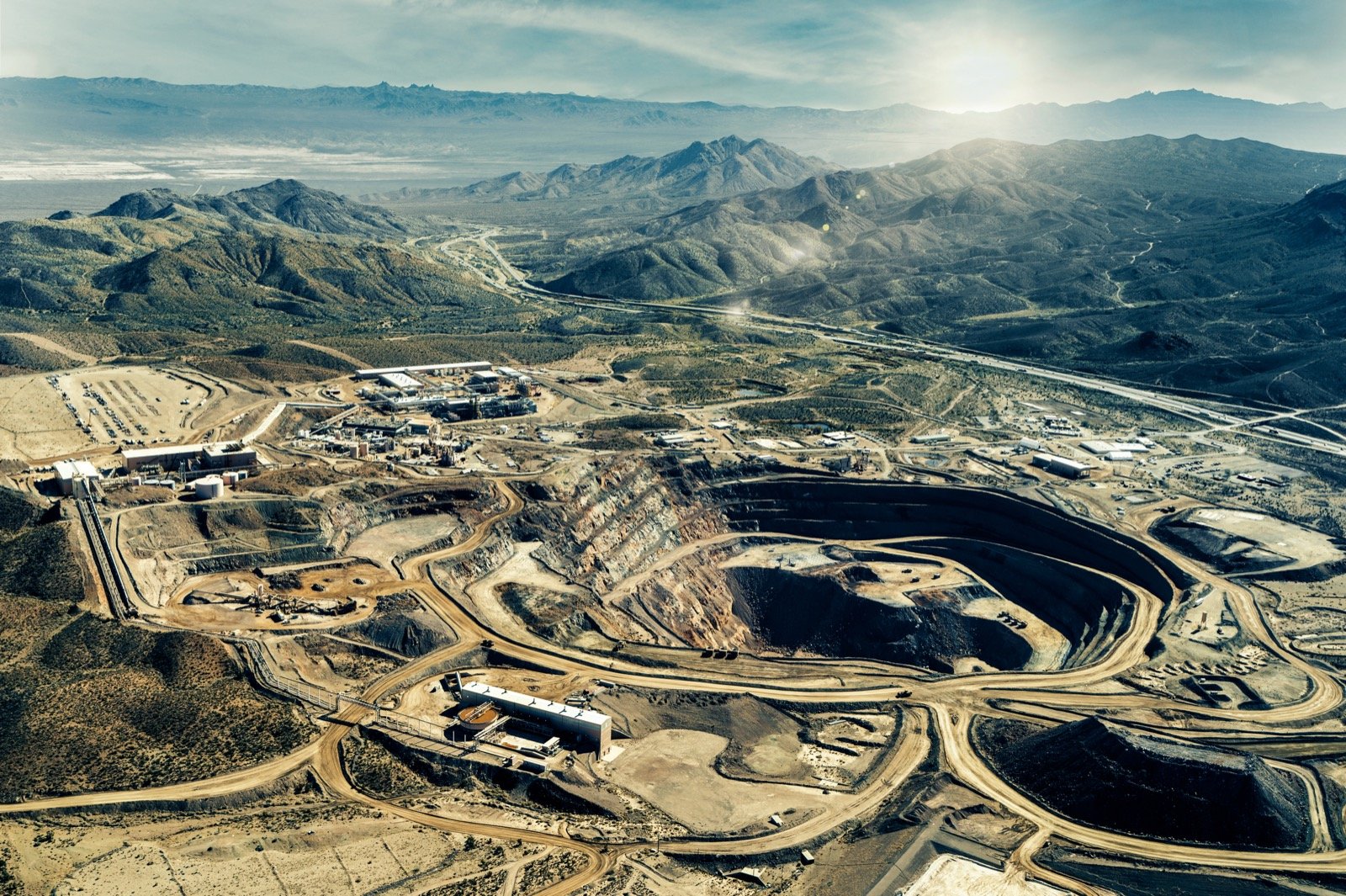
Mountain Pass, California — the only rare-earth mine currently producing at scale in the United States, paired with on-site processing. Photo: Tmy350 / Wikimedia Commons (CC BY-SA 4.0).
Infographic 4 — The 2010–2026 China Rare-Earth Timeline
Every entry labelled by status — newest first
Some Chinese suppliers pause some US shipments Reported shipment disruption
What was reported: Reuters reported that a handful of Chinese rare-earth suppliers had refused to ship some materials — including the rare earths yttrium and terbium, alongside separate critical minerals tungsten, gallium and indium phosphide — to some US clients. Reuters said it could not determine the total number of suppliers involved.
Why: The pause followed China’s early-August-2026 sanctioning of the Responsible Business Alliance (RBA), a US-based supply-chain auditor, leaving some Chinese firms wary of falling foul of Beijing over RBA-linked compliance audits. China’s Foreign Ministry said only that Beijing remained “committed to maintaining global critical mineral supply chains,” without confirming or detailing the halts.
China expands, then suspends, its broadest 2025 rare-earth control Temporary suspension
What it was: On 9 October 2025, China’s Ministry of Commerce (MOFCOM) expanded its rare-earth licensing regime to cover europium, holmium, erbium, thulium and ytterbium, and added a sweeping extraterritorial rule requiring a Chinese export permit for foreign-made goods — including magnets and some semiconductor-related devices — containing Chinese-origin rare-earth value above a low threshold.
What happened next: Following the Xi–Trump meeting at the APEC summit in Busan, China suspended these October controls for one year, until 10 November 2026, as part of a broader trade truce that also rolled back curbs on gallium, germanium and antimony (separate critical minerals). The April 2025 licensing regime on seven other elements, described below, was not suspended and remained active.
China requires export licences for seven rare earths Confirmed policy
What happened: China’s Ministry of Commerce added export-licensing requirements — not a ban — on alloys, compounds, metals and oxides of samarium, gadolinium, terbium, dysprosium, lutetium, scandium and yttrium. Exporters had to newly apply for permits, and some shipments were held up awaiting approval while the licensing system came online. Widely reported as a response to new US tariff measures.
Status today: This licensing requirement remains in effect. Per USGS, China began issuing general export licenses to selected exporters in December 2025, easing some of the earlier backlog without removing the licensing requirement itself.
China bans export of rare-earth processing technology Confirmed policy
What happened: China’s Ministry of Commerce banned the export of technology used for rare-earth extraction, separation, smelting and some magnet-preparation processes, folding it into an overhauled national-security technology export catalogue. This restricted know-how, not raw ore or finished metal — a country could still buy Chinese rare-earth oxide after this date, but could not license Chinese separation technology to build its own plant.
Clean-energy and defence demand accelerates In development
What happened: EV, wind-turbine, electronics and defence demand for rare-earth magnets grew through this period, raising the strategic profile of a supply chain most governments had treated as a niche industrial-policy issue since the WTO case closed. This is a demand trend, not a single dated policy event — specific market-size forecasts are avoided here for that reason.
China confirms compliance, removes rare-earth export quotas Confirmed policy
What happened: At a WTO Dispute Settlement Body meeting, China confirmed it had removed the export duties, export quotas and trading-rights restrictions on rare earths, tungsten and molybdenum that the WTO had ruled unlawful the previous year. China did not replace the quota system with an equivalent one — it shifted toward the licensing and technology-control tools used later in this timeline instead.
WTO Appellate Body rules against China’s export quotas Confirmed policy
What happened: The WTO Appellate Body upheld the March 2014 panel finding that China’s rare-earth, tungsten and molybdenum export quotas and duties breached its trade obligations, rejecting China’s argument that the restrictions were justified as resource-conservation measures under GATT Article XX(g).
WTO panel rules China’s export quotas illegal Confirmed policy
What happened: A WTO dispute panel ruled that China’s export quotas and duties on rare earths, tungsten and molybdenum violated GATT Article XI’s ban on quantitative export restrictions, and were not justified as conservation measures.
US, EU and Japan file a WTO case against China’s export quotas Confirmed policy
What happened: The United States, European Union and Japan jointly challenged China’s rare-earth, tungsten and molybdenum export quota-and-duty system at the WTO, arguing it unfairly restricted global supply while favouring Chinese domestic manufacturers.
Japan launches its rare-earth diversification programme Confirmed policy
What happened: Weeks after the Senkaku/Diaoyu disruption below, Japan’s government approved a roughly ¥100 billion (about $1.2 billion) supplemental budget for a “Rare Earths Comprehensive Plan,” extending a Rare Metal Security Strategy first set out in July 2009 around four pillars: overseas resource development, recycling, substitute materials and strategic stockpiling.
Result over time: Japan’s rare-earth import dependence on China fell from roughly 90% in 2010 to roughly 60% by 2020, and has held near that level through this update — a real reduction, not full independence. Japan’s state agency JOGMEC also financed Lynas’s Malaysian processing plant beginning in 2011.
Senkaku/Diaoyu boat collision triggers an informal Japan shipment slowdown Reported shipment disruption
What happened: After a Chinese trawler collided with Japanese Coast Guard vessels near the disputed Senkaku/Diaoyu islands on 7 September 2010 and its captain was detained, Japanese buyers reported that Chinese customs unofficially slowed rare-earth shipments to Japan from around 21 September. China’s total rare-earth exports fell by roughly 77% year-on-year that September, and global prices roughly quadrupled over the following months.
China’s position: Beijing officially denied imposing any export ban, describing the slowdown as unrelated to the diplomatic dispute. No customs notice or official policy document confirming a deliberate embargo has ever been published.
Infographic 7 — What Is Confirmed vs What Is Still Uncertain, Right Now
| Development | Status | What is confirmed | What is not confirmed |
|---|---|---|---|
| Chinese supplier shipment pauses | Reported | Some suppliers reportedly halted some US shipments | No evidence of a total worldwide embargo |
| Export licensing (April 2025 regime) | Confirmed policy | Licences are required for 7 medium/heavy rare earths and can affect delivery time | Outcomes differ by product, buyer and how quickly a licence is granted |
| October 2025 licensing expansion | Temporary suspension | Suspended for one year, until 10 November 2026 | Whether it is extended, allowed to lapse, or reinstated early |
| US domestic response | In development | MP Materials mining, DoD-backed magnet capacity and a price floor exist | Full domestic mine-to-magnet independence is not complete |
| EU diversification | Policy and projects | CRMA 2030 targets and a demand-aggregation platform exist | Targets are not yet guaranteed capacity |
| Alternative supply (Australia, India, Japan) | Expanding | Real, funded projects are underway at each | Replacement capacity at China’s scale is not imminent |
Why Magnets Matter More Than Headlines About Mines
Neodymium-iron-boron (NdFeB) magnets are exceptionally strong for their size, which is why some motor and generator designs use them to improve power density and efficiency in a smaller package. But magnet production requires reliable material quality, specialised sintering and coating equipment, and a lengthy customer-qualification process before an automaker, wind developer or defence contractor will actually use a new supplier’s part. A country can mine rare-earth ore and still depend entirely on another country for separation, alloys or finished magnets — mining alone buys none of that downstream capability.
| Product | Possible rare-earth connection | Important nuance |
|---|---|---|
| EV motors | Some use permanent magnets | Not all EV motors use rare-earth magnets — induction motors use none |
| Wind turbines | Some direct-drive designs use magnets | Geared and other designs do not rely on rare-earth magnets |
| Smartphones/electronics | Magnets, speakers, vibration motors and components | Material content per device is small, but the supply chain behind it is complex |
| Data-centre hardware | Selected electronics, storage and power systems | Rare earths are one input among many — not shown to be the dominant one |
| Defence and aerospace | High-performance magnets and specialised systems | Use is real but sourced examples are limited; avoid blanket claims |
Infographic 5 — Country-by-Country Diversification Map
The Full Ecosystem
China mined an estimated 270,000 tonnes of rare-earth oxide equivalent in 2025 — about 69% of the world total of 390,000 tonnes (USGS), and holds an estimated 44 million of the world’s 75-million-plus tonnes of reserves. Its larger advantage is downstream: the International Energy Agency (IEA) estimates China separates over 90% of the world’s refined rare earths and manufactures a comparably dominant share of finished magnets.
Lynas Rare Earths
Lynas mines at Mt Weld, Western Australia, and separates rare earths at Kuantan, Malaysia — the largest rare-earth separation facility outside China, with roughly 10,500 tonnes/year of neodymium-praseodymium capacity. In 2026, Lynas became the first company outside China to commercially separate heavy rare earths dysprosium and terbium, though at a much smaller scale (roughly 1,500 tonnes/year). A proposed heavy-rare-earth plant in Seadrift, Texas remains in planning, not construction. Lynas alone does not replace Chinese output at scale.
MP Materials & the DoD Partnership
MP Materials mines at Mountain Pass, California, and began commercial NdFeB magnet production at its Fort Worth, Texas facility in 2025. A July 2025 Department of Defense deal made the Pentagon MP’s largest shareholder (roughly 15%, via preferred stock and warrants), added a 10-year $110/kg neodymium-praseodymium price floor, and committed to a 10-year magnet offtake agreement. A second Texas magnet facility (Northlake) and an expanded heavy-rare-earth separation line at Mountain Pass are both still under construction, targeted for 2026–2028.
National Critical Mineral Mission
India’s Cabinet approved the National Critical Mineral Mission in January 2025, with a ₹34,300 crore (about $4 billion) outlay over seven years, per the Press Information Bureau (PIB) and Ministry of Mines. State-run IREL (India Rare Earths Limited) processes monazite at plants in Odisha and Kerala; a separate ₹7,280 crore scheme to build domestic rare-earth permanent-magnet manufacturing was Cabinet-approved in November 2025. India is building a strategy, not yet operating at meaningful magnet-manufacturing scale.
Critical Raw Materials Act
The EU’s Critical Raw Materials Act (CRMA) sets 2030 benchmarks: at least 10% of annual EU consumption from domestic extraction, 40% from domestic processing, 25% from recycling, and no more than 65% reliance on any single third country for any strategic raw material, which includes rare earths for permanent magnets. An April 2026 “Raw Materials Mechanism” lets EU buyers pool demand and connect with suppliers and financiers. Named projects, such as a German magnet-recycling plant that began operating in April 2026, are real but individually small next to China’s scale.
JOGMEC & Stockpiling
Japan’s state agency JOGMEC maintains a national critical-minerals stockpile (60 days for most materials, up to 180 days for higher-risk ones) and has financed Lynas’s Malaysian plant since 2011. Japan’s rare-earth import dependence on China fell from roughly 90% in 2010 to roughly 60% by 2020, holding near that level through this update. Japanese firms are also developing NdFeB-magnet recycling from consumer and industrial equipment, targeted for fuller-scale operation around 2027.
Infographic 8 — Can the World Diversify Away From China?
Diversification is genuinely underway, not just talked about: the United States, Australia, India, the EU and Japan each have funded, named projects moving through construction or early operation. But new mines alone will not solve the problem, because mining was never the whole chokepoint. Separation, alloy-making and magnet manufacturing require specialised technical expertise, environmental controls, patient financing and long-term offtake contracts with customers willing to qualify a new, unproven supplier — each of those takes years, not a single funding announcement. Recycling can help extend supply but cannot instantly meet new demand growth on its own, since there is not yet a large installed base of end-of-life magnets to recycle from. China remains central to global rare-earth supply chains today, though its exact share differs sharply by stage: closer to two-thirds in mining, and estimated above 90% in separation and magnets. The most realistic outcome over the next several years is broader supply diversity across multiple countries — not a sudden, complete decoupling from China.
| Region | 2030-era target | Reality check, now |
|---|---|---|
| European Union | ≤65% reliance on any one country; 40% domestic processing | Targets set in law; funded projects are still small and early-stage |
| United States | DoD-backed 3,000+ tonnes/year magnet capacity | First commercial magnets shipped 2025; expansion under construction |
| Australia | Commercial heavy-rare-earth separation outside China | Achieved at small scale (2026); Texas expansion still in planning |
| India | Domestic magnet manufacturing scheme funded | Cabinet-approved Nov 2025; production capacity not yet online |
| Japan | Reduced China import dependence via stockpiles + recycling | Dependence roughly halved since 2010, plateaued near 60% |
Infographic 6 — Trade Friction, Economic Security & Price Risk
Export-control friction does not automatically translate into shortages or price spikes — but it does raise operating risk for manufacturers who depend on Chinese-sourced materials.
This chain does not always run to completion. Companies with existing inventory, qualified substitute suppliers, or alternative material designs can absorb friction that would otherwise reach the factory floor.
What to Watch Next
Live-update tracker — last reviewed 4 September 2026
| Signal | Why it matters |
|---|---|
| Chinese licence approvals and export data | Shows actual material flow, not just policy announcements |
| Supplier shipment decisions | Indicates whether company-level caution is spreading or easing |
| US mine-to-magnet project milestones | Tests whether domestic capacity buildout stays on schedule |
| Australian and Japanese processing expansion | Adds non-Chinese separation and magnet capacity |
| EU strategic projects and recycling capacity | Tests whether CRMA targets translate into real output |
| India’s project and policy implementation | Shows whether its funded schemes reach production |
| Magnet prices and lead times | A more direct real-world tightness indicator than headlines |
| Whether the suspended October 2025 controls are reinstated | Would be a material policy escalation before the 10 Nov 2026 deadline |
Explore More Timelines
Infographic 2 — The Supply Chain at a Glance
Frequently Asked Questions
✅ What This Page Does
- Labels every measure Confirmed policy, Reported, Temporary suspension, Target or In development
- Cites USGS, WTO, EU and Reuters sources directly for every consequential figure
- Keeps mining, separation and magnet-manufacturing shares separate and dated
❌ What This Page Avoids
- Calling any licensing regime a “blanket ban”
- Treating “some suppliers” as “all Chinese suppliers”
- Confusing rare earths with gallium, germanium, graphite, lithium or antimony
⚠️ Editorial Note
This article separates confirmed government and agency statements from editorial interpretation throughout, and never presents a licensing requirement, a suspended control or a reported shipment pause as a blanket export ban. Figures are drawn directly from the USGS Mineral Commodity Summaries, WTO dispute records, the European Commission, India’s Press Information Bureau and Reuters reporting; where a figure could only be confirmed through secondary or industry sources, that is noted in the text. “The Rare Earth War” in this page’s framing is editorial shorthand for economic-security competition, not a literal military claim. Facts may become outdated as policy evolves — check the “Updated” date above, and treat every 2026–2030 figure as current understanding, not a guarantee.
Sources & further reading
Every dated entry above was checked against these references. Last reviewed 15 September 2026.
- Reuters - China rare earth firms halt some US shipments over geopolitical worries, sources say
- USGS Mineral Commodity Summaries 2026 - Rare Earths
- WTO - China - Measures Related to the Exportation of Rare Earths (DS431)
- CSET Georgetown - Translation of MOFCOM Notice 2025 No. 61 on rare-earth export controls
- European Commission - Critical Raw Materials Act
- European Commission - Raw Materials Mechanism platform launch, April 2026
- PIB - Cabinet approves National Critical Mineral Mission
- IEA - With new export controls on critical minerals, supply concentration risks become reality