Agentic AI in Finance Timeline 2023–2026: How Wall Street Is Moving From Chatbots to AI Agents
How Wall Street moved from chatbots to AI agents (2023-2026): Goldman-Anthropic Claude agents, the 51% bank pilot survey, and what regulators allow.
Latest Story
For the first phase of Wall Street’s generative-AI boom, the human still did almost everything important. The AI summarised a filing; a person read the summary. The AI drafted a memo; a person sent it. The AI suggested code; an engineer ran it. Agentic AI changes that sequence: instead of returning one answer, an agent can take a goal, find information, call software tools, move between applications, check its own intermediate results and complete several steps — increasingly deciding which step comes next. This agentic AI in finance timeline tracks how Wall Street and its regulators actually moved from chatbots to agents between 2023 and 2026. The headline is not that banks handed trading floors to robots. It is that they started giving AI real authority over workflows — and now have to decide where that authority stops.
Data last verified: 2 September 2026. This article separates what banks and AI vendors have officially announced, what regulators have published, what news organisations have reported, and what remains simulation or future risk. It contains no investment advice, no trading signals, no buy/sell or portfolio recommendations, and no instructions for autonomous live trading.
🧠 AI Overview Summary
Between 2023 and 2026, Wall Street’s use of AI evolved from chatbots that answer questions to agents that complete multi-step workflows using approved data and tools. Enabling technology such as OpenAI’s June 2023 function calling and Microsoft’s AutoGen made structured tool use and multi-agent designs practical. Goldman Sachs rolled out a firmwide AI assistant in June 2025, detailed an AI-driven operating model in early 2026, and in February 2026 confirmed it had spent roughly six months with embedded Anthropic engineers building Claude-based agents for trade and transaction accounting, client due diligence and onboarding. In May 2026 Anthropic released ten finance-specific agent templates. By mid-2026, a KPMG survey cited by Reuters put 51% of surveyed banks as piloting AI agents, mostly as “digital coworkers” in research, wealth, treasury and operations. Regulators — FINRA, ESMA, the Federal Reserve, the Bank of England and the Financial Stability Board — treat fully autonomous AI trading as a future risk to study, not a documented mainstream practice; the FSB’s most immediate concern as of August 2026 is AI-amplified cyber risk.
Agentic AI in Finance: Key Questions
What actually changed between 2023 and 2026
- The shift is from AI that answers to AI that completes workflows. Chatbot, copilot, tool-using assistant, agent, agentic workflow, multi-agent workflow, bounded autonomous system — Wall Street moved several rungs up that ladder, but not to the top.
- Function calling (June 2023) made tool use structured and reliable — it did not invent AI agents. ReAct-style research and LangChain agent concepts predate it.
- Agentic AI is not the same as multi-agent AI. One agent can use many tools; a multi-agent system splits work across specialised agents. Not every bank deployment uses multi-agent architecture.
- Goldman Sachs is the clearest public case. Firmwide AI assistant (June 2025), then software-engineering agents, then an AI-driven operating model (early 2026), then Claude-based agents with Anthropic for accounting, due diligence and onboarding (February 2026).
- Banks let AI write code before they let it control capital. Code can be tested, reviewed, sandboxed and rolled back; a live trade changes counterparty exposure and capital in ways that cannot simply be undone.
- “AI in trading” usually means research, analytics, surveillance, pricing or execution support — not an LLM independently selecting a security, sizing a position, executing and managing risk.
- Regulators separate three horizons: today’s concern is cyber and operational resilience; the emerging concern is client-facing and financial decision-making autonomy; the future systemic concern is correlated behaviour across many similar agents.
- The FSB’s most immediate AI concern (August 2026) is cyber risk — frontier AI changing the speed, scale and economics of finding and exploiting vulnerabilities — not an imminent AI-driven flash crash.
- Bounded autonomy is the operating model. The Wall Street question is no longer “can AI write the memo?” but “what are we willing to let it do after the memo?”
🔴 Reading the status labels used throughout this article
🟢 VERIFIED DEPLOYMENT — announced by the institution or vendor as in production use. 🔵 PILOT / DEVELOPMENT — confirmed as being built or tested, not yet general production. 🟡 REPORTED / PARTIALLY VERIFIED — from credible reporting or a survey, with details (sample, scope) not fully public. ⚪ CONCEPT / SIMULATION — a research project or simulated environment, not a live market system. 🔴 NOT YET ESTABLISHED — not a documented normal practice at major institutions; do not assume it.
Generative AI answers. Agentic AI acts. Wall Street’s question is no longer “can AI write the memo?” It is “what are we willing to let it do after the memo?”
Chatbot vs Agent vs Multi-Agent System
Three different things that get blurred together in coverage
A chatbot takes a question and returns an answer. An agent takes a goal, makes a plan, calls tools, takes actions and returns a result — and can maintain state across the steps. A multi-agent system divides that work across specialised agents, for example a research agent, a risk agent and a compliance agent coordinated by an orchestrator, usually with a human approval step before anything is actioned.
The important correction: agentic does not automatically mean multi-agent. A single agent using several tools is still an agentic system, and many bank deployments are exactly that. Multi-agent architecture is an option, not a requirement — and it introduces its own failure modes (agent disagreement, error propagation, authority confusion, feedback loops) rather than being automatically safer.
Generative AI Assistant vs Agentic AI
| Capability | Generative AI assistant | Agentic AI |
|---|---|---|
| Main purpose | Generate or analyse information | Complete goals across steps |
| Typical interaction | Prompt → response | Goal → plan → tools → actions |
| Tool use | Optional | Often central |
| Memory / state | Usually limited task context | Can maintain workflow state |
| Autonomy | Low to moderate | Bounded / moderate, depending on permissions |
| Human role | Reviews output | Sets boundaries, approvals and exceptions |
| Finance example | Summarise a 10-K | Collect documents, run checks, prepare workflow output |
| High-risk action | Human executes | Usually permission-gated |
| Audit requirement | Prompt / output history | Full action, tool and approval trail |
Autonomy is a spectrum, not a switch. The realistic picture is “bounded and permission-gated,” not “constant prompting” versus “humans only supervise.”
The Real Wall Street Model: Bounded Autonomy
Banks generally do not want an unconstrained AI model with unlimited access to money, markets, client accounts or regulated systems. Instead, agentic AI is connected to specific tools, specific data, specific permissions, specific workflows and human approval gates. The critical word is bounded.
An agent may be allowed to read documents, query databases, calculate values, draft forms and reconcile records. It is not necessarily allowed to move funds, send regulated communications, approve client onboarding, change risk limits or execute trades. The more authority an agent gets, the more important its permission boundary becomes.
Human-in-the-loop vs human-on-the-loop
Human-in-the-loop: the agent must pause and get approval before a critical action. Human-on-the-loop: the agent can operate inside pre-approved boundaries while a human monitors and can intervene. Full autonomy: minimal or no human approval. For regulated finance, many high-risk applications should stay bounded and approval-gated — and neither in-the-loop nor on-the-loop is mandatory for every agent; the right setting depends on the action’s blast radius.
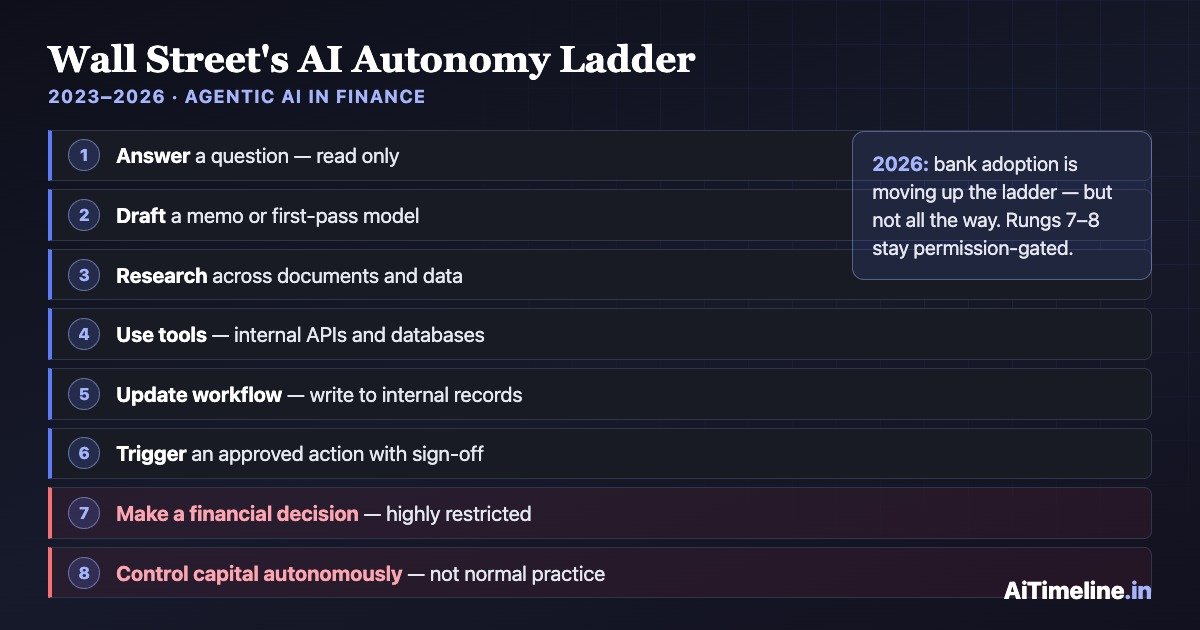
Wall Street’s AI Autonomy Ladder
2026 adoption is moving up the ladder — but not all the way
The question is not “can an AI agent do the job?” It is “how much authority should it be given?”
Where Is the Agent Allowed to Act?
An AI does not need direct exchange access to create large productivity gains — it can automate everything around the final controlled action.
Goldman Sachs’ Agentic-AI Stack
The clearest public sequence from assistant to digital coworker
At the February 2026 report, Goldman was described as “in the early stages” of developing these agents and expecting to launch them “soon” — not as having deployed autonomous Claude agents across the bank. Goldman executives said they were surprised at how capable Claude was beyond coding, in accounting and compliance work that combines parsing large volumes of documents with applying rules and judgement. The bank also reported a roughly 30% reduction in the time to onboard new institutional clients using Claude’s reasoning. 🔵
Why code is easier than money
✅ Code
- Can be tested before it runs
- Can be reviewed by a human or another system
- Runs in a sandbox first
- Version controlled — can be rolled back
❌ A live trade
- The market moves while you act
- Execution changes counterparty exposure
- Capital changes hands
- Some effects cannot simply be undone
This is why banks let AI write code before they let it control capital — software engineering is a relatively controlled environment for agent autonomy.
A Note on the Model Version
Anthropic released Claude Opus 4.6 on 5 February 2026, improving agentic task performance, coding, long-horizon work and document and spreadsheet workflows, and some reporting connects that model to Goldman’s agent development. But Goldman’s confirmation refers broadly to Claude-based agents. Unless a first-party Goldman source names the exact production model, the bank’s agent strategy is better described model-agnostically. Model versions change quickly; the architecture is what lasts: approved data → model → tools → permissions → checks → human gate → audit trail.
Who Is Using Agents?
Based on July 2026 Reuters reporting and company disclosures; blanks mean no public evidence, not “no”
| Institution | Reported agentic / AI focus areas | Autonomous live trading |
|---|---|---|
| Goldman Sachs | AI assistant, software engineering, accounting, due diligence, onboarding, operating-model redesign | No public evidence |
| JPMorgan | Internal productivity, research, treasury and financial-services workflows | No public evidence |
| Morgan Stanley | Adviser-support agents, client interaction; humans kept in the loop | No public evidence |
| Citi | Enterprise AI, agentic architecture, digital-assistant rollout | No public evidence |
| BNY | AI systems managed operationally like “digital employees” with defined identities | No public evidence |
| UBS | Digital assistants with human oversight | No public evidence |
| Visa, AIG | Named by Anthropic among financial-services adopters of its agents | Not applicable / no public evidence |
“Digital employees” is an operational management metaphor for identity, permissions and ownership — not a claim that an AI legally becomes an employee. No entry here should be read as evidence of autonomous trading.
“Trading” Is Not One Thing
When a source says AI is used in trading, it can mean any of: research, analytics, data processing, surveillance, execution support, pricing, workflow automation or algorithm development. It does not automatically mean an LLM independently selects a security, chooses a position, sets size, executes and manages risk. There are at least six distinct meanings, and collapsing them into “AI trading” is the single most common error in coverage:
- AI helps trading research — summarising filings, news, positioning.
- AI helps algorithm development — writing and testing execution code.
- AI adjusts existing models — tuning parameters a human owns.
- AI suggests orders — a human decides.
- AI manages a portfolio under constraints — inside hard limits and suitability rules.
- AI autonomously creates and executes strategies — the frontier, not documented as mainstream.
Algorithmic trading is not agentic AI
Algorithmic trading has existed for decades: a predefined rule or model receives market data and executes. An agentic system can potentially plan, reason, select tools, adapt its workflow and make sequences of decisions. Not every algorithm is an AI agent.
High-frequency trading is not an LLM agent
High-frequency trading prioritises latency, deterministic execution, market microstructure and specialised infrastructure. LLM agents add reasoning and tool orchestration — but also latency, non-determinism and model risk. It is technically misleading to say “LLM agents execute trades at zero latency.” The more accurate concern: machine-speed decisions can amplify risk if more autonomous AI is eventually connected directly to financial decision-making.
What Regulators Actually Worry About
Three horizons that should be kept separate
| Body | 2026 action / position | Status |
|---|---|---|
| FINRA (US) | 2026 Annual Regulatory Oversight Report treats AI agents as an emerging trend; flags autonomy and scope creep, authority beyond intended scope, auditability and transparency, data sensitivity, domain knowledge and incentive design — on top of hallucination, bias and privacy risks | 🟡 Guidance |
| ESMA (EU) | 26 February 2026 supervisory briefing on algorithmic trading under MiFID II: governance, testing, outsourcing and the interpretation of key concepts; existing trading rules still apply when AI is used | 🟢 Published |
| Federal Reserve (US) | Examining agentic AI both as a user (applying AI to financial-stability analysis) and supervisor; AI named among top potential market shocks in the 2026 Financial Stability Report; US interagency work in April 2026 noted traditional model-risk guidance does not specifically encompass generative/agentic AI | 🟡 Reported |
| Bank of England | July 2026 Financial Stability Report: frontier AI raises financial-stability risk mainly via cyber and operational vulnerabilities and third-party concentration; analysis indicates more autonomous AI in markets is currently weighted toward research, coding and surveillance, not fully autonomous trading | 🟢 Published |
| Financial Stability Board | 31 August 2026 letter to G20: frontier AI’s effect on cyber risk is the most immediate concern for the financial system — it could alter the speed, scale and economics of cyber attacks, amplified by concentrated third-party providers | 🟢 Published |
| BIS Innovation Hub + BoE + Bundesbank | Project Logos: an agent-based simulation comparing rules-based and LLM-based asset managers in a simulated market, to study how agents allocate capital and whether they amplify correlated decision-making | ⚪ Simulation |
🔮 Project Logos — regulators testing the future
Actual market today → simulated agent market → study collective behaviour → design future oversight. Project Logos is a simulation, not proof that central banks allow AI agents to manage real portfolios. Its research question is the systemic one: if many systems share common models, data, signals, cloud providers and optimisation objectives, could they react similarly to the same signal and amplify a market move? One bad AI agent is an operational risk; thousands of similar AI agents can become a systemic question.
On flash crashes: regulators are not claiming an AI-driven “Flash Crash 2.0” is expected tomorrow. The historical analogy is used to frame a research question about correlated automated behaviour — not to describe a documented agent-driven crash. And using AI does not erase existing regulation: rules on supervision, records, market conduct, best execution, risk controls and communications can still apply. Regulation here is technology-neutral.
The Agentic-AI Governance Problem: Who Authorised the Action?
Traditional software usually follows defined logic. Generative AI can produce unexpected output. Agentic AI adds another dimension: unexpected action. So the key governance question is not only “was the answer correct?” but “was the agent allowed to do that?“
For every action, a bank may need to reconstruct which model acted, what data it saw, which tools it called, what permissions it had, what rule it applied, what intermediate output it generated, whether another agent reviewed it, whether a human approved it, and what happened afterward. That makes auditability, permissioning, identity, monitoring and action logs into core financial infrastructure.
Liability is not a simple choice
Responsibility for an agent’s mistake is not a clean pick between the bank, the model provider and a human supervisor. It can depend on the activity, jurisdiction, contract, regulatory obligation, delegation, supervision and product design. In many regulated contexts, an institution cannot simply outsource its responsibility to an AI vendor.
Traceability, not full explainability
Banks realistically need traceability — observable inputs, outputs, actions, tool calls, approvals and policy decisions — rather than a promise of full explanation of a model’s internal reasoning. Every action needs a receipt: input → plan → tool call → data accessed → policy decision → approval → action → result.
Agent passport
Name: KYC-Agent-23. Role: document preparation. Can read: approved KYC systems. Can write: draft case file. Can approve client: no. Can move money: no. Can execute trade: no. Human owner: compliance team. Audit log: on. Expiry: set.
Beyond generic GenAI risk
Prompt injection (an external document carrying a malicious instruction the agent then acts on), data leakage across client data, market data and material non-public information, and long multi-step workflows drifting out of scope. An AI agent acting for a professional does not get a free pass on insider-information rules or information barriers.
Multi-agent systems do not automatically add safety. A “risk agent” checking a “research agent” can add defence — but if both share the same model, data and prompt assumptions, they can fail together. Real safety diversity includes deterministic rules, traditional risk engines, independent data, hard position limits and human review, not just asking another language model.
Finance Agent Use-Case Maturity, 2026
| Use case | 2026 maturity | Autonomy risk |
|---|---|---|
| Document summarisation | High | Low |
| Research preparation | High | Low–Medium |
| Software engineering | High | Medium |
| Pitchbook drafting | High | Medium |
| KYC preparation | Growing | Medium |
| Reconciliation / accounting | Growing | Medium |
| Compliance monitoring | Growing | Medium–High |
| Client interaction | Pilot / growing | High |
| Portfolio recommendations | Controlled / pilot | High |
| Autonomous portfolio decisions | Limited / research | Very High |
| Unsupervised live trading | Not established as mainstream | Extreme |
Cost, Tokens and ROI
Agents do not automatically reduce operating cost. An agentic workflow can require many model calls, long contexts, multiple agents, tool execution, monitoring and human review. Goldman Sachs Research has said it expects agentic AI to materially increase token consumption, because agents think, check, retry, call tools, delegate and process more context. One chatbot handles one task; a multi-agent setup adds an orchestrator, a researcher, a reviewer, a risk check and retries. The right scorecard measures cycle-time reduction, manual touches, error rate, exception rate, human review time, compute cost, regulatory incidents and customer outcome — not “jobs eliminated” as the only metric.
Will AI Agents Replace Bankers?
The honest answer is not yes or no: tasks are likely to change before whole occupations disappear. Work most exposed includes document review, data gathering, routine coding, reconciliation, pitch materials and basic analysis. Human-heavy work — relationships, judgement, negotiation, risk ownership and regulatory accountability — remains central.
For decades, a junior banker learned by doing the slow work: reading the filings, checking the spreadsheet, updating the presentation, finding the number that did not reconcile. AI agents are very good candidates for exactly that kind of work. The productivity case is obvious. The training problem is not. If software completes the first five steps, the next generation of bankers may arrive at step six without having learned why the first five mattered.
Consider an analyst who asks an AI: “Prepare tomorrow’s client meeting.” A chatbot writes a briefing note. An agent could open the CRM, retrieve the client’s holdings, check recent earnings, review previous meeting notes, update approved analytics, find upcoming maturities, prepare the presentation and schedule a reminder. The human asked one question; the machine performed many tasks. That is the agentic shift.
Now change the instruction to “Manage the client’s portfolio.” The same convenience becomes a governance problem. What can the agent buy? How much? Using which data? Under which suitability rules? Who approved the strategy? Who stops it? That is why agentic finance will likely advance one permission boundary at a time.
Agentic AI in Finance: The Full Timeline (2023–2026)
Newest first. Each entry carries a verification status.
The Digital-Coworker Phase
What happened: Across large banks, AI assistants are widespread, agentic workflows are deploying or piloting in operations and research, software-engineering agents are in real use, and client onboarding and KYC agents are in development or rollout. Autonomous portfolio management and unsupervised LLM live trading are not established as normal major-bank practice.
Why it matters: The unresolved question is no longer whether an agent can do the task — it is how much authority comes next, and where it stops.
FSB: Frontier-AI Cyber Risk Is the Most Immediate Concern
What happened: In a letter to G20 finance ministers and central-bank governors, FSB Chair Andrew Bailey said frontier AI’s potential impact on cyber risk is the most immediate concern for the financial system, because it can materially alter the speed, scale and economics of finding and exploiting vulnerabilities, and because critical third-party providers are highly concentrated.
Why it matters: The biggest current regulatory fear is not an AI trader causing a flash crash tomorrow. It is cyber and operational resilience — a different risk from future market autonomy, and one that should be kept separate.
Bank of England: Autonomous AI in Markets Is Still Mostly Lower-Risk Work
What happened: The Bank of England’s July 2026 Financial Stability Report warned that frontier AI increases financial-stability risk mainly through cyber and operational vulnerabilities and dependence on a small number of cloud and AI providers. Its analysis indicated that more autonomous AI systems in markets are used primarily for research, coding, surveillance and other lower-risk operational functions, rather than fully autonomous trading. Separately, the BIS Innovation Hub London Centre, the Bank of England and the Deutsche Bundesbank set up Project Logos to observe LLM-based agents acting as portfolio managers in a simulated market.
Why it matters: This is the central distinction of the whole story — “AI in trading” today is mostly research and surveillance, and the portfolio-manager scenario is being studied in simulation, not run live.
Reuters: Banks Promote Agents From Research Aids to “Digital Coworkers”
What happened: Reuters reported major banks — Goldman Sachs, JPMorgan, Morgan Stanley, Citi, BNY and UBS — accelerating agentic-AI adoption across wealth management, client vetting, trading-related work, treasury and operations. A June KPMG survey cited by Reuters found 51% of surveyed banks were piloting AI agents. BNY was reported to be experimenting with AI systems managed operationally like “digital employees,” with defined identities and management structures.
Why it matters: The “51%” figure is a survey of surveyed banks piloting agents — not 51% of every bank worldwide, and not production deployment. It marks a shift in framing from research aid to coworker, with humans still in the loop for high-stakes decisions.
Anthropic Launches Ten Finance-Specific Agent Templates
What happened: Anthropic released ten agent templates for financial services: five research and client-coverage agents (pitch builder, meeting preparer, earnings reviewer, model builder, market researcher) and five finance and operations agents (valuation reviewer, general-ledger reconciler, month-end closer, statement auditor, KYC screener), shipped as plugins for Claude Cowork and Claude Code and as cookbooks for Claude Managed Agents. Anthropic identified financial-services customers including Goldman Sachs, Citi, Visa and AIG, and formed a services-led joint venture with Goldman Sachs, Blackstone and Hellman & Friedman.
Why it matters: Finance-specific agent workflows moved from custom experimentation toward repeatable products. Naming an institution as a customer does not mean it uses all ten templates.
ESMA Supervisory Briefing on Algorithmic Trading
What happened: ESMA issued a supervisory briefing to help national regulators supervise algorithmic trading under MiFID II, covering governance, testing, outsourcing and the interpretation of key concepts, including emerging AI use.
Why it matters: Using AI does not remove existing trading rules. Pre-trade controls, governance, testing and outsourcing obligations continue to apply.
Goldman Sachs Confirms Claude-Based Agents With Anthropic
What happened: Goldman confirmed it had spent roughly six months working with embedded Anthropic engineers to build Claude-based autonomous agents for internal workflows. Reuters-confirmed development areas: trade and transaction accounting, client due diligence, and client onboarding. Goldman said it was still in the early stages of developing these agents and planned to launch them soon; it reported a roughly 30% reduction in institutional-client onboarding time.
Why it matters: This is the central milestone of the story — and it is post-trade and operational work, not autonomous trading. February 2026 should not be rewritten as “Goldman deployed autonomous Claude agents across the bank.”
Anthropic Releases Claude Opus 4.6
What happened: Anthropic released Claude Opus 4.6, with improvements in agentic task performance, coding, long-horizon work, financial analysis, research and document and spreadsheet workflows.
Why it matters: Some reporting links the model to Goldman’s agent development, but Goldman’s public confirmation refers broadly to Claude-based agents. The bank’s strategy is best described model-agnostically — model versions change faster than architecture.
Goldman’s One GS 3.0 Operating Model
What happened: Around its Q4 2025 earnings call and 2026 annual meeting, Goldman detailed “One Goldman Sachs 3.0,” a multi-year, AI-driven operating-model transformation. Initial workstreams included client onboarding and KYC, enterprise risk management, vendor management, lending, regulatory reporting and sales enablement, with emphasis on auditability, data lineage, risk insights and workflow automation.
Why it matters: The redesign frames AI as an operating-model change, not a set of point tools — and starts in operations and control functions, not trading.
FINRA Flags AI Agents as an Emerging Risk
What happened: FINRA’s 2026 report explicitly treated AI agents — systems that plan, decide and act without predefined rules — as an emerging trend, flagging autonomy and scope creep, authority exceeding intended scope, and auditability and transparency, alongside data sensitivity, domain knowledge and incentive design, plus existing GenAI risks of hallucination, bias and privacy.
Why it matters: A US self-regulatory body put agent-specific risks on member firms’ agenda before most retail-facing deployments existed. Traditional GenAI risks still apply on top.
Software-Engineering Agents Enter Bank Workflows
What happened: Banks explored and adopted agentic software-engineering tools, with Goldman among those testing autonomous coding assistants. Code is a relatively controlled setting for agent autonomy because it can be tested, reviewed, version-controlled, sandboxed and rolled back.
Why it matters: Engineering became the intermediary step between the copilot phase and higher-stakes finance workflows — banks let AI write code before letting it touch capital.
Goldman Sachs Rolls Out the GS AI Assistant Firmwide
What happened: Goldman made its GS AI Assistant available across the firm, with about 10,000 employees already using it at rollout. Typical tasks: summarising documents, drafting content and performing data analysis.
Why it matters: This is the copilot phase — “help me understand this,” not “complete this approved workflow.” Large institutions, not just retail investors and junior analysts, were the adopters.
The Copilot Era: Wall Street Learns to Talk to AI
What happened: Large banks scaled generative-AI assistants for document summarisation, research assistance, code generation, internal search and meeting preparation.
Why it matters: Adoption at scale by major institutions set the base for the agentic step — but the AI still mostly returned information for a human to act on.
Microsoft Publishes AutoGen for Multi-Agent Workflows
What happened: Microsoft released AutoGen, a framework for building applications with multiple conversing agents, popularising multi-agent orchestration among developers. LangGraph and other production-orchestration tools followed in 2024.
Why it matters: Multi-agent design became a practical pattern — but it is an option, not a requirement, and it adds coordination-failure modes of its own.
OpenAI Introduces Function Calling
What happened: OpenAI added function calling, letting models generate structured arguments for external functions and APIs: model → tool request → external system → result → model.
Why it matters: Function calling made tool integration more structured and reliable — an important enabling technology for modern agents. It did not invent AI agents; agent concepts and ReAct-style research predate it.
–23
ReAct and Early Agent Frameworks Gain Developer Attention
What happened: ReAct-style “reason + act” research and early LangChain chains and tool-using agent concepts drew developer interest, establishing the pattern of an LLM planning steps and calling tools.
Why it matters: The conceptual groundwork for agents existed before function calling made it robust — the enabling technologies stacked up rather than arriving in one moment.
📝 Update History
- 2 September 2026 — Full rewrite: corrected “Wall Street gave AI the power to trade” framing to the verified “chatbots to agents, with bounded autonomy” picture; added FSB August 2026 cyber warning, BoE July 2026 FSR, Project Logos, Anthropic May 2026 templates, Goldman-Anthropic February 2026 detail, FINRA and ESMA 2026 actions.
- 31 August 2026 — FSB frontier-AI cyber-risk letter to G20.
- July 2026 — Reuters “digital coworker” reporting; KPMG 51% survey; Bank of England FSR and Project Logos.
- 5 May 2026 — Anthropic ten finance-agent templates.
- 6 February 2026 — Goldman Sachs confirms Claude-based agents with Anthropic.
- January 2026 — One Goldman Sachs 3.0 operating model.
- June 2025 — GS AI Assistant firmwide.
- 13 June 2023 — OpenAI function calling.
Explore More Timelines
People Also Ask
Frequently Asked Questions
Related AiTimeline Coverage
⚠️ Editorial & Accuracy Note
This article separates company and vendor announcements (Goldman Sachs, Anthropic), regulator publications (FINRA, ESMA, the Federal Reserve, the Bank of England, the Financial Stability Board, the BIS Innovation Hub), and news reporting (Reuters, CNBC), and labels each with a verification status. Figures were verified as of 2 September 2026. In India, the Securities and Exchange Board of India regulates algorithmic and automated trading and has consulted on AI/ML use in markets; there is no public evidence of major Indian institutions running unsupervised autonomous LLM trading. Nothing here is investment advice, a trading signal, or a recommendation to buy, sell or allocate. “Pilot” is not “production,” “research” is not “execution,” and “trade accounting” is not “trading.”
Sources & further reading
Every dated entry above was checked against these references. Last reviewed 15 September 2026.
- CNBC: Goldman Sachs taps Anthropic's Claude to automate accounting
- Anthropic: Agents for financial services
- Reuters via Investment News: Wall Street banks promoting AI agents into digital coworkers
- Bank of England: Financial Stability Report, July 2026
- Financial Stability Board: FSB Chair warns of risks from frontier AI models
- BIS Innovation Hub: Project Logos