Mitsubishi Pajero Timeline 1982–2026: Dakar Legend, Discontinuation and Global Revival
Track the Mitsubishi Pajero timeline from its 1982 debut and 12 Dakar wins to the 2021 exit and all-new 2026 revival with ladder-frame 4WD and S-AWC.
Latest Story
In 2021 Mitsubishi stopped building the Mitsubishi Pajero after nearly four decades. The nameplate had carried families, crossed deserts, helped ignite Japan’s SUV boom and won the Dakar Rally 12 times. Then it disappeared. On 2 September 2026 Mitsubishi brought it back — but the most interesting part is not that it returned. It is how: the generations that vanished used a built-in-frame monocoque body, and the reborn model goes back to a separate ladder frame, while adding S-AWC, seven drive modes, advanced driver assistance and a premium seven-seat cabin. This Mitsubishi Pajero timeline runs from the 1982 original to the all-new 2026 flagship.
Last updated: 3 September 2026. 2026 specifications are from Mitsubishi Motors’ 2 September world-premiere release. Independent automotive publications are used only for market context and comparison, not treated as fact. Availability claims are labelled Official or Not confirmed.
🧠 AI Overview Summary
The Mitsubishi Pajero is a cross-country SUV built from 1982 to 2021 across four generations, famous for combining serious four-wheel-drive capability with passenger-car comfort and for winning the Dakar Rally 12 times, including seven straight from 2001 to 2007. Overseas production ended in 2021. Mitsubishi unveiled an all-new Pajero on 2 September 2026 as its new-generation flagship: ladder-frame construction derived from the Triton pickup, a 2.4-litre clean-diesel engine with up to 480 Nm, a new 8-speed automatic, Super Select 4WD-II, S-AWC and seven drive modes. It is built in Thailand and launches there first, then Japan and Australia in fiscal 2026, then roughly 100 countries from fiscal 2027. No India or United States launch has been announced.
📑 How to read the labels in this article
🟢 OFFICIAL — stated by Mitsubishi Motors in its own material. 🟡 WIDELY REPORTED — consistent across credible automotive publications but not an official Mitsubishi statement. 📈 HERITAGE — historical record from Mitsubishi’s archives and Dakar results. 🔴 NOT CONFIRMED — no official announcement exists; treat any figure as speculation.
The Pajero did not return as a retro SUV. It returned as Mitsubishi’s flagship — and after two generations of built-in-frame monocoque construction, its ladder frame came back too.
Mitsubishi Pajero: Key Questions
What the Pajero story is really about
- A famous badge, brought back deliberately. Mitsubishi paused the Pajero for five years and returned it as its new-generation flagship, not as a lightly updated old model.
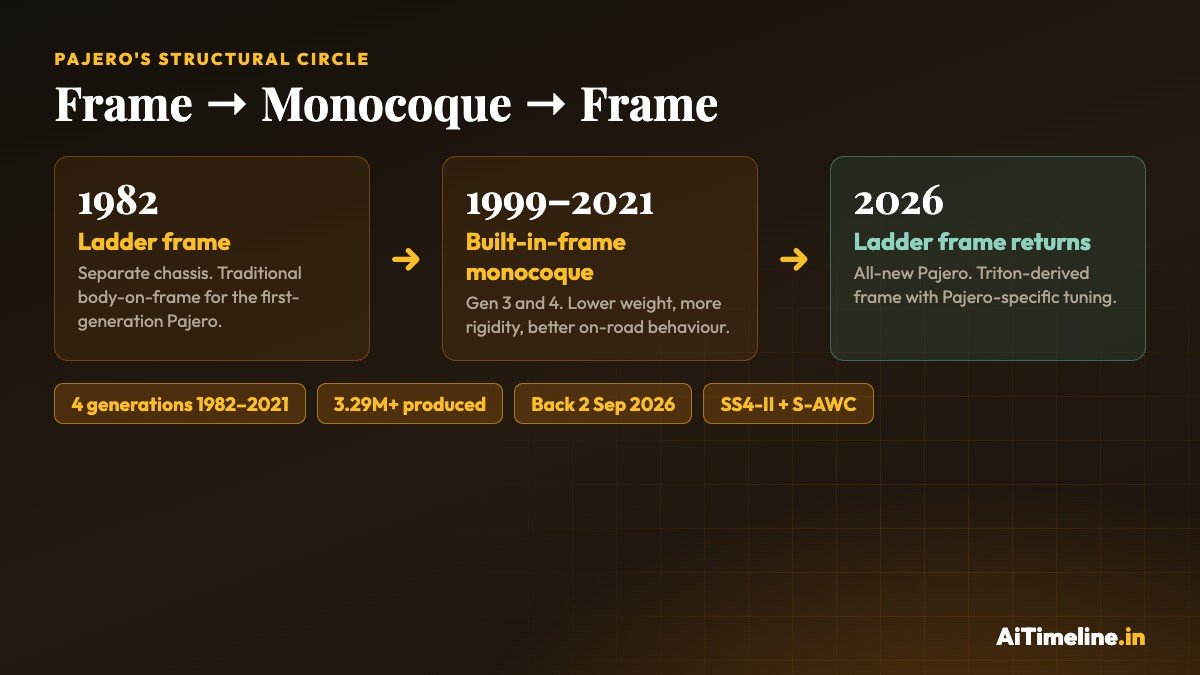
- The architecture came full circle. Ladder frame (1982), built-in-frame monocoque (1999–2021), ladder frame again (2026).
- Built-in-frame monocoque is not a plain ladder frame. The third generation in 1999 abandoned the separate ladder frame; do not describe every historical Pajero as body-on-frame.
- 12 Dakar wins, seven in a row. First overall win 1985 (Patrick Zaniroli); first Japanese overall winner 1997 (Kenjiro Shinozuka); dynasty 2001–2007.
- The race cars were not the showroom cars. Dakar Pajeros were specialised competition machines; Mitsubishi says rally experience fed into 4WD, durability and production development.
- Super Select 4WD-II and S-AWC are different systems. SS4-II manages the drivetrain modes; S-AWC is broader integrated vehicle-dynamics control.
- Shared frame, not a rebadge. The 2026 Pajero shares a ladder-frame foundation with the Triton but gets Pajero-specific cabin, front and rear suspension.
- No single reason it disappeared. Aging architecture, changing regulations, market shifts and Mitsubishi’s portfolio priorities all played a part; Mitsubishi did not name one cause.
- Pajero is not Pajero Sport. They are separate model lines with different platforms, histories and Dakar records.
- India and the US are unconfirmed. The rollout runs Thailand first, then Japan and Australia in fiscal 2026, then about 100 countries from fiscal 2027.
Why Did Mitsubishi Bring the Pajero Back — and Why a Ladder Frame Again?
The central editorial question
The reborn Pajero combines a structural return to ladder-frame architecture with far more modern electronic vehicle control, safety, infotainment, comfort and premium positioning. That is the article’s central tension: the new Pajero goes back to its structural roots while moving further upmarket than ever.
Mitsubishi’s own framing is that the all-new Pajero is a core model in its long-term brand strategy and will serve as its new-generation flagship — a vehicle intended, in the company’s words, “to lead not only the Pajero series to follow, but the entire Mitsubishi Motors lineup.” The comeback is therefore best read as a brand-reset vehicle, not a nostalgia exercise.
The old Pajero ended as a mature, long-running SUV in a market moving quickly toward more advanced safety, connectivity, refinement and electrification. Rather than update the old vehicle, Mitsubishi paused the nameplate and returned five years later with a different structural strategy: a separate ladder frame for robustness, wrapped in S-AWC, Super Select 4WD-II, seven drive modes, advanced driver assistance, dual 14.3-inch displays and a premium seven-seat cabin.
Its 12 Dakar wins built the legend. The 2026 Pajero has to prove that the name still means something off the rally stage.
Heritage Matrix
Four original generations, plus the all-new model
| Era | Generation | Engineering shift | Legacy |
|---|---|---|---|
| 1982–1991 | First | Accessible, passenger-friendly 4WD on a ladder-frame architecture | Dakar debut 1983; first overall victory 1985 |
| 1991–1999 | Second | Super Select 4WD combines part-time and full-time 4WD characteristics | Helped define the Pajero’s 1990s boom |
| 1999–2006 | Third | Switched from separate ladder frame to built-in-frame monocoque body | Major step toward better on-road handling and lower weight |
| 2006–2021 | Fourth | Mature evolution of the built-in-frame architecture and SS4-II | Final original-era Pajero; global production ended 2021 |
| 2026– | All-new (widely described as fifth generation) | Returns to ladder frame; adds SS4-II, S-AWC and modern flagship luxury | First global Pajero in five years |
⚠️ One matrix correction
Do not group the second and third generations as though both introduced unibody integration. The second generation (1991) introduced Super Select 4WD. The third generation (1999) introduced the built-in-frame monocoque body. Different breakthroughs. And the 2026 model is “all-new” and “new-generation” in Mitsubishi’s English material; most automotive reporting calls it the fifth generation, which is logically consistent since the previous run had four.
Pajero’s Structural Circle: Frame → Monocoque → Frame
1982 — Mitsubishi Creates a Different Kind of 4WD
The first Pajero combined genuine rough-road capability with passenger-car-like usability and comfort. It launched as a short-wheelbase three-door; a longer five-door followed later. Many early 4WD vehicles were primarily utility-oriented. The Pajero’s concept was to make 4WD capability comfortable enough for everyday and recreational use, and Mitsubishi’s own heritage material emphasises making 4WD accessible to ordinary drivers.
🔸 What 1982 did and did not do
The Pajero did not invent SUVs, 4x4s or recreational off-roaders. It helped popularise the idea that a serious 4WD could also be a comfortable family and leisure vehicle — and it became one of the defining vehicles of Japan’s 1990s recreational-vehicle boom, appealing through a rugged image, winter and recreation use, family usability and increasing luxury.
The Dakar Record
Debut 1983, first overall win 1985, dynasty 2001–2007
Just one year after launch, Mitsubishi entered the Paris–Dakar Rally in 1983, initially winning the production category before taking outright victories later.
1985 — first overall win. Patrick Zaniroli won the rally outright in a Mitsubishi Pajero/Montero, with Mitsubishi taking a 1–2 finish. It was the first Dakar overall victory for a Japanese manufacturer. (Do not credit the 1985 win to Kenjiro Shinozuka or Hiroshi Masuoka — those are later milestones.)
1997 — Kenjiro Shinozuka makes history. Shinozuka won the Dakar outright driving a Mitsubishi Pajero/Montero, becoming the first Japanese driver to win the event overall. Mitsubishi finished 1–2–3–4. The road-going Pajero Evolution, developed in response to Dakar homologation rules, dates from this era and is one of the most collectible Pajero derivatives.
⚠️ Handle the superlatives carefully
Do not write “Guinness World Record” unless a direct Guinness source confirms the category. Mitsubishi itself describes the seven consecutive victories as unprecedented — use that. For evergreen content prefer “a record 12 Pajero/Montero overall victories” or “one of the most successful vehicle programs in Dakar history” over unverified current all-time rankings.
1991 — Super Select Changes 4WD
The second-generation Pajero introduced Super Select 4WD, a system combining features of part-time and full-time four-wheel drive. Drivers could select 2WD, full-time 4WD, locked 4WD and low range depending on conditions.
Traditional locked 4WD is excellent off-road but less suitable for dry paved-road cornering, because the front and rear axles are forced to turn at the same speed. A centre differential lets the wheels turn at different speeds, so the Pajero could use four-wheel drive more naturally on the road. The third generation evolved the system into Super Select 4WD-II (SS4-II), with an initial front/rear torque split shifted toward roughly 33:67 in the relevant mode and electronic actuation.
🔄 Old-school 4WD
- 2WD, or
- Locked 4WD only
- Compromised on dry tarmac
⚙️ Super Select
- 2WD
- Full-time 4WD
- Locked 4WD
- Low range
1999 — Pajero Abandons the Traditional Separate Ladder Frame
This is one of the most important events on the timeline. The third-generation Pajero moved to a built-in-frame monocoque body: lower weight, greater rigidity, a lower centre of gravity and better on-road behaviour. Mitsubishi’s own terminology is “built-in-frame monocoque” — not a pure unibody, and not a conventional body-on-frame. The fourth generation in 2006 continued this architecture as a mature evolution of the built-in-frame Pajero formula, and eventually an aging platform became commercially difficult to sustain against newer rivals and tighter regulations.
2019 and 2021 — The Original Era Ends
Pajero production and sales for the Japanese market ended in 2019, marked by a Final Edition. Production for overseas markets ended in 2021, closing a roughly 39-year original run. Across four generations, cumulative production exceeded 3.29 million units (earlier 2026 material cited sales of more than 3.25 million; the world-premiere release uses the 3.29 million figure). The original Pajero earned a following across more than 170 countries and regions.
Why Did It Disappear?
There is no single-cause explanation. The end of the original Pajero reflected an aging product architecture, changing regulatory requirements, shifts in customer demand, Mitsubishi’s portfolio priorities and specific production decisions. Unless Mitsubishi explicitly names one reason, it should not be invented — “emissions killed it” is too simple.
🔸 Body-on-frame SUVs were not dying
Rugged ladder-frame off-roaders — Land Cruiser, Prado, Fortuner, Wrangler, G-Class and the modern Defender-style segment — continued to see strong demand through this period. A more accurate reading of the 2026 story is that authentic 4x4s have become premium lifestyle products, which is part of why the new Pajero returns as a flagship rather than a workhorse.
2026 — The Return
Name confirmed May, previewed August, premiered 2 September
Mitsubishi confirmed in May 2026 that the new vehicle would carry the Pajero name, with a worldwide premiere planned for autumn, after a five-year overseas hiatus. The company positioned the all-new Pajero as a central brand-building product within its mid-to-long-term vision. Through August 2026 Mitsubishi previewed the ladder-frame chassis and confirmed S-AWC and off-road and comfort development. On 2 September 2026 the all-new Pajero had its world premiere, positioned as the company’s new-generation flagship.
Is the New Pajero Coming to India?
As of 3 September 2026, Mitsubishi has not announced an India launch for the all-new Pajero. Indian automotive reporting also indicates no India launch is confirmed. No India price, launch date, booking window or dealer-network plan has been stated — any such figure circulating is speculation. The Pajero name has a strong enthusiast following in India through the original Pajero, the Pajero SFX and later the separate Pajero Sport, which is part of why India interest in the revival is high despite the lack of an official plan.
Is the Pajero or Montero Returning to America?
As of September 2026, Mitsubishi has not confirmed the new Thai-built Pajero for the United States. A Montero revival should not be inferred from trademark filings alone.
The 2026 Platform: Triton Frame, Pajero-Specific Development
Mitsubishi confirmed that the all-new Pajero is based on the robust ladder frame of the Triton pickup, but the cabin, front suspension and rear suspension receive Pajero-specific development. The shared architecture does not make the Pajero a rebadged Triton — it is better described as a shared ladder-frame foundation with Pajero-specific engineering. The wheelbase of 2,870 mm creates room for three rows.
Engine and transmission
The Pajero uses a 2.4-litre clean diesel engine with a wide-range single variable-geometry turbocharger, producing up to 480 Nm of maximum torque depending on the variant (470 Nm on some specifications). It is paired with a newly developed 8-speed automatic transmission with a sport mode. Power output varies by regional specification; third-party horsepower figures should not be copied into a global spec table unless Mitsubishi confirms the same tuning.
Core 4WD: Super Select 4WD-II and S-AWC
The all-new Pajero uses Super Select 4WD-II with four drivetrain modes:
- 2H — rear-wheel drive, for normal road conditions where appropriate.
- 4H — full-time four-wheel drive, providing four-wheel traction without locking the centre differential.
- 4HLc — centre differential locked, for lower-grip surfaces.
- 4LLc — locked centre differential plus low-range gearing, for more demanding off-road conditions.
On top of that, the new Pajero adds S-AWC (Super-All Wheel Control), which integrates vehicle-dynamics systems including Active Yaw Control, Active Stability and Traction Control, and ABS. This is one of the biggest differences between the old Pajero philosophy and the 2026 flagship.
⚠️ Super Select 4WD-II is not S-AWC
SS4-II manages the four-wheel-drive drivetrain modes. S-AWC is broader integrated vehicle-dynamics control that coordinates acceleration, cornering, traction, stability and braking. They work together but are distinct systems — do not describe them as the same thing.
Seven drive modes
- Normal
- Eco
- Gravel
- Snow
- Mud
- Sand
- Rock
Design and Interior: “Grand Charisma”
Mitsubishi’s design concept for the 2026 Pajero is “Grand Charisma”: bold upright proportions, strong horizontal lines, large fenders and heritage cues. The company says the front design conveys a sense of inner strength inspired by kendo — a manufacturer design explanation rather than an objective fact.
Heritage details. The C-pillar is inspired by the first-generation roll bar. A hexagonal rear motif reinterprets the rear-mounted spare-wheel imagery. The Multi Meter display is a modern reinterpretation of the classic triple-gauge layout, showing altitude, compass, temperature, vehicle pitch and roll, and AYC status.
Interior. Three rows, seven seats, with a second-row slide range of 150 mm and a tumble function, three-zone automatic climate control, seat ventilation across the whole seat surface, and improved cabin quietness. Soft-touch dashboard and door materials use stitching inspired by kimekomi, a traditional Japanese craft. The dashboard carries a monolithic display integrating two 14.3-inch screens (12.3-inch on some specifications) for instrumentation and infotainment — Mitsubishi’s term is “monolithic display,” not “panoramic screens.”
Dimensions, Off-Road Geometry and Chassis
| Measure | 2026 Pajero (Mitsubishi spec) |
|---|---|
| Length | 4,920 mm |
| Width | 1,925 mm |
| Height | 1,910 mm (on 20-inch tyres) |
| Wheelbase | 2,870 mm |
| Front / rear track | 1,630 mm |
| Ground clearance | 230 mm |
| Approach angle | 30.4° |
| Breakover angle | 22.6° |
| Departure angle | 25.8° |
| Weight distribution | 52:48 front / rear |
| Front suspension | Independent double-wishbone |
| Rear suspension | Newly developed five-link rigid axle |
| Brakes | 18-inch rotors, electric brake booster |
The suspension mix matters: independent double-wishbone front for comfort, a solid five-link rigid rear axle for robustness. The 52:48 weight distribution is an engineering detail, not proof the vehicle handles better than any rival.
Safety and Driver Assistance
2026 systems include Forward Collision Mitigation with pedestrian, cyclist and motorcyclist detection and junction assist, Predictive Forward Collision Warning, Emergency Assist for Pedal Misapplication, Emergency Lane Assist and Front Cross Traffic Alert. The Pajero has eight airbags, including Mitsubishi Motors’ first SRS centre airbag.
MI-PILOT combines Adaptive Cruise Control and Lane Keep Assist for highway single-lane driver assistance. It is a driver-assistance feature, not autonomous driving. The 3D Multi Around Monitor uses four vehicle-mounted cameras and a 3D vehicle representation, processing at roughly 30 frames per second, useful for parking and terrain visibility; a front under-floor view is available in the 4HLc and 4LLc modes.
Pajero vs Pajero Sport — They Are Not the Same Vehicle
This distinction is critical, especially for India. The Pajero is Mitsubishi’s original flagship cross-country SUV, with the four-generation history and the Dakar record described above. The Pajero Sport is a separate model line derived from the Triton/L200 pickup. Do not mix their generations, production numbers or Dakar history.
Is Pajero Sport the new Pajero? No. They are separate model lines. The all-new 2026 Pajero revives the flagship Pajero nameplate; it is not a renamed Pajero Sport.
Pajero, Montero or Shogun?
The same broad model family used different names by market: Pajero in many markets, Montero in North America and some others, and Shogun in the United Kingdom. Specific engines and trims varied by country. Broadly, the Pajero and the Montero are the same vehicle family.
Heritage Off-Roader Comparison
Market comparison — not a “better than” claim
| Model | Heritage | Current structure | 4WD approach | Position |
|---|---|---|---|---|
| Mitsubishi Pajero | 1982; Dakar dynasty | Ladder frame | SS4-II + S-AWC | Premium cross-country flagship |
| Toyota Land Cruiser | Long-running off-road lineage | Ladder frame | Market and model dependent | Global premium off-roader |
| Land Rover Defender | Historic utility lineage | Modern unibody architecture | Electronic AWD and terrain systems | Premium adventure SUV |
| Jeep Wrangler | Jeep off-road heritage | Body-on-frame | Mechanical and electronic 4×4 | Dedicated off-road lifestyle SUV |
⚠️ What this table is not
This is a market-context comparison, not comparative testing. Avoid “better than Land Cruiser,” “more capable than Defender,” “most rugged” or “unbeatable” without back-to-back testing. Mitsubishi has not publicly named the Land Cruiser as an official target. A Pajero versus Fortuner comparison is more relevant for India and ASEAN searches, but with no confirmed India launch it is a global-spec comparison, not an India buying guide. Any price comparison must wait for announced, same-market pricing normalised for currency and tax methodology.
💼 Executive insight — why the Pajero had to return differently
The old Pajero ended as a mature SUV in a market moving fast toward advanced safety, connectivity, refinement and electrification. Mitsubishi did not simply update it. It paused the nameplate and came back five years later with a different structural strategy: ladder-frame construction, plus S-AWC, SS4-II, seven drive modes, advanced driver assistance, dual 14.3-inch displays and a premium seven-seat cabin. That is an unusual combination — old-school structural toughness with modern electronic control. Mitsubishi calls the Pajero its new-generation flagship and a model meant to lead the wider lineup. The comeback is more than one nostalgic product; it is a brand-reset vehicle.
What it is not: sharing architecture with the Triton may create engineering efficiencies, but Mitsubishi has not quantified any R&D saving, so “dramatically reduced R&D cost” is not supported. “Flagship” is official; “high-margin flagship” is financial speculation — use “premium flagship.”
The Human Side
For many buyers, a Pajero was never simply a specification sheet. In India the name became associated with long road trips, mountains, deserts and the unmistakable shape of the Pajero SFX. In Japan it helped define the 1990s recreational-vehicle boom. In motorsport the badge became almost inseparable from the Dakar. That creates a problem for Mitsubishi in 2026: a famous badge brings attention, but it cannot guarantee the new vehicle deserves the reputation of the old one.
The new Pajero’s most interesting specification may not be its 480 Nm, its screens or its seven terrain modes. It may be the steel structure underneath them. In 1999 Mitsubishi moved the Pajero away from separate-frame construction to a built-in-frame monocoque to improve weight, ride and handling. Twenty-seven years later the new Pajero goes back to a ladder frame — not nostalgia alone, but a sign of how much the premium off-road market has changed.
Explore More Timelines
Mitsubishi Pajero Timeline (Newest First)
From the September 2026 world premiere back to the 1982 original
2026
All-new Pajero world premiere
What happened: Mitsubishi unveiled the all-new Pajero as its new-generation flagship, built in Thailand, with a ladder frame, 2.4L clean diesel (up to 480 Nm), new 8-speed automatic, SS4-II, S-AWC and seven drive modes.
Why it matters: First global Pajero in five years, and a structural return to body-on-frame after two monocoque generations.
Ladder-frame and S-AWC development preview
What happened: Mitsubishi previewed the Triton-derived ladder-frame chassis and confirmed S-AWC, alongside off-road and comfort development work.
Why it matters: Confirmed the body-on-frame direction before the full reveal.
Pajero name and comeback confirmed
What happened: Mitsubishi confirmed the new vehicle would be called Pajero, with a worldwide premiere planned for autumn 2026, after a five-year overseas hiatus.
Why it matters: Positioned the all-new Pajero as a central brand-building product in Mitsubishi’s mid-to-long-term vision.
Overseas production ends
What happened: Production of the fourth-generation Pajero for overseas markets ended, closing a roughly 39-year original run.
Why it matters: The last original-era Pajero; the nameplate went dormant globally until 2026.
Japan production and sales end
What happened: Pajero sales for the Japanese market ended, marked by a Final Edition.
Why it matters: The domestic-market exit came two years before the global one.
Seven consecutive Dakar victories
What happened: Mitsubishi won the Dakar Rally outright seven years in a row, bringing the Pajero/Montero total to 12 overall wins by 2007.
Why it matters: Mitsubishi describes the streak as unprecedented; 2007 was the final Pajero Dakar victory.
Fourth generation — the final original-era Pajero
What happened: A mature evolution of the built-in-frame architecture with SS4-II, stability and traction control, improved engines and more premium equipment.
Why it matters: It served until 2021, by which point the platform was hard to sustain commercially against newer rivals and regulations.
Third generation — built-in-frame monocoque
What happened: The Pajero abandoned the traditional separate ladder frame for a built-in-frame monocoque body, and evolved Super Select into SS4-II.
Why it matters: Lower weight, greater rigidity, lower centre of gravity and better on-road behaviour — the structural choice the 2026 model reverses.
Kenjiro Shinozuka makes history
What happened: Shinozuka won the Dakar outright in a Mitsubishi Pajero/Montero, becoming the first Japanese driver to win the event overall; Mitsubishi finished 1–2–3–4.
Why it matters: A landmark in Japanese motorsport; the road-going Pajero Evolution belongs to this homologation era.
Second generation — Super Select 4WD
What happened: The Pajero introduced Super Select 4WD, combining part-time and full-time 4WD characteristics with selectable 2WD, full-time 4WD, locked 4WD and low range.
Why it matters: A centre differential let the Pajero use four-wheel drive naturally on road; it helped drive the 1990s boom.
First overall Dakar victory
What happened: Patrick Zaniroli won the rally outright in a Mitsubishi Pajero/Montero, with Mitsubishi taking a 1–2 finish.
Why it matters: The first Dakar overall victory for a Japanese manufacturer.
Dakar debut
What happened: Just one year after launch, Mitsubishi entered the Pajero at the Paris–Dakar, initially winning the production category.
Why it matters: The start of a 25-year factory program that ran through 2007.
The original Pajero launches
What happened: Mitsubishi launched the first Pajero as a short-wheelbase three-door on a ladder-frame architecture, combining rough-road capability with passenger-car comfort. A five-door followed later.
Why it matters: It helped popularise the idea that a serious 4WD could also be a comfortable family and leisure vehicle.
Pajero update log
- 3 September 2026 — full world-premiere specifications added to this timeline.
- 2 September 2026 — all-new Pajero world premiere.
- August 2026 — ladder-frame and S-AWC development preview.
- May 2026 — Pajero name and comeback officially confirmed.
- 2021 — overseas production ends.
- 2019 — Japan Final Edition and domestic production end.
- 2007 — final Pajero Dakar victory; 12 overall wins reached.
- 1999 — switch to built-in-frame monocoque.
- 1985 — first overall Dakar win; 1982 — original Pajero launched.
⚠️ Editorial and E-E-A-T note
2026 specifications verified against Mitsubishi Motors. Figures for the all-new Pajero are taken from Mitsubishi’s 2 September 2026 world-premiere release. Some values (power output, torque, height, screen size) are market-dependent and are labelled as such. Credible automotive publications are used only for context and comparison.
Dakar results methodology. Win totals, consecutive-win counts and driver names follow Mitsubishi’s Dakar archive and published event results. Market availability. India and United States launches are described as not confirmed because no official announcement exists as of 3 September 2026. Corrections policy. Errors are corrected on publication; this note and the update log record material changes. This article is editorial, not buying or investment advice.
Frequently Asked Questions
Explore More on AiTimeline
Sources & further reading
Every dated entry above was checked against these references. Last reviewed 15 September 2026.