US Strategic Petroleum Reserve: Emptied, Refilled, and Emptied Again
The US Strategic Petroleum Reserve fell to its lowest level since 1982 in 2026. See its full history of releases, refills and what a rebuild would cost.
Latest Story
The US Strategic Petroleum Reserve (SPR) was built after the 1973 Arab oil embargo as America’s emergency answer to a supply shock — hundreds of millions of barrels of crude stored underground in Gulf Coast salt caverns. It peaked at 726.6 million barrels in 2009, was drawn down to a 40-year low after Russia’s 2022 invasion of Ukraine, spent 2023–2025 slowly refilling, and then in 2026 — after Iran closed the Strait of Hormuz following strikes by Israel and the United States — began its largest drawdown yet. By September 2026 it had fallen to roughly 285 million barrels, the lowest level since November 1982. This is the full history of how it was built, drained, refilled, and drained again — and what refilling it again would actually cost.
🔋 The SPR, in Short
The Strategic Petroleum Reserve is a US government stockpile of crude oil held in underground salt caverns on the Gulf Coast, created by the Energy Policy and Conservation Act of 1975 after the 1973–74 oil embargo. It peaked at 726.6 million barrels in 2009. Congress-mandated sales, a record 180-million-barrel emergency release in 2022 after Russia invaded Ukraine, and a partial 2023–2025 refill left it at roughly 411 million barrels at the end of 2025. In March 2026, after Israel and the United States struck Iran and Iran closed the Strait of Hormuz, President Trump ordered a 172-million-barrel US contribution to a 400-million-barrel IEA-coordinated release — structured mostly as an exchange, not an outright sale. By September 2026 the reserve had fallen to about 285 million barrels, its lowest level since November 1982.
The SPR: Key Questions
What to know about the SPR
- Born from a shock, not a plan: the SPR exists because the 1973–74 Arab oil embargo exposed how vulnerable the US economy was to a single supply interruption.
- It is a cavern system, not a warehouse: the oil sits in solution-mined underground salt caverns on the Gulf Coast, not steel tanks.
- 726.6 million barrels, 2009: the reserve’s historical year-end peak, reached decades after the first 412,000 barrels arrived in 1977.
- Mandated sales predate the 2022 crisis: Congress ordered non-emergency SPR sales starting in fiscal 2017, years before the Ukraine-related drawdown, which is why the decline cannot be pinned on any one administration or event.
- 2022 was the largest emergency drawdown ever: 180 million barrels released over six months after Russia’s invasion of Ukraine, at an average sale price of about $95 a barrel.
- The 2023–2025 refill was never a clean “buy it all back”: DOE directly purchased about 59 million barrels at under $76 average, and separately secured roughly 140 million more by cancelling future mandated sales — not a matched trade for the barrels sold in 2022.
- By the end of 2025 the SPR held about 411 million barrels — recovered from its 2023 low, but still roughly 316 million barrels below the 2009 peak.
- March 2026 triggered the reserve’s next major test: after Israel and the US struck Iran and Iran closed the Strait of Hormuz, President Trump ordered a 172-million-barrel US share of a 400-million-barrel IEA-coordinated release.
- Unlike 2022, the 2026 action is mostly an exchange, not a sale: the oil leaves the reserve now under contracts that require it — plus extra barrels — to be returned later.
- By September 2026 the SPR had fallen to about 285 million barrels, the lowest level since November 1982 — lower than the 2023 trough that was itself a 40-year low at the time.
Origins: An Idea That Waited 30 Years
1944–1975, from proposal to law
The idea of a US strategic oil stockpile predates the crisis that finally created one. In 1944, wartime Interior Secretary Harold Ickes proposed an emergency crude stockpile on national-security grounds. In 1952, President Truman’s Minerals Policy Commission recommended the same thing. The 1956 Suez Crisis, which disrupted international oil transport, prompted President Eisenhower to consider it again. Each time, the warning was the same — global oil supply can be interrupted by geopolitics — and each time, no reserve was built.
It took the October 1973 Arab oil embargo, imposed after the Yom Kippur War by Arab oil producers against the United States and other supporters of Israel, to change that. Gasoline lines, price controls and fuel rationing gave Americans a direct, visible experience of energy vulnerability that three prior proposals had not. In 1974, major oil-importing nations formed the International Energy Agency (IEA) and agreed to maintain emergency stocks equal to at least 90 days of net imports — a framework the future SPR would help the US meet. On 22 December 1975, President Gerald Ford signed the Energy Policy and Conservation Act, creating the Strategic Petroleum Reserve, with an original policy ceiling contemplating up to one billion barrels.
Why Salt Caverns, Not Steel Tanks
The engineering behind an underground oil fortress
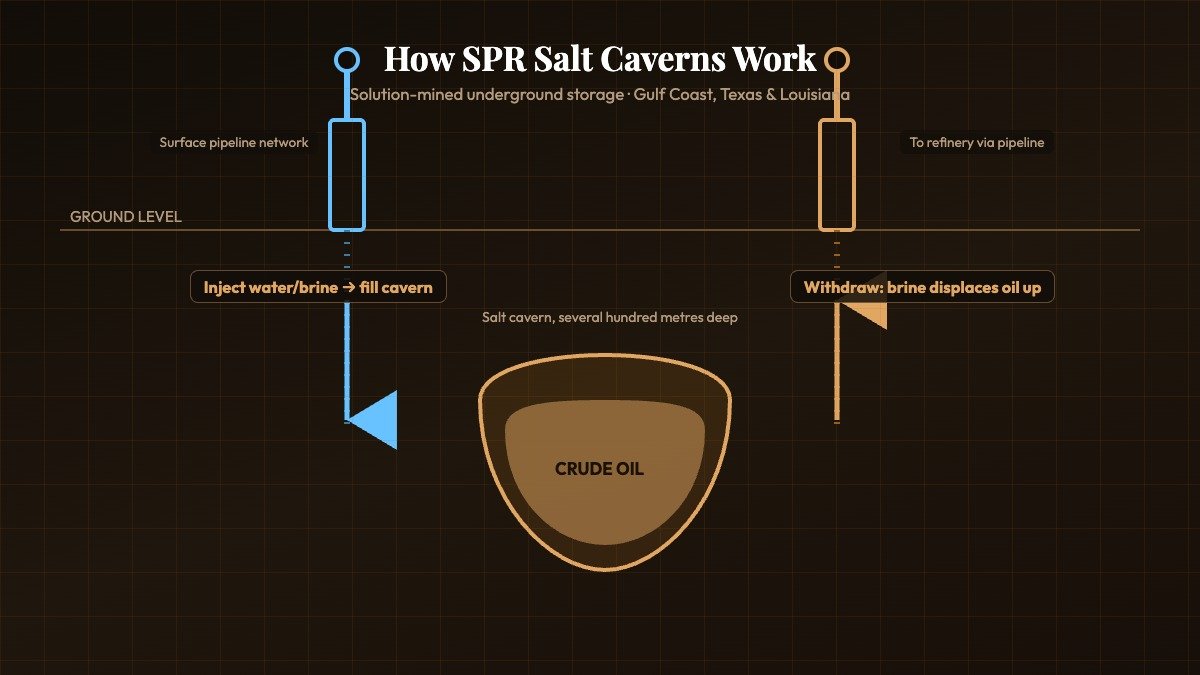
Storing hundreds of millions of barrels above ground would require enormous, expensive, hard-to-protect tank farms. Engineers instead turned to naturally occurring salt domes along the Texas and Louisiana Gulf Coast. Water is pumped down a well to dissolve a cavity out of the salt — a process called solution mining — and the resulting brine is pumped out, leaving a vast underground cavern that crude oil then fills. Salt’s very low permeability helps it seal small fractures, and a single cavern can hold millions of barrels at a fraction of the cost of surface tanks.
How Oil Moves In and Out of a Cavern
- Wells and pipes run from the surface down hundreds of metres into a solution-mined salt cavern.
- To fill the cavern, crude oil is pumped in from the surface pipeline network.
- To withdraw oil, water or brine is injected, which displaces the lighter crude upward.
- The displaced crude is pumped back into the commercial pipeline system for delivery to refineries.
1977–2009: The Long Build-Up to a Peak
From the first 412,000 barrels to 726.6 million
The first crude — about 412,000 barrels of Saudi Arabian light — arrived on 21 July 1977. The 1979 Iranian Revolution triggered a second oil shock within the decade, reinforcing the case for the reserve and accelerating purchases through the early 1980s. Filling continued through the 1990s and 2000s, including a directive from President George W. Bush after the September 11, 2001 attacks to fill the reserve toward capacity. By 2009, the SPR reached its historical year-end peak of 726.6 million barrels — at 42 US gallons per barrel, more than 30 billion gallons of crude held underground. Even a reserve that size is finite: its purpose was always to buy time during a disruption, not to replace the oil market indefinitely.
| Year-end | SPR inventory | Context |
|---|---|---|
| 2009 | 726.6 million bbl | Historical peak |
| 2021 | 593.7 million bbl | Before Russia’s invasion of Ukraine |
| 2022 | 372.0 million bbl | After the 180-million-barrel emergency release |
| 2023 | 354.7 million bbl | Post-crisis low; refill purchases begin |
| 2024 | ~394 million bbl | Direct purchases + cancelled mandated sales |
| 2025 | 411 million bbl | Still ~316 million bbl below the 2009 peak |
| Sept 2026 (weekly) | ~285 million bbl | Lowest since November 1982, after the 2026 exchange began |
Source: EIA weekly/year-end petroleum stocks data; DOE announcements. Early build-up figures (1977–2000) are approximate, rounded historical milestones.
The First Uses: War, Storms, and a Shale Boom
1991–2017, before anyone had heard of the 2022 drawdown
The SPR was not used in a major emergency for its first fifteen years. That changed with Iraq’s 1990 invasion of Kuwait: the 1990–91 Gulf War produced the reserve’s first major emergency sale, as part of an internationally coordinated response. In 2005, Hurricane Katrina devastated Gulf Coast refining and pipeline infrastructure, and the SPR responded — not to a foreign embargo, but to domestic infrastructure failure, expanding what “energy security” was understood to cover. In 2011, civil conflict in Libya removed oil from world markets and the US drew down the SPR again as part of a coordinated IEA release.
Through the 2010s, the American shale revolution sharply increased domestic oil production and cut import dependence, prompting a genuine policy debate: if the US imports far less oil, does it still need a 700-million-barrel reserve? Congress’s answer, starting in fiscal year 2017, was a series of mandated non-emergency sales tied to budget and modernisation priorities — meaning SPR inventory was already declining years before 2022, for reasons that had nothing to do with any single geopolitical event. A different kind of stress hit in 2020: COVID-19 collapsed oil demand so severely that US crude futures briefly traded below zero, and DOE used SPR capacity in reverse, letting commercial producers store oil there temporarily through exchange arrangements.
Gulf War
Iraq’s invasion of Kuwait triggers the SPR’s first major emergency sale, as part of an internationally coordinated response.
Hurricane Katrina
Gulf Coast refining and pipeline damage prompts an SPR release for a domestic infrastructure failure, not a foreign embargo.
Libya civil war
Conflict removes Libyan oil from world markets; the US releases SPR crude as part of a coordinated IEA action.
Russia–Ukraine energy shock
The largest single emergency drawdown in SPR history — 180 million barrels — follows Russia’s invasion of Ukraine.
Middle East supply disruption
Iran’s closure of the Strait of Hormuz after Israeli/US strikes triggers a 400-million-barrel IEA action and a 172-million-barrel US exchange.
COVID demand collapse
Oil demand crashes so far that US crude briefly trades below zero; the SPR takes in commercial oil via reverse exchange instead of releasing it.
2022: The Largest Emergency Drawdown in SPR History
Russia’s invasion of Ukraine and the 180-million-barrel release
Russia’s February 2022 invasion of Ukraine sent a shock through global energy markets: Russia is one of the world’s largest oil exporters, and sanctions, buyer avoidance and shipping disruption pushed prices sharply higher, feeding directly into US gasoline prices. After an initial coordinated IEA release in March, President Biden announced a far larger step on 31 March 2022: a target of 1 million barrels per day for six months, totaling 180 million barrels — the largest emergency release in the reserve’s history. Supporters argued the shock was extraordinary and justified using the reserve for its intended purpose; critics argued it cut America’s emergency cushion too far and questioned whether it was also aimed at influencing prices rather than responding narrowly to a physical shortage. That debate continues, but one number matters most for what came next: the emergency barrels sold in 2022 fetched an average price of about $95 per barrel. Year-end SPR inventory fell to 372.0 million barrels, down from 593.7 million a year earlier.
💳 Sale vs. Exchange — Why the Difference Matters
A sale permanently transfers SPR oil for revenue; the barrels do not come back unless the government later buys replacements. An exchange temporarily lends crude to a company under contract, requiring the original volume plus additional barrels to be returned later. The 2022 release was structured as a sale. The 2026 release, discussed below, is structured mostly as an exchange — a distinction that changes how “barrels released” should be read on any chart.
2023–2025: The Refill That Was Never a Clean Buyback
Direct purchases, cancelled sales, and a price gap that isn’t quite profit
Once the 2022 emergency passed, DOE began refilling the reserve through three separate mechanisms: direct purchases when crude traded at attractive prices (DOE initially targeted $79/barrel or below), exchange returns from companies that had previously borrowed SPR oil, and cancelling future mandated sales that Congress had scheduled years earlier — effectively raising future inventory by simply not selling, rather than buying anything back. By the time the Biden administration made its final purchase, DOE reported it had directly purchased about 59 million barrels at an average price under $76, and separately secured roughly 140 million more barrels by working with Congress to cancel mandated sales through fiscal 2026 — together described by DOE as securing about 200 million barrels for the reserve. Year-end inventory rose from 354.7 million barrels in 2023 to about 394 million in 2024 and 411 million barrels by the end of 2025.
2022 Emergency Sale vs. 2023–2024 Refill Purchases
2026: Iran, the Strait of Hormuz, and a New Emergency
The refill was still incomplete when the next crisis arrived
On 28 February 2026, Israel and the United States began strikes against Iran targeting its nuclear and ballistic missile programmes. In response, Iranian forces declared the Strait of Hormuz — the channel through which roughly a fifth of the world’s petroleum and LNG normally passes — closed starting 4 March 2026, threatening and attacking vessels attempting to transit it. Oil prices spiked sharply: US crude posted its largest weekly gain since futures trading began in 1983, with benchmark prices climbing into the $90-a-barrel range.
On 11 March 2026, the International Energy Agency and its 32 member nations unanimously agreed to a coordinated release of 400 million barrels of oil and refined products. President Trump authorised the Department of Energy to release 172 million barrels from the SPR as the US contribution, with delivery planned over roughly 120 days. Crucially, DOE structured much of this release as an emergency exchange: companies receive SPR crude now under contracts requiring the original volume, plus additional barrels, to be returned later. Through May and June 2026, DOE awarded multiple exchange contracts covering tens of millions of barrels as the drawdown continued.
Where the Reserve Stands Right Now
September 2026: the lowest level since November 1982
By 10 August 2026, the SPR had fallen below 300 million barrels for the first time since 1983. The decline continued: EIA reported 285.4 million barrels for the week ending 4 September 2026 — the lowest level since November 1982 — down from about 405.2 million barrels a year earlier, a drop of nearly 30% in twelve months. Reporting through mid-September put the level essentially unchanged at around 285 million barrels. Energy Secretary Chris Wright has said the administration intends to proceed with the drawdown as planned, while industry and oversight reporting has flagged growing strain on infrastructure that has now absorbed two record-scale drawdowns — 2022 and 2026 — within four years.
The Refill Cost Question, Again
A moving target that just moved further away
Before the 2026 drawdown, the Government Accountability Office reported a DOE estimate that restoring the SPR to a roughly 680-million-barrel effective peak capacity would require about 250 million additional barrels, costing around $20 billion at $80-a-barrel crude — on top of a separately identified $1.4 billion Life Extension Phase 2 modernisation programme and more than $100 million in immediate cavern and pipeline repairs. That estimate was built around an SPR sitting near 400–430 million barrels. At today’s ~285-million-barrel level, the arithmetic gap to the same 680-million-barrel target is closer to 395 million barrels — meaningfully larger than the figure GAO’s estimate assumed.
| Oil price | Barrels needed (~395M gap) | Illustrative purchase cost |
|---|---|---|
| $60/barrel | 395 million | ~$23.7 billion |
| $70/barrel | 395 million | ~$27.6 billion |
| $80/barrel | 395 million | ~$31.6 billion |
| $90/barrel | 395 million | ~$35.5 billion |
| $100/barrel | 395 million | ~$39.5 billion |
Illustrative calculation using the current ~285 million barrel level against a ~680 million barrel target, at GAO’s own $80/barrel reference price plus surrounding scenarios — not an official updated GAO or DOE figure, and excluding the $1.4B+ infrastructure costs above.
Even with money in hand, a fast refill runs into physical limits: injection rates, pipeline capacity, cavern maintenance, and the risk that large government purchases themselves move the oil market. And every barrel released in 2026 as an exchange rather than a sale carries a contractual promise of return — meaning some of this gap should eventually close on its own as exchange partners deliver their obligations, on a timeline that is not yet fully public.
How Big Should the Reserve Actually Be?
The question behind the refill question
✅ Case for a smaller reserve
- US oil production and net import dependence are far higher/lower respectively than in 1975.
- Holding hundreds of millions of barrels carries real maintenance and opportunity costs.
- Domestic shale supply can respond faster to price signals than in the 1970s.
❌ Case against shrinking it
- Oil is a global market: a Persian Gulf or Russian disruption still raises US prices even if US wells keep pumping.
- Domestic infrastructure (hurricanes, pipelines, cyberattacks) can disrupt supply independent of imports.
- 2026 showed a new crisis can arrive before the previous refill even finishes.
Explore More Timelines
The SPR Stores Crude, Not Gasoline
A common misconception worth correcting
Because of this chain, releasing more SPR crude does not by itself fix a refinery-capacity or distribution bottleneck — it only adds crude supply at the front of a system that still has to process and move it.
Full Timeline: 1944–2026
Reverse chronological — newest first
SPR falls to lowest level since November 1982
What happened: EIA reported SPR inventory of 285.4 million barrels, down from about 405.2 million a year earlier — a decline of nearly 30% in twelve months, and the lowest level since November 1982.
SPR falls below 300 million barrels
What happened: The reserve dropped below the 300-million-barrel mark for the first time since 1983, as the 172-million-barrel exchange continued delivering.
DOE awards multiple emergency-exchange contracts
What happened: DOE continued implementing the US contribution to the IEA action, awarding contracts covering tens of millions of barrels structured as exchanges requiring later return.
IEA agrees 400-million-barrel release; US commits 172 million
What happened: The International Energy Agency’s members unanimously agreed to a coordinated release of 400 million barrels of oil and refined products. President Trump authorised DOE to release 172 million barrels from the SPR, with delivery over roughly 120 days, primarily via emergency exchange.
Israel and US strike Iran; Iran closes the Strait of Hormuz
What happened: Israel and the United States conducted strikes against Iran’s nuclear and missile programmes beginning 28 February 2026. Iran responded by declaring the Strait of Hormuz — through which roughly a fifth of world petroleum and LNG normally transits — closed from 4 March, attacking vessels attempting passage. Oil prices spiked sharply, with US crude posting its largest weekly gain since 1983.
Year-end SPR inventory reaches 411 million barrels
What happened: The refill that began after the 2023 low brought SPR inventory to roughly 411 million barrels — still about 316 million barrels below the 2009 peak, and about to be reversed by the 2026 drawdown within weeks.
DOE solicits 1 million barrels for Bryan Mound
What happened: DOE announced a solicitation to purchase 1 million barrels of crude for delivery to the Bryan Mound site across December 2025 and January 2026, using newly appropriated refill funds.
Congress appropriates new refill and maintenance funding
What happened: A 2025 law provided $171 million for acquiring petroleum for the SPR and a separate $218 million for maintenance and repairs — funding that GAO’s own figures show is less than 1% of the roughly $20 billion a full refill to peak capacity was estimated to cost.
Biden administration completes final SPR purchase
What happened: DOE announced its final purchase under the post-2022 refill programme, reporting it had secured about 200 million barrels total — roughly 59 million bought directly at an average price under $76, plus about 140 million more secured by cancelling future mandated sales through fiscal 2026. Year-end inventory reached about 394 million barrels.
SPR bottoms at 354.7 million barrels; refill begins
What happened: Year-end inventory fell to 354.7 million barrels, the lowest level in decades at the time. DOE began targeting direct purchases when crude traded at $79 a barrel or below.
Biden orders the largest emergency SPR release in history
What happened: Following Russia’s February 2022 invasion of Ukraine and a preceding smaller coordinated IEA release, President Biden announced a release of up to 1 million barrels a day for six months — 180 million barrels total, the largest emergency SPR drawdown ever ordered. The barrels sold for an average of about $95 each. Year-end inventory fell to 372.0 million barrels.
COVID demand collapse turns the SPR into a storage lender
What happened: Collapsing transportation demand during COVID lockdowns pushed US benchmark crude futures briefly below zero. DOE made SPR capacity available through reverse exchange arrangements, letting commercial producers store excess crude in the reserve temporarily.
Congress mandates the first non-emergency sales
What happened: Congress authorised a series of future SPR sales for budget priorities and reserve modernisation, with regular mandated sales beginning in fiscal 2017 — years before the 2022 emergency release, and a major reason the later decline cannot be attributed to any single event.
Libya release amid the shale boom
What happened: Civil conflict in Libya removed oil from world markets; IEA countries, including the US, coordinated an emergency release. At the same time, US shale production was rising sharply, beginning a decade-long debate over how large the SPR still needed to be.
SPR reaches its historical peak
What happened: Year-end SPR inventory reached 726.6 million barrels, the highest level in the reserve’s history — more than 30 billion gallons of crude held in underground salt caverns.
Hurricane Katrina forces a domestic-disruption release
What happened: Hurricane Katrina devastated Gulf Coast oil production, refining and pipeline infrastructure. The SPR responded with emergency crude, expanding the practical definition of “energy security” beyond foreign supply threats to domestic infrastructure failure.
Post-9/11 directive to fill the reserve
What happened: After the September 11 attacks, President George W. Bush directed that the SPR be filled toward its capacity, reflecting heightened concern about energy security during a period of high US oil imports.
91
Gulf War triggers the first emergency sale
What happened: Iraq’s invasion of Kuwait disrupted oil markets. The United States participated in an internationally coordinated response, marking the SPR’s first use in a major emergency sale — fifteen years after the reserve was created.
1977
First oil arrives at the SPR
What happened: Approximately 412,000 barrels of Saudi Arabian light crude became the reserve’s first delivery, following the acquisition of salt-cavern sites and construction of surface infrastructure.
1975
Energy Policy and Conservation Act creates the SPR
What happened: President Ford signed the Energy Policy and Conservation Act, formally establishing the Strategic Petroleum Reserve, with an original policy ceiling contemplating a reserve of up to one billion barrels.
The Arab oil embargo creates the case for a reserve
What happened: Arab oil-producing states embargoed the United States and other supporters of Israel following the Yom Kippur War. Gasoline shortages and price surges in the US turned a decades-old policy proposal into a near-term political priority.
Frequently Asked Questions
30+ questions on the SPR’s history, mechanics and 2026 drawdown
Related on AiTimeline
⚠️ Editorial Note
This article compiles figures from EIA petroleum stocks data, US Department of Energy announcements, GAO reports and reputable news coverage of events still unfolding as of publication (September 2026). SPR inventory levels, exchange contract volumes and their return timelines can change quickly; figures for the ongoing 2026 drawdown should be treated as the latest publicly reported data, not a final tally. This is editorial content, not financial, investment or policy advice.
Sources & further reading
Every dated entry above was checked against these references. Last reviewed 20 September 2026.
- U.S. Department of Energy -- United States to Release 172 Million Barrels From the SPR
- U.S. Department of Energy -- SPR Quick Facts
- EIA -- DOE Has Released 17.5 Million Barrels From the SPR Since March
- CNBC -- Oil in Strategic Petroleum Reserve Falls Below 300 Million Barrels
- U.S. Department of Energy -- Biden-Harris Administration Makes Final SPR Purchase, Secures 200 Million Barrels
- GAO -- Strategic Petroleum Reserve: Long-Term Plan Amid Drawdowns and Maintenance Backlogs
- Congressional Research Service -- The Strait of Hormuz: Security Developments and Impacts on Oil, Gas and Other Commodities