Dainik Jagran History: From Jhansi in 1942 to India’s Most-Read Daily
Dainik Jagran history from its 1942 Jhansi launch and 1947 Kanpur relaunch to 37 editions, IRS No. 1 readership, the 2006 IPO and the digital era.
Latest Story
Before 24-hour television and before news apps, millions of Hindi-speaking households started the day with a folded copy of Dainik Jagran. The paper did not start in Delhi or Mumbai. It started in Jhansi in 1942, in the same year as the Quit India Movement, when Puran Chandra Gupta launched a daily called Jagran. It moved to Kanpur on 21 September 1947. Over the next eight decades it added one local edition after another across the Hindi heartland. By IRS 2019 it had become the most-read daily in India across all languages, with about 6.87 crore readers. This timeline covers how that happened, and what “most-read” actually measures.
🧠 AI Overview Summary
Dainik Jagran began as Jagran, a Hindi daily launched in Jhansi in 1942 by freedom-movement publisher Puran Chandra Gupta. It relaunched from Kanpur on 21 September 1947 as Dainik Jagran and added local editions for decades: Rewa (1953), Bhopal (1956), Gorakhpur (1975), Lucknow and Allahabad (1979), Meerut (1984), Agra (1986), Bareilly (1989) and Delhi (1990). Printing many city editions under one brand made it India’s most-read daily in IRS surveys through the 2000s and 2010s. IRS 2019 Q4 put its total readership at about 6.87 crore. That figure counts readers, not copies printed.
Dainik Jagran: Key Questions
84 Years in Ten Lines
- Born in Jhansi, 1942: Puran Chandra Gupta launched Jagran in the year of the Quit India Movement. His earlier Kanpur weekly, Swatantra (1940), came out of nationalist publishing.
- Kanpur, 21 September 1947: about five weeks after independence, the paper relaunched from Kanpur, an industrial city, and became Dainik Jagran.
- It spread by opening editions: Rewa 1953, Bhopal 1956, Gorakhpur 1975, Lucknow and Allahabad 1979, Meerut 1984, Agra 1986, Bareilly 1989 and Delhi 1990.
- 21,000 copies in 1956: the Indian Press Year Book recorded a claimed circulation of about 21,000 copies across Uttar Pradesh and Vindhya Pradesh.
- 19,10,562 copies in 2004: ABC’s January–June 2004 figures made it the largest-circulated daily in India across all languages.
- No. 1 in readership from 2003: by the company’s own account, IRS rounds ranked it India’s most-read daily from 2003 onward.
- Went public in 2006: Independent News & Media (the Irish group behind London’s The Independent) took a 26% stake in 2004, and Jagran Prakashan listed on the stock exchanges in 2006.
- Grew into a media group: it launched the youth paper i-Next, took over Mid-Day’s print business (2010) and Nai Dunia (2012), and added Radio City.
- IRS 2019 was the peak on record: about 7.36 crore total readers in Q1 and 6.87 crore in Q4, ranked first among all Indian dailies.
- Current scale: Jagran Prakashan lists 10 titles across 13 states in five languages, 68 million total readers, and more than 59 million unique visitors for Jagran New Media.
1942: A Newspaper Born in Jhansi
A freedom-movement publisher, a wartime press, and a small city far from the metros.
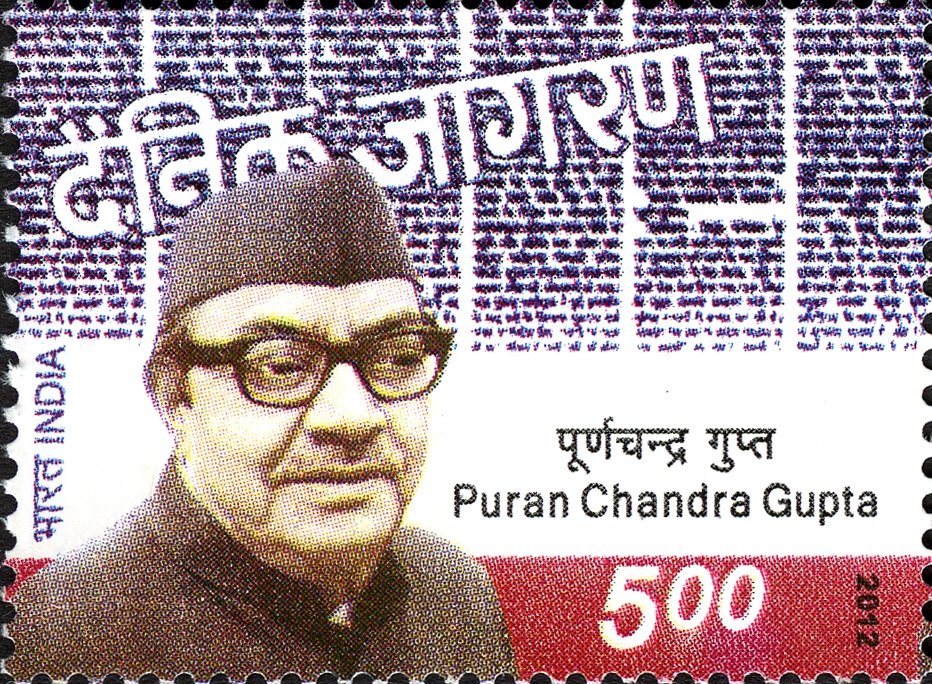
Puran Chandra Gupta was born on 2 January 1912 in Kalpi, in present-day Uttar Pradesh. Before Jagran, he was already a nationalist publisher: in 1940 he launched Swatantra, a weekly from Kanpur. Accounts of his career say the printing operation later moved to Jhansi after it drew official disapproval. In 1942, the year the Quit India Movement began in August, he started the daily Jagran from Jhansi. Jagran’s own history names him as founder. Other accounts also credit associates, including J.C. Arya and Gurudev Gupta, with the early work.
Under British rule the press was tightly controlled. Paper and printing equipment were scarce in wartime, and censorship was a constant risk. A Hindi daily based in Jhansi rather than a big metro also had to find its own reporters, distribution and advertisers. The paper’s own history describes its founding idea as a “free voice of the people”. Behind that slogan, the practical choice was to report locally for readers the big city papers did not serve.
1947: Kanpur and a New Name
About five weeks after independence, the paper moved to a bigger market.
India became independent on 15 August 1947. On 21 September 1947, the paper relaunched from Kanpur, and 1947 is also the year sources give for the name Dainik Jagran (“daily Jagran”). The move made commercial sense. Kanpur was one of north India’s biggest industrial and trading cities, with mills, merchants and a dense population around it. The Kanpur edition became the paper’s commercial base for decades.
The next two moves were outside Uttar Pradesh: Rewa (1953) and Bhopal (1956), both in what is now Madhya Pradesh. The Indian Press Year Book for 1956 lists a claimed circulation of about 21,000 copies across Uttar Pradesh and Vindhya Pradesh. That is a small number next to the crores of readers that came later, but it is a documented baseline.
The Edition Map, 1942–1990
Twelve cities in 48 years, each one a separate local edition.
| Year | City | State today | What it added |
|---|---|---|---|
| 1942 | Jhansi | Uttar Pradesh | Founding edition, Bundelkhand |
| 1947 | Kanpur | Uttar Pradesh | Industrial hub; renamed Dainik Jagran |
| 1953 | Rewa | Madhya Pradesh | First edition outside UP (Vindhya Pradesh) |
| 1956 | Bhopal | Madhya Pradesh | A state capital |
| 1975 | Gorakhpur | Uttar Pradesh | Eastern UP / Purvanchal |
| 1979 | Lucknow, Allahabad | Uttar Pradesh | UP’s capital and its high-court city |
| 1979/81 | Varanasi | Uttar Pradesh | Eastern UP (sources differ on year) |
| 1984 | Meerut | Uttar Pradesh | Western UP |
| 1986 | Agra | Uttar Pradesh | Western UP / Braj |
| 1989 | Bareilly | Uttar Pradesh | Rohilkhand |
| 1990 | Delhi | Delhi | The national capital’s Hindi market |
The Gorakhpur launch in 1975 took the paper into eastern Uttar Pradesh, where readers already had other papers to choose from. The same year, Puran Chandra Gupta was elected chairman of the Press Trust of India, and Jagran Prakashan was incorporated as a company on 18 July. The Emergency began in June 1975, and press censorship applied to every Indian paper, including this one. After that came Lucknow and Allahabad (1979), then Meerut (1984), Agra (1986) and Bareilly (1989). Together they gave the paper editions across most of Uttar Pradesh.
Puran Chandra Gupta died on 16 September 1986. His eldest son, Narendra Mohan, took over, followed later by Mahendra Mohan Gupta as chairman and managing director. Narendra Mohan’s son Sanjay Gupta became CEO and editor-in-chief. In 1990, the paper opened a Delhi edition, in one of the most crowded newspaper markets in the country.
Why the Edition Model Worked
The same event reads differently in Lucknow than it does in Meerut.
One National Edition vs Many Local Editions
| Edition | Hypothetical lead for the same north-India flood |
|---|---|
| Lucknow | State relief package, district magistrates’ orders, secretariat briefings |
| Agra | Yamuna water levels, low-lying colonies, effect on tourist traffic |
| Gorakhpur | Rapti and Ghaghra embankments, Nepal-side rainfall, village evacuations |
| Delhi | Yamuna danger mark, traffic diversions, water supply cuts |
| Bhopal | Madhya Pradesh rainfall, dam releases, crop damage |
The Jagran Formula
- A well-known Hindi name that readers recognise from Jhansi to Delhi.
- Local editions: news about the reader’s own district, which a paper printed in another city cannot match.
- Local advertising: shops, coaching centres and property developers pay to reach their own town.
- Repeat: revenue from one edition helped pay for the next.
- The daily habit: the paper arrives with the morning tea, every day.
1990s–2019: The Readership Era
Liberalisation, rising literacy and the Hindi newspaper boom.
After liberalisation in the 1990s, advertising budgets grew and literacy rose across the Hindi belt, which created many new newspaper readers. Hindi dailies found that India’s biggest news audience did not read in English. Published accounts say Jagran added 18 new editions between 1997 and 2006, and more in 2007–08. In March 2000, the company also absorbed the separate Jagran companies that ran the Delhi and Varanasi editions and the Rohilkhand (Bareilly) edition into one listed-company structure.
By the company’s own account, IRS 2003 made Dainik Jagran India’s most-read daily, with about 1.64 crore readers, and it stayed first in later rounds. ABC’s January–June 2004 audit counted 19,10,562 copies, making it the largest-circulated daily in India across languages for that period. Its 2005–06 annual report said it was the first Indian publication to cross 2 crore readers. The survey numbers kept rising. IRS 2019 Q1 reported about 7.36 crore total readers against 5.14 crore for second-placed Dainik Bhaskar. IRS 2019 Q4, a rolling average released in May 2020 during the pandemic, reported 6,86,67,000 total readers and an average issue readership of 1,68,72,000. It was still first among all Indian dailies.
2004–2019: From Family Paper to Listed Media Group
A foreign investor, a stock-market listing, and acquisitions.
In 2004, Independent News & Media, Tony O’Reilly’s Irish newspaper group, agreed to take a 26% stake in Jagran Prakashan for about Rs 150 crore. Some accounts date the deal to 2005, when it was completed. Jagran Prakashan’s IPO followed in 2006, and the family-run publisher became a company listed on the NSE and BSE. INM sold its stake by 2010.
After listing, the group added more titles. i-Next, a compact bilingual daily for readers aged roughly 18–35, became part of its print business. In 2010 it bought the print business of Mid-Day, which brought in the Urdu daily Inquilab. In 2012 it bought Madhya Pradesh’s Nai Dunia for an enterprise value of about Rs 150 crore. The group also bought Radio City, an FM network that had launched in 2001. Its own site now describes businesses in print, radio, digital, outdoor advertising and brand activations.
10 titles, 13 states
Dainik Jagran, Nai Dunia, i-Next, Inquilab, Mid-Day and others, in five languages, with 68 million total readers (company figure).
Radio City 91.1 FM
An FM brand dating from 2001, now a Jagran Prakashan subsidiary.
Jagran New Media
Hindi news, education and health sites with more than 59 million unique visitors (company figure).
2000s–2026: From Front Page to Phone Screen
The same question as in 1942: will the reader come back tomorrow?
A printed paper comes out once a day. The internet updates all the time. Jagran moved online through Jagran.com, an e-paper that copied the print pages, and SMS short-code news services. Later came mobile apps and video. COVID-19 in 2020 disrupted newspaper delivery during lockdowns just as more readers turned to phones for news. The group’s 2023 annual report, citing Comscore data for April 2023, said its digital sites were among India’s top 10 news-and-information properties.
Print still earns most of the money. Jagran Prakashan reported consolidated revenue of about Rs 2,026 crore in FY2023–24, up about 3% on the year before, with print as its largest business. Recent quarters have shown the same pressure every Indian print publisher faces: newsprint costs, falling copy sales and advertising moving online.
What “Most-Read” Actually Means
Three different numbers that often get mixed up.
| Year | Figure | Metric | Source |
|---|---|---|---|
| 1956 | ~21,000 | Claimed circulation (copies) | Indian Press Year Book |
| 2003 | ~1.64 crore | Readership (people) | IRS 2003, per company reporting |
| 2004 | 19,10,562 | Audited circulation (copies) | ABC, Jan–Jun 2004 |
| 2005 | 2 crore+ | Readership (people) | Company annual report 2005–06 |
| 2019 Q1 | ~7.36 crore | Total readership (people) | IRS 2019 Q1 |
| 2019 Q4 | 6,86,67,000 | Total readership (people) | IRS 2019 Q4 |
| 2019 Q4 | 1,68,72,000 | Average issue readership | IRS 2019 Q4 |
The Complete Dainik Jagran Timeline
Newest first.
A Print, Radio and Digital Group
Jagran Prakashan describes itself as India’s largest print media group: 10 titles across 13 states in five languages, with 68 million total readers. It also runs Radio City and Jagran New Media, which has more than 59 million unique visitors.
Digital Grows, Print Still Pays
The group reported consolidated revenue of about Rs 2,026 crore, with print its largest business. It also said its digital sites ranked among India’s top 10 news-and-information properties, and it expanded into text, audio and video.
COVID-19 and IRS 2019 Q4
Lockdowns disrupted newspaper delivery. IRS 2019 Q4, released in May 2020, still ranked Dainik Jagran first among all Indian dailies with 6,86,67,000 total readers.
The Readership Peak
IRS 2019 Q1 reported about 7.36 crore total readers for Dainik Jagran, ahead of Dainik Bhaskar’s 5.14 crore. This is the highest total-readership figure on record for the paper.
Mid-Day and Nai Dunia Acquisitions
Jagran bought Mid-Day’s print business in 2010, which included the Urdu daily Inquilab. In 2012 it bought Madhya Pradesh’s Nai Dunia for about Rs 150 crore. INM sold its stake by 2010.
Jagran Prakashan IPO
The family-run publisher listed on the NSE and BSE, after Independent News & Media had taken a 26% stake. The youth-focused bilingual compact i-Next became part of its print business.
Top Circulation, and 2 Crore Readers
ABC counted 19,10,562 copies, the most of any Indian daily in any language. Independent News & Media agreed a 26% stake. The company then reported becoming the first Indian publication with more than 2 crore readers.
India’s Most-Read Daily
By the company’s own reporting, IRS ranked Dainik Jagran first in readership with about 1.64 crore readers. It stayed first in later rounds.
Rapid Growth in Editions
Published accounts say 18 new editions opened in these nine years, with more in 2007–08. In March 2000, the separate Jagran companies behind the Delhi, Varanasi and Rohilkhand editions were merged into one company.
Delhi Edition
The paper launched in Delhi, one of India’s most competitive newspaper markets and its political centre.
Meerut, Agra, Bareilly
Three new editions strengthened the paper in western UP and Rohilkhand. Founder Puran Chandra Gupta died on 16 September 1986, and Narendra Mohan took over.
Lucknow and Allahabad
Editions opened in UP’s capital and in Allahabad (now Prayagraj). Varanasi followed around the same time; sources give 1979 or 1981.
Gorakhpur, PTI and the Emergency
The Gorakhpur edition opened. Puran Chandra Gupta was elected chairman of the Press Trust of India, and Jagran Prakashan was incorporated. The Emergency, declared in June, brought press censorship for every paper in India.
Rewa and Bhopal
The first editions outside Uttar Pradesh opened, in what is now Madhya Pradesh. The 1956 Indian Press Year Book recorded a claimed circulation of about 21,000 copies.
Kanpur Relaunch as Dainik Jagran
About five weeks after independence, the paper relaunched from Kanpur under the name Dainik Jagran.
Jagran Launched in Jhansi
Puran Chandra Gupta, who had launched the Kanpur weekly Swatantra in 1940, started the daily Jagran from Jhansi.
Quiz: How Well Do You Know Jagran?
Tap a question to reveal the answer.
1. Where was Jagran launched?
2. Which city got the second base, in 1947?
3. Which strategy did Jagran build its growth on?
4. When did Jagran enter Delhi?
5. IRS 2019 Q1 put Dainik Jagran’s total readership at about…
6. What does “readership” measure?
Explore More Timelines
People Also Ask
Frequently Asked Questions
Related AiTimeline Stories
⚠️ Editorial Note
Dates and figures in this timeline come from published histories of the paper, Wikipedia’s articles on Dainik Jagran and Puran Chandra Gupta, IRS 2019 coverage in afaqs and BestMediaInfo, Newslaundry’s ownership report, Jagran Prakashan’s corporate site and FY24 results coverage. Sources disagree on two details: the Varanasi edition year (1979 or 1981) and the year of the INM deal (2004 or 2005). Both are marked where they appear. Figures for 2003 and 2005 come from the company’s own reporting. Readership numbers are survey estimates and should not be read as copies printed. This is editorial, AI-assisted content and not an official Jagran publication.
Sources & further reading
Every dated entry above was checked against these references. Last reviewed 25 September 2026.
- Wikipedia -- Dainik Jagran
- Wikipedia -- Puran Chandra Gupta
- Wikipedia -- Jagran Prakashan
- Jagran Prakashan Ltd -- Corporate site (print, radio, digital figures)
- afaqs -- IRS Q1 2019: Top newspapers and magazines
- BestMediaInfo -- IRS 2019 Q4 released: Dainik Jagran and TOI remain largest-read
- Newslaundry -- Who Owns Your Media: Jagran Group
- Equitymaster -- Jagran Prakashan 2023-24 Annual Report Analysis
- Wikimedia Commons -- Puran Chandra Gupta 2012 stamp of India