Rohith Vemula: The 2016 Death That Sparked a National Campus Movement
Rohith Vemula timeline: the 2016 campus protests, conflicting inquiry and police findings, the Supreme Court petition and the stayed UGC equity rules.
Latest Story
On 17 January 2016, 26-year-old doctoral researcher Rohith Vemula was found dead in a hostel room at the University of Hyderabad. He and four other members of the Ambedkar Students’ Association had been barred from the hostels after a dispute with a student leader of the ABVP. His death set off protests on campuses across India and a debate about caste, campus discipline and institutional accountability that has not ended. This Rohith Vemula timeline follows each official track separately: the campus disciplinary process, the commission and caste findings, the police case and its 2024 closure report, and the Supreme Court petition that produced new UGC rules in 2026, rules that are now stayed.
Official findings in this case contradict each other. We keep them apart: a commission’s report is not a court judgment, a police closure report is not an acquittal, and an allegation is not a proven offence. On his caste, we report what each authority found, with attribution, because no court has settled it. Where the brief we worked from was wrong or imprecise, we say so in the entry.
💡 Short Answer
Rohith Vemula, a Dalit doctoral researcher by his family’s account and the NCSC’s finding, died by suicide at the University of Hyderabad on 17 January 2016 after being barred from the hostels. A judicial commission later called the university’s action justified and questioned his Scheduled Caste status. Police filed a closure report in March 2024, then announced further investigation. His mother’s 2019 Supreme Court petition led to new UGC equity rules in January 2026, which the court stayed on 29 January 2026.
Rohith Vemula Case: Key Questions
The Rohith Vemula Case in Ten Points
- The dispute: a night-time confrontation with an ABVP leader in August 2015 started the disciplinary case.
- The reports: the Proctorial Board found no evidence of assault on 12 August, then recommended suspension on 31 August.
- The letter: a Union minister’s letter to the HRD Ministry in between became the most contested fact.
- The punishment: five scholars were barred from hostels and common spaces in late 2015.
- The death: Rohith Vemula died on 17 January 2016; his note became a national text.
- Two caste findings: the NCSC said he was Scheduled Caste; the Roopanwal Commission said he was not.
- Police case: closure report in March 2024, further investigation announced in May 2024.
- The petition: Radhika Vemula and Abeda Tadvi took campus discrimination to the Supreme Court in 2019.
- The rules: the UGC notified new equity regulations on 13 January 2026.
- The stay: the Supreme Court paused them on 29 January 2026; the Centre is reconsidering them.
The Campus Case: August 2015 to January 2016
Six months from a Facebook post to a hostel ban.
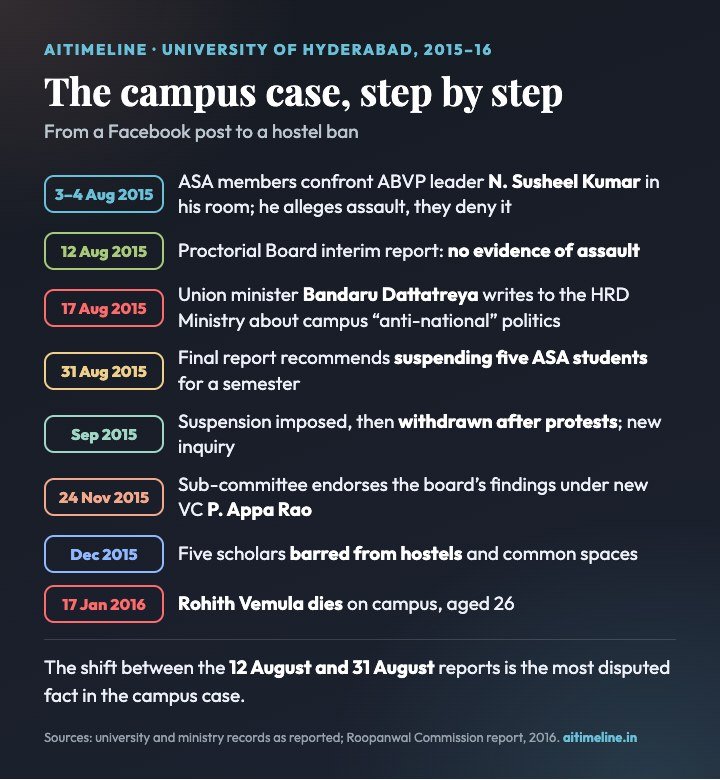
The dispute began with a Facebook post. After the Ambedkar Students’ Association protested against the execution of Yakub Memon and the disruption of a documentary screening in Delhi, ABVP leader N. Susheel Kumar called its members “goons”. On the night of 3–4 August 2015, ASA members confronted him in his hostel room and he wrote an apology. He later alleged he had been assaulted.
What happened next is the heart of the case. The university’s Proctorial Board found in an interim report that there was no evidence of assault. Five days later, Union Minister of State Bandaru Dattatreya wrote to HRD Minister Smriti Irani about “anti-national” activity on campus, and the ministry forwarded the letter to the university repeatedly. The board’s final report then recommended suspending five ASA students. Critics see a direct link; the Roopanwal Commission found the university acted on its own judgment. The suspension was withdrawn after protests, then replaced in late 2015 by a ban on the five living in the hostels or entering common spaces.
Timeline: The Rohith Vemula Case, 1989 to 2026
Newest first. Colour shows which track each event belongs to.
Where things stand Supreme Court & UGC rules
Settled: Nothing in the criminal case has been decided by a court after a trial. The Roopanwal Commission’s report and the 2024 police closure report are investigative or inquiry conclusions, not judgments.
Not settled: The 2026 UGC Equity Regulations remain in abeyance under the Supreme Court’s order of 29 January 2026, and the 2012 regulations continue to apply. The Centre has said it is reconsidering the rules and may set up a review committee. We found no report of a court ruling on the further police investigation announced in May 2024.
Centre says it is weighing a review committee Supreme Court & UGC rules
What happened: The Centre told the Supreme Court it was contemplating a committee to re-examine the 2026 equity regulations. The bench adjourned the batch of petitions. Reports differ on whether the committee had been set up; the Solicitor General described it as under consideration.
Why it matters: The petitions mainly target the regulations’ definition of caste-based discrimination, which names members of the Scheduled Castes, Scheduled Tribes and Other Backward Classes. Petitioners argue that leaves general-category students without the same grievance route.
“Under reconsideration” Supreme Court & UGC rules
What happened: The Union government told the court that the 2026 regulations were being reconsidered. The court recorded the submission and adjourned the matter.
Why it matters: It was the first formal sign that the government might rewrite rather than defend the rules as notified.
Karnataka cabinet approves a “Rohith Vemula Bill” Protest, politics & legacy
What happened: Karnataka’s cabinet approved the Karnataka Rohith Vemula (Prevention of Discrimination, Exclusion or Injustice) (Right to Education and Dignity) Bill, 2026, after sending an earlier draft back for review in February. Reported provisions include equity committees in every institution and fines of up to Rs 10 lakh on institutions.
Status: The bill was to be introduced in the legislature’s monsoon session. We could not confirm that it has been passed.
Supreme Court stays the new regulations Supreme Court & UGC rules
What happened: Hearing petitions by Mritunjay Tiwari, Vineet Jindal and Rahul Dewan, the court kept the 2026 regulations in abeyance, saying some provisions appeared vague and capable of misuse. It ordered that the 2012 regulations would continue to operate, framed questions of law and listed the matter for March.
Why it matters: The rules that grew out of the Vemula–Tadvi petition were paused by a different set of petitions, heard by the same court.
Court told the rules are in force Supreme Court & UGC rules
What happened: In the Vemula–Tadvi petition, the court recorded that the regulations had been notified on 13 January and made operative, and allowed the petitioners to place further suggestions before it.
Why it matters: For a fortnight, the petition appeared to have achieved its main aim.
UGC notifies the 2026 Equity Regulations Supreme Court & UGC rules
What happened: The UGC notified the University Grants Commission (Promotion of Equity in Higher Education Institutions) Regulations, 2026. They required every institution to set up an equal opportunity centre and an equity committee, and to act on complaints within fixed time limits.
Why it matters: They replaced the 2012 regulations, which the petitioners said had been widely ignored.
Petitioners set out what the rules should contain Supreme Court & UGC rules
What happened: The court recorded the petitioners’ suggestions: an explicit ban on all known forms of discrimination, no segregation by rank or marks, representation of SC, ST and OBC members on grievance bodies, personal liability for institution heads, caste-sensitive counselling, audits linked to accreditation and withdrawal of grants for non-compliance.
Why it matters: Several of these went well beyond both the 2012 rules and the UGC’s 2025 draft.
UGC allowed to finalise and notify Supreme Court & UGC rules
What happened: The court refused to halt the regulatory process and said the UGC could finalise and notify its draft. The rules would operate alongside any recommendations of the National Task Force on student mental health that the court had set up on 24 March 2025 in a separate case, Amit Kumar v. Union of India.
Why it matters: The court described the UGC’s steps as being in the right direction and treated the rules as open to later refinement.
UGC publishes a draft Supreme Court & UGC rules
What happened: The UGC released the draft Promotion of Equity in Higher Education Institutions Regulations, 2025, and invited comments for 30 days.
Reaction: Radhika Vemula and Abeda Salim Tadvi said the draft diluted the existing rules. Student groups questioned how discrimination was defined and who would sit on the equity committees.
Supreme Court asks for data and a draft Supreme Court & UGC rules
What happened: The court directed the UGC to collect data from universities on their equal opportunity cells, the complaints received and the action taken, and to place its new draft regulations on record.
Why it matters: The order treated the question as one of implementation: whether the 2012 rules had worked at all.
Closure report made public; DGP orders further investigation Police case
What happened: News broke that Cyberabad police had filed a closure report. The same day, the DGP said the investigation would continue and that police would ask the magistrate for permission to investigate further, citing doubts raised by Vemula’s mother.
Family’s response: The family said it would contest the closure report. Radhika Vemula met Chief Minister A. Revanth Reddy and asked for a fresh investigation.
Police file a closure report Police case
What happened: The investigating officer filed a final report stating that there was not enough evidence that the accused abetted Vemula’s suicide. It also said he was not a Dalit and suggested he feared his caste would be exposed, a claim his family rejected.
Legal status: A closure report is a police conclusion. A court can accept it, reject it or order further investigation. It is not an acquittal or a judgment after trial.
Two mothers go to the Supreme Court Supreme Court & UGC rules
What happened: Radhika Vemula and Abeda Salim Tadvi, whose daughter Payal Tadvi, a resident doctor in Mumbai, died by suicide on 22 May 2019 after alleged caste harassment, petitioned the Supreme Court. They asked for the UGC’s 2012 anti-discrimination rules to be enforced and for stronger mechanisms on campuses.
Why it matters: This petition, not the criminal case, became the main legal route through which Vemula’s death shaped national policy.
Guntur administration questions the caste certificate Inquiries & caste finding
What happened: The Guntur district administration, which had earlier reported that Vemula belonged to the Mala community (a Scheduled Caste), now said he and his mother were not Dalits and issued a show-cause notice asking her to prove her caste status.
Why it matters: The reversal kept the caste question open and delayed any action under the SC/ST atrocities law.
Report and action taken placed before Parliament Inquiries & caste finding
What happened: The government informed Parliament that the Roopanwal Commission report and the memorandum of action taken on it had been laid before both Houses.
Why it matters: Its conclusions became the government’s official record of the affair, though they were contested.
Roopanwal Commission submits its report Inquiries & caste finding
Findings as reported: The report found the university’s disciplinary action justified and said Vemula’s death was linked to personal reasons. It concluded that his mother belonged to the Vaddera community, so his Scheduled Caste certificate “cannot be said to be a genuine one”. The findings were first reported on 24 August and in more detail in October.
Reaction: NCSC chairman P.L. Punia called the caste finding “totally wrong” and questioned the commission’s authority to decide it. The family rejected the report.
NCSC says he was a Scheduled Caste Inquiries & caste finding
What happened: The NCSC issued its findings that Vemula belonged to the Mala community, a Scheduled Caste, relying on a report from the Guntur District Collector received on 2 June. It said the police should proceed under the SC/ST (Prevention of Atrocities) Act.
Why it matters: Two official bodies would soon reach opposite conclusions on the same question.
Radhika Vemula embraces Buddhism Protest, politics & legacy
What happened: Radhika Vemula and her younger son Raja converted to Buddhism on B.R. Ambedkar’s birth anniversary, a step many Dalits take in rejection of caste.
Why it matters: She became the public face of the movement, campaigning across the country.
Judicial commission appointed Inquiries & caste finding
What happened: The ministry announced a one-member commission headed by a retired Allahabad High Court judge to examine the circumstances of Vemula’s death and the university’s grievance-redressal mechanisms. It was formally notified on 2 February with three months to report.
Why it matters: Its terms of reference covered facts and campus mechanisms, not criminal liability.
Ministry fact-finding team reports Inquiries & caste finding
What happened: The team sent by the ministry submitted its report. Accounts based on leaks said it found a lack of sensitivity in parts of the university’s handling of the suspensions.
Why it matters: It was the first official review, but the ministry did not publish its contents at the time.
Suspension of the four scholars revoked Campus
What happened: Citing the “extraordinary situation in the campus”, the Executive Council withdrew the suspension of the four remaining scholars, subject to the outcome of their pending writ petition in the High Court.
Reaction: Protesters said it came too late and demanded the vice-chancellor’s removal. Several SC and ST faculty members gave up administrative posts in protest.
FIR names a minister and the vice-chancellor Police case
What happened: On a complaint from students, police registered a case of abetment of suicide and offences under the SC/ST (Prevention of Atrocities) Act against Union Minister of State Bandaru Dattatreya, Vice-Chancellor P. Appa Rao, BJP MLC N. Ramchander Rao, ABVP leader N. Susheel Kumar and others.
Why it matters: This is the case that ended in the 2024 closure report. All the accused denied wrongdoing.
Rohith Vemula dies on campus Protest, politics & legacy
What happened: Rohith Vemula was found dead in a friend’s room in a hostel on the University of Hyderabad campus. He left a note in which he wrote that “the value of a man was reduced to his immediate identity and nearest possibility”. He blamed no one by name.
Why it matters: His death and his note set off protests on campuses across India within days.
Velivada: the protest camp Campus
What happened: After being made to leave their hostel rooms, the five suspended scholars set up a tent at the campus shopping complex and slept there. They called it Velivada, the name for the segregated quarter outside a village where Dalits were made to live.
Why it matters: The name framed the punishment as social exclusion.
Vemula writes to the vice-chancellor Campus
What happened: In a bitter letter, Vemula asked the vice-chancellor to give Dalit students “sodium azide” at admission and “a nice rope” in their rooms, and asked for “euthanasia facility” for students like him.
Why it matters: The letter was later read as a warning that was ignored.
Hostel ban imposed Campus
What happened: A sub-committee reported to the new vice-chancellor on 24 November, broadly endorsing the Proctorial Board’s findings. The university then barred Rohith Vemula, Dontha Prashanth, Vijay Kumar, Seshu Chemudugunta and Velpula Sunkanna from the hostels and from administrative buildings and common areas, while allowing them to attend classes.
Why it matters: Vice-Chancellor P. Appa Rao later said he had reduced the punishment from a full suspension. The students called it a social boycott.
First suspension withdrawn; new vice-chancellor Campus
What happened: The university implemented the suspension on 8 September 2015. After three days of protests it withdrew the order and set up a fresh inquiry. P. Appa Rao became vice-chancellor later that month.
Why it matters: The case was reopened under a new administration.
Proctorial Board: interim and final reports Campus
What happened: The Proctorial Board’s interim report of 12 August found no evidence that Susheel Kumar had been assaulted. On 17 August, Union Minister Bandaru Dattatreya wrote to HRD Minister Smriti Irani describing the campus as a “den of casteist, extremist and anti-national politics”. The board’s final report of 31 August recommended suspending five ASA students for a semester.
Why it matters: The ministry forwarded the letter to the university several times. Critics say that pressure changed the outcome; the Roopanwal report said it did not.
Confrontation over a Facebook post Campus
What happened: ABVP leader N. Susheel Kumar had called ASA members “goons” in a Facebook post after the ASA protested against the execution of Yakub Memon and the disruption of a screening of the documentary Muzaffarnagar Baaqi Hai in Delhi. ASA members went to his room at night and made him write an apology. He later said he had been beaten; they said there was no assault.
Why it matters: Every later disciplinary step traced back to this night.
Rohith Chakravarti Vemula is born Protest, politics & legacy
Life: He grew up in Guntur, studied science, and joined the University of Hyderabad, where he was a doctoral researcher in science, technology and society studies. He was active in the Ambedkar Students’ Association.
Why it matters: He wrote that he had wanted to be “a writer of science, like Carl Sagan”.
Conflicting Official Findings
Why no single report settles the case.
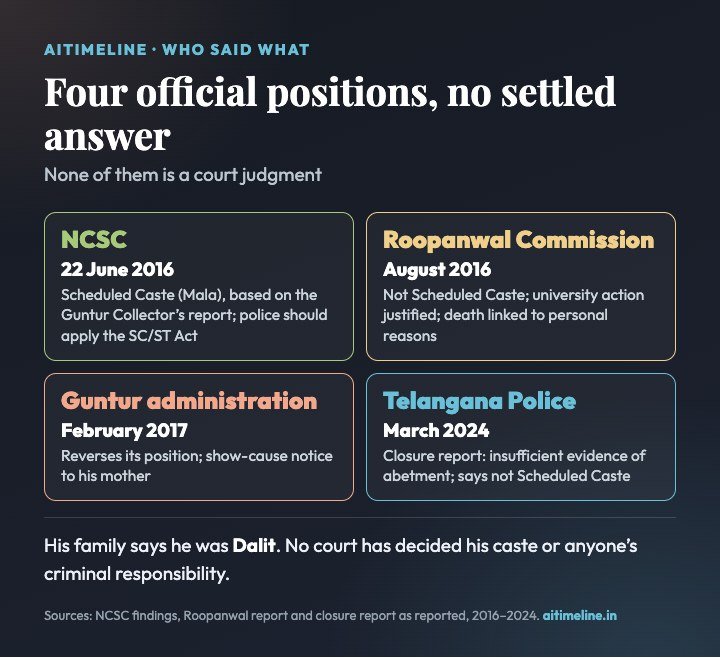
| Body | Date | On his caste | On responsibility | Legal weight |
|---|---|---|---|---|
| NCSC | 22 Jun 2016 | Scheduled Caste (Mala), per Guntur Collector | Police should act under the SC/ST Act | Constitutional body’s finding |
| Roopanwal Commission | Aug 2016 | Not Scheduled Caste | University action justified; personal reasons | Inquiry report, not binding on courts |
| Guntur district administration | Feb 2017 | Not Dalit; show-cause notice to mother | — | Administrative position |
| Telangana Police | Mar 2024 | Not Scheduled Caste | Insufficient evidence of abetment | Closure report; court yet to decide |
| Family | — | Dalit (Mala, through his mother) | University and political pressure | Complainants |
The caste question matters legally because the SC/ST (Prevention of Atrocities) Act applies only if the victim belonged to a Scheduled Caste or Tribe. It matters politically because the case became a symbol of Dalit students’ experience on campus. His mother says she was raised in a Mala family, a Scheduled Caste, though she married a man from the Vaddera community; certificates in such cases can turn on how a child was brought up. Each finding above rests on a different body’s reading of that history.
The Police Case
Eight years from FIR to closure report, and still open.
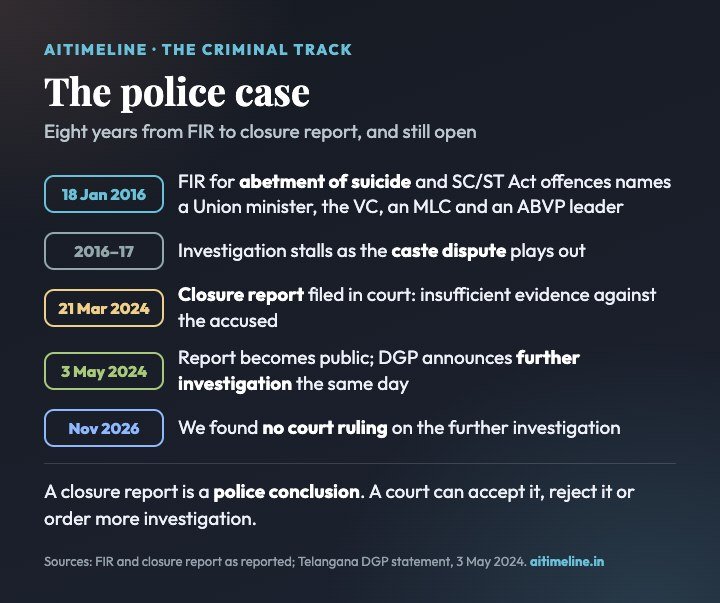
The FIR named Bandaru Dattatreya, Vice-Chancellor P. Appa Rao, BJP MLC N. Ramchander Rao and ABVP leader N. Susheel Kumar, among others. All denied wrongdoing. The investigation moved slowly while the caste dispute played out. When the closure report emerged in May 2024, during the Lok Sabha campaign, Telangana’s Congress government faced criticism from its own allies, and the DGP announced further investigation within hours. Our Hyderabad veterinarian case timeline follows another Cyberabad investigation through the courts.
The Supreme Court Petition
Two mothers, two deaths, one demand.
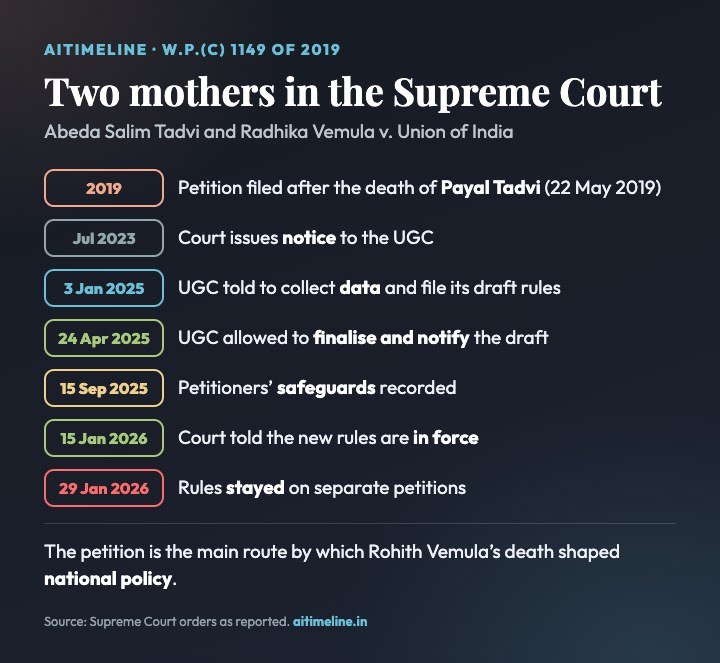
Payal Tadvi, a resident doctor at a Mumbai medical college from the Bhil Tadvi tribal community, died by suicide on 22 May 2019 after alleged caste harassment. Her mother joined Radhika Vemula in asking the Supreme Court to enforce the UGC’s 2012 anti-discrimination rules. The petition sat almost untouched for four years. From January 2025, a bench including Justice Surya Kant pressed the UGC for data and a new framework, and the regulations followed. Discrimination cases elsewhere show the same gap between law and enforcement, from Hathras to the Bhima Koregaon violence.
The UGC Rules: 2012, 2025 Draft, 2026 and the Stay
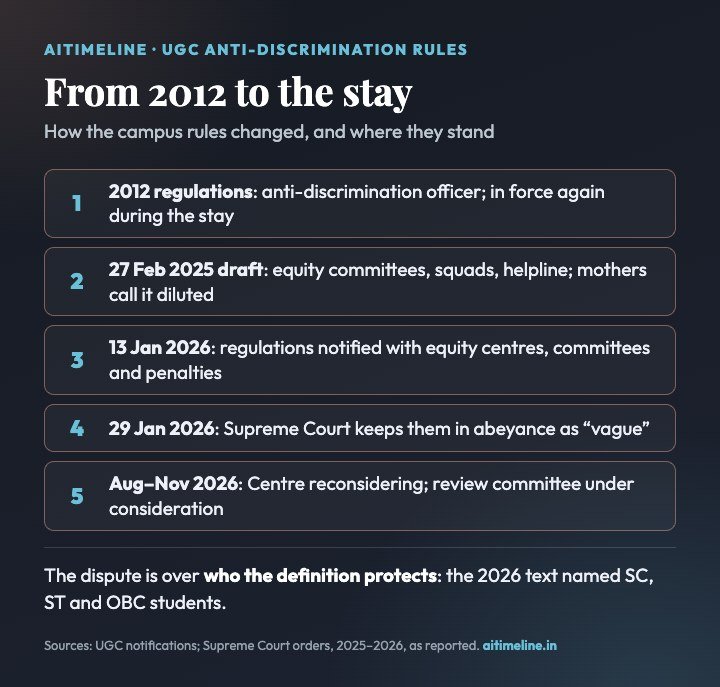
| Stage | Date | What it did | Status |
|---|---|---|---|
| 2012 regulations | 2012 | Anti-discrimination officer; complaints mechanism | In force during the stay |
| Draft regulations | 27 Feb 2025 | Equity committees, squads, helpline; public comments | Superseded |
| 2026 regulations | 13 Jan 2026 | Equal opportunity centres, equity committees, time-bound action, penalties | Stayed 29 Jan 2026 |
| Review | Aug–Nov 2026 | Centre reconsidering; committee under consideration | Pending |
The 2026 regulations were the first major rewrite since 2012. Within days, students in several states protested that the definition of caste-based discrimination covered only SC, ST and OBC students. The Supreme Court agreed that the wording appeared vague and capable of misuse and paused the rules. The underlying dispute is about who the rules protect, not whether campuses need them. Reservation and representation debates have a long history, from the Mandal Commission to the Maratha quota.
A Law in His Name
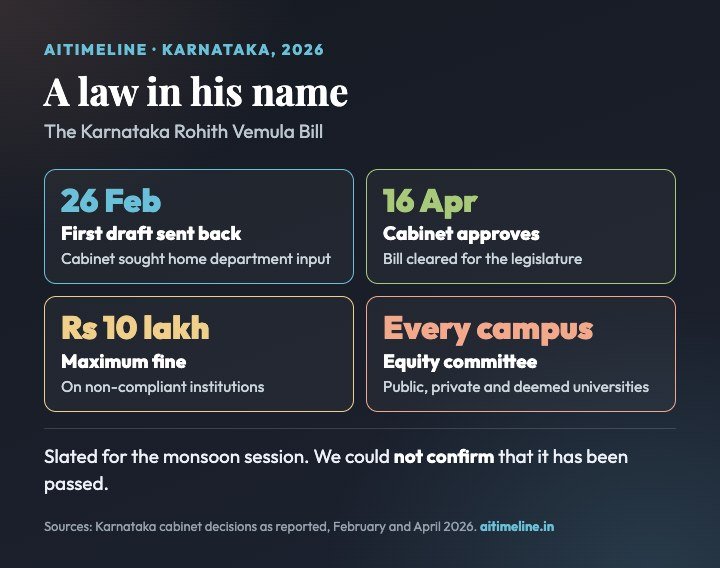
The demand for a “Rohith Act” began on campuses in 2016. In 2025 Rahul Gandhi asked Congress-ruled states to legislate, and Karnataka produced a bill. If passed, it would apply to state, private and deemed universities in Karnataka, independent of the stayed UGC rules.
What Did the Movement Change?
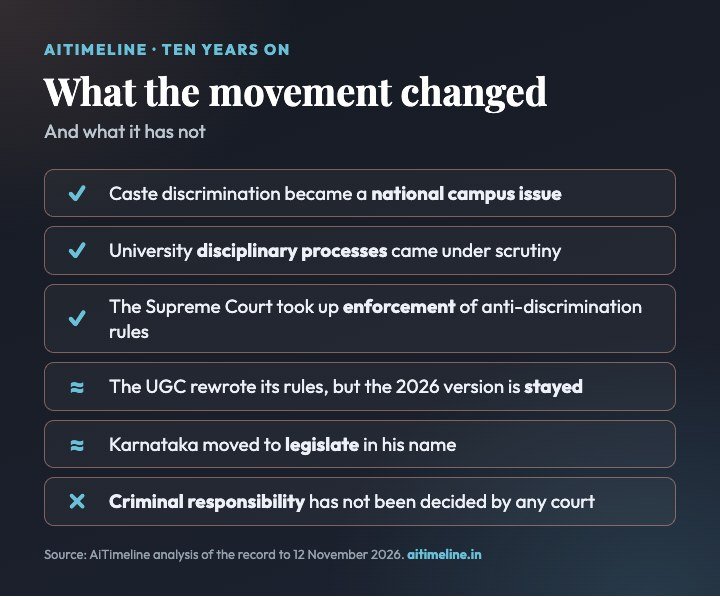
- Caste on campus: the debate moved from admissions and reservation to everyday treatment — hostels, evaluation, supervision and social exclusion.
- Discipline under scrutiny: the case raised questions about how universities investigate student disputes and how outside pressure can enter that process.
- Grievance systems: it showed that a complaint mechanism on paper is not one students trust.
- The UGC framework: the 2019 petition put enforcement before the Supreme Court and led to the 2026 rules, now stayed.
- Student well-being: the case fed a wider debate on discrimination, isolation and mental health. One death does not support a general medical conclusion about student suicides.
- Dissent and discipline: it sharpened the argument over where student political expression ends and campus discipline begins.
Key People and Institutions
| Person or institution | Role |
|---|---|
| Rohith Vemula | Doctoral researcher, University of Hyderabad; member of the Ambedkar Students’ Association |
| Radhika Vemula | His mother; co-petitioner in the Supreme Court |
| Dontha Prashanth, Velpula Sunkanna, Vijay Kumar, Seshu Chemudugunta | Fellow scholars barred from the hostels with him |
| N. Susheel Kumar | ABVP leader whose complaint began the disciplinary case |
| P. Appa Rao | Vice-chancellor from September 2015; named in the FIR |
| Bandaru Dattatreya | Union Minister of State whose August 2015 letter became part of the controversy; named in the FIR |
| Justice Ashok Kumar Roopanwal | Retired judge who headed the commission of inquiry |
| Abeda Salim Tadvi | Mother of Payal Tadvi; co-petitioner |
| National Commission for Scheduled Castes | Found him to be Scheduled Caste in June 2016 |
| University Grants Commission | Framed the 2012 and 2026 equity regulations |
Facts at a Glance
| Detail | Information |
|---|---|
| Born | 30 January 1989, Guntur |
| Died | 17 January 2016, aged 26 |
| Campus confrontation | 3–4 August 2015 |
| Suspension of four revoked | 21 January 2016 |
| Commission announced | 28 January 2016 (notified 2 February) |
| NCSC finding | 22 June 2016 |
| Police closure report | 21 March 2024 |
| Further investigation announced | 3 May 2024 |
| UGC 2026 regulations | Notified 13 January 2026 |
| Supreme Court stay | 29 January 2026 |
Explore More Timelines
People Also Ask
Frequently Asked Questions
Based on official records and reporting to 12 November 2026.
⚠️ Editorial Note
This timeline distinguishes allegations, inquiry findings, police conclusions and court orders. The Roopanwal Commission report and the 2024 police closure report are not criminal court judgments, and we attribute every statement about Rohith Vemula’s caste to the body that made it. Checking the record, we corrected or clarified several points in the brief we worked from: the commission was announced on 28 January 2016 but formally notified on 2 February; the Proctorial Board’s 12 August 2015 interim report found no evidence of assault, and suspension was recommended on 31 August; the 24 April 2025 order allowed the UGC to finalise and notify its draft; and the Centre’s committee proposal was made in court on 5 November 2026, not 6 November. We could not independently confirm the exact date of the November 2015 Executive Council decision or whether Karnataka’s bill has been passed. If you or someone you know is struggling, please contact a mental health helpline such as Tele-MANAS (14416).
Related Reading on AiTimeline
Sources & further reading
Every dated entry above was checked against these references. Last reviewed 12 November 2026.
- Commission appointed to enquire the cause of the death of the research scholar (notification of 2 February 2016)
- The chain of events leading to Rohith Vemula's suicide
- Rohith Vemula was not a Dalit: HRD Ministry probe panel report (24 August 2016)
- Saying that Rohith was not Dalit 'totally wrong': NCSC rejects MHRD report
- Hyderabad varsity revokes suspension of four students (21 January 2016)
- Rohith Vemula case: hours after closure report, Telangana police promise further investigation (3 May 2024)
- Caste discrimination in colleges: Supreme Court allows UGC to notify draft regulations (24 April 2025)
- 'Capable of misuse, vague': Supreme Court stays UGC Equity Regulations 2026 (29 January 2026)
- Equity on hold: Supreme Court's interim stay of the UGC Regulations 2026 (with orders of 3 Jan 2025, 24 Apr 2025, 15 Sep 2025)
- Centre mulls panel to review UGC's 2026 equity rules amid SC challenge (5 November 2026)
- Karnataka cabinet approves Rohith Vemula Bill to curb caste discrimination in campus (April 2026)