Muzaffarpur Shelter Home Case: How the Abuse Was Exposed
Explore the Muzaffarpur shelter home case timeline, TISS findings, CBI investigation, 2020 convictions, survivor compensation and child-protection reforms.
Latest Story
In April 2018 a team from the Tata Institute of Social Sciences handed Bihar’s government an audit of the state’s shelter homes. One entry, on a government-funded girls’ home in Muzaffarpur run by Brajesh Thakur’s NGO, described sexual abuse. Within months the CBI had taken over, a minister had resigned and the Supreme Court was monitoring the investigation. In January 2020 a Delhi court convicted 19 people. This Muzaffarpur shelter home case timeline follows the audit, the investigation, the verdict, the separate cases that followed, and the child-protection safeguards the case put to the test.
The case produced several legal proceedings with different outcomes. We keep apart the main sexual-abuse trial in Delhi, the murder allegations that the CBI said it could not substantiate, the separate missing-women case decided in 2025, and the money-laundering case. Arguments in court are not findings. Survivors are not named and no details of the abuse are described.
💡 Short Answer
The Muzaffarpur shelter home case concerns the sexual abuse of girls at a government-funded home in Bihar run by Brajesh Thakur’s NGO. A TISS social audit submitted in April 2018 exposed it, and an FIR followed on 31 May 2018. The CBI investigated under Supreme Court monitoring, and on 20 January 2020 a Delhi court convicted 19 people. Thakur was jailed for the rest of his life. Appeals were pending in the Delhi High Court as of November 2026.
Muzaffarpur Shelter Home Case: Key Questions
The Muzaffarpur Case in Nine Points
- The warning: an outside audit, not a government inspection, exposed the abuse.
- The delay: about five weeks passed between the TISS report and the FIR.
- The investigation: the CBI took over in July 2018 and the Supreme Court monitored it.
- The politics: Social Welfare Minister Manju Verma resigned in August 2018.
- The trial: moved to Delhi in February 2019; 19 convicted in January 2020.
- The sentence: Thakur jailed for the rest of his life; at least ten others got life terms.
- The murder claims: investigated, but the CBI found no evidence.
- The wider system: the CBI was told to investigate 16 other shelter homes in Bihar.
- Still open: appeals in the Delhi High Court and a money-laundering case.
What the Law Requires of a Children’s Home
The safeguards that existed on paper when the abuse was happening.
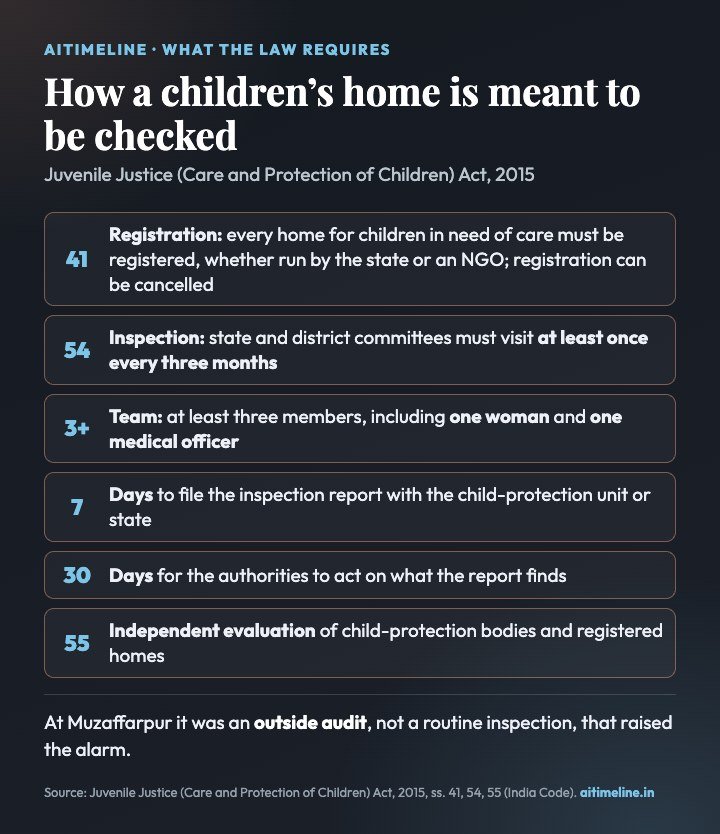
The Muzaffarpur home was not operating outside the law’s reach. It was registered, funded by the state and, on paper, subject to inspection. Section 54 of the Juvenile Justice Act requires inspection committees to visit every home at least once every three months, with a team that includes a woman and a medical officer, to report within a week, and the authorities to act within a month. Section 55 adds independent evaluation of how the system works.
What the case revealed was the gap between those rules and their use. The abuse came to light through a social audit the department had commissioned from outside, not through its own inspections, and even then the first criminal case took five weeks. The practical lesson is less about new law than about inspections that include private conversations with children, complaint channels that do not run through the people accused, and follow-up that someone is answerable for.
The TISS Audit That Broke the Silence
Commissioned by the department it went on to criticise.
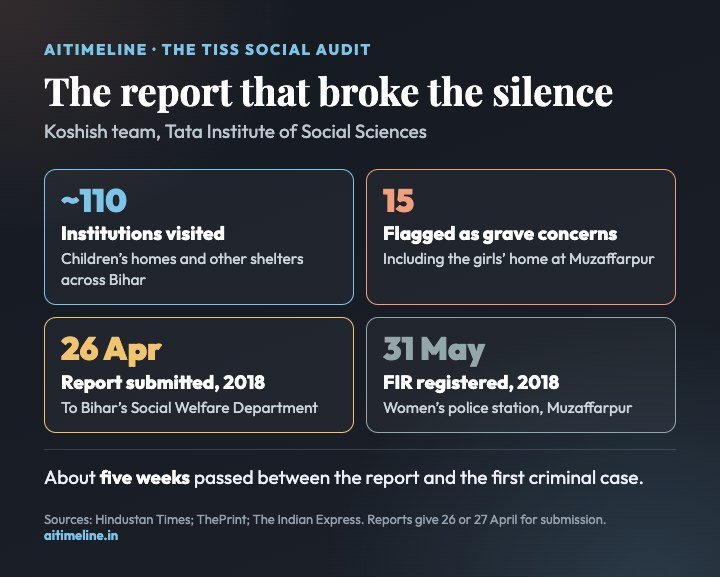
In 2017 Bihar’s Social Welfare Department asked Koshish, a field project of the Tata Institute of Social Sciences, to assess its shelter homes. The team, led by Mohammed Tarique, visited about 110 institutions. Its report described conditions ranging from neglect to violence and singled out 15 as grave concerns. At the Muzaffarpur girls’ home, girls told the researchers of sexual abuse.
The report reached the department in late April 2018. Officials later faced questions about the weeks that passed before the police were brought in. Six assistant directors of child-protection units were suspended in August 2018, and in 2022 the Supreme Court was still asking Bihar what disciplinary action had followed the CBI’s recommendations.
Timeline: The Muzaffarpur Case, 2018 to November 2026
Newest first. Colour shows the type of event.
Where the case stands Appeals & other cases
The convictions: The January 2020 convictions and the February 2020 sentences remain in force. The appeals by Brajesh Thakur and other convicts, heard together with Crl.A. 364/2020 as the lead case, were being argued before Justices Prathiba M. Singh and Amit Sharma in 2024 and 2025.
What we could not find: We found no report or court record of a final High Court judgment, or of the judgment being reserved, by 12 November 2026. Readers should check the Delhi High Court’s case-status page for the latest position.
Custody: Thakur remains in jail on the 2020 sentence. The 2025 acquittal in a separate case did not change that.
Delhi High Court records continuing arguments in the appeals Appeals & other cases
The order: A division bench of Justices Prathiba M. Singh and Amit Sharma recorded a long hearing in Thakur’s appeal and the connected appeals of other convicts, including the former Child Welfare Committee chairman Dilip Kumar Verma.
What it is: It is a hearing order, not a verdict. It shows the appeals were at the stage of final arguments.
Thakur acquitted in a separate missing-women case Appeals & other cases
The case: This case concerned 11 women and four girls reported missing from another home run by Thakur’s NGO in Muzaffarpur. It stayed in Bihar when the main trial moved to Delhi.
The outcome: The court acquitted Thakur and two associates, Shaista Praveen alias Madhu and Krishna Kumar, for lack of evidence. A fourth accused had died during the trial.
What it did not do: It did not overturn the 2020 convictions in the Delhi case. Thakur stayed in jail.
Defence attacks the survivors’ evidence Appeals & other cases
The argument: Thakur’s senior counsel, Pramod Kumar Dubey, argued that the girls’ statements had been “improved” over time and were not of “sterling quality”, pointing to a gap of about three months between the events and the statements.
How to read it: These are defence submissions in an appeal, not findings. Earlier that month the same bench had remarked that Thakur “turned a blind eye to everything”.
A film brings the case back to public attention Government & politics
What happened: Bhakshak, starring Bhumi Pednekar as a journalist investigating abuse at a shelter home in Bihar, was released on Netflix. Its makers did not officially say it was based on the Muzaffarpur case, but reviewers and explainers widely linked the two.
Why it matters: The film led to a new wave of explainers about the case, often mixing allegations with court findings. This page keeps them apart.
Supreme Court extends protection to Thakur’s mother and wife Appeals & other cases
The allegation: The ED accuses Thakur, his mother and his wife of diverting government and other funds meant for the NGO’s children to personal use and property, under the Prevention of Money Laundering Act.
The order: The court extended interim protection from arrest, first granted on 3 March 2023, until the case was completed, noting that the petitioners were women and the mother was elderly.
What it is not: Protection from arrest is not a finding of guilt or innocence. We found no trial verdict in this case.
Supreme Court asks Bihar what it did about erring officials Supreme Court
What happened: The court directed Bihar to file an action-taken report on the CBI’s recommendations for disciplinary action against officials connected with the shelter homes.
Why it matters: The criminal trial dealt with the abusers. The question of officials who failed to act on warnings ran on a separate, slower track.
Bihar reports compensation for 49 survivors Government & politics
What Bihar told the NHRC: Compensation of Rs 3 lakh to Rs 9 lakh had been paid to 49 victims, the NGO’s registration had been cancelled, and the building had been demolished.
How to read it: These are the state’s reported actions. They are separate from the fines in the criminal case.
Thakur appeals to the Delhi High Court Appeals & other cases
The appeal: Thakur challenged his conviction and sentence, arguing among other things that the trial had been conducted in a “hurried manner”. He also sought suspension of his Rs 32.20 lakh fine, which the CBI opposed.
Other appeals: It was listed with the appeal of Dilip Kumar Verma, then chairman of the Child Welfare Committee, and later with the appeals of other convicts.
Thakur sentenced to jail for the rest of his life Trial & verdicts
The sentence: Thakur was sentenced to rigorous imprisonment for the remainder of his natural life and fined about Rs 32 lakh. The court called him the “kingpin” of a “meticulously planned” conspiracy.
The others: Reports differ on how many others received life terms: LiveLaw reported 10, The Tribune 11. Several convicts received shorter terms, and one convict, Rosy Rani, received six months, which she had already served.
Nineteen convicted, one acquitted Trial & verdicts
The verdict: The court convicted Brajesh Thakur and 18 others, including shelter-home staff and child-protection officials, of offences including rape, aggravated sexual assault under the POCSO Act and criminal conspiracy. One accused, Vicky, was acquitted of all charges.
The delay: The verdict had been deferred more than once from November 2019.
CBI: no evidence that children were killed Supreme Court
What the CBI said: All 35 girls once believed to have been killed had been traced alive. Forensic tests showed that two skeletons recovered were of an adult man and an adult woman, not of minors from the home.
The petitioner’s reply: Lawyer Shoeb Alam, for petitioner Nivedita Jha, said finding the girls did not rule out a murder and asked for the allegations to be examined.
Seven more girls allowed to go home Supreme Court
What happened: On 8 November 2019 the court allowed seven more girls to be reunited with their families after checks. Only six of the eight girls covered by the September order had by then been able to return home.
Eight girls to be reunited with families Supreme Court
The order: The court told Bihar to reunite eight of the 44 girls with their families, after TISS found their cases fit for it, and to give them financial and medical help.
Why it matters: It was the first step in moving the survivors from institutional care back to their homes.
Three more months for the CBI Supreme Court
What happened: The court gave the CBI three months to complete its investigation, including into the suspected murders.
CBI raises the possibility of murders Supreme Court
The claim: The CBI said 11 girls may have been killed by Thakur and his associates and that it had found a “bundle of bones” at a site in Muzaffarpur.
How to read it: This was a line of investigation. In January 2020 the CBI told the court it had found no evidence of murder.
Charges framed in Delhi Trial & verdicts
What happened: The Delhi court framed charges against Thakur and the other accused, including rape, sexual assault under POCSO and criminal conspiracy, and the trial began in earnest.
On dates: Reports put the order around 20 March 2019; some summaries say 30 March, which we could not confirm.
Supreme Court moves the trial to Delhi Supreme Court
The order: The court transferred the Muzaffarpur case from Bihar to a POCSO court at Saket in Delhi and asked for the trial to be completed within six months.
Why: The court had been critical of the Bihar government’s handling of the case. The move was meant to ensure a fair and closely watched trial.
The building is demolished Government & politics
What happened: Demolition began after the civic body found the structure exceeded its approved plan. Reports differ on whether the whole building or only the illegal part was pulled down.
CBI told to probe 16 more shelter homes Supreme Court
The order: The court handed the CBI the investigation of 16 other shelter homes in Bihar flagged in the TISS audit.
Why it matters: The case stopped being about one home and became an examination of Bihar’s whole child-care system.
Former minister Manju Verma surrenders Government & politics
What happened: After weeks of evading arrest, Manju Verma surrendered in an Arms Act case filed after about 50 cartridges were found at her home during a CBI raid connected with the shelter-home probe. Her husband Chandrashekhar Verma had surrendered on 29 October.
How to read it: This was a separate case. She was not charged in the shelter-home sexual-abuse trial.
Supreme Court lifts the ban on reporting Supreme Court
The ruling: The court vacated the Patna High Court’s blanket ban on media reporting of the investigation. It said there could be no blanket ban on reporting rape and sexual abuse, but such incidents should not be sensationalised and victims must not be identified.
Social Welfare Minister Manju Verma resigns Government & politics
What happened: Verma resigned after reports of phone calls between her husband and Thakur. She denied wrongdoing.
How to read it: A resignation is a political consequence, not a criminal finding.
Six assistant directors suspended Government & politics
What happened: Six assistant directors of district child-protection units were suspended over negligence and delay in acting on the TISS findings.
Supreme Court takes up the case Supreme Court
What happened: The court took notice of the reports on its own and sought responses from Bihar and the Centre. It also barred the media from showing images of the victims, even blurred.
Later: The case continued as Nivedita Jha v. State of Bihar, on a petition by a Patna journalist.
CBI takes over Audit & police
What happened: After days of protests and national coverage, the Nitish Kumar government handed the investigation to the CBI, which registered its case at the end of July.
Also: A new FIR was filed on 29 July against Thakur over 11 women missing from another home run by his NGO.
NHRC issues notice to Bihar Audit & police
What happened: The commission took suo motu notice of a media report that at least 16 girls had been raped at the state-funded home, which housed 44 girls, and asked Bihar’s Chief Secretary and Director General of Police to report within two weeks.
Brajesh Thakur arrested Audit & police
What happened: Thakur was arrested at his house in Muzaffarpur, which stood on the same premises as the shelter home. The girls had already been moved to homes in other districts.
FIR registered Audit & police
What happened: After a preliminary inquiry on 30 May, an FIR was registered against Thakur and others connected with the shelter home run by Sewa Sankalp Evam Vikas Samiti.
TISS report reaches the government Audit & police
The report: A team led by Mohammed Tarique submitted its social audit to Bihar’s Social Welfare Department. It flagged 15 institutions as grave concerns, including the girls’ home at Muzaffarpur, where girls described sexual abuse.
On dates: Some timelines say February 2018. Contemporary reporting puts the submission on 26 or 27 April 2018, after field visits that had begun in 2017.
2018: From a Report to a National Scandal
Seven months that moved the case from a file to the Supreme Court.
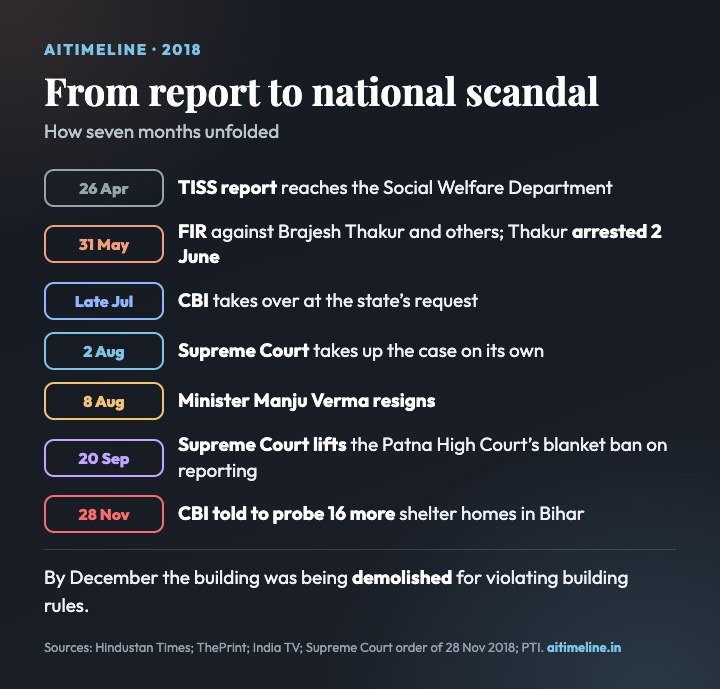
Through June and early July the case was a local police investigation. It became national in late July, when Bihar Police said at least 34 girls had been abused, and the state handed the case to the CBI; opposition protests in Patna and Delhi followed in early August. The Supreme Court took it up on 2 August and barred the media from showing the victims’ images, even blurred.
The political cost fell on the Social Welfare Department. Its minister, Manju Verma, resigned on 8 August after reports of phone contact between her husband and Thakur, and later surrendered in a separate Arms Act case. Meanwhile the Patna High Court’s ban on reporting the investigation was overturned by the Supreme Court on 20 September, with a warning against sensationalism. In November the court widened the CBI’s brief to 16 other homes.
The Trial in Delhi and the Verdict
Transferred by the Supreme Court, decided in under a year.
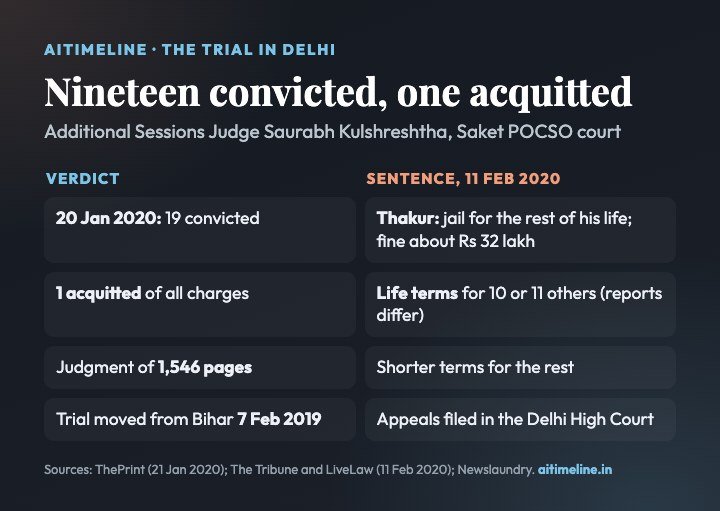
On 7 February 2019 the Supreme Court moved the trial to a POCSO court at Saket in Delhi and set a six-month target. Charges were framed in March 2019, and survivors testified in camera. After several deferrals, Additional Sessions Judge Saurabh Kulshreshtha convicted 19 of the 20 accused on 20 January 2020, under the POCSO Act and the IPC, including for criminal conspiracy. Those convicted included shelter-home staff and child-protection officials, among them the then chairman of the district Child Welfare Committee.
On 11 February 2020 the court sentenced Thakur to rigorous imprisonment for the remainder of his natural life, calling him the “kingpin” of a “meticulously planned” conspiracy. Reports agree that a large group of others received life terms but differ on the number, 10 or 11, and on some shorter terms. We give both figures rather than pick one.
| Issue | What the record shows |
|---|---|
| Sexual and physical abuse | 19 convicted, 1 acquitted, Saket POCSO court, 20 Jan 2020 |
| Thakur’s sentence | Rigorous imprisonment for the rest of his life; fine about Rs 32 lakh |
| Other sentences | Life terms for 10 or 11 others (reports differ); shorter terms for the rest |
| Alleged murders | CBI found no evidence (8 Jan 2020); no one charged with murder |
| Missing-women case | Separate SC/ST Act case; acquittals for lack of evidence, 2 Jan 2025 |
| NGO and building | Registration cancelled; building demolished from Dec 2018 for plan violations |
| Compensation | Rs 3 lakh to Rs 9 lakh to 49 victims, Bihar told the NHRC (Jan 2022) |
| Appeals | Pending in the Delhi High Court as of 12 Nov 2026 |
The Murder Claims, and What the CBI Found
Why an allegation that dominated headlines is not part of the verdict.
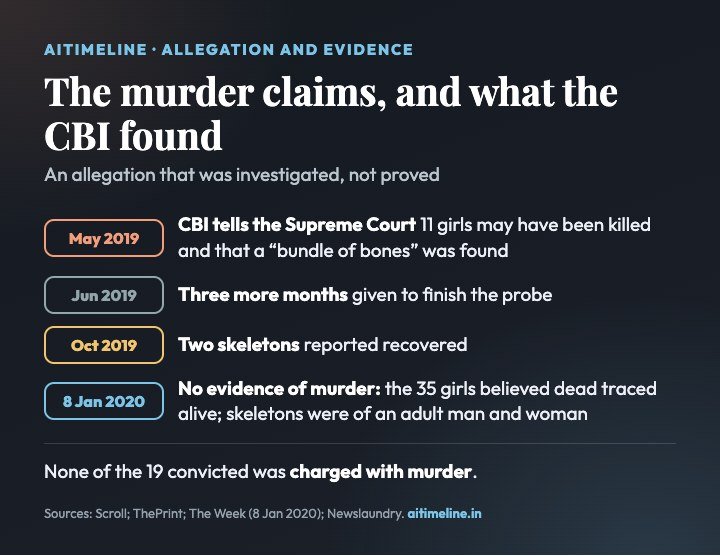
In May 2019 the CBI told the Supreme Court that 11 girls may have been killed. The claim was widely reported and is still repeated. Eight months later, on 8 January 2020, the agency told the same court that it had found no evidence of any child being killed: all 35 girls once believed dead had been traced alive, and two skeletons recovered were of an adult man and an adult woman. The petitioner’s lawyer argued that this did not rule out a murder. No one was charged with murder, and the verdict that followed twelve days later dealt with sexual and physical abuse.
One Scandal, Several Legal Tracks
Why later headlines about acquittals do not undo the 2020 convictions.
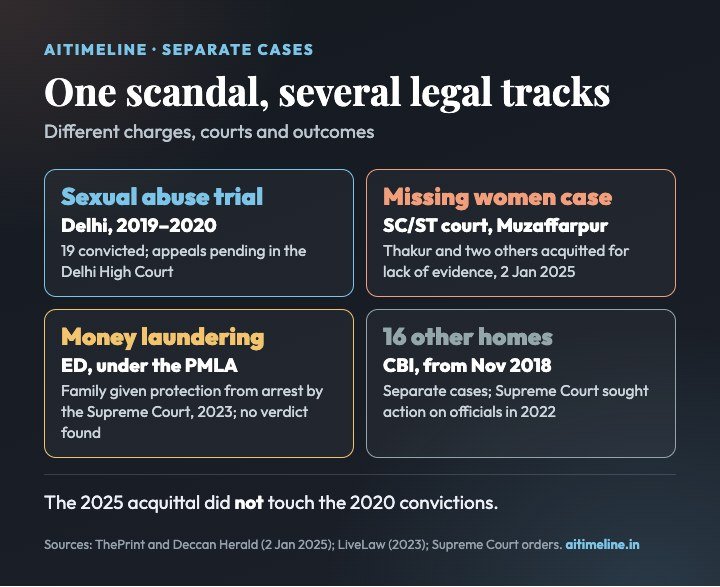
When the Supreme Court moved the main trial to Delhi, a case under the SC/ST (Prevention of Atrocities) Act about 11 women and four girls missing from another of Thakur’s homes stayed in Bihar. On 2 January 2025 a special court in Muzaffarpur acquitted Thakur and two associates for lack of evidence. That ruling concerned a different set of charges. Thakur stayed in jail on the 2020 sentence.
The Enforcement Directorate’s money-laundering case is another track. It alleges that Thakur and his family diverted funds meant for children’s welfare. The Supreme Court protected his mother and wife from arrest in 2023, which is not a finding either way. The CBI’s investigation of 16 other homes produced chargesheets in most of them and closures in some.
Where the Appeals Stand in November 2026
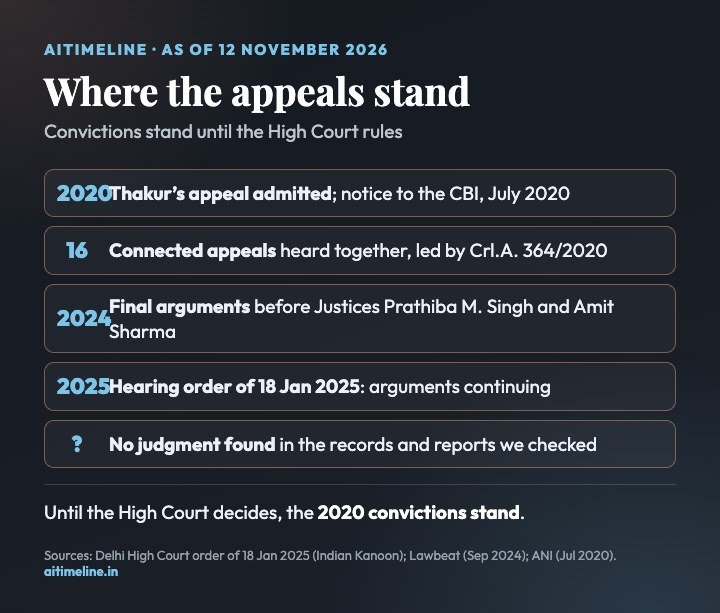
The last court record we located is a Delhi High Court order of 18 January 2025 in Brajesh Kumar Thakur v. State (Through CBI), which records a long day of arguments in the lead appeal and the connected appeals. In September 2024 Thakur’s counsel had argued that the girls’ statements were not of “sterling quality”; that is an argument, not a finding. We found no report of a judgment, or of judgment being reserved, by 12 November 2026. Until the High Court rules, the 2020 convictions stand.
Key People and Institutions
| Person or body | Role |
|---|---|
| Brajesh Thakur | Head of the NGO that ran the home; convicted in 2020; appealing |
| Sewa Sankalp Evam Vikas Samiti | NGO that ran the Balika Grih; registration cancelled |
| TISS Koshish | Social audit team, led by Mohammed Tarique, whose report exposed the abuse |
| Bihar Social Welfare Department | Commissioned the audit and oversaw the homes |
| Manju Verma | Social Welfare Minister; resigned August 2018; separate Arms Act case |
| CBI | Investigated from July 2018 and prosecuted the case |
| Supreme Court | Monitored the probe, transferred the trial, widened the inquiry to 16 homes |
| Nivedita Jha | Patna journalist whose petition carried the Supreme Court case |
| Saurabh Kulshreshtha | Additional Sessions Judge who tried the case at Saket |
| NHRC | Issued notice in July 2018; reported compensation in 2022 |
What Effective Shelter-Home Oversight Should Involve
A checklist drawn from the law and the failures the case exposed, not a list of reforms made because of it.
- Verified registration: confirms a home is authorised to house children, and lets the state withdraw that authority.
- Inspections that happen: quarterly visits, as the law requires, with a woman and a medical officer on the team.
- Private conversations with children: the only way abuse by staff is likely to be reported.
- Complaint channels outside the home: so a child does not have to report abuse to the people accused of it.
- Follow-up that someone owns: reports within a week, action within a month, and consequences when neither happens.
- Financial audits: checks that public money reaches the children it is meant for.
- Survivor support beyond the trial: counselling, education, safe housing and protection from being identified.
Muzaffarpur is often discussed alongside other cases that tested India’s protection of women and children, including the Unnao case, Kathua and the Nirbhaya case, which changed India’s rape laws in 2013.
Explore More Timelines
People Also Ask
Frequently Asked Questions
Based on court orders and reporting to 12 November 2026.
⚠️ Editorial Note
Survivors are not named and the abuse is not described, in line with the POCSO Act, Section 72 of the Bharatiya Nyaya Sanhita and the Supreme Court’s 2018 directions. The main sexual-abuse convictions are kept apart from the murder allegations, which the CBI told the Supreme Court it could not substantiate, and from the separate missing-women case, whose 2025 acquittals did not reverse the 2020 convictions. We corrected some details in earlier summaries: the TISS report was submitted in late April 2018, not February; the missing-women verdict was on 2 January 2025; and the building was demolished on a civic body’s order for plan violations. Reports differ on how many convicts received life terms (10 or 11 besides Thakur) and on the exact fine; we give the range. We could not confirm reported dates for the girls’ transfer, the sealing of the home or the framing of charges, and do not rely on them. Thakur denies the charges and his appeal is pending.
Related Reading on AiTimeline
Sources & further reading
Every dated entry above was checked against these references. Last reviewed 12 November 2026.
- Brajesh Kumar Thakur v. State (Through CBI), Crl.A. 364/2020: Delhi High Court order of 18 January 2025
- Bihar government informs NHRC Rs 3 to 9 lakh paid as compensation to 49 victims of sexual abuse in Muzaffarpur shelter home (25 January 2022)
- NHRC issues notice to Bihar government over reported sexual exploitation of girls at a Muzaffarpur shelter home (26 July 2018)
- Twists and turns in the Muzaffarpur shelter home sexual abuse case and its political impact (21 January 2020)
- Muzaffarpur shelter home: Brajesh Thakur, 11 others sentenced to life term (11 February 2020)
- Muzaffarpur shelter home: Delhi court imposes life sentence on Brajesh Thakur and 10 others (11 February 2020)
- Muzaffarpur shelter home case: 35 minors believed to be dead are alive, CBI tells Supreme Court (8 January 2020)
- SC transfers Muzaffarpur shelter home cases from Bihar to Delhi (7 February 2019)
- Muzaffarpur shelter home case: SC vacates Patna HC order imposing ban on media reporting (20 September 2018)
- Bihar: Brajesh Thakur, two others acquitted in SC/ST case related to Muzaffarpur shelter home (2 January 2025)
- 'Victim statements are not of sterling quality': Brajesh Thakur to Delhi HC in his appeal (20 September 2024)
- Supreme Court extends protection to mother of Brajesh Thakur in money-laundering case (2023)
- Muzaffarpur shelter home case: some victims get justice, but key allegations remain unaddressed (15 February 2020)
- Muzaffarpur shelter home case: SC orders reunion of 8 girls with families (12 September 2019)
- Juvenile Justice (Care and Protection of Children) Act, 2015
- Juvenile Justice (Care and Protection of Children) Act, 2015, Section 54: Inspection of institutions