P. Rajan Case: The Student Who Disappeared During India’s Emergency
Rajan custodial disappearance timeline: the 1976 arrest in Kerala, Eachara Warrier's habeas corpus battle and the Supreme Court's 1993 ruling.
Latest Story
On 1 March 1976, in the middle of the Emergency, Kerala police picked up P. Rajan, a final-year engineering student, near his college hostel in Calicut. His father was told nothing for a year. When the courts reopened, a habeas corpus petition forced the government to admit that Rajan had died under torture at a police camp the day after his arrest. His body was never found, and none of the officers tried for his death was convicted. This is the Rajan custodial disappearance case, step by step: the arrest, the father’s search, the High Court writ that brought down a Chief Minister, and the trial that ended without a conviction.
We keep the proceedings apart. The 1977 habeas corpus case established that Rajan was taken into custody; a later affidavit acknowledged his death. The perjury order of June 1977 was a direction to prosecute, not a conviction. The criminal trial ended in acquittals. Accounts of how the body was disposed of are reported claims, not findings. Dates come from the court judgments; where sources differ, we say so.
💡 Short Answer
P. Rajan, a student at the Regional Engineering College, Calicut, was taken by Kerala police on 1 March 1976 and never seen again. In March 1977 his father, T.V. Eachara Warrier, filed a habeas corpus petition. The High Court held on 13 April 1977 that Rajan had been in police custody; Chief Minister K. Karunakaran resigned on 25 April; and on 22 May he swore that Rajan had died after torture at the Kakkayam camp on 2 March 1976. Seven police officers were tried, but the Supreme Court upheld their acquittals in 1993.
Rajan Custodial Disappearance: Key Questions
The Rajan Case in Nine Points
- The arrest: Rajan was taken on 1 March 1976, two days after the Kayanna police station attack.
- The death: the State later admitted he died after torture at Kakkayam on 2 March 1976.
- The silence: his father’s letters to ministers and officials went unanswered for a year.
- The closed courts: the ADM Jabalpur ruling had barred habeas corpus during the Emergency.
- The writ: the High Court found custody proved on 13 April 1977 and ordered Rajan produced.
- The resignation: Chief Minister K. Karunakaran quit on 25 April 1977, a month into his term.
- The perjury order: the High Court ordered a complaint over his false denial; the Supreme Court let it stand.
- The trial: seven officers tried in Coimbatore; no conviction survived appeal.
- The absence: Rajan’s body has never been found.
Denied, Then Admitted
How the official account changed in eight weeks of 1977.
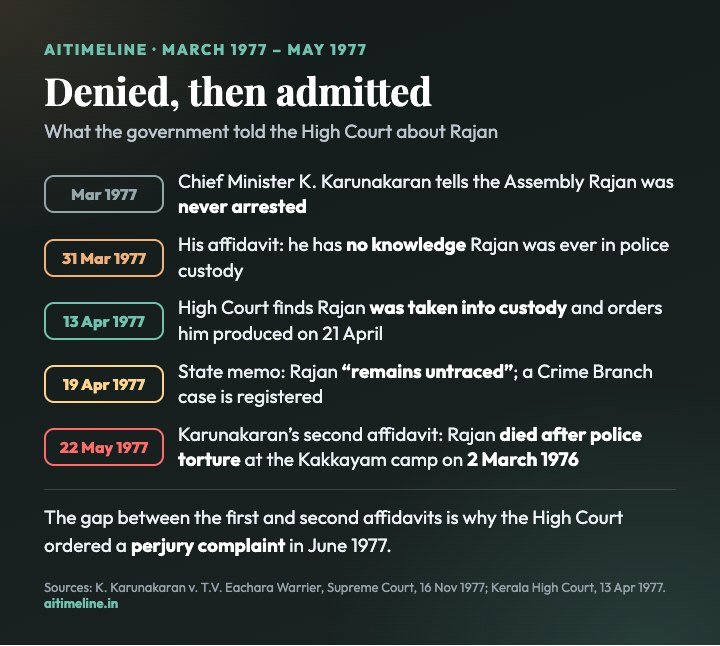
For a year the State said nothing. Then, when the question reached court, it said no. As Chief Minister, K. Karunakaran told the Assembly that Rajan had never been arrested, and swore on 31 March 1977 that he had no knowledge that Rajan had ever been in police custody. He said he relied on an Inspector General’s report of 7 January 1977.
The High Court did not accept the denial. After hearing the college principal, students and a detainee who had seen Rajan being tortured at Kakkayam, it held on 13 April that he had been taken into custody. Within six weeks a Crime Branch inquiry had reported his death, and Karunakaran, by then no longer Chief Minister, filed a second affidavit admitting that Rajan had died after police torture on 2 March 1976. That reversal is what the perjury complaint was about.
The First Ten Days
From the Kayanna raid to the father’s meeting with the Home Minister.
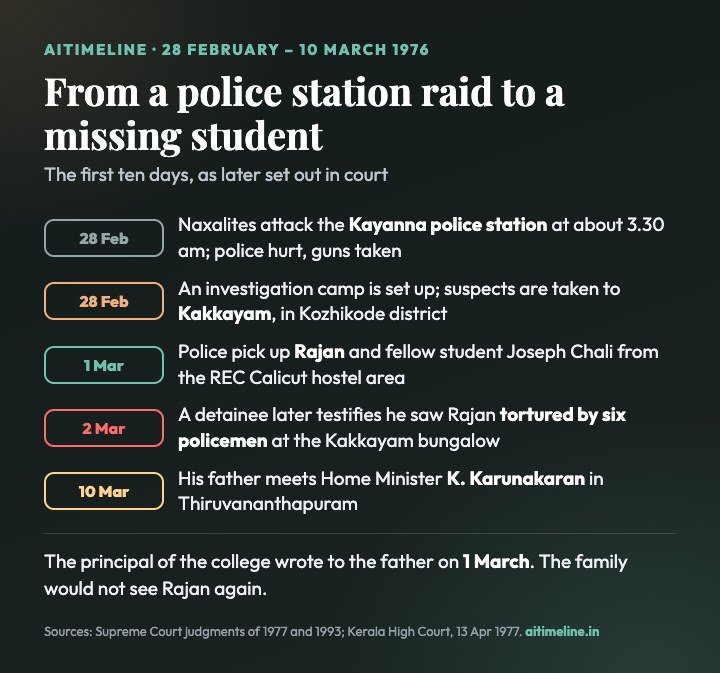
The Kayanna attack, in the early hours of 28 February 1976, set off a sweep of the area by police under the Crime Branch. A tourist bungalow at Kakkayam, a remote spot near a reservoir in Kozhikode district, became the interrogation centre. Police suspected students at the Regional Engineering College at Chathamangalam of links to the attackers. Rajan, who was known on campus for music and theatre rather than politics, was taken on 1 March along with another student, Joseph Chali.
The next day, according to the evidence the High Court accepted, another detainee saw Rajan being tortured by six policemen and carried out unconscious. That is the last reliable sighting. The family learned of the arrest from the principal’s letter, and on 10 March his father met the Home Minister. What was said at that meeting would later be disputed under oath.
Timeline: The Rajan Case, 1975 to 2026
Newest first. Colour shows the type of event.
Where the record stands Trial, politics & memory
The legal position: The two Supreme Court judgments remain the last word: the 1977 ruling that let a perjury complaint against K. Karunakaran go forward, and the 1993 judgment that left all seven police accused without a conviction.
What is still missing: Rajan’s remains have never been recovered. We found no later court finding fixing individual responsibility for his death, and no reported outcome of the perjury complaint ordered in 1977.
Fifty years since Rajan’s death Trial, politics & memory
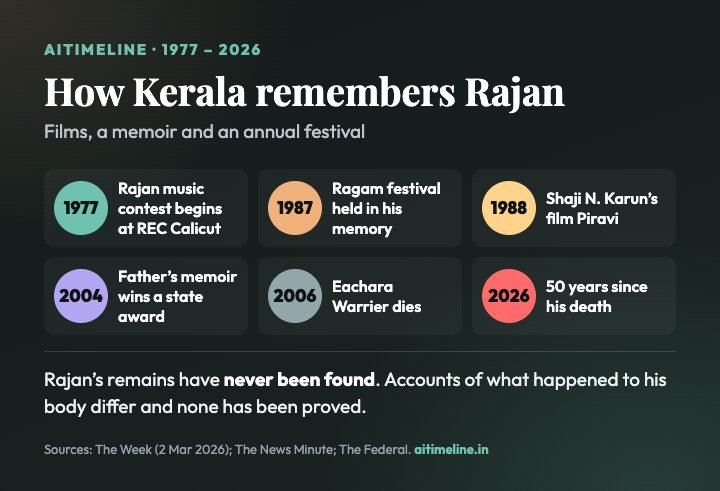
What happened: Kerala marked 50 years since Rajan died at the Kakkayam police camp. The Week’s anniversary report said almost 200 people had been tortured at the camp, and recalled that divers searched the Kakkayam dam for two days without finding anything.
Why it matters: The anniversary coverage repeated the two competing accounts of what police did with the body, without either being proved.
Jai Bhim brings the case to new viewers Trial, politics & memory
What happened: The Tamil film Jai Bhim, about a custodial death in Tamil Nadu, cited the Rajan case as a precedent in which a High Court took oral evidence in a habeas corpus petition. Articles explaining the reference sent a new audience back to the 1977 judgment.
K. Karunakaran dies Trial, politics & memory
What happened: Karunakaran, Home Minister when Rajan disappeared and Chief Minister when the High Court ruled, died aged 92. He returned to power three more times after his 1977 resignation.
The perjury complaint: We could not find a reported verdict in the perjury complaint the High Court ordered against him in 1977. His obituaries recalled the Rajan case as the lowest point of his career.
Eachara Warrier dies without his son’s remains Father’s search
What happened: T.V. Eachara Warrier died in 2006, 30 years after his son was taken. Rajan’s mother had been hospitalised after a breakdown that followed the disappearance.
His words: He ended his memoir with the line that he would never close the door, so that his son would know his father was still waiting.
“Memories of a Father” is published Father’s search
What happened: Warrier’s memoir of the search, Oru Achante Ormakkurippukal, won a Kerala state award in 2004. An English translation, Memories of a Father, was published the same year.
Supreme Court dismisses the father’s appeals Supreme Court
What happened: Eachara Warrier asked the court to restore the convictions of the three officers the trial court had found guilty of lesser offences. The court refused and dismissed all the appeals.
The reasoning: It agreed with the Madras High Court that the witnesses to the arrest were “highly discrepant, contradictory and unsatisfactory”, and held that being in charge of the investigation was not enough to convict without reliable evidence.
What the court said: The judges wrote that they understood the father’s feelings and that the disappearance caused “distress to us also”, but the prosecution had not proved its case beyond reasonable doubt.
Madras High Court sets aside the convictions Trial, politics & memory
What happened: The three convicted officers appealed. The State appealed against the acquittals on the main charges and sought higher sentences. The High Court allowed the officers’ appeals and dismissed both State appeals.
Coimbatore court: four acquitted, three convicted of lesser offences Trial, politics & memory
The charges: Seven police officers were tried for criminal conspiracy, wrongful confinement, causing hurt to extort a confession, grievous hurt, murder and causing the disappearance of evidence.
The verdict: The judge acquitted accused 1, 2, 4 and 7. Accused 3, 5 and 6 were convicted under sections 348, 330 read with 109, and 201 of the IPC and given six months, one year and four months, to run concurrently.
No murder finding: No one was convicted of murder. Without a body, and with conflicting witnesses, the court found that charge not proved.
Trial moved from Kozhikode to Coimbatore Supreme Court
What happened: The case was first filed before the Sessions Judge, Kozhikode. Because of the public furore and the political colour of the case, the Supreme Court transferred it to the Sessions Judge at Coimbatore to ensure a fair trial.
Supreme Court lets the perjury complaint stand Supreme Court
What happened: Karunakaran appealed against the High Court’s order to file a perjury complaint against him. The court dismissed the appeal.
The limit: It stressed that it was not convicting anyone: the trial court must decide independently whether the offence under section 193 of the IPC was proved beyond reasonable doubt.
The line people quote: “A person cannot swear a falsehood in the court as a minister with impunity and come out with the truth only as a commoner.”
High Court orders a perjury complaint Kerala High Court
What happened: On Warrier’s application, the court found a prima facie case that Karunakaran’s first affidavit, denying any knowledge of Rajan’s custody, was deliberately false. It ordered a complaint under section 193 of the IPC.
Who else: Similar orders were made against the Deputy Inspector General of Police, Crime Branch, and the Superintendent of Police, Kozhikode. The court declined action against the Home Secretary and the Inspector General.
Karunakaran’s second affidavit admits the death Kerala High Court
What he swore: That Rajan, taken into custody on 1 March 1976, was “belabored” by police and died “as a result of police torture at the Kakkayam Investigation Camp on 2-3-1976”, so the writ could not be obeyed.
What changed: Seven weeks earlier he had sworn he had no knowledge that Rajan was ever in custody. He now said he had relied on an Inspector General’s report of 7 January 1977.
Crime Branch report confirms death in custody Police & Kakkayam
What happened: The investigation registered after the writ reported that Rajan had died at the Kakkayam camp on the evening of 2 March 1976. This report was the basis of Karunakaran’s second affidavit.
Karunakaran resigns as Chief Minister Trial, politics & memory
What happened: The High Court had refused leave to appeal on 23 April, and the Supreme Court rejected his special leave petition on 25 April. Karunakaran resigned the same day.
Date note: The Supreme Court’s 1977 judgment says he resigned “on April 26”; contemporary and later accounts give 25 April.
State tells the court Rajan “remains untraced” Police & Kakkayam
What the State said: It could not produce Rajan because he was not in the custody or control of the respondents anywhere. Police inside and outside Kerala had been alerted.
What it disclosed: Some police officers had been suspended, the DIG had been moved out of the Crime Branch, and a criminal case had been registered based on the court’s observations.
High Court issues the writ of habeas corpus Kerala High Court
What the court found: Rejecting the counter-affidavits of the government and police, it held that Rajan had been taken into police custody. It accepted the evidence of a detainee who saw him being tortured at the Kakkayam bungalow.
What it ordered: Rajan to be produced on 21 April 1977, or a memo filed by 19 April explaining why not. The case was kept open.
Witnesses testify in a habeas case Kerala High Court
What happened: Warrier filed his reply with affidavits from 12 people. Most offered themselves for cross-examination. The college principal was examined; the government’s lawyer did not challenge his honesty.
The key witness: A detainee arrested on 1 March 1976 in the Kayanna case said he was taken to Kakkayam on 2 March and saw Rajan tortured by six policemen until he lost consciousness.
Karunakaran is made a respondent Kerala High Court
What happened: As Chief Minister, Karunakaran told the Assembly that Rajan had never been arrested. Warrier asked the court to add him and the Kozhikode Superintendent of Police as respondents; it did so the same day.
The denial: In his affidavit Karunakaran said he had never told Warrier that his son was in custody and had no knowledge that he ever had been.
Habeas corpus petition filed Father’s search
What happened: Four days after the Emergency was lifted, Warrier asked the court to order the production of his son. He named the Home Secretary, the Inspector General and the DIG, Crime Branch.
Why only now: During the Emergency, the Supreme Court’s ADM Jabalpur ruling had barred such petitions.
Emergency withdrawn Trial, politics & memory
What happened: The Emergency proclaimed in June 1975 was withdrawn after the Congress lost the Lok Sabha election. In Kerala, voting for the Assembly took place on 19 March.
Why it mattered: With fundamental rights restored, the courts were open again to petitions against illegal detention.
Inspector General reports Rajan was never in custody Police & Kakkayam
What happened: The Inspector General of Police reported that Rajan had not been in police custody. Karunakaran later said this report was his only source when he denied the arrest in the Assembly.
Letters to Delhi go unanswered Father’s search
What happened: On 24 August 1976 Warrier wrote to the Union Home Minister, copying every Member of Parliament from Kerala. He sent a reminder on 22 October. Some MPs raised it with Karunakaran in November.
The result: No reply.
Three petitions to Kerala’s Home Secretary Father’s search
What happened: Warrier petitioned the State Home Secretary three times, asking at least to be told where his son was held. He also met Chief Minister C. Achutha Menon several times; at the last meeting Menon said the matter was with the Home Minister.
ADM Jabalpur shuts the courts to detainees Supreme Court
What happened: The Supreme Court ruled that while the Emergency suspension of rights was in force, no one could go to a High Court with a habeas corpus petition challenging detention, even on grounds of bad faith.
Link to Rajan: The 1977 judgment cites this ruling to explain why Warrier could do nothing in court for a year.
Father meets Home Minister Karunakaran Father’s search
What happened: Warrier met Karunakaran at his official residence. By Warrier’s account, the minister said Rajan had been arrested for involvement in a serious case and promised to help.
Why it mattered: This meeting became the centre of the perjury issue, because Karunakaran later swore he had never been told of any arrest.
Rajan dies at the Kakkayam camp Police & Kakkayam
What happened: According to the Crime Branch investigation, Rajan died after torture at the Kakkayam investigation camp. One method described in later accounts is uruttal, rolling a heavy wooden roller or pestle over a detainee’s thighs.
The body: Accounts differ. Some say it was weighted and thrown into the Kakkayam reservoir; others that it was burned. A search of the dam found nothing, and none of the accounts has been proved.
Rajan taken by police from his college Police & Kakkayam
What happened: Rajan, a final-year student known for music and theatre, was picked up in the early morning near the college hostel at Chathamangalam, about 30 km from Kozhikode. The principal wrote to his father the same day.
The official line: Police later denied arresting him. In the 1993 trial account, some witnesses placed the arrest on the night of 29 February.
Naxalites attack the Kayanna police station Police & Kakkayam
What happened: A group of Naxalites attacked the station, injuring policemen and taking firearms. An investigation camp was set up and suspects were rounded up across the area.
Who led the hunt: The investigation was entrusted to the Crime Branch under DIG Jayaram Padikkal. The Kozhikode SP said he was at the camp from 28 February to 12 March.
National Emergency declared Trial, politics & memory
What happened: Indira Gandhi’s government proclaimed an internal Emergency. Fundamental rights were suspended and thousands were detained without trial.
In Kerala: K. Karunakaran was Home Minister in C. Achutha Menon’s government, and the police were given wide powers against suspected Naxalites.
A Father’s Year of Letters
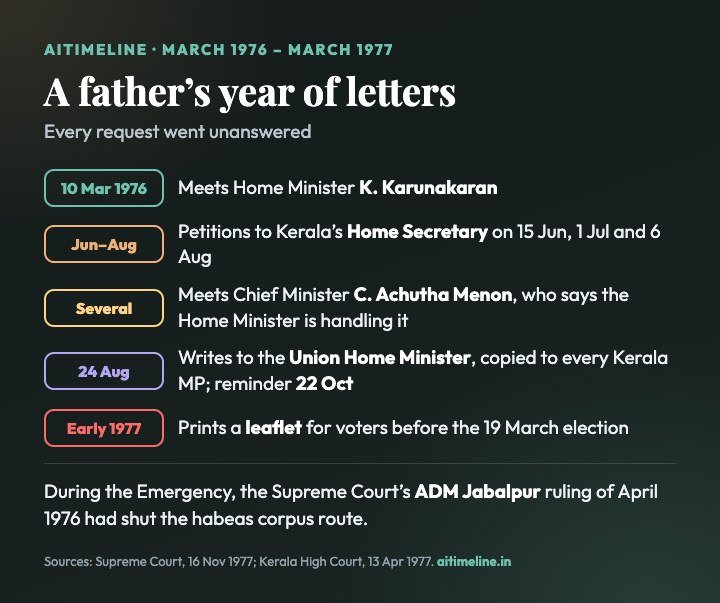
Eachara Warrier was a retired Hindi professor living in Kochi. Between March 1976 and March 1977 he wrote to the State Home Secretary three times, met the Chief Minister repeatedly, wrote to the Union Home Minister and every Kerala MP, and visited jails and police camps looking for his son. The Supreme Court later described his “piteous queries” as going unanswered. With the courts closed to detainees by the Emergency and the ADM Jabalpur ruling, there was nowhere else to go. When elections were called in 1977 he printed a leaflet telling voters about his missing son.
The Writ That Brought Down a Chief Minister
Kerala High Court, March to June 1977.
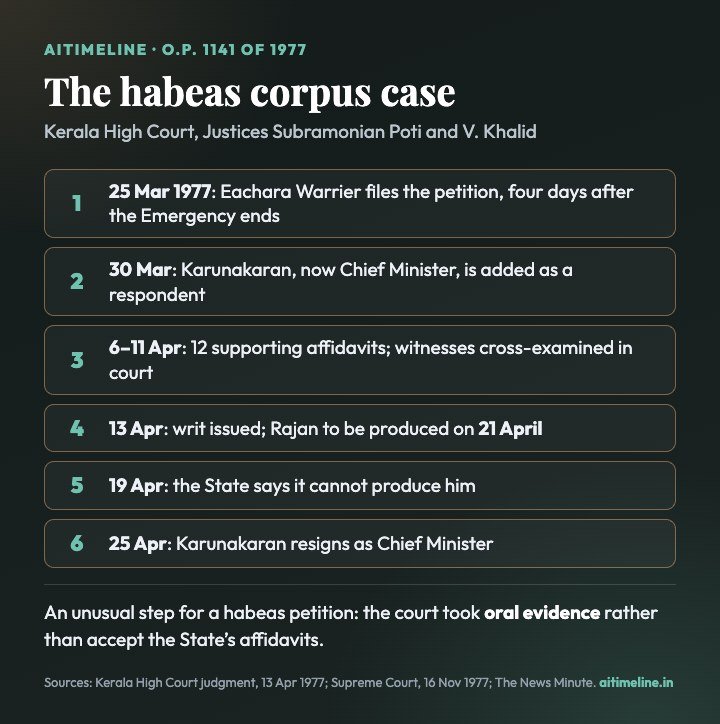
Habeas corpus petitions are usually decided on affidavits. This one was not. Justices Subramonian Poti and V. Khalid let the father’s witnesses be cross-examined and examined the college principal themselves. The government’s lawyer did not cross-examine Warrier, and the Kozhikode Superintendent of Police did not offer himself for cross-examination. On that record the court found that the police had taken Rajan into custody, and issued the writ.
The State could not comply. Its memo of 19 April said Rajan remained untraced, and disclosed suspensions and a new criminal case. Karunakaran, sworn in as Chief Minister on the day the petition was filed, resigned on 25 April. On 13 June the court ordered a perjury complaint against him and two senior officers, a decision the Supreme Court upheld on 16 November 1977.
| Date | Step in the High Court |
|---|---|
| 25 Mar 1977 | Petition filed (O.P. 1141 of 1977) |
| 30 Mar 1977 | Karunakaran and the Kozhikode SP added as respondents |
| 31 Mar 1977 | Counter-affidavits deny custody (filed 4 April) |
| 6–11 Apr 1977 | Reply, 12 affidavits, cross-examination; hearing closed |
| 13 Apr 1977 | Writ issued; production ordered for 21 April |
| 19 Apr 1977 | State memo: Rajan untraced |
| 22 May 1977 | Karunakaran’s second affidavit admits death in custody |
| 13 Jun 1977 | Perjury complaint ordered against three officials |
What the Courts Established, and What They Did Not
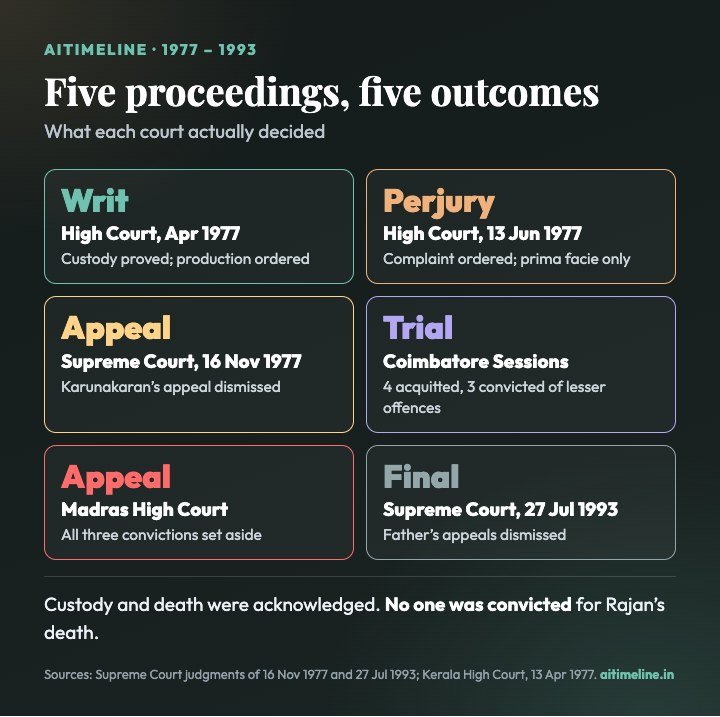
| Proceeding | Outcome | What it means |
|---|---|---|
| Habeas corpus, Kerala High Court, 13 April 1977 | Custody found; production ordered | Overturned the official denial |
| Perjury inquiry, Kerala High Court, 13 June 1977 | Complaint ordered against Karunakaran and two officers | A prima facie finding, not a conviction |
| K. Karunakaran v. T.V. Eachara Warrier, 16 Nov 1977 | Appeal dismissed | Complaint left to go to trial |
| Sessions trial, Coimbatore | 4 acquitted, 3 convicted of lesser offences | No murder conviction |
| Madras High Court appeals | 3 convictions set aside; State appeals dismissed | All seven acquitted |
| T.V. Eachara Warrier v. T.O. Kunchiraman Nambiar, 27 Jul 1993 | Father’s appeals dismissed | Acquittals final |
The Trial: Seven Officers, No Conviction
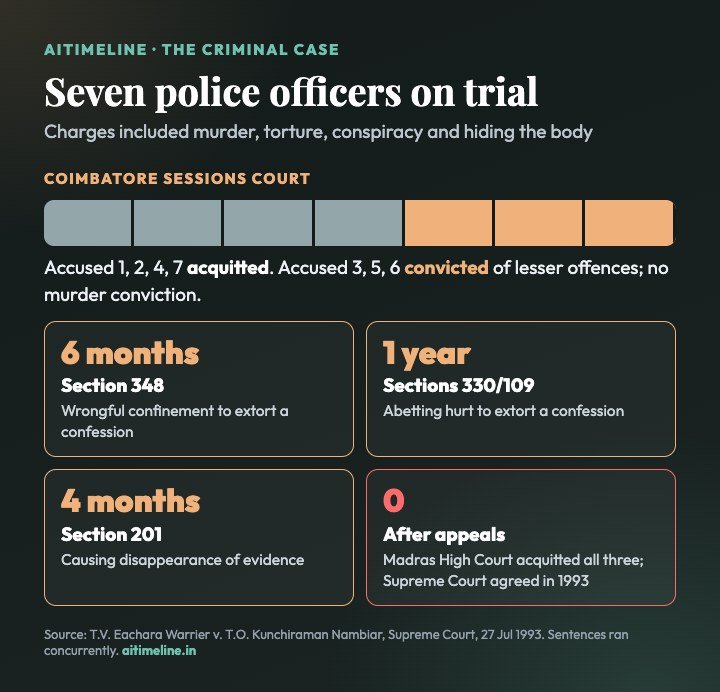
The prosecution case was that seven police officers conspired to investigate the Kayanna attack by illegal means, took Rajan and others to the Kakkayam camp, tortured them, and hid Rajan’s body when he died. The trial was moved out of Kerala because of public feeling. In Coimbatore, the judge rejected much of the prosecution evidence, acquitted four of the accused and convicted three only of lesser offences, reasoning that as officers in charge they must have known of the confinement and torture.
The Madras High Court found that reasoning could not stand on evidence it had already found unreliable. The witnesses to the arrest gave “mutually destructive” versions; one claimed to be Rajan’s friend but had no connection with the college. When the father appealed, the Supreme Court agreed. Its conclusion is the heart of the case’s legacy: the State had admitted that Rajan died in police custody, yet the courts could not say beyond reasonable doubt which officer was responsible. Later cases such as the Sathankulam custodial deaths show the same problem, and it is one reason police reform remains on the Supreme Court’s docket, as in Prakash Singh.
The Missing Body
No part of Rajan’s remains has ever been found. Two accounts circulate. One says his body was weighted with stones and thrown into the Kakkayam reservoir; navy divers searched the dam for two days and found nothing. Another says it was burned and the ashes scattered. Neither was established in court. The absence of a body is why several charges could not be sustained, and why his father wrote that he would never close the door of his house.
How Kerala Remembers Rajan
Why the Rajan Case Still Matters
- Enforced disappearance: a student was taken by the State, denied for a year, and acknowledged dead only when a court forced the question.
- Habeas corpus in practice: the High Court took oral evidence instead of accepting the government’s word, a step still cited by lawyers and in films such as Jai Bhim.
- The Emergency’s cost: with ADM Jabalpur in force, there was no legal remedy while Rajan’s fate could still have been known. The Shah Commission later catalogued abuses of the same period.
- Ministerial accountability: the Supreme Court refused to let a former Chief Minister escape a perjury complaint because he had changed his story after leaving office.
- Custody versus guilt: the acknowledgement of death in custody did not translate into a conviction, a gap that recurs in custodial death cases.
- A father’s persistence: Eachara Warrier’s memoir and the films it inspired kept the case in public memory for 50 years.
Key People and Institutions
| Person or body | Role |
|---|---|
| P. Rajan | Final-year student, REC Calicut; taken by police on 1 March 1976 |
| T.V. Eachara Warrier | His father; retired Hindi professor; petitioner and appellant; died 2006 |
| K. Karunakaran | Home Minister in 1976; Chief Minister 25 March – 25 April 1977; subject of the perjury complaint |
| C. Achutha Menon | Chief Minister of Kerala in 1976 |
| Jayaram Padikkal | DIG, Crime Branch; led the Kayanna investigation; tried and ultimately acquitted |
| K. Lakshmana | Superintendent of Police, Kozhikode; placed at Kakkayam by a witness |
| Pulikkodan Narayanan | Sub-inspector named by a witness as one of those torturing Rajan |
| Justices Subramonian Poti and V. Khalid | Kerala High Court bench that issued the writ |
| Supreme Court of India | Ruled on the perjury complaint (1977) and the criminal appeals (1993) |
Facts at a Glance
| Detail | Information |
|---|---|
| Kayanna attack | 28 February 1976 |
| Taken into custody | 1 March 1976 |
| Death (per 1977 affidavit) | 2 March 1976, Kakkayam camp |
| Habeas petition | 25 March 1977 |
| Writ issued | 13 April 1977 |
| Karunakaran resigned | 25 April 1977 |
| Death acknowledged | 22 May 1977 |
| Perjury complaint ordered | 13 June 1977 |
| Supreme Court, perjury appeal | 16 November 1977 |
| Supreme Court, criminal appeals | 27 July 1993 |
| Body recovered | No |
Explore More Timelines
People Also Ask
Frequently Asked Questions
Based on the court judgments and reporting to 12 November 2026.
⚠️ Editorial Note
This timeline separates the habeas corpus findings, the perjury direction and the criminal prosecution. It does not treat the High Court’s prima facie perjury finding as a conviction, and it does not describe any officer as guilty of Rajan’s death. Accounts of how his body was disposed of are reported as claims. Checking the court records, we added the March 1977 Assembly denial, the 30 March impleadment, the 17 May investigation report and the trial sentences; we give Karunakaran’s resignation as 25 April 1977, noting that the 1977 judgment says 26 April; and we record that some court papers date the Kayanna attack to 29 February. We could not verify the dates of the Coimbatore verdict or the Madras High Court appeal, or any outcome of the perjury complaint, and we have not cited 2025 newspaper retrospectives we could not locate.
Related Reading on AiTimeline
Sources & further reading
Every dated entry above was checked against these references. Last reviewed 12 November 2026.
- T.V. Eachara Varier v. Secretary to the Ministry of Home Affairs, Kerala High Court (habeas corpus judgment, 13 April 1977)
- K. Karunakaran v. T.V. Eachara Warrier, Supreme Court of India (16 November 1977)
- T.V. Eachara Warrier v. T.O. Kunchiraman Nambiar and Others, Supreme Court of India (27 July 1993)
- 50 years of Rajan case: An unparalleled story of police brutality and a heartbroken father's quest for justice (2 March 2026)
- Kerala Chronicles: How one missing student brought down a Congress govt in just a month
- The Rajan case that Jai Bhim refers to in passing (11 November 2021)
- Memories of a Father, T.V. Eachara Warrier (English translation)