Rafale Deal: How India’s Fighter Jet Purchase Became a Political Controversy
Follow the Rafale deal controversy timeline: the 126-jet plan, the 2016 agreement, allegations, CAG findings, Supreme Court rulings and the French probe.
Latest Story
In April 2015 Prime Minister Narendra Modi announced in Paris that India would buy 36 Rafale fighters from France, ready to fly, in place of a long-running plan for 126 jets that Hindustan Aeronautics was to build mostly in India. The deal signed in September 2016 became one of the most bitter political fights of the decade: over the smaller number, the price, and why Dassault’s offset partner was Anil Ambani’s Reliance rather than HAL. This Rafale deal controversy timeline follows the tender, the agreement, the allegations, the CAG audit, three Supreme Court refusals to order a probe, and the separate French judicial investigation that opened in 2021.
Two legal tracks run through this story and must be read separately. In India, the Supreme Court declined to order an investigation; that was not a criminal trial. In France, a judicial investigation into suspected offences connected with the sale opened in June 2021; an investigation is not proof of wrongdoing. Political allegations, government explanations, audit findings and media reports are labelled as what they are.
💡 Short Answer
The Rafale deal controversy is the dispute over India’s 23 September 2016 agreement to buy 36 Rafale jets from France for about €7.87 billion, replacing a stalled plan for 126. Critics questioned the price, the smaller number and Reliance’s role as Dassault’s offset partner. India’s Supreme Court declined to order a probe in 2018 and 2019. A separate French judicial investigation opened in June 2021 and was continuing in 2026, with no charges found.
Rafale Deal Controversy: Key Questions
The Rafale Controversy in Ten Points
- The switch: a 126-jet tender from 2007 gave way to a 36-jet government-to-government deal announced on 10 April 2015.
- The agreement: signed 23 September 2016, about €7.87 billion, with a 50% offset obligation.
- The partner: Dassault’s joint venture with Reliance, announced 3 October 2016, became the centre of the row.
- The remark: François Hollande was quoted in September 2018 saying India proposed Reliance; India and Dassault denied it.
- The court: the Supreme Court refused a probe in December 2018, again on review in November 2019, and a fresh plea in August 2022.
- The audit: the CAG found the package 2.86% cheaper but did not resolve every question.
- The election: “Chowkidar chor hai” was a Congress slogan in 2019; the BJP won a bigger majority.
- France: a judicial investigation opened on 14 June 2021, slowed by refusals to declassify documents.
- The aircraft: all 36 jets were delivered by 15 December 2022.
- Still open: no charges in India or France as of November 2026, while India negotiates for 114 more Rafales.
Two Deals for the Same Jet: 126 Versus 36
Most of the controversy comes from comparing these two arrangements.
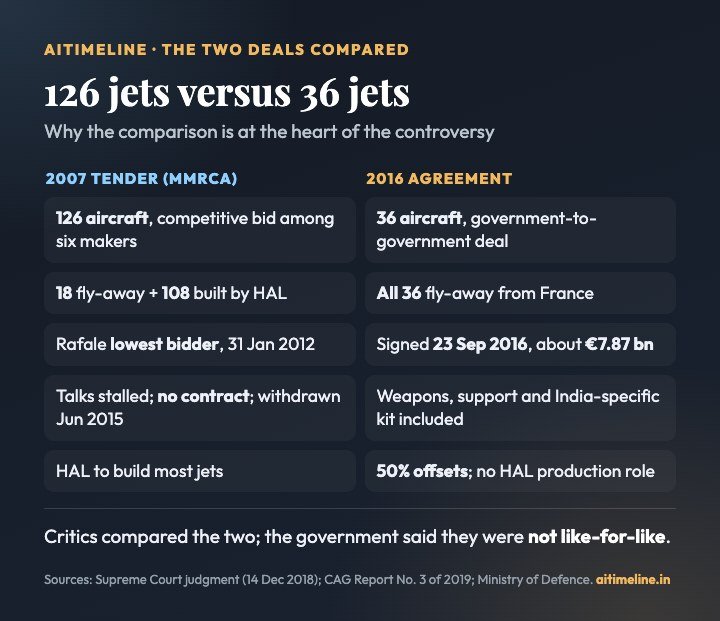
The 2007 tender was a competitive bid for 126 Medium Multi-Role Combat Aircraft. After trials, the Rafale beat the Eurofighter Typhoon on life-cycle cost in January 2012. Under that plan 18 jets would come ready-built from France and 108 would be made by HAL in Bengaluru under licence. Two years of talks failed to settle how many man-hours HAL would need and whether Dassault would guarantee jets made in India.
The 2016 agreement was different in kind. It was a deal between two governments, not a tender; it bought 36 jets ready to fly, with India-specific enhancements, weapons and support; and it gave HAL no production role. Supporters said it got urgently needed aircraft to the Air Force quickly. Critics said it bought too few jets, gave up local manufacturing, and was announced in April 2015, two months before the old tender was formally withdrawn.
Timeline: The Rafale Deal Controversy, 2007 to November 2026
Newest first. Colour shows the type of event.
Where the controversy stands French investigation
In India: The Supreme Court’s decisions of 14 December 2018 and 14 November 2019 remain the last word on the petitions for a court-ordered probe. A fresh petition based on the French reports was dismissed as withdrawn on 29 August 2022. No Indian agency has opened a criminal case into the 2016 agreement.
In France: The judicial investigation opened in June 2021 was still continuing in 2026, according to The Wire in February 2026. We found no charges against any person or company, and no court finding of corruption, in the reporting we reviewed.
Meanwhile: India is negotiating for 114 more Rafales, separately from the 2016 agreement.
Dassault submits a proposal for 114 more jets Procurement
What happened: Dassault Aviation was reported to have handed the Ministry of Defence a techno-commercial proposal for 114 Rafales on 6 August 2026, with most of them to be built in India.
Sticking points: Later reports said talks were held up over Indian requests for access to software and source code for the radar and electronic-warfare systems.
Defence Acquisition Council approves 114 Rafales in principle Procurement
What happened: The council granted Acceptance of Necessity for 114 Rafale fighters for the Air Force, part of a package of approvals reported at about Rs 3.6 lakh crore.
How to read it: An Acceptance of Necessity is the first formal step in Indian defence procurement, not a contract. It also has no bearing on the questions raised about the 2016 agreement.
French investigation reported to be continuing French investigation
The report: The Wire reported that the French investigation into the 2016 sale was still active. It said investigators had questioned the actor and producer Julie Gayet, François Hollande’s partner, towards the end of 2024 about how a company linked to Anil Ambani’s group came to fund a film she co-produced.
How to read it: These are reported investigative steps. Being questioned is not an accusation. Hollande said in 2018 that the film funding had no connection with the Rafale decision.
India signs for 26 Rafale Marine jets Procurement
The deal: India and France signed an agreement for 26 Rafale Marine aircraft for the Navy, 22 single-seat and four twin-seat, with training, weapons and support, reported at about Rs 63,000 crore.
How to read it: This is a separate purchase. It neither settles nor reopens the questions raised about the 2016 Air Force agreement.
The last of the 36 jets lands in India Procurement
What happened: The 36th and final Rafale under the 2016 agreement landed in India after a refuelling stop with a UAE Air Force tanker. The IAF said the “pack is complete”.
Why it matters: Delivery of all 36 aircraft ran from October 2019 to December 2022.
French judges ask India for documents French investigation
The request: Mediapart reported that the French investigating judges sent India a formal request for judicial documents in November 2022, and later reported that India had not complied.
How to read it: This is Mediapart’s account. We did not find an Indian government statement on the request.
Supreme Court refuses a fresh probe plea Supreme Court
The petition: Advocate M.L. Sharma sought an investigation based on the 2021 French reports about payments to a middleman.
The order: The bench said no case was made out for it to intervene. At Sharma’s request the petition was recorded as dismissed as withdrawn. When Sharma said he could approach the CBI, the Chief Justice replied: “Nobody is stopping you.”
Secrecy blocks access to classified documents French investigation
What happened: France’s defence-secrecy commission advised against declassifying documents that the judges had requested from the armed forces and foreign ministries. Reports later counted five such refusals.
How to read it: The refusals limited what the judges could see. They are not a finding about the deal either way.
Second Rafale squadron formed Procurement
What happened: The IAF formally inducted the Rafale into No. 101 Squadron, the “Falcons of Chamb and Akhnoor”, at Hasimara under Eastern Air Command.
Context: About 26 of the 36 aircraft had reached India by then.
Mediapart alleges further secret commissions French investigation
The allegation: Mediapart reported that offshore companies and allegedly false invoices had been used to pay a middleman, Sushen Gupta, about €7.5 million, and that the CBI and Enforcement Directorate had documents on this from October 2018 but did not open a Rafale investigation.
The response: The BJP rejected the report, and Dassault did not comment in detail.
How to read it: These are a publication’s allegations, based on documents it says it saw. No court has ruled on them.
Judges seek classified French documents French investigation
What happened: The judges asked France’s armed forces and foreign ministries for classified documents about the negotiation of the India contract.
France opens a judicial investigation French investigation
What happened: France’s national financial prosecutor’s office opened a judicial investigation into suspected corruption, influence peddling, money laundering and favouritism connected with the 2016 sale. An independent investigating judge was put in charge.
Why now: It followed a second complaint by the anti-corruption group Sherpa, filed after Mediapart’s April 2021 reports. The PNF had declined to act on Sherpa’s first complaint in 2019.
How to read it: An investigation is not an accusation against any named person. The BJP said it was triggered by an NGO complaint and was not evidence of corruption; the Congress renewed its demand for a parliamentary probe.
Mediapart reports a payment flagged by France’s anti-corruption agency French investigation
The allegation: Mediapart reported that AFA auditors had questioned a payment of about €1 million by Dassault, booked as “gifts to clients”, to Defsys Solutions, an Indian company linked to the family of Sushen Gupta, for 50 replica Rafale models.
The response: Dassault said its anti-corruption controls had found no violation. The Indian government dismissed the report.
How to read it: This was an audit query reported by a publication. It is not a judicial finding.
Formal induction at Ambala Procurement
What happened: The Rafale was formally inducted into the Indian Air Force at Ambala, in No. 17 Squadron, the “Golden Arrows”.
First five Rafales land at Ambala Procurement
What happened: The first five aircraft flew from Mérignac in France, with a stop in the UAE, and landed at Ambala Air Force Station.
Review petitions dismissed Supreme Court
The ruling: The court found no grounds to review its December 2018 judgment and again declined to order an investigation.
Justice Joseph’s opinion: Agreeing that the reviews failed, Justice Joseph wrote separately that the verdict would not prevent the CBI from acting on the petitioners’ complaint, subject to prior approval under Section 17A of the Prevention of Corruption Act.
Same day: The court closed the contempt case against Rahul Gandhi for attributing his “chowkidar chor hai” slogan to the court, after his unconditional apology, and told him to be more careful.
First Rafale handed over in France Procurement
What happened: Defence Minister Rajnath Singh received the first Rafale for India at Dassault’s facility, on Dussehra, and performed a shastra puja on the aircraft.
Rahul Gandhi apologises to the Supreme Court Politics & allegations
What happened: In his third affidavit, Rahul Gandhi tendered an unconditional apology for wrongly attributing the “chowkidar chor hai” slogan to the Supreme Court after its 10 April order.
Court allows the leaked documents to be considered Supreme Court
What happened: The government had argued that documents published by The Hindu and others were privileged and had been taken from the defence ministry without authorisation. The court rejected that objection and said it would hear the review petitions on their merits.
CAG report tabled in Parliament Audit & Parliament
The finding: The Comptroller and Auditor General found the 36-aircraft package 2.86% cheaper than its “audit-aligned” price for the earlier MMRCA offer. The price of the basic fly-away aircraft was the same; savings were in India-specific enhancements, support and weapons.
What it rejected: The CAG did not accept the defence ministry’s claim that the deal was 9% cheaper.
What it did not do: The report gave prices in redacted form and did not examine the choice of offset partner.
Report on “parallel negotiations” Politics & allegations
The report: The Hindu published a defence ministry note in which officials objected that discussions held by the Prime Minister’s Office with the French side undermined the position of the Indian Negotiation Team.
The response: Defence Minister Nirmala Sitharaman said the publication left out the then minister Manohar Parrikar’s note that the concern was an “overreaction” and that the PMO was only monitoring progress.
Review petitions filed Supreme Court
What happened: The petitioners asked the court to review its December judgment, arguing that it relied on an incorrect statement that the CAG report on pricing had already been examined by Parliament’s Public Accounts Committee.
The government: The Centre had already asked the court to correct that sentence, saying it had been misread.
Supreme Court dismisses pleas for a probe Supreme Court
The ruling: The court said it found no reason to doubt the decision-making process, that it was not its job to compare prices, and that it found no material showing commercial favouritism in the choice of offset partner. It dismissed all the petitions.
The limit: The court stressed that judicial review of defence contracts is limited. It ruled on whether to intervene; it was not a criminal trial and no one was acquitted or convicted.
Government gives the court sealed-cover details Supreme Court
What happened: On 10 October the court asked for the decision-making steps, in a sealed cover, saying it was not examining price or technical suitability. On 31 October it asked for pricing details too. The government filed them in November, with a public note on the process, and the court reserved judgment after a hearing on 14 November.
Hollande’s remark sets off the biggest row Politics & allegations
The remark: Former French president François Hollande was quoted as saying that India had proposed Reliance as the offset partner and France “did not have a choice”.
The responses: The Indian government said it had no role in the choice of a commercial partner. Dassault said it had chosen Reliance itself, and the French government said French companies pick their own Indian partners. Hollande later said only Dassault could comment on how the choice was made.
First petition to stay the deal listed Supreme Court
What happened: On 5 September the court agreed to hear Sharma’s plea for a stay and a court-monitored investigation. Further petitions followed, from advocate Vineet Dhanda, AAP MP Sanjay Singh and, in October, Yashwant Sinha, Arun Shourie and Prashant Bhushan.
Defence ministry defends the agreement Politics & allegations
The statement: The ministry said the purchase followed the Defence Procurement Procedure, that its terms were better than the earlier “notionally negotiated” offer in capability, price, equipment, delivery and maintenance, and that giving a detailed price would reveal the aircraft’s weapons fit.
Dassault and Reliance announce a joint venture Politics & allegations
The announcement: Dassault Aviation’s Eric Trappier and Reliance Group’s Anil Ambani announced a joint venture to help carry out Dassault’s offset obligations, with a plant at Mihan in Nagpur. Reliance was to hold 51%.
The criticism: Critics pointed out that Reliance Defence had been set up only in 2015, shortly before the April announcement, and had no aircraft-making record, unlike the state-owned HAL.
Intergovernmental agreement signed Procurement
The agreement: India and France signed an agreement for 36 Rafales in fly-away condition, with India-specific enhancements, weapons and five years of support. The value was reported at about €7.87 billion, roughly Rs 58,000–59,000 crore at the time.
Offsets: The vendors were required to invest 50% of the value in India as offsets.
Negotiations begin; the old tender is withdrawn Procurement
What happened: The Defence Acquisition Council cleared the 36-jet purchase and an Indian Negotiation Team began talks with the French side in May 2015. The 2007 request for proposal was formally withdrawn in June 2015.
The criticism: The Supreme Court later noted that the April announcement came before the old tender was withdrawn, though it found no reason to intervene.
Modi announces 36 Rafales in Paris Politics & allegations
The announcement: During a visit to France, the Prime Minister announced that India would buy 36 Rafales in fly-away condition through a government-to-government agreement, citing the Air Force’s “critical operational necessity”.
Why it was controversial: It replaced the plan for 126 jets, most of them to be built by HAL. The critics’ questions about price, numbers and offsets all start here.
Talks over the 126-jet contract stall Procurement
The sticking point: Of the 126 aircraft, 18 were to come ready-built from France and 108 to be made by HAL. Dassault and HAL could not agree on man-hours and on who would answer for the quality of jets made in India.
The result: No contract was signed under the UPA government, which left office in May 2014.
Rafale declared the lowest bidder Procurement
What happened: The defence ministry declared Dassault’s Rafale the lowest bidder for the 126-aircraft contract.
How to read it: Being L1 meant contract negotiations could begin. It did not mean a contract had been agreed.
Two fighters shortlisted Procurement
What happened: After technical evaluation and flight trials, the Air Force shortlisted the Rafale and the Eurofighter Typhoon. Boeing, Lockheed Martin, Saab and MiG were eliminated.
Tender issued for 126 fighters Procurement
What happened: The ministry issued a request for proposal for 126 aircraft. Six manufacturers bid: Dassault, Eurofighter, Boeing, Lockheed Martin, Saab and Russia’s MiG.
The background: The Air Force had sought a new medium fighter since the early 2000s to replace its ageing fleet.
From Announcement to Signature, 2015–2016
Seventeen months that turned a tender into a government deal.
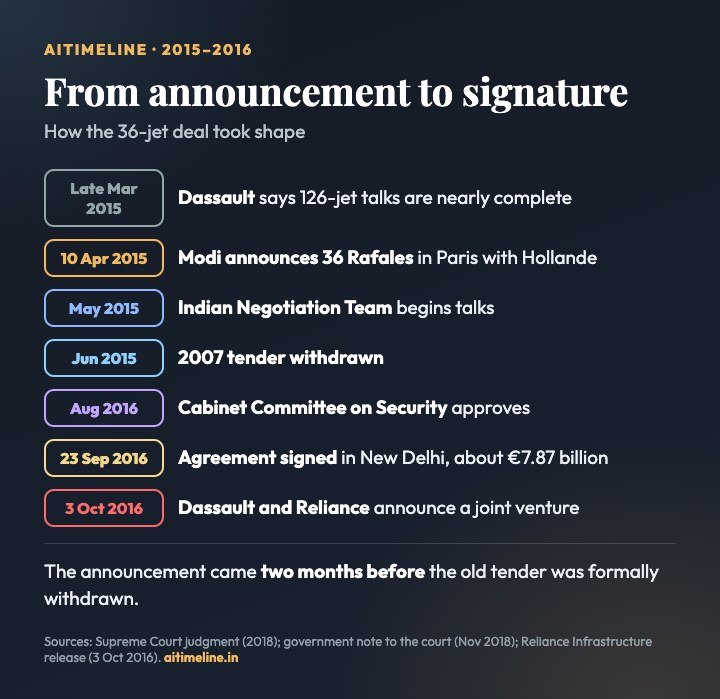
The government’s note to the Supreme Court in November 2018 set out the sequence: an announcement in Paris on 10 April 2015, clearance by the Defence Acquisition Council, about 14 months of negotiation by an Indian Negotiation Team, approval by the Cabinet Committee on Security and signature on 23 September 2016. Critics fixed on the order of events, since the announcement came before the 126-jet tender was formally withdrawn in June 2015, and on a defence ministry note, published in 2019, objecting to parallel talks by the Prime Minister’s Office.
The Five Main Allegations, and the Answers Given
What critics said, what the government said, and what any institution found.
| Allegation | Government’s answer | What institutions found |
|---|---|---|
| Why 36 jets, not 126? | Old talks had stalled; the Air Force needed jets urgently | Supreme Court did not question the need for the aircraft |
| Was the price inflated? | Better terms; packages not directly comparable | CAG: 2.86% cheaper overall; basic aircraft price the same |
| Why Reliance, not HAL? | Vendor picks offset partners; no government role | Supreme Court found no material showing commercial favouritism |
| Were offsets transparent? | Offsets followed the 2016 procurement rules | Not examined in detail by the CAG; part of the French inquiry’s subject |
| Did the PMO undercut negotiators? | PMO only monitored progress | Court allowed the leaked note to be considered, then dismissed the reviews |
Offsets, Reliance and the Hollande Remark
The part of the story that turned a procurement debate into a political storm.
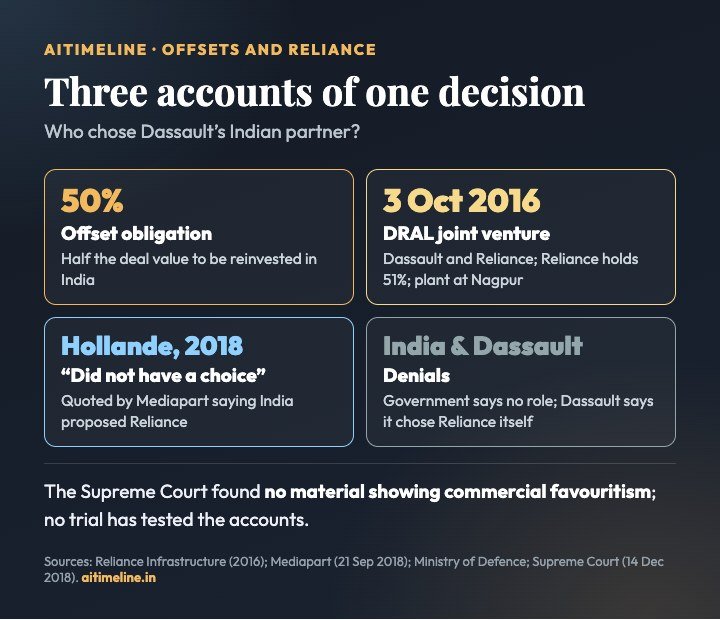
The agreement required Dassault and its suppliers to reinvest half the contract value in India. Under the rules in force, the foreign vendor chose its Indian offset partners and did not need government approval for them at signing. On 3 October 2016 Dassault and Reliance announced a joint venture, Dassault Reliance Aerospace, with a plant at Nagpur. Reliance Defence had been set up only in 2015, which critics contrasted with HAL’s decades of building aircraft.
The row peaked on 21 September 2018, when Mediapart quoted François Hollande as saying the Indian government had proposed Reliance and France “did not have a choice”. India denied any role, Dassault said the choice was its own, and Hollande later said only Dassault could explain it. The Supreme Court said in December 2018 that it found no material showing commercial favouritism by the government. Those competing accounts have never been tested in a trial.
What the CAG Audit Found
A specific price comparison, not a verdict on every allegation.
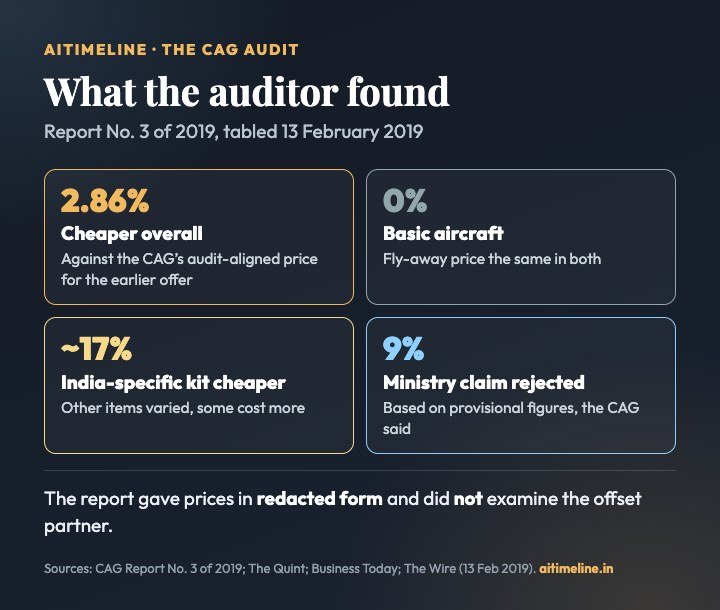
The Comptroller and Auditor General tabled its report on Air Force capital acquisitions on 13 February 2019, the last day of the Budget Session. It built an “audit-aligned” price for the 2007 offer and found the 2016 package 2.86% cheaper overall. The basic aircraft cost the same; India-specific enhancements were about 17% cheaper; some other items cost more. The CAG did not accept the defence ministry’s figure of a 9% saving, and it published prices only in redacted form. The government said the report vindicated it. Opposition parties called it incomplete, pointing out that it did not deal with the offset partner.
The Indian Legal Track: Three Refusals to Order a Probe
Why the Supreme Court’s rulings are not a criminal acquittal.
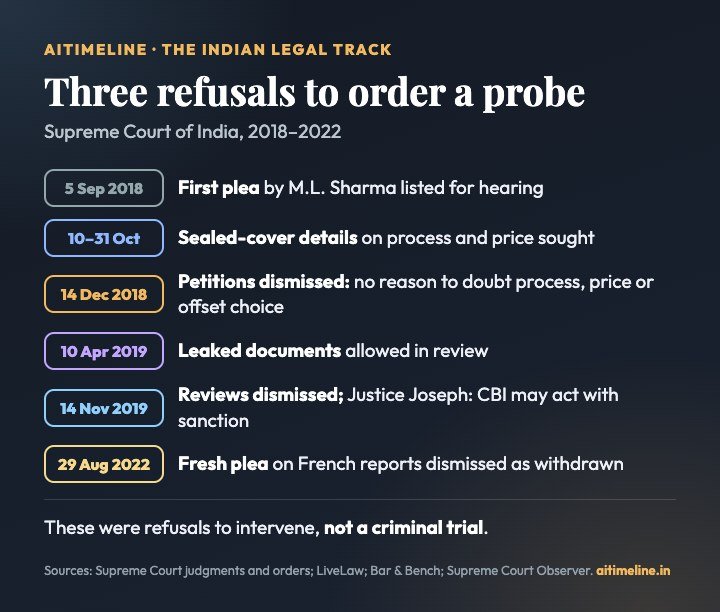
The petitions asked the court to stop the deal or order an investigation. Hearing them, a bench led by Chief Justice Ranjan Gogoi took the decision-making details and the price in sealed covers, and on 14 December 2018 dismissed the petitions. It said judicial review of defence contracts is limited, that comparing prices was not its job, and that it had found no reason to doubt the process or material showing favouritism.
The review petitions were dismissed on 14 November 2019. In a separate opinion, Justice K.M. Joseph said the judgment did not stop the CBI from acting on the petitioners’ complaint if it obtained approval under Section 17A of the Prevention of Corruption Act. No such investigation was opened. A third plea, based on the 2021 French reports, was dismissed as withdrawn on 29 August 2022. None of these was a trial, and none produced a finding that anyone was innocent or guilty of a crime.
The French Legal Track: An Investigation, Not a Verdict
What has been reported since 2021, and what has not happened.

France’s anti-corruption agency, in an audit of Dassault, queried a payment of about €1 million booked as “gifts to clients” to an Indian company linked to the middleman Sushen Gupta, Mediapart reported in April 2021. The NGO Sherpa filed a new complaint, and on 14 June 2021 the national financial prosecutor’s office opened a judicial investigation under an independent judge into suspected corruption, influence peddling, money laundering and favouritism. In November 2021 Mediapart reported further alleged payments of about €7.5 million and said Indian agencies had held documents on them since 2018.
Since then, reported progress has been slow. The defence-secrecy commission advised against releasing classified documents the judges requested, and Mediapart reported that India had not answered a request for judicial documents sent in November 2022. In February 2026 The Wire reported the investigation was still active. As of 12 November 2026 we found no charges against any person or company and no court finding of corruption.
Where Things Stand in November 2026
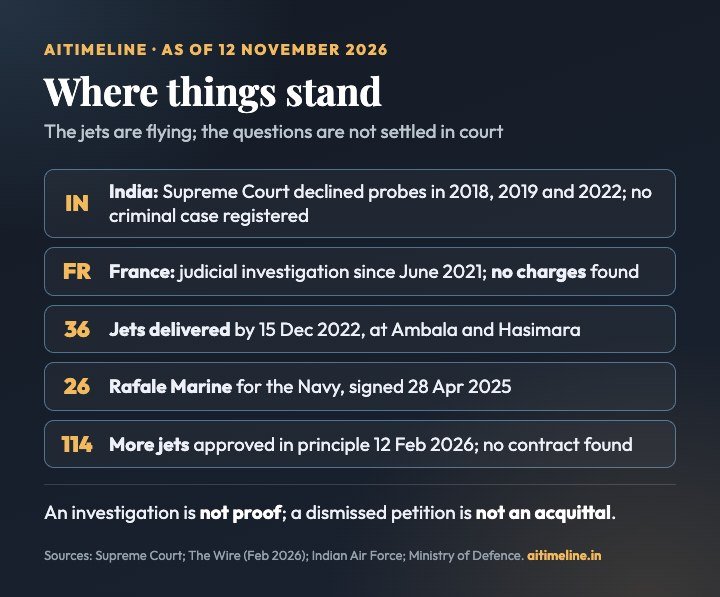
The 36 jets are in service with two squadrons, and both the Navy and Air Force have since chosen more Rafales. The political argument has quietened but the legal picture is unchanged: Indian courts have declined to order an inquiry, and the French investigation has not reached charges. Any final French judicial step would be the first independent legal test of the allegations about payments and partners.
What Each Institution Decided
| Institution | What happened | What it did not establish |
|---|---|---|
| Supreme Court, 14 Dec 2018 | Dismissed petitions seeking a probe | No criminal trial, conviction or acquittal |
| CAG, 13 Feb 2019 | Package 2.86% cheaper than its audit benchmark | Did not examine the offset partner choice |
| Supreme Court, 14 Nov 2019 | Dismissed review petitions | Justice Joseph left room for a CBI probe with sanction |
| Supreme Court, 29 Aug 2022 | Fresh plea dismissed as withdrawn | Did not examine the French reports on merits |
| French PNF, Jun 2021 | Opened a judicial investigation | Opening a probe is not proof of guilt |
| Dassault Aviation | Said it chose Reliance itself | A company statement, not a finding |
Key People and Organisations
| Person or body | Role |
|---|---|
| Narendra Modi | Prime Minister; announced the 36-jet purchase in April 2015 |
| François Hollande | French President 2012–2017; quoted in 2018 on Reliance |
| Manohar Parrikar | Defence Minister who signed the agreement |
| Nirmala Sitharaman | Defence Minister who defended the deal in 2018–19 |
| Dassault Aviation | Maker of the Rafale; chose Reliance as a partner |
| Reliance Defence / Anil Ambani | Partner in the DRAL joint venture |
| HAL | State-owned maker due to build 108 jets under the old plan |
| Rahul Gandhi | Congress leader who led the political attack |
| Yashwant Sinha, Arun Shourie, Prashant Bhushan | Petitioners in the Supreme Court |
| Sherpa and Mediapart | French NGO whose complaint led to the probe; publication that reported the allegations |
The Impact of the Rafale Controversy
- Defence became electoral politics: the deal was a central issue in the 2019 Lok Sabha campaign.
- Offsets under scrutiny: the row drew attention to how foreign vendors pick Indian partners and how offsets are audited.
- Make in India debate: dropping HAL’s production role sharpened the argument over building fighters at home; the 114-jet plan now promises most aircraft made in India.
- Limits of judicial review: the Supreme Court made clear it would not second-guess defence pricing or technical choices without strong grounds.
- Sealed covers and secrecy: the case became a reference point in the debate over sealed-cover hearings and confidentiality in court.
- The relationship held: India and France signed for 26 Rafale Marine jets in 2025 and began talks on 114 more in 2026.
Rafale is often compared with earlier defence-procurement rows, notably the Bofors scandal and the AgustaWestland helicopter case, in which the same middleman, Sushen Gupta, was arrested. For the wider policy context, see our timeline on India’s defence imports and self-reliance.
Explore More Timelines
People Also Ask
Frequently Asked Questions
Based on court records, the CAG report and reporting to 12 November 2026.
⚠️ Editorial Note
This timeline separates political allegations, government explanations, audit findings, court decisions and the French investigation, and does not present any allegation against a person or company as established wrongdoing. Mediapart’s reports are attributed to Mediapart. We corrected several details found in common summaries: the Rafale and Eurofighter were shortlisted in April 2011 (the 2009–10 dates are the flight trials); the first petition was taken up in September 2018; the second Rafale squadron was formed in July 2021, not 2023–24; and the Supreme Court also declined a third plea in August 2022. We could not confirm the exact date of the Defence Acquisition Council’s 2015 clearance, or details of any French investigative step after February 2026. This page will be updated if the French investigation produces a verifiable judicial development.
Related Reading on AiTimeline
Sources & further reading
Every dated entry above was checked against these references. Last reviewed 12 November 2026.
- Manohar Lal Sharma v. Narendra Damodardas Modi: Supreme Court judgment of 14 December 2018
- Rafale fighter jet deal: case page, orders and judgments in plain English
- SC dismisses Rafale review but Justice Joseph says CBI can still take lawful action (14 November 2019)
- Breaking: SC dismisses Rafale review petitions (14 November 2019)
- Supreme Court refuses to entertain PIL seeking probe into Rafale deal based on reports of French agency (29 August 2022)
- Rafale price negotiated by Modi govt cheaper than UPA's: CAG (13 February 2019)
- Dassault Aviation and Reliance Infrastructure form joint venture in India: media release (3 October 2016)
- India's Rafale deal under scanner in France, judge appointed to probe alleged corruption (July 2021)
- Rafale deal faces new row as report says Dassault paid 1 mn euros as gift to Indian middleman (April 2021)
- Military secrecy gets in the way of French judges' Rafale sale probe: report
- Exclusive: As India looks to buy 114 Rafales, French prosecutors continue probe into earlier deal (February 2026)
- The pack is complete, says IAF as last of 36 Rafale jets land in India (15 December 2022)
- IAF inducts second squadron of Rafale aircraft at Hasimara airbase (28 July 2021)
- India and France finalise deal for 26 Rafale-M jets (28 April 2025)
- India clears procurement of 114 Rafale jets, other acquisition projects totalling Rs 3.6 lakh crore (12 February 2026)
- SC closes contempt plea against Rahul Gandhi (14 November 2019)