Hindustan Times: A Century of Indian Journalism (1924–Present)
Hindustan Times history, 1924-2026: Gandhi's press, Birla ownership, the 1942 shutdown, the Emergency, going online in 1996, Mint and a new editor in 2026.
Latest Story
In September 1924 Mahatma Gandhi opened a small printing press near Old Delhi railway station for a new English paper started by Akali activists. A century later that paper, now owned by the Birla family’s HT Media, is read mostly on phones and is getting a new editor-in-chief. This is the Hindustan Times history in order: the founders and owners, the freedom struggle and the Emergency, the move online, Mint, Covid and the money behind it all in 2026.
💡 Short Answer
Hindustan Times was founded in Delhi in 1924 by leaders of the Akali movement; Mahatma Gandhi inaugurated its press on 15 September 1924 and K.M. Panikkar was its first editor. Madan Mohan Malaviya bought it in 1925, and from 1927 G.D. Birla was its main owner; the Birla family, now through HT Media and chairperson Shobhana Bhartia, still controls it. Gandhi’s son Devdas edited it from 1937 to 1957. It went online in 1996, launched Mint in 2007 and turned 100 in 2024. Kunal Pradhan became acting Editor-in-Chief on 1 October 2026.
Hindustan Times History: Key Questions
Hindustan Times in Ten Points
- 1924: founded by Akali activists; Gandhi opens the press on 15 September.
- 1925-27: rescued by Madan Mohan Malaviya, then owned mainly by G.D. Birla.
- 1937-57: Devdas Gandhi, the Mahatma’s son, runs the paper.
- 1942: HT stops publishing for about four months rather than accept wartime press rules.
- 1947: ‘India Independent: British Rule Ends’. In 1948 Gandhi is killed at the owner’s house.
- 1975: Emergency censorship; editor B.G. Verghese removed by the proprietor.
- 1996: hindustantimes.com, one of India’s first newspaper websites.
- 2005-07: Mumbai edition, stock-market listing, and Mint with The Wall Street Journal.
- 2020: Covid coverage and a redesign: ‘First Voice. Last Word.’
- 2026: print still pays the bills; a new editor-in-chief from October.
The Hindustan Times Timeline, 1924–2026
Newest first. Tags mark expansion, ownership, press freedom and turning points. Where HT’s own history is the only source, we say so.
A new editor-in-chief Turning point
HT Media announced on 13 August 2026 that Sukumar Ranganathan, who had edited both Mint and Hindustan Times over two decades, would leave after the 2026 Hindustan Times Leadership Summit. His successor, Kunal Pradhan, a former HT managing editor with stints at India Today, The Indian Express, Mumbai Mirror and Reuters, joined as acting Editor-in-Chief on 1 October 2026 and takes full charge in mid-November. ‘Hindustan Times is a newsroom I know well,’ Pradhan said. The brief this page started from still names Ranganathan as editor; that changed this month.
Aug 2026
Fresh capital, and a return to profit Ownership
On 11 July 2026 HT Media’s board approved issuing 3,87,87,137 warrants at Rs 24.57, up to Rs 95.29 crore, to the promoter company The Hindustan Times Ltd and five other investors, with the money earmarked mainly for cutting debt. Shareholders voted at an EGM on 7 August. On full conversion the promoter’s stake falls from 69.50% to about 64.52%. Weeks later, April-June 2026 results showed revenue from operations of about Rs 437 crore and a return to net profit (about Rs 43.5 crore, against a loss of Rs 11.4 crore a year earlier), driven by print advertising. Digital revenue, by contrast, fell 28% to Rs 27 crore.
Print pays, radio shrinks Ownership
HT Media’s 2025-26 accounts, approved on 29 May 2026, told two stories. Before one-off items the group earned Rs 153 crore, up 44%, on revenue from operations of Rs 1,803.31 crore, with print alone bringing in about Rs 1,500 crore. But Rs 114.23 crore of exceptional charges, including radio write-downs, the surrender of radio licences and the cost of India’s new labour codes, turned that into a reported loss of Rs 49.07 crore. A century after it began, the newspaper is still the part of the business that pays the bills.
One hundred years Turning point
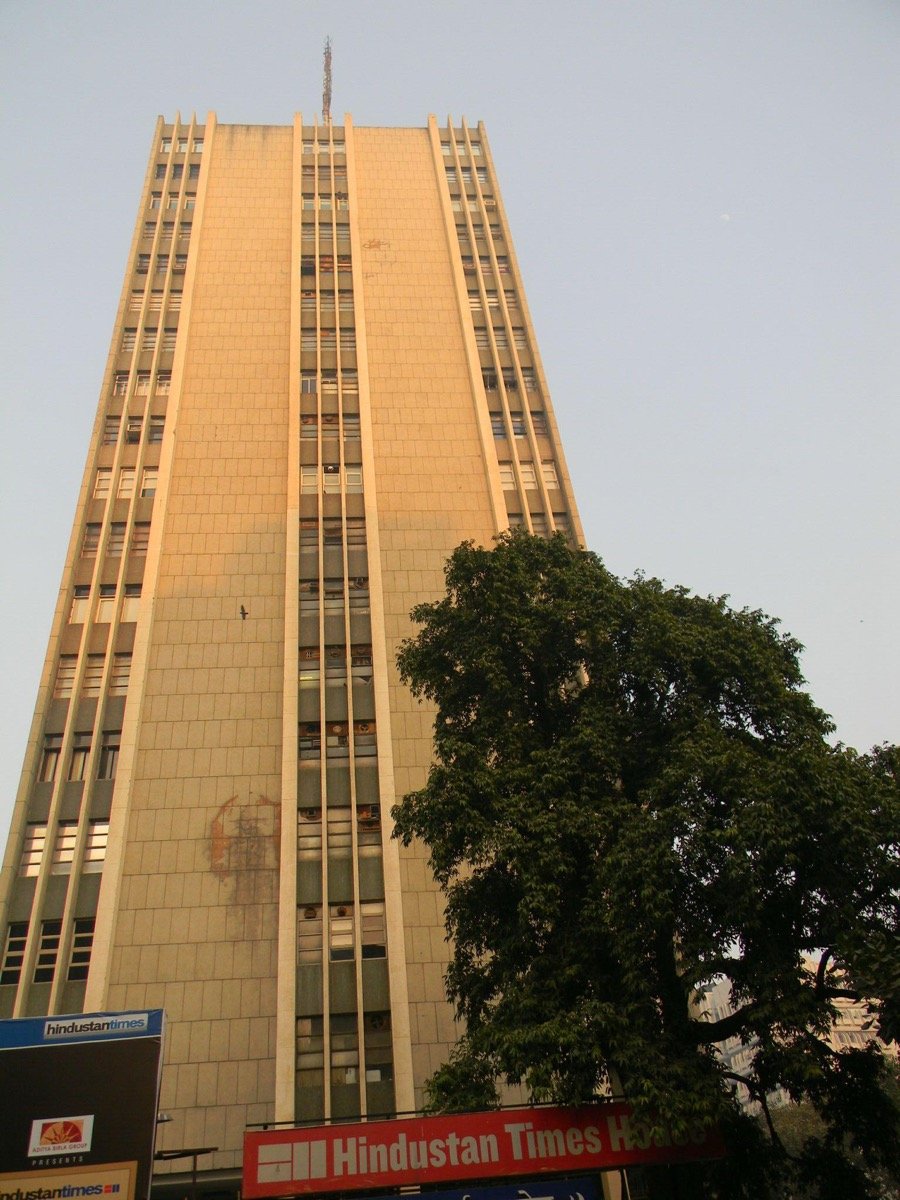
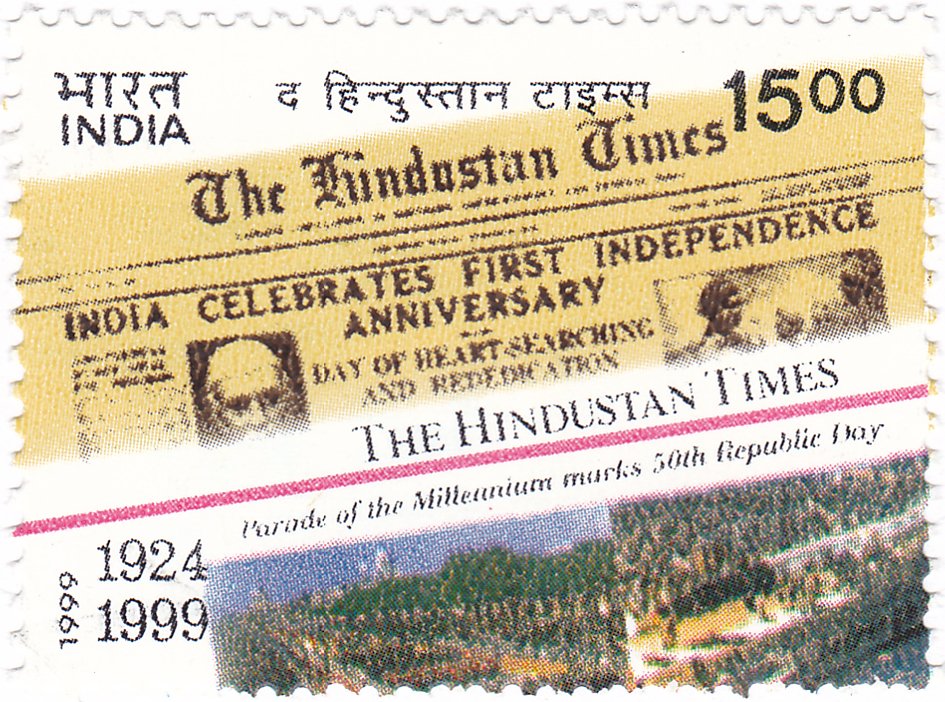
Hindustan Times marked its centenary in September 2024 with a special edition, a laser show on HT House and a year of archive-led features. On 16 November 2024, at the Hindustan Times Leadership Summit, Prime Minister Narendra Modi released a commemorative postage stamp and recalled that Gandhi had inaugurated the paper. HT Media said hindustantimes.com reached about 81 million unique visitors and 490 million page views a month in India in April 2024, citing Comscore. The paper that began on a hand-fed press had become, by audience, mainly a website.
Covid, and First Voice. Last Word. Turning point
The pandemic moved the newsroom home. HT built a Covid dashboard, and from 19 March 2020 Sukumar Ranganathan wrote a daily explainer, ‘All That You Need To Know Today’, which by HT’s count ran for more than 350 days. On 31 August 2020 the paper relaunched with a design by Mario Garcia, a new blackletter logo echoing its 1961 masthead, QR codes linking print to video and podcasts, and a new line: ‘First Voice. Last Word.’ First, for digital speed; last, for the verified version.
26/11 and real-time news Turning point
The Mumbai attacks of 26 November 2008 were one of the first big Indian stories in which updates on Twitter and live television ran far ahead of any newspaper. HT’s three-year-old Mumbai bureau covered the siege. The lesson for print was blunt: it would no longer be first with breaking news, so its value had to come from verification, context and analysis.
2007
Mint Expansion
HT Media launched Mint on 1 February 2007, a business daily printed in a compact Berliner format, with The Wall Street Journal as exclusive content partner supplying about a fifth of its content. The seven-year partnership ended in 2014. Mint gave the group a business brand alongside HT and the Hindi Hindustan, and it became the training ground for many of the group’s later editors, Ranganathan among them.
Mumbai, and the stock market Expansion
On 14 July 2005 Hindustan Times launched a Mumbai edition, taking the Delhi paper into The Times of India’s home city. The same year HT Media listed on the stock exchanges, giving the 80-year-old paper public shareholders for the first time, with the Birla family firmly in control. A Kolkata edition had launched in early 2000, and a youth daily, HT Next, in 2004.
A newspaper for a younger India Expansion
Hindustan Times hired Michael Keegan, who had redesigned The Washington Post in 1998, to redesign the Delhi edition, which appeared in its new look from May 2000: cleaner typography, more graphics and colour, sharper hierarchy. Over the decade supplements such as HT City and the Sunday magazine Brunch pushed the paper towards lifestyle and city coverage, as the post-liberalisation advertiser wanted.
hindustantimes.com Turning point
In 1996 HT put its journalism on the web at hindustantimes.com, early by Indian standards. At first the site was a copy of the paper. Over the next two decades it became the main product: continuously updated, with no page limit and no single deadline. HT now calls the 1996 launch the start of its digital-first, app-first approach.
1991
Shobhana Bhartia and liberalisation Ownership
Shobhana Bhartia, K.K. Birla’s daughter, joined the paper in 1986 and went on to lead it as chairperson and editorial director. HT’s own history credits the period with professionalising the newsroom. By the early 1990s the office was computerised and colour photographs and graphics changed the look of the paper. After the 1991 reforms, a new urban middle class and a flood of consumer advertising changed what newspapers covered: business, careers, lifestyle and technology.
1984
A founder-proprietor dies; a year of crises Turning point
Ghanshyam Das Birla, the paper’s owner for more than half a century, died on 11 June 1983; control was already with his son K.K. Birla. In 1984 the newsroom covered Indira Gandhi’s assassination on 31 October and the anti-Sikh violence that followed in Delhi. By HT’s account it printed an extra midday edition to counter rumours and ran an editorial appeal for calm. Weeks later came the Bhopal gas disaster, where photographs did much of the reporting.
The Emergency, and an editor removed Press freedom
When the Emergency was declared on 25 June 1975, electricity to Delhi’s newspaper offices was cut that night. Editor B.G. Verghese went back to the office after midnight to bring out a late city edition of 26 June carrying the news; HT followed with a slim six-page edition. Under censorship, cartoonist Sudhir Dar said with drawings what reports could not. Verghese, editor since 1969, had already angered the government, including with a signed editorial on Sikkim’s annexation, ‘Kanchenjunga, here we come’. Proprietor K.K. Birla removed him on 23 September 1975; Verghese challenged the decision in court. That same year he won the Ramon Magsaysay Award for journalism. The brief this page started from leaves this episode out; it is the clearest example in HT’s history of ownership and editorship pulling in different directions.
1969
Wars, famine and the camera Turning point
HT’s chief photographer Kishor Parekh covered the 1962 war with China, the 1965 war with Pakistan and the 1966-67 Bihar famine. His famine photographs were exhibited in the United States to raise money for relief. The paper also tracked the Green Revolution: by HT’s account wheat output rose from about 12 million tonnes in 1964 to 17 million in 1968, and M.S. Swaminathan wrote for its Sunday edition in 1969. A news photograph had become evidence, not decoration.
1957
Covering the Republic Turning point
On 26 January 1950, according to HT’s archive, the paper published a 44-page special issue on the new Constitution alongside the regular edition. It covered the first general election of 1951-52, dams, steel plants and the redrawing of states in 1956, printing maps of the new map of India. Devdas Gandhi remained managing editor until his death in August 1957, after 20 years in charge.
1948
Independence, and Gandhi’s death Turning point
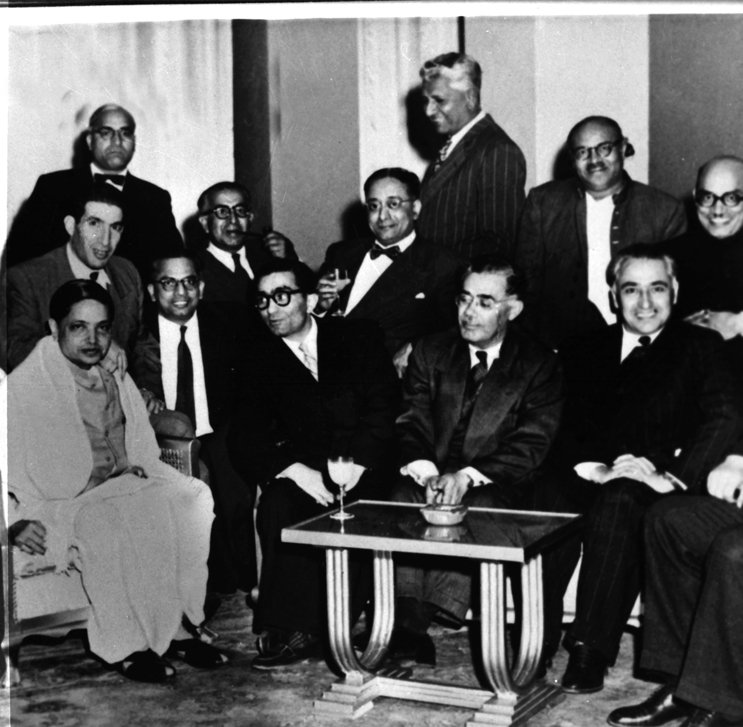
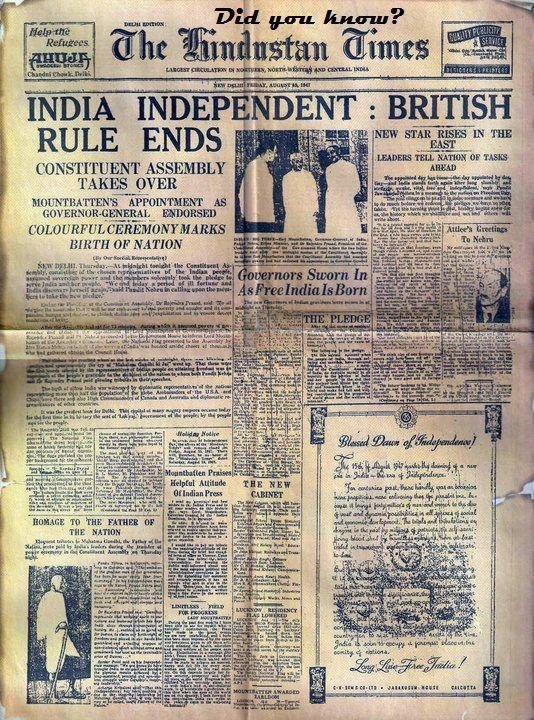
On 15 August 1947 the front page read ‘India Independent: British Rule Ends’. The paper’s founding cause was won; its new job was to explain a country being built, and the violence of Partition around Delhi. On 30 January 1948 Gandhi, who had opened the press in 1924, was shot dead at Birla House in Delhi, the home of the paper’s owner. HT, whose managing editor was Gandhi’s son Devdas, published an extensive obituary edition.
The paper goes silent in protest Press freedom
After the Quit India resolution of August 1942, the colonial government restricted what newspapers could print about the movement and its leaders, and searched HT’s office. Rather than publish under those rules, Hindustan Times stopped publishing, and press histories record that it stayed shut for about four months. HT’s centenary archive holds the August 1942 front-page report on newspapers closing in protest. It was not covering the freedom struggle from outside; it was part of the argument over who had the right to publish.
1937
Hindi, and a Gandhi in charge Expansion
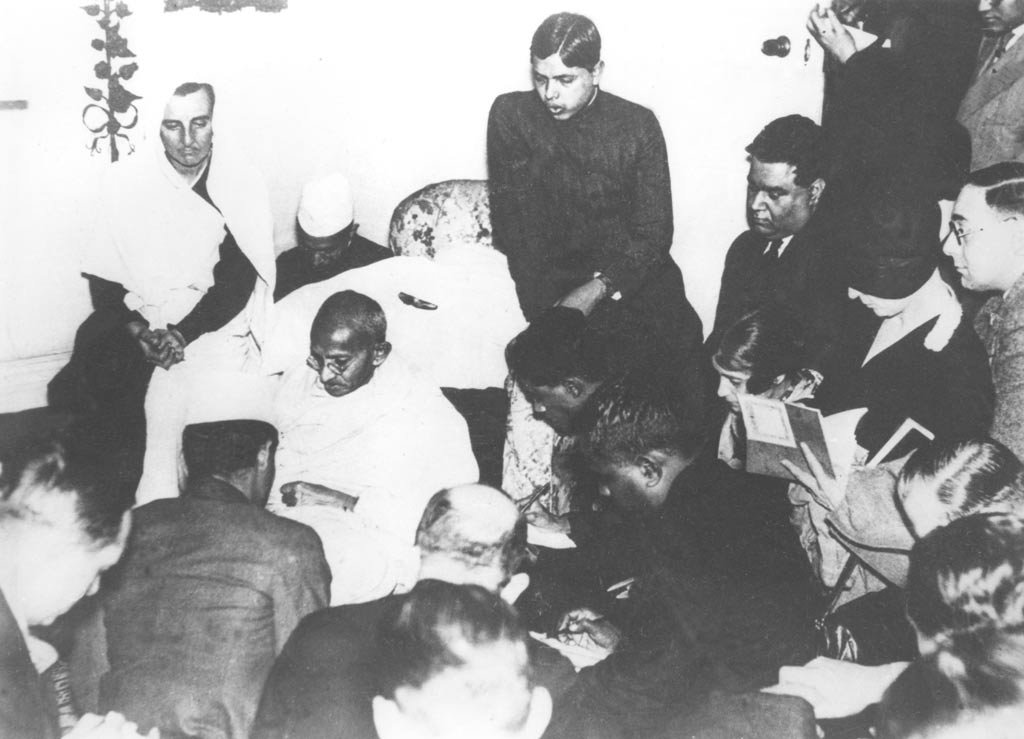
In 1936 the group launched the Hindi daily Hindustan, recognising that a national readership could not be served in English alone; it is now one of India’s largest Hindi papers. In 1937 Mahatma Gandhi’s youngest son, Devdas Gandhi, became managing editor. HT’s centenary history describes his home as a place where Gandhi, Sardar Patel and C. Rajagopalachari met; the newsroom was close to the national movement’s leadership.
1930
Rescued by Malaviya, then Birla Ownership
Within about six months the young paper was in financial trouble. Madan Mohan Malaviya bought it, reportedly with a Rs 40,000 loan arranged with Lala Lajpat Rai’s help. In 1927 it became a joint-stock company with Ghanshyam Das Birla, the industrialist and Gandhi associate, as its biggest shareholder and, in HT’s phrase, its virtual proprietor. Editor J.N. Sahni turned it from an evening into a morning paper, with narrower columns, shorter editorials and the big news on page one, and editions timed to railway and postal routes. By HT’s count circulation was approaching 30,000 by about 1930.
Born in the freedom movement Turning point
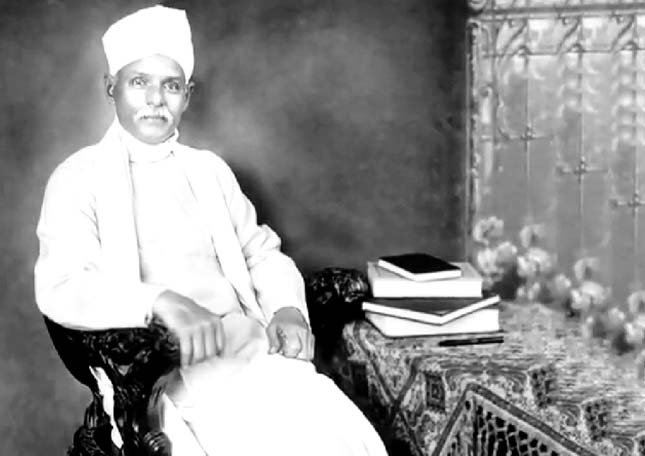
The paper came out of the Akali movement and Punjab’s Gurdwara Reform Movement. Akali leaders including Sunder Singh Lyallpuri, Tej Singh Samundri and Mangal Singh wanted an English daily in Delhi to carry their case and the nationalist argument. On 15 September 1924 Mahatma Gandhi inaugurated the press in a three-storey building in a grain market near Old Delhi railway station; the printing machines filled a ground floor of about 24 by 24 feet. Gandhi helped choose the first editor, K.M. Panikkar. The first issue followed later in September: HT’s archive says 23 September, while other records give 22, 24 or 26 September.
Pick a year and see who ran the paper, how it reached you, and the story of the day
Drag from 1924 to 2026. Cyan chips are HT titles and editions in print; sepia chips are digital and other platforms.
Who Owned Hindustan Times, Period by Period
Founded by activists, rescued by a politician, owned by one industrial family for almost a century.
| Period | Who controlled HT | How it worked |
|---|---|---|
| 1924-25 | Akali founders (Sunder Singh Lyallpuri and others) | Political paper, short of money within months |
| 1925-27 | Madan Mohan Malaviya | Bought with a reported Rs 40,000 loan |
| 1927-1983 | G.D. Birla, then his son K.K. Birla | Joint-stock company; G.D. Birla the largest shareholder and ‘virtual proprietor’; K.K. Birla was proprietor by 1975 |
| 1983-2000s | K.K. Birla | Family control after G.D. Birla’s death |
| 1986 onward | Shobhana Bhartia (K.K. Birla’s daughter) | Joins 1986; later chairperson and editorial director |
| 2005- | HT Media Ltd, listed | The Hindustan Times Ltd (Birla family) about 69.5% promoter stake |
| 2026 | HT Media, after warrant issue | Promoter stake falls to about 64.5% on full conversion of 2026 warrants |
Editors Who Shaped HT
A selection, not a complete list. Dates as given by HT and press reports.
| Editor | Role and period | Why they matter |
|---|---|---|
| K.M. Panikkar | First editor, 1924 | Historian, later a diplomat; chosen with Gandhi’s help |
| J.N. Sahni | Editor, late 1920s | Made HT a morning paper and redesigned page one |
| Devdas Gandhi | Managing editor, 1937-1957 | Longest-serving; Gandhi’s youngest son |
| B.G. Verghese | Editor, 1969-1975 | Removed by the proprietor during the Emergency; Magsaysay Award 1975 |
| Khushwant Singh | Editor, early 1980s | Novelist and columnist |
| Sukumar Ranganathan | Editor-in-Chief, to 2026 | Edited Mint, then HT; led its Covid coverage |
| Kunal Pradhan | Editor-in-Chief, from Oct 2026 | Acting from 1 Oct, full charge mid-November |
Where the Money Comes From
HT Media’s three businesses in 2025-26.
How HT Lasted a Century
Four things the paper kept doing.
Pick a side
HT was openly nationalist. It was founded by activists, opened by Gandhi, edited by his son, and closed itself in 1942 rather than print under wartime rules.
Find patient money
Birla capital kept the paper alive through its early losses and every slump since. The price was a proprietor who could, as in 1975, overrule an editor.
Add languages and titles
The Hindi Hindustan, then Mint and radio. The group became a portfolio, and the Hindi paper and print ads now carry much of the profit.
Move early, redesign often
Online in 1996, redesigned in 2000, 2009 and 2020. Each redesign chased a younger reader on a newer screen.
Hindustan Times in Numbers
Company, audited and reported figures, kept apart and dated.
| Figure | What it measures | Source and date | How to read it |
|---|---|---|---|
| About 30,000 | Daily copies, c. 1930 | HT centenary history | Company account |
| 9.94 lakh / 6.06 lakh | Daily circulation, 2017 / 2023 | Wikipedia, citing audit figures | Print in decline |
| 81m / 490m | Monthly unique visitors / page views, India | Comscore, Apr 2024, company-cited | Historical, not current |
| Rs 1,803.31 cr | Revenue from operations, FY26 | HT Media results, 29 May 2026 | Up 3.3% |
| Rs 153 cr / -Rs 49.07 cr | Profit before exceptional items / reported result, FY26 | HT Media results | Rs 114.23 cr one-off charges |
| Rs 437 cr | Revenue from operations, Apr-Jun 2026 | HT Media results, Aug 2026 | Back to net profit |
| Rs 95.29 cr | Warrant issue at Rs 24.57 | Board, 11 Jul 2026 | Mainly to cut debt |
Corrections and Clarifications
Claims in the earlier draft of this page and in the brief it was built from, checked against Wikipedia, HT’s centenary material, exchange4media, afaqs, bestmediainfo, Campaign India, HT Media results coverage and other press reports.
“As of 2026, Sukumar Ranganathan is Editor-in-Chief”
No longer. Kunal Pradhan became acting Editor-in-Chief on 1 October 2026 and takes full charge in mid-November; Ranganathan leaves after the 2026 Leadership Summit.
The Emergency, without its editor
The brief’s Emergency section leaves out the most important HT event of 1975: proprietor K.K. Birla removed editor B.G. Verghese on 23 September 1975, after he had criticised the government.
“1942: HT shut down in protest”
Not a one-day protest. Press histories record HT suspended publication from August 1942 for about four months.
Kishor Parekh’s photos “established a famine relief fund”
What is documented is that his 1966-67 Bihar famine photographs were exhibited in the US to raise money for victims. We could not confirm that they led to a specific fund.
“February 2004: major redesign and Brunch”
We could confirm redesigns in May 2000 (Michael Keegan), 2009 and August 2020 (both Mario Garcia), and the HT Next youth daily in 2004, but not a February 2004 redesign or Brunch’s launch date.
“2020: masthead redesigned”
Correct, but the date and designer matter: 31 August 2020, by Mario Garcia, with a blackletter logo echoing the 1961 masthead.
“Mint, in partnership with The Wall Street Journal”
That partnership ended in 2014. Mint has run on its own since.
First-issue date
The press opened on 15 September 1924. HT’s archive gives 23 September for the first issue; other records give 22, 24 or 26 September. We give the range.
What the brief left out
The Mumbai launch (2005), HT Media’s listing, FY26 results (Rs 153 crore before one-offs, Rs 49 crore reported loss), the July 2026 warrant issue and the return to profit in April-June 2026.
What Comes Next
HT’s first century was about getting news to readers: by rail and post, then colour print, then the web and the phone. Its finances show the unfinished part of that move. Print, which most readers have left, still earns about eight times what digital does. Digital revenue fell 28% in April-June 2026.
The next problem is AI. If a reader asks an assistant what happened in Delhi today, the answer may draw on HT’s reporting without the reader ever visiting it. A century-old archive, original reporting and a name readers trust are the paper’s main assets. Whether they can be turned into revenue in an AI-summarised news market is the test for the new editor and for the Birla family’s next decade of patience.
Explore More Timelines
People Also Ask
Frequently Asked Questions
The Bottom Line
Hindustan Times began in 1924 as a nationalist paper founded by Akali activists and opened by Gandhi, was rescued by Malaviya and then owned by G.D. Birla from 1927, and was edited by Devdas Gandhi through Independence. It shut itself in 1942, lost an editor in the Emergency, went online in 1996, added Mumbai and Mint in 2005-07 and turned 100 in 2024. In 2026 it is a mostly digital audience paid for mostly by print, with a new editor-in-chief from October.
Related AiTimeline Stories
⚠️ Editorial Note
Last updated 8 October 2026. Founding history is from Wikipedia’s Hindustan Times entry and HT’s centenary material as reported by afaqs and others; the 1942 suspension from press histories; the Emergency and B.G. Verghese’s removal from Wikipedia and The Leaflet; Kishor Parekh from Wikipedia; Mint from Wikipedia and Quartz; redesigns from afaqs, Campaign India and exchange4media; the 2024 stamp from narendramodi.in; FY26, Q1 FY27 and the warrant issue from HT Media results as reported; the editor change from bestmediainfo. Figures attributed to HT are the company’s own. AiTimeline has no commercial relationship with HT Media.
Sources & further reading
Every dated entry above was checked against these references. Last reviewed 8 October 2026.
- Wikipedia: Hindustan Times (founding, owners, editors, editions, circulation)
- afaqs: Hindustan Times celebrates 100 years as India's trusted voice
- Wikipedia: B. G. Verghese (editor 1969-1975, removal in 1975)
- The Leaflet: Predicament of the press during the Emergency
- Wikipedia: Kishor Parekh (HT chief photographer, Bihar famine)
- Wikipedia: Mint (newspaper)
- Quartz: India's Mint and The Wall Street Journal end their seven-year partnership
- afaqs: Hindustan Times to go for a design makeover (Michael Keegan, 2000)
- afaqs: Hindustan Times flaunts new avatar (August 2020 redesign)
- narendramodi.in: PM addresses Hindustan Times Leadership Summit 2024, releases centenary stamp
- multibagg.ai: HT Media FY26 results summary
- indiantelevision.com: HT Media returns to profit in Q1 as print and radio drive recovery
- indiantelevision.com: HT Media approves Rs 95.3 crore preferential warrant issue
- bestmediainfo: Sukumar Ranganathan moves on, Kunal Pradhan appointed Hindustan Times editor-in-chief