The Gaza Medical Crisis: A Public Health and Healthcare Timeline
An evidence-based timeline of the Gaza healthcare crisis: hospitals, water, disease and humanitarian aid, sourced from WHO, UNICEF, UN OCHA and the ICRC.
Latest Story
It is past two in the morning at a partially functioning hospital in the Gaza Strip, and the emergency department has no queue system left, only a corridor of stretchers. A doctor moves between them by torchlight when the generator dips, checking dressings that were changed with gauze counted out by the piece, because there is no telling when the next resupply truck will clear inspection at the crossing. The saline bag hanging over one patient is one of a dwindling number left in the store room. Down the hall, a colleague is trying to keep a dialysis machine running through a scheduled power cut. None of this is exceptional for a night shift here — it has been the baseline, with periods better and periods far worse, for years. This is not a story about a single night or a single doctor. It is the setting for a wider, well-documented account of what happens to a healthcare system, and to the population that depends on it, when electricity, fuel, medical supply chains, clean water and safe passage for the sick can no longer be taken for granted. This Gaza medical crisis timeline traces how that system was built, strained and repeatedly damaged — using primary reporting from the World Health Organization, UNICEF, UN OCHA, UNRWA and the International Committee of the Red Cross, with medical evidence drawn from peer-reviewed journals — and it is written to remain a useful reference as the situation continues to change.
🧠 AI Overview Summary
Gaza’s healthcare system has been under sustained strain since Israel’s 2007 blockade began, with the most severe disruption following the escalation after 7 October 2023. As of 2026, WHO reports that just over half of Gaza’s hospitals and about 58% of primary healthcare centres are partially functional, none at full capacity. UNICEF and OCHA report that roughly 90% of water and sanitation infrastructure has been damaged, over 96% of households lack adequate safe water, and malnutrition among children under five is projected to affect at least 132,000 by mid-2026. A ceasefire agreed on 10 October 2025 has improved humanitarian access compared with earlier in the conflict, but WHO, UNICEF and UN OCHA continue to describe healthcare delivery, water systems and disease prevention as severely constrained.
The Gaza medical crisis in six direct answers
What the evidence actually shows
- Gaza’s healthcare strain did not begin in 2023. It has roots in the 2007 blockade and was repeatedly worsened by conflicts in 2008-09, 2014 and 2021 — the escalation since October 2023 is the most severe documented episode, not an isolated event.
- Hospital functionality is partial, not binary. WHO describes hospitals as “partially functional,” meaning they provide some services at reduced capacity, dependent on backup generators and irregular medical supply deliveries — not simply “open” or “closed.”
- Water and sanitation damage drives disease risk directly. UNICEF and WHO have linked the roughly 90% damage to water and sanitation infrastructure to large-scale outbreaks of acute watery diarrhoea and suspected hepatitis A, particularly among children.
- Malnutrition and famine risk have fluctuated, not steadily worsened or improved. The IPC’s Famine (Phase 5) classification was confirmed for Gaza Governorate in August 2025; by December 2025, UN agencies reported famine conditions had eased following the October ceasefire, while warning the improvement was fragile.
- Medical evacuation capacity remains far below both pre-war levels and current need. WHO reported over 15,000 patients still awaiting evacuation as of recent reporting, against a pre-war baseline of 50-100 referrals per day for a broader range of routine and complex care.
- Maternal and child health indicators have deteriorated sharply. UNFPA reported recorded births roughly halved between the first half of 2022 and the first half of 2025, with only five hospitals still providing maternity care across Gaza as of 2025 reporting.
- Mental health need is described as near-universal among children. UNICEF stated in 2024 that all children in Gaza needed some form of mental health and psychosocial support, a statement it said it had not made about any other crisis.
- Attack figures on healthcare vary by source and reporting period — WHO’s Surveillance System for Attacks on Health Care and other monitors have published different totals depending on the exact dates covered and methodology; this page cites each figure with its source and period rather than a single unqualified number.
- The October 2025 ceasefire improved humanitarian access without resolving the health crisis. UN reporting through mid-2026 continues to describe severe pressure on hospitals, water systems and disease prevention despite the reduction in active hostilities.
- This is a framework for understanding evolving humanitarian data, not a final tally. Every figure on this page is dated and sourced because the underlying situation, and the reporting on it, continues to change.
Executive Summary & One-Minute Read
📋 Executive Summary
Gaza’s healthcare system entered 2023 already constrained by 16 years of blockade-related restrictions on the movement of people, medicines and equipment. The escalation following 7 October 2023 caused what WHO and UN agencies describe as the most severe disruption to that system on record: hospitals damaged or forced to partially close, mass displacement of patients and staff, and the collapse of routine disease prevention. A first ceasefire (January-March 2025) allowed a partial recovery before fighting resumed; a second ceasefire from October 2025 has since permitted expanded, though still constrained, humanitarian access. As of mid-2026, WHO, UNICEF and OCHA describe a health system that is functioning at reduced capacity across the board — hospitals, water systems, nutrition services and disease surveillance all included — rather than one that has either collapsed entirely or been restored.
⏳ One-Minute Summary
Since 2007, Gaza’s 2+ million residents have depended on a healthcare system repeatedly strained by blockade and conflict. The period since October 2023 has been the most severe: hospitals damaged, medical evacuations restricted, water and sanitation systems largely destroyed, and disease outbreaks and malnutrition documented at scale by WHO, UNICEF and IPC. A ceasefire since October 2025 has eased some conditions, but as of 2026 official reporting still describes a health system under severe, sustained pressure — not one that has recovered.
How Armed Conflict Affects a Healthcare System
The mechanics behind every figure in this timeline.
A hospital is not a building with doctors in it. It is the end point of a long, fragile chain: electricity to run ventilators, incubators and operating lights; fuel to keep backup generators running when the grid fails; refrigeration to store vaccines and blood; a supply pipeline for medicines, dressings, dialysis fluid and surgical consumables; and enough trained staff, safely able to reach the building, to actually use all of it. Conflict does not need to destroy a hospital directly to disable it — cutting fuel supply, blocking a spare-part shipment, or making the roads too dangerous for staff to travel can each independently stop a department from functioning, and in Gaza, WHO and UN OCHA reporting has documented all three happening at once, repeatedly, since 2023.
Vaccination matters in this context for a specific epidemiological reason: population immunity against diseases like polio and measles depends on sustained coverage, typically above 90-95% for polio, delivered through routine health visits. Mass displacement and damaged clinics interrupt that routine delivery, which is exactly what allowed poliovirus to begin circulating in Gaza’s wastewater in 2024 for the first time in 25 years, according to WHO and UNICEF, despite no children having shown symptoms of paralysis before the environmental detection prompted an emergency vaccination campaign.
Clean water and sanitation are a public health intervention in their own right, not just a comfort. When water and sewage systems are damaged, people are forced to use unsafe sources or improvised sanitation, which directly drives outbreaks of diarrhoeal disease and hepatitis A — both spread through the faecal-oral route. UNICEF’s WASH (water, sanitation and hygiene) reporting treats this as one of the most direct, measurable links between infrastructure damage and disease incidence anywhere in humanitarian response.
Disease surveillance is the early-warning system that lets health authorities detect an outbreak before it becomes a crisis — tracking cases of specific syndromes (like acute watery diarrhoea or acute jaundice) through clinics and reporting them centrally. WHO has noted that Gaza’s surveillance capacity has itself been degraded by the conflict, which creates a specific risk: diseases such as hepatitis A can spread significantly during their most infectious, pre-symptomatic phase before standard syndromic surveillance would normally detect the wider outbreak.
Emergency medicine and trauma care depend on triage systems, blood banks, imaging equipment and intensive care capacity that assume a predictable patient flow — conflict produces the opposite: mass-casualty surges that can arrive faster than a facility can process them, even before accounting for damaged equipment or short-staffing. Maternal and child health services (antenatal care, safe delivery, neonatal care, routine immunisation, growth monitoring) are typically the first “non-emergency” services to be curtailed when a system is overwhelmed, even though the underlying health need does not pause — which is why UNFPA and UNICEF track maternal and child indicators as leading signals of overall system strain, not as a separate, secondary concern.
Finally, mental health support and international humanitarian assistance sit alongside physical healthcare rather than beneath it. Sustained exposure to conflict, displacement and loss is independently associated with high rates of post-traumatic stress, depression and anxiety, documented in Gaza by UNICEF and peer-reviewed research alike; and the scale of need across all of these categories exceeds what any local system can meet alone, which is why coordinated international assistance — through the UN humanitarian system, the ICRC, and organisations like MSF — is treated by WHO as a core component of the health response, not an optional supplement to it.
📊 Public Health Insight · Why clean water, sanitation and vaccination are essential during humanitarian emergencies
Three interventions consistently do more to prevent death in a humanitarian crisis than emergency surgery: safe water, adequate sanitation, and maintained vaccination coverage. This is because the leading causes of excess mortality in most protracted crises are not trauma injuries but communicable disease and malnutrition, both of which are preventable with functioning WASH systems and immunisation programmes. Damage to water and sanitation infrastructure can increase the risk of diarrhoeal disease, skin infections and other communicable illnesses well beyond the population directly affected by any single incident, which is why WHO and UNICEF treat WASH restoration as a medical priority, not just an infrastructure one.
The Complete Timeline: Gaza’s Healthcare System, Pre-2000 to 2026
Historical background, healthcare situation, humanitarian developments and public health risk are separated in every entry, newest first.
A fragile ceasefire holds while the health system remains severely constrained
Healthcare situation: WHO reported that just over half of Gaza’s hospitals and about 58% of primary healthcare centres were partially functional in 2026, with none operating at full capacity; all hospitals remain dependent on backup generators, with delays in fuel, spare parts and electrical components affecting intensive care, dialysis, operating theatres and laboratories. WHO documented 22 attacks affecting hospitals and healthcare centres across Gaza since the start of 2026.
Water, nutrition and humanitarian access: UNICEF reported that 96% of households lacked access to adequate safe water by early 2026, with families receiving an average of 4.5-6 litres per person per day (well below the roughly 15 litres per person per day used as a minimum humanitarian benchmark by aid agencies). IPC-linked projections cited by WHO and UNICEF estimated at least 132,000 children under five would experience acute malnutrition through June 2026. In May-June 2026, only 44% of UNICEF aid trucks staged at the Egypt border were able to offload, per UNICEF reporting.
International response and political context: WHO launched a $1 billion global Health Emergency Appeal on 3 February 2026, identifying 2.9 million people in the occupied Palestinian territory as needing humanitarian health assistance. Separately, on 30-31 July 2026, the US-led Board of Peace announced that mediators from Egypt, Qatar, Turkey and the United States had reached an agreement with Hamas on a roadmap for disarmament and a transfer of civilian administration to a newly proposed National Committee for the Administration of Gaza, though Israel had not publicly agreed to the proposal and implementation questions remained open, according to contemporaneous reporting. This is a rapidly evolving political process; its humanitarian implications were not yet reflected in official WHO or UN data as of this page’s last update.
Two ceasefires, a confirmed famine, and a fragile recovery
Ceasefire timeline: a first ceasefire and hostage-prisoner exchange agreement took effect 19 January 2025. Israel imposed a total blockade on humanitarian aid entering Gaza on 2 March 2025; the ceasefire collapsed on 18 March 2025 when Israeli strikes resumed, which the Israeli Prime Minister’s office attributed to Hamas’s refusal to release remaining hostages and rejection of ceasefire-extension proposals, according to contemporaneous statements. A second ceasefire agreement took effect 10 October 2025.
Public health risk: the Integrated Food Security Phase Classification (IPC) confirmed Famine (Phase 5, “with reasonable evidence”) in Gaza Governorate as of 15 August 2025 — a formal technical classification requiring specific evidence thresholds on food consumption, malnutrition and mortality, not a general description. By 19 December 2025, WHO, UNICEF and the IPC jointly reported that famine conditions had eased following the October ceasefire and improved access, while cautioning that the gains were fragile and could reverse without sustained assistance.
Healthcare and maternal health: WHO reported that between 19 January and 17 March 2025, 1,702 patients (21.7% of all evacuations to that point) were evacuated from Gaza for medical treatment under the ceasefire’s terms. UNFPA reported that recorded births in the first half of 2025 (17,000) were roughly 40% lower than in the equivalent period of 2022 (29,000), that one in three pregnancies were considered high-risk, and that only five hospitals across Gaza were still providing maternity care. In October 2025, WHO reported that 42,000 people in Gaza had sustained life-changing injuries over the course of the conflict.
Disease outbreaks accelerate and poliovirus resurfaces after 25 years
Disease surveillance: WHO reported 222,620 cases of acute watery diarrhoea between 16 October 2023 and 13 February 2024, of which 117,989 were in children under five — substantially above typical seasonal rates according to WHO. Separately, WHO figures cited over 107,000 suspected cases of acute jaundice syndrome (consistent with hepatitis A) reported in the crisis’s first year, transmitted through contaminated water and food and linked directly by WHO to the collapse of sanitation infrastructure.
Vaccination: poliovirus was detected in Gaza’s wastewater in mid-2024, the first evidence of transmission in the territory in 25 years. Following the paralysis of a 10-month-old child in August 2024 — the only confirmed case of vaccine-derived poliovirus type 2 paralysis in this period — WHO and UNICEF, working with the Palestinian Ministry of Health and UNRWA, launched an emergency vaccination campaign in September 2024, initially reaching the large majority of the roughly 640,000 targeted children, though WHO reported that approximately 7,000 children in areas including Jabalia, Beit Lahiya and Beit Hanoun could not be reached during the second round due to access constraints.
Healthcare situation: multiple hospitals, including Gaza’s largest, Al-Shifa, were the site of military operations and related damage during 2024; the Israeli military stated its operations targeted Hamas military infrastructure it said was located in and under hospital grounds, while Gaza health officials and hospital staff disputed elements of these characterisations — this page does not adjudicate between those accounts and presents both as reported positions rather than established fact.
Escalation after 7 October triggers the most severe healthcare disruption on record
Historical background: on 7 October 2023, Hamas-led fighters launched an attack on southern Israel; Israel subsequently declared war and began a large-scale military campaign in Gaza. Israel’s Defence Minister announced a “complete siege” restricting electricity, food, fuel and water entering Gaza, a statement widely reported by international media and referenced in subsequent UN assessments of humanitarian conditions.
Healthcare situation: WHO and UN OCHA reported rapid, severe disruption to hospital capacity as fuel and supplies ran short, hospitals faced evacuation orders affecting patient care, and mass civilian displacement overwhelmed remaining functional facilities. WHO’s Surveillance System for Attacks on Health Care began recording a substantially elevated rate of incidents affecting health facilities, workers and transport compared with any prior period covered by the system.
Displacement and public health risk: UN OCHA reported unprecedented internal displacement across Gaza within weeks of the escalation, with overcrowded shelters creating conditions that WHO and UNICEF warned would elevate the risk of communicable disease transmission, a warning subsequently borne out by the 2024 outbreak data described in the next entry.
A comparatively calmer year allows limited health system stabilisation
Healthcare situation: outside a brief escalation in August 2022 between Israel and Palestinian Islamic Jihad, 2022 was relatively less disrupted than the years before or after it, allowing UNRWA, WHO and the Palestinian Ministry of Health to sustain routine primary care, immunisation and chronic disease management programmes at closer to pre-blockade-era levels, according to their own programme reporting from the period.
Humanitarian developments: UNRWA continued to operate the majority of Gaza’s primary healthcare clinics serving registered refugees, alongside Ministry of Health facilities, in a year UN agencies subsequently referenced as a comparative baseline against which the disruption of 2023-24 was measured.
An 11-day escalation damages health infrastructure amid the pandemic response
Healthcare situation: during the conflict of May 2021, WHO recorded 47 attacks on healthcare in Gaza, East Jerusalem and the West Bank combined, resulting in 37 injured health workers, 11 damaged, detained or confiscated health vehicles, and five damaged health facilities, including the near-total destruction of the Hala Al Shawa primary care clinic and severe damage to a COVID-19 testing laboratory at Gaza City’s Rimal clinic. Broader reporting cited by UN agencies put the number of health facilities damaged across Gaza at around 30.
Humanitarian developments: UN OCHA reported that the escalation caused 278 Palestinian deaths, over 9,000 injuries and the internal displacement of more than 77,000 people, occurring while Gaza’s health system was still managing an active COVID-19 response with limited intensive care and oxygen capacity.
Vaccination: later in 2021, Gaza began receiving COVID-19 vaccine doses through the COVAX international vaccine-sharing mechanism, though rollout was constrained by the same cold-chain, electricity and access limitations affecting the rest of the health system.
COVID-19 reaches Gaza’s general population
Healthcare situation: Gaza recorded its first COVID-19 cases outside supervised quarantine facilities on 24 August 2020, among members of one family in Al-Maghazi refugee camp — the first evidence of community transmission in the territory. Authorities imposed an immediate lockdown. WHO and UN OCHA reporting from the period documented Gaza’s limited baseline capacity for intensive care beds, ventilators and oxygen supply relative to the population, a constraint that predated the pandemic and reflected the effects of the blockade in place since 2007.
International response: UN agencies coordinated COVID-19 testing, isolation facility support and public health messaging throughout 2020, ahead of vaccine availability, which did not reach Gaza in meaningful quantities until 2021.
The Great March of Return produces a mass-casualty trauma caseload
Historical background: weekly protests along the Gaza-Israel perimeter fence, known as the Great March of Return, began 30 March 2018 and continued into December 2019. A UN Human Rights Council-mandated Commission of Inquiry investigated the demonstrations and, in its report presented 28 February 2019, documented that Israeli forces shot more than 6,106 demonstrators with live ammunition and that 189 demonstration-related Palestinian fatalities occurred between 30 March and 31 December 2018, based on 325 interviews and over 8,000 documents reviewed.
Public health risk and healthcare response: the Commission’s official finding — stated as its own conclusion, not this page’s characterisation — was that it found “reasonable grounds” to believe Israeli forces committed violations of international human rights and humanitarian law, some potentially amounting to war crimes or crimes against humanity, and that the use of live ammunition against protesters was unlawful in all but two investigated cases. The resulting caseload of gunshot-fracture injuries, many affecting the lower limbs, produced an unusually large demand for complex orthopaedic reconstruction; the ICRC and MSF both established dedicated reconstructive-surgery and physiotherapy programmes in Gaza specifically in response to this caseload, as documented in their own public programme reporting.
Operation Protective Edge damages health infrastructure at scale
Historical background: the 2014 conflict between Israel and Hamas, referred to by the Israeli military as Operation Protective Edge, lasted 51 days, from 8 July to 26 August 2014.
Healthcare situation: WHO reported that four hospitals were forced to close after being shelled, nine ambulances were damaged, and 27 primary health centres stopped operating because they were located in unsafe areas. On 21 July 2014, al-Aqsa Hospital in Deir al-Balah came under tank fire, according to contemporaneous UN and news reporting; its surgical ward and intensive care unit were severely damaged, with fatalities and injuries among patients, companions and staff reported at the time — the exact circumstances and responsibility were disputed by the parties involved and this page does not resolve that dispute.
International response: the Lancet published an analysis of Gaza’s health and humanitarian crisis during and after the 2014 conflict, adding independent academic scrutiny to the UN’s operational reporting on facility damage and casualty patterns.
Operation Cast Lead exposes an already-strained health system to intense conflict
Historical background: Israel’s military campaign in Gaza, referred to as Operation Cast Lead, ran from 27 December 2008 to a unilateral ceasefire on 18 January 2009 — a 22-day conflict occurring roughly 18 months into the blockade described in the entry below.
Healthcare situation: WHO estimated that 34 health facilities were damaged or destroyed during the 22-day conflict. Al-Quds Hospital, Gaza’s second-largest, was shelled during the operation; humanitarian organisations reported that ambulance movement and staff access to health facilities were severely restricted during active fighting.
International response: the United Nations Fact-Finding Mission on the Gaza Conflict (the “Goldstone Report”), mandated by the UN Human Rights Council, investigated the conduct of the operation, including allegations concerning attacks near medical facilities, and published its findings in September 2009; its conclusions were, and remain, contested by the Israeli government, which did not cooperate with the mission.
Gaza is designated “hostile territory” and blockade-era restrictions begin
Historical background: after Hamas took military control of the Gaza Strip in June 2007 following clashes with rival Fatah forces, Israel’s security cabinet declared Gaza “hostile territory” in September 2007 and, together with Egypt, imposed extensive restrictions on the movement of people and goods, citing security concerns related to Hamas.
Healthcare situation: the restrictions that followed affected the entry of medical equipment, spare parts and, at various points, fuel used to power hospital generators — constraints that UN agencies and health-sector monitors would go on to document as a recurring, baseline strain on the health system for the following decade and beyond, independent of any specific conflict episode.
International response: the blockade’s healthcare and humanitarian effects became a recurring subject of UN OCHA and WHO reporting from 2007 onward, generally distinguishing between the blockade’s chronic, ongoing effects and the acute effects of each subsequent conflict.
Israel’s disengagement transfers nominal civil control without resolving access
Historical background: Israel unilaterally withdrew its settlements and permanent military presence from inside the Gaza Strip between August and September 2005, in a policy referred to as “disengagement,” while retaining control of Gaza’s airspace, territorial waters, and — together with Egypt — its land crossings.
Healthcare situation: civil administration of Gaza, including nominal oversight of health services, passed to the Palestinian Authority, which had already been managing much of the day-to-day health system since the mid-1990s. A November 2005 agreement, monitored by the European Union, briefly opened the Rafah crossing with Egypt to greater movement of people, though this and other crossing arrangements were later curtailed.
Current relevance: the limits of the 2005 disengagement — Israel’s continued control of airspace, maritime access and most land crossings — set the practical framework within which the 2007 blockade, and every subsequent restriction on medical supply and patient movement, would operate.
Gaza’s modern healthcare system is built under successive administrations
Historical background: UNRWA, the UN agency mandated to provide relief and human development services to registered Palestine refugees, began operating in Gaza in 1950, establishing a network of primary healthcare clinics that continues to serve a large share of the population today. Gaza was administered by Egypt from 1948 to 1967, then came under Israeli military occupation from 1967, during which an Israeli Civil Administration ran government health services alongside UNRWA’s refugee-focused clinics.
Healthcare situation: following the 1993-95 Oslo Accords, the newly created Palestinian Authority progressively assumed civil administration of Gaza, including its Ministry of Health, from 1994 onward, inheriting and expanding a health system built from these three overlapping historical layers — Egyptian-era, Israeli-administration-era and UNRWA infrastructure.
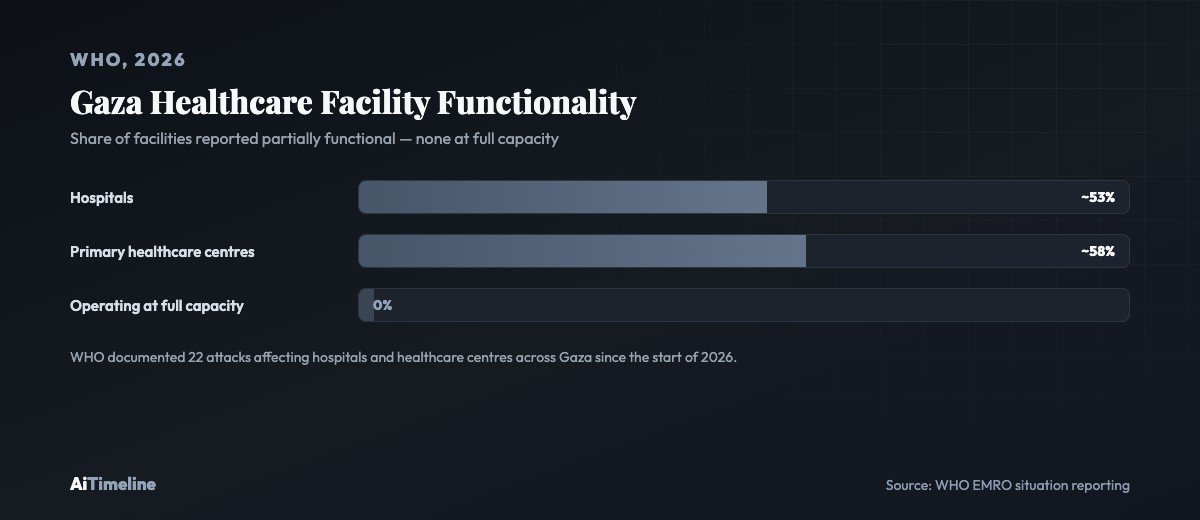
Hospital functionality in Gaza has moved in stages, not a single decline — shaped by the 2007 blockade, repeated conflicts, and the two ceasefires of 2025.
🩺 Medical Insight · How prolonged conflict affects hospitals, supply chains and healthcare workers
A hospital’s capacity is not fixed — it is the product of several independent systems that all have to work at once: a power supply, a cold chain for medicines and blood, a pipeline of consumables that typically arrives on a matter of days’ notice, and a workforce that has to physically reach the building. Prolonged conflict degrades each of these on a different timeline. Fuel and consumable shortages can bite within days; equipment breakdowns compound over weeks as spare parts fail to arrive; and workforce capacity erodes over months as healthcare workers are killed, injured, displaced or simply unable to reach their post safely. WHO’s reporting on Gaza treats hospital status as a spectrum — “fully functional,” “partially functional” or “non-functional” — precisely because a binary open/closed framing does not capture how these systems actually fail and partially recover.
The Vocabulary: Public Health and Humanitarian Medicine Terms
Fourteen terms this timeline relies on, defined plainly.
Humanitarian health reporting uses a specific, fairly technical vocabulary. Understanding it is what separates a precise reading of a WHO situation report from a general impression of “things are bad” — the terms below are used consistently throughout this page.
Primary Healthcare
Routine, first-contact medical care — vaccination, maternal checkups, chronic disease management, minor illness — typically delivered through community clinics rather than hospitals.
Emergency Medicine
Immediate care for acute, life-threatening conditions, delivered through a hospital emergency department or field facility, distinct from the scheduled, routine nature of primary care.
Trauma Care
The specific clinical response to physical injury — from wound stabilisation through surgery to rehabilitation — that scales up sharply during armed conflict and mass-casualty events.
Intensive Care
Critical care for patients whose organ function needs continuous monitoring and support, requiring reliable electricity, trained staff and specific equipment such as ventilators — among the first services lost when power supply becomes unreliable.
Medical Evacuation
The transfer of patients requiring care unavailable locally to a hospital elsewhere, in Gaza’s case typically via the Rafah or Kerem Shalom crossings, coordinated by WHO with Egyptian and other authorities.
Vaccination
Immunisation against specific infectious diseases; population-level protection depends on sustained high coverage (often 90%+ for diseases like polio), which is why interrupted routine vaccination during conflict creates outbreak risk even without a single new imported case.
Malnutrition
Insufficient intake of calories or specific nutrients; acute malnutrition in children is measured using mid-upper-arm circumference and weight-for-height, and is classified by the IPC framework into severity tiers used throughout this page.
Waterborne Diseases
Illnesses such as acute watery diarrhoea and hepatitis A, transmitted through water or food contaminated with faecal matter — directly linked by WHO and UNICEF to damaged sanitation infrastructure and unsafe water access.
Respiratory Infections
Illnesses affecting the lungs and airways, spread more readily in overcrowded displacement shelters and worsened by cold, damp conditions and limited access to care — a leading cause of paediatric illness in protracted crises generally.
Sanitation
Systems for safely managing human waste — sewage networks, treatment plants and latrines — whose failure is one of the most direct, well-documented drivers of disease outbreak in any humanitarian crisis.
Public Health Surveillance
The ongoing, systematic collection and analysis of disease-case data from clinics, used to detect outbreaks early; WHO has noted that Gaza’s surveillance capacity has itself been degraded by damage to clinics and disrupted reporting.
Mental Health
Psychological wellbeing and psychiatric care; UNICEF has described the scale of trauma-related need among Gaza’s children as effectively universal, requiring group and individual psychosocial support delivered by trained staff.
Nutrition (Programmatic)
In humanitarian response, the organised delivery of therapeutic and supplementary feeding to prevent and treat malnutrition, run by agencies including UNICEF and the World Food Programme alongside the health system.
International Humanitarian Law on Medical Care
The Geneva Conventions and their Additional Protocols grant specific protection to medical personnel, facilities and transport during armed conflict; the ICRC promotes and monitors compliance with this framework but does not itself adjudicate individual violations, which fall to courts and UN-mandated bodies.
👶 Child Health Insight · Why children face elevated risk from malnutrition, interrupted vaccination and infectious disease
Children are not simply smaller adults in a health crisis — they are physiologically more vulnerable on several specific measures. Acute malnutrition progresses faster in young children because their nutritional reserves are smaller relative to their metabolic needs; a missed vaccination round has a larger population effect on children because routine childhood immunisation is how diseases like polio and measles are kept below outbreak thresholds in the first place; and diarrhoeal disease is disproportionately dangerous in children under five specifically because dehydration progresses faster in smaller bodies. This is why UNICEF’s Gaza reporting consistently breaks out under-five statistics separately from the general population figures cited elsewhere on this page — the age group is not incidental to the data, it is the reason the data is collected that way.
💡 Did You Know?
Damage to water and sanitation infrastructure can increase the risk of diarrhoeal disease, skin infections and other communicable illnesses during humanitarian emergencies — a well-established public health relationship, not unique to Gaza. UNICEF has applied this same WASH-to-disease framework in crises from Yemen to South Sudan; what is specific to Gaza is the scale of the infrastructure damage (UN agencies have estimated roughly 90% of water and sanitation systems damaged) combined with population density in displacement shelters.
👀 Future Watch
Officially tracked, not speculated: future editions of this page will be updated when WHO publishes new health-cluster situation reports or EMRO emergency updates, when UNICEF publishes new WASH or child-nutrition data, when UN OCHA issues new humanitarian situation updates, when the IPC releases its next Gaza food-security and malnutrition classification, or when peer-reviewed research on the health impacts of the conflict is published in journals such as The Lancet or The BMJ. This page does not speculate about future political or military developments.
How Armed Conflict Affects Public Health, in General
A framework that applies well beyond Gaza.
Public health researchers generally describe conflict’s health impact in two categories: direct effects (injury and death from weapons) and indirect effects (everything that happens when health systems, food systems and infrastructure stop functioning normally). In most protracted conflicts studied by WHO and peer-reviewed epidemiology, indirect effects — malnutrition, communicable disease, interrupted care for chronic conditions, maternal and newborn complications — account for a large share of excess mortality, often exceeding deaths from weapons-related trauma over the full course of a prolonged crisis. This is precisely why humanitarian health responses in any conflict, not only Gaza, prioritise restoring water systems, vaccination coverage and primary care alongside trauma surgery, rather than treating trauma care as the whole of the health response.
The scale of indirect impact depends heavily on population density, displacement, and how long disruption lasts. A short, contained conflict with intact supply lines produces a different health profile than a protracted crisis with sustained access restrictions and mass displacement into crowded shelters — which is part of why WHO and UN agencies track duration and access constraints as carefully as they track direct casualty figures, and why this page separates blockade-era baseline conditions from the acute effects of specific conflict episodes throughout its timeline.
Why Water and Sanitation Matter During Emergencies
Humanitarian agencies work to a widely used technical benchmark, set out in the Sphere Handbook (the humanitarian sector’s most widely referenced minimum-standards framework): roughly 15 litres of water per person per day for drinking, cooking and basic hygiene, alongside safe excreta disposal and hand-washing facilities. Below that threshold, the risk of disease transmission rises sharply, particularly for diarrhoeal illness and hepatitis A, both spread through the faecal-oral route when water is contaminated or sanitation facilities are inadequate or overcrowded. In Gaza, UNICEF reported households receiving an average of 4.5-6 litres per person per day in early 2026 — roughly a third of the Sphere benchmark — which is the direct, mechanical link between the infrastructure statistics in this timeline and the disease-case counts reported alongside them.
Sanitation failure compounds water scarcity rather than acting independently of it: when sewage networks are damaged, waste can contaminate the same wells, boreholes or desalination-plant output that displaced populations rely on for drinking water, creating a single point of failure that affects both supply and safety simultaneously — which is why WASH (water, sanitation and hygiene) is treated as one integrated field rather than three separate problems.
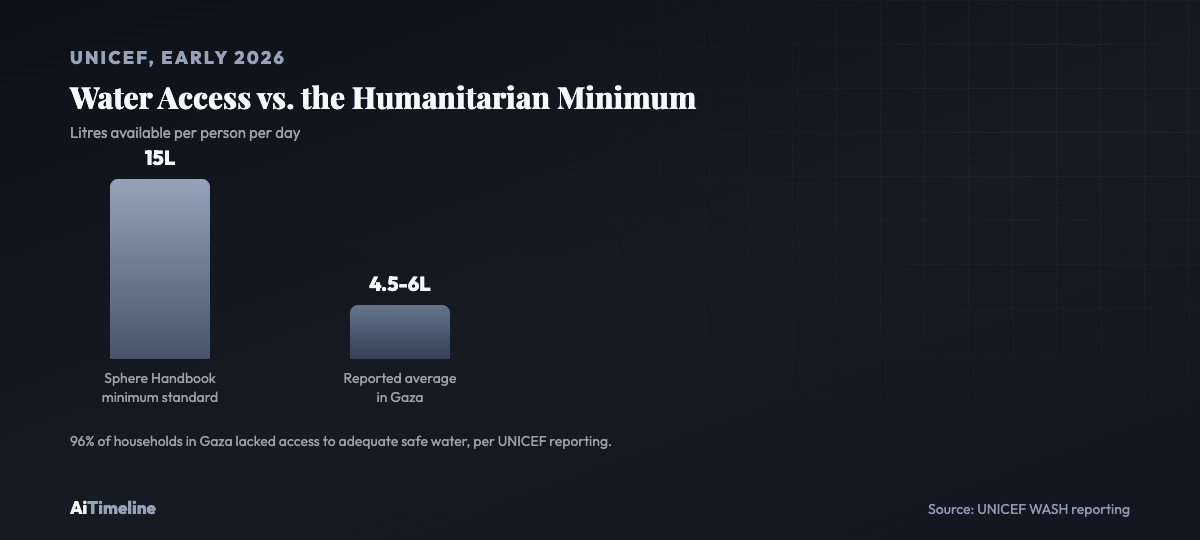
UNICEF-reported water access in Gaza in early 2026 sat at roughly a third of the Sphere handbook’s 15-litre-per-person-per-day minimum benchmark.
How Humanitarian Medical Supply Chains Work
Getting a box of antibiotics from a manufacturer to a patient in a crisis zone involves more steps than a normal hospital supply chain. Items are typically procured by WHO, UNICEF or another agency, consolidated at a logistics hub, then moved to a border crossing where they undergo customs and security screening — a step that can take anywhere from hours to weeks depending on access conditions and whether an item is classified as having potential “dual use” (civilian and military) application, a classification that has historically slowed the entry of items like certain generators, communications equipment and some water-treatment chemicals into Gaza, according to UN agency reporting on access constraints.
Once inside, supplies still need a functioning “last mile” — transport from a border warehouse to individual clinics and hospitals, which requires fuel, secure roads and, in an active conflict, real-time coordination (sometimes called “deconfliction”) to reduce the risk of aid convoys being caught in hostilities. A shortage or delay at any single link in this chain — procurement, border clearance, in-country transport or last-mile delivery — can leave a fully stocked warehouse unable to help a hospital that runs out of a specific item, which is why humanitarian logistics reporting tracks each stage separately rather than reporting only a single “aid delivered” figure.
How Disease Surveillance Operates in Crisis Settings
WHO coordinates disease surveillance in humanitarian crises through systems generally modelled on its Early Warning, Alert and Response Network (EWARN) approach: designated clinics and health points report defined “syndromes” — for example, “acute watery diarrhoea” or “acute jaundice syndrome” — on a regular cycle, rather than waiting for a confirmed laboratory diagnosis of a specific pathogen. This syndromic approach trades some diagnostic precision for speed, which matters because early detection of a rising case count can trigger a targeted response (a chlorination campaign, a vaccination round, a public health advisory) before an outbreak becomes widespread.
The system has a specific, well-documented limitation relevant to Gaza: it depends on functioning clinics with staff able to record and transmit data, so the same conflict conditions that damage healthcare delivery also degrade the surveillance system meant to track its consequences. WHO has explicitly flagged this for hepatitis A in Gaza, noting the disease’s roughly one-month incubation period and pre-symptomatic infectious window mean actual transmission can run ahead of what syndromic surveillance is able to detect and report in real time.
Comparison Tables
Seven tables covering the core distinctions this page relies on.
1. Healthcare Capacity: Before October 2023 vs. 2026
| Indicator | Before October 2023 | 2026 (per WHO/UNICEF reporting) |
|---|---|---|
| Hospitals fully functional | Constrained by blockade but largely operating | None at full capacity; just over half partially functional |
| Primary healthcare centres | Operating, blockade-affected supply chain | ~58% partially functional |
| Water access | Below international benchmarks, but higher than 2026 | 96% of households lack adequate safe water |
| Medical evacuation pace | 50-100 patients/day (routine referrals) | Over 15,000 patients awaiting evacuation (backlog) |
| Polio transmission | None detected for prior 25 years | Detected in wastewater from 2024; vaccination campaigns ongoing |
2. Primary Care vs. Emergency Care
| Feature | Primary Care | Emergency Care |
|---|---|---|
| Purpose | Routine, preventive and chronic-condition management | Immediate treatment of acute, life-threatening conditions |
| Typical setting in Gaza | UNRWA and Ministry of Health clinics | Hospital emergency departments and field hospitals |
| Most affected by | Clinic closures, staff shortages, supply gaps | Mass-casualty surges, power and equipment failures |
| First to be curtailed under strain | Often yes — deprioritised relative to acute care | Rarely reduced by choice; degrades due to resource limits |
3. Water Infrastructure vs. Health Outcomes
| Water/Sanitation Condition | Associated Health Outcome |
|---|---|
| Damaged sewage network | Contamination of drinking-water sources; diarrhoeal disease |
| Water supply below Sphere minimum (15L/person/day) | Reduced hygiene practice; higher transmission of skin and enteric infection |
| Overcrowded shelters with shared sanitation | Faster person-to-person spread of hepatitis A and respiratory illness |
| Damaged water-testing/treatment capacity | Reduced ability to detect and respond to contamination events |
4. Acute Trauma Care vs. Chronic Disease Management
| Factor | Acute Trauma Care | Chronic Disease Management |
|---|---|---|
| Example conditions | Blast and gunshot injury, burns, fractures | Diabetes, hypertension, kidney disease requiring dialysis |
| Time sensitivity | Minutes to hours | Ongoing, disrupted by any missed treatment cycle |
| Resource dependency | Surgical capacity, blood supply, triage systems | Continuous medicine supply, functioning outpatient clinics |
| Conflict-era visibility | High — drives headline casualty reporting | Lower, though dialysis and cancer-treatment interruption carry serious, under-reported mortality risk |
5. Communicable vs. Non-Communicable Disease Risk During Conflict
| Factor | Communicable Disease | Non-Communicable Disease |
|---|---|---|
| Examples | Acute watery diarrhoea, hepatitis A, respiratory infection | Diabetes, cardiovascular disease, cancer |
| Primary driver in crisis | Water/sanitation collapse, overcrowding | Interrupted medicine supply and outpatient follow-up |
| Surveillance approach | Syndromic surveillance (EWARN-style reporting) | Harder to track in crisis; often relies on facility records |
| Who is most affected | Children under five disproportionately | Older adults and those with pre-existing conditions |
6. Short-Term Emergency Response vs. Long-Term Health System Recovery
| Factor | Short-Term Emergency Response | Long-Term Recovery |
|---|---|---|
| Time horizon | Days to weeks | Months to years |
| Typical actions | Trauma stabilisation, mass vaccination rounds, water trucking | Rebuilding facilities, restoring supply chains, retraining/re-staffing |
| Led by | WHO Emergency Medical Teams, ICRC, MSF field response | Ministry of Health, UNRWA, development-focused UN agencies and donors |
| Funding mechanism | Flash appeals and emergency allocations | Multi-year reconstruction and health-system financing |
7. Timeline Summary
| Date | Event | Public Health Significance |
|---|---|---|
| Pre-2000 | Health system built under successive administrations | UNRWA primary-care network established; layered system origins |
| 2005 | Israeli disengagement | Civil administration to PA; access control unresolved |
| 2007 | Blockade begins | Structural, chronic constraint on medical supply begins |
| 2008-09 | Operation Cast Lead | WHO: 34 health facilities damaged/destroyed |
| 2014 | Operation Protective Edge | WHO: 4 hospitals closed, 27 primary centres stopped operating |
| 2018-19 | Great March of Return | OHCHR-documented mass casualties; surge in reconstructive-surgery need |
| 2020 | COVID-19 reaches Gaza | Pandemic response constrained by pre-existing capacity limits |
| 2021 | May escalation | WHO: 47 attacks on health care recorded in 11 days |
| 2022 | Relative stability | Baseline system capacity ahead of 2023 escalation |
| 2023 | Escalation after 7 October | Most severe healthcare disruption on record, per WHO/UN |
| 2024 | Disease outbreaks; polio resurfaces | 222,620 AWD cases; poliovirus detected after 25 years |
| 2025 | Two ceasefires; famine confirmed then eased | IPC Phase 5 in August; famine “pushed back” by December |
| 2026 | Fragile ceasefire continues | Health system still severely constrained despite reduced hostilities |
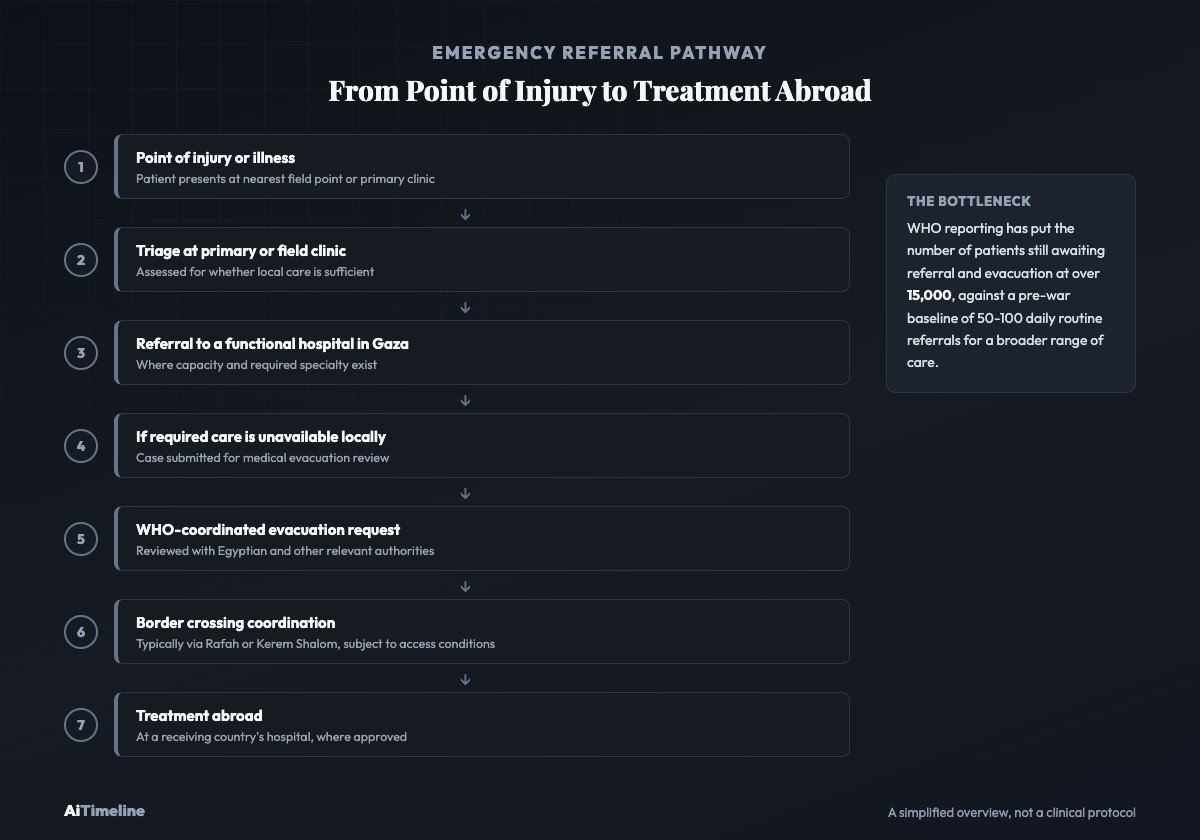
A simplified view of how a patient needing care unavailable in Gaza moves through triage, in-Gaza referral and, where approved, cross-border medical evacuation.
Who’s Involved: The Organisations Behind This Reporting
World Health Organization (WHO)
The UN’s specialised health agency; leads the health cluster in Gaza, verifies attacks on healthcare through its Surveillance System for Attacks on Health Care, and coordinates medical evacuations.
UNICEF
The UN’s children’s agency; leads water, sanitation and hygiene (WASH) programming, child nutrition response and mental health/psychosocial support for children in Gaza.
UN OCHA
The UN Office for the Coordination of Humanitarian Affairs; publishes regular Humanitarian Situation Updates and coordinates the overall inter-agency response and access reporting.
UNRWA
The UN Relief and Works Agency for Palestine Refugees, operating since 1950; runs a large share of Gaza’s primary healthcare clinics for registered refugees alongside education and relief services.
International Committee of the Red Cross (ICRC)
A neutral, independent humanitarian organisation with a specific mandate under the Geneva Conventions; visits detainees, facilitates medical evacuations and exchanges, and runs field and reconstructive-surgery programmes.
Médecins Sans Frontières (MSF)
An independent medical humanitarian organisation operating clinics, surgical teams and specialised care (including reconstructive surgery) in Gaza, publishing its own field reporting separate from UN agencies.
International Federation of Red Cross and Red Crescent Societies (IFRC)
Supports the Palestine Red Crescent Society’s ambulance, first-aid and primary-care operations, coordinating with the wider global Red Cross and Red Crescent movement.
The Lancet & The BMJ
Peer-reviewed medical journals that have published independent analyses of Gaza’s health and humanitarian crisis, providing academic scrutiny distinct from UN operational reporting.
Explore More Timelines
Official Data, Reported Claims and Independent Analysis
Kept deliberately separate, per this page’s editorial policy.
Official data (WHO / UN / IPC)
- WHO: just over half of hospitals, ~58% of primary healthcare centres partially functional (2026).
- UNICEF: 96% of households lack adequate safe water; ~90% of WASH infrastructure damaged.
- IPC: Famine (Phase 5) confirmed in Gaza Governorate, 15 August 2025.
- WHO: 1,702 patients evacuated Jan-Mar 2025 ceasefire; over 15,000 still awaiting evacuation.
- WHO Health Emergency Appeal: 2.9 million people in oPt need humanitarian health assistance (2026).
Reported claims & independent analysis
- Attack and health-worker casualty totals vary by monitor and reporting period — figures from 720 to 1,800+ attacks and 900 to 1,700+ health-worker deaths have each been reported, depending on dates covered and source.
- Statements by parties to the conflict about intent or justification for specific incidents are reported as their position, not verified fact.
- The 2019 OHCHR Commission of Inquiry’s findings on the Great March of Return, and the 2009 UN Fact-Finding Mission’s findings on Operation Cast Lead, are official UN conclusions, cited as such; both were contested by the Israeli government.
- Academic analyses (e.g., in The Lancet) of mortality and health-system impact sometimes differ from single-source official tallies due to differing methodology.
💡 Interesting Facts, Neutrally Stated
- UNRWA has operated continuously in Gaza since 1950, making its primary healthcare network older than the State of Israel’s occupation of the territory, which began in 1967.
- Poliovirus had not been detected in Gaza for 25 years before its reappearance in wastewater samples in 2024.
- The Sphere Handbook’s 15-litre-per-person-per-day water benchmark is a humanitarian sector-wide standard, not one set specifically for Gaza or this conflict.
- WHO classifies hospital status on a spectrum (fully functional, partially functional, non-functional) rather than a simple open/closed measure, because that better reflects how facilities actually operate under strain.
- The ICRC’s mandate to protect medical personnel and facilities during conflict derives from the Geneva Conventions, first adopted in 1949 and subsequently updated by Additional Protocols.
People Also Ask
60 Frequently Asked Questions
Grouped by health system status, water and disease, humanitarian response, and historical context.
Related Reading on AiTimeline
Russia-Ukraine War: Every Verified Milestone Since 1991
The U.S. Economy: 250 Years of Growth, Slowdown and Inflation
India’s Renewable Energy Transition
Fuel Price Dynamics and Their Economic Impact
Explore every AiTimeline story
Why Protecting Healthcare Matters During Humanitarian Crises
The doctor working the overnight shift in this page’s opening scene is not choosing which system to prioritise — electricity, water, medicine supply, disease surveillance, evacuation access — because in practice they all fail or hold together at once. That is the central, evidence-based finding running through every entry in this timeline: healthcare outcomes in a protracted crisis are never determined by trauma care alone. They depend on whether hospitals have power, whether water is safe to drink, whether vaccination coverage has been maintained, whether a severely injured patient can actually reach the specialist care they need, and whether the humanitarian system delivering all of this is allowed to function.
Understanding the Gaza medical crisis, or any comparable humanitarian health emergency, requires exactly the kind of careful, source-by-source evidence this page has tried to apply throughout: distinguishing WHO and UN operational data from statements made by parties to the conflict, treating official UN fact-finding conclusions as exactly that — official conclusions, not this page’s own judgment — and being explicit whenever figures from different monitors disagree rather than picking the most convenient one. None of that caution changes the underlying, well-documented picture: a population of over two million people whose access to functioning hospitals, clean water, vaccination and safe evacuation has been severely and repeatedly constrained since 2007, most severely since October 2023, with a fragile ceasefire since October 2025 easing but not resolving the crisis.
Readers who want to follow how this situation develops should go directly to the sources this page relies on: WHO’s EMRO emergency situation reports, UNICEF’s State of Palestine humanitarian updates, UN OCHA’s Humanitarian Situation Updates, UNRWA’s public reporting, and peer-reviewed research as it is published in journals including The Lancet and The BMJ. Those sources will remain accurate as the situation changes in ways that any single article, including this one, cannot guarantee to keep pace with in real time.
✉ Editorial note, sources and limitations
Last reviewed: 1 August 2026. This page separates official UN/WHO data, medical evidence from peer-reviewed research, statements from parties to the conflict, and independent analysis throughout. Figures are attributed to their source and reporting period; where sources disagree, that disagreement is stated rather than resolved by this page. This is not a work of legal or political analysis, does not assign blame beyond what official rulings or UN-mandated findings state, and is not a substitute for real-time official reporting.
Primary and official sources used:
- World Health Organization — occupied Palestinian territory: WHO Health Emergency Appeal 2026
- UN OCHA (oPt) — Humanitarian Situation Update, Gaza Strip
- UNICEF State of Palestine — Water, Sanitation and Hygiene
- UNRWA — Official site and mandate
- International Committee of the Red Cross — Israel and the Occupied Territories
- IPC (Integrated Food Security Phase Classification) — Palestine country analysis
- UNFPA Palestine — Maternal health reporting
Sources & further reading
Every dated entry above was checked against these references. Last reviewed 15 September 2026.
- World Health Organization — occupied Palestinian territory: WHO Health Emergency Appeal 2026
- UN OCHA (oPt) — Humanitarian Situation Update, Gaza Strip
- UNICEF State of Palestine — Water, Sanitation and Hygiene
- UNRWA — official site and mandate
- International Committee of the Red Cross — Israel and the Occupied Territories
- IPC (Integrated Food Security Phase Classification) — Palestine country analysis
- UNFPA Palestine — maternal health reporting