8th Pay Commission Timeline 2026: Salary, Pension, Fitment Factor and What Comes Next
India's Pay Commission timeline 1946-2026: salary, pension, fitment factor, DA and 8th CPC updates - confirmed facts kept separate from demands.
Latest Story
For millions of central government employees and pensioners, the 8th Pay Commission is not just a policy file — it decides monthly salary, pension comfort, household budgets, loans, rent, school fees and retirement planning. This 8th Pay Commission timeline starts where the story actually began: 1946, the year India’s first Pay Commission was formed, runs through six more Commissions across eight decades, and arrives at the 8th Central Pay Commission — constituted 3 November 2025 and still working through consultations as of September 2026. The hard part in 2026 isn’t finding numbers; ₹46,260, ₹54,000, ₹58,500 and ₹69,000 are all over search results. It’s separating what’s confirmed from what’s proposed, demanded, or simply expected.
Data last verified: 7 September 2026. Every salary, pension or date figure below is labelled CONFIRMED, PROPOSED, DEMANDED, EXPECTED or UNKNOWN. Nothing is presented as a confirmed salary hike, fitment factor, implementation date, arrears amount or pension change unless it has been officially announced by the Government of India, the 8th CPC, the Department of Expenditure, DoPT, PIB or the PMO.
🧠 Quick Answer
The 8th Pay Commission has moved into its consultation and review phase, but the final salary hike, fitment factor, pension revision and implementation details should be treated as unconfirmed until the Commission submits recommendations and the government approves them. The one number that is officially locked for 2026 is Dearness Allowance at 60% of basic pay, effective 1 January 2026. Everything else — from ₹69,000 minimum pay to a January 2026 implementation date — is a proposal, demand or expectation, not a decision.
8th Pay Commission: Key Questions
What history and the present both tell us
- Seven Pay Commissions since 1946 built India’s modern government pay system, each roughly a decade apart, each addressing a different economic pressure.
- The 8th CPC is real and working. Constituted 3 November 2025 under Justice Ranjana Prakash Desai, it spent 2026 collecting data and holding stakeholder consultations.
- Only DA at 60% (effective 1 January 2026) is genuinely confirmed for 2026 — everything else circulating is a proposal, demand or expectation.
- No fitment factor has been announced. 2.57 (7th CPC historical), 3.00–3.25 (FNPO demand) and 3.833 (NC-JCM demand) are all reference points, not government numbers.
- Every past Commission’s implementation lagged its formation by one to three years or more — the 7th CPC alone took nearly two years from constitution to effective pay.
- The 6th CPC (2006) introduced Pay Bands and Grade Pay; the 7th CPC (2016) replaced that with the Pay Matrix still in use today.
- Pre-2026 pensioners face a genuine open question — the 8th CPC’s Terms of Reference do not explicitly guarantee their pension revision.
- DA does not automatically merge into basic pay at any threshold; that depends on the new pay structure’s fitment methodology once it exists.
- 2026 has been a consultation and data year, not an implementation year — memorandum deadlines closed 15 June, state consultations run through September.
🔴 Reading the labels used throughout this article
🟢 CONFIRMED — announced by the Government of India, Department of Expenditure, Cabinet or the 8th CPC itself. 🟡 PROPOSED — an option, scenario or working range circulating from analysts, media or historical comparison. 🟠 DEMANDED — a figure formally submitted by an employee federation or pensioner body. 🔴 EXPECTED — an anticipated outcome based on precedent, not yet decided. ❓ UNKNOWN — genuinely undecided, with no credible figure to report.
The Pay Commission History: 1946 to 2026
Seven completed Commissions, and one still in progress
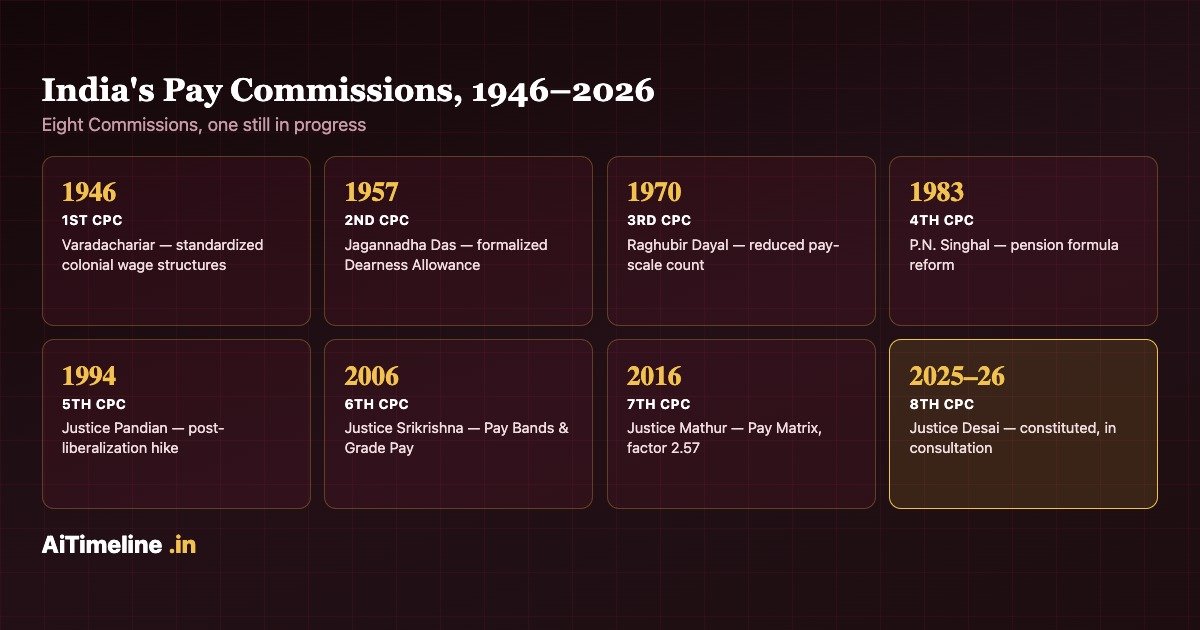
Every “8th Pay Commission” headline sits on top of eight decades of precedent. Since 1946, the Government of India has periodically convened a Pay Commission — roughly once a decade — to review and restructure the pay, allowances and pension of central government employees. No two Commissions used the same method, and no two took the same time to actually change anyone’s salary. Reading that pattern is the fastest way to understand why the 8th CPC, constituted in November 2025, still hasn’t announced a number in September 2026.
First Pay Commission
What happened: India’s first Pay Commission was formed shortly before independence to standardize the chaotic, fragmented wage structures inherited from colonial administrative departments.
Why it matters: It created the very first uniform framework for central government pay — the template every later Commission would build on.
Second Pay Commission
What happened: Constituted to address post-independence inflation and the rising cost of living for public servants.
Why it matters: It formalized cost-of-living adjustments, effectively institutionalizing what we now call Dearness Allowance — the mechanism still used to protect employee purchasing power in 2026.
Third Pay Commission
What happened: Reviewed a complex web of pay hierarchies across central ministries, reducing the sheer number of distinct pay scales and introducing more structured fringe benefits.
Fourth Pay Commission
What happened: Recalibrated compensation against the high inflation of the late 1970s and early 1980s, restructured minimum and maximum salary ceilings, and refined pension formulas for retiring employees.
Fifth Pay Commission
What happened: Arrived amid India’s post-1991 economic liberalization, recommending a substantial salary hike to help retain skilled government staff being drawn to a fast-growing private sector.
Sixth Pay Commission
What happened: Replaced the old system of rigid pay scales with a Pay Band and Grade Pay structure, and introduced the Modified Assured Career Progression (MACP) scheme. Minimum basic pay rose to around ₹7,000, with effect from 1 January 2006.
Why it matters: It’s the direct ancestor of today’s Pay Matrix — the 7th CPC replaced Pay Bands, but the underlying logic of linking career progression to tenure started here.
Seventh Pay Commission
What happened: Constituted February 2014, submitted its report in November 2015, and replaced Pay Bands with a transparent Pay Matrix. Recommended a 2.57 fitment factor, raising minimum basic pay to ₹18,000/month, effective retrospectively from 1 January 2016.
Why it matters: This is the pay structure central government employees are still paid under today, in September 2026 — it has not been replaced yet.
Eighth Pay Commission — Constituted, In Consultation
What happened: Formally constituted 3 November 2025, after the Cabinet approved its Terms of Reference on 28 October 2025. Through 2026 it has collected employee/pensioner memoranda, requested department-wise manpower data, and held in-person consultations in multiple cities.
Where things stand: No fitment factor, minimum pay, arrears rule or implementation date has been announced as of 7 September 2026.
SEVEN COMMISSIONS TOOK EIGHTY YEARS TO REACH TODAY.
THE EIGHTH IS STILL WRITING ITS CHAPTER.
What Is the 8th Pay Commission?
The 8th Central Pay Commission is a Government of India body constituted to review and recommend changes to the pay structure, allowances, retirement benefits and service conditions of central government employees and pensioners. Its formation follows the same roughly-decade-long cycle as every Commission since 1946 — the 7th CPC’s pay structure took effect on 1 January 2016, and a new Commission was announced in January 2025.
The Union Cabinet approved the 8th CPC’s Terms of Reference on 28 October 2025, instructing it to examine emoluments, allowances and working conditions while weighing fiscal prudence, non-contributory pension costs, and comparisons with public and private sector pay. The Commission was formally constituted on 3 November 2025, starting an 18-month clock for its recommendations.
| Role | Name | Background |
|---|---|---|
| Chairperson | Justice Ranjana Prakash Desai | Former Judge, Supreme Court of India |
| Part-Time Member | Prof. Pulak Ghosh | IIM Bengaluru |
| Member-Secretary | Pankaj Jain | IAS officer |
⚠️ A workload concern worth tracking
Justice Desai has also been appointed to head Uniform Civil Code drafting committees for Uttarakhand, Maharashtra and West Bengal. The All India NPS Employees Federation (AINPSEF) has publicly flagged the cumulative workload as a possible delay risk to the 8th CPC’s report. No delay has been officially confirmed as of September 2026 — but the concern itself is real.
What Is the Fitment Factor?
Existing basic pay × fitment factor = indicative revised basic pay
A fitment factor is a single multiplier applied to an employee’s existing basic pay to construct a new, revised basic pay. For example, ₹18,000 × 2.57 = ₹46,260 — that 2.57 was the 7th CPC’s actual, approved factor, not an 8th CPC prediction. The final pay matrix that emerges from any fitment exercise also involves rounding, level restructuring and minimum-pay methodology, so a single multiplication is only ever an indicative starting point.
| Scenario | Fitment Factor | ₹18,000 Example | Status |
|---|---|---|---|
| 7th CPC (2016), for comparison | 2.57 | ₹46,260 | 🟢 CONFIRMED (historical) |
| Some media/analyst estimates | ~1.92–2.86 | ₹34,560–₹51,480 | 🟡 PROPOSED (media range) |
| FNPO demand (Levels 1–5) | 3.00 | ₹54,000 | 🔴 DEMANDED |
| FNPO demand (Levels 16+) | 3.25 | ₹58,500 | 🔴 DEMANDED |
| NC-JCM demand | 3.833 | ~₹69,000 | 🔴 DEMANDED |
| Official 8th CPC factor | Not announced | Unknown | ❓ UNKNOWN |
These are historical comparisons, media ranges and union demands — not approved salaries. No ranking of “most likely” is implied by table order.
What Salary Increase Is Confirmed?
Short answer: none, beyond the routine DA revision
✅ Confirmed for 2026
- 8th CPC formally constituted (3 Nov 2025)
- Chairperson and members appointed
- 18-month recommendation mandate
- DA raised from 58% to 60%, effective 1 Jan 2026
- Consultations and union memoranda underway
❌ Not Yet Confirmed
- Fitment factor
- New minimum basic salary
- Arrears rules and dates
- HRA and TA treatment
- Pre-2026 pensioner revision
- Implementation/effective date
No confirmed 8th CPC salary hike, fitment factor, arrears amount or implementation date exists as of 7 September 2026. The only genuinely confirmed 2026 pay-related change is the routine Dearness Allowance revision to 60%, issued by the Department of Expenditure on 22 April 2026 under the existing 7th CPC formula — not a new 8th CPC decision.
What Employee Unions Are Demanding
The NC-JCM (National Council – Joint Consultative Machinery) Staff Side held its first Standing Committee meeting with the 8th CPC on 28 April 2026, proposing a fitment factor of 3.833 — implying a minimum basic pay of roughly ₹69,000. NC-JCM also proposed a 6% annual increment, two increments on promotion (minimum benefit ₹10,000), and calculated its minimum-wage estimate using a five-member family unit instead of the three-member unit used for the 7th CPC.
The Federation of National Postal Organisations (FNPO) separately proposed a level-dependent fitment factor: 3.00 for Levels 1–5, 3.05–3.10 for Levels 6–12, and up to 3.25 for Levels 16 and above — based on the Akroyd Formula for a minimum living wage. Other federations, including the Central Government Employees’ Confederation and the All India Defence Employees’ Federation, have submitted their own charters of demands covering pay, allowances and service conditions.
🔴 Demanded ≠ recommended ≠ accepted
A union proposing 3.833 does not mean the Commission will recommend 3.833. A Commission recommendation does not mean the government will accept it unmodified. Each link in that chain is a separate decision that has not yet happened.
What Pensioners Want Changed
The 8th CPC’s Terms of Reference cover retirement benefits and service conditions, and pensioner organizations have submitted their own demands — but a genuine, unresolved question remains: the Terms of Reference notification does not explicitly state that pensions of employees who retired before 1 January 2026 will be revised. Bharat Pensioners Samaj (BPS) and the All India Defence Employees’ Federation (AIDEF) flagged this “vague language” in a letter to the Prime Minister’s Office; DoPT has forwarded representations seeking a Terms-of-Reference amendment to the Department of Expenditure. In November 2025, Union Minister Jitendra Singh gave a verbal assurance that old pensions would be revised and pensioners’ interests protected — but no written amendment had been issued as of this update.
Pensioners are also asking for clarity on family pension revision, medical allowance increases, and whether the 5-member-family minimum-wage logic used in NC-JCM’s fitment proposal will carry through to pension calculations. None of these have been decided.
DA, HRA, Pension and Arrears — Explained
Dearness Allowance (DA) is a cost-of-living top-up paid on basic pay, revised twice yearly under the existing 7th CPC formula. It rose from 58% to 60% effective 1 January 2026, via a Department of Expenditure order issued 22 April 2026 — benefiting an estimated 50.46 lakh employees and, via the matching Dearness Relief hike, 68.27 lakh pensioners. DA does not automatically merge into basic pay at any fixed threshold; a new pay structure typically absorbs accumulated DA when it’s built, but no rule forces a merge on a specific date.
HRA (House Rent Allowance) has its own precedent worth knowing: under the 7th CPC, revised basic pay took effect from 1 January 2016, but revised HRA didn’t become effective until 1 July 2017 — 18 months later, following the Ashok Lavasa Committee’s review. Employees received no retrospective HRA arrears back to 2016. If the 8th CPC follows a similar pattern, basic pay and allowances could again move on different timelines — but this has not been decided for the 8th CPC.
Pension under the current system is directly linked to last-drawn basic pay (broadly 50% of last basic for a full-career employee), so any change in the fitment factor flows through to pension amounts too — which is exactly why the pre-2026-retiree ToR ambiguity above matters so much to pensioner bodies.
Arrears — retrospective payment covering the gap between an effective date and the actual notification date — are not yet confirmed for the 8th CPC. The government has said the effect of recommendations would “normally” be expected from 1 January 2026 based on the usual ten-year cycle, but that is an expectation, not a guarantee; arrears only become real once a final notification actually specifies a retrospective effective date.
| 7th CPC (historical) | 8th CPC (current) | |
|---|---|---|
| Pay effective date | 1 January 2016 | Expected 1 Jan 2026 (unconfirmed) |
| Cabinet approval of pay | June 2016 | Not yet reached |
| Revised allowances (incl. HRA) effective | 1 July 2017 | Unknown |
Confirmed vs Proposed vs Demanded vs Expected
The same question, answered four different ways
| Topic | 🟢 Confirmed | 🟡 Proposed / Media Range | 🔴 Demanded (Unions) | Expected, Unconfirmed |
|---|---|---|---|---|
| Fitment factor | Not announced | ~1.92–2.86 (various estimates) | 3.00–3.25 (FNPO), 3.833 (NC-JCM) | Somewhere above 2.57 |
| Minimum basic pay | ₹18,000 (still current, 7th CPC) | ₹34,560–₹51,480 (media range) | Up to ~₹69,000 (NC-JCM) | Higher than 7th CPC, exact figure unknown |
| Implementation date | Not notified | — | — | “Normally” from 1 Jan 2026 per government statement |
| Arrears | Not guaranteed | — | Retrospective from Jan 2026 (union ask) | Depends entirely on final notification |
| Pre-2026 pensioner revision | Not explicit in ToR | — | Written ToR amendment (BPS/AIDEF) | Verbal assurance given, Nov 2025 |
| DA treatment in new structure | No automatic merge rule | Likely absorbed into new basic, per past pattern | — | Depends on final fitment methodology |
This table exists to stop one specific mistake: reading a union’s demand, a media estimate, or a “normally expected” government statement as if it were an announced decision. None of the four columns except the first represents government policy.
How Much Could Your Salary Rise?
Illustrative scenario tool — not an official salary calculator
📝 8th CPC Update Log
- September 2026 — Regional consultations continue (Chennai 7–8 Sept, Puducherry 9 Sept, Chandigarh 16–18 Sept scheduled); Justice Desai’s UCC workload flagged as a delay risk.
- 31 Aug–1 Sept 2026 — Jaipur stakeholder consultation held.
- 30 June 2026 — Ministries/Departments data-submission deadline extended to 31 July 2026.
- 15 June 2026 — Final extended memorandum-submission deadline.
- 28 April 2026 — NC-JCM’s first Standing Committee meeting with the 8th CPC; 3.833 fitment factor demand submitted.
- 22 April 2026 — DA raised from 58% to 60%, effective 1 January 2026.
- 3 November 2025 — 8th CPC formally constituted.
- 28 October 2025 — Terms of Reference approved by Cabinet.
- January 2025 — Formation of 8th CPC announced.
Explore More Timelines
People Also Ask
Frequently Asked Questions
Related AiTimeline Coverage
⚠️ Editorial & Sources Disclaimer
This article is editorial coverage of publicly available government and union information, not financial or legal advice. Every fitment factor, salary figure and date is labelled CONFIRMED, PROPOSED, DEMANDED, EXPECTED or UNKNOWN, and figures were verified against 8cpc.gov.in, the Department of Expenditure, PIB, DoPT, NC-JCM’s own memoranda and reputable financial publications as of 7 September 2026. Nothing here should be treated as a confirmed salary, arrears or pension amount until the Government of India or the 8th CPC formally announces it.
Sources & further reading
Every dated entry above was checked against these references. Last reviewed 15 September 2026.