Israel-Gaza Ceasefires: A Neutral Timeline of Agreements, Disputes and Implementation
A source-attributed history of Israel-Gaza ceasefires from 1949 to 2026, separating verified facts, official statements, allegations and UN reporting.
Latest Story
At a crossing point on Gaza’s southern edge, a convoy of trucks idles in the heat. Inside them: flour, medical supplies, tents, fuel for hospital generators. The drivers are waiting on a clearance that depends on a ceasefire holding for one more day, on an inspection process both sides have separately agreed to and separately criticized, and on a security escort that itself depends on political decisions being made in rooms hundreds of miles away. A few hundred meters off, aid workers from the ICRC and UN agencies coordinate with counterparts on both sides of the line to confirm a route is clear. In a hotel conference room in Cairo or Doha, negotiators are arguing not about whether the guns stay silent, but about the order of the next ten steps — who withdraws first, who disarms first, who verifies compliance, and what happens if one side says the other side went first. This is what a Gaza ceasefire actually looks like in practice: not a single signed document that ends a war, but a fragile, continuously renegotiated set of military, humanitarian and political arrangements that can unravel over a sequencing dispute as easily as over a rocket.
This guide is not a running news account of the latest incident. It is a reference — a structured history of every major Israel-Gaza ceasefire since the 2005 Israeli disengagement, the humanitarian and legal machinery that surrounds them, and the recurring pattern of disputed compliance that has followed nearly every one of them. Casualty figures, hostage counts and blame for specific incidents are among the most contested facts in this conflict, cited differently by the Israeli government, Hamas, the Gaza Health Ministry, the United Nations and independent researchers. This article does not adjudicate those disputes. It attributes each claim to the party or institution that made it, distinguishes a verified fact from an allegation, and updates as official bodies — the United Nations, the International Court of Justice, the International Criminal Court, the ICRC and the parties’ own statements — publish new information.
🧠 60-Second Overview
Israel and Gaza-based armed factions, principally Hamas, have reached at least seven major ceasefires since 2008, each brokered primarily by Egypt, Qatar and (since 2023) the United States, and each followed by disputes over compliance. The most recent framework began October 10, 2025, under a 20-point US-brokered plan, endorsed by UN Security Council Resolution 2803 on November 17, 2025. As of this update, the ceasefire’s first phase (hostage-prisoner exchange, partial Israeli withdrawal) has been implemented, but its second phase — Hamas disarmament, full Israeli withdrawal, and deployment of an International Stabilization Force — remains disputed over sequencing: Israel says it will not withdraw further before “genuine disarmament,” while Hamas says it will not disarm before Israel ends operations and withdraws. Neither position has been independently verified as the sole cause of the impasse; both are the parties’ own stated positions.
⚠️ Editorial Note & Scope
This is a YMYL (Your Money or Your Life) topic involving active armed conflict, civilian safety and contested international-law questions. This guide separates verified facts, official statements (attributed to the specific government, institution or party making them), allegations (attributed to whichever side makes them, never presented as established), humanitarian reporting (UN OCHA, UNRWA, ICRC), and independent analysis (research institutes, journalism) at every point they diverge. Casualty and hostage figures are cited with their source and date because they are revised over time and reported differently by different parties — the Gaza Health Ministry’s tallies, Israeli military figures and independent estimates do not always match, and this guide notes that explicitly rather than picking one. This article does not take a position on responsibility for the conflict, the legality of specific military actions, or the outcome of pending court proceedings. It is maintained as a living reference and revised as the United Nations, the ICJ, the ICC, the ICRC, or the parties themselves publish verified developments.
Who, What, When, Where, Why and How
What the Record Actually Shows
- No Gaza ceasefire since 2008 has been permanent on its first attempt: every major truce — 2008, 2012, 2014, 2021, January 2025 — was followed by renewed hostilities, though the specific triggers and attributed responsibility differ in each case.
- Ceasefires are multi-part agreements, not single events: they typically bundle a halt in fighting with hostage or prisoner exchanges, humanitarian access commitments, and a sequence of further political steps — and disputes usually concern the later steps, not the initial halt.
- The January 2025 ceasefire collapsed after its first phase, not before it: Phase 1 (hostage-prisoner exchange, partial withdrawal) was substantially completed; the collapse came from a failure to agree on Phase 2 terms, followed by Israeli strikes on March 18, 2025.
- The October 2025 framework is the first to carry UN Security Council endorsement: Resolution 2803 (November 17, 2025) authorized an International Stabilization Force and a transitional “Board of Peace” — a structure none of the earlier ceasefires had.
- Phase 2 of the current framework remains unimplemented as of this update: full Israeli withdrawal, Hamas disarmament and Stabilization Force deployment are each conditioned, by the respective party, on the other happening first.
- Casualty and hostage figures differ by source and are revised over time: this guide cites the Gaza Health Ministry, Israeli official figures, and UN or independent sources separately, with dates, rather than presenting one number as final.
- Two major international legal proceedings remain open and unresolved: the ICJ genocide case (South Africa v. Israel) is in the written-pleadings phase with no ruling expected before 2028; ICC arrest warrants against Israel’s prime minister and former defense minister, issued in November 2024, remain unexecuted.
- Humanitarian access has fluctuated with the political and security situation: UN agencies report periods of significant aid scale-up alongside periods of severe restriction, and reconstruction of housing, water and health infrastructure remains, per UN reporting, largely not yet underway even where the ceasefire itself has held.
- Alleged violations are typically contested by both sides: the October 28, 2025 Rafah incident, detailed later in this guide, is this ceasefire’s clearest documented example — each side blamed the other, and this guide presents both attributed claims rather than resolving which is correct.
- This is a living reference: as the UN, the ICJ, the ICC, the ICRC or the parties themselves publish further developments, this guide will be revised, not replaced.
What a Ceasefire Actually Is
The vocabulary this guide uses precisely, and why the distinctions matter.
A ceasefire is an agreement, formal or informal, to stop active fighting for a defined or open-ended period. It does not, by itself, end a state of war, resolve the underlying political dispute, or establish a permanent border or governing arrangement — it is a military and often humanitarian pause, not a legal settlement. This is the single most important distinction for understanding why ceasefires in this conflict have repeatedly broken down: a ceasefire suspends hostilities; it does not, on its own, answer the harder questions — who governs Gaza, whether an armed group retains weapons, what security guarantees each side receives — that a durable peace requires.
Why ceasefires fail is a well-studied question in conflict-resolution research, not unique to this conflict. Common causes include: disputes over the sequencing of obligations (each side wants the other to act first); inadequate or contested monitoring mechanisms (no agreed, trusted way to verify compliance); the absence of enforcement consequences for violations; unresolved underlying political disputes that resurface once the immediate crisis passes; and domestic political incentives on either side to resume fighting. Several of these factors recur throughout the timeline below, attributed to the specific ceasefire and sourced account in which they were reported.
Ceasefire, truce and armistice are related but distinct terms this guide uses precisely. A truce is generally a short-term, often informal halt to fighting, sometimes for a specific limited purpose (recovering casualties, allowing an exchange). A ceasefire is typically a more formal, broader agreement to stop hostilities, which may or may not have a fixed end date. An armistice is a formal agreement, usually between states, to end active fighting as a step toward a final peace settlement — the 1949 Armistice Agreements between Israel and its Arab neighbors are the clearest historical example in this region, and they left final borders and peace terms unresolved for decades. None of these three is the same as a peace treaty, which is a comprehensive, typically permanent legal settlement.
Mediators in this conflict have consistently been regional and international actors without a direct stake in the fighting itself: Egypt (bordering Gaza, with a long-standing role dating to 2008), Qatar (hosting Hamas’s political office and providing a communication channel), and, since 2023, the United States at a senior political level, with Turkiye participating in some rounds of talks. Their role is typically to shuttle proposals between parties who do not negotiate directly, to provide guarantees, and — in the case of the US since 2025 — to attach a broader political and reconstruction framework to the immediate ceasefire terms.
Humanitarian access refers to the ability of aid organizations to deliver food, medical supplies, fuel and shelter materials into Gaza and to reach the population in need, generally requiring security guarantees, open crossings, and coordination with the parties controlling the territory. It is consistently one of the most contested and most closely monitored elements of any ceasefire, tracked by UN OCHA and reported in near-real time.
Verification — the ability to confirm, through some agreed and trusted mechanism, whether each side is complying with its obligations — has historically been the weakest link in Gaza ceasefires. Earlier agreements largely lacked a dedicated verification body; the 2025-2026 framework is the first to propose a formal International Verification Committee, though its operational track record is, as of this update, still developing.
📜 History Insight
Most ceasefires require continuous monitoring and political negotiation after the initial agreement — the signing is the beginning of the hardest part, not the end of it. Every ceasefire covered in this guide required follow-on talks to address implementation disputes, and several collapsed specifically at the transition between an initial phase and a harder-to-agree second phase, rather than immediately after signing.
Core Concepts, Defined
Terms this guide uses precisely and consistently throughout.
Ceasefire
An agreement to stop active fighting, for a defined or open-ended period, that does not by itself resolve the underlying political dispute or establish a permanent settlement.
Truce
Typically a shorter, narrower halt to fighting, sometimes for a specific purpose such as recovering casualties or exchanging remains, often less formal than a ceasefire.
Armistice
A formal agreement, usually between states, to end active fighting as a step toward eventual peace, without necessarily resolving final borders or political status — as with the 1949 agreements in this region.
Humanitarian Corridor
A designated, time-limited safe route or crossing agreed by the parties to allow civilians to move, or aid, medical evacuations and supplies to pass, generally requiring both sides’ security cooperation.
Hostage Exchange
An arrangement, negotiated as part of a ceasefire, in which one party releases people it holds captive in return for the other party releasing detainees or prisoners it holds, often phased and staggered over the agreement’s duration.
Prisoner Release
The release of individuals held in detention by a state, as part of a negotiated exchange or as an independent confidence-building step, distinct from a hostage release in that it concerns people processed through a formal legal or detention system.
International Humanitarian Law (IHL)
The body of international law, centered on the Geneva Conventions, that governs the conduct of armed conflict and protects people not or no longer participating in hostilities, including civilians, the wounded, and detainees, regardless of which side they are affiliated with.
Civilian Protection
The set of legal obligations and practical measures aimed at shielding civilians from the effects of armed conflict, including the IHL principles of distinction (between combatants and civilians) and proportionality.
Monitoring Mechanism
An agreed structure — which can range from informal mediator check-ins to a dedicated verification body — for observing and reporting on whether parties are complying with a ceasefire’s terms.
Confidence-Building Measure
A step taken by one or both parties, often outside the core military terms, intended to demonstrate good faith and reduce the risk of miscalculation — humanitarian gestures and partial releases have often served this function in this conflict.
Peace Treaty
A comprehensive, typically permanent legal agreement formally ending a state of war and resolving major outstanding issues between the parties — distinct from and more durable than a ceasefire or armistice.
Human Rights Law
The body of international law protecting individual rights at all times, including peacetime, distinct from International Humanitarian Law, which applies specifically during armed conflict — the two bodies of law overlap but are not identical, as detailed in the comparison table below.
The Complete Timeline: From 1948 to the Present
Reverse-chronological. Each entry separates political background, military and security context, humanitarian developments, official statements, and current relevance.
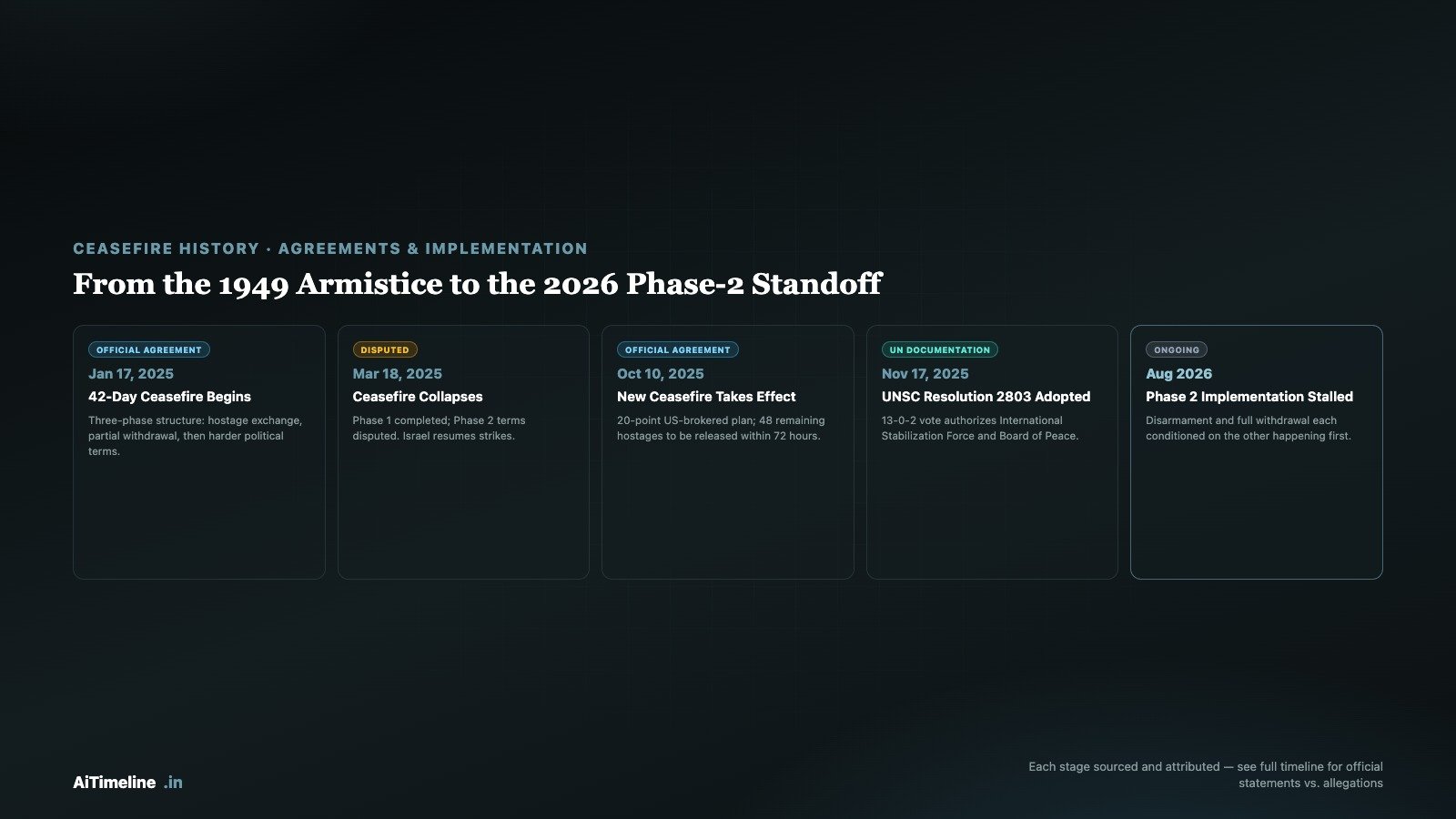
Phase 2 Implementation Remains Stalled
Political background: As of this update, full Israeli withdrawal, Hamas disarmament, and deployment of the full International Stabilization Force — the core elements of the framework’s second phase — have not been completed. UN Security Council briefings describe the ceasefire as holding but the broader recovery as not yet underway.
Official statements: Israel’s government has stated it will not withdraw further absent what it calls genuine disarmament. Hamas has stated it will not disarm before Israel ends military operations, increases humanitarian aid, and completes withdrawal. Both are the parties’ own stated positions, not independently verified preconditions.
Humanitarian developments: UN Security Council briefings in this period describe the ceasefire as “far from perfect” but still a basis for recovery, noting food security has meaningfully improved for Palestinians in Gaza while reconstruction has not meaningfully begun — UN reporting cites roughly 80% of buildings in Gaza as damaged or destroyed and over a million people lacking permanent shelter.
Current relevance: This sequencing dispute — each side conditioning its next step on the other’s — is the same structural pattern that contributed to the collapse of the January 2025 ceasefire, discussed further below.
2026
Trump Announces Hamas Disarmament Agreement; Israel Objects to Parts of It
Political background: US President Donald Trump announced that Hamas had agreed to a disarmament roadmap, negotiated through the Board of Peace with mediators from Egypt, Qatar, Turkiye and the US, under which a National Committee and the International Stabilization Force would enter Gaza first, followed by staged disarmament, with a detailed roadmap due within 14 days subject to approval by an international verification body.
Official statements: Hamas stated it would not implement any part of the deal unless Israeli forces first met their own withdrawal obligations under the agreement. An Israeli minister was reported to have called the deal “unacceptable”; Israel had not, as of this announcement, publicly endorsed the full proposal.
International response: Reactions from other governments were described in contemporaneous reporting as “cautious optimism,” reflecting the plan’s ambition alongside the unresolved sequencing dispute between the two principal parties.
Current relevance: This announcement is the most recent major diplomatic development in the framework’s implementation and remains, as of this update, unresolved.
2026
Israel Approves Entry of the International Stabilization Force
Political background: The Israeli government approved the entry of an initial International Stabilization Force (ISF) contingent into Gaza, to operate, per the announcement, in coordination with the Israeli military. An initial contingent of roughly 200 troops, reported as drawn from Uganda and Morocco, was cited in this period, with the US reported to have approached around 70 countries with a target of roughly 10,000 troops by the end of 2026.
International response: The ISF’s mandate derives from UN Security Council Resolution 2803, adopted in November 2025 (detailed below), which authorized the force as part of the broader ceasefire framework.
Current relevance: The scale and pace of ISF deployment is one of the concrete, trackable indicators of whether the framework’s second phase is advancing, independent of either party’s public statements.
Israeli Military Aligns With Gaza Health Ministry Death Toll Figures
Political background: Israeli military figures were reported to have moved into closer alignment with the Gaza Health Ministry’s cumulative death toll of approximately 70,000-71,000, a figure the Israeli government had previously publicly questioned. This is reported by multiple outlets as a significant shift, not a joint or independently audited count.
Humanitarian reporting: Independent researchers and the Gaza Health Ministry itself have noted the ministry’s own tally likely undercounts total fatalities, since it generally excludes people who are missing, unidentified, or presumed buried under rubble; at least one peer-reviewed estimate cited in this period suggested the true toll could be meaningfully higher than the reported figure. This guide treats the ~70,000 figure as the most widely cited total as of this date, sourced and dated, not as a final or independently audited number.
Current relevance: Casualty figures in this conflict have been persistently contested by methodology and by source throughout the war; this alignment between Israeli and Gaza Health Ministry figures narrowed, but did not eliminate, that dispute.
2026
Transition to the Ceasefire’s Second Phase Begins
Political background: The United States announced the start of the framework’s second phase, centered on a new Palestinian technocratic National Committee to help administer Gaza, reported to be headed by Ali Shaath, with Nickolay Mladenov reported in a director role for the Board of Peace overseeing the transition.
Official statements: US officials described the phase’s focus as “demilitarization, technocratic governance and reconstruction.” Israel’s internal security service was reported to hold effective veto power over committee membership, having approved a list of names that excluded individuals affiliated with Hamas or the Palestinian Authority.
Diplomatic negotiations: The transition proceeded despite reported Israeli objections that insufficient progress had been made on Hamas disarmament and on the return of the remains of an Israeli hostage, Ran Gvili, still held at that time.
Current relevance: This is the formal start of the phase whose stalled implementation is described in the August 2026 entry above.
UN Security Council Adopts Resolution 2803
Political background: The UN Security Council adopted Resolution 2803 by a vote of 13 in favor, none against, with Russia and China abstaining. The resolution formally endorsed the US-proposed “Comprehensive Plan to End the Gaza Conflict,” authorized the International Stabilization Force, established the transitional “Board of Peace,” and called for a Palestinian technocratic committee to help administer Gaza.
International response: The resolution was welcomed by the Palestinian Authority. Hamas publicly denounced the resolution, per contemporaneous reporting, having not been a direct party to the Security Council process.
Current relevance: This is the current framework’s principal international-legal instrument — the first Gaza ceasefire arrangement in this timeline to carry a dedicated UN Security Council resolution of this scope.
Rafah Incident: Competing Allegations of a Ceasefire Violation
Military and security context: An Israeli soldier was killed in a shooting incident in Rafah. Israel stated Hamas was responsible and separately accused Hamas of staging the discovery of a deceased hostage’s remains around the same period; the Israeli government ordered what officials described as immediate, forceful strikes in response.
Humanitarian developments: Gaza’s Health Ministry reported at least 104 people killed in strikes over the following hours, including a significant number of children and women by its account — described in multiple outlets as the deadliest single period in Gaza since the October 2025 ceasefire began. This guide attributes this figure to the Gaza Health Ministry, as independent, real-time verification of casualty figures in active strike zones is generally not immediately possible.
Official statements: Hamas denied responsibility for the soldier’s death and separately accused Israel of “a blatant violation of the ceasefire deal” through the scale of the strikes. Israel maintained its own account of the triggering incident. Hamas subsequently delayed handing over the remains of another deceased hostage, citing the strikes as its reason.
Current relevance: This episode is the clearest documented case, under the current ceasefire, of each side alleging a violation by the other — and is used in this guide’s Verified Facts vs. Allegations comparison table below as a worked example of how to read such competing claims.
Final Living Hostages Released; War Declared Over by US Officials
Humanitarian developments: Hamas released the final 20 living hostages it held, some after nearly two years in captivity, to the International Committee of the Red Cross, as part of the agreed exchange. Israel released close to 2,000 Palestinian prisoners and detainees in return, per the agreed terms.
Official statements: President Trump and Egyptian President Abdel Fattah el-Sisi held a signing ceremony in Sharm el-Sheikh, Egypt. Trump separately addressed Israel’s Knesset and stated the war was over — a political statement by a mediating head of state, not a formal legal determination ending the state of war between the parties.
Current relevance: This date is widely treated in subsequent reporting as the practical end of the war’s active combat phase, though the ceasefire’s later phases — covered above — remained, and remain, unresolved.
2025
Israel and Hamas Agree to Ceasefire and Hostage-Prisoner Exchange
Diplomatic negotiations: Following intensive indirect talks in Sharm el-Sheikh, Egypt, mediated by the US, Qatar, Egypt and Turkiye, Israel and Hamas agreed to a ceasefire and hostage-prisoner exchange on October 9, 2025. The Israeli cabinet formally ratified the agreement October 10, 2025, and the ceasefire took effect the same day.
Humanitarian developments: The agreement specified Hamas would release all 48 remaining hostages — 20 believed alive, 28 deceased — within a 72-hour window following the start of the ceasefire.
International response: The UN Secretary-General publicly called on Israel and Hamas to “abide fully” by the terms of the US-brokered plan.
Current relevance: This is the operative agreement underlying the ceasefire framework still nominally in effect as of this guide’s last update, though substantially modified in practice by the phase-2 disputes described above.
The United States Unveils a 20-Point Gaza Peace Plan
Political background: President Trump presented a 20-point plan at the White House, with Israeli Prime Minister Benjamin Netanyahu present, outlining a framework intended to make Gaza what the plan’s text described as a “terror-free zone,” guarantee humanitarian recovery and redevelopment, establish a new transitional governance structure, and secure regional stability with Arab-state support.
Diplomatic negotiations: The announcement launched a period of intensive indirect negotiations hosted in Egypt, which produced the October 9-10 agreement above.
Current relevance: This plan is the direct origin of every subsequent 2025-2026 development covered in this timeline — the ceasefire, UNSC Resolution 2803, the Board of Peace, and the disarmament negotiations.
2025
Israel Ends the January 2025 Ceasefire With a Wave of Strikes
Political background: The ceasefire’s first phase formally ended March 1, 2025. Hamas sought to proceed directly to the originally envisioned second phase; the Israeli government and the Trump administration instead pushed to renegotiate its terms. On March 18, 2025, Israel launched a large-scale wave of strikes on Gaza, which multiple outlets reported killed more than 400 people, effectively ending the ceasefire.
Military and security context: The following day, the Israeli military announced a ground offensive to retake the Netzarim Corridor, an area from which it had withdrawn under the January ceasefire’s terms.
Official statements: Israel’s official stated justification was that it saw no alternative path to securing the return of remaining hostages. Contemporaneous political analysis — attributed here as analysis, not established fact — noted the strikes coincided with domestic political pressures on the Netanyahu government, including a budget deadline and the return of a coalition partner; this guide presents this as reported analysis, not as Israel’s own stated reasoning.
Current relevance: This collapse is the most direct precedent for the sequencing dispute still unresolved in the current ceasefire’s second phase, described above.
2025
A 42-Day Ceasefire Begins, Structured in Three Phases
Political background: Israel and Hamas agreed to a 42-day ceasefire on January 17, 2025, mediated by Qatar, Egypt and the outgoing Biden administration in coordination with the incoming Trump transition team; implementation began January 19, 2025, one day before the presidential inauguration. Steve Witkoff, later named the Trump administration’s Middle East envoy, was among the US officials most credited with the deal’s completion.
Humanitarian developments: Phase 1 provided for a staggered release of 33 Israeli hostages (female soldiers and civilians) in exchange for approximately 1,900 Palestinian prisoners, a partial Israeli withdrawal from populated areas of Gaza, and the return of displaced Gazans to parts of the territory starting on the agreement’s seventh day.
Diplomatic negotiations: The agreement’s structure envisioned a Phase 2, to be negotiated during Phase 1, covering the release of all remaining living hostages, a wider Israeli withdrawal, and a declared permanent end to the war, followed by a Phase 3 covering the return of remains and reconstruction.
Current relevance: Phase 1 was substantially completed; the failure to agree Phase 2 terms led directly to the March 2025 collapse detailed above — establishing the phase-transition failure pattern that recurred in 2026.
2023
A Week-Long Humanitarian Pause and Hostage-Prisoner Exchange
Diplomatic negotiations: A temporary pause, brokered by Qatar and Egypt, began November 24, 2023, initially for four days and extended twice, ultimately lasting seven days.
Humanitarian developments: Over the full pause, Hamas released a reported 105 hostages (Israeli and foreign nationals) in stages, in exchange for Palestinian prisoners and detainees released by Israel, alongside a significant, though temporary, increase in humanitarian aid entering Gaza.
Current relevance: This was the first sustained pause of the war that began October 7, 2023, and established the hostage-for-prisoner exchange format later scaled up in the January 2025 and October 2025 agreements.
Hamas-Led Attack on Israel Triggers the War That Followed
Military and security context: Hamas and allied armed groups launched a multi-front attack on southern Israel. Widely cited figures put Israeli deaths at approximately 1,200, the large majority described as civilians, though exact civilian/combatant breakdowns vary by source. Between 251 and 253 hostages were taken into Gaza, figures that differ slightly across the Associated Press, US State Department and other trackers — this guide notes the range rather than a single number.
International response: Israel declared war and launched a large-scale military campaign in Gaza in response, beginning the conflict whose successive ceasefires and their collapses make up the remainder of this timeline.
Current relevance: This date is the starting point for every ceasefire, hostage negotiation, and legal proceeding covered from this point forward in the guide.
An 11-Day Conflict Ends in an Egyptian-Brokered Ceasefire
Political background: Tensions in Jerusalem around the Al-Aqsa Mosque compound and planned evictions in the Sheikh Jarrah neighborhood escalated into an 11-day conflict beginning May 10, 2021, during which Hamas fired rockets toward Jerusalem and Israel conducted extensive airstrikes on Gaza in response, ending in an Egyptian-brokered ceasefire on May 21, 2021.
International response: The United Nations and the United States both issued public calls for de-escalation during the conflict.
Current relevance: This episode illustrated how tensions originating outside Gaza itself — in Jerusalem — could rapidly escalate into a Gaza ceasefire crisis, a pattern distinct from the more Gaza-centered triggers of other rounds in this timeline.
The “Great March of Return” Protests and Recurring Border Clashes
Political background: A sustained series of protests along the Gaza-Israel border, organized under the banner of the “Great March of Return,” began in 2018 and led to repeated cycles of border violence, cross-border fire and localized, Egyptian-mediated truces over the following months.
Current relevance: This period demonstrated that non-military civilian action along the border could also trigger the same escalation-and-truce cycle otherwise associated with military operations.
A 50-Day Conflict and Multiple Failed Truces Before a Lasting Ceasefire
Political background: Fighting began July 8, 2014, following the abduction and killing of three Israeli teenagers and a subsequent escalation. Multiple short-term truces were attempted and collapsed within hours or days before an Egyptian-brokered ceasefire, reached August 26, 2014, held on a lasting basis.
Current relevance: The repeated failure of short truces before a durable one took hold is an early instance of the phased-implementation fragility seen again in 2025-2026.
An Eight-Day Conflict Ends in an Egyptian-Brokered Ceasefire
Political background: Israel’s military operation, launched November 14, 2012, followed increased rocket fire from Gaza and the killing of a senior Hamas military commander. An Egyptian-brokered ceasefire ended the eight-day conflict on November 21, 2012, including provisions to ease movement restrictions on Gaza.
Current relevance: This ceasefire established the modern template — Egyptian mediation, an agreement to ease the blockade in exchange for a halt in rocket fire — repeated in most subsequent rounds through 2021.
The First Major Egypt-Brokered Truce Collapses Into a Large-Scale Offensive
Political background: An Egyptian-brokered six-month truce began June 19, 2008, intended to reduce rocket fire from Gaza and ease Israel’s blockade. The truce formally lapsed in December 2008; Hamas did not renew it, citing the continued blockade. A large-scale Israeli military operation followed shortly after the truce’s end.
Current relevance: This is the first ceasefire-collapse-to-major-operation cycle in this conflict’s modern history, establishing the pattern every later round in this timeline has, to varying degrees, repeated.
Hamas Wins Elections, Then Takes Sole Control of Gaza
Political background: Hamas won a majority (74 of 132 seats) in Palestinian Legislative Council elections held January 25, 2006, a result most of the international community did not recognize as a basis for engagement with a Hamas-led government. Internal Palestinian factional fighting between Hamas and Fatah followed, culminating in Hamas taking sole administrative and military control of the Gaza Strip in 2007, while the Palestinian Authority retained control of the West Bank.
Current relevance: This division is the direct reason Gaza-specific ceasefires since 2008 have been negotiated with Hamas as the Gaza-based authority, separately from any process involving the Palestinian Authority.
Israel Completes Its Unilateral Disengagement From Gaza
Political background: Israel withdrew its military forces and evacuated roughly 9,000 Israeli settlers from the Gaza Strip, completing the process on September 12, 2005, ending a direct Israeli military and civilian presence inside Gaza that had lasted since 1967.
Current relevance: The disengagement created the de facto boundary and administrative separation of Gaza that shaped every ceasefire negotiated since — these are Israel-Gaza ceasefires specifically, distinct from any broader Israeli-Palestinian framework covering the West Bank.
1995
The Oslo Accords Establish Interim Palestinian Self-Governance
Political background: The Oslo I Accord (1993) and Oslo II Accord (1995), signed between Israel and the Palestine Liberation Organization, established the Palestinian Authority and a framework for interim Palestinian self-governance in parts of Gaza and the West Bank, intended as a transition toward a final-status agreement that was never concluded.
Current relevance: The Oslo framework’s incomplete, interim nature — a final agreement was never reached — is part of the underlying political context every ceasefire in this timeline operates within.
1973
The Six-Day War and the October (Yom Kippur) War
Political background: In the 1967 Six-Day War, Israel occupied the Gaza Strip, the West Bank, the Sinai Peninsula and the Golan Heights. In the 1973 October War, Egypt and Syria launched a surprise attack on Israeli-held territory; the war’s aftermath eventually contributed to the 1979 Egypt-Israel peace treaty, the first between Israel and an Arab state.
Current relevance: The 1967 occupation of Gaza is the direct predecessor to the administrative and security arrangements Israel’s 2005 disengagement later unwound.
The 1948 War and the 1949 Armistice Agreements
Political background: Following Israel’s 1948 declaration of independence, war broke out between Israel and neighboring Arab states; the conflict displaced a large Palestinian population, an event referred to in Palestinian and UN historiography as the Nakba (“catastrophe”). The 1949 Armistice Agreements, including the Egypt-Israel armistice of February 1949, formally ended active fighting and placed the Gaza Strip under Egyptian administration, without resolving final borders or the status of Palestinian refugees.
Current relevance: The 1949 Armistice Agreements are the clearest historical illustration, in this region, of the difference between an armistice and a peace treaty — fighting stopped, but the underlying dispute remained unresolved for decades, a pattern this guide’s ceasefire-vs-armistice-vs-peace-treaty comparison table addresses directly.
⏱️ Timeline Takeaway
Understanding alleged ceasefire violations requires examining official agreements, humanitarian reporting and independent verification rather than isolated headlines. Nearly every ceasefire in this timeline was followed, at some point, by competing claims of who broke it first — and in almost every case, the more complete picture only became clear through UN reporting, mediator statements and independent reconstruction of events published days or weeks after the initial incident, not from same-day claims by either party.
The Role of the Mediators and International Institutions
Who negotiates these agreements, and what each actor’s role actually is.
Egypt
Egypt has mediated every major Gaza ceasefire since 2008, a role rooted in its direct border with Gaza, its 1979 peace treaty with Israel, and its historical administration of Gaza between 1949 and 1967. Cairo has typically hosted shuttle diplomacy between Israeli and Hamas negotiators, who do not negotiate directly with one another, and has played a central role in monitoring the Rafah crossing between Gaza and Egyptian territory.
Qatar
Qatar hosts Hamas’s political office and has served as a communication channel between Hamas and Western governments, including the United States, which does not have direct diplomatic relations with Hamas. Qatar co-mediated the November 2023 humanitarian pause, the January 2025 ceasefire, and the October 2025 framework alongside Egypt and the US.
The United States
US involvement escalated markedly after October 7, 2023, from a supporting diplomatic role to, by 2025, direct authorship of the ceasefire framework itself — the September 2025 20-point plan, the October 2025 agreement, and the subsequent Board of Peace and International Stabilization Force structures. This represents the most direct and sustained US political engagement in Gaza ceasefire negotiations of any period in this timeline.
The United Nations
The UN’s role includes the Security Council (which adopted Resolution 2803 in November 2025, the current framework’s principal legal instrument), the Secretary-General’s office (which has issued repeated public calls for compliance and de-escalation), and operational agencies — OCHA and UNRWA — responsible for coordinating and reporting on humanitarian conditions on the ground, discussed further below.
Humanitarian Organizations
The International Committee of the Red Cross (ICRC) has played a central, largely apolitical operational role in this conflict, including facilitating hostage and prisoner transfers and providing protection and assistance under the Geneva Conventions’ mandate. UNRWA, the UN agency for Palestinian refugees, has been Gaza’s largest humanitarian operator by scale, though it has also been the subject of Israeli allegations regarding specific staff members’ conduct — allegations UNRWA and independent reviewers have addressed through internal and external investigation processes, the findings of which are separate from, and should not be conflated with, the agency’s broader humanitarian operations.
🤝 Diplomacy Insight
Implementation disagreements are common because parties may differ over sequencing, verification and security guarantees — not necessarily because either side is acting in bad faith. The recurring dispute in this conflict’s ceasefires is rarely about the initial halt to fighting, which both sides have generally observed at the outset of each agreement; it is almost always about what comes next, and in what order.
Humanitarian Access: Aid, Healthcare, Infrastructure and Reconstruction
What ceasefires are meant to enable on the ground, and what UN reporting says has and has not happened.
Aid delivery during ceasefires depends on open crossings, agreed inspection procedures, and security guarantees from both parties — and has fluctuated significantly across this conflict’s various truces, with periods of substantial scale-up (as reported around the October 2025 ceasefire’s early phase) alongside periods of severe restriction reported during active fighting.
Civilian protection under the ceasefires covered in this guide has included provisions for the return of internally displaced people to parts of Gaza, restrictions on military activity in populated areas, and, in the current framework, the proposed International Stabilization Force’s civilian-facing security role — though UN reporting as of this update describes that force’s deployment as still in an early, partial stage.
Healthcare infrastructure in Gaza sustained extensive damage over the course of the war, per UN and humanitarian reporting, and its restoration is treated in the current framework as part of the reconstruction phase rather than the initial ceasefire terms — meaning healthcare-system recovery has generally lagged behind the halt in fighting itself.
Infrastructure and reconstruction is, per UN Security Council briefings from mid-2026, the area where the least concrete progress has been reported: UN officials have described roughly 80% of buildings in Gaza as damaged or destroyed and more than a million people as lacking permanent shelter, even as the ceasefire itself has, per the same briefings, generally held.
🏥 Humanitarian Insight
Access to food, water, healthcare and shelter often becomes one of the most urgent issues during ceasefires — not despite the fighting having stopped, but because a ceasefire alone does not rebuild a hospital, restore a water system, or replace a destroyed home. The gap between “the guns are silent” and “the humanitarian crisis is resolved” has, per UN reporting across every major ceasefire in this timeline, consistently been measured in months and years, not days.
International Humanitarian Law and Civilian Protection
The legal framework every party to this conflict operates under, regardless of political position.
International Humanitarian Law (IHL), centered on the four 1949 Geneva Conventions and their additional protocols, governs the conduct of parties during armed conflict. Its core principles include distinction (parties must distinguish between combatants and civilians, and between military and civilian objects), proportionality (an attack expected to cause civilian harm excessive in relation to the anticipated military advantage is prohibited), and precaution (parties must take feasible steps to minimize civilian harm). These obligations apply to all parties to a conflict, regardless of which side is considered to have started the fighting or which side’s cause is viewed as more legitimate — a foundational principle of IHL that this guide applies consistently rather than selectively.
Two international legal proceedings, both still open as of this update, concern allegations arising from this conflict. The International Court of Justice (ICJ) is hearing South Africa’s case alleging Israel has violated the Genocide Convention; Israel disputes the allegations and has separately challenged the Court’s jurisdiction. As of this update, the case remains in the written-pleadings phase — Israel filed its counter-memorial on March 12, 2026, and the Court has set November 22, 2027 as South Africa’s deadline to file its Reply, meaning a final judgment on the merits is not expected before 2028. The International Criminal Court (ICC) issued arrest warrants on November 21, 2024 for Israeli Prime Minister Benjamin Netanyahu and former Defense Minister Yoav Gallant, alleging war crimes and crimes against humanity including the use of starvation as a method of warfare, alongside a warrant for a Hamas commander; Israel rejects the ICC’s jurisdiction over the matter. As of this update, none of the individuals named has been arrested, though the ICC’s 125 member states are, under the Rome Statute, obligated to arrest and surrender any of them if they enter their territory — an obligation that has not, in at least one reported case (Hungary hosting Netanyahu in March 2026), been observed, drawing criticism from human rights organizations.
This guide presents both proceedings as ongoing and unresolved. Reporting or commentary asserting a final legal determination of genocide, war crimes, or any other charge in either case would be inaccurate as of this update — both remain allegations under active adjudication, not established legal findings.
⚖️ Legal Insight
International humanitarian law protects civilians regardless of political affiliation or military objectives. The law does not ask whether a civilian supports one party or another, or whether a military action was undertaken for a cause considered just — the protections and the obligations they place on all parties to a conflict are the same regardless.
How Ceasefire Monitoring Works
The mechanisms, historically weak, that the current framework is attempting to strengthen.
An agreement specifies the terms to be monitored
A ceasefire agreement lists the obligations each side has accepted — a halt in specific military activity, humanitarian access commitments, hostage or prisoner releases — which becomes the baseline against which compliance is judged.
Mediators or a designated body receive reports of incidents
In earlier Gaza ceasefires, this was typically informal — mediators such as Egypt or Qatar fielding complaints from either side. The 2025-2026 framework proposes a more formal International Verification Committee for this function.
Each side typically investigates and reports its own account
As with the October 28, 2025 Rafah incident detailed above, the Israeli military and Hamas or Gaza-based officials have historically each produced their own account of a disputed incident, often conflicting.
UN agencies and humanitarian organizations publish independent reporting
OCHA, UNRWA and the ICRC generally do not adjudicate blame, but do report verified humanitarian impact — casualty figures from hospitals and Gaza’s Health Ministry, aid-delivery volumes, and access restrictions — which serves as a partial, though not complete, independent check on the parties’ competing claims.
Independent researchers and journalists reconstruct events over time
A fuller picture of a disputed incident has, in this conflict’s history, often only emerged days or weeks later, through open-source analysis, satellite imagery, or on-the-ground reporting — meaning same-day claims from either party should generally be treated as initial, not final, accounts.
Mediators press the parties to resume compliance or renegotiate terms
Where a dispute threatens the ceasefire’s stability, mediators — historically Egypt and Qatar, now including the US — engage both sides directly to de-escalate, as occurred following the October 28, 2025 incident.
Formal verification bodies, where they exist, assess compliance against the agreed roadmap
The International Verification Committee proposed under the current framework is intended to formally certify compliance at each stage of the disarmament and withdrawal roadmap — a mechanism none of the pre-2025 ceasefires in this timeline had in comparable form.
Comparison: Ceasefire vs. Armistice vs. Peace Treaty
Three distinct legal and political instruments, often conflated in casual usage.
| Instrument | Typical Duration | Resolves Underlying Dispute? | Regional Example |
|---|---|---|---|
| Ceasefire | Defined or open-ended, often fragile | No — pauses fighting only | October 2025 Israel-Hamas ceasefire |
| Armistice | Intended as durable, pending final settlement | Partially — ends active fighting formally | 1949 Egypt-Israel Armistice Agreement |
| Peace Treaty | Permanent | Yes — comprehensive legal settlement | 1979 Egypt-Israel Peace Treaty |
Ceasefire vs. Peace Agreement
Verified Facts vs. Allegations: A Worked Example
Using the October 28, 2025 Rafah incident to illustrate how this guide separates categories of claim.
✅ Verified / Officially Documented
- An Israeli soldier was killed in Rafah on October 28, 2025.
- Israel conducted strikes in Gaza in the following hours.
- Gaza’s Health Ministry reported at least 104 people killed in those strikes.
- Hamas delayed the handover of a deceased hostage’s remains following the strikes, and stated the strikes as its reason.
⚠️ Allegations (Attributed by Party)
- Israel’s allegation: Hamas was responsible for the soldier’s death and staged the discovery of a hostage’s remains.
- Hamas’s allegation: it denied responsibility for the soldier’s death.
- Hamas’s allegation: Israel’s strikes constituted “a blatant violation of the ceasefire deal.”
- Neither allegation has been independently adjudicated by a body with binding authority as of this update.
International Humanitarian Law vs. Human Rights Law
💡 Did You Know?
Many ceasefire agreements include provisions on humanitarian aid, detainee exchanges and monitoring, in addition to halting hostilities. The January 2025 and October 2025 Gaza ceasefires each bundled a military stand-down with a hostage-for-prisoner exchange, humanitarian access commitments, and a phased political roadmap — meaning “the ceasefire” in casual usage typically refers to several distinct, separately negotiated agreements bundled together.
Explore More Timelines
Data Tables: Agreements, Mediators and Milestones
Reference tables summarizing the ceasefire history at a glance.
| Ceasefire / Agreement | Date Reached | Primary Mediator(s) | Outcome |
|---|---|---|---|
| First Egypt-brokered truce | Jun 19, 2008 | Egypt | Lapsed Dec 2008; followed by Operation Cast Lead |
| Operation Pillar of Defense ceasefire | Nov 21, 2012 | Egypt | Held; eased blockade restrictions |
| Operation Protective Edge ceasefire | Aug 26, 2014 | Egypt | Held after multiple failed short truces |
| Guardian of the Walls ceasefire | May 21, 2021 | Egypt | Held; ended 11-day conflict |
| Humanitarian pause | Nov 24, 2023 | Qatar, Egypt | Lasted 7 days; 105 hostages released |
| January 2025 ceasefire | Jan 17, 2025 | Qatar, Egypt, US | Phase 1 completed; collapsed Mar 18, 2025 |
| October 2025 ceasefire | Oct 9-10, 2025 | US, Qatar, Egypt, Turkiye | Phase 1 implemented; Phase 2 disputed as of this update |
| Institution | Role | Current Status (as of this update) |
|---|---|---|
| UN Security Council | Endorsed current framework via Resolution 2803 | Adopted Nov 17, 2025; briefings ongoing |
| UN OCHA | Coordinates and reports on humanitarian access | Ongoing reporting on aid, shelter, reconstruction gaps |
| UNRWA | Largest UN humanitarian operator in Gaza | Operational; subject to separate, unresolved allegations regarding specific staff |
| ICRC | Facilitates hostage/prisoner transfers, protection under Geneva Conventions | Operational throughout the conflict |
| International Court of Justice | Hearing South Africa v. Israel genocide case | Written-pleadings phase; no merits ruling; final judgment not expected before 2028 |
| International Criminal Court | Issued arrest warrants for Netanyahu, Gallant, a Hamas commander | Warrants issued Nov 21, 2024; unexecuted as of this update |
| Date | Event | Historical Importance |
|---|---|---|
| Sep 12, 2005 | Israeli disengagement completed | Established Gaza’s de facto administrative separation |
| 2007 | Hamas takes sole control of Gaza | Created the Gaza-specific ceasefire-negotiation dynamic |
| Oct 7, 2023 | Hamas-led attack on Israel | Triggered the current war and its successive ceasefires |
| Jan 17, 2025 | 42-day ceasefire agreed | First multi-phase hostage-exchange framework of this scale |
| Mar 18, 2025 | Ceasefire collapses | Demonstrated the Phase-1-to-Phase-2 transition risk |
| Nov 17, 2025 | UNSC Resolution 2803 adopted | First UN-authorized international force for this conflict |
| Aug 2026 | Phase 2 implementation stalled | Most recent confirmed status as of this update |
Did You Know?
- The 1949 Egypt-Israel Armistice Agreement placed Gaza under Egyptian administration for nearly two decades before the 1967 Six-Day War changed that arrangement.
- UN Security Council Resolution 2803 is the first resolution in this conflict’s history to authorize a standing international military force for Gaza.
- The International Committee of the Red Cross, not any government, has typically served as the physical intermediary for hostage and remains transfers in this conflict.
- Both the January 2025 and October 2025 ceasefires used a nearly identical three-phase structure — hostage exchange and partial withdrawal, then a harder-to-agree political phase, then reconstruction — despite being negotiated eight months apart under different US administrations’ active involvement.
- The ICJ’s South Africa v. Israel case and the ICC’s arrest warrants are two entirely separate legal proceedings, at two different courts, addressing different legal questions — they are frequently conflated in casual discussion but should not be treated as the same case.
👀 Future Watch
What to watch for next, based only on official channels: further UN Security Council briefings on ceasefire implementation; the pace of International Stabilization Force deployment against its stated target; any agreement on a detailed disarmament roadmap between Hamas and the Board of Peace; procedural developments in the ICJ genocide case as it moves toward a Reply and Rejoinder; and any change in the enforcement status of the ICC’s outstanding arrest warrants. This guide does not speculate on political or military outcomes beyond what official bodies, mediators or the parties themselves have stated.
Frequently Asked Questions
100 questions, from foundational definitions through the current implementation dispute.
Israeli Settler Violence in the West Bank: Legal Record
Global Geopolitical Conflicts and Shifting Alliances
Iran Attacks on US Bases: Middle East Timeline
Russia-Ukraine War: Complete Timeline and History
Gaza Children’s Shoes Tribute: A Humanitarian Story
Explore All AiTimeline Stories
⚠️ Sources, Methodology & Update Policy
This guide draws on UN Security Council press releases and meeting coverage, the UN Question of Palestine document archive, official ICJ and ICC case documentation, ICRC statements, and reporting from Reuters, the Associated Press, NPR, BBC News, Al Jazeera, CNN, and other established outlets, cross-checked against each other where their accounts overlapped. Every contested figure — casualty counts, hostage totals, and blame for specific incidents — is attributed to its source and dated, because these figures are revised over time and reported differently by the parties involved. Where this guide could not independently verify a claim found in secondary reporting against a primary source, it has omitted that claim rather than repeat an unverified figure.
This is educational reference content on an active, evolving conflict, not legal advice, political commentary, or a substitute for official UN, ICJ, ICC or ICRC documentation. If you are seeking the most current status of any element covered here, always verify against the official sources named above, since this guide’s last update may predate more recent developments. No court has issued a final ruling on the genocide allegations before the ICJ, and no individual named in the ICC’s arrest warrants has been convicted of any crime; both facts will be revised here if that changes.
Sources & further reading
Every dated entry above was checked against these references. Last reviewed 15 September 2026.
- UN Security Council: Security Council Authorizes International Stabilization Force in Gaza, Adopting Resolution 2803 (2025)
- UN Security Council Press Coverage: Gaza Ceasefire Briefing, 2026
- UN News: ICC Issues Arrest Warrants for Netanyahu, Gallant and Hamas Commander
- International Court of Justice: Application of the Convention on the Prevention and Punishment of the Crime of Genocide (South Africa v. Israel)
- NPR: Israel Ends Ceasefire as It Launches Airstrikes on Gaza
- Al Jazeera: Gaza Board of Peace Announces Hamas Disarmament Agreement -- What We Know
- ICRC: Israel and the Occupied Territories
- United Nations: Question of Palestine (UNISPAL Document Archive)