The AI Boom: How Artificial Intelligence Reshaped Technology, Markets and the Global Economy
A historical guide to the AI boom, from the Turing Test to ChatGPT, GPUs and the 2026 infrastructure race, with OECD and IMF productivity research.
Latest Story
Meera runs a nine-person logistics startup out of a shared office in Hyderabad. Three years ago, she spent her Sunday nights writing client reports by hand, copying numbers between spreadsheets, and personally answering every support email that came in after 6pm. Today, a generative AI tool drafts the first version of each weekly report from her raw shipment data, another helps her small engineering team write and debug code faster than they could alone, and a third handles the routine half of her customer inquiries before a human ever sees them. None of this required a data science team or a research lab — it required a browser tab and, in most cases, a monthly subscription. What changed between Meera’s Sunday nights of manual spreadsheet work and her current toolkit is not one invention but the tail end of a seventy-year research programme finally becoming cheap, reliable and accessible enough to show up inside an ordinary small business. That is the real story of the AI boom: not a single breakthrough, but the point at which decades of laboratory research, semiconductor engineering and cloud infrastructure converged into tools an individual founder could simply use. This guide traces that full arc — from a 1950 thought experiment about machines and minds to the data-centre construction boom of 2026 — and draws a clear, sourced line between what has actually happened, what companies have announced, what independent researchers have measured, and what remains genuinely uncertain.
🧠 AI Overview Summary
The “AI boom” refers to the rapid commercial expansion of artificial intelligence — especially generative AI and large language models — into mainstream business and consumer use since around 2022, following the public release of ChatGPT in November 2022. It rests on more than 70 years of research beginning with Alan Turing’s 1950 proposal of the Turing Test and the 1956 Dartmouth Conference, accelerated by the 2012 AlexNet breakthrough in deep learning, the 2017 introduction of the Transformer architecture, and a series of large language model releases from OpenAI, Google DeepMind, Anthropic and others between 2020 and 2026. Economically, it has driven historic capital investment in semiconductors and data-centre infrastructure by companies including NVIDIA, Microsoft, Google, Amazon and Meta, alongside research from the OECD, IMF and Stanford AI Index describing AI as a significant driver of productivity investment, while consistently emphasising that the distribution, pace and durability of economic benefits remain uncertain and vary substantially by industry and use case.
The AI boom, in six direct answers
What matters most about the AI boom, at a glance
- This is a seventy-year story, not a two-year one. Today’s generative AI systems are the commercial product of research dating to the 1950s, deep-learning advances from 2006-2012, and the 2017 Transformer architecture — not a sudden, isolated invention.
- ChatGPT’s November 2022 launch was an adoption event, not a technical one. The underlying model family had existed in research form before; what changed was accessibility through a simple chat interface that let millions of non-technical users try it immediately.
- Hardware is as important as software. Training and running large AI models requires specialised GPU chips, primarily made by NVIDIA and AMD, manufactured predominantly by TSMC — making semiconductor supply chains a central part of the AI story, not a footnote.
- Infrastructure investment has reached historic scale. Major technology companies have announced tens of billions of dollars annually in data-centre and AI infrastructure capital expenditure, reported in their own quarterly earnings disclosures.
- Company valuations reflect expectations, not just current earnings. Markets price in anticipated future growth; a stock’s rise or fall on AI-related news reflects sentiment about future prospects as much as it reflects present-day business fundamentals.
- Economic research is genuinely mixed on pace and distribution. The OECD and IMF have published research describing AI as a potentially significant driver of productivity, while consistently flagging major uncertainty about how quickly, and to whom, those gains will actually accrue.
- Enterprise adoption is selective, not universal. Most organisations report gains from targeted AI deployment in specific workflows (drafting, coding assistance, customer support triage) rather than wholesale replacement of jobs or processes.
- Open-source and closed-source models are both advancing. Meta’s Llama family and other openly released models compete alongside closed systems from OpenAI, Google and Anthropic, each with different trade-offs for businesses choosing between them.
- Regulation is arriving in stages, not all at once. The EU’s AI Act, adopted in 2024, phases in obligations over several years; other jurisdictions, including the US, have taken different and evolving regulatory approaches.
- This guide separates fact from forecast throughout. Historical milestones, company announcements, peer-reviewed research and independent analysis are labelled separately from this guide’s own commentary — and no section promises a specific future outcome for any company, technology or market.
Executive Summary & One-Minute Read
📋 Executive Summary
Artificial intelligence research began formally in 1950 with Alan Turing’s proposal of what became known as the Turing Test, followed by the 1956 Dartmouth Conference that coined the term “artificial intelligence” itself. The field went through cycles of early optimism and funding retreat — commonly called “AI winters” — through the 1970s and 1980s, punctuated by real milestones like expert systems and IBM’s Deep Blue defeating world chess champion Garry Kasparov in 1997. The modern era traces to a 2012 breakthrough (AlexNet, a deep neural network that dramatically outperformed rivals on an image-recognition benchmark using GPU hardware) and a 2017 Google Research paper that introduced the Transformer architecture, which underpins nearly every major large language model built since. OpenAI’s GPT-3 (2020) demonstrated the commercial potential of large-scale language models, but it was the November 2022 public launch of ChatGPT that turned generative AI into a mainstream phenomenon, reportedly reaching 100 million users within about two months. The years since have seen a broad “generative AI boom” (2023), rapid enterprise adoption (2024), an intensifying race to build AI computing infrastructure (2025), and, as of the most recent published data in 2026, continued heavy capital investment alongside maturing enterprise use, phased regulatory rollout in the EU and elsewhere, and ongoing academic research into AI’s actual, measurable economic effects. Throughout, this guide separates verified historical fact, official company announcements, peer-reviewed and institutional research, and independent analysis — and at no point claims that AI guarantees particular investment returns or business outcomes.
⏳ One-Minute Summary
AI’s current boom is built on old research (1950s-1980s), a deep-learning revival (2006-2012), a key architectural breakthrough (the 2017 Transformer), and a public-adoption event (ChatGPT, November 2022) that turned a research tool into a mainstream product almost overnight. Behind the chat interface sits an enormous, capital-intensive hardware and infrastructure buildout — GPUs, data centres, cloud computing — led by companies including NVIDIA, Microsoft, Google, Amazon and Meta, whose spending and valuations now attract close scrutiny. Independent economic research from bodies like the OECD and IMF sees real productivity potential in AI but is careful to flag how uneven and uncertain the payoff has been so far. None of this is a guarantee of future stock performance or of any specific business result — it is a still-unfolding, closely studied economic and technological shift.
What Artificial Intelligence Actually Is
Machine learning, deep learning, generative AI, large language models, foundation models and AI agents, explained in plain terms before the timeline begins.
Artificial intelligence (AI) is the broad field of building computer systems that perform tasks normally associated with human intelligence — recognising patterns, making predictions, generating language, or making decisions under uncertainty. It is an umbrella term, not a single technology, and it has meant different things at different points in its seventy-plus-year history, from rule-based logic systems in the 1960s to the neural-network-based systems dominant today.
Machine learning is the subfield of AI where systems improve at a task by learning statistical patterns from data, rather than following explicitly programmed rules. Instead of a human writing out every rule for recognising a cat in a photo, a machine learning system is shown many labelled examples and learns the pattern itself. Deep learning is a specific approach within machine learning that uses artificial neural networks with many layers (“deep” refers to the number of layers) to learn increasingly abstract representations of data — it is the technique behind essentially all of today’s headline AI systems, from image recognition to language models.
Generative AI refers to systems that create new content — text, images, audio, code, video — rather than simply classifying or predicting a single output from existing data. A spam filter (classifying an email as spam or not) is machine learning but not generative; a tool that writes a new email from a short instruction is generative. Large language models (LLMs) are a specific and currently dominant category of generative AI, trained on enormous quantities of text to learn statistical relationships between words and concepts, enabling them to generate coherent, contextually appropriate text in response to a prompt.
Foundation models is the broader term for large, general-purpose models — not limited to text — trained on broad data at scale and then adapted (through further training or prompting) to a wide range of specific tasks, rather than being built from scratch for each one. GPT-4, Claude and Gemini are all foundation models. AI agents are a newer, related concept: systems built on top of foundation models that can take multi-step actions toward a goal — searching the web, calling other software tools, writing and running code — rather than simply responding to a single prompt with a single answer.
None of this runs on ordinary laptops at scale. Semiconductors, particularly the graphics processing units (GPUs) originally designed for rendering video-game graphics, turned out to be extremely well-suited to the parallel mathematical operations neural networks require, making chip design and manufacturing central to AI’s development. Cloud computing and data centres — the physical warehouses of servers that cloud providers operate — are what let companies rent access to this specialised hardware at scale, rather than building and maintaining it themselves, which is why cloud platform revenue and AI infrastructure spending have become so closely linked in the years covered by this guide’s timeline.
Finally, the terms productivity and economic transformation appear throughout serious AI coverage because they are the actual questions economists are trying to answer: does AI let people and businesses produce more output for the same input, and if so, how much, how fast, and for whom? This guide treats those as open research questions, summarised later with reference to specific institutional studies — not as settled facts.
🔬 Technology Insight
AI progress depends on advances in algorithms, data and computing hardware — not software alone. The 2012 AlexNet breakthrough, for example, used a neural network architecture that had existed in earlier forms for years; what made it work was the combination of a large labelled dataset (ImageNet), a well-designed algorithm, and, critically, GPU hardware fast enough to train it in a practical amount of time. Understanding AI progress means tracking all three inputs together, not crediting any single one.
The Complete Historical Timeline: From the Turing Test to the 2026 Infrastructure Race
Historical background, technology breakthrough, economic impact, business significance and current relevance are separated in every entry, newest first. Historical milestones, research breakthroughs, commercial adoption, regulatory developments and this guide’s own analysis are never blended into one unqualified claim.
Infrastructure spending continues at record scale as enterprise adoption matures
Current relevance: as of the most recently published data referenced in this guide, major cloud and semiconductor companies continue to report substantial year-on-year growth in AI-related infrastructure capital expenditure in their quarterly disclosures, while independent surveys increasingly describe enterprise AI adoption as shifting from pilot projects toward more selective, workflow-specific deployment.
Regulatory developments: phased obligations under the EU’s AI Act continue rolling out on their published timetable, and multiple national governments have continued publishing or updating AI policy frameworks, with approaches still varying meaningfully across jurisdictions.
The AI infrastructure race intensifies, and a market shock tests investor assumptions
Business significance: in January 2025, OpenAI, SoftBank and Oracle announced the “Stargate” initiative, a large, multi-year commitment to building AI data-centre infrastructure in the United States — one of several announcements through 2025 reflecting the scale of capital hyperscale companies were committing to AI compute capacity.
Market observation: later that same January, the release of an efficient open-weight reasoning model called DeepSeek-R1 by a Chinese AI lab triggered a sharp single-day sell-off in AI and semiconductor stocks, as investors questioned assumptions about how much computing hardware frontier AI models actually required — a widely reported event that became a case study in how quickly market sentiment around AI infrastructure spending can shift on a single piece of news.
Technology breakthrough: 2025 also saw wider adoption of “reasoning models” — systems designed to work through multi-step problems more deliberately before producing an answer — extending the model architectures introduced with the Transformer nearly a decade earlier.
Enterprise AI expands, and semiconductor valuations reach historic levels
Business significance: 2024 saw continued releases of frontier models — including GPT-4o, updated Claude and Gemini model families — alongside a marked shift in enterprise messaging from major software vendors toward embedding generative AI features directly into existing business tools, rather than selling AI as a standalone product.
Market observation: NVIDIA’s market capitalisation crossed several trillion-dollar thresholds in rapid succession during 2024, reported at the time as among the fastest such increases in stock-market history, driven by demand for its data-centre GPU hardware; independent commentators widely noted this reflected market expectations for future AI infrastructure demand as much as then-current earnings.
Regulatory developments: the European Union’s AI Act was formally adopted and entered into force in 2024, establishing a risk-based regulatory framework for AI systems with obligations phased in over the following several years.
The generative AI boom becomes a full-blown industry, from GPT-4 to open-weight rivals
Technology breakthrough: OpenAI released GPT-4 in March 2023; Anthropic released the Claude 2 model family; Meta released Llama 2 as an openly available model in July 2023, meaningfully expanding the open-weight AI ecosystem; Google rebranded and expanded its Bard chatbot ahead of the later Gemini model family.
Business significance: Microsoft’s investment in OpenAI, reported at a further $10 billion in January 2023 on top of earlier funding, became one of the most widely cited examples of a major technology company betting heavily on a single AI research lab’s commercial trajectory.
Economic impact: 2023 marked the first full calendar year in which generative AI investment, enterprise pilot programmes and public discussion of AI’s economic implications all accelerated simultaneously, prompting early research notes and commentary from institutions including the IMF and OECD on AI’s potential productivity effects.
ChatGPT’s public launch turns generative AI into a mainstream phenomenon
Historical background: OpenAI publicly released ChatGPT, built on its GPT-3.5 model family, on 30 November 2022, as a free web-based chat interface requiring no technical setup or API access.
Economic impact: ChatGPT was widely reported to have reached 100 million monthly active users within roughly two months of launch, commonly cited at the time as the fastest consumer application growth of its kind on record — a genuinely significant adoption milestone, distinct from any claim about the model’s underlying novelty.
Business significance: the launch triggered an immediate, industry-wide competitive response, with Google, Microsoft, Meta and a wave of well-funded startups all accelerating public generative AI product launches within months.
GPT-3 demonstrates the commercial potential of large-scale language models
Technology breakthrough: OpenAI released GPT-3 in June 2020, a 175-billion-parameter language model made available initially through a paid API rather than a public chat interface, demonstrating a substantial jump in the fluency and versatility of machine-generated text compared with prior publicly available models.
Business significance: GPT-3’s API access model let a wave of startups build products on top of it well before ChatGPT existed, seeding much of the developer ecosystem and business familiarity with large language models that the 2022-2023 boom would later scale dramatically.
The Transformer architecture is introduced, and becomes the foundation of modern generative AI
Technology breakthrough: researchers at Google published “Attention Is All You Need” in 2017, introducing the Transformer architecture — a new neural network design built around a mechanism called “attention” that let models weigh the relevance of different words in a sequence to one another far more efficiently than prior architectures.
Research significance: the Transformer proved dramatically more efficient to train at scale than earlier recurrent neural network approaches, directly enabling the much larger language models — including GPT, BERT, Claude and Gemini — that followed over the next several years.
AlphaGo defeats a world champion Go player, demonstrating deep learning’s reach
Historical background: in March 2016, Google DeepMind’s AlphaGo system defeated professional Go champion Lee Sedol four games to one, in the ancient board game long considered far more computationally complex than chess due to its vastly larger number of possible positions.
Research significance: AlphaGo combined deep neural networks with a search technique and reinforcement learning (learning through trial, error and reward rather than only from labelled examples), demonstrating that deep learning methods could master domains requiring long-term strategic planning, not just pattern recognition.
AlexNet’s ImageNet win sparks the modern deep learning era
Technology breakthrough: a deep convolutional neural network named AlexNet, developed by researchers including Alex Krizhevsky, Ilya Sutskever and Geoffrey Hinton, won the 2012 ImageNet Large Scale Visual Recognition Challenge by a wide margin over the next-best competing system, using consumer GPU hardware to train the network in a practical timeframe.
Research significance: AlexNet’s win is widely regarded by AI researchers as the moment deep learning decisively demonstrated its advantage over prior computer vision techniques, directly credited with reviving broad research and industry interest in neural networks after decades of more limited attention.
A deep learning revival begins after two AI winters
Historical background: Geoffrey Hinton and colleagues published influential research in 2006 on training deep neural networks more effectively (work on what were termed “deep belief networks”), helping revive academic interest in neural network approaches that had fallen out of favour during the AI winters of the 1970s and late 1980s.
Research significance: this period of renewed academic work through the late 2000s laid the methodological groundwork that the 2012 AlexNet breakthrough would later build on and popularise far beyond academic circles.
IBM’s Deep Blue defeats a reigning world chess champion
Historical background: IBM’s Deep Blue chess-playing computer defeated reigning world champion Garry Kasparov in a six-game rematch in May 1997, becoming the first computer system to beat a sitting world chess champion under standard tournament conditions.
Business significance: Deep Blue relied on specialised hardware and brute-force search through possible chess moves rather than the statistical, learning-based methods that define modern AI — a meaningfully different technical approach from today’s large language models, even though both are commonly grouped under “artificial intelligence.”
Expert systems boom, then a second AI winter follows
Historical background: the 1980s saw a commercial boom in “expert systems” — software encoding human specialists’ knowledge as explicit rules, used in areas like medical diagnosis and industrial configuration (Digital Equipment Corporation’s XCON system being a widely cited commercial example). Enthusiasm and investment grew significantly through the decade.
Economic impact: by the late 1980s and early 1990s, the commercial market for specialised AI hardware and expert-system software contracted sharply as the approach’s practical limitations became clear, contributing to a second, broader pullback in AI research funding and industry investment, commonly referred to as the second “AI winter.”
Early expert systems and the first AI winter
Historical background: the 1960s produced some of the first genuine “expert systems,” including Stanford’s DENDRAL project (begun in 1965), which used rule-based reasoning to help identify chemical compounds — among the earliest practical demonstrations that a computer could encode narrow, specialist expertise.
Economic impact: despite this early progress, funding cuts followed later in the decade and into the 1970s after reports, including the UK’s 1973 Lighthill Report, concluded that AI research had fallen well short of its early, ambitious promises — a period now commonly termed the first AI winter.
The Dartmouth Conference coins the term “artificial intelligence”
Historical background: the Dartmouth Summer Research Project on Artificial Intelligence, organised in 1956 by John McCarthy, Marvin Minsky, Nathaniel Rochester and Claude Shannon, is widely credited as the event where the term “artificial intelligence” was formally coined and the field was established as a distinct area of academic study.
Research significance: the conference’s founding proposal expressed considerable optimism that machine intelligence comparable to human reasoning could be achieved within a relatively short research programme — a timeline that, with the benefit of seven decades of hindsight, proved substantially more optimistic than how the field actually developed.
Alan Turing proposes the Turing Test
Historical background: in his 1950 paper “Computing Machinery and Intelligence,” mathematician and computer scientist Alan Turing proposed what became known as the Turing Test (originally the “imitation game”) — a thought experiment for evaluating whether a machine’s conversational responses could be distinguished from a human’s.
Research significance: Turing’s paper predates any working AI system by years, but it established the conceptual question — can a machine convincingly exhibit intelligent behaviour? — that has framed AI research and public discussion ever since, including much of the debate around today’s conversational AI systems.
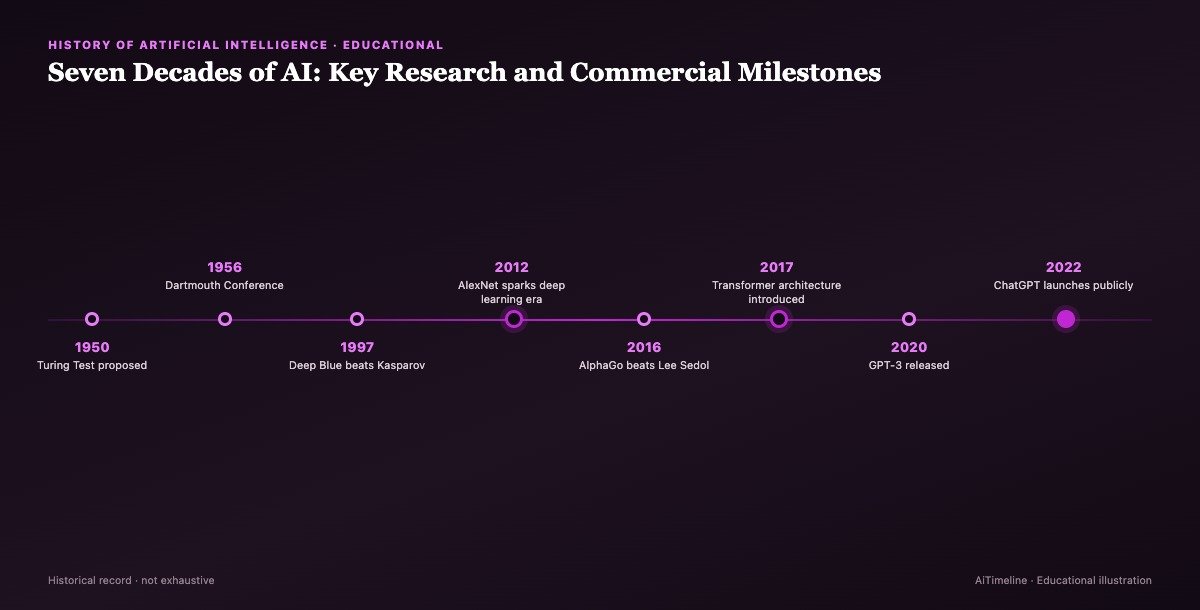
Seven decades of AI research and commercialisation, compressed into one chart — the 2022-2026 boom is the most recent chapter, not the whole story.
Key Terms, Explained
Fifteen terms that appear throughout AI coverage, defined in plain language.
Neural Network
A computing structure loosely inspired by biological neurons, organised in layers that transform input data step by step to learn patterns from examples rather than explicit rules.
Large Language Model (LLM)
A neural network trained on vast amounts of text to predict and generate language, enabling it to answer questions, write text and follow instructions across a huge range of topics.
GPU (Graphics Processing Unit)
A chip originally built for rendering graphics, whose ability to perform many calculations in parallel makes it far more efficient than a general-purpose CPU for training and running neural networks.
Training
The computationally intensive process of exposing a model to large datasets and adjusting its internal parameters so it learns to produce accurate or useful outputs.
Inference
The process of actually running a trained model to generate a response to a new input — what happens every time a user sends a prompt to a chatbot.
Fine-Tuning
Further training a pre-trained foundation model on a smaller, specific dataset to specialise its behaviour for a particular task, tone or domain.
AI Agent
A system built on a foundation model that can plan and take multiple actions — searching, calling tools, writing and executing code — toward a goal, rather than answering a single prompt.
Reasoning Model
A model variant designed to work through intermediate steps before answering, generally improving performance on tasks involving logic, maths or multi-step problems.
RAG (Retrieval-Augmented Generation)
A technique where a model retrieves relevant information from an external database or document set before generating its answer, improving accuracy on facts outside its training data.
Multimodal AI
Models that can process and generate more than one type of content — text, images, audio and video — within a single system, rather than being limited to text alone.
Data Centre
A large facility housing the servers, storage and networking equipment — including specialised GPU hardware — needed to train and run AI models at scale.
Cloud Computing
The model of renting computing power, storage and software over the internet from providers like AWS, Microsoft Azure or Google Cloud, rather than owning and maintaining the hardware directly.
Tokenisation
The process of breaking text into smaller units called tokens (often word fragments) that a language model actually processes internally, rather than working with raw text directly.
Open-Source AI
Models whose weights (and sometimes training code) are released publicly, letting anyone download, run, inspect or modify them, as distinct from closed, API-only commercial models.
Responsible AI
The set of organisational practices — safety testing, bias evaluation, transparency reporting — that AI developers use to identify and reduce risks before and after deploying a model.
💰 Economic Insight
AI may improve productivity, but the pace and distribution of benefits differ across industries. Sectors with large amounts of structured, digitisable work — software development, customer support, content drafting — have generally reported the earliest and clearest gains from generative AI deployment. Sectors more dependent on physical processes, regulatory approval cycles or highly specialised judgment have generally reported slower, more uneven adoption. Aggregating these differences into a single “AI boosts productivity by X%” figure tends to obscure more than it reveals.
Evergreen Explainers
Four standalone explainers covering the mechanics behind the systems described above.
How Large Language Models Work
A large language model is, at its core, a very large neural network trained to predict the next piece of text given everything that came before it. During training, the model is shown enormous quantities of text — books, articles, code, web pages — and repeatedly adjusts billions of internal parameters to get slightly better at this next-token prediction task. Text is first broken into tokens (see “Tokenisation” above); the model processes these tokens through many layers of a Transformer-based neural network, using an “attention” mechanism that lets it weigh how relevant every other word in the input is to predicting the next one. Repeated at massive scale, this simple prediction task turns out to produce systems that can answer questions, summarise documents, write code and hold coherent conversations — not because the model “understands” language the way a human does, but because it has learned extraordinarily rich statistical patterns in how language is actually used.
Why GPUs Matter for AI
Training a large neural network requires performing the same type of mathematical operation — matrix multiplication, at the core of it — billions or trillions of times. A traditional CPU (central processing unit) is built to handle a wide variety of tasks one after another very quickly; a GPU (graphics processing unit) is built to perform many similar, simpler calculations simultaneously, which happens to be exactly the kind of workload neural network training and inference require. This is why the same chip architecture originally built for rendering video-game graphics turned out to be, with modification, extraordinarily well-suited to AI — and why companies like NVIDIA and AMD, and the contract chip manufacturer TSMC that fabricates many of their most advanced chips, sit at the centre of the AI infrastructure story covered throughout this guide’s timeline.
Training vs Inference
Training and inference are the two distinct computational phases of using an AI model, and they have very different cost and infrastructure profiles. Training is the process of building the model in the first place — extremely computationally expensive, often requiring thousands of GPUs running for weeks, done relatively infrequently (for a new model or a major update). Inference is the process of actually using a trained model to answer a query — far cheaper per request, but performed constantly, at massive scale, every time a user sends a message to a chatbot or an application calls a model’s API. As AI products have scaled to hundreds of millions of users, inference costs in aggregate have become a major and growing share of AI companies’ infrastructure spending, alongside the upfront cost of training new models.
How AI Creates Economic Value
In economic terms, AI creates value primarily by reducing the time or cost required to complete a task, or by enabling a task that would otherwise not be economically viable at all. A support team that resolves routine queries automatically frees human agents for complex cases; a developer who gets a first draft of code from an AI assistant spends more time reviewing and less time typing. Economists studying this effect distinguish between labour substitution (AI directly replacing a task a human previously did) and labour augmentation (AI making a human more productive at a task they still perform) — and current institutional research, discussed later in this guide, suggests both effects are occurring simultaneously, in different proportions across different industries and roles.
💼 Business Insight
Many organisations gain value from targeted AI deployment rather than replacing every workflow. Enterprise case studies and industry surveys consistently describe the most successful early AI implementations as narrow and specific — automating a defined step in a larger process — rather than attempts at wholesale, end-to-end automation of an entire department. Businesses that treat AI as a general-purpose replacement for broad job categories, rather than a tool for specific tasks, more frequently report disappointing results in independent surveys.
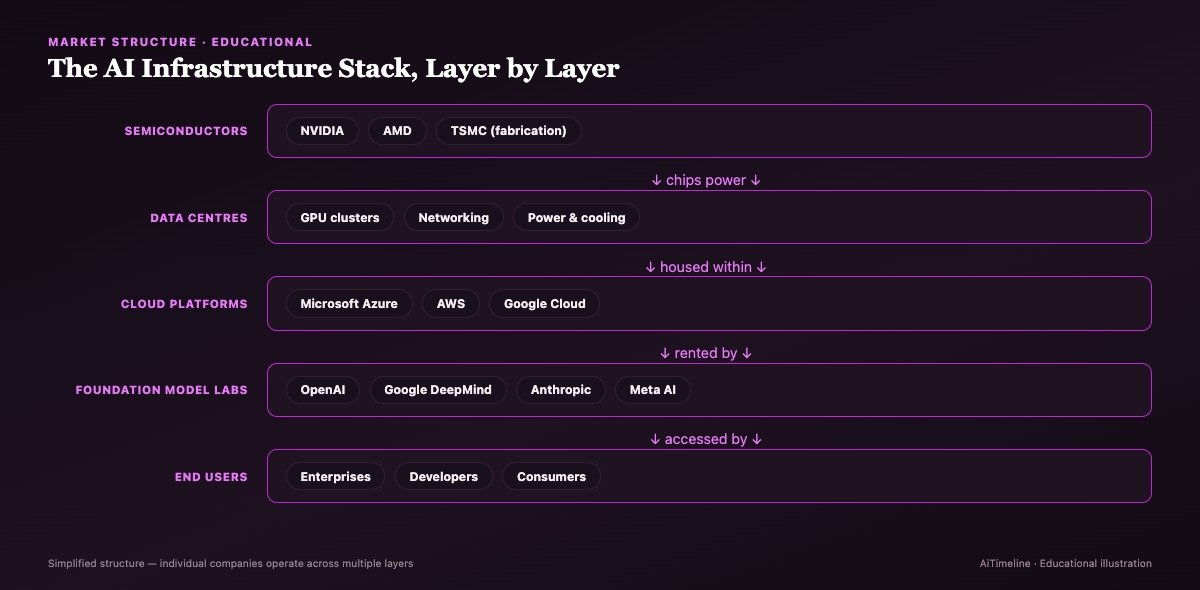
How the AI infrastructure stack fits together, from chip design to the model a user actually interacts with.
Side-by-Side Comparisons
Seven comparison tables covering the concepts and choices that come up most often in AI coverage.
Machine Learning vs Deep Learning vs Generative AI
| Factor | Machine Learning | Deep Learning | Generative AI |
|---|---|---|---|
| Scope | Broad field: learning from data | Subfield using multi-layer neural networks | Subfield producing new content |
| Typical output | Prediction or classification | Prediction, classification, or generation | New text, image, audio, code |
| Example | Spam filter | Image recognition system | Chatbot writing an email |
CPU vs GPU
| Factor | CPU | GPU |
|---|---|---|
| Design goal | Fast, flexible, general-purpose tasks | Many simultaneous, similar calculations |
| AI workload fit | Poor for large-scale training | Well-suited to neural network training/inference |
| Leading makers | Intel, AMD | NVIDIA, AMD |
Training vs Inference
| Factor | Training | Inference |
|---|---|---|
| Frequency | Occasional (new model/update) | Continuous, per user request |
| Cost per event | Very high (many GPUs, weeks) | Low individually, high in aggregate |
| Purpose | Builds the model’s parameters | Uses the model to answer a query |
Closed-Source vs Open-Source AI
| Factor | Closed-Source | Open-Source |
|---|---|---|
| Access | API only, model weights private | Weights publicly downloadable |
| Example | GPT-4, Claude, Gemini | Llama, several DeepSeek models |
| Customisation | Limited to provider’s fine-tuning options | Fully modifiable by the user |
| Typical trade-off | Convenience, managed infrastructure | Control, potential cost savings at scale |
Traditional Search vs AI Assistants
| Factor | Traditional Search | AI Assistant |
|---|---|---|
| Output | Ranked list of links | Direct, synthesised answer |
| Sourcing | User evaluates each source | May cite sources; requires verification |
| Best for | Exploring, comparing many sources | Quick synthesis, drafting, coding help |
AI vs Traditional Automation
| Factor | Traditional Automation | AI (Generative/ML-based) |
|---|---|---|
| Logic | Explicit, human-written rules | Learned patterns from data |
| Flexibility | Breaks on unexpected input | Generalises to novel input, imperfectly |
| Predictability | Deterministic output | Probabilistic, can vary or err |
Timeline Summary
| Year | Event | Global Impact |
|---|---|---|
| 1950 | Turing Test proposed | Frames the core question of machine intelligence |
| 1956 | Dartmouth Conference | Field formally named and founded |
| 1960s | Early expert systems; first AI winter | First boom-bust cycle in AI funding |
| 1980s | Expert systems boom, second AI winter | Reinforces caution around AI hype cycles |
| 1997 | Deep Blue beats Kasparov | First public “AI beats human champion” moment |
| 2006 | Deep learning revival begins | Academic groundwork for the 2010s boom |
| 2012 | AlexNet wins ImageNet | Sparks the modern deep learning era |
| 2016 | AlphaGo beats Lee Sedol | Deep learning masters strategic reasoning |
| 2017 | Transformer architecture introduced | Technical foundation of modern generative AI |
| 2020 | GPT-3 released | Demonstrates large-model commercial potential |
| 2022 | ChatGPT launches publicly | Generative AI becomes a mainstream phenomenon |
| 2023 | Generative AI boom broadens | Multi-company, open and closed model race begins |
| 2024 | Enterprise AI expansion; EU AI Act adopted | Adoption scales; regulation formalises |
| 2025 | Infrastructure race intensifies; DeepSeek shock | Tests scale of AI capital commitments |
| 2026 | Continued infrastructure investment | Ongoing, closely measured capital cycle |
🧠 Did You Know?
The Transformer architecture introduced in 2017 became the foundation for many modern generative AI systems. It replaced an older approach called recurrent neural networks, which processed text one word at a time in sequence; the Transformer’s “attention” mechanism let models look at an entire passage of text at once, making both training and the resulting model’s capabilities far more scalable.
📈 Investor Insight
Company valuations can reflect expectations as well as current earnings. When a semiconductor or cloud company’s stock moves sharply on AI-related news, that movement typically reflects a shift in investor expectations about future revenue and growth — not necessarily a change in the company’s current, already-reported financial results. Separating a company’s business fundamentals (reported revenue, profit, order backlogs) from market sentiment (how investors currently feel about its future prospects) is essential to understanding any AI-related stock move, and neither this guide nor any of the sources it cites should be read as predicting future share prices.
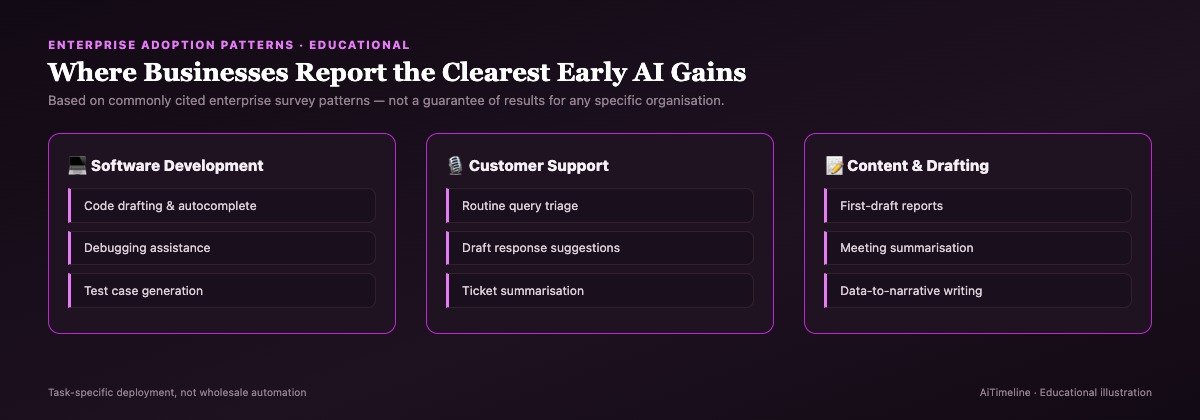
Where enterprises report the clearest early gains from generative AI — a pattern of targeted, task-specific adoption rather than wholesale automation.
✅ What Research Actually Shows
- Stanford AI Index and similar reports track measurable indicators: model releases, private investment, benchmark performance, and adoption survey data.
- OECD and IMF research describes AI as a potential driver of productivity, with effects varying significantly by sector and country.
- The Transformer architecture (2017) is a documented, peer-reviewed foundation of nearly all major LLMs since.
- Enterprise surveys report the clearest gains in narrow, specific workflows, not company-wide automation.
⚠️ Common Misconceptions
- “AI will replace most jobs soon” — independent research describes task-level augmentation and substitution effects that vary widely, not a uniform replacement trend.
- “ChatGPT was a completely new invention” — its core model family and Transformer architecture predate its November 2022 public launch by years.
- “Rising AI stock prices prove the technology works” — stock prices reflect investor expectations, which can diverge from a company’s actual current performance.
- “Bigger models always mean better AI” — efficiency gains, exemplified by events like the 2025 DeepSeek release, show smaller, well-optimised models can be highly competitive.
Who Is Building the AI Boom
The primary companies and institutions referenced throughout this guide.
OpenAI
Developer of the GPT model family and ChatGPT; publishes model and safety research and official product announcements.
Google DeepMind
Google’s AI research division, behind AlphaGo, the Gemini model family, and extensive peer-reviewed AI research publications.
Anthropic
Developer of the Claude model family, with a stated focus on AI safety research and responsible deployment practices.
Microsoft
Major OpenAI investor and Azure cloud provider, embedding generative AI across its enterprise software products.
NVIDIA
Leading designer of GPUs used for AI training and inference; central to the data-centre hardware supply chain discussed throughout this guide.
AMD
A major alternative GPU and data-centre chip designer, competing with NVIDIA in the AI hardware market.
Amazon Web Services (AWS)
A leading cloud infrastructure provider offering AI training and inference capacity, and its own foundation model offerings.
Google Cloud
Google’s cloud infrastructure platform, offering AI compute capacity, developer tools and access to Google’s foundation models.
Stanford University
Home of the Stanford Institute for Human-Centered AI (HAI), publisher of the widely cited annual Stanford AI Index report.
OECD
The Organisation for Economic Co-operation and Development publishes cross-country research on AI’s economic and labour-market effects.
IMF
The International Monetary Fund publishes research and policy analysis on AI’s macroeconomic and productivity implications.
Common Mistakes in Reading AI Coverage
- Treating a single model release as proof of a broader trend. One company’s benchmark result doesn’t establish an industry-wide pattern on its own.
- Confusing a stock price move with a verified business result. Share prices move on expectations; company earnings disclosures show actual results.
- Assuming “open-source” means unlimited, unrestricted use. Many openly released models carry specific licence terms that limit certain commercial uses.
- Reading “AI winter” history as guaranteeing today is different. Prior cycles are informative, not predictive, of how the current one will unfold.
- Treating a chatbot’s confident answer as automatically accurate. Language models can generate fluent, plausible-sounding text that is factually incorrect.
- Assuming enterprise AI adoption is uniform across industries. Survey data consistently shows wide variation by sector, company size and use case.
- Attributing a company’s entire valuation to AI alone. Most major technology companies covered in this guide have substantial non-AI revenue lines too.
- Skipping the difference between training cost and inference cost. They are different expenses with different scaling patterns and business implications.
👀 Future Watch
What is genuinely worth watching going forward: official model and research releases from OpenAI, Google DeepMind, Anthropic and other labs; peer-reviewed AI research published in venues like NeurIPS, ICML and Nature; the annual Stanford AI Index report; government AI policy and regulatory updates, including the phased rollout of the EU AI Act; and productivity and labour-market research from the OECD, IMF and national statistical agencies. This guide does not forecast where any of these will lead — only that these are the specific, official and peer-reviewed channels worth watching, rather than speculative commentary or price predictions.
Interesting Facts
- Alan Turing’s 1950 Turing Test paper predates the term “artificial intelligence” itself, which wasn’t coined until the 1956 Dartmouth Conference.
- AlexNet, the 2012 breakthrough that revived deep learning, was trained using consumer gaming GPUs — not specialised AI hardware, which barely existed at the time.
- The Transformer architecture’s title, “Attention Is All You Need,” is now one of the most cited papers in modern computer science.
- ChatGPT’s reported two-month climb to 100 million users made it, at the time, one of the fastest-adopted consumer software products on record.
Explore More Timelines
People Also Ask
Frequently Asked Questions
70 questions on the history, technology and economics of the AI boom.
Related Reading on AiTimeline
Google Pixel 11 Pro: Future of Flagship Phones
US Economy: Growth, Slowdown & Inflation Timeline
Invest in US Stocks From India
Why the AI Boom Is a Story of Decades, Not Months
It is tempting to date the AI boom to a single Wednesday in November 2022, when ChatGPT quietly went live and, within weeks, became the fastest-growing consumer application anyone could remember. But as this guide’s timeline shows, that moment was the visible tip of a research programme that began with Alan Turing’s 1950 question about whether a machine could convincingly imitate a mind, ran through two distinct “AI winters” that should caution against assuming any boom is permanent, and depended on a very specific, very technical 2017 paper about an attention mechanism that almost nobody outside AI research noticed at the time. The chatbot Meera uses to draft her weekly reports is standing on the shoulders of Geoffrey Hinton’s 2006 deep-learning papers, the 2012 AlexNet result, and years of unglamorous engineering work on GPU chips and data-centre construction that rarely made headlines until the bill for it started showing up in quarterly earnings calls.
What happens next is genuinely not settled, and this guide has tried, throughout, not to pretend otherwise. Company disclosures show enormous, continuing capital investment in AI infrastructure. Peer-reviewed research and institutional studies from the Stanford AI Index, the OECD and the IMF describe real productivity potential, alongside real uncertainty about how quickly and evenly that potential will be realised. Market prices for AI-exposed companies move on sentiment as much as on fundamentals, sometimes sharply, as the January 2025 DeepSeek episode demonstrated in a single trading day. None of that adds up to a guarantee — not that AI will keep improving at its current pace, not that every industry will benefit equally, and not that any specific company’s valuation will hold.
What it does add up to is a rare, well-documented case study in how a research field can spend seventy years mostly out of public view and then, in the space of about two years, become one of the defining economic stories of the decade. Understanding that arc — the algorithms, the hardware, the infrastructure, the regulation, and the genuine open questions that remain — is more useful than trying to predict next quarter’s headlines. For anyone who wants to keep following this story accurately, the most reliable path is the same one this guide has tried to model throughout: official company announcements, peer-reviewed academic research, and independent studies from credible economic institutions, read critically and kept separate from speculation.
Editorial Note & Sources
This guide separates Official facts and company disclosures, Reported market observations and widely covered events, and Analysis educational framing and this guide’s own commentary, throughout. Historical dates and figures are drawn from the primary sources below and well-documented public records; company financial figures should always be confirmed from the company’s own current disclosures.
- Official OpenAI: openai.com
- Official Google DeepMind: deepmind.google
- Official Anthropic: anthropic.com
- Official NVIDIA Investor Relations: investor.nvidia.com
- Official Stanford HAI — AI Index Report: aiindex.stanford.edu
- Official OECD AI Policy Observatory: oecd.ai
- Official International Monetary Fund: imf.org
- Official European Union — AI Act: digital-strategy.ec.europa.eu
Sources & further reading
Every dated entry above was checked against these references. Last reviewed 15 September 2026.