Qwen3.8-Max: Alibaba’s Open-Weight Flagship, Explained
A complete guide to Alibaba Qwen3.8-Max: architecture, benchmarks, licensing status, and deployment paths for the 2.4T-parameter open-weight AI model.
Latest Story
Six months into 2026, an AI engineer at a mid-size logistics company is choosing between two paths for a new internal copilot. One is a closed, proprietary frontier model, billed per token, running on infrastructure she will never see, governed by a usage policy she cannot negotiate. The other is an open-weight model: a set of downloadable parameter files she can run on her own company’s GPUs, inspect for how it behaves on sensitive data, fine-tune on internal documents without sending them anywhere, and keep running exactly as it is today even if the vendor changes its pricing, its policies, or disappears entirely. Two years earlier this would have been a lopsided choice. By August 2026, thanks to a wave of releases from Chinese and American labs alike, it is a genuinely close call — and the newest, largest entrant in that open-weight column is Alibaba’s Qwen3.8-Max.
This guide exists because Qwen3.8-Max’s announcement, on August 3, 2026, was covered everywhere as breaking news and almost nowhere as a reference: what the model actually is, what “8 Max” means inside Alibaba’s own naming scheme, how it fits into six years of Qwen releases, what is officially confirmed versus what trade press is reporting, and what a team evaluating it should actually check before betting a production workload on it. That is what follows — architecture, history, benchmarks with their sources attached, deployment paths, and the licensing nuance that matters most right now: Qwen3.8-Max’s weights shipped on August 12, 2026 under a custom, non-Apache license, and the model itself received a coding-focused refresh, Qwen3.8-Max-0902, on September 2, 2026.
🧠 60-Second Answer
Qwen3.8-Max is Alibaba’s largest AI model to date — a 2.4-trillion-parameter Mixture-of-Experts system with a 1-million-token context window, announced August 3, 2026. It became Alibaba’s first Max-tier model released as open-weight when its parameters, as the text-only checkpoint Qwen3.8-2.4T-A95B, shipped on Hugging Face and ModelScope on August 12, 2026, under a custom Qwen3.8-Max License (not Apache 2.0). A smaller, Apache-2.0-licensed Qwen3.8-27B followed a day or two later. On September 2, 2026, Alibaba shipped a further post-trained snapshot, Qwen3.8-Max-0902, focused on coding and agentic work, which ranked first on the CodeArena WebDev leaderboard at launch.
Last updated September 2026 · reconfirm benchmark and pricing fields before citing this page after that date
Qwen3.8-Max: Who, What, Why, When, Where, How
What to Know About Qwen3.8-Max
- It is open-weight now. The text-only Qwen3.8-2.4T-A95B checkpoint shipped to Hugging Face and ModelScope on August 12, 2026, under a custom Qwen3.8-Max License — not Apache 2.0.
- It is Alibaba’s biggest model to date at 2.4 trillion total parameters, using a sparse Mixture-of-Experts design that activates roughly 95 billion parameters per forward pass rather than all 2.4 trillion at once.
- The 1-million-token context window applies to the hosted API; the downloadable open-weight checkpoint is text-only and drops the API version’s native image input and full 1M-token context.
- Benchmark numbers in circulation come from trade press, not an independently verified Alibaba benchmark table — treat every score in this guide as attributed, not as settled fact.
- A separate, smaller Qwen3.8-27B checkpoint shipped under Apache 2.0 a day or two after the Max-tier weights, aimed at teams that want a self-hostable Qwen3.8-generation model without needing Max-tier infrastructure.
- Qwen3.8-Max’s own license departs from prior Qwen3-generation precedent. Earlier open-weight Qwen3 releases used the permissive Apache 2.0 license; the 2.4T Qwen3.8-Max checkpoint instead ships under a custom license requiring a paid agreement from MaaS and AI coding/office-assistant businesses above $50 million in aggregate revenue with affiliates.
- Open-weight does not mean open-source in the strict software sense: publishing the trained parameters is different from publishing the training data, training code, or a license that meets the Open Source Initiative’s definition.
- Self-hosting trades a per-token API bill for infrastructure and operations cost — the right call depends on workload volume, data-residency requirements, and in-house ML-ops capacity, not on benchmark scores alone.
- This is a living reference. Licensing, the full benchmark table, and weight availability were all still firming up at publication; this guide will be updated as Alibaba, Hugging Face, and GitHub publish further detail.
What Qwen Is, and What “8 Max” Means
The naming, the company behind it, and the vocabulary this whole topic runs on.
Qwen (pronounced roughly like “Chwen,” a shortening of the model’s original Chinese name Tongyi Qianwen, “truth from a thousand questions”) is Alibaba Cloud’s family of large language models, first introduced in 2023. It has since grown into one of the most active open-weight model lineages in the world by release count, spanning dense text models, Mixture-of-Experts models, vision-language models, audio models, and dedicated reasoning models. Qwen3 refers to the third major generation of that family, launched in April 2025, which established Apache 2.0 as Alibaba’s standard license for open-weight Qwen releases going forward. Everything since — Qwen3.5, Qwen3.6, Qwen3.7, and now Qwen3.8 — is a point release within that same third generation rather than a full architectural reset.
“8 Max” is Alibaba’s own product-tier naming, not an industry-standard term. Within the Qwen lineup, “Max” denotes the largest, most capable model in a given generation, distinct from smaller “Plus” or numbered-parameter variants aimed at lower-cost or self-hosted use. Qwen3.7-Max, released two and a half months earlier, was a Max-tier model that stayed closed-weight and API-only. Qwen3.8-Max is notable specifically because Alibaba has said this Max-tier model — not just a smaller sibling — will get an open-weight release, which trade coverage has described as a first for the Max tier.
Open-weight vs. open-source: the distinction that matters most here
These two terms get used interchangeably in casual conversation and should not be. An open-source project, in the sense the term has held since the 1990s, ships source code (or, for a model, the training code and ideally the training data) under a license that grants broad rights to use, modify, and redistribute. An open-weight model ships only the trained parameters — the numbers that define the network after training — typically alongside inference code, but usually without the training data, the training scripts, or full documentation of every design decision made along the way. You can download an open-weight model’s weights, run it, fine-tune it, and often redistribute derivatives of it, but you generally cannot reproduce how it was built from scratch. Qwen3-generation models, including Qwen3.8-Max since August 2026, are open-weight in this precise sense: downloadable and self-hostable, but not fully open-source by the stricter definition some in the free-software community use.
Why this distinction still matters even though the weights have shipped
Qwen3.8-Max moved from announced open-weight to actually open-weight on August 12, 2026, but the distinction this guide draws between “open-weight” and “open-source” remains directly relevant: you can call the model through Alibaba’s API under Alibaba’s terms of service, or download and self-host the 2.4T checkpoint under its own custom license (or the 27B checkpoint under Apache 2.0) — but in neither case do you get the training data, training code, or a full account of every design decision made along the way. The self-hosting, fine-tuning, and on-premise deployment sections of this guide are directly actionable today, not forward-looking, and this guide flags every place the license’s specific terms — particularly the 2.4T checkpoint’s commercial-revenue threshold — matter to that decision.
Why Alibaba released it this way
Alibaba has not published a detailed rationale alongside the release, so this section is analysis, not an official statement. Three factors are widely discussed in AI-industry commentary as drivers behind large labs’ open-weight strategies generally, and plausibly apply here: open-weight releases build developer mindshare and ecosystem lock-in around a lab’s tooling and cloud services even when the model itself is free to self-host elsewhere; they function as a competitive signal against rival open-weight releases from labs like Moonshot (Kimi), DeepSeek, Meta, and Mistral, several of which released large open-weight models in the weeks around Qwen3.8-Max’s own announcement; and for a China-based lab, open distribution through both Hugging Face and the domestic ModelScope platform maximizes reach in a market where cross-border cloud dependencies are a live commercial and political consideration.
💡 AI Insight
The AI ecosystem in 2026 increasingly runs on two parallel tracks rather than one: proprietary frontier models chasing the absolute top of capability benchmarks, and open-weight models chasing “good enough, and I can run it myself.” Qwen3.8-Max is unusual for trying to compete on both tracks with the same model — a Max-tier capability target released through an open-weight distribution model historically reserved for a lab’s second-tier offerings.
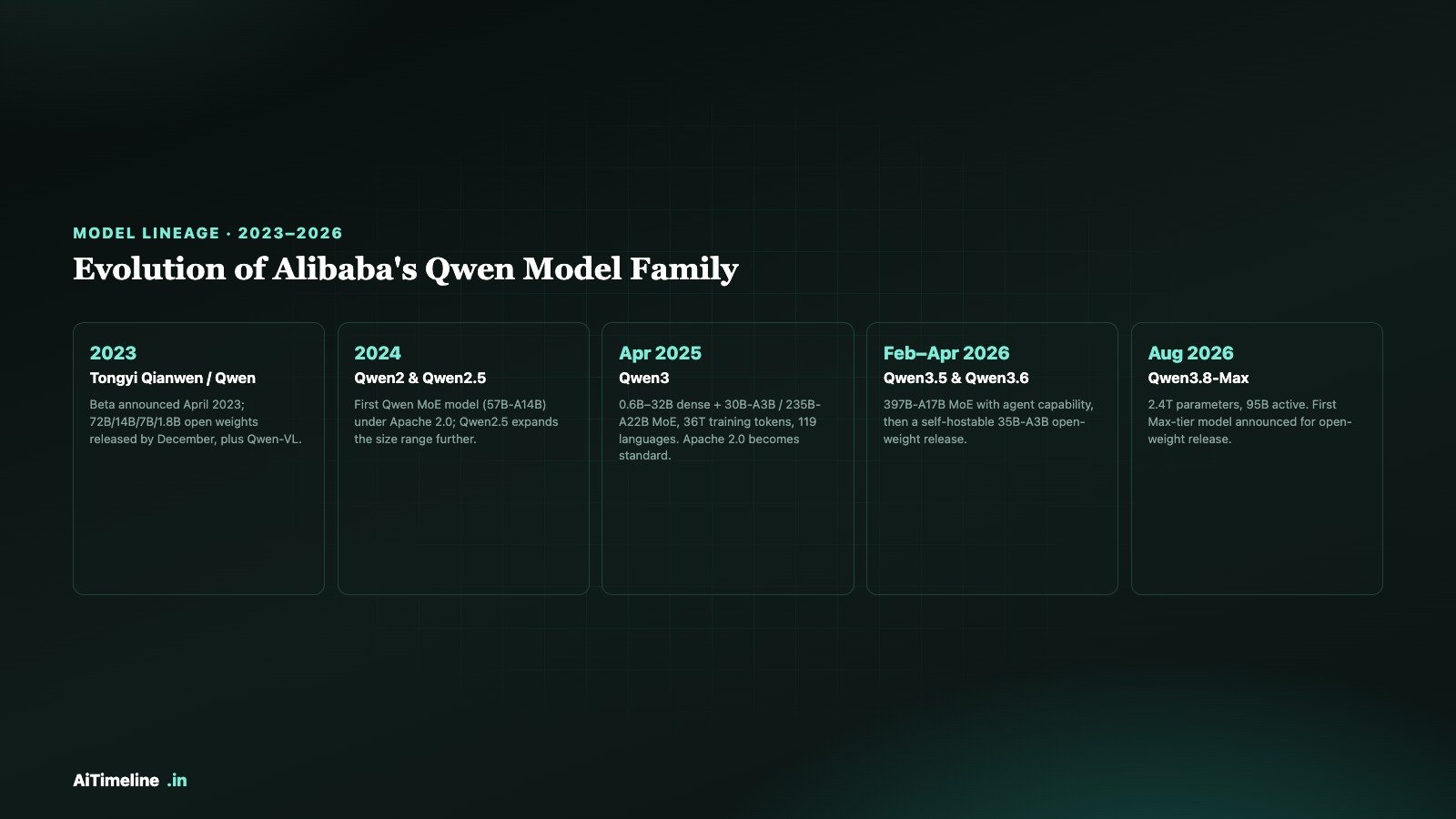
The Complete Qwen Timeline: 2023 to 2026
Reverse-chronological. Each entry separates industry context, the technical change, and why it still matters.
Qwen3.8-Max-0902 Refresh Tops CodeArena
Industry context: Released September 2, 2026, as Alibaba continued rapid post-training iteration on the same base model rather than shipping a new full generation, competing directly against Claude Opus 5 and Kimi K3 on coding-agent workloads.
Technical breakthrough: Same 2.4-trillion-parameter architecture, 1-million-token context, and $2/$6 per-million-token pricing as the original Qwen3.8-Max, further post-trained on what Alibaba calls “Coding & Cowork.” On Code Arena WebDev, the refresh ranked first overall at 1,691 points, ahead of Claude Opus 5 Max (1,687) and Kimi K3 Max (1,674), and up 22 points from the original Qwen3.8-Max (1,669), per trade-press reporting.
Developer impact: Available immediately via the existing DashScope API under the model ID qwen3.8-max-0902, with qwen3.8-max-2026-09-02 documented as an alias — no migration required for existing integrations.
Enterprise relevance: All eight coding benchmarks reportedly improved, with the largest gains on TerminalBench 3.0 (11.3 to 29.0) and ProgramBench Almost Solved (10.5 to 28.0), both more than doubling — relevant to teams evaluating Qwen3.8-Max specifically for agentic coding and multi-tool orchestration.
Qwen3.8-Max Reaches General Availability
Industry context: The announcement landed in the middle of a dense stretch of large open-weight releases from multiple labs, and immediately moved Alibaba’s stock, with CNBC reporting a share-price rally the same day — a market reaction to a model release, not a technical fact about the model itself.
Technical breakthrough: At 2.4 trillion total parameters with roughly 95 billion active per forward pass, it is the largest model Alibaba has shipped, with a 1-million-token context window, a three-level reasoning-effort toggle (xhigh, medium, low), and five built-in tools including a code interpreter and web search.
Developer impact: At GA, developers could only reach it through Alibaba’s DashScope API; self-hosting, fine-tuning, and offline use were unavailable until the weights shipped nine days later.
Enterprise relevance: Enterprises evaluating it at GA were evaluating an API product with published per-token pricing only — the open-weight option followed the same month.
Open Weights Ship: Qwen3.8-2.4T-A95B and Qwen3.8-27B
Industry context: Nine days after GA, Alibaba became the first lab to publish downloadable weights for a Max-tier, frontier-scale model, a distinction trade coverage repeatedly noted as a first for that product tier.
Technical breakthrough: The 2.4-trillion-parameter checkpoint, published as Qwen3.8-2.4T-A95B, went live on Hugging Face and ModelScope on August 12, 2026, under a custom Qwen3.8-Max License rather than Apache 2.0 — a permissive-at-consumer-scale license that requires a separate paid agreement from MaaS and AI coding/office-assistant businesses once combined revenue with affiliates exceeds $50 million. The open checkpoint is text-only, dropping the hosted API’s native image input and full 1-million-token context. A separate, dense Qwen3.8-27B model followed on August 13–14 under the fully permissive Apache 2.0 license.
Developer impact: Self-hosting, fine-tuning, and offline deployment became possible for the first time on a Qwen Max-tier model, via inference engines such as vLLM once downloaded.
Enterprise relevance: The license split matters for procurement: the 2.4T checkpoint’s custom terms require legal review before large-scale commercial MaaS or coding-assistant use, while the smaller 27B model carries no such revenue threshold under Apache 2.0.
Qwen3.8-Max Previewed at WAIC Shanghai
Industry context: The preview arrived days after a major open-weight release from rival lab Moonshot (Kimi K3), a timing trade coverage explicitly noted as competitive positioning.
Technical breakthrough: The preview endpoint, `qwen3.8-max-preview`, exposed the same 2.4-trillion-parameter, 1-million-token-context architecture that would GA two weeks later, accessible through Alibaba’s Token Plan subscription and its Qoder / QoderWork coding-agent products.
Developer impact: Early access let developers begin evaluating the model’s coding and agentic behavior roughly two weeks before the wider GA rollout.
Current relevance: The two-stage preview-then-GA rollout is now a recurring pattern for Alibaba’s Max-tier releases, mirrored in the Qwen3.5-Max-Preview and Qwen3.6-Max-Preview releases earlier in 2026.
Qwen3.7-Max Launches as a Closed-Weight Flagship
Industry context: Announced at the Alibaba Cloud Summit, Qwen3.7-Max reportedly scored 56.6 on the Artificial Analysis Intelligence Index v4.0 — described by reporting at the time as the highest score any Chinese-developed model had reached on that index, placing it in the global top five.
Technical breakthrough: A 1-million-token context window and a native extended-thinking mode, with reported benchmark results including GPQA Diamond 92.4 and SWE-Pro 60.6.
Developer impact: Priced at a reported $2.50 per million input tokens and $7.50 per million output tokens, with a 90% discount on cached input — API-only, with no open-weight release.
Current relevance: Qwen3.7-Max is the direct predecessor Qwen3.8-Max’s benchmark improvements are typically measured against, though differing benchmark versions between the two releases (Terminal-Bench 2.0 versus 2.1, for instance) complicate direct score comparisons.
Qwen3.6 Ships an Open-Weight MoE Model
Industry context: Qwen3.6 Plus was announced April 2, with the open-weight Qwen3.6-35B-A3B sparse Mixture-of-Experts model following on April 16, and a Qwen3.6-Max-Preview appearing April 20 — three releases in under three weeks.
Technical breakthrough: The 35B-A3B naming denotes 35 billion total parameters with roughly 3 billion active per forward pass, released under Apache 2.0.
Developer impact: A genuinely self-hostable MoE model at a size runnable on a single high-memory GPU or a modest multi-GPU setup, unlike the Max-tier models in the same generation.
Current relevance: Established the pattern Qwen3.8 later followed — open-weight releases at smaller/mid sizes arriving well before (or, in Qwen3.8’s case, alongside the announcement of) a Max-tier counterpart.
Qwen3.5 Adds Computer-Use Agent Capability
Industry context: Released as a 397B-A17B Mixture-of-Experts model, with a preview of a Max-tier sibling (Qwen3.5-Max-Preview) appearing on the LM Arena leaderboard the following month before Alibaba moved directly to Qwen3.6 without a full 3.5 Max GA release.
Technical breakthrough: Reporting describes Qwen3.5 as adding desktop- and mobile-operation agent capability — the ability to drive a graphical interface autonomously, not just generate text.
Developer impact: Apache 2.0 for the open variant, with a separate proprietary “Plus” tier for teams wanting managed hosting.
Current relevance: The architectural foundation Qwen3.8-Max is reportedly built on, per trade-press descriptions of the newer model.
Qwen3 Establishes Apache 2.0 as the Standard
Industry context: Landed amid intensifying open-weight competition from Meta’s Llama series, Mistral, and the newly prominent DeepSeek, all racing to define what a “good enough to matter” open-weight model looked like in 2025.
Technical breakthrough: Dense models from 0.6B to 32B parameters plus Mixture-of-Experts variants at 30B-A3B and 235B-A22B, trained on a reported 36 trillion tokens across 119 languages. From this release forward, Alibaba states all of its open-weight Qwen releases use the Apache 2.0 license.
Developer impact: A genuinely broad size range in one generation, from edge-deployable sub-1B models to a 235-billion-parameter MoE flagship, all under one permissive license.
Current relevance: Every later 3.x point release, including Qwen3.8-Max, is a descendant of this generation’s architecture and licensing precedent.
MAR 2025
QwQ Brings Dedicated Reasoning Models to Qwen
Industry context: Arrived as OpenAI’s o1 popularized the idea of a model trained specifically to “think” through extended chains of reasoning before answering, rather than answering immediately.
Technical breakthrough: QwQ-32B-Preview shipped November 2024; a full QwQ-32B followed in March 2025, both under Apache 2.0, at a comparatively modest 32-billion-parameter size.
Developer impact: Gave self-hosters access to reasoning-focused behavior without needing a frontier-scale model, running on hardware a single well-equipped workstation could handle.
Current relevance: The reasoning-effort toggle now built directly into Qwen3.8-Max (xhigh/medium/low) descends conceptually from the dedicated-reasoning-model experiments QwQ began.
Qwen2.5 Expands the Family
Industry context: Released into an increasingly crowded open-weight field, with mixed licensing across sizes — some open, some kept proprietary at the largest scale, a pattern common across labs at the time.
Technical breakthrough: Broadened the Qwen2 family’s size range and, alongside it, Alibaba shipped Qwen2.5-Omni (7B and 3B, Apache 2.0/research license) in early 2025, adding multimodal input and output including voice interaction.
Developer impact: More size options meant more deployment targets, from edge devices to multi-GPU servers, within a single generation.
Current relevance: One of the most heavily downloaded and fine-tuned Qwen generations on Hugging Face, forming a large share of the 200,000-plus Qwen-derivative models the platform now hosts.
Qwen2 Adds Mixture-of-Experts and Multimodal Variants
Industry context: Released June 7, 2024, as open-weight LLMs were shifting from “impressive demo” to “production-viable” in enterprise conversations generally.
Technical breakthrough: Four dense sizes (0.5B, 1.5B, 7B, 72B) plus Alibaba’s first Qwen-branded sparse MoE model, Qwen2-57B-A14B, under Apache 2.0 (the 72B model was proprietary at launch). Qwen2-Audio followed in August 2024 with speech-interaction capability; Qwen2-VL followed in December 2024 with video-analysis support beyond 20 minutes of footage.
Developer impact: The first Qwen generation where a genuinely capable MoE model was available to self-host, ahead of most Western labs’ equivalent open-weight MoE releases.
Current relevance: Set the multimodal and MoE precedent Qwen3.8-Max’s image-input support and expert-routing architecture both build on.
Qwen’s First Open-Weight Releases
Industry context: Arrived as Meta’s Llama 2 and other 2023-era open-weight releases were establishing that a large lab publishing real, usable model weights — not just a paper — was commercially viable.
Technical breakthrough: Initial 7B weights released in August 2023; 72B and 1.8B models followed by December, alongside Qwen-VL, a vision-language variant with mixed licensing across its Base/Chat (open) and Max/Plus (proprietary) tiers.
Developer impact: Gave the open-weight community its first genuinely large (72B) Qwen model to build on, roughly a year and a half before Qwen3 would formalize Apache 2.0 as the family-wide standard.
Current relevance: The starting point of the download-and-derivative ecosystem that now includes one individual Qwen model surpassing 18 million downloads on Hugging Face.
Tongyi Qianwen Is Announced
Industry context: Announced in beta in April 2023, with public access in China following in September 2023 after regulatory clearance — part of the wave of large Chinese-language models that emerged in the year after ChatGPT’s public debut.
Technical breakthrough: The original bilingual (Chinese/English) foundation model line, developed under Alibaba Cloud with research roots in Alibaba’s DAMO Academy.
Developer impact: Established Alibaba, alongside a handful of other Chinese labs, as a serious foundation-model developer rather than solely a cloud-infrastructure provider.
Current relevance: Every model in this timeline, including Qwen3.8-Max, is a direct descendant of this original 2023 line — the “Qwen” name has never changed even as the underlying architecture has been rebuilt multiple times over.
Architecture: How Qwen3.8-Max Is Built
Plain-English explanations of the concepts that actually determine cost, speed, and capability.
Every claim in this section is attributed to the trade-press reporting cited in the sources list below; Alibaba’s own detailed technical report for Qwen3.8-Max was not independently retrievable at the time of writing, which is itself worth noting as a gap this guide will fill once that documentation is public.
Mixture-of-Experts: why 2.4 trillion parameters doesn’t mean what it sounds like
A traditional (“dense”) language model uses every one of its parameters on every single token it processes. A Mixture-of-Experts (MoE) model instead splits its parameters into many specialized sub-networks, called experts, and uses a small routing mechanism to decide which experts are relevant to a given piece of input. Only those selected experts do work on that token; the rest sit idle. Qwen3.8-Max’s 2.4 trillion total parameters describes the sum of every expert combined — the full “library” of specialized knowledge the model has access to. Its reported 95 billion active parameters describes what’s actually doing computation for any single token, which is the number that mostly determines inference speed and GPU memory bandwidth demands in practice. This is why an MoE model with a huge total parameter count can still run at a speed closer to a much smaller dense model — you’re paying the compute cost of the active parameters, not the total.
Context window: what 1 million tokens actually buys you
A model’s context window is the maximum amount of text (measured in tokens, roughly three-quarters of a word each in English) it can consider at once, including both the prompt and its own output. Qwen3.8-Max’s reported 1,000,000-token window — with a max input of 991,000 tokens (983,000 with extended reasoning enabled) and up to 131,072 output tokens — means it can, in principle, ingest an entire large codebase, a lengthy legal contract set, or hundreds of pages of documentation in a single request and reason across all of it at once, rather than needing that material chunked and retrieved piecemeal. In practice, very large context windows come with real trade-offs: cost scales with tokens processed, latency increases with context length, and a model’s ability to actually use information buried in the middle of a very long context (sometimes called the “lost in the middle” problem in research literature) varies by model and isn’t fully captured by the headline context-window number alone.
Reasoning modes: xhigh, medium, and low
Qwen3.8-Max exposes a reasoning-effort toggle with three levels, xhigh (the default), medium, and low. This lets a request trade latency and cost against answer quality on a per-call basis: a simple factual lookup doesn’t need the same extended internal reasoning budget as a multi-step coding or math problem. A reported max reasoning budget of 262,144 tokens at the xhigh setting indicates the model can spend a very large amount of internal “thinking” tokens on genuinely hard problems before producing a final answer, at a proportional cost and latency increase.
Multimodal input
Qwen3.8-Max accepts text and image input, with output limited to text. Some reporting additionally describes video input support, though this is not corroborated across the sources used for this guide and should be verified against Alibaba’s own documentation once it’s published, rather than treated as confirmed here.
Built-in tools
Trade-press coverage of the release describes five built-in tools available through the API: a code interpreter, web search, a web-content extractor, and two image-search tools (text-to-image and image-to-image search). This positions Qwen3.8-Max as an agentic model out of the box, capable of taking actions beyond pure text generation, rather than requiring a separate agent framework to be bolted on for basic tool use.
Training philosophy: what “built on Qwen3.5” likely means
Trade-press reporting describes Qwen3.8-Max as built on the “Qwen 3.5 foundation,” which in industry practice usually means a point release reuses much of a prior generation’s pretraining run and architecture, then adds further training stages — more data, additional reasoning-specific fine-tuning, tool-use training, or architecture tweaks like added expert capacity — rather than training an entirely new base model from a blank slate. This is a common and sensible engineering pattern across the industry: full pretraining runs for a model of this scale represent an enormous compute investment, and iterating on top of a proven base lets a lab ship meaningful capability gains on a faster cadence, which is consistent with Alibaba shipping four Max-tier or near-Max-tier releases (3.5-Max-Preview, 3.6-Max-Preview, 3.7-Max, 3.8-Max) within roughly a five-month span in 2026. Alibaba has not published a detailed technical report confirming the exact training methodology for Qwen3.8-Max specifically, so this section should be read as informed inference from the reported lineage, not as an official architecture disclosure.
Model sizes across the Qwen3 generation
One detail easy to miss amid the Qwen3.8-Max headlines: the Qwen3 generation spans an unusually wide size range for a single model family. At the small end, the original Qwen3 release shipped dense models as compact as 0.6 billion parameters, runnable on modest consumer hardware. At the large end, Qwen3.8-Max’s 2.4 trillion total parameters sits roughly four thousand times larger. That range matters practically: it means an organization can standardize on one model family’s tokenizer, prompt conventions, and tooling, then pick whichever size in the lineup actually fits a given deployment target — a small model for an edge device, a mid-size MoE model for a self-hosted server, and Qwen3.8-Max (or its smaller, Apache-2.0-licensed 27B sibling) for the highest-capability tasks, now that weights for that generation are downloadable.
💡 Research Insight
Benchmark scores provide a useful, standardized comparison point, but they do not fully predict real-world performance. A model can score well on a coding benchmark built from competitive-programming problems while underperforming on a team’s actual, messier internal codebase, and vice versa. Treat every benchmark number in this guide, and everywhere else, as one data point among several — not a verdict.
Licensing and the Open-Weight Question
What is actually confirmed, versus what is a reasonable expectation based on precedent.
Alibaba’s Qwen3-generation open-weight releases prior to Qwen3.8-Max — Qwen3 itself (April 2025), the open Qwen3.5 variant, and Qwen3.6-35B-A3B — all used the Apache License 2.0, a permissive open-source license allowing commercial use, modification, and redistribution without royalty payments. That precedent did not carry through cleanly: the 2.4-trillion-parameter Qwen3.8-2.4T-A95B checkpoint that shipped August 12, 2026 instead uses a custom Qwen3.8-Max License. It is permissive for consumer-scale use — it keeps an MIT-style grant and only requires preserving the copyright and permission notice — but adds a paid-license requirement specifically for Model-as-a-Service and AI coding/office-productivity-assistant businesses once their aggregate revenue, combined with affiliates, exceeds $50 million. The smaller Qwen3.8-27B, released a day or two later, carries no such threshold: it uses the standard Apache 2.0 license.
Two separate models were involved in the release: Qwen3.8-Max itself (2.4T total / 95B active parameters, custom license, text-only as an open checkpoint) and the smaller Qwen3.8-27B (Apache 2.0), positioned by reporting as suited to on-premise deployment on a smaller GPU footprint than the Max-tier model requires. Teams evaluating this release should track both models’ licenses separately: an organization approaching the $50 million MaaS/coding-assistant revenue threshold needs legal review of the Qwen3.8-Max License specifically before scaling a commercial product on the 2.4T checkpoint, even though the smaller 27B model carries no equivalent restriction.
✅ Confirmed as of This Update
- Qwen3.8-Max is accessible via Alibaba’s DashScope API, and via a coding-focused refresh (0902) since September 2, 2026
- Open weights for Qwen3.8-2.4T-A95B shipped August 12, 2026 under a custom Qwen3.8-Max License
- Qwen3.8-27B shipped August 13–14, 2026 under Apache 2.0
- API pricing has been published for the hosted version, unchanged by the 0902 refresh
⏳ Pending / Not Yet Confirmed
- A full, independently reproduced benchmark table from Alibaba directly, rather than trade-press figures
- Precise hardware requirements for self-hosted inference at full precision versus quantized builds
- Whether the open-weight checkpoint will later gain image input or the API’s full 1M-token context
- An Alibaba-published responsible-AI or safety disclosure specific to Qwen3.8-Max
The Ecosystem: Who’s Involved
The organizations, platforms and tools that make an open-weight release usable.
Alibaba Cloud
Alibaba’s cloud-computing division develops and distributes every Qwen model, hosts the DashScope API that currently serves Qwen3.8-Max, and operates the Qoder / QoderWork coding-agent products built on top of it.
DAMO Academy
Alibaba’s research institute, founded in 2017, provided much of the early research foundation behind Alibaba’s large-model efforts, including the original Qwen work; Alibaba has since consolidated large-model development into a dedicated Tongyi Large Model Business Unit.
GitHub — QwenLM
Alibaba’s Qwen organization on GitHub hosts inference code, documentation, and links to model weights for every open-weight Qwen release, and is typically the first place technical release notes appear alongside the official blog.
Hugging Face
The dominant global platform for hosting and downloading open-weight model files; over 200,000 Qwen-derivative models exist on Hugging Face as of recent reporting, with at least one individual Qwen model surpassing 18 million downloads.
ModelScope
Alibaba’s own model-hosting platform, functionally a China-accessible parallel to Hugging Face; it exists in large part because Hugging Face access has been restricted within mainland China since 2022.
vLLM
An open-source, high-throughput inference server widely used to self-host large open-weight models in production, with day-one or near-day-one support typical for major Qwen releases once weights ship.
Ollama
A popular tool for running open-weight models locally on a single machine, commonly used to test smaller Qwen checkpoints (like the eventual Qwen3.8-27B) on a workstation before committing to production infrastructure.
ONNX / PyTorch
PyTorch is the training and reference-inference framework most open-weight LLMs, including Qwen, are released in; ONNX is a portable model-interchange format some deployment pipelines convert to for cross-platform inference optimization.
How Qwen3.8-Max Compares
Qualitative positioning based on each family’s known licensing and ecosystem — not fabricated head-to-head benchmark scores.
No independently reproduced benchmark suite pitting Qwen3.8-Max directly against Llama, DeepSeek, or Mistral’s latest models was available at the time of writing. The comparisons below are therefore structural — license, typical deployment pattern, ecosystem maturity — rather than score-based. Where a specific benchmark comparison is sourced (Terminal-Bench 2.1, discussed above), it’s called out separately in the benchmark table further down this guide, attributed to its source.
| Model family | Typical license | Notable strength (by reputation) | Primary distribution |
|---|---|---|---|
| Qwen3.8-Max | Custom Qwen3.8-Max License (2.4T); Apache 2.0 for the 27B sibling | Very large context window; strong agentic tool-use; #1 on CodeArena WebDev (0902) | DashScope API; Hugging Face / ModelScope (weights live since Aug 12, 2026) |
| Meta Llama family | Custom Llama Community License (permissive but not OSI-approved) | Broadest third-party tooling and fine-tuning ecosystem | Hugging Face, Meta’s own site |
| DeepSeek family | Varies by release; several MIT/permissive | Strong reasoning and coding benchmarks at competitive training cost | Hugging Face, GitHub |
| Mistral family | Apache 2.0 for most open releases | Efficient smaller models; strong performance-per-parameter | Hugging Face, Mistral’s own API |
Open-Weight vs. Proprietary Models
Inference vs. Training
Deployment: How to Run Qwen3.8-Max
Cloud, on-premise, and edge paths — generic, documented patterns rather than release-specific commands not yet published.
1. Decide access mode first
Decide whether you need the hosted DashScope API (fastest to integrate, no download required) or self-hosted deployment from the open weights published August 12, 2026 onward. This single decision determines every step that follows, and the two are not mutually exclusive across different workloads.
2. Cloud API access
Alibaba’s DashScope API, with reported endpoints in Beijing, Singapore, and Virginia, exposes Qwen3.8-Max (including the September 2026 Qwen3.8-Max-0902 refresh) with OpenAI-format compatibility — meaning existing OpenAI-SDK-based application code can typically point at a DashScope endpoint with minimal changes to request formatting.
3. Self-hosted cloud deployment
Download Qwen3.8-2.4T-A95B or Qwen3.8-27B from Hugging Face or ModelScope and serve them through an inference engine such as vLLM on rented GPU infrastructure (AWS, GCP, Azure, or a specialized GPU cloud) — giving you API-compatible serving without depending on Alibaba’s own hosted endpoint. Review the Qwen3.8-Max License’s revenue-threshold terms first if the deployment is a commercial MaaS or coding/office-assistant product.
4. On-premise deployment
For teams with data-residency or air-gap requirements, the same self-hosted weights can run on owned hardware. Given Qwen3.8-Max’s 2.4 trillion total parameters, this realistically requires a multi-GPU server class of hardware even with quantization; the smaller Apache-2.0-licensed Qwen3.8-27B checkpoint is the more realistic on-premise target for teams without large GPU clusters.
5. Local / edge deployment for evaluation
Tools like Ollama support running quantized versions of smaller open-weight models on a single workstation for testing and prototyping. This is realistic for a distilled or heavily quantized Qwen3.8-27B, not for the full 2.4T Max model, as community quantized builds become available.
6. Fine-tuning
With weights available, fine-tuning — further training the model on a smaller, task-specific dataset — lets a team adapt the base model’s behavior to internal terminology, tone, or task formats without training a model from scratch. This requires meaningfully more compute than pure inference and is a separate infrastructure decision from serving the model.
Explaining the Core Concepts
A working glossary for the vocabulary this whole topic depends on.
Foundation model
A large model trained on broad, general-purpose data, intended as a base that can be adapted (via fine-tuning, prompting, or additional training) to a wide range of downstream tasks, rather than built for one narrow purpose from the start. Qwen3.8-Max is a foundation model in this sense — general-purpose by design, specialized only at the point of use.
Transformer architecture
The neural-network architecture underlying essentially every major LLM since 2017, built around a mechanism called “attention” that lets the model weigh the relevance of every other token in its context when processing any given token. Nearly every detail in this guide — context window, MoE routing, reasoning modes — is a variation built on top of this same underlying transformer design.
Tokenizer
The component that converts raw text into the numeric “tokens” a model actually processes, and converts the model’s output tokens back into readable text. Tokenizer design affects how efficiently different languages are represented — a tokenizer optimized primarily for English can require noticeably more tokens (and therefore more cost and context-window budget) to represent the same sentence in another language.
Instruction tuning and RLHF
A freshly pre-trained foundation model is good at predicting plausible next text, but not naturally good at following instructions or refusing harmful requests. Instruction tuning is additional training on examples of instructions paired with good responses. RLHF (reinforcement learning from human feedback) is a further refinement step where human raters’ preferences between candidate responses are used to train the model toward answers people actually find helpful and appropriate, rather than merely plausible.
Quantization
A technique for reducing a model’s numeric precision (for example, from 16-bit to 8-bit or 4-bit representations of each parameter) to shrink its memory footprint and speed up inference, at some cost to output quality that varies by technique and model. Quantized builds are typically what make a large model like Qwen3.8-27B practical to run on a single consumer or workstation-class GPU.
Distillation
A process of training a smaller “student” model to mimic a larger “teacher” model’s behavior, producing a compact model that captures much of the larger model’s capability at a fraction of its size and inference cost. It is a distinct technique from quantization: distillation changes the model’s architecture and parameter count; quantization changes the numeric precision of an existing model’s parameters.
Mixture-of-Experts (MoE)
Covered in the architecture section above: a design where a model’s parameters are split into specialized sub-networks (“experts”), with a routing mechanism activating only a relevant subset for each token, decoupling total parameter count from per-token compute cost.
Where Qwen3.8-Max Fits: Use Cases
Realistic applications, framed around what an open-weight model specifically enables.
Software development
Large context windows and a built-in code interpreter make Qwen3.8-Max-class models well-suited to whole-repository code review, refactoring assistance, and agentic coding workflows where the model needs to read many files before making a change — the same category of task Qwen3.8-Max’s early access through Alibaba’s Qoder coding-agent product specifically targeted.
Enterprise search and RAG
Retrieval-augmented generation (RAG) pairs a language model with a search step over an organization’s own documents, retrieving relevant passages and feeding them into the model’s context before it answers. Rather than relying solely on a larger proprietary model’s built-in knowledge, many organizations combine a capable open-weight model like Qwen3.8-Max with RAG over internal knowledge bases — keeping sensitive documents inside their own infrastructure while still getting grounded, current answers.
Customer support automation
A self-hosted deployment lets a support team fine-tune on historical ticket data without that data ever leaving company infrastructure — a meaningful consideration for any organization handling regulated customer data.
Education
Long-context, multilingual capability supports use cases like tutoring systems that need to reason across an entire textbook or course syllabus at once, or explain material across the 119 languages the base Qwen3 generation was trained on.
Healthcare (with real limitations)
Open-weight, self-hostable deployment is attractive in healthcare specifically because patient data can stay within an institution’s own infrastructure and audit boundary. That said, no general-purpose model, Qwen3.8-Max included, should be treated as a clinical decision-making tool without rigorous, domain-specific validation, regulatory review appropriate to the jurisdiction, and human oversight — this guide is not medical guidance and none of the capabilities described here have been independently validated for clinical use.
Research
An open-weight model lets academic and industrial researchers actually inspect model behavior, run controlled experiments, and publish reproducible results in a way a closed API-only model does not allow, since the underlying weights (once released) are fixed and independently obtainable rather than subject to silent vendor-side updates.
Translation and multilingual applications
The base Qwen3 generation’s reported training across 119 languages positions the family generally as a strong option for multilingual applications, particularly for language pairs involving Chinese where Alibaba’s training data likely has particular depth — though specific multilingual benchmark scores for Qwen3.8-Max specifically were not available at the time of writing.
Automation and agents
The five built-in tools reported for Qwen3.8-Max (code interpreter, web search, web extraction, and two image-search tools) point toward agentic workloads — tasks where the model needs to take actions and incorporate their results, not just generate a single text response.
Security considerations
Deploying a model with built-in tool use and a very large context window raises specific security questions beyond generic infrastructure hardening. Agentic tool use introduces prompt-injection risk: content the model retrieves via web search or a document it reads through its code interpreter could contain instructions designed to manipulate its subsequent behavior, a risk category that applies to any tool-using model, not uniquely to Qwen3.8-Max. A very large context window also expands the surface area for sensitive data to end up inside a single request — worth deliberate access controls around what gets fed into the model, particularly in a self-hosted deployment handling regulated data. None of this is specific guidance from Alibaba; it reflects general practice for deploying any large, tool-using model in production, and teams should consult current security research on LLM agent deployments rather than treating this paragraph as a complete security review.
Responsible AI
No public Alibaba responsible-AI disclosure specific to Qwen3.8-Max was identifiable in the sources used for this guide at the time of writing — a gap worth tracking as more documentation becomes available. In its absence, the general responsible-deployment practices covered elsewhere in this guide apply: appropriate human oversight for high-stakes use cases, transparency with end users about AI involvement, and validation specific to a given deployment’s domain before trusting model output in consequential decisions.
💡 Developer Insight
Open-weight models let an organization inspect, customize, and self-host an AI system while keeping operational flexibility a closed API can’t offer — the ability to pin an exact model version indefinitely, run it fully offline, or fine-tune on data that never leaves your own network. That flexibility comes with a real cost: you now own the infrastructure, monitoring, and update decisions a managed API vendor would otherwise handle.
💡 Enterprise Insight
Most enterprise AI evaluations that reach for an open-weight model like Qwen3.8-Max are balancing four factors at once: raw performance, data-privacy and compliance requirements, total infrastructure cost at their actual usage volume, and long-term maintainability if the vendor changes course. Weighing all four together, rather than performance alone, is what tends to separate a deployment that survives its first budget review from one that doesn’t.
Data Tables: The Documented Record
Reference tables condensing the specifications and benchmark reporting covered above.
| Model | Release | Size | License | Weight status |
|---|---|---|---|---|
| Qwen (Tongyi Qianwen) | Sep 2023 | 72B / 14B / 7B / 1.8B | Tongyi Qianwen license | Released |
| Qwen2 | Jun 2024 | 0.5B–72B + 57B-A14B MoE | Apache 2.0 (72B proprietary at launch) | Released |
| Qwen2.5 | Sep 2024 | Multiple sizes | Mixed | Released |
| Qwen3 | Apr 2025 | 0.6B–32B dense + 30B-A3B / 235B-A22B MoE | Apache 2.0 | Released |
| Qwen3.5 | Feb 2026 | 397B-A17B MoE | Apache 2.0 (open variant) | Released |
| Qwen3.6 | Apr 2026 | 35B-A3B MoE | Apache 2.0 | Released |
| Qwen3.7-Max | May 2026 | Undisclosed (closed) | Proprietary | Never open-weight |
| Qwen3.8-Max | Aug 2026 (GA); refreshed Sep 2026 (0902) | 2.4T total / 95B active MoE | Custom Qwen3.8-Max License | Released Aug 12, 2026 |
| Qwen3.8-27B | Aug 2026 | 27B | Apache 2.0 | Released Aug 13–14, 2026 |
| Benchmark | Qwen3.8-Max score | Source | Notes |
|---|---|---|---|
| PaperBench | 93.0 | MarkTechPost | Research-comprehension benchmark |
| Terminal-Bench 2.1 | 86.6 | MarkTechPost | Reported behind a competing model at 88.8 on the same benchmark |
| GPQA Diamond | 92.6 | MarkTechPost | Graduate-level science Q&A |
| OSWorld-Verified | 86.1 | MarkTechPost | Computer-use / agentic tasks |
| Parametric CAD Bench | 91.5 | MarkTechPost | CAD/engineering reasoning |
| OmniDocBench 1.5 | 92.1 | MarkTechPost | Document understanding |
| DeepSWE 1.1 | 56.6 | MarkTechPost | Reported up from a predecessor Qwen model’s 21.6 on the same benchmark |
| IFBench | 82.8 | warp2search | Instruction-following |
| Code Arena WebDev (0902 refresh) | 1,691 | Trade press (Sep 2026) | Up from 1,669 pre-refresh; ranked #1, ahead of Claude Opus 5 Max (1,687) and Kimi K3 Max (1,674) |
All benchmark figures attributed to the trade-press outlets that reported them, not to an independently verified Alibaba source. See Sources & Further Reading.
| Deployment option | Availability | Typical use case |
|---|---|---|
| DashScope API (cloud, hosted) | Available now | Fastest path to production; no infrastructure to manage |
| Self-hosted cloud (vLLM on rented GPUs) | Available since Aug 12, 2026 | Full control, API-compatible serving, no dependency on Alibaba’s endpoint |
| On-premise (owned hardware) | Available since Aug 12–14, 2026 | Data-residency / air-gap requirements; realistically the 27B checkpoint, not the 2.4T Max model, for most organizations |
| Local / edge (Ollama, quantized) | Depends on community quantization | Prototyping and evaluation on a single workstation |
| Deployment target | Approx. hardware class | Realistic for |
|---|---|---|
| Qwen3.8-Max, full precision | Multi-GPU server cluster (data-center class) | Large enterprises, cloud providers, research labs |
| Qwen3.8-Max, quantized | Multiple high-memory GPUs | Mid-size organizations with dedicated ML infrastructure |
| Qwen3.8-27B, full precision | Single high-memory GPU or small multi-GPU setup | Smaller teams, on-premise deployments |
| Qwen3.8-27B, quantized | Single consumer/workstation-class GPU | Individual developers, prototyping, local evaluation |
Hardware guidance is general MoE-deployment reasoning, not release-specific figures published by Alibaba — exact requirements depend on quantization options not yet documented for this model.
Did You Know?
- Many organizations combine open-weight models with retrieval-augmented generation (RAG) rather than relying on ever-larger proprietary systems alone — matching model size to the task instead of defaulting to the biggest available option.
- Over 200,000 Qwen-derivative models exist on Hugging Face, and at least one individual Qwen model has surpassed 18 million downloads — among the largest open-weight ecosystems of any single model family.
- Qwen3.8-Max’s benchmark reporting places its Terminal-Bench 2.1 score just behind a competing model’s 88.8 — a reminder that “flagship” does not automatically mean “highest score on every benchmark.”
- The Qwen name has remained constant since 2023 even though the underlying architecture has been substantially rebuilt at least three times (Qwen, Qwen2, Qwen3) plus multiple point releases since.
💡 Future Watch
What to track next, from official sources only: whether Alibaba extends the open-weight checkpoint with image input or the API’s full 1-million-token context; further post-trained snapshots following the same 0902-style cadence Alibaba used for the September coding refresh; any official Alibaba technical report or benchmark disclosure superseding the trade-press figures cited in this guide; and community quantized builds of Qwen3.8-27B landing on Ollama and similar local-inference tools. This guide avoids speculating about capability claims beyond what official channels confirm.
Explore More Timelines
People Also Ask
Frequently Asked Questions
86 questions, organized from definitions through model specifics, history, deployment, comparisons, use cases, and this guide’s own methodology.
Google Pixel 11 Pro: Future Flagship Phones
AI Boom’s Impact on Stocks & Economy
Passkeys Explained: Passwordless Authentication
Gen Z Career Choices in the AI Era
Explore All AiTimeline Stories
⚠️ Editorial Note & Disclaimer
This article covers a fast-moving story that has continued developing since Qwen3.8-Max’s August 3, 2026 general availability: the open-weight checkpoints shipped August 12–14, 2026, and a coding-focused refresh (Qwen3.8-Max-0902) followed September 2, 2026. A complete, independently reproduced official benchmark table from Alibaba directly is still not available. Every specification and benchmark figure above is attributed to its source: Alibaba’s own announcements for the existence and headline specifications of each release, trade-press technical coverage (primarily MarkTechPost, warp2search, and coverage of the September refresh) for detailed benchmark figures Alibaba’s own report was not directly accessible to verify, and Wikipedia’s sourced release history for the broader Qwen timeline.
No benchmark superiority claim in this guide goes beyond what a named source explicitly states. Where a fact is single-sourced or unconfirmed — video input support, Anthropic API-format compatibility, the precise hardware requirements for self-hosting — this guide says so directly rather than presenting it as settled.
AiTimeline is an independent editorial publication, not affiliated with Alibaba, Qwen, or any model provider discussed here, and this article is not a substitute for a provider’s own technical documentation when making a production deployment decision.
Methodology & update note: Compiled from the primary and secondary sources listed below. Maintained as a living reference and will be revised as Alibaba publishes further technical reports, license updates, or model refreshes. Last substantive update: September 2026 (added the August 12–14 open-weight releases and the September 2 Qwen3.8-Max-0902 refresh).
Choosing an Enterprise AI Model: A Practical Framework
The evaluation questions that matter more than any single benchmark score.
Every section above has pointed toward the same conclusion from a different angle, so it’s worth stating directly: choosing between Qwen3.8-Max, a proprietary frontier model, or a different open-weight competitor is not primarily a benchmark question. It’s a fit question, and it has a fairly consistent shape across organizations regardless of which specific model they’re evaluating.
Start with data-residency and privacy requirements. If regulatory, contractual, or internal policy requirements mean certain data categories cannot leave your own infrastructure or a specific jurisdiction, that alone may rule out any API-only proprietary model regardless of its capability, and point toward a self-hostable open-weight option like Qwen3.8-Max, whose weights have been downloadable since August 2026 — or rule out cloud self-hosting too, if the requirement is a genuine air gap.
Then estimate real usage volume. A team running a handful of requests per day rarely benefits from the infrastructure investment self-hosting requires; API pricing, whether from Alibaba or a competitor, is usually cheaper at that scale. A team running millions of requests per month against a stable, well-understood workload is exactly where self-hosting’s economics tend to improve, though the specific crossover point depends on your negotiated infrastructure costs, not a general rule this guide can state precisely.
Weigh long-term maintainability honestly. A self-hosted model gives you version stability a vendor can’t silently take away, but it also makes you responsible for monitoring, scaling, security patching, and eventually deciding when to upgrade to a newer model generation — work a managed API vendor absorbs on your behalf. Neither approach is free of ongoing cost; the cost just shows up in different places on your organization’s balance sheet.
Only then, look at benchmarks — and look at them as one input alongside your own evaluation against your own representative workload, not as a final verdict. A model that tops a published leaderboard on general reasoning tasks can still underperform a smaller, more specialized model on your particular domain, your particular data, and your particular definition of a good answer. This is precisely why every benchmark figure in this guide is presented with its source attached rather than as an unqualified ranking — the number matters less than knowing exactly what it measured, and whether that’s the thing you actually need measured.
Why Open-Weight AI Models Are Reshaping Enterprise AI
Qwen3.8-Max is one release in a much larger movement: foundation models of genuinely frontier-class scale increasingly being made available for organizations to download, inspect, and run themselves, rather than remaining permanently locked behind a single vendor’s API. That movement did not begin with this release and will not end with it — Llama, Mistral, DeepSeek, Moonshot’s Kimi, and Alibaba’s own earlier Qwen generations have all pushed the same direction over the preceding three years, each expanding what “good enough to self-host” actually means at increasingly larger scale.
What Qwen3.8-Max adds to that pattern is scale at the very top of a lab’s own lineup: a Max-tier model, not a second-tier one, actually shipped as open-weight, nine days behind schedule but under fully public terms since August 12, 2026. The one caveat worth carrying forward is that the license wasn’t the fully permissive Apache 2.0 some observers expected — it’s a custom license with a real, if high, commercial revenue threshold — a reminder that “open-weight” covers a range of actual terms, not one uniform promise, and each release’s license is worth reading rather than assuming.
The practical lesson for any organization evaluating it, or any open-weight model like it, is the same one this guide has returned to throughout: evaluate based on your actual workload requirements, your licensing obligations, your deployment flexibility needs, your privacy and compliance constraints, your real infrastructure cost at your real usage volume, and your tolerance for the long-term maintenance a self-hosted model demands — not on a headline benchmark score, and not on which model launched most recently. Official documentation, reproducible testing against your own data, and real-world evaluation remain the best basis for choosing an AI model, in this case as in every other.
Sources & further reading
Every dated entry above was checked against these references. Last reviewed 19 September 2026.