U.S. AI Data Center Timeline 2010–2026: When the AI Boom Met America’s Electric Grid
US data centers used 192 TWh (4.7%) of electricity in 2024. Berkeley Lab projects 9.5% to 15.3% by 2030. Ghost demand, PJM prices, nuclear deals explained.
Latest Story
America’s data centers used about 192 terawatt-hours of electricity in 2024 — 4.7% of total U.S. electricity consumption, according to Lawrence Berkeley National Laboratory (LBNL), a U.S. Department of Energy national lab. LBNL’s 2025 Update to that report now puts 2030 data-center electricity use at a Reference Case of 649 TWh, or 11.8% of forecast U.S. electricity that year, with a modeled range of 9.5% to 15.3% (521–843 TWh) depending on how fast GPU shipments, AI-server lifetimes and inference workloads actually play out. Generative AI is the single biggest reason that curve bent upward after 2022. But every one of those figures is for the broader U.S. data-center sector — cloud storage, streaming, enterprise IT and AI workloads together — not for AI alone. What’s real: demand growth is fast and regionally concentrated. What’s uncertain: exactly how much of it gets built, how fast, and who pays for the wires and power plants underneath it.
🧠 U.S. AI Electricity Boom in 60 Seconds
U.S. data centers used about 192 TWh of electricity in 2024 — 4.7% of national electricity — per Lawrence Berkeley National Laboratory’s 2025 Update. That report’s Reference Case puts 2030 at 649 TWh, or 11.8% of forecast U.S. electricity, inside a 9.5%–15.3% scenario range — for data centers broadly, not AI alone. AI accelerators, not storage or web hosting, are driving most of the new growth. The grid’s real bottleneck isn’t generation alone: it’s transmission lines, substations, transformers and permitting, which move on a multi-year clock while chip orders move on a multi-month one.
US AI Data Center Electricity: Key Questions
What Actually Matters Here
- Data centers, not “AI,” are the reported unit: Berkeley Lab’s numbers cover the whole sector — cloud, enterprise, streaming and AI combined.
- The 2030 range is wide on purpose: 9.5% to 15.3% reflects genuine forecasting uncertainty, not a single confirmed outcome.
- Software scales in months. Power scales in years. Chips ship faster than transmission lines get permitted and built.
- Requested load is not built load. Utilities are seeing far more interconnection requests than will ever become real data centers.
- The constraints are regional, not national. PJM, ERCOT and Northern Virginia face real pressure; most of the country does not.
- Nuclear, gas, solar, wind and batteries are all expanding — not because one solves the problem, but because no single source can.
- Whether your bill rises depends on your state, your utility and how regulators allocate cost — not on a single national rule.
- Training and inference are different electricity problems. Training is episodic and concentrated; inference is continuous and scales with usage.
- There is no reliable “one AI prompt = X electricity” number that holds across models, hardware and data centers.
The 2030 Number: 9.5%–15.3%
Data centers — not AI alone. Scenario range, not a forecast lock-in.
Lawrence Berkeley National Laboratory’s original December 2024 U.S. Data Center Energy Usage Report estimated 2023 consumption at ~176 TWh (4.4% of U.S. electricity) and projected a 2028 range of 325–580 TWh (6.7%–12%). LBNL’s 2025 Update, published in 2026, revised the near-term numbers — 2024 data-center electricity use came in at 192 TWh (4.7%), and its Reference Case now puts 2028 at 464 TWh. Extending that same Reference Case to 2030 gives 649 TWh, or 11.8% of forecast U.S. electricity that year — a share calculated against the North American Electric Reliability Corporation’s (NERC) 2025 Long-Term Reliability Assessment. Combining LBNL’s sensitivity scenarios (lighter or heavier GPU shipments, shorter AI-chip lifetimes, higher inference idle power) produces a Compounded Uncertainty range of 521–843 TWh, or 9.5%–15.3%. The spread exists because nobody can yet say how many announced gigawatt-scale campuses actually get built, financed and energized on schedule.
| Year | US data-center electricity use | Share of total U.S. electricity | Source basis |
|---|---|---|---|
| 2014 | ~58–70 TWh | ~1.8% | LBNL historical estimate |
| 2023 | ~176 TWh | ~4.4% | LBNL 2024 report |
| 2024 | 192 TWh | 4.7% | LBNL 2025 Update (confirmed) |
| 2028 (Reference Case) | 464 TWh | — | LBNL 2025 Update |
| 2030 (Reference Case) | 649 TWh | 11.8% | LBNL 2025 Update, vs. NERC 2025 forecast |
| 2030 (uncertainty range) | 521–843 TWh | 9.5%–15.3% | LBNL 2025 Update, compounded scenarios |
Methodology changed between the 2014 and 2023/2028 figures — treat this as directional growth, not one continuous, perfectly comparable trend line.
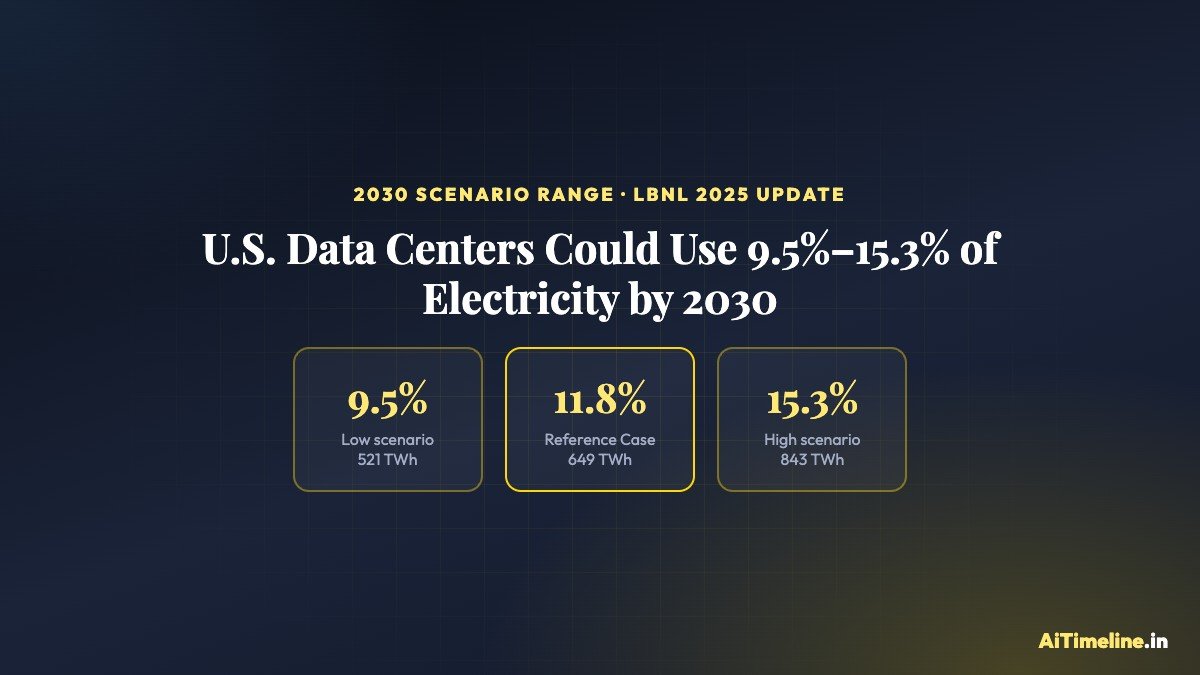
LBNL’s 2025 Update Reference Case: 649 TWh, 11.8% of forecast 2030 U.S. electricity, inside a 521–843 TWh scenario range. Source: LBNL.
Interactive: Power America’s AI Boom
Pick a data-center load, then build an energy portfolio. There’s no single right answer — only trade-offs.
Illustrative, not a real grid-dispatch model. Actual portfolios also depend on hourly timing, location, transmission access and contract structure.
Can America Build Electricity Infrastructure As Fast As It Builds AI?
Chips, software and capital can scale in months. Generation, transmission, substations, transformers, permits, fuel supply and land take years. That mismatch — not electricity itself — is the real story.
AI development can move fast because its inputs — chips, code and money — are things a company can buy or build in-house on a compressed timeline. Electricity infrastructure can’t move that fast, because it depends on things no single company controls: utility interconnection studies, state permitting processes, transformer and turbine manufacturing queues, and, often, entirely new transmission lines that cross multiple jurisdictions. Software can scale in months. Power systems can take years. A utility cannot serve a new 1-gigawatt customer with a software update.
U.S. AI Data Center Timeline 2010–2026
Reverse chronological. Cloud growth came first — generative AI didn’t create data-center electricity demand, it accelerated it.
Ghost Demand, Texas Scrutiny and Record EIA Forecasts
What happened: The EIA’s September 2026 Short-Term Energy Outlook projects U.S. electricity generation will rise 2.2% to a record 4,368 billion kWh in 2026, then another 1.7% to a new record in 2027 — citing data-center development, alongside broader manufacturing and electrification growth, as a key driver. The same outlook flags a pause in new data-center project processing in Texas even as national interconnection requests exceed 700 GW. Texas’s PUCT publishes its draft SB6 large-load rule (16 TAC §25.194) requiring 75 MW+ loads to prove financial and site readiness.
Why it matters: 2026 is the year “ghost demand” became a named, tracked phenomenon rather than an afterthought in interconnection queues, and the first year regulators started building formal readiness filters into the process.
Gigawatt-Scale Campuses Become the New Normal
What happened: Hyperscalers and AI-infrastructure ventures (including OpenAI’s Stargate program with Oracle and SoftBank) announce campuses sized in the hundreds of megawatts to multiple gigawatts, most prominently in Texas. Utilities report unprecedented volumes of large-load interconnection requests.
Why it matters: Announced capacity and built capacity are different things — a large share of 2025’s headline numbers describe financing and land deals, not energized megawatts.
Big Tech Signs Nuclear Power Deals
What happened: Microsoft signs a 20-year power purchase agreement tied to Constellation Energy’s restart of Three Mile Island Unit 1 (rebranded the Crane Clean Energy Center). Google, Amazon and Meta separately pursue advanced nuclear agreements — including small modular reactor development deals and existing-plant power contracts — to lock in firm, low-carbon electricity for AI campuses.
Why it matters: These are power-purchase agreements and restart/development deals, not acquisitions — no tech company owns a nuclear plant.
Electricity Becomes a Named Constraint on AI Growth
What happened: Lawrence Berkeley National Laboratory publishes its U.S. Data Center Energy Usage Report in December 2024, estimating 2023 consumption near 176 TWh (4.4% of U.S. electricity) and projecting 6.7%–12% by 2028. Utility executives and grid operators begin citing data centers by name as a demand-growth driver in earnings calls and resource plans. (LBNL’s 2025 Update, published in 2026, later revised 2024 usage to 192 TWh/4.7% and set the 2030 Reference Case at 11.8%.)
Why it matters: This is the first widely-cited, methodologically transparent national estimate distinguishing data-center electricity growth from general load growth.
The GPU Buildout Accelerates
What happened: Demand for advanced AI accelerators grows rapidly following ChatGPT’s 2022 debut. NVIDIA becomes the central supplier of AI training and inference hardware; hyperscalers race to secure GPUs, high-bandwidth memory, networking gear and the cooling and electrical systems needed to run them at scale.
Why it matters: Buying GPUs is only the beginning — someone still has to power and cool them, and that “someone” is a utility, not a chipmaker.
ChatGPT Triggers Mass Consumer Adoption
What happened: ChatGPT’s public launch drives explosive consumer awareness of generative AI, followed immediately by enterprise investment across nearly every major technology company.
Why it matters: This is the demand-side shock that turned AI compute from a research expense into a commercial infrastructure race.
Large Language Models Demonstrate Rapid Scaling
What happened: GPT-3-era research shows that larger transformer models, trained on more data with more compute, produce meaningfully better capabilities. Compute requirements for frontier training runs rise sharply.
Why it matters: This is where “bigger models need more chips and more electricity” became a common industry pattern — though scaling gains depend heavily on architecture, data quality and training method, not compute alone.
“Attention Is All You Need” Introduces the Transformer
What happened: Google researchers publish the transformer architecture, which became the technical foundation for nearly every modern large language model.
Why it matters: Transformers made it practical to train much larger models on much larger datasets — a prerequisite for the compute race that followed, though the architecture itself, not raw scale, is what made the approach work.
Custom AI Accelerators Emerge
What happened: Google deploys its first Tensor Processing Units for internal machine-learning workloads; GPU-based training expands across the industry as a more efficient alternative to general-purpose CPUs for deep learning.
Why it matters: Specialized AI hardware improved performance-per-watt substantially over CPU training — but total electricity use still grew, because model and dataset sizes grew faster than efficiency gains.
AlexNet Shows GPU-Accelerated Deep Learning Works
What happened: AlexNet demonstrates a major leap in computer-vision accuracy by training a deep neural network on GPUs rather than CPUs, at the ImageNet competition.
Why it matters: This result is widely cited as the moment GPU training entered mainstream AI research — but it is one data point in a longer research arc, not a single cause of today’s data-center electricity demand.
The Cloud Era Expands Data-Center Electricity Demand
What happened: Amazon Web Services, Microsoft and Google rapidly expand U.S. hyperscale cloud infrastructure to support enterprise migration to the cloud, streaming video and mobile internet growth.
Why it matters: Cloud computing was already increasing U.S. data-center electricity demand for over a decade before generative AI existed as a consumer product — AI accelerated an existing trend, it didn’t start one.
2027–2030: What to Watch
- Whether Berkeley Lab or EIA publish updated data-center share estimates as more 2026–2027 build-out data becomes available.
- Whether Three Mile Island Unit 1 / Crane Clean Energy Center’s restart stays on its announced schedule.
- How many gigawatts of announced AI campuses (including Stargate-linked sites) reach actual commercial operation versus remaining announcements.
- Whether more states adopt Texas-style large-load interconnection rules requiring proof of financial and technical readiness.
- Whether PJM and other RTOs formally separate “requested” from “committed” load in public interconnection-queue reporting.
- Whether small modular reactors move from licensing/design into actual construction at scale.
- Whether AI inference efficiency gains (smaller models, better accelerators, higher utilization) slow electricity-demand growth, or whether falling costs simply increase total usage.
This section describes plausible developments to monitor, not confirmed future events.
Why Does AI Need So Much Electricity?
A rack of AI accelerators doesn’t care whether its electricity came from a nuclear plant, a wind farm or a gas turbine — the grid does the work of turning fuel or sunlight into electrons, and the data center just consumes them. What makes AI workloads unusually power-hungry is scale and density: training a large model means running thousands of GPUs continuously for weeks, and serving millions of users means running inference around the clock. Add networking, high-bandwidth memory, and the cooling systems needed to keep dense server racks from overheating, and a single AI campus can draw as much power as a mid-sized industrial facility — or more.
Training AI vs Using AI: Which Consumes Electricity?
As AI adoption grows, inference’s share of total electricity use tends to become more important simply because it never stops, while training runs are finite events. No credible public research currently gives a precise, universal split between the two at the U.S. national level — treat any specific percentage you see with caution.
❓ How Much Electricity Does One AI Prompt Use?
There is no single honest answer. Energy per query depends on the model’s size, the prompt and response length, the hardware it runs on, how many requests are batched together, how efficiently the data center is run (see PUE below), and the facility’s location and cooling design. Viral comparisons like “one AI query uses as much electricity as several web searches” usually come from a single vendor’s own optimized system and don’t generalize across models or providers. Treat any single-number claim about “one prompt” as illustrative at best.
MW, GW and TWh: What’s the Difference?
Data-center coverage constantly mixes these up. Here’s the distinction.
Megawatts (MW) and gigawatts (GW) measure power — the rate at which electricity is used at any given moment, like the speedometer in a car. Megawatt-hours (MWh) and terawatt-hours (TWh) measure energy — the total amount used over time, like the odometer. One gigawatt sustained for one hour equals one gigawatt-hour. The same 1 GW sustained continuously for a full year equals about 8.76 TWh.
Interactive: What Does 1 GW Actually Mean?
Grid Connection Capacity vs. Annual Energy Use
A data center’s grid connection is measured in MW/GW (power). Its annual electricity bill is measured in MWh/TWh (energy). Pick a connection size to see the theoretical annual maximum — and why real usage is almost always lower.
Formula: power (MW) × 8,760 hours × utilization = annual energy (MWh). A 1 GW connection running continuously all year at 100% utilization is a theoretical maximum of 8.76 TWh — real facilities rarely sit at 100% because of maintenance, ramp-up, and load variability. This ignores PUE, actual server deployment schedules and capacity reserved-but-unused — it’s a ceiling, not a bill.
Where the Electricity Actually Goes
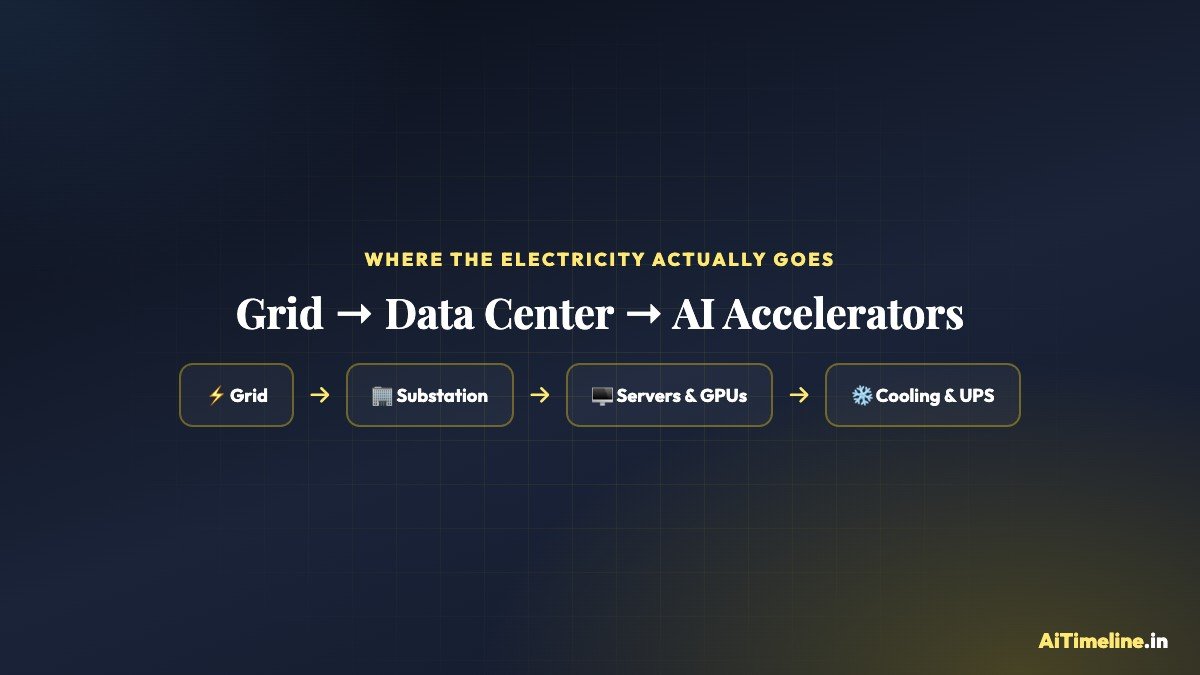
Electricity doesn’t stop at the meter — it’s stepped down, distributed, computed with, and cooled.
What Is PUE?
Power Usage Effectiveness (PUE) = total facility energy ÷ IT equipment energy. A PUE of 1.5 means a facility uses 1.5 units of total electricity for every 1 unit that actually reaches servers and chips — the rest goes to cooling, power conversion losses and backup systems. PUE varies by facility design, climate and age; there is no single PUE that applies to every data center.
Why Can’t America Just Build More Power Plants?
Every new generation project needs site development, financing, permitting, an interconnection study, equipment procurement, fuel supply arrangements where applicable, environmental review and construction — then transmission capacity to actually move the power to where it’s needed. But timelines vary enormously by technology: utility-scale solar and battery storage can sometimes be sited and built in one to three years, while new nuclear plants, large gas turbines (currently facing multi-year order backlogs) and major transmission lines routinely take five to ten years or more. AI capacity, grid capacity and generation capacity do not scale at the same speed — and pretending they do is why “just build more power plants” undersells how the constraint actually works.
The Grid Connection Problem
Connecting a new large customer to the grid isn’t just a matter of running a wire. It requires an interconnection study to confirm the local substation, transformers and transmission lines can handle the added load without destabilizing the grid for existing customers, plus often new transmission or generation to serve it. For a 1-gigawatt data center, that can mean new substations, transformer orders (some with multi-year lead times), and transmission upgrades spanning dozens or hundreds of miles.
What Is “Ghost Demand”?
One of the most important, least-understood parts of this story.
By 2026, reported large-load interconnection requests nationally — overwhelmingly from data centers — had climbed past 700 gigawatts, more than ten times LBNL’s estimate of actual current U.S. data-center electricity consumption. Texas alone saw its ERCOT queue grow from roughly 48 GW in 2023 to about 474 GW by 2026. A meaningful share of that requested load is what researchers and grid planners now call “ghost demand”: duplicate applications from the same developer filed with multiple utilities to keep options open, speculative site reservations without secured financing or chip orders, and projects that never break ground. Filing an interconnection request has historically cost a developer almost nothing — some paperwork, a modest deposit, maybe a feasibility fee — with no requirement to show financing, permits or a signed power contract first, so there was until recently little cost to over-requesting.
This matters because exaggerated queues distort planning: utilities may study or even build infrastructure for demand that never materializes, other customers can face longer interconnection wait times behind inflated queues, and long-term capital gets allocated based on unreliable signals. It’s why Texas and other markets have started requiring large-load applicants to show financial and technical commitment — a signed equipment order, secured financing, site control — before their request is treated as real in grid planning.
Why Texas Became a Test Case
ERCOT’s data-center interconnection queue grew from about 48 GW in 2023 to roughly 474 GW by 2026 — nearly a tenfold jump, and far more than Texas could ever realistically connect, let alone power. In response, Texas Governor Greg Abbott signed Senate Bill 6 on June 20, 2025, directing the Public Utility Commission of Texas (PUCT) and ERCOT to overhaul how large loads connect to the grid. In March 2026, the PUCT published a draft rule (16 TAC §25.194) requiring any new load of 75 MW or more to prove site control (a deed, purchase option, or a lease running at least five years past its contracted peak-demand date) and sign an intermediate agreement with the transmission provider before ERCOT even begins an interconnection study — alongside a proposed $50,000-per-MW interconnection fee meant to filter out speculative filings. A final large-load rule is expected by December 31, 2026. Separately, the PUCT has already affirmed ERCOT’s authority to curtail co-located data-center load during grid emergencies, in its first net-metering case decided under SB6. None of this amounts to a ban on data centers — it’s a readiness and cost-allocation filter aimed squarely at Texas’s own ghost-demand problem.
PJM and Northern Virginia: Where the Grid Meets the Queue
PJM Interconnection is a regional transmission organization — not a utility — that coordinates wholesale electricity markets and grid reliability across 13 states and Washington, D.C., including Virginia, Ohio and Pennsylvania. PJM’s territory contains the country’s densest concentration of data centers, concentrated heavily in Northern Virginia. Rising large-load forecasts, alongside power-plant retirements and market-rule changes, have pushed PJM’s capacity-market auction clearing prices sharply higher: from $28.92 per megawatt-day for the 2024/2025 delivery year to $269.92/MW-day for 2025/2026, and $329.17/MW-day for 2026/2027 (a figure PJM’s own price cap held down from going higher still). PJM’s Independent Market Monitor has attributed 63% of the 2025/2026 increase — about $9.3 billion — to data-center load growth specifically, with the remainder tied to generator retirements and other market dynamics. That single-auction attribution is the most-cited figure; multi-year cumulative projections (one advocacy estimate puts $100–163 billion through 2033 absent reform) are forward-looking projections, not settled facts, and depend on auctions that haven’t happened yet.
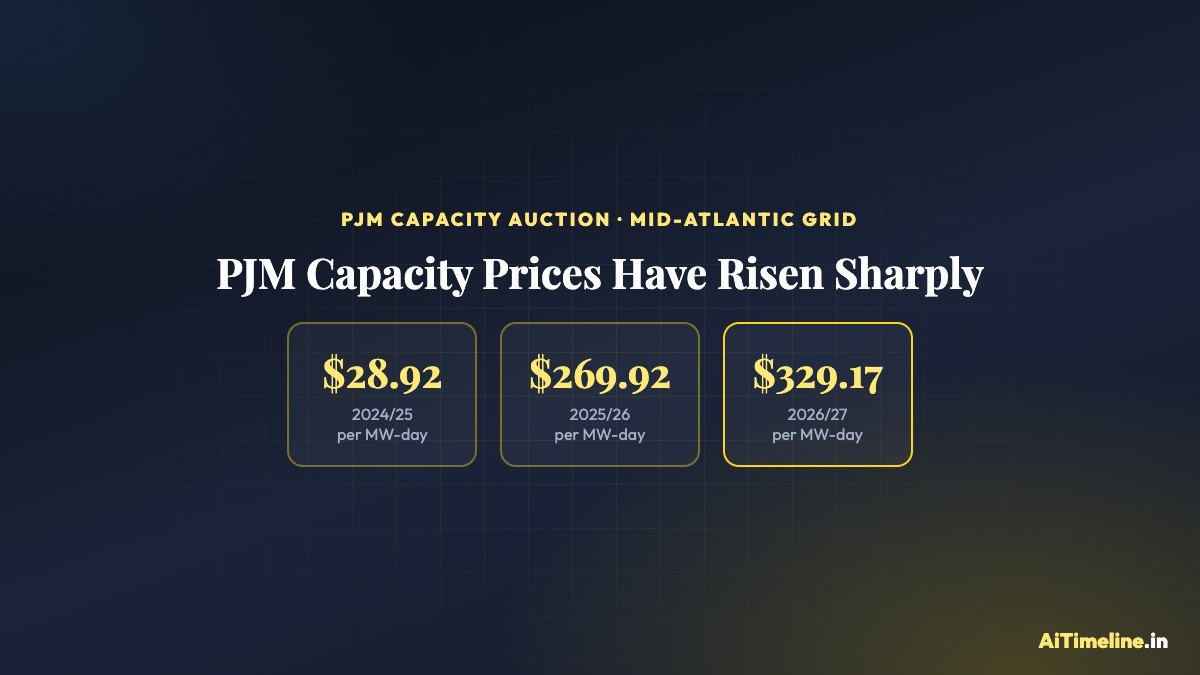
PJM’s capacity clearing price roughly tripled year-over-year, then rose again under a price cap. Source: PJM auction results.
Northern Virginia became “Data Center Alley” for reasons that predate AI: dense fiber-optic connectivity, major internet exchange points, an established cloud-computing ecosystem, available land and historically favorable tax policy. Those same advantages now collide with real constraints — transmission capacity, community opposition to new substations and transmission lines, and Dominion Energy’s own long-range load forecasts. These constraints are specific to Virginia’s grid geography; they don’t automatically apply to every U.S. data-center market.
Interactive: AI vs the Grid
Illustrative teaching tool, not a real interconnection study or rate-case model.
Will AI Raise Household Electricity Bills?
Maybe — but the answer depends heavily on where you live and how costs are allocated, not on a single national rule. New transmission lines, generation, substations and capacity-market costs can all flow into utility rates if regulators let data-center-driven costs be spread across all customers. Some states and utilities are moving toward large-load tariffs and minimum-demand contracts specifically designed to make data centers, not households, shoulder the infrastructure risk they create. Distinguish four different things reporters often blur together: the wholesale price (what generators are paid), the capacity price (paid for guaranteed future availability), the utility retail rate (what you actually pay per kWh) and separate transmission/distribution charges on your bill. A rise in one doesn’t automatically mean a rise in the others. Concrete, market-specific examples exist: Washington, D.C.-area utility Pepco raised residential bills by roughly $21 a month starting in June 2025, and one advocacy group’s modeling projects PJM-territory households could see bills rise by roughly $70 a month by 2028 versus pre-surge levels if capacity costs keep climbing and aren’t reallocated. Those are PJM-specific, capacity-market-linked figures — not a claim that every U.S. household’s bill is rising because of AI.
Interactive: Who Pays for a 1-GW AI Campus?
Real cost allocation is set by state utility regulators case by case — this is a simplified teaching model of the trade-offs regulators weigh.
Why AI Is Reviving Interest in Nuclear Power
Nuclear plants offer qualities that make them attractive to data-center operators seeking firm power: large, steady output; a high capacity factor (they run near-full power most of the time); low operational carbon emissions; and, for existing plants, a connection to the grid that already exists.
Three Mile Island Unit 1 / Crane Clean Energy Center
Constellation Energy’s plan to restart Unit 1 — not Unit 2, the reactor involved in the 1979 accident — under a 20-year power purchase agreement with Microsoft. Constellation has said the restart would add roughly 835 MW back to the grid. This is a PPA for output, not an acquisition; Microsoft does not own the plant.
Google & Kairos Power
Google signed an agreement to purchase power from small modular reactors developed by Kairos Power, aimed at bringing new nuclear capacity online later in the decade — a development deal, not an operating plant today.
Amazon & X-energy
Amazon has invested in X-energy’s small modular reactor technology and signed agreements to support SMR projects near existing nuclear sites — again, development-stage, not current supply.
Meta & Constellation
Meta has signed long-term power agreements tied to existing U.S. nuclear generation to secure firm, carbon-free electricity for its data-center growth.
Can Small Modular Reactors Power AI Today?
Not yet, at scale. SMRs could plausibly provide firm, low-carbon power for future data centers, but as of 2026 most U.S. SMR projects tied to tech-company deals are in licensing, design or early construction — not commercial operation. Treat SMRs as a real but multi-year-out part of the electricity mix, not a current solution to today’s grid pressure.
Why Natural Gas May Grow Alongside AI
Natural gas remains the largest single source of U.S. electricity generation, and gas turbines can be dispatched quickly and paired relatively fast with new data-center load compared to nuclear or major transmission builds — though current turbine order backlogs still stretch several years. Gas plants emit CO2 and are exposed to future price volatility and long asset lifespans that could clash with state and corporate climate targets, plus pipeline capacity constraints in some regions. It is neither an obviously good nor obviously bad choice — it’s a trade-off between near-term reliability and long-term emissions commitments.
Can Solar, Wind and Batteries Carry the Load?
Solar can supply large volumes of low-cost electricity during sunny hours; wind adds output that peaks at different times and in different locations, improving diversity across a portfolio. Batteries can shift some of that electricity across hours, but most deployed storage today covers short durations (hours, not days) — a different problem from a data center’s need for essentially uninterrupted power. The honest answer is neither “solar alone can’t power data centers” nor “solar plus batteries can always deliver 24/7 supply” — it depends on the specific site, the portfolio mix and how much firm backup (gas, nuclear, or grid import) sits alongside the renewables.
AI Needs Electricity — But What About Water?
Cooling systems in many data centers use water, and electricity generation itself (especially thermal plants) can also be water-intensive depending on the cooling technology used. Water intensity varies enormously by data-center cooling design (air-cooled vs. evaporative vs. liquid cooling) and by region — there is no single “liters per AI prompt” figure that applies everywhere. Local community concerns about water use are real and documented in specific markets, but they don’t generalize into a single national number.
Will AI Agents Use More Electricity?
Possibly — but there’s no reliable universal conversion yet
An AI agent may make multiple model calls, tool calls, searches, code executions and retries to complete one task, which could mean more total compute than a single chatbot reply. But total energy still depends on model size, hardware efficiency, inference optimization, task complexity and how many calls actually run. Treat “AI agents will definitely use vastly more electricity” as an open question, not a settled fact.
What If AI Gets More Efficient Faster Than Demand Grows?
Better accelerators, quantization, smaller and more specialized models, Mixture-of-Experts architectures, model distillation, software optimization and higher data-center utilization are all reducing the electricity cost of a given AI task over time. But cheaper, more efficient AI tends to get used more — a pattern economists call the rebound effect. Efficiency gains lowering the cost per task don’t automatically translate into lower total electricity demand if usage grows faster than efficiency improves.
Who Is Building the AI Infrastructure?
NVIDIA
Supplies the majority of AI training and inference accelerators used across U.S. data centers.
Microsoft, Google, Amazon (AWS), Meta, Oracle
Build and operate the hyperscale data centers running AI workloads; increasingly also the ones signing power-purchase agreements directly with generators.
Regional electric utilities
Own the wires and, often, the generation that actually delivers electricity to a data center’s meter.
RTOs / ISOs (PJM, ERCOT and others)
Coordinate wholesale electricity markets and grid reliability across multi-state regions; don’t generate or sell power themselves.
Not every AI company is a data-center owner — some (OpenAI, xAI) primarily lease or co-develop capacity rather than build and operate facilities outright.
Stargate and AI Megaprojects
OpenAI, Oracle and SoftBank’s Stargate program is among the largest announced AI-infrastructure efforts, with sites including one near Abilene, Texas. Announced financing and site plans are real, but announced capacity and actually energized, operating capacity are not the same thing — large infrastructure programs routinely take longer and cost more than their initial announcements suggest, and not every announced phase is guaranteed to be built as originally described.
Building Electricity Isn’t the Only Problem
Reported bottlenecks beyond power plants themselves
- Large power transformers, with multi-year order backlogs at some manufacturers
- Grid-scale switchgear and gas turbines
- Transmission-line equipment and steel
- Electrical engineers and skilled construction labor
- Data-center cooling equipment
- GPU and high-bandwidth-memory supply
- Fiber connectivity for new sites
- Permitting timelines at the state and local level
One bottleneck — a single missing transformer, a permit stuck in review — can delay an entire facility’s energization by months or years, regardless of how quickly the chips and buildings themselves are ready.
AI Data-Center Boom: Benefits and Costs
Jobs: Be Precise
Large data centers generate substantial construction employment for one to three years, but typically far fewer permanent operations jobs once running — often dozens to a few hundred, not thousands, for a single large campus. Indirect and induced jobs (suppliers, local services) add more, but claims about a specific project’s job creation should be checked against that project’s own public filings, not assumed from headline investment figures.
Key U.S. Data-Center Markets
| Market | Grid operator | Known for | Main constraint |
|---|---|---|---|
| Northern Virginia | PJM (Dominion Energy) | Largest U.S. data-center concentration | Transmission & substation capacity |
| Dallas–Fort Worth / Abilene, TX | ERCOT | Gigawatt-scale AI campuses, Stargate site | Interconnection queue & large-load rules |
| Columbus, OH | PJM | Hyperscale expansion, chip manufacturing nearby | Regional transmission planning |
| Phoenix, AZ | WECC region utilities | Growing hyperscale footprint | Water availability, summer peak demand |
| Atlanta, GA | Southern Company territory | Rapid data-center growth | Generation adequacy planning |
| Chicago, IL | PJM | Established colocation hub | Aging transmission infrastructure |
U.S. AI Power Tracker 2026
| Date | Development | Status |
|---|---|---|
| 2026-09 | EIA: record U.S. generation, 4,368 BkWh in 2026 (+2.2%), new record again in 2027 (+1.7%) | Confirmed forecast |
| 2026-03 | Texas PUCT publishes draft SB6 large-load rule (75 MW+, $50,000/MW fee) | Draft; final rule due Dec 31, 2026 |
| 2026 | National data-center interconnection requests exceed 700 GW; ERCOT queue hits ~474 GW | Confirmed queue data; largely ghost demand |
| 2026/2027 | PJM capacity auction clears at $329.17/MW-day (price-capped) | Confirmed |
| 2025/2026 | PJM capacity auction clears at $269.92/MW-day; IMM attributes 63% ($9.3B) to data centers | Confirmed |
| 2025-06 | Texas Senate Bill 6 signed into law | Confirmed |
| 2024-09 | Microsoft-Constellation 20-year PPA for Three Mile Island Unit 1 restart (835 MW) | Restart targeted 2027 |
| 2024-12 | LBNL’s original Data Center Energy Usage Report published | Confirmed baseline data |
This tracker will be updated as new verified developments are confirmed; it is not exhaustive.
Explore More Timelines
People Also Ask
Frequently Asked Questions
Explore More on AiTimeline
⚠️ Editorial Note
Figures in this article are drawn from Lawrence Berkeley National Laboratory, the U.S. Energy Information Administration, PJM, ERCOT and company/regulatory disclosures where available, current as of September 2026. Electricity-demand forecasting is inherently uncertain; ranges reflect that uncertainty rather than a single confirmed outcome. This is editorial analysis, not investment, engineering or regulatory advice.
Sources & further reading
Every dated entry above was checked against these references. Last reviewed 13 September 2026.
- Lawrence Berkeley National Laboratory — United States Data Center Energy Usage Report: 2025 Update
- U.S. Energy Information Administration — EIA Expects Record Electricity Generation in 2026 and 2027
- Utility Dive — PJM Capacity Prices Hit Record High as Grid Operator Falls Short of Reliability Target
- Bracewell LLP — Texas Senate Bill 6 Ushers in Major Overhaul of Large Load Interconnection Rules
- White & Case — PUCT Affirms Curtailment Authority Over Co-Located Data Centers Under SB6
- Constellation Energy — Official Announcement: Crane Clean Energy Center (Three Mile Island Unit 1) Restart
- Inside Climate News — Texas Grid Operators and Regulators Iron Out New Rules for Data Centers