Iconic Sports Video Games: The Complete History From Pong to Esports
A sourced history of sports video games, from Pong in 1972 to Madden, FIFA/EA Sports FC, Wii Sports, motion capture and modern AI-assisted gameplay.
Latest Story
Two friends, a bag of chips, and a CRT television with a curved glass screen that hummed faintly when you turned it on. That’s a Saturday afternoon in 1998, somewhere in a living room with wood-panelled walls, two controllers connected by cords just long enough to reach the couch, and a football game loading off a cartridge with an audible click. There’s no chat window, no matchmaking screen, no ping counter in the corner. There’s just the two of you, arguing about whether that tackle was late, whether the running back should have cut left, and whether it’s your turn to be the away team next time. Fast forward to today, and that same rivalry plays out differently: two strangers, on opposite sides of a country, matched by an algorithm in a ranked online mode, their reactions streamed live to a tournament chat of thousands, prize money on the line, every touch of the ball tracked by motion-capture data pulled from actual professional matches. Both moments are recognisably “sports video games.” Almost nothing about how they’re built, sold, played or watched is the same. This guide traces the more than five decades between them — not as nostalgia, but as a sourced, dated history of how a genre that started with two paddles and a square ball became one of the largest, most technically sophisticated corners of interactive entertainment.
🧠 AI Overview Summary
Sports video games trace back to Pong, released by Atari in November 1972, widely credited as the first commercially successful video game and the genre’s founding title. The category evolved through arcade classics like Track & Field (Konami, 1983) and Tecmo Bowl (1989), home console pioneers like Excitebike (Nintendo, 1985) and John Madden Football (EA, 1988), and 3D-era breakthroughs including FIFA International Soccer (1993), NBA Live (1994) and Gran Turismo (1998). Online multiplayer, motion controls (Nintendo Wii Sports, 2006), licensing consolidation (EA’s exclusive NFL deal, 2004), and competitive esports scenes reshaped the genre from the mid-2000s onward, while EA’s 2023 rebrand from FIFA to EA Sports FC marked one of the industry’s most significant recent licensing shifts. Today’s sports games combine motion-captured animation, physics-based simulation, live-service content updates and, increasingly, machine-learning techniques for realistic player movement, built on engines from companies including EA, 2K, Konami and Sony’s Polyphony Digital.
Sports video game history, in six direct answers
What matters most about sports gaming history
- Pong (1972) is the genre’s accepted starting point. A simple table-tennis simulation became the first commercially successful video game and set the template for competitive, two-player sports gaming.
- Sports games repeatedly showcased new hardware first. Track & Field pushed arcade input hardware, Excitebike showcased the NES, Gran Turismo showcased the original PlayStation’s 3D capabilities, and Wii Sports sold the Wii itself.
- Licensing shaped competition as much as gameplay did. EA’s 2004 exclusive NFL deal ended the ESPN NFL 2K series; EA’s 2023 split from FIFA created the EA Sports FC brand and opened the door for Konami’s eFootball to compete for official FIFA branding.
- Realism came from several technologies working together, not graphics alone. Motion capture, physics engines and AI-driven animation all had to mature before sports games looked and moved convincingly.
- Sports games were social long before online play existed. Local multiplayer on a single console, going back to Pong itself, made these titles a shared social experience from the very beginning.
- Annual release cycles created some of gaming’s longest-running franchises. Madden NFL and FIFA/EA Sports FC have released new entries nearly every year for three decades or more.
- Esports turned sports games into spectator content. Publisher-run competitive circuits, including the NBA 2K League, formalised competitive play that had grown organically through the 2010s.
- Live-service updates changed how these games are sold and played. Ultimate Team-style modes and ongoing seasonal content turned annual releases into continuously updated platforms rather than fixed, one-time products.
- Console makers and publishers are separate parts of this history. Nintendo, Sony and Microsoft built the hardware; EA, 2K, Konami, Sega and others built the software — and both sides’ decisions shaped the genre together.
- This guide separates fact from nostalgia throughout. Historical milestones, official announcements, critical reception and this guide’s own analysis are labelled separately, and no title is called “the greatest ever” as an unsupported claim.
What Sports Video Games Actually Are
Arcade era, console era, PC gaming, online multiplayer, motion controls, esports, live-service updates, licensing, game engines and AI — the vocabulary of sports gaming history, explained before the timeline begins.
A sports video game is any interactive title built around simulating or stylising a real-world sport — its rules, movement, scoring and competitive structure — whether that means an arcade cabinet rewarding fast reflexes or a home console simulation modelling the physics of a curling free kick. The genre spans a wide range of design philosophies, from pure arcade action to deep statistical simulation, and this guide covers both ends of that spectrum.
The arcade era, running roughly from the early 1970s into the late 1980s, established sports gaming’s core appeal: quick, competitive, coin-operated experiences designed for short sessions and bragging rights among friends standing at the same cabinet. The console era, beginning with early home systems and accelerating through the NES, Genesis and PlayStation generations, moved that experience into the living room, enabling longer play sessions, season-length career modes, and eventually much larger game worlds and rosters than any arcade board could hold. PC gaming ran alongside consoles throughout, often serving as an early testbed for statistical depth and modding communities, particularly for management-style sports simulations.
Online multiplayer connected players beyond the same room or arcade for the first time at scale, maturing through the Xbox Live and PlayStation Network era from the mid-2000s onward. Motion controls — physically swinging a controller to swing a tennis racket or a golf club — had experimented in earlier eras but reached mainstream maturity with the Nintendo Wii in 2006. Esports turned competitive sports gaming into a spectator activity in its own right, with publisher-backed leagues and prize pools built around titles like FIFA/EA Sports FC and NBA 2K. Live-service updates — ongoing content drops, roster updates and in-game economies like Ultimate Team modes — changed sports games from a one-time annual purchase into an evolving platform played continuously across a season.
Real player licensing — the rights to use official league branding, team names, kits, stadiums and named athletes — became one of the industry’s defining competitive battlegrounds, discussed in detail later in this guide. Game engines, the underlying software frameworks handling graphics, physics and animation, evolved from simple 2D sprite systems into sophisticated proprietary and licensed 3D engines capable of real-time physics simulation. And artificial intelligence in sports games today covers everything from the decision-making of computer-controlled opponents and teammates to newer machine-learning techniques used to generate more lifelike player animation from real motion data — a very different use of the term “AI” than the tactical logic that powered a 1988 football game’s defensive plays.
📜 History Insight
Sports games have often showcased new console technology before many other genres. Excitebike demonstrated the NES’s scrolling and physics capabilities in 1985; Gran Turismo showed off the original PlayStation’s 3D rendering in 1998; Wii Sports sold the motion-sensing Wii Remote to a mainstream, non-gaming audience in 2006. This pattern repeats because sports gameplay — movement, physics, competition — is an intuitive, immediately legible way to demonstrate what new hardware can actually do.
The Complete Historical Timeline: Sports Video Games, 1972-2026
Historical background, technology breakthrough, gameplay innovation, commercial impact and industry significance are separated in every entry, newest first. Historical facts, official announcements, critical reception and independent analysis are never blended into one unqualified claim.
Live-service sports gaming continues to mature, with AI-driven animation now standard
Current relevance: as of the most recently confirmed publisher disclosures referenced in this guide, annual sports franchises continue to centre their business models on live-service seasonal content and Ultimate Team-style modes, with motion-capture and machine-learning-assisted animation technology now standard across major titles rather than a marketed novelty.
Industry evolution: licensing arrangements between publishers, leagues and player associations continue to be renegotiated on their own schedules, with EA Sports FC, 2K’s basketball and golf titles, and Konami’s eFootball each operating under separate, publicly disclosed agreements.
Current sports gaming trends consolidate around live-service platforms and cross-title esports
Industry significance: 2025 continued a trend, well underway since the previous decade, of major publishers treating flagship sports titles as long-running platforms — supported by frequent content updates and competitive modes — rather than as fixed, self-contained annual releases.
Commercial impact: industry revenue reporting continued to show in-game purchases and seasonal content, rather than the upfront cost of the game itself, as the dominant revenue driver for major sports franchises, a pattern first clearly established in the Ultimate Team era discussed later in this guide.
AI-assisted gameplay technology moves from experiment to marketed feature
Technology breakthrough: 2K’s NBA 2K25, released in 2024, introduced “ProPLAY” technology, which the publisher described as using real broadcast basketball footage, processed with machine-learning techniques, to generate more lifelike in-game player animation — a publicly documented example of AI-assisted animation moving into a major annual sports release.
Gameplay innovation: EA continued expanding its HyperMotion motion-capture and animation-blending technology, first introduced in FIFA 22 (2021), across its EA Sports FC titles, combining large-scale real-match motion data with real-time animation systems.
Hyper-realistic graphics become the standard on PlayStation 5 and Xbox Series X
Technology breakthrough: the console generation that began in late 2020 with the PlayStation 5 and Xbox Series X|S reached full multi-title maturity by 2022, with sports franchises across football, basketball and racing showcasing real-time lighting, crowd density and player detail well beyond the prior console generation’s capabilities.
Industry significance: this period is also when EA’s HyperMotion2 technology (an expansion of the motion-capture system introduced the previous year) and comparable systems from other publishers became a standard marketing point across the genre, not a one-off feature.
Cloud gaming reaches sports titles as streaming platforms expand
Historical background: Google Stadia had launched in November 2019, and Microsoft’s Xbox Cloud Gaming (then Project xCloud) entered public preview around the same period, both aiming to stream games — including major sports titles — to devices without dedicated console hardware.
Industry significance: 2020’s pandemic-driven surge in overall gaming engagement accelerated interest in cloud and streaming access to sports titles specifically, though cloud gaming’s broader commercial success remained mixed across the industry in the years that followed, with Google discontinuing Stadia in January 2023.
Cross-platform play breaks down console-exclusive multiplayer barriers
Historical background: Sony enabled cross-platform play on PlayStation 4 starting in September 2018, following pressure led publicly by Fortnite developer Epic Games and other publishers, ending a long-standing industry norm of keeping console players separated by platform in online multiplayer.
Business significance: sports and sports-adjacent titles with strong online communities, including Rocket League, were among the games that benefited from unified cross-platform player bases once the policy changed, widely reported at the time as a significant shift in console platform strategy.
Esports growth reaches mainstream recognition, and sports titles build competitive scenes
Industry significance: the broader esports industry saw major mainstream growth around the mid-2010s, with large prize pools and sponsorship deals across multiple genres drawing significant media coverage; sports titles including FIFA began building more formalised competitive tournament structures during this period, building on years of organic competitive community activity.
Current relevance: this period laid groundwork for later, more formal publisher-run competitive structures, including the NBA 2K League (announced by the NBA and Take-Two in 2017, launched 2018) and EA’s official FIFA/EA Sports FC esports tournament programmes.
Motion gaming reaches technical maturity with Kinect and PlayStation Move
Historical background: Microsoft released the Kinect motion and camera sensor for Xbox 360 in November 2010, and Sony released the PlayStation Move controller in September 2010, both extending motion-based play (pioneered commercially by Wii Sports in 2006) with more precise tracking technology.
Gameplay innovation: sports titles built specifically around these systems, including Kinect Sports and various motion-based golf and tennis titles, aimed for finer-grained physical control than the original Wii Remote offered, though critical reception for tracking precision varied by title and sport.
Online multiplayer becomes a standard, expected feature across major sports franchises
Historical background: Xbox Live (launched 2002) and PlayStation Network (launched 2006) had matured enough by around 2008 that online play — ranked matches, online seasons, and eventually online team-building modes — became a standard, expected component of major annual sports releases rather than an experimental add-on.
Industry significance: this period marks the point where a sports game’s online infrastructure became as important to its critical and commercial reception as its on-field gameplay, a shift multiple gaming publications documented through their review coverage of the era’s major titles.
Nintendo Wii Sports brings motion controls to a mainstream, non-gaming audience
Historical background: Wii Sports launched alongside the Nintendo Wii console in November 2006, bundled with the console in most regions, using the Wii Remote’s motion sensing to let players swing, throw and putt with physical gestures rather than button presses.
Commercial impact: Wii Sports became one of the best-selling video games of all time by units sold, widely credited by industry press and Nintendo’s own reporting with significantly broadening the console’s audience beyond traditional gamers, including many players and households that had not owned a games console before.
EA’s exclusive NFL licensing deal reshapes American football gaming
Historical background: Electronic Arts signed an exclusive licensing agreement with the NFL and NFL Players Association in December 2004, granting EA sole rights to develop games using official NFL teams, players and the league’s branding — a deal reported at the time to be worth several hundred million dollars over multiple years.
Business significance: the deal effectively ended competition from Take-Two/Sega’s ESPN NFL 2K series, whose 2004 entry (ESPN NFL 2K5) had been sold at a notably low price point and received strong critical reception, making the licensing deal one of the most consequential and widely discussed business decisions in sports gaming history.
Pro Evolution Soccer becomes Konami’s answer to FIFA’s growing dominance
Historical background: Konami’s Pro Evolution Soccer series (building on its earlier International Superstar Soccer and ISS Pro Evolution lines in Japan) launched internationally in 2001, distinguishing itself from EA’s FIFA series with gameplay widely praised by critics for its ball physics and player control, even while lacking some of FIFA’s official licensing breadth.
Critical reception: through the 2000s, gaming publications frequently rated Pro Evolution Soccer’s on-pitch gameplay above FIFA’s in head-to-head comparisons, even as FIFA generally outsold it commercially — a well-documented divergence between critical and commercial performance covered further in this guide’s comparison tables.
Gran Turismo redefines what a racing simulation could look and feel like
Historical background: Gran Turismo, developed by Kazunori Yamauchi’s Polyphony Digital studio, released in Japan in December 1997 and internationally in 1998 for the original PlayStation, featuring a large roster of licensed cars and a level of driving-physics detail unusual for console racing games of the period.
Commercial impact: Gran Turismo became one of the best-selling PlayStation titles and established a franchise that has continued across every subsequent PlayStation generation, widely credited by gaming press with elevating console racing games’ reputation for technical simulation depth.
Olympic-licensed games tie sports gaming to the real-world sporting calendar
Historical background: the 1996 Atlanta Summer Olympics prompted a wave of officially licensed Olympic-themed video games across multiple consoles and publishers, following a pattern of real-event tie-in releases that has continued around subsequent Olympic Games.
Industry significance: Olympic and other real-event-licensed sports games illustrate a distinct commercial model within the genre — tied to a fixed real-world calendar event rather than an ongoing annual league season — with release timing and content directly bound to the Olympics’ own four-year cycle.
Virtua Striker showcases early 3D polygon graphics in arcade soccer
Technology breakthrough: Sega AM2’s Virtua Striker, running on Sega’s Model 2 arcade hardware, brought fully 3D polygonal player models and pitches to arcade soccer, a significant visual step up from the 2D sprite-based sports games that had dominated arcades through the 1980s.
Industry significance: Virtua Striker’s arcade success demonstrated 3D sports gaming’s commercial viability ahead of the home console 3D transition that FIFA, NBA Live and other franchises would undergo in the years that followed.
NBA Live launches, beginning EA’s long-running basketball franchise
Historical background: EA released NBA Live 95 in 1994, building on the studio’s earlier basketball titles (including Lakers versus Celtics and the NBA Playoffs and Bulls versus Blazers and the NBA Playoffs) and establishing the NBA Live name that would continue as one of EA Sports’ core franchises for over two decades.
Commercial impact: NBA Live became EA’s flagship basketball series through the 1990s and 2000s, eventually facing sustained competitive pressure from Take-Two’s NBA 2K series (discussed in this guide’s comparison tables) that would reshape basketball gaming’s competitive landscape by the following decade.
FIFA International Soccer establishes EA Sports as a licensing-driven powerhouse
Historical background: EA released FIFA International Soccer in December 1993 for the Sega Genesis (and subsequently other platforms), licensed by FIFA, football’s international governing body, featuring an isometric viewing angle distinct from the side-on perspective common in earlier soccer games.
Business significance: the title launched under the “EA Sports” brand established the year before, and its FIFA licence set a template EA would use across other sports — official league and organisation branding as a core competitive advantage — that shaped the publisher’s strategy for the following three decades, until the 2023 EA Sports FC rebrand discussed later in this guide.
Tecmo Bowl becomes an arcade-to-console football classic
Historical background: Tecmo Bowl launched in arcades in 1987 and was ported to the Nintendo Entertainment System in 1989, featuring simplified, fast-paced American football gameplay without an official NFL license, instead using a fictional team roster.
Cultural impact: the NES version became known for a widely discussed gameplay quirk involving the in-game representation of NFL running back Bo Jackson, whose in-game counterpart’s speed made him famously difficult to tackle — a detail frequently referenced in retrospective gaming coverage and considered one of the era’s most memorable examples of a game’s design producing unintended, legendary gameplay.
John Madden Football lays the foundation for the modern EA Sports franchise
Historical background: EA released John Madden Football for the Apple II in 1988, developed by Robin Antonick, after a multi-year development process that reportedly began around 1984 following EA founder Trip Hawkins’ efforts to bring broadcaster and former NFL coach John Madden on board as the game’s namesake and design consultant.
Developer commentary: Madden was widely reported at the time, and in later retrospective interviews, to have insisted on full 11-on-11 team simulation rather than a simplified arcade format, a requirement that shaped the technical ambition of the project relative to other sports titles of its era.
Excitebike demonstrates the NES’s physics and level-editing potential
Historical background: Excitebike released in Japan in 1984 and internationally in 1985 as one of the Nintendo Entertainment System’s early titles, developed by a team that included Shigeru Miyamoto, featuring motocross racing with momentum- and heat-based physics unusual for the era.
Gameplay innovation: the game included a track design and editing feature, letting players build and save their own courses — an early example of user-generated content tools embedded directly in a console sports title, well before such features became common industry practice.
Track & Field turns physical button-mashing into a genre convention
Historical background: Konami released Track & Field in arcades in 1983, simulating Olympic athletics events including the 100-metre dash and long jump through rapid, repeated button presses to build a runner’s speed, alongside timed button taps for actions like jumping.
Cultural impact: the game’s demanding button-mashing controls became notorious for damaging arcade cabinet joysticks and buttons under heavy competitive play, a detail frequently cited in retrospective gaming journalism as both a design signature and a real, practical maintenance issue for arcade operators at the time.
Early sports arcade games diversify beyond Pong’s table-tennis formula
Historical background: following Pong’s success, the mid-1970s arcade industry saw a wave of sports-themed cabinets exploring other sports and formats, including basketball-themed titles like Midway’s TV Basketball (1974) and early racing cabinets, as manufacturers sought follow-up hits building on Pong’s proven commercial appeal.
Industry significance: this period established that sports as a category — not just table tennis specifically — had broad arcade appeal, encouraging manufacturers to keep experimenting with different real-world sports as source material for new cabinets.
Pong launches and becomes the founding title of sports video gaming
Historical background: Atari released Pong in arcades in November 1972, designed by engineer Allan Alcorn as a training exercise assigned by co-founders Nolan Bushnell and Ted Dabney, simulating table tennis with two paddles and a ball rendered on a simple black-and-white display.
Commercial impact: Pong’s arcade success is widely credited with proving video games could be a commercially viable entertainment product at scale, directly launching Atari as a company and establishing sports simulation as a foundational video game genre from the industry’s earliest commercial days.
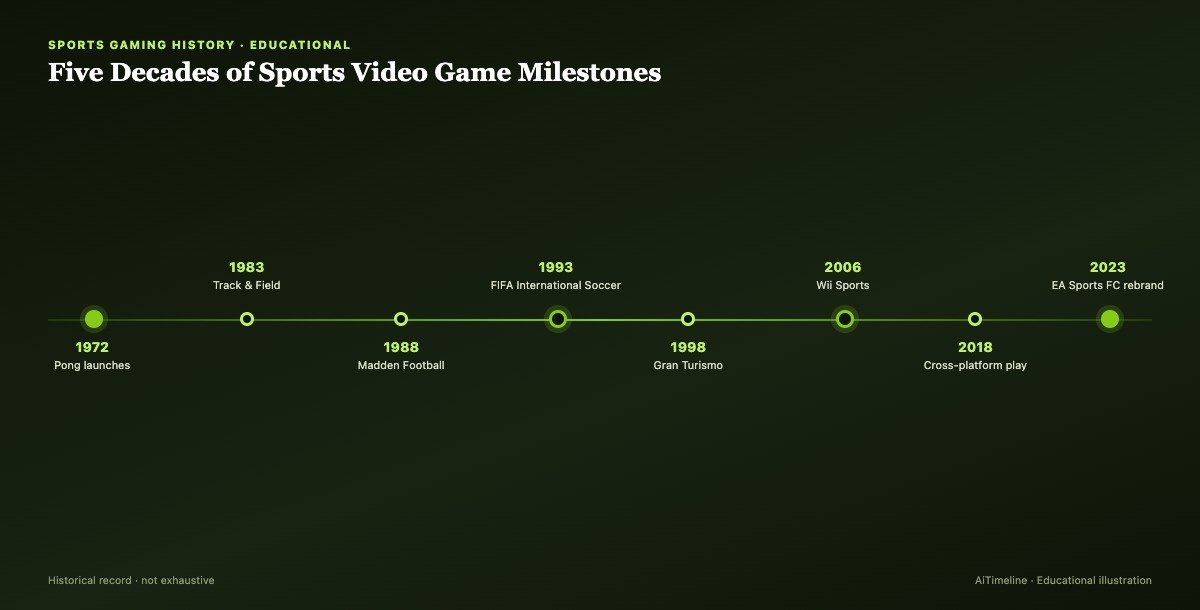
Five decades of sports gaming milestones, from arcade cabinets to AI-assisted animation.
Key Terms, Explained
Thirteen concepts that appear throughout sports gaming coverage, defined in plain language.
Sports Simulation
A design approach aiming to closely replicate real-world sport mechanics, statistics and physics, prioritising realism and depth over simplified, immediate action.
Arcade Gameplay
A design approach favouring fast, accessible, immediately rewarding mechanics over statistical depth, historically built for short coin-operated play sessions.
Physics Engine
Software that simulates real-world physical forces — momentum, collision, gravity — governing how a ball, vehicle or player body moves and interacts in-game.
Motion Capture
A process of recording real people’s physical movement with sensors or cameras, then applying that captured data to animate in-game characters more naturally.
AI Opponents
Computer-controlled players or teams whose in-game decisions are governed by programmed logic (and, increasingly, machine-learning techniques) simulating realistic sporting strategy.
Career Mode
A single-player mode following a player or team’s progression over a simulated season or multi-year span, often including statistics, contracts and progression systems.
Ultimate Team-Style Modes
A game mode where players build a squad by collecting virtual player cards, often through in-game purchases, and compete online — a major modern revenue driver for sports franchises.
Cross-Play
The ability for players on different gaming platforms (such as PlayStation and Xbox) to play online multiplayer matches together, rather than being restricted to their own platform’s player base.
Cloud Gaming
Playing a game that runs on a remote server and is streamed to a device over the internet, rather than running on local console or PC hardware.
Game Preservation
The practice of archiving historical games, hardware and development materials so older titles remain playable and studiable, led by organisations including the Video Game History Foundation.
Licensing
Legal agreements granting a publisher rights to use official league, team, player or event branding and likenesses in a game.
Microtransactions
Small, optional in-game purchases — often for virtual currency, player packs or cosmetics — that generate ongoing revenue beyond a game’s initial purchase price.
Accessibility
Design features — adjustable difficulty, control remapping, visual and audio aids — that let players with varying abilities and preferences play a sports title comfortably.
🔬 Technology Insight
Improved graphics alone did not transform sports games; AI, physics and networking were equally important. A visually impressive player model means little if that player’s movement doesn’t respond convincingly to a physics engine, if the AI controlling their teammates doesn’t make sound tactical decisions, or if online infrastructure can’t reliably connect players for a smooth match. Sports gaming’s realism is the product of several separate engineering disciplines improving together, not a single graphics-technology story.
Evergreen Explainers
Four standalone explainers covering how sports games actually get built.
How Sports Games Became Realistic
Realism in sports games is the product of several distinct technical disciplines maturing in parallel, not a single breakthrough. Motion capture provides the raw animation data — real athletes, recorded performing real movements, digitised into a library a game can draw from. Physics engines take that animation and layer real-time simulation on top of it, so a tackle, a deflected shot, or a slide into a bunker responds to momentum and collision rather than playing a single fixed animation regardless of context. AI systems govern the decisions non-player characters make — where a defender positions themselves, when an AI-controlled teammate makes a run — adding tactical believability that graphics alone cannot provide. Finally, licensing supplies the visual and structural authenticity fans recognise: correct kits, real stadiums, accurate rosters. Strip out any one of these four elements and a game can still look impressive in a screenshot while feeling unconvincing to actually play.
The Evolution of Motion Capture
Early sports games relied entirely on hand-animated sprites and, later, hand-keyframed 3D models — an artist manually posing a character frame by frame. Motion capture, which records real actors’ or athletes’ movement using body-worn markers or camera-based tracking, let developers instead work from real human movement data, producing more naturalistic animation at a fraction of the manual labour cost once a capture pipeline was established. Over time, motion-capture libraries grew large enough to cover situational variety — different tackle angles, different shot types — rather than a handful of generic animations reused constantly. The most recent evolution, exemplified by systems like EA’s HyperMotion and 2K’s ProPLAY, uses machine-learning techniques to process large volumes of real match or broadcast footage and translate that movement data into in-game animation more efficiently than traditional motion-capture studio sessions alone.
Why Licensing Changed Sports Games
An officially licensed sports game can use real league names, team branding, correct kits, real stadiums and named athletes; an unlicensed game must use fictional substitutes. That distinction matters enormously to how “authentic” a game feels to sports fans, which is why licensing rights became a genuinely competitive business battleground, not just a legal formality. EA’s 2004 exclusive NFL deal and the 2023 end of EA’s FIFA partnership (discussed in this guide’s timeline) are the two clearest examples of licensing decisions directly reshaping which publishers could compete in a given sport, sometimes more decisively than any gameplay difference between competing titles.
Arcade vs Simulation Design
Arcade-style sports games prioritise immediate, accessible fun — simplified controls, fast pacing, forgiving mechanics that reward quick reflexes over deep tactical knowledge. Simulation-style sports games prioritise realism and depth — detailed statistics, nuanced controls, and mechanics that reward players who understand the underlying sport’s real tactics and rules. Neither approach is inherently “better”; they serve different audiences and different sessions. Many long-running franchises have shifted their position on this spectrum over time, and some, including certain arcade-inspired spin-off titles, have deliberately built entire sub-franchises around the more accessible end of the spectrum specifically because simulation depth isn’t what every player wants from a sports game.
🎭 Culture Insight
Sports games became social experiences long before online multiplayer. Two controllers plugged into one console, friends taking turns at an arcade cabinet, entire households gathering around a single television for a Wii Sports bowling tournament — local, shared-screen play was the genre’s original social format, and it remained central to how many people experienced sports games for decades before online connectivity added a second, distinct social layer on top of it.
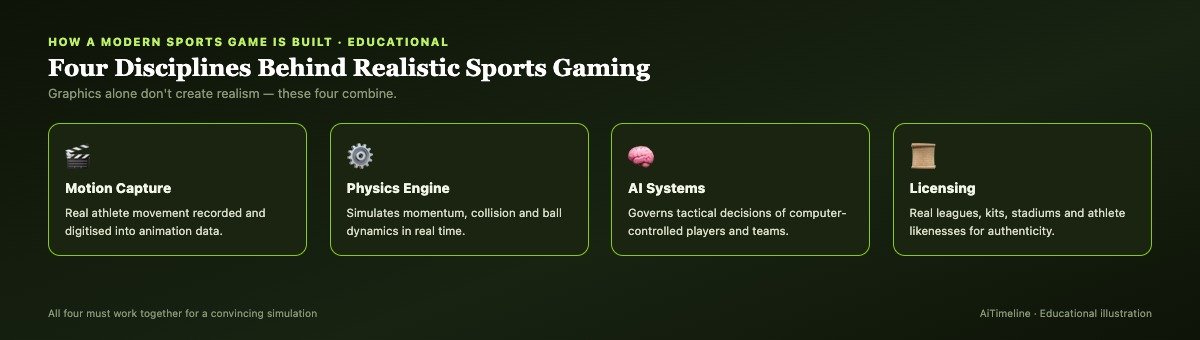
The four engineering disciplines that combine to make a modern sports game feel realistic.
Side-by-Side Comparisons
Six comparison tables covering the rivalries and design choices that define sports gaming history.
Arcade vs Simulation Sports Games
| Factor | Arcade Style | Simulation Style |
|---|---|---|
| Design priority | Fast, accessible fun | Realism and statistical depth |
| Session length | Short, immediate | Longer, season/career-focused |
| Example | Tecmo Bowl (1989) | Madden NFL (modern era) |
FIFA vs eFootball Evolution
| Factor | EA Sports FC (formerly FIFA) | Konami eFootball (formerly PES) |
|---|---|---|
| Publisher | Electronic Arts | Konami |
| Historical strength | Official league/team licensing breadth | On-pitch gameplay, critically praised through 2000s-2010s |
| Major rebrand | FIFA to EA Sports FC, 2023 | PES to eFootball, 2021 |
NBA Live vs NBA 2K
| Factor | NBA Live | NBA 2K |
|---|---|---|
| Publisher | Electronic Arts | 2K (Take-Two Interactive) |
| Series debut | 1994 (as NBA Live 95) | 1999 (Sega Dreamcast) |
| Recent status | Largely dormant in recent years | Continued as the dominant basketball franchise |
Single-Player vs Online Multiplayer
| Factor | Single-Player / Local | Online Multiplayer |
|---|---|---|
| Social format | Shared screen, same room | Connected players, any location |
| Historical era | Dominant from 1972 onward | Matured from roughly 2008 onward |
| Typical modes | Career, exhibition | Ranked seasons, Ultimate Team-style modes |
Console vs PC Sports Gaming
| Factor | Console | PC |
|---|---|---|
| Historical role | Primary platform for major franchises | Strong for management sims, modding communities |
| Control input | Gamepad-standardised | Keyboard/mouse or gamepad, more configurable |
| Cross-play era | Matured from 2018 onward | Matured from 2018 onward |
Timeline Summary
| Year | Game | Industry Impact |
|---|---|---|
| 1972 | Pong | Founding title of sports video gaming |
| 1983 | Track & Field | Establishes physical-input arcade convention |
| 1985 | Excitebike | Early user-generated track editor |
| 1988 | John Madden Football | Founds the modern EA Sports simulation approach |
| 1993 | FIFA International Soccer | Establishes EA Sports’ licensing-led strategy |
| 1998 | Gran Turismo | Redefines console racing simulation depth |
| 2004 | EA’s exclusive NFL deal | Reshapes American football gaming competition |
| 2006 | Wii Sports | Brings motion controls to a mainstream audience |
| 2015 | Esports growth | Sports titles build formal competitive scenes |
| 2018 | Cross-platform play | Unifies online player bases across consoles |
| 2023 | FIFA to EA Sports FC | Ends a 30-year publisher-league licensing era |
| 2024 | AI-assisted animation (ProPLAY, HyperMotion) | Machine learning enters mainstream sports gaming |
🧠 Did You Know?
Many of the world’s longest-running annual game franchises are sports titles that have evolved alongside real-world leagues and broadcasting technology. Madden NFL has released a new entry nearly every year since 1988; FIFA (now EA Sports FC) has done the same since 1993 — making them among the longest continuously running annual entertainment franchises in any medium, not just gaming.
💼 Business Insight
Licensing agreements with leagues and athletes helped define competition between franchises. When one publisher secures exclusive rights to a league, competitors are structurally locked out of making games using that league’s official branding, regardless of how good their gameplay might be. This dynamic, most visibly demonstrated by EA’s 2004 NFL deal, means sports gaming competition has often been decided as much in licensing negotiations as in game design studios.

How competitive sports gaming grew from community tournaments into publisher-run leagues.
✅ What History Actually Shows
- Pong (1972) is the documented founding title of commercially successful video gaming and sports gaming specifically.
- EA’s 2004 NFL exclusivity deal is officially confirmed and directly ended the ESPN NFL 2K series’ competition.
- Wii Sports launched bundled with the Wii in most regions in November 2006, a confirmed Nintendo release decision.
- EA and FIFA’s partnership ended in 2023, officially confirmed by EA, resulting in the EA Sports FC rebrand.
⚠️ Common Misconceptions
- “FIFA and EA Sports FC are different game series” — it is the same ongoing franchise under a new name following EA and FIFA’s 2023 split.
- “Motion capture alone makes a game realistic” — physics, AI and licensing all contribute equally, as this guide’s Technology Insight explains.
- “Esports for sports games started with a big publisher announcement” — community-driven competitive play predates most official league structures by years.
- “Arcade sports games disappeared once consoles took over” — arcade design philosophy continues in many modern accessible, pick-up-and-play sports titles.
Who Built Sports Gaming History
The primary companies referenced throughout this guide.
Nintendo
Released Excitebike (1985) and the motion-control-pioneering Wii Sports (2006), among many sports-adjacent titles across its console history.
Sony Interactive Entertainment
PlayStation platform holder; home to Polyphony Digital’s Gran Turismo series since 1998.
Microsoft Xbox
Xbox platform holder; Xbox Live (2002) and Kinect (2010) shaped online and motion-based sports gaming.
Electronic Arts
Publisher of Madden NFL (since 1988), FIFA/EA Sports FC (since 1993) and NBA Live, among the industry’s most influential sports publishers.
2K
Take-Two Interactive’s sports label, publisher of the NBA 2K series (originating 1999) and the NBA 2K League.
Konami
Publisher of Track & Field (1983) and the Pro Evolution Soccer/eFootball series.
Sega
Developer of Virtua Striker (1995) and publisher of numerous arcade and console sports titles across its history.
Capcom
Longtime publisher of sports and sports-adjacent arcade and console titles across multiple genres and console generations.
Epic Games
Developer of the Unreal Engine, used across numerous modern sports and sports-adjacent titles, and a vocal advocate for cross-platform play.
Unity Technologies
Developer of the Unity game engine, widely used across sports and simulation titles, particularly by smaller studios.
Common Mistakes in Reading Sports Gaming History
- Treating FIFA and EA Sports FC as separate franchises. They are the same continuous series under a renamed brand following the 2023 EA-FIFA split.
- Assuming graphics alone define “realistic.” Physics, AI and licensing all shape a game’s authenticity independently of visual fidelity.
- Crediting a single game for motion controls. Wii Sports popularised the format commercially, but earlier motion-sensing experiments existed before 2006.
- Assuming critical acclaim always meant commercial success. Pro Evolution Soccer’s gameplay praise through the 2000s didn’t translate into outselling FIFA.
- Overlooking licensing as a competitive factor. EA’s 2004 NFL deal changed the market more than any single gameplay feature did that year.
- Assuming esports for sports games is a recent invention. Competitive community play predates most publisher-run leagues by years.
- Confusing arcade and simulation design as a quality hierarchy. They are different design goals for different audiences, not a spectrum from worse to better.
- Assuming every hardware experiment became permanent. Google Stadia’s 2023 shutdown shows cloud gaming’s adoption has been uneven, not a straight line of progress.
👀 Future Watch
What is genuinely worth watching going forward: official publisher announcements about new titles and technology; confirmed game engine upgrades disclosed by developers; industry reports from research firms and trade press covering sales and engagement trends; and console manufacturer hardware roadmaps as officially announced by Sony, Microsoft and Nintendo. This guide does not speculate about unannounced titles, rumoured licensing changes, or future release dates — only about the specific, official channels worth watching for confirmed developments.
Interesting Facts
- Pong was originally built as an internal engineering training exercise before Atari realised its commercial potential.
- Track & Field’s punishing button-mashing controls were notorious for physically wearing out arcade cabinet hardware.
- Tecmo Bowl’s in-game Bo Jackson became legendary among players specifically because of how difficult his in-game speed made him to tackle.
- The FIFA video game license lasted almost exactly three decades, from 1993 to 2023, before EA and FIFA parted ways.
Explore More Timelines
People Also Ask
Frequently Asked Questions
70 questions on the history and technology of sports video games.
Related Reading on AiTimeline
Google Pixel 11 Pro: Future of Flagship Phones
Commonwealth Games: India’s Sporting Journey
Women’s Cricket in India: A Timeline
Why Sports Video Games Continue to Shape Interactive Entertainment
Sports video games have evolved from simple arcade experiences — two paddles, a ball, a black-and-white screen — into sophisticated simulations powered by advanced graphics, artificial intelligence, online connectivity and official league licensing worth hundreds of millions of dollars. That evolution didn’t happen in a straight line, and it didn’t happen because of any single breakthrough. It happened because arcade engineers kept building on Pong’s proven appeal, because Nintendo and Konami and EA kept pushing what home hardware could simulate, because motion capture and physics engines matured into genuinely convincing systems, because console makers built the online infrastructure that turned local rivalries into global ones, and because leagues and publishers spent decades negotiating the licensing agreements that let a game carry a real team’s crest or a real athlete’s face.
Their lasting popularity reflects both of those forces at once: relentless technological innovation, and the simple, universal appeal of competitive sport itself. A game can only get so far on graphics or licensing alone — what has kept people coming back, from two friends on a couch in the 1990s to millions of players in an online Ultimate Team match today, is the same competitive thrill Track & Field’s arcade cabinet offered in 1983: a direct, immediate contest against another person, decided by skill and a bit of luck, exactly the way sport has always worked.
For readers who want to go deeper than this guide, official publisher histories, developer interviews, and game preservation initiatives like the Video Game History Foundation’s archives are the most reliable places to keep following this story — not rumour and speculation about titles that haven’t been officially confirmed.
Editorial Note & Sources
This guide separates Official publisher and console-manufacturer information, Reported historical and critical coverage widely documented by gaming press, and Analysis this guide’s own educational framing, throughout. Release dates and developer credits are drawn from official statements and established gaming archives; where a detail could not be confirmed with confidence, it has been described in appropriately qualified language rather than stated as settled fact.
- Official Electronic Arts — EA Sports: ea.com/ea-sports
- Official Nintendo: nintendo.com
- Official Sony Interactive Entertainment / PlayStation: playstation.com
- Official Xbox: xbox.com
- Official Konami: konami.com
- Official 2K: 2k.com
- Official Video Game History Foundation: gamehistory.org
- Reported Industry and historical coverage compiled from established gaming press archives
Sources & further reading
Every dated entry above was checked against these references. Last reviewed 15 September 2026.