Ultra-Processed Food Timeline 1950–2026: How Packaged Food Changed the Modern Diet
⚠️ Health information notice
This article explains research and food-policy developments. It is not individualized medical or dietary advice. People with medical conditions or specific nutritional needs should consult a qualified health professional. Every disease-risk claim below is labeled by evidence type — observational, randomized-trial, or mechanistic — because these carry different strength of proof.
Track the rise of ultra-processed food from TV dinners and fast food to NOVA, health research, warning labels and the growing 2026 regulation debate.
Latest Story
Walk through a modern supermarket and most of the food does not look particularly futuristic — bread, breakfast cereal, yogurt, frozen pizza, soft drinks, instant noodles, packaged snacks. Yet a large share of that shelf belongs to a food system a shopper from a century ago would not recognize. The change did not happen overnight; it happened one convenience at a time, as frozen meals, supermarkets, fast food, food science and global manufacturing each made packaged eating faster, cheaper and more available. Decades after that transformation was already underway, researchers gave one part of it a name: ultra-processed food (UPF). This ultra-processed food timeline traces that history from the 1950s to the active 2026 regulatory debate over how — and whether — governments should define and restrict it.
🧠 AI Overview Summary
Ultra-processed foods (UPFs) are industrial formulations made largely from refined substances and additives rather than intact ingredients — NOVA Group 4 in the classification system developed by Brazilian researcher Carlos Monteiro and colleagues from the late 2000s. As of the latest CDC/NCHS data (August 2021–August 2023), UPFs supply about 55% of daily calories for Americans age 1 and older. A small 2019 NIH inpatient trial found participants ate roughly 508 more calories a day and gained about 0.9 kg on a matched ultra-processed diet versus an unprocessed one. In 2026, the U.S. is working toward its first federal UPF definition (submitted for final review 10 August 2026) while California’s AB 1264 phases certain “UPFs of concern” out of school meals, and India is debating nutrient-based warning labels — a different, older question from UPF classification itself.
The term “ultra-processed food” is relatively new. The food system it describes is not.
Processed and Ultra-Processed Are Not the Same Thing
A food can come in a package without being “ultra-processed.”
The single most common mistake in this debate is treating “processed” and “ultra-processed” as interchangeable. They are not. Processing spans a huge range — freezing, pasteurizing, canning, milling, and fermenting are all forms of processing, and most of them make food safer, longer-lasting or more nutritious, not worse. NOVA, the classification system most researchers use, does not sort foods by how much processing happened; it sorts them by what kind of processing happened and what ingredients that processing introduced.
🔸 Two different questions
How much of a nutrient does a food contain? That is a traditional nutrition question — sugar, salt, fat, fiber. How was the food made, and from what? That is what NOVA and the UPF concept ask. The two lenses often overlap — many UPFs are also high in sugar or salt — but they are not the same measurement, and a food can score differently on each.
Ultra-Processed Food: Key Questions
What the ultra-processed food story is really about
- The term is new; the food system is not. Convenience foods, fast food and packaged snacks expanded across the 1950s–1990s. NOVA gave that transformation a research name only from 2009 onward.
- Processed ≠ ultra-processed. Freezing, canning, pasteurizing and fermenting are processing methods that can make food safer and more available — they do not automatically make a food “ultra-processed.”
- NOVA classifies by formulation, not nutrients. It asks what the food is made from and how, which is a different lens from asking how much sugar, salt or fat it contains.
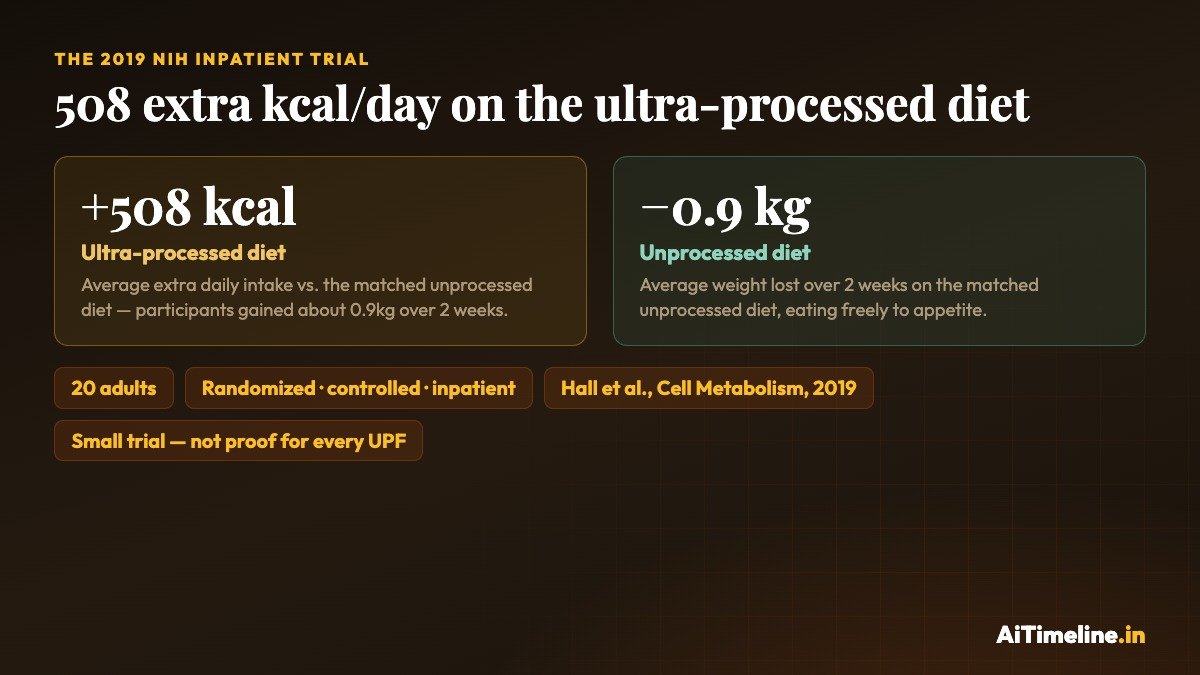
- The 2019 NIH trial is real evidence, with real limits. Twenty adults ate about 508 more calories a day and gained roughly 0.9kg on a matched ultra-processed diet — strong for a controlled trial, but too small to generalize to every UPF.
- Observational studies show associations, not proof. Large cohort studies link higher UPF intake to several health outcomes; they cannot, on their own, establish that UPFs caused those outcomes.
- Scientists still debate why. Energy density, eating speed, food texture, palatability and additives are all studied candidate mechanisms — none is singularly proven.
- California did not ban all ultra-processed food. AB 1264 (signed 8 October 2025) creates a legal UPF definition and phases specific “foods of concern” out of California public school meals on a multi-year timetable.
- The U.S. federal government has not banned UPFs either. FDA and USDA are working toward a uniform definition, a necessary first step before any future labeling or procurement policy.
- India’s front-of-pack debate is a different question. It concerns nutrient thresholds (sugar, salt, saturated fat), not a legal UPF classification — the two get conflated often, including in some coverage of this story.
- Not all packaged food is unhealthy, and not all “natural” food is safe. The debate is about specific formulations and dietary patterns, not a blanket verdict on the modern food system.
NOVA in Plain English: The Four Groups
The most widely used research classification for processing
Developed by Brazilian epidemiologist Carlos Monteiro and colleagues at the University of São Paulo, with an influential paper in 2009 later refined into today’s four-group framework, NOVA sorts food not by nutrient content but by the extent and purpose of industrial processing.
Unprocessed / minimally processed
Fruit, vegetables, eggs, milk, meat, grains — and minimally altered versions such as frozen, dried or pasteurized forms.
Processed culinary ingredients
Substances extracted from Group 1 foods or nature and used in home cooking — oil, butter, sugar, salt.
Processed foods
Made mainly by combining Groups 1 and 2 through methods like canning, bottling or baking — canned vegetables, simple cheeses, freshly made bread.
Ultra-processed foods
Industrial formulations typically using refined substances, additives, flavorings, colors, emulsifiers or other industrial ingredients rarely found in a home kitchen.
🔸 Why NOVA was different
Traditional nutrition science asks how much — how much sugar, fat, sodium, fiber, protein. NOVA asks a different question: what happened to the food before you ate it? That shift in framing is what let researchers study “degree of processing” as its own variable, separate from a food’s nutrient panel.
Supporters argue
- Nutrient panels alone miss industrial formulation, additives and how a product is structured and eaten.
- NOVA captures dietary patterns that nutrient-only models can overlook.
- It has driven a large, fast-growing body of research since 2009.
Critics argue
- Group 4 can lump together very different products — a fortified whole-grain bread and a sugary soda — under one label.
- Processing markers are sometimes applied inconsistently across studies.
- A processing-only lens can obscure genuine nutrient differences between products.
The debate is not whether diet quality matters. It is how best to classify and regulate it.
The 1950–2026 Timeline: How the Modern Diet Changed
From TV dinners to a federal definition debate
The Convenience Revolution
Refrigeration, freezing technology, supermarket expansion and mass manufacturing converged with changing household patterns to create real demand for convenience food. Swanson popularized the frozen “TV Dinner” in 1953 (frozen meals existed earlier; Swanson’s marketing made the format a household name). Dinner shifted from a cook→serve→eat process at home toward an industrial formulate→manufacture→package→ship→store→reheat chain.
Fast Food and Mass Distribution
Fast-food chains standardized meals and distribution nationwide; supermarkets grew larger; industrial bakery products, soft drinks and packaged snacks expanded alongside a growing frozen-food aisle. No single company or product drove this — it was a systemic shift in how food reached households.
The Global Packaged-Food Era
Consolidation, globalization, advertising and food science combined to build today’s global packaged-food industry. Philip Morris acquired Kraft in 1988 for roughly $12.9 billion, one of several tobacco-company forays into food conglomerates during this period — a documented corporate fact, distinct from any claim about product formulation strategy (see box below).
The Nutrition Debate Changes
As obesity and diet-related disease rates climbed globally, researchers began asking whether nutrient counts alone explained what was happening to diets, or whether something about how food was made mattered too.
NOVA Gives It a Name
Researchers led by Carlos Monteiro published an influential 2009 framework classifying foods by the extent and purpose of industrial processing rather than nutrient content, subsequently refined into the familiar four-group NOVA system used worldwide today.
Research Accelerates
Large population studies using NOVA began finding associations between higher UPF intake and various health outcomes. Brazil’s national dietary guidelines became the first to explicitly incorporate processing-based recommendations.
The Studies That Changed the Debate
Two large observational studies published in BMJ in May 2019 found higher UPF consumption associated with increased cardiovascular disease risk in one cohort and increased all-cause mortality risk in another — association, not proof of causation. That same month, a small NIH-run randomized controlled inpatient trial (Hall et al., Cell Metabolism) gave the debate its most cited experimental data point: see the dedicated section below.
From Research to Policy
Front-of-pack nutrient warning labels spread across Latin America (Chile, Mexico and others), global UPF sales research estimates grew, and health agencies worldwide began citing NOVA-based research in dietary guidance — without most countries adopting a legal UPF definition of their own.
California Acts First
Governor Gavin Newsom signed AB 1264, the “Real Food, Healthy Kids Act,” making California the first U.S. state to legally define “ultra-processed food” and to task a state health department with identifying and phasing “UPFs of concern” out of public school meals. See the dedicated section below for the real implementation timetable.
The Definition War
The U.S. moved toward its first federal UPF definition: after a July 2025 request for public input drew over 5,000 comments, HHS announced on 10 August 2026 that FDA and USDA had submitted a proposed definition to the Office of Management and Budget for final review. In parallel, India’s food regulator FSSAI advanced a front-of-pack nutrient-warning proposal, with the Supreme Court of India scheduled to review the framework on 10 September 2026.
Before governments can regulate ultra-processed food, they first have to agree on what it is.
The 2019 NIH Experiment That Changed the Debate
Randomized, controlled, inpatient — and small
Most UPF research is observational: it tracks what people already eat and looks for statistical associations with health outcomes. That kind of evidence cannot, by itself, prove cause and effect. In 2019, NIH researcher Kevin Hall and colleagues ran something different: a randomized controlled inpatient trial published in Cell Metabolism. Twenty weight-stable adults were admitted to the NIH Clinical Center and given two matched diets, two weeks each, in random order — one built from ultra-processed foods, one from unprocessed and minimally processed foods. The two diets were matched for presented calories, energy density, macronutrients, sugar, sodium and fiber. Participants could eat as much or as little as they wanted from what was offered.
Participants ate about 508 more calories per day on the ultra-processed diet, driven mainly by extra carbohydrate and fat intake (protein intake did not differ meaningfully between diets). Weight changes tracked calorie intake closely: participants gained roughly 0.9kg during the two-week ultra-processed phase and lost roughly 0.9kg during the two-week unprocessed phase.
❓ Why did people eat more on the ultra-processed diet?
Scientists are still investigating. Candidate mechanisms under study include energy density, eating rate, food texture, palatability, how nutrients are delivered within the food’s physical matrix, and possible effects of additives on appetite signaling. No single mechanism is fully proven — this is an active area of nutrition science, not a settled explanation.
⚠️ What this trial does and does not show
This is strong evidence, for a controlled trial, that the specific tested ultra-processed diet caused greater calorie intake and weight gain under the study’s conditions. It is a single study of 20 adults over four weeks. It should not be stretched into “every ultra-processed food causes obesity” — different UPFs vary enormously in nutrient profile, and the mechanisms behind this result are still being studied.
What Does the Research Actually Show?
Separating evidence types matters in a YMYL topic
Established / higher-confidence
- Large cohort studies consistently associate higher UPF intake with several adverse health outcomes.
- A controlled inpatient trial (Hall et al., 2019) showed a tested UPF diet caused greater calorie intake and weight gain under trial conditions.
- UPFs supply a majority of daily calories in the U.S. diet, per CDC/NCHS survey data.
Debated / still being studied
- Which specific characteristics of UPFs (additives, texture, energy density) drive health effects.
- Whether “food addiction” is a valid clinical construct comparable to substance addiction.
- How much processing itself, versus a product’s underlying nutrient profile, explains health associations.
- Whether NOVA’s broad Group 4 category should be split into finer sub-categories for regulation.
| Outcome | Evidence type | What can be said |
|---|---|---|
| Higher calorie intake | Controlled trial | Demonstrated in a small NIH inpatient trial (2019) |
| Weight gain | Controlled trial | Demonstrated under that trial’s specific conditions |
| Cardiovascular disease | Cohort / observational | Higher UPF intake associated with higher risk (BMJ, 2019 and later studies) |
| Type 2 diabetes | Observational / meta-analytic | Association reported across multiple cohorts |
| All-cause mortality | Cohort evidence | Higher consumption associated with increased mortality (BMJ, 2019 and later studies) |
| Cancer | Observational | Associations reported for some cancer types; causality not established |
| Depression / mental health | Mostly observational | Association reported; confounding factors not fully ruled out |
🔸 “Addictive” claims need careful handling
Some researchers argue certain highly rewarding, energy-dense foods can produce addiction-like behavioral responses; others dispute whether “food addiction” should be defined analogously to nicotine or drug addiction at all. The “bliss point” — a product-formulation concept describing an optimal combination of sugar, salt and fat for consumer appeal — is not, on its own, scientific proof of engineered addiction. Comparing eating packaged snacks directly to smoking cigarettes overstates what the evidence supports.
🔸 What we know vs. what is claimed, on the tobacco-food connection
Known: tobacco corporations owned major food companies for a period (e.g. Philip Morris and Kraft, 1988) and brought large consumer marketing and product-research operations with them. Debated: whether modern UPFs were deliberately engineered using the same addiction strategies developed for cigarettes. That claim requires specific documentary or peer-reviewed evidence and should not be presented as settled fact.
How Much Ultra-Processed Food Do Americans Eat?
CDC/NCHS, National Health and Nutrition Examination Survey
Common calorie sources CDC identifies include sandwiches and burgers assembled with industrial breads and processed fillings, sweet bakery products, salty snacks and sugar-sweetened beverages — but exact classification still depends on a given product’s specific formulation, not its category alone.
⚠︗ Don’t merge this with other countries’ figures
Do not combine this U.S. figure with any other country’s UPF share (e.g. the U.K.) into one number — different surveys use different methodologies and dates. Cite each country’s data separately.
📈 Global market context
Research estimates put the global value of UPF sales at roughly $1.5 trillion in 2009, rising to about $1.9 trillion by 2023, in constant 2023 dollars — a research estimate, not audited industry revenue. There is no reliable basis for calling any single year, including 2023, “peak” UPF consumption or sales; the market has continued to grow since, and this figure should be read as a research estimate, not a final tally.
The World Didn’t Wait for a U.S. Definition
Nutrient warnings and UPF-specific policy are two different tools
| Jurisdiction | Tool | Basis |
|---|---|---|
| Brazil | National dietary guidelines | NOVA / processing-based — NOVA’s country of origin |
| Chile | Front-of-pack warning labels + marketing restrictions | Nutrient thresholds (sugar, salt, fat, calories) — not NOVA Group 4 status directly |
| Mexico | Front-of-pack warning labels | Nutrient thresholds, similar model to Chile |
| California (U.S.) | AB 1264 — legal definition + school-meal restriction | Processing-based UPF definition, first in the U.S. |
| United States (federal) | FDA/USDA definition in development | Uniform federal UPF definition, submitted for final review Aug 2026 |
| India | FSSAI front-of-pack warning label (proposed) | Nutrient thresholds (added sugar, salt, saturated fat) — not a UPF classification |
🔸 Three different label systems
Nutrient warning (“High in sugar”) flags a threshold. Ingredient warning (“Contains artificial color X”) flags a specific additive. Processing classification (“Ultra-processed”) flags how the product was made. These should never be treated as interchangeable — a product can trigger one system without being treated identically by another.
California’s AB 1264: What It Actually Does
Signed 8 October 2025 — not a statewide ban on ultra-processed food
On 8 October 2025, Governor Gavin Newsom signed AB 1264, authored by Assemblymember Jesse Gabriel and titled the Real Food, Healthy Kids Act, making California the first U.S. state to create a legal definition of “ultra-processed food.” The law tasks the California Department of Public Health with identifying which UPFs qualify as “of concern” and phasing those specific products out of public school meals.
⚠️ What AB 1264 is not
It is not a ban on ultra-processed food sold to the general public, and it does not apply outside school-meal procurement. It restricts a state health department-identified subset (“UPFs of concern”) from a specific channel — California public schools — on the multi-year timetable above. Several outlets, including California’s own state government, have used “ban” language for the school-meal context specifically; this article uses the more precise framing because the law does not reach ultra-processed food generally.
The U.S. Moves Toward Its First Federal UPF Definition
A definition is not a ban
In July 2025, FDA and USDA issued a joint Request for Information seeking public input on a uniform definition of ultra-processed food for the U.S. food supply, drawing more than 5,000 public comments. On 10 August 2026, the Department of Health and Human Services announced that FDA and USDA had submitted the federal government’s first proposed definition of ultra-processed foods to the Office of Management and Budget for final review, alongside a related proposal to reform GRAS (“generally recognized as safe”) ingredient notification.
❓ Why a definition matters before anything else
Without a standard federal definition, regulators cannot build consistent labeling rules, school procurement standards, dietary guidance, research methodology or marketing policy around the term “ultra-processed.” That is why 2026 is best understood as the year the U.S. tries to decide what “ultra-processed” legally means — not the year it bans the category.
| Policy question | 2026 status | Why it matters |
|---|---|---|
| What legally counts as UPF? | Federal definition submitted for final review, Aug 2026 | Foundation for any future policy |
| Are all UPFs equally risky? | Unresolved | Could determine targeted vs. broad regulation |
| Should packages carry warnings? | Varies by jurisdiction | Consumer information |
| Should schools restrict products? | California moving ahead (AB 1264) | Child nutrition |
| Should additives be separately regulated? | Active area (GRAS reform proposal, Aug 2026) | Distinct issue from UPF classification itself |
What Does the UPF Debate Mean for India?
An active, separate front-of-pack labeling question
India has its own food-regulation system, diet patterns and nutrition burden under the Food Safety and Standards Authority of India (FSSAI) — it is not simply copying the U.S. framework. As of September 2026, FSSAI has proposed red hexagonal front-of-pack warning labels reading “High Sugar,” “High Salt,” “High Fat” or “Highly Sweetened Beverage” based on nutrient-of-concern thresholds, building on a labeling effort that dates back to 2018 (an earlier 2022 draft proposing a Health Star Rating stalled). The Supreme Court of India is scheduled to review the proposed framework on 10 September 2026. Health groups argue warnings should be clear and prominent; industry — including major packaged-food and beverage companies — has raised concerns about thresholds, serving-size methodology and commercial impact.
India’s proposal answers one question: does a food have too much sugar, salt or saturated fat?
❓ Two different questions, again
Question 1 — nutrient content: does this food exceed a sugar/salt/fat threshold? That triggers a nutrient warning, which is what FSSAI’s current proposal addresses. Question 2 — degree of processing: how extensively was this food industrially formulated? That is a NOVA-style UPF classification, which India has not adopted as regulation. A product could trigger the first system without being treated identically by the second — this distinction matters for anyone reading Indian food-policy coverage that uses “ultra-processed” loosely.
Why People Buy Ultra-Processed Food
The human side of a policy debate
The UPF debate can sound like a simple instruction: cook everything from scratch. For many households, it isn’t that simple. A parent working two jobs may value a frozen meal because it saves thirty minutes. A student may choose instant noodles because they are cheap. Someone without reliable refrigeration may depend on shelf-stable products. That means the public-health question is not simply how to tell people to eat differently — it is how to make healthier food affordable, convenient, available and realistic.
Convenience isn’t a moral failure. It is a feature the food system learned to sell extremely well.
Reasons people choose UPFs
- Price — often the cheapest calories available per meal.
- Convenience and time savings for working households.
- Shelf life, especially without reliable refrigeration.
- Wide availability, including in “food desert” areas with few fresh-food retailers.
- Marketing and brand familiarity built over decades.
- Taste and palatability engineered for broad appeal.
- Portability for shift work, commutes and school lunches.
Explore More Timelines
Processing Is Not the Enemy
✅ What processing does well
- Pasteurization and canning prevent foodborne illness.
- Freezing preserves nutrients and reduces spoilage and waste.
- Fortification (e.g. iodized salt, vitamin D milk) prevents nutrient deficiencies at scale.
- Fermentation extends shelf life and can improve digestibility.
- Industrial-scale production lowers cost and increases access.
❌ What the UPF debate is not about
- Not a blanket claim that all processed food is unhealthy.
- Not a claim that all packaged food is ultra-processed.
- Not proof that observational associations equal causation.
- Not a basis for treating UPFs as equivalent in risk to cigarettes.
- Not romanticizing pre-1950 diets, which had their own deficiencies and food-safety problems.
Frequently Asked Questions
⚠️ Editorial Note
Sourced from FDA, USDA, HHS, CDC/NCHS, NIH, WHO/PAHO, FSSAI, California legislative records, and peer-reviewed research in BMJ and Cell Metabolism. Observational associations are labeled separately from controlled-trial and mechanistic evidence throughout. This article is editorial and AI-assisted, not individualized medical, dietary or legal advice; policy details (especially the 2026 U.S. federal definition and India’s FSSAI proposal) are active and may change after publication.
⚠️ Health information notice
This article explains research and food-policy developments and is not individualized medical or dietary advice. People with medical conditions or specific nutritional needs should seek guidance from a qualified health professional.
Sources & further reading
Every dated entry above was checked against these references. Last reviewed 15 September 2026.
- CDC/NCHS Data Brief No. 536 — Ultra-processed Food Consumption in Youth and Adults, Aug 2021-Aug 2023
- Hall et al., Cell Metabolism (2019) — Ultra-Processed Diets Cause Excess Calorie Intake and Weight Gain
- NIH Clinical Center — First randomized controlled study finds ultra-processed diet leads to weight gain
- California Governor's Office — Governor Newsom Signs First-in-the-Nation Law (AB 1264)
- HHS.gov — Secretary Kennedy Announces Landmark Food Policy Reforms
- Nova Classification — background and four-group framework
- Drishti IAS — FSSAI Proposes Front-of-Pack Warning Labels for Packaged Foods