Chennai Floods 2015: Warnings, the Deluge and What the CAG Found
The Chennai floods of 2015 followed weeks of heavy rain and peaked on 1–2 December. This timeline separates the weather, the Chembarambakkam release, the
Latest Story
The Chennai floods of 2015 began with a depression on 8 November and peaked on 1–2 December, when the city had its heaviest 24-hour rain since 1901. This timeline runs newest first, from this month’s northeast-monsoon downpour back to the first rain, and keeps weather, reservoir decisions, rescue and the CAG’s 2018 audit apart. It does not blame one reservoir or one decision alone.
💡 Short Answer
Record rain, not a single failure, started the Chennai flood: 345 mm fell at Meenambakkam in 24 hours on 1–2 December 2015. But the CAG’s 2018 audit called it a man-made disaster, citing a Chembarambakkam release that peaked at 29,000 cusecs for 21 hours, encroached water bodies, delayed desilting and a disaster authority that never met. Tamil Nadu’s government counted 470 deaths.
Chennai Floods 2015: Key Questions
The 2015 Chennai Flood in Ten Points
- Built over weeks: floods in mid-November came before the December deluge.
- Record rain: Meenambakkam’s 345 mm beat the 1901 December record of 262 mm.
- Release timing: the CAG said discharge jumped to 20,960, then 29,000 cusecs for 21 hours.
- Missed decision: the CAG said an emergency should have been declared on 16 November.
- Man-made: the CAG’s verdict, tabled 9 July 2018; the state disputed it.
- Death toll disputed: 250, 421 and 470 all appear in sources.
- Services failed together: power, airport, roads and phones went down at once.
- Repeat events: Michaung in 2023 and a heavy night in October 2026.
- Spending: a US$251 million ADB drainage loan was signed in October 2021.
- Warnings: a rain forecast is not an evacuation plan or a reservoir protocol.
Chennai Floods Timeline, Latest First
Each entry is tagged and ends with why it matters. Use the filter to separate weather from decisions.
Rain, reservoirs, rescue or audit? Filter the Chennai flood timeline by type.
–
2026
North Chennai floods again as the northeast monsoon sets in Audit and aftermath
Heavy rain from Saturday evening, 17 October, flooded roads across North Chennai, and Oneindia reported that nearly half of Kathivakkam’s total fell between 9:30 and 10:30 pm. The Greater Chennai Corporation said most stagnation had cleared by Sunday morning. Tamil Nadu’s public works minister said it was being called a cloudburst but that confirmation would come later. Ahead of the season the corporation had said 1,400 of the city’s 1,600 km of stormwater drains were desilted, with 15,000 personnel and about 600 pump sets deployed (ANI, 19 October).
2023
Cyclone Michaung: Chennai floods again Rainfall
Michaung made landfall in Andhra Pradesh on 5 December after sitting off the Tamil Nadu coast. Down To Earth reported Chennai recorded 468 mm in 48 hours, more than fell in the 48 hours of December 2015, and said researchers called the two events comparable, though 2015 came from a depression rather than a cyclone. About 32,000 people were evacuated in Tamil Nadu, and power was cut in flooded areas as a precaution.
2021
India and the ADB sign a US$251 million Chennai flood loan Reservoirs and drains
The agreement, reported by Swarajya, also covered upgrading drainage channels and a pumping station and rehabilitating four disaster relief camps. Officials said Chennai’s rapid urbanisation had encroached on its natural landscape and reduced its water-retention capacity.
2018
CAG audit tabled: the floods were ‘man-made’ Audit and aftermath
The audit said: ‘All factors put together indicate that it was a man-made disaster and unless the government of Tamil Nadu takes full charge of mitigating the contributing factors … another disaster cannot be ruled out’ (DailyO). It faulted the Water Resources Department’s reservoir management, the CMDA’s permission for construction on water bodies, delayed desilting in 2014 and 2015, and a State Disaster Management Authority that had not met since 2013. The News Minute reported the state had delayed tabling by about a year and that the report had no political repercussions.
2015
Tamil Nadu asks the Centre for relief funds Audit and aftermath
Wikipedia reports the state’s request on 22 December for about ₹259,125 million. Estimates of the economic damage vary widely depending on what is counted, including direct damage, lost output and the wider region beyond Chennai.
2015
Schools begin to reopen; rescue effort peaks at 80,000 personnel Rescue and relief
As water receded, the focus moved from rescue to relief, restoration of services and reopening of schools. Reopening was uneven across districts, and damaged homes, vehicles and records kept many families in recovery long after the water went.
2015
Passenger flights resume at Chennai airport Rescue and relief
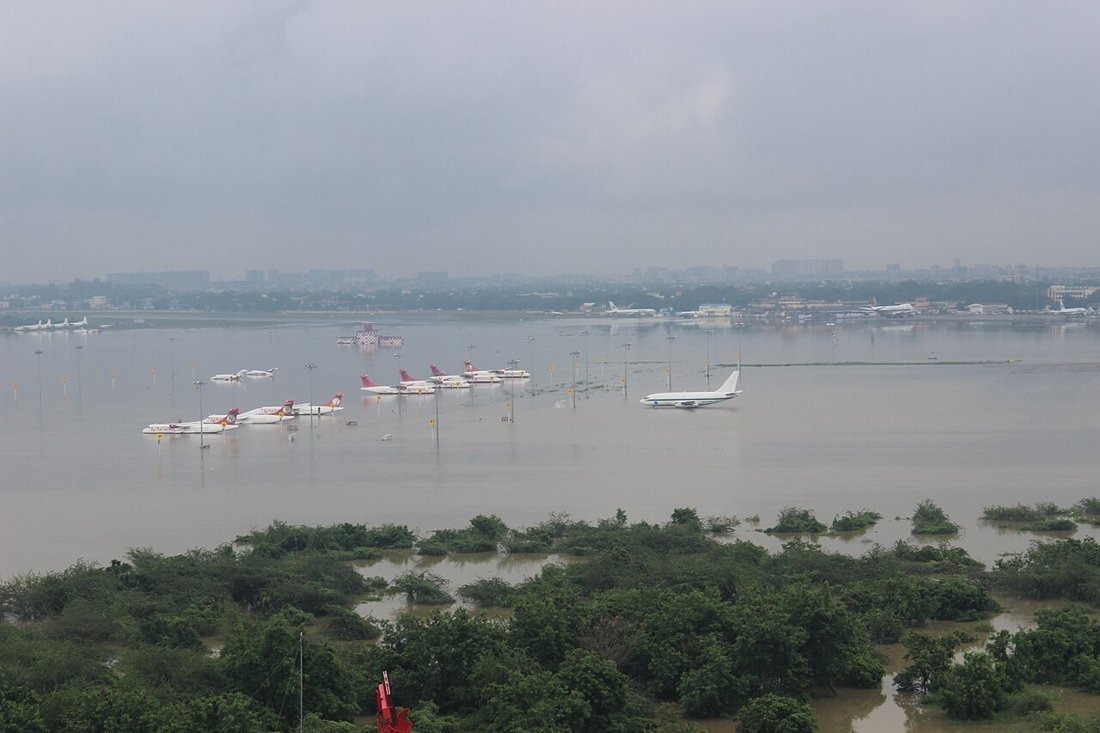
Aircraft were photographed standing in floodwater on 2 December. Its closure and the loss of rail and road links cut Chennai off from much of the country for days.
2015
Water pours out of Chembarambakkam at 29,000 cusecs for 21 hours Reservoirs and drains
The Vagaries blog, citing IMD data, recorded Meenambakkam’s 345 mm as the heaviest 24-hour fall since at least 1901, beating the 262 mm December record. The CAG later said officials could have held 12,000 cusecs for six more hours and stored 0.268 TMC instead of releasing 20,960 to 29,000 cusecs. Wikipedia reports NDRF strength rose from 11 teams to 22 by the night of 2 December.
2015
Wettest day on record; the city is flooded and the airport closes Rainfall
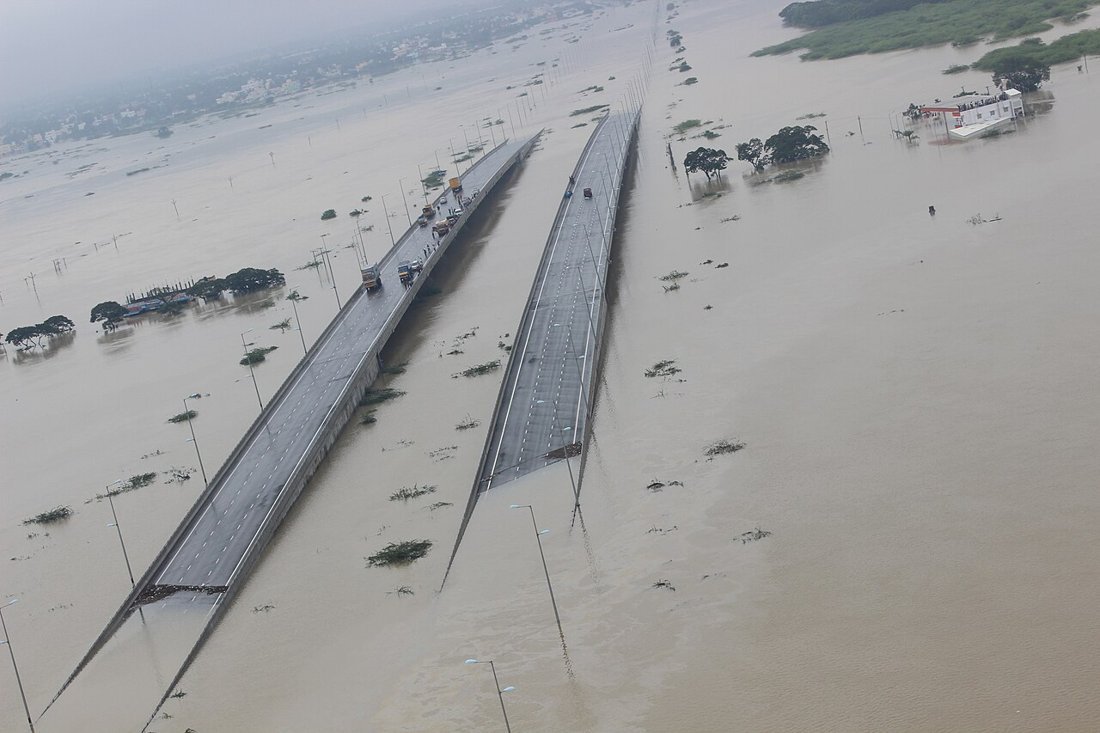
Rain from the second system, which reached Tamil Nadu on 30 November, peaked on 1 December. Wikipedia reports power was suspended to about 60% of Chennai by the afternoon. The CAG said the district collector and police were informed as the release was raised that day. Roads, bridges and the airport went under as the Adyar overflowed.
2015
A second weather system builds as the lakes fill Rainfall
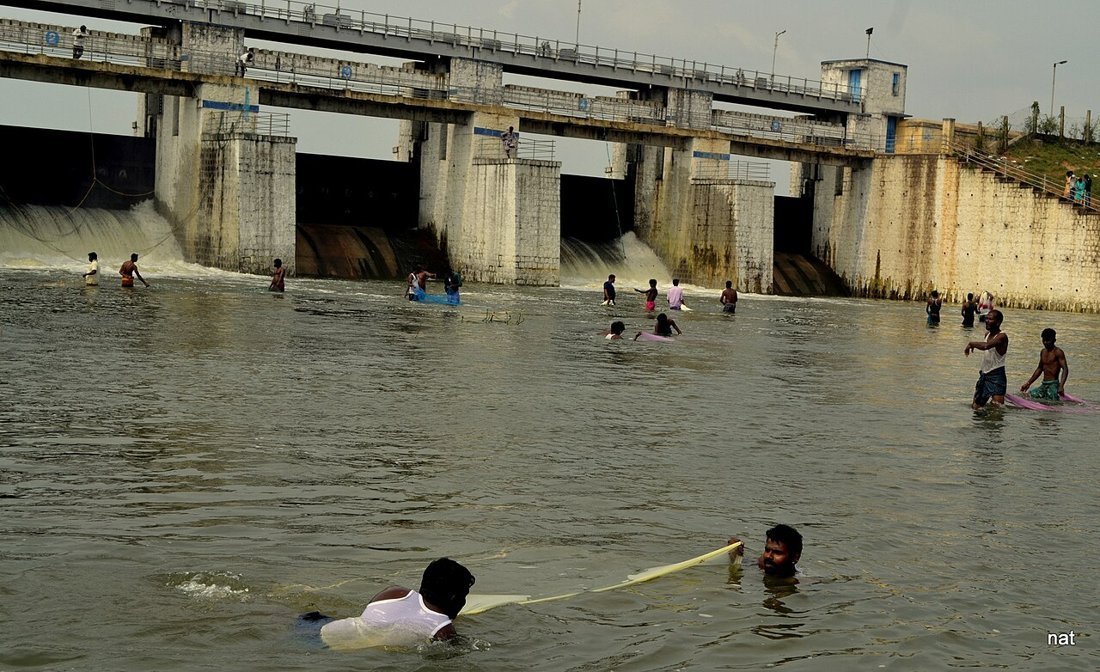
The two sources give different November totals, but both describe the wettest November in about a century. The photograph below, dated 28 November, shows water flowing through the Chembarambakkam lake sluices days before the main release.
2015
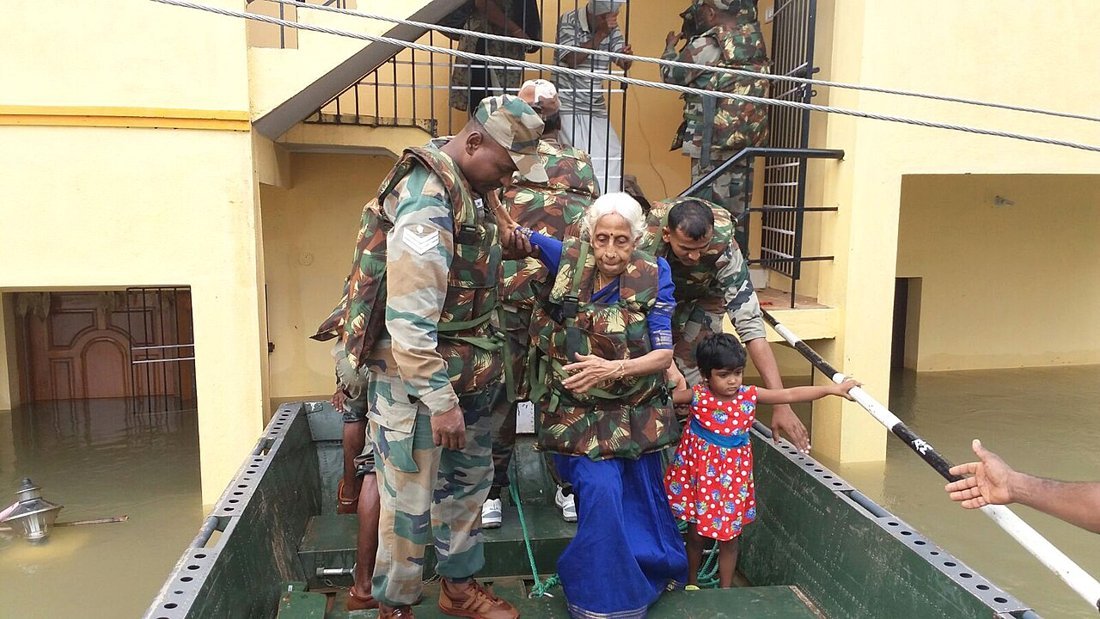
Army and Navy rescue teams work in Chennai after the mid-November spell Rescue and relief
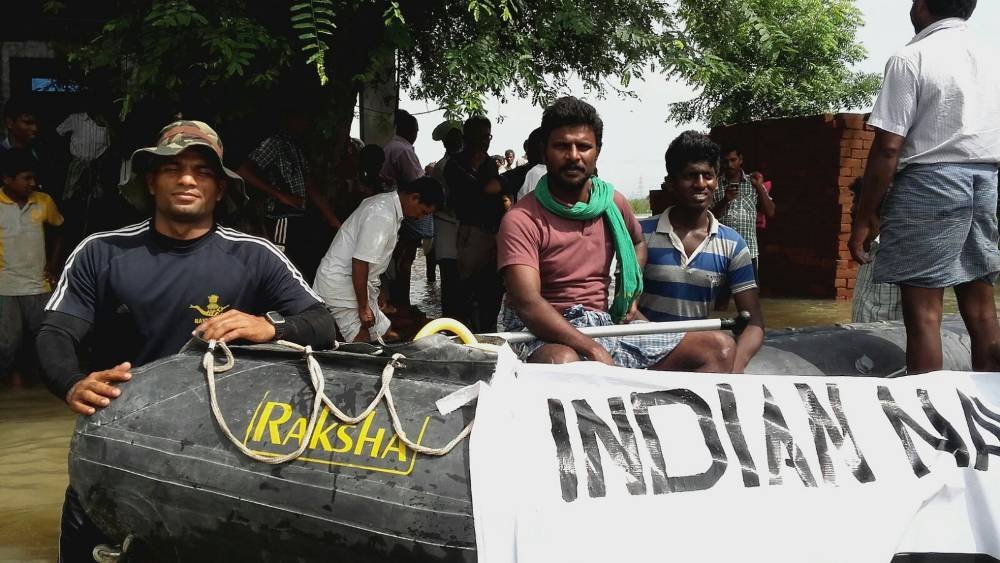
Defence photographs from 17 November show soldiers helping residents from flooded houses and a Navy team with an inflatable boat. The mid-November floods came two weeks before the December deluge.
2015
Chembarambakkam reaches 21 feet: the CAG says an emergency should have been declared Reservoirs and drains
The News Minute’s summary of the audit said the CAG found that an extraordinary emergency should have been declared at that level, and that the reservoir had no scientific real-time inflow forecasting. The same summary says the lake’s emergency rules dated from 1993.
2015
A second spell: Chennai airport records 266 mm in 24 hours Rainfall
The depression that formed on 8 November was followed by more heavy rain in the middle of the month. Chennai’s airport recorded 266 mm in 24 hours on 15 November, and rain around Kanchipuram on 13 November was heavier still.
2015
A depression crosses the coast near Puducherry; Cuddalore floods Rainfall
The first major spell of the 2015 northeast monsoon hit the coastal districts south of Chennai hardest. Rainfall over the Tamil Nadu coast was well above normal before the first Chennai flood.
2015
Northeast monsoon runs far above normal over record-warm seas Rainfall
NASA’s Earth Observatory said regional monsoon patterns were amplified by record-warm Bay of Bengal waters and El Niño conditions, and described the deluge as historic. These were the weather conditions. How they became a flood depended on the rest of this timeline.
The Rain and the Release in Numbers
What the CAG Audit Found
Report No. 4 of 2017, tabled 9 July 2018. The state government rejected the man-made label.
| Area | What the CAG found | Reported by |
|---|---|---|
| Reservoir release | Discharge raised abruptly on 1 Dec from 12,000 to 20,960 cusecs, then 29,000 cusecs for 21 hours; 12,000 could have been held six more hours and 0.268 TMC stored | News Minute, DailyO |
| Early warning | No scientific inflow forecast or real-time flood forecasting at Chembarambakkam; emergency should have been declared at 21 ft on 16 Nov | News Minute |
| Emergency rules | Reservoir compendium of rules lapsed; protocols not revised since 1993; wireless communication out of order for six months | News Minute, DailyO |
| Water bodies | CMDA allowed construction on water bodies, including its own buildings; second master plan did not demarcate floodplains | News Minute |
| Desilting | In 2014 and 2015, desilting did not start before the monsoon because funds were delayed | News Minute |
| Disaster authority | State Disaster Management Authority had not met once since its formation in 2013 | News Minute |
| Overall verdict | ‘Man-made disaster’; another cannot be ruled out unless the state mitigates the contributing factors | DailyO |
Numbers That Do Not Agree
Sources count different places and periods. This page shows each figure with its source rather than choosing one.
| Measure | Figure | Source and caveat |
|---|---|---|
| Deaths, Tamil Nadu | 470 (Oct-Dec 2015) | State government figure cited in coverage of the CAG report |
| Deaths, official | 421 (28 Oct-31 Dec 2015) | January 2016 state statement, via Wikipedia; relief workers reported more missing |
| Deaths, early count | At least 250 | NASA, 9 December 2015; counted days after the peak |
| Chennai November rainfall | 1,049 mm or 1,218.6 mm | Wikipedia and NASA disagree on the total |
| Relief requested | About ₹25,912 crore | Tamil Nadu, 22 December 2015 (Wikipedia) |
| Total economic loss | US$2 billion to US$10 billion | Independent estimates listed by Wikipedia; scope differs |
| People evacuated | Over 1.1 million | Wikipedia, Chennai region |
2015, 2023 and 2026 Compared
| Event | Peak rain | Deaths | Airport |
|---|---|---|---|
| Dec 2015 floods | Meenambakkam 345 mm in 24 h; Tambaram 490 mm | 421 to 470 depending on source | Closed 1-6 Dec |
| Dec 2023 Michaung | Nungambakkam 530 mm over 2-4 Dec; 468 mm in 48 h (DTE) | At least 17 | Closed 4 Dec, reopened next day |
| Oct 2026 monsoon onset | Nungambakkam 157.8 mm, Meenambakkam 146.7 mm in 24 h; Kathivakkam 310.2 mm | None reported | No closure reported |
Were There Warnings Before the Chennai Floods?
Rain was expected, but expected rain is not a flood warning. A forecast says how much rain may fall. A warning tells specific communities where water will go, when and what to do. The documented gaps here are on the second step: the CAG said Chembarambakkam had no scientific inflow forecasting or real-time flood forecasting, that an emergency should have been declared at 21 feet on 16 November, and that the lake’s emergency rules dated from 1993.
What this page does not claim. It does not say forecasters gave no warning, because we have not verified the IMD’s own forecast record for each spell, and it does not say every household received or ignored a warning. Where a statement rests on a single source, the text says so.
What practical warnings need. Reservoir operators, meteorologists and city officials need shared triggers, rehearsed releases timed to downstream capacity, working communications, and clear messages to the neighbourhoods along the Adyar and other floodplains.
Who’s Who in the Chennai Flood Record
Roles as described in the CAG audit and press coverage. Naming an institution here is not a finding of individual fault.
Comptroller and Auditor General
Tabled Report No. 4 of 2017 on 9 July 2018 and called the floods man-made.
Water Resources Department
Ran the Chembarambakkam release that the CAG criticised for its timing and rate.
Chennai Metropolitan Development Authority
Faulted for allowing building on water bodies and for a master plan that did not mark floodplains.
State Disaster Management Authority
Formed in 2013; the CAG said it never met before the floods.
NDRF, army, navy, air force
Over 80,000 personnel were involved by 10 December, per Wikipedia.
Greater Chennai Corporation
Owns the stormwater drain network and, in October 2026, reported 1,400 of 1,600 km desilted.
What the Record Suggests for Indian Cities
Treat lakes, wetlands and floodplains as drainage infrastructure. The CAG’s criticism of building on water bodies, including by the planning authority itself, is the single most transferable lesson.
Connect forecasts to reservoir decisions. The audit’s sharpest points are about timing and protocol, not about the rain. A reservoir that is nearly full before the peak leaves little room for a smooth release.
Keep the drains ready before the season. The CAG found desilting did not start before the monsoon in 2014 and 2015. In 2026 the corporation reported 1,400 of 1,600 km desilted before the rains, an improvement that the 17–18 October downpour has now begun to test.
Expect services to fail together. Power, airports, roads and phones all failed in 2015, so continuity plans need to treat them as one system.
Explore More Timelines
People Also Ask
Frequently Asked Questions
Related AiTimeline Stories
⚠️ Editorial Note
This page separates rainfall records, reservoir figures reported from the CAG audit, and counts of deaths and losses that differ between sources. The CAG audit’s findings are quoted through The News Minute and DailyO coverage and the CAG report page; the full report should be consulted for exact wording. The death toll is given as a range because sources cover different periods and places. Rainfall for 15 November and 1 December comes from Wikipedia and the Vagaries weather blog, which cites IMD data, and Chennai’s November total differs between Wikipedia and NASA. October 2026 rainfall figures come from press reports and vary by station and time window. This page is a historical record, not a flood warning service.
Sources & further reading
Every dated entry above was checked against these references. Last reviewed 20 October 2026.
- Performance Audit of Flood Management and Response in Chennai and its Suburban Areas, Report No. 4 of 2017 (tabled 9 July 2018)
- 2015 South India floods
- CAG report slams Chennai administration for 2015 floods, says govt was unprepared
- How grave lapses at Chembarambakkam Lake caused Chennai's 'manmade' flood in 2015
- Obfuscation to blame-games: How TN govt attempted to bury CAG report on 2015 Chennai flood
- Chennai floods: CAG report and the Chembarambakkam reservoir
- Historic Rainfall Floods Southeast India (9 December 2015)
- Chennai's historic December 2015 rainfall (2 December 2015)
- Cyclone Michaung
- Chennai rain: cloudburst claims, flooded roads and the race to clear water (18 October 2026)