India Banking Liquidity Timeline 2026: How $136 Billion Flowed Into Banks and What It Means for the Rupee
Indian banks mobilised $136.38 billion via FCNR(B) deposits and overseas borrowings in 2026. See RBI swap effects on reserves, liquidity and the rupee.
Latest Story
In less than three months, Indian banks mobilised $136.38 billion in foreign currency. That is several times the size of India’s entire 2013 emergency dollar mobilisation. But it was not a $136 billion government loan, not a sovereign bond, and the Reserve Bank of India did not simply print rupees and buy $136 billion in the open market. Banks attracted foreign-currency deposits and overseas borrowings, then swapped much of those dollars with the RBI through special facilities — dollars moved to the central bank, rupees moved into the banking system. The result is two effects at once: a bigger dollar cushion, and banks awash in rupee liquidity. This India banking liquidity timeline 2026 tracks how it happened and what it means for the rupee.
Last updated: 3 September 2026. Data points carry a source label — RBI OFFICIAL, MARKET DATA, ECONOMIST ESTIMATE or SCENARIO. Fast-moving values (the rupee, banking-system liquidity, oil, weekly reserves) are timestamped and change after this update. This article is editorial, not investment, currency, bond or interest-rate advice.
🧠 AI Overview Summary
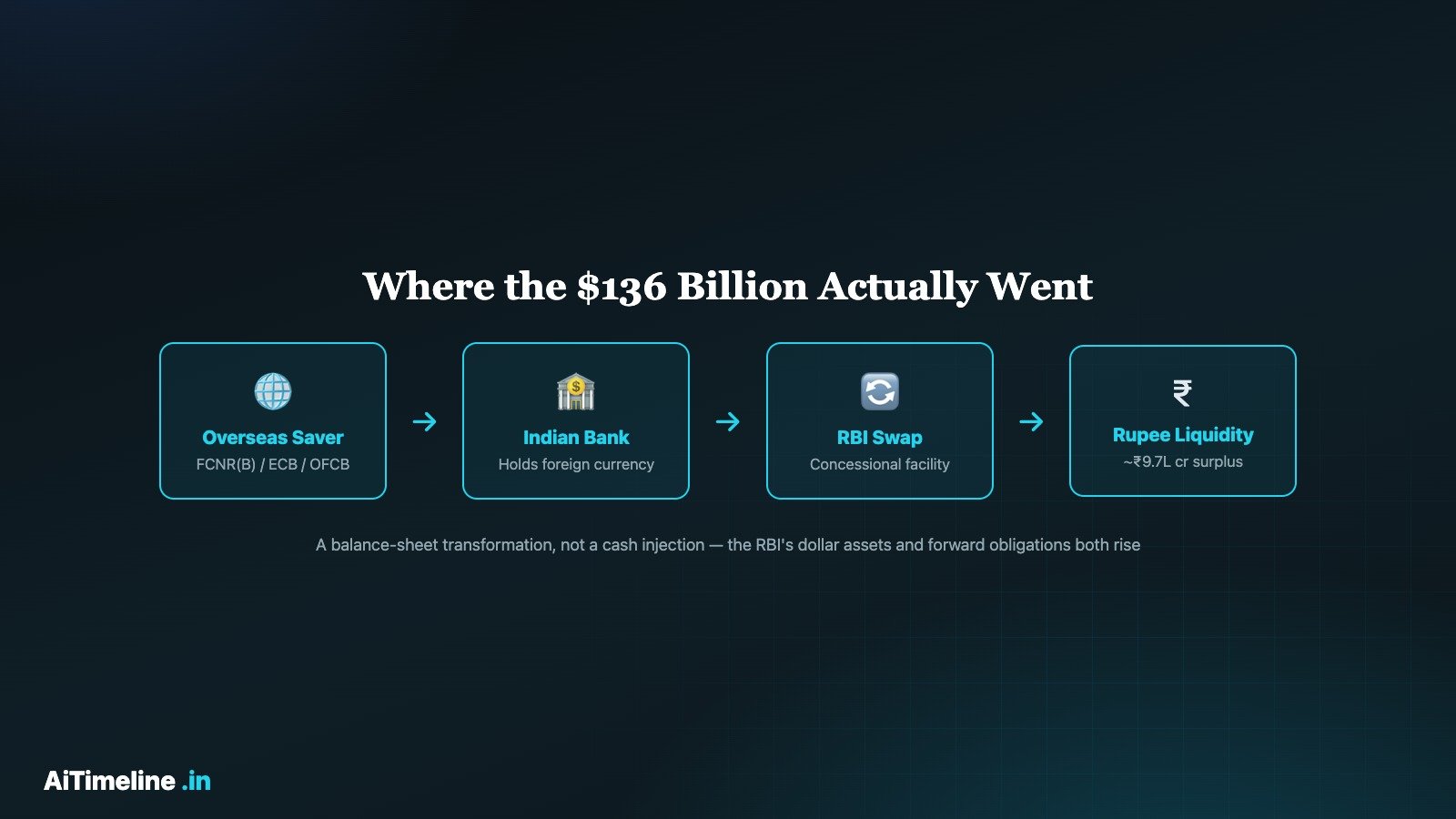
India’s “$136 billion” story of 2026 is a balance-sheet transformation, not a cash injection. Indian banks mobilised $136.38 billion in foreign currency between early June and 31 August 2026 — $127.23 billion through FCNR(B) deposits, $3.89 billion via external commercial borrowings and $5.26 billion via overseas foreign-currency borrowings — using an RBI-supported concessional swap facility. Banks swapped much of those dollars with the RBI and received rupees. That lifted India’s foreign-exchange reserves to a record $729.33 billion (as of 21 August 2026), pushed the RBI’s forward dollar book to about $137 billion, and drove surplus banking-system liquidity to roughly ₹9.7 lakh crore by 3 September 2026. The rupee firmed to a two-month high near 94.30 per dollar. Each swap has a future reversal leg, so the same operation created new dollar obligations for later.
📑 How to read the source labels
RBI OFFICIAL — from the Reserve Bank of India: circulars, the weekly statistical supplement, MPC statements or official press releases. MARKET DATA — timestamped values from exchanges, benchmark providers or credible financial press. ECONOMIST ESTIMATE — a forecast or attribution from named analysts, not an official figure. SCENARIO — interpretation or illustration by AiTimeline, clearly not a prediction. Where the RBI has not yet published a number, this article does not present a market estimate as official.
India did not create $136 billion. It changed who held the dollars — and who held the rupees.
The RBI solved one problem — dollar scarcity. It then had to manage another — too many rupees.
The $136 billion is an inflow today. Part of it is also a dollar obligation tomorrow.
India’s $136 Billion FX Mobilisation: Key Questions
What the $136 billion story is really about
- It was not a single RBI cash injection. $136.38 billion is foreign currency raised by banks through three channels, enabled by an RBI-supported swap facility.
- FCNR(B) dominates. $127.23 billion — about 93% — came from Foreign Currency Non-Resident (Bank) deposits. Do not call the whole total “NRI deposits”, and do not call it one giant swap.
- The depositor deals with the bank, not the RBI. An NRI places an FCNR(B) deposit with a bank; the bank separately swaps dollars with the RBI.
- Dollars in, rupees out. Swapping foreign currency with the RBI credits banks with rupees, which is why domestic liquidity surged even as the FX cushion grew.
- Reserves and the forward book can both rise. Headline reserves hit $729.33 billion; the RBI’s net forward dollar book climbed to about $137 billion. A swap has a future reversal leg.
- Reserves did not jump $136 billion overnight. Settlement timing, RBI FX operations, and currency and gold valuation all move the weekly number.
- The new challenge is excess rupees. The RBI may need to absorb (sterilise) some of the liquidity to keep monetary conditions from loosening unintentionally.
- Echoes of 2013, not a repeat. The 2013 taper-tantrum swaps mobilised roughly $34 billion with reserves near $275–290 billion; 2026 began from record reserves and a stronger macro position.
- There is borrowing here. FCNR(B) is a bank deposit liability; ECB and OFCB are borrowings. What is absent is $136 billion of new sovereign debt.
- A future maturity question. Most special-window deposits are three-to-five-year money, so a large block could mature around 2029–2031 — a liquidity-management issue, not a predetermined crisis.
How Did India Attract $136 Billion of Dollars in Under Three Months?
And why did that leave banks swimming in rupees?
The headline number sounds like India suddenly became $136 billion richer. That is not what happened. The operation moved foreign currency and rupee liquidity between balance sheets — savers and lenders abroad, Indian banks, and the RBI — rather than conjuring new wealth. Follow the flow:
Where Did the $136.38 Billion Come From?
| Channel | Amount | Share | What it is |
|---|---|---|---|
| FCNR(B) deposits | $127.23bn | ~93.3% | Foreign-currency deposits placed with Indian banks by eligible non-residents |
| External commercial borrowings (ECB) | $3.89bn | ~2.9% | Foreign-currency borrowing raised by eligible Indian entities from overseas lenders |
| Overseas foreign-currency borrowings (OFCB) | $5.26bn | ~3.9% | Foreign-currency borrowing by banks from overseas sources |
| Total special FX mobilisation | $136.38bn | 100% | Provisional RBI data as of 31 August 2026 |
⚠️ What the total is not
Source: RBI OFFICIAL (provisional). Do not describe all $136.38 billion as “NRI deposits” — the FCNR(B) share is about 93%, and ECB and OFCB are separate borrowing channels. Do not describe it as one forex swap: it is mobilisation through three channels, much of which was then swapped with the RBI. And do not describe it as an RBI or Government of India loan.
What Is an FCNR(B) Deposit?
FCNR(B) stands for Foreign Currency Non-Resident (Bank) deposit. An eligible non-resident places money with an Indian bank in an approved foreign currency — for example, US dollars. The deposit stays denominated in that foreign currency, so on the principal the depositor does not take rupee exchange-rate risk in the same way a rupee deposit would. These are term deposits, and under the 2026 special window most were three-to-five-year tenors.
🔸 The depositor’s contract is with the bank
It is not accurate to say an NRI “gave the RBI dollars.” The contractual relationship runs: NRI → bank FCNR(B) deposit → bank → RBI swap. The RBI’s counterparty in the swap is the bank. The bank’s obligation is to the depositor. Keep the layers separate.
🔸 On interest rates and tax
There was no single universal “7% tax-free in dollars” rate. FCNR(B) rates varied by bank, currency, tenor and date; during the special window banks offered elevated rates and certain regulatory ceilings and conditions were eased. On tax: interest on qualifying FCNR(B) deposits can receive favourable Indian tax treatment for eligible non-residents, subject to residential status and the Income Tax Act. This is general information, not personal tax advice; specific bank rates should be checked against that bank’s dated rate sheet.
What Did the RBI Actually Offer?
In early June 2026 (announced on 8 June), the RBI unveiled special measures to attract foreign-currency inflows, with a key element being a concessional, hedging-support swap facility tied to FCNR(B) deposits and eligible foreign borrowings. The purpose was to reduce banks’ hedging cost, which made raising three-to-five-year foreign-currency deposits far more attractive. Reuters and other outlets described parts of the programme as providing free or concessional hedging support.
⚠️ “Free hedge” — handle with care
Do not paraphrase this as “the RBI guaranteed today’s exchange rate for free.” That oversimplifies swap pricing, maturity, cash flows and eligibility. The accurate framing: the RBI offered banks highly concessional hedging through its swap facility, lowering the cost of converting foreign-currency funding into rupees safely. The exact terms are set out in the RBI’s circulars.
How the Dollar–Rupee Swap Works
🔸 The accounting point that matters
The RBI does not own those dollars permanently. A swap includes a future reversal. So the RBI’s foreign-exchange assets can rise while its forward liabilities also rise. Think of it as dollars that arrive with a return date: headline reserves increase, and so does the forward obligation. It is not a literal cheque — it is a contracted two-legged transaction.
The Number Behind the $136bn Story That Matters Most
By July 2026, the RBI’s net short forward dollar position rose to a record of about $137 billion, up from roughly $104 billion in June. Forward liabilities are future contracted foreign-exchange obligations. A larger forward book is the mirror image of the swap-driven inflow: the RBI took in dollars now and committed to deliver dollars later.
⚠️ Related numbers, not identical concepts
The ~$137 billion forward book and the $136.38 billion mobilisation are close in size and clearly linked, but they are not the same accounting measure. The forward book also reflects the RBI’s other FX operations, including spot-market intervention managed through forwards. Do not treat one as simply equal to the other.
🔸 Do not subtract the forward book from reserves
Netting ~$137 billion off $729.33 billion to produce “true reserves” is analytically too crude. Reserve adequacy depends on the full forward book, the maturity structure, the intervention position and the composition of assets — not a single subtraction.
Why Didn’t Reserves Rise by $136 Billion?
Foreign-exchange reserves stood at a record $729.33 billion in the week to 21 August 2026 — up $12.4 billion on the week, and above the previous peak of about $728.5 billion set in February. But the special scheme mobilised $136.38 billion, so reserves did not move dollar-for-dollar on any announcement date. Mobilisation is not the same as the weekly change in RBI reserves.
Reserve changes over any period also reflect the timing of swap settlement, RBI purchases and sales of foreign exchange in the market, valuation changes as the dollar moves against other reserve currencies, gold price moves, and other capital flows and forward maturities. Through 21 August, RBI measures introduced in June had drawn roughly $72.8 billion of inflows; the rest of the $136.38 billion was recorded as the FCNR(B) window ran to its early close on 31 August.
❓ If India raised $136 billion, why didn’t reserves increase by $136 billion?
Because mobilisation is not identical to the weekly change in RBI reserves. Some inflows settle over time, the RBI simultaneously buys and sells foreign exchange, and reserve values shift with currencies, gold prices and other transactions.
Why Do Dollar Inflows Create Rupee Liquidity?
31 August 2026: surplus banking-system liquidity was about ₹6.65 lakh crore, then described as the highest since April 2022. By 3 September 2026 the surplus had surged to roughly ₹9.7 lakh crore (around $103 billion equivalent), as most banks swapped their dollar inflows with the central bank. Reporting placed that above the previous record of about ₹9.2 lakh crore from September 2021. Banking-system liquidity is not static — it changes daily with government cash balances, currency in circulation, FX intervention, tax flows, bond settlements and swap maturities — so the ₹9.7 lakh crore figure should not be treated as permanent.
🔸 Why the call rate matters
Around 31 August the weighted average call rate (WACR) was near 4.98%, against a repo rate of 5.25% (repo was held at the 5 August MPC; it is not 5.0%). The RBI’s operating framework aims to keep overnight money-market rates close to the policy rate. When the system holds too much cash, overnight rates can drift below repo, which complicates monetary-policy transmission. That is why a very large surplus is a policy issue, not just a headline.
Too Many Dollars Became Too Many Rupees
The operation that built the FX buffer also expanded domestic liquidity. To keep the currency action from unintentionally loosening monetary conditions, the RBI may need sterilisation — adding rupee liquidity through the FX operation, then using another tool to remove some rupees.
Possible absorption tools, at a high level, include variable-rate reverse repo auctions, the Standing Deposit Facility, cash-reserve-ratio adjustments (including an incremental CRR), open-market bond sales and other liquidity-absorption operations. The RBI has not announced a specific future step here, so none should be presented as decided. Reuters reported that funds raised under the special foreign-currency deposit scheme were exempt from normal reserve requirements; the precise scope is set by the RBI’s circular and should not be generalised to all bank deposits.
⚠️ The “no bonds” framing is wrong
It is true the mobilisation did not involve a $136 billion sovereign bond issue. But the RBI may use government securities or other monetary tools for sterilisation, so the story should not be built around “without issuing a single bond.”
✅ What the surplus can do
- Ease bank funding conditions and support money-market functioning
- Give the RBI more room to smooth rupee volatility
- Support net interest margins for some banks through cheaper funding
❌ What it does not automatically do
- Turn into new loans one-for-one — lending depends on credit demand, capital, risk appetite and regulation
- Guarantee cheaper home or business loans — retail pricing depends on repo, EBLR/MCLR, deposit rates and competition
- Guarantee inflation — that depends on demand, supply, oil, food, the exchange rate and expectations, and on whether the liquidity is sterilised
2013 vs 2026 — Same Tool Family, Very Different India
The comparison is irresistible: both episodes used India’s overseas diaspora and bank balance sheets, via FCNR(B) and overseas-borrowing swap windows, to bring foreign currency into the system. In 2013 the RBI’s two swap windows together mobilised roughly $34 billion (Reuters sometimes isolates the FCNR(B) portion at about $26 billion), at a fixed swap cost of 3.5% per annum, with the windows opened in September 2013 and closed on 30 November 2013. Most of those swaps were extinguished by 2016.
The backdrop was different. In 2013 India was fighting a taper-tantrum currency shock — the rupee fell beyond ₹68 per dollar at its lows — with reserves in the $275–290 billion range. In 2026 the RBI acted with record reserves already in place. That makes the 2026 programme look less like an emergency rescue and more like a very large pre-emptive balance-sheet operation.
| Metric | 2013 taper-tantrum response | 2026 FX mobilisation |
|---|---|---|
| Total special-window mobilisation | ~$34bn | $136.38bn |
| Main source | FCNR(B) + overseas bank borrowings | FCNR(B) overwhelmingly dominant, plus ECB and OFCB |
| FCNR(B) component | ~mid-$20 billions (source-dependent) | $127.23bn |
| RBI reserve context | ~$275–290bn during the crisis period | $729.33bn by 21 Aug 2026 |
| Rupee backdrop | Sharp taper-tantrum depreciation, past ₹68/$ | Oil, geopolitical and Fed-policy pressure |
| Swap cost / tenor | Fixed 3.5% p.a.; mainly 3–5-year FCNR(B) | Concessional, scheme-specific; mainly 3–5-year deposits |
| Domestic liquidity effect | Added rupee liquidity | Produced an exceptionally large surplus |
| Primary lesson | Emergency FX stabilisation | FX buffer plus a liquidity-management challenge |
🔸 “Echoes of 2013”, not “the Rajan playbook”
The 2026 scheme is historically similar to the 2013 FCNR(B) strategy, but it was designed under different RBI leadership, different macro conditions, different terms and a far larger scale — roughly four times the 2013 total. Treat it as an echo, not a re-run.
Why Did the RBI Act in June?
In early September, Brent crude traded around $95–97 a barrel depending on the timestamp (spot, settlement and intraday highs differ — this article uses dated market values, not a fixed “$95+ forever”). On the currency: the rupee closed near ₹94.97 per dollar on 2 September, then opened at about ₹94.30 on 3 September, up roughly 67 paise — its biggest single-day gain since June and a two-month high — before trading moved further during the session. Any exact record-low figure should carry its own source and date rather than being rounded to “near 97.”
📈 Rupee: before vs after the dollar flood
SCENARIO / illustration. Read the path as: pressure through May → the June swap launch → inflows through July → acceleration in August → ₹94.97 on 2 September → ₹94.30 intraday high on 3 September, with Brent crude pressure running the other way. This shows RBI support against oil pressure; it does not mean any one variable drives every move in the exchange rate.
$729.33 Billion in Reserves — and What “Firepower” Really Means
India’s foreign-exchange reserves reached a record $729.33 billion in the week to 21 August 2026. Reserves are made up of foreign-currency assets, gold, Special Drawing Rights and the reserve tranche position at the IMF — the headline is quoted as a dollar equivalent, but it is not all spendable dollars, and non-dollar assets revalue as exchange rates and the gold price move.
A larger buffer gives the RBI greater intervention capacity, not an unlimited ability to defend the rupee. No central bank has infinite resources. The RBI typically seeks to manage excessive volatility and absorb external shocks rather than to publicly defend a fixed exchange rate, and it does not announce a rupee target. Reuters reported that the RBI stepped up dollar sales to support the currency around this period — and here is the paradox: the RBI receives dollars via swaps, and can later sell dollars in the spot market to smooth depreciation, but such sales withdraw rupee liquidity. Multiple channels operate at once.
Balance of Payments: Pressure, Not a 1991-Style Crisis
For April–June 2026, India’s current-account deficit was about $4.2 billion, roughly 0.5% of GDP, and the overall balance of payments recorded a deficit of about $8.1 billion for the quarter. That is context for why stable capital inflows matter — but it is pressure and a risk of deterioration, not a balance-of-payments crisis.
| Episode | Core problem | Reserve position |
|---|---|---|
| 1991 | Severe reserve shortage; import cover measured in weeks | Critically low |
| 2013 | Taper-tantrum capital-flow and currency shock | ~$275–290bn |
| 2026 | Oil, geopolitical and external-funding risk — pre-emptive action | Record $729.33bn |
So 2026 policy is best read as preemptive risk management, not a last-resort rescue. India entered this episode with a much stronger reserve position and macro backdrop than in 1991 or the 2013 crisis-like period.
The 2029–2031 Question
The central trade-off: today’s benefit is more dollars, more rupees and a stronger reserve headline; the future cost is the swap reversal, when the RBI must deliver dollars back under the contracts. Most FCNR(B) deposits under the special facility were three-to-five-year funds, so a large block of liabilities could mature roughly between 2029 and 2031. That does not mean all $127 billion must leave India in one fixed period — deposits can be rolled over, refinanced or behave differently — and if many transactions mature around similar dates, banks and the RBI will need to manage rollovers, swap reversals and FX demand. It is a future liquidity-management issue, not a predetermined crisis.
🔸 Who owes whom?
NRI depositor holds a deposit claim on the bank. The bank holds a swap contract with the RBI, and owes the depositor at maturity. The RBI holds FX assets and a forward obligation. Three balance sheets, three separate contracts — the RBI does not owe NRIs directly.
The $136 Billion Illusion: It Looks Like Reserves, but It Also Creates Liabilities
The headline can sound like India suddenly became $136 billion richer. It did not. Banks raised foreign-currency liabilities; they swapped much of that foreign exchange with the RBI; the RBI’s reserve assets rose; banks received rupees; domestic liquidity surged; and at maturity the swap must reverse. The operation is useful — but not free.
The immediate benefit is stronger FX buffers and easier bank liquidity. The medium-term challenge is too much domestic liquidity and a much larger RBI forward book. The long-term challenge is managing maturities and potential rollovers. The real achievement was not creating money from nothing — it was using India’s banking system and diaspora funding base to change the timing, currency and location of financial liquidity.
That is also why $136 billion and ₹9.7 lakh crore are not two versions of the same number. One measures foreign currency raised by banks. The other measures the net surplus of rupees sitting in the banking system after many different liquidity flows. Confusing them makes the policy look simpler than it is. The same holds for reserves: a country can show larger headline FX reserves and larger forward liabilities at the same time without the reserves being “fake” — it means some of the dollars arrived through transactions that include future reversal commitments, which is why the RBI’s forward book deserves nearly as much attention as the headline reserve number.
A Human View
Imagine an NRI in Dubai placing $100,000 into an FCNR(B) deposit with an Indian bank. The saver still sees a dollar deposit. The bank now has dollar funding — but it may want rupees to operate in India. Instead of paying normal market hedging costs to convert that dollar funding safely, the special RBI window made that transformation far cheaper. The bank swaps the dollars with the RBI. The RBI gains foreign currency; the bank gains rupees. Nothing magically appeared — the currency and the risk moved.
Explore More Timelines
India Banking Liquidity 2026 — Full Timeline
Newest first
Liquidity surplus hits ~₹9.7 lakh crore; rupee at a two-month high
What happened: Surplus banking-system liquidity surged to roughly ₹9.7 lakh crore (about $103 billion equivalent) as most banks swapped their dollar inflows with the RBI — above the previous record near ₹9.2 lakh crore from September 2021. The rupee opened at about ₹94.30 per dollar, up roughly 67 paise and its strongest in two months.
Why it matters: The FX buffer and the rupee both improved, but the domestic liquidity overhang became large enough to raise sterilisation questions.
RBI provisional data: $136.38 billion mobilised
What happened: The RBI disclosed that special-scheme FX mobilisation stood at $136.38 billion — $127.23 billion FCNR(B), $3.89 billion ECB and $5.26 billion OFCB. The rupee closed near ₹94.97 per dollar.
Why it matters: The final figure came in far above the ~$50–60 billion initially expected and the ~$80–90 billion later projected by economists.
FCNR(B) window closes; liquidity surplus ~₹6.65 lakh crore
What happened: The FCNR(B) leg of the swap facility closed, a month ahead of the original 30 September deadline. Banking-system surplus liquidity was about ₹6.65 lakh crore, then the highest since April 2022; the weighted average call rate was near 4.98%.
Why it matters: The early close signalled that inflows had outrun expectations and that excess rupee liquidity and future maturity concentration were becoming the bigger concerns.
Forex reserves hit a record $729.33 billion
What happened: Reserves rose $12.4 billion on the week to $729.33 billion, passing the previous peak of about $728.5 billion from February. RBI measures introduced in June had by then attracted roughly $72.8 billion of inflows.
Why it matters: Record reserves are the visible side of the operation; the growing forward book is the less visible side.
RBI caps the FCNR(B) swap facility
What happened: After strong take-up — reporting cited about $52.3 billion of FCNR(B) inflows by then — the RBI limited the FCNR(B) forex swap facility, while keeping the ECB and OFCB windows open.
Why it matters: The first formal sign that the RBI wanted to control the pace and total size of the mobilisation.
MPC holds the repo rate at 5.25%
What happened: The RBI’s Monetary Policy Committee kept the repo rate unchanged at 5.25% and retained a neutral stance, with the Standing Deposit Facility at 5.00% and the MSF and Bank Rate at 5.50%.
Why it matters: Rate policy stayed on hold while the swap facility did the heavy lifting on external stability — and while it added to the liquidity the MPC would later have to watch.
FCNR(B) inflows accelerate; forward book climbs
What happened: Banks aggressively mobilised foreign-currency deposits, and the RBI’s net short forward dollar position rose to a record of about $137 billion in July, up from roughly $104 billion in June.
Why it matters: The forward book expanding after several months is the accounting counterpart of the swap-driven dollar inflow.
RBI announces special forex measures
What happened: The RBI unveiled special measures to attract foreign-currency inflows, centred on a concessional, hedging-support swap facility for FCNR(B) deposits and eligible foreign borrowings, originally open until 30 September 2026.
Why it matters: Cutting banks’ hedging cost is what made raising three-to-five-year foreign-currency funding attractive at scale.
Oil and geopolitical pressure builds on the rupee
What happened: Renewed US–Iran conflict pushed crude prices higher. With India importing around 85% of its crude, a higher oil bill raised dollar demand and inflation risk, and the rupee weakened alongside a firm dollar and shifting global yields.
Why it matters: This is the trigger for the whole programme — the RBI chose to build the buffer pre-emptively rather than spend reserves defending the currency day to day.
The precedent: the taper-tantrum FCNR(B) swap
What happened: Facing a taper-tantrum currency shock, the RBI opened FCNR(B) and overseas-bank-borrowing swap windows in September 2013 at a fixed 3.5% per annum cost, closing them on 30 November 2013. They mobilised roughly $34 billion, with reserves then near $275–290 billion and the rupee past ₹68 per dollar at its lows.
Why it matters: 2026 used the same tool family at about four times the scale — but from a position of record reserves, making it pre-emptive rather than an emergency.
Update log
- 3 September 2026 — full explainer published: $136.38bn breakdown, forward-book context, ~₹9.7 lakh crore liquidity, 2013 comparison.
- 3 September 2026 — rupee two-month high (~94.30/$) and record liquidity surplus added.
- 2 September 2026 — RBI provisional mobilisation data ($136.38bn) recorded.
- 31 August 2026 — FCNR(B) window closed; liquidity surplus ~₹6.65 lakh crore.
- 21 August 2026 — forex reserves record $729.33bn.
- 14 August 2026 — RBI capped the FCNR(B) swap facility.
- 8 June 2026 — RBI announced the special forex measures.
⚠️ No investment advice
This article explains a monetary and balance-of-payments event. It does not provide currency trading advice, bond recommendations, bank-stock recommendations, interest-rate trading calls or investment recommendations. Any market reaction mentioned — including moves in Indian financial stocks on 3 September — is reported as context, not as a suggestion to act.
⚠️ Editorial and E-E-A-T note
What the $136.38bn figure includes: foreign currency mobilised by banks through FCNR(B) deposits, ECB and OFCB under the RBI’s 2026 special measures — not an RBI cash injection, not sovereign borrowing. FX inflows vs rupee liquidity: the $136.38bn (dollars) and the ~₹9.7 lakh crore surplus (net domestic rupees) are linked but distinct measures. Reserves vs forward liabilities: record reserves and a record forward book can coexist. 2013 comparison methodology: the ~$34bn figure is the combined 2013 FCNR(B) plus overseas-borrowing swap total; the FCNR(B)-only figure is about $26bn. Market-data timestamp: rupee, oil and daily liquidity values are as of 3 September 2026 and move afterwards. Corrections policy: material changes are logged above. Sources: Reserve Bank of India (weekly statistical supplement, circulars, MPC statements, press releases), Ministry of Finance balance-of-payments data, and credible financial press (Reuters, Bloomberg, Business Standard) for market context.
Frequently Asked Questions
Explore More on AiTimeline
Sources & further reading
Every dated entry above was checked against these references. Last reviewed 15 September 2026.
- Reserve Bank of India — Weekly Statistical Supplement
- Reserve Bank of India — Press Releases
- Business Standard — RBI forex swap scheme attracts $127.23 billion through FCNR(B) deposits
- Business Today — Dollar deluge: RBI's forex scheme draws $136.37 billion
- Business Standard — Banking system surplus liquidity hits 4-year high on strong FCNR(B) flows
- Business Standard — RBI MPC keeps repo rate unchanged at 5.25%
- Business Today — Rupee jumps 67 paise to open at 94.30 against the US dollar
- ians live — India's forex reserves hit record $729.3 billion