Global Disaster Insurance Timeline 2026–2030: Who Pays When Catastrophes Aren’t Insured?
Natural disasters caused about $112B in losses in H1 2026, but only $44B was insured. See who pays the 60% gap and how parametric insurance works.
Latest Story
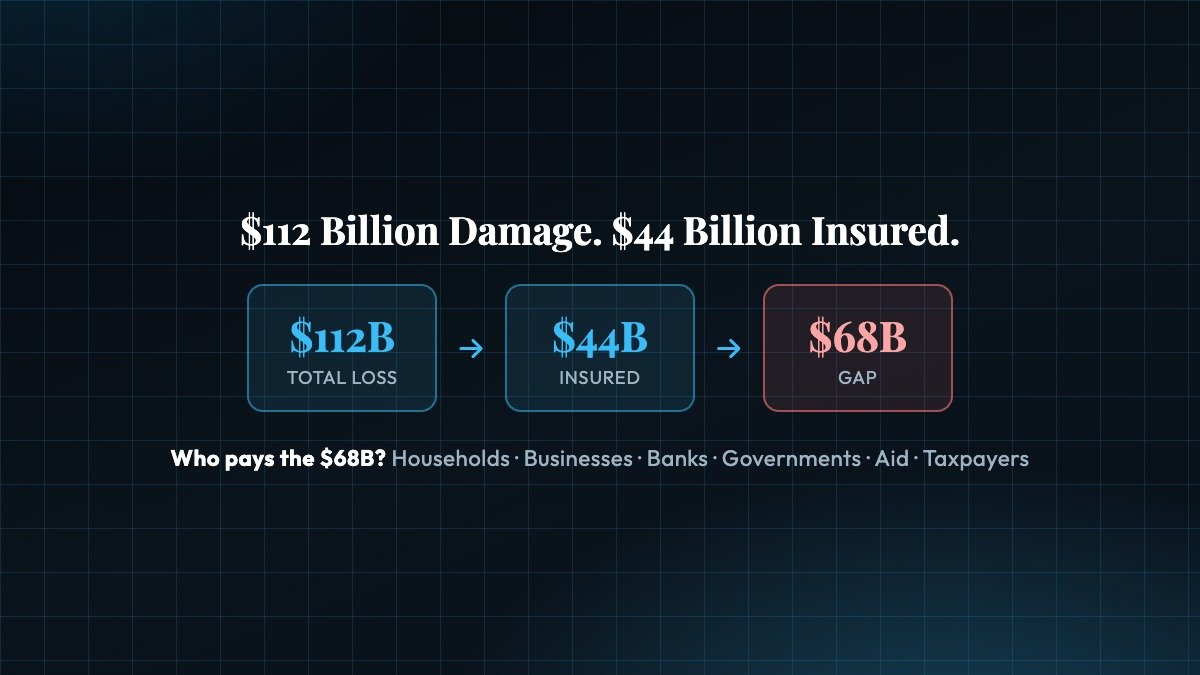
When a city floods, burns or is shaken by an earthquake, the physical damage is only half the story. The second, quieter disaster is financial: someone has to pay to rebuild. In the first six months of 2026, natural disasters caused an estimated $112 billion in economic losses worldwide — and only about $44 billion of that was insured, per Munich Re’s NatCatSERVICE. This global disaster insurance gap of roughly $68 billion, about 60% of the total, does not vanish. It moves — onto households, businesses, banks, governments and, in Nepal’s case, onto a national economy trying to absorb a rebuild bill equal to roughly a tenth of its annual output.
Catastrophe data last verified: 1 September 2026. Every figure below is labelled by trust level — 🟢 verified/official, 🟡 credible reporting/estimate, 🟠 modelled/forecast, 🔵 historical context, ⚪ future watchpoint — and sourced to Munich Re, Reuters, Swiss Re, CCRIF SPC or named government officials. Natural-disaster losses are never automatically relabelled “climate disaster losses” — earthquakes are not climate-driven.
🧠 AI Overview Summary
When disaster damage isn’t insured, the loss doesn’t disappear — it shifts. Households and businesses may absorb it directly, banks can face loan losses, governments fund relief and reconstruction, and international lenders may step in, usually with loans rather than grants. Munich Re estimates natural disasters caused about $112 billion in global losses in H1 2026, with only $44 billion insured — a 60% protection gap. The exact burden depends on each country’s insurance penetration, public finances and disaster-finance tools.
A disaster doesn’t destroy money — it transfers the loss
🔵 Conceptual framework underlying every figure in this article.
A flooded house, a collapsed bridge or a burned-out shop represents a real, physical loss of value. What insurance does is not prevent that loss — it decides in advance who carries it financially. With insurance, thousands of policyholders pay premiums into a shared pool before disaster strikes; when it does, the pool pays eligible claims, and insurers can pass part of that risk to reinsurers. Without insurance, the destroyed asset is still destroyed — the bill simply lands somewhere else: on the household, the lender, the local government, or eventually the national budget.
This is the article’s central thesis: a disaster destroys the asset. Insurance — or its absence — decides who carries the financial loss.
Disaster insurance: key questions
What the 2026 numbers actually show
- $112B economic loss, $44B insured, 60% gap. Munich Re’s H1 2026 NatCatSERVICE review is the anchor dataset for this article.
- Economic loss ≠ insured loss. $112bn of total damage does not mean insurers owe $112bn — only the covered portion is an insurance claim.
- H1 2026 was not a record. It was roughly in line with the 10-year average and below the 5-year average — the story is a persistent gap, not a single freak period.
- Same-size losses, wildly different outcomes. A $30bn Venezuela earthquake left under $1bn insured; a $30bn US thunderstorm season left about $22bn insured.
- Earthquakes are not climate disasters. Grouping every natural-disaster dollar under “climate losses” is a common but inaccurate shorthand this article avoids.
- Parametric insurance trades precision for speed — it can pay out in days instead of months, but the payout may not exactly match the real loss (“basis risk”).
- Development-bank aid is often a loan. World Bank and Asian Development Bank disaster financing frequently includes concessional loans and emergency credit alongside grants — not free money.
- India’s insurance penetration is low relative to disaster exposure — a cited estimate puts only about 5% of disaster losses as insured, and a national parametric scheme remains an early-stage proposal, not policy.
- Nepal’s 2026 Himalayan flood shows the gap in real time — a preliminary $4–5 billion rebuild estimate, roughly 10% of GDP, in a market where insurance penetration is among the lowest in Asia.
- Insurance is financial resilience; early warning and building codes are physical resilience — neither replaces the other, and Nepal’s floods showed both a coverage gap and a warning system that worked.
Same $30 billion loss, two very different outcomes
🟢 Verified/official — Munich Re H1 2026 preliminary event estimates.
The clearest illustration of the protection gap is not the size of a disaster — it’s what happens after. Two H1 2026 events caused almost identical total damage. Their insured share could not have been more different.
Venezuela Earthquake vs U.S. Thunderstorms
The Venezuela quake — the most powerful to hit the region since 1900, per the USGS — struck an area with underdeveloped domestic insurance markets, so most of the ~$30bn loss falls on households, businesses and government. The US thunderstorm season, led by an April Midwest outbreak with roughly 100 tornadoes including one EF4, hit a market with deep, mature property insurance penetration. What determines financial resilience is not the severity of the disaster alone — it’s insurance penetration, building standards, wealth and disaster-finance infrastructure already in place before the event.
What is parametric insurance?
🔵 Established mechanism, per CCRIF SPC and industry sources.
Traditional insurance asks: how much damage did you suffer? An adjuster inspects the property, tallies the loss, and pays out accordingly — a process that can take weeks or months. Parametric insurance asks a different question: did the agreed trigger happen? If rainfall crosses a set threshold, an earthquake exceeds a given magnitude, or wind speed passes a defined level, a pre-agreed payout follows — without waiting for a full damage assessment.
Traditional vs Parametric Insurance
CCRIF SPC, the Caribbean’s sovereign parametric pool, explains the mechanism simply: because payouts are based on a pre-agreed event measurement rather than a property-by-property damage survey, funds can reach a government or policyholder far faster than a conventional claims process allows. That speed matters most in the first days after a disaster, when emergency response and basic government functions need cash immediately — before anyone knows the full damage total.
The catch: basis risk
A parametric trigger may fire even when actual loss is smaller than expected — or fail to pay out fully when real damage is severe but the measured trigger falls just short. Example: a rainfall policy triggers at 200mm; a building floods badly at 190mm. Traditional coverage would still pay for the real damage. A parametric policy, depending on its exact terms, might pay nothing. This mismatch between the trigger and the true loss is called basis risk, and it is the main reason parametric cover is usually a complement to traditional insurance — especially for fast liquidity — rather than a full replacement for it.
Governments can buy parametric protection too, known as sovereign parametric insurance. A trigger — a storm’s wind speed, an earthquake’s magnitude, cumulative rainfall — releases emergency cash before the full reconstruction cost is even known, helping fund the first weeks of response while a fuller damage assessment and traditional/reinsurance claims process plays out in parallel.
Who insures the insurance companies?
🔵 Established mechanism — reinsurance and capital markets.
Insurers themselves transfer part of their risk to reinsurers — companies such as Munich Re, Swiss Re and Hannover Re that specialise in absorbing large, correlated catastrophe risk so that one severe event doesn’t overwhelm a single insurer’s balance sheet. A reinsurer can in turn pass on part of its own exposure through retrocession, spreading risk further within the industry. Beyond that, some catastrophe risk moves into capital markets through catastrophe bonds: investors provide capital up front; if no qualifying disaster occurs, they receive interest and their principal back; if a defined trigger event does occur, some or all of that capital can be used to pay claims instead. This is a specialty, high-risk instrument — principal can be lost after a qualifying event — not a conventional bond, and nothing here is investment guidance.
Layering disaster risk, not insuring it all the same way
🔵 Standard disaster-risk-financing framework used by the World Bank and sovereign risk pools.
Disaster-finance practitioners generally don’t try to insure every level of risk identically. Frequent, low-cost events are cheaper to absorb directly than to insure; rare, catastrophic events are exactly what insurance and capital markets are built for. This is usually described as risk layering:
| Layer | Typical event | Typical financing tool |
|---|---|---|
| Bottom | Small, frequent losses | Household savings, business reserves, government budget/reserves |
| Middle | Major single events | Traditional insurance, sovereign parametric cover |
| Top | Rare mega-disasters | Reinsurance, catastrophe bonds, contingent credit, international financing |
Nepal 2026: what happens when a disaster costs roughly 10% of an economy?
🟢 Verified/official casualty data · 🟡 preliminary damage estimate — still evolving as of 1 September 2026.
On 26 August 2026, a large ice-and-rock avalanche and temporary river blockage in the upper Lhende Khola triggered a violent flash flood down the transboundary Bhote Koshi–Trishuli river system, devastating settlements across a roughly 72km stretch in northern Nepal and southern Tibet. As of the latest confirmed figures, at least ~800 people have died in Nepal and 16 in Tibet, with roughly 2,500 more missing in Nepal and 546 in Tibet — numbers Nepali and Chinese authorities have both cautioned are likely to keep changing as search operations continue. This is a human catastrophe first; the financial story below does not reduce that loss to a dollar figure.
Nepal’s Finance Minister, Swarnim Wagle, said the country could need $4–5 billion to rebuild — an amount he and Reuters both frame as approaching 10% of Nepal’s economy. This is a preliminary reconstruction estimate, not a final audited damage assessment; Nepal’s own government put initial flood damage at roughly Rs 200 billion, including about Rs 15 billion in road and bridge damage alone, affecting 41 bridges and 42km of road.
The flood heavily damaged hydropower, roads, bridges, homes and businesses along the river system — hitting Upper Trishuli-1, a 216MW run-of-river hydropower project financed by a consortium of nine multilateral development banks and finance institutions led by the International Finance Corporation. Over 100 workers were reported missing from the project site. Because the 2015 Nepal earthquake had already made traditional insurers reluctant to cover earthquake risk at this remote site, Swiss Re helped structure a parametric risk-transfer solution into the project’s original financing — making Upper Trishuli-1’s response to this flood a closely watched test case for how parametric cover performs under real catastrophic conditions. That is one insured project, not a national safety net: its outcome says nothing about whether Nepal’s broader $4–5bn rebuild bill is covered.
Who could pay Nepal’s rebuild?
No source has confirmed a specific committed amount from any single institution as of 1 September 2026 — this sequence describes typical channels, not a finalized financing plan.
Aid is often a loan, not a gift
World Bank and Asian Development Bank disaster financing frequently combines grants with concessional loans and emergency credit lines. Some countries arrange contingent credit in advance — the World Bank’s Catastrophe Deferred Drawdown Option (Cat DDO) is one such tool — giving eligible governments fast access to pre-arranged financing once specific trigger conditions are met, well before tax revenue or full reconstruction funding catches up. None of this is confirmed to apply to Nepal’s 2026 response specifically; it describes the kind of instruments typically available.
A 14-minute warning that worked
Not every part of this story is about money. In Bidur, headmaster Rajendra Dawadi evacuated his school after an accountant received a phone call warning that floodwater was approaching from upstream. The last bus crossed a bridge roughly 14 minutes before it collapsed — helping save more than 900 students and 16 staff. It’s a reminder that early warning and building standards are physical resilience, distinct from insurance, which is financial resilience. Neither substitutes for the other.
India: a huge economy with a large disaster insurance gap
🟡 Credible reporting/estimate — figures vary by year, hazard and methodology.
India faces a wide range of disaster risk — flood, cyclone, heat, landslide, earthquake, urban flooding and coastal exposure — but catastrophe insurance penetration remains comparatively low. A commonly cited estimate puts only about 5% of India’s disaster losses as insured, a figure that should be read as an illustrative snapshot rather than a fixed, permanent ratio — it varies by year, hazard type and the methodology behind the estimate.
India’s government has begun early-stage talks with the National Disaster Management Authority, the finance ministry and GIC Re, among other insurers, about a possible nationwide climate-linked parametric insurance scheme. The proposed model would pay out based on weather thresholds — rainfall, temperature, wind speed — for events like floods and heatwaves, aiming to speed up compensation versus a traditional claims process. As of the most recent reporting, federal officials back the idea but no formal proposal has been floated; funding options under discussion include reallocating existing disaster-relief funds or introducing small, mandatory charges on utility bills (water or electricity), particularly in urban areas. Neither mechanism is currently in force — both remain proposals under discussion, not policy.
Nagaland’s parametric cover
In 2024, Nagaland became the first Indian state to insure its entire geography against excess rainfall through a multi-year parametric policy underwritten by SBI General Insurance, with Munich Re as lead reinsurer and GIC Re also involved. It received a payout after a 2024 rainfall trigger and has since processed further claims under the state’s Disaster Risk Transfer Parametric Solution.
Nationwide parametric scheme
Early-stage discussions between India’s finance ministry, NDMA and insurers on a national climate-linked parametric programme for floods and heatwaves — still exploratory, with no formal proposal announced as of the latest reporting.
Regional sovereign catastrophe risk pools
🟢 Verified/official — established multi-country parametric insurance facilities.
Rather than each government buying disaster cover alone, several regions pool sovereign catastrophe risk together, which can lower the cost of reinsurance for participating countries. CCRIF SPC, the Caribbean Catastrophe Risk Insurance Facility, is the longest-running example: it currently covers 23 member governments across the Caribbean and Central America, offering earthquake, tropical cyclone, excess rainfall, loan-portfolio and fisheries-sector parametric policies, and grew its total coverage by about 9% to roughly $1.57 billion ahead of the 2026 Atlantic hurricane season.
CCRIF SPC
23 member governments; earthquake, tropical cyclone, excess-rainfall, loan-portfolio and fisheries parametric cover; ~$1.57B total coverage ahead of the 2026 hurricane season.
African Risk Capacity (ARC)
Sovereign parametric drought, flood and cyclone risk pool for African Union member states, paired with early-response contingency planning.
Pacific Catastrophe Risk Insurance Company (PCRIC)
Parametric earthquake, tsunami and tropical cyclone cover for Pacific island nations, designed for rapid post-disaster liquidity.
Southeast Asia Disaster Risk Insurance Facility (SEADRIF)
A regional platform supporting flood and other catastrophe risk-financing tools for member ASEAN economies.
Membership and products change
Regional pool membership, product lines and coverage totals are updated regularly by each facility — verify current terms directly with the pool (e.g. ccrif.org) before citing specific figures beyond what’s sourced here.
Underinsurance, deductibles and exclusions
🔵 Standard insurance concepts.
Being insured is not the same as being fully covered. Underinsurance happens when a policy’s payout limit is below the real cost of rebuilding — a $300,000 reconstruction cost against a $200,000 policy limit leaves a $100,000 gap even though the homeowner has “insurance.” A deductible is the amount the policyholder pays before the insurer covers the remaining eligible loss. An exclusion removes a specific peril from cover entirely — in many markets, standard home policies exclude or sharply limit flood, storm surge or earthquake damage, requiring separate cover that not everyone buys. These gaps mean even a nominally “insured” country or household can carry a meaningful uninsured loss.
✅ Insurance Can
- Pay covered claims quickly once assessed or triggered
- Protect a mortgage lender’s collateral value
- Spread catastrophic risk across reinsurers and capital markets
- Give governments faster liquidity via sovereign parametric cover
❌ Insurance Cannot
- Prevent the physical destruction itself
- Guarantee full replacement value if underinsured
- Cover perils explicitly excluded from a policy
- Substitute for building codes, warning systems or land-use planning
The cheapest disaster claim is the one that never happens
🟡 Munich Re and disaster-risk-reduction guidance.
Munich Re’s own H1 2026 commentary stresses two things alongside the loss figures: avoid building in the highest-risk locations, and invest in prevention. Flood barriers, drainage, resilient building codes, wildfire buffers, early-warning systems and resilient power grids reduce how much damage occurs in the first place — they are physical resilience. Insurance, reinsurance, disaster funds and aid instead determine who absorbs the financial shock after the fact. Nepal’s 2026 flood illustrates both sides at once: a 14-minute warning saved hundreds of lives at one school, while a thinly insured national economy now faces a multibillion-dollar, multi-year rebuild.
H1 2026 losses by event — the numbers side by side
🟢 Verified/official, Munich Re NatCatSERVICE, all figures approximate and in USD.
| Event / region | Economic loss | Insured loss | Insured share |
|---|---|---|---|
| Global, H1 2026 | ~$112B | ~$44B | ~39% |
| North America, H1 2026 | ~$47B | ~$34B | ~72% |
| Europe, 9 winter storms | ~$22B | ~$7B | ~32% |
| US severe thunderstorms | ~$30B | ~$22B | ~73% |
| Venezuela double earthquake | ~$30B | <$1B | ~3% |
| Period | Economic loss | Insured loss |
|---|---|---|
| H1 2026 (actual) | $112B | $44B |
| 10-year H1 average | $113B | $50B |
| 5-year H1 average | $136B | $66B |
Why this matters more than a “record” headline
H1 2026 was not the worst half-year on record — it was close to the 10-year average and below the 5-year average. That makes the ~60% protection gap a more durable, structural finding than a one-off spike would be: even in a relatively ordinary catastrophe-loss period, roughly six in ten dollars of damage were uninsured.
💡 Worth Knowing
- The Venezuela earthquake on 24 June 2026 was, per the USGS, the most powerful to hit that highly quake-prone region since 1900.
- CCRIF’s 23-member Caribbean/Central America pool grew coverage 9% to ~$1.57 billion ahead of the 2026 hurricane season.
- Nagaland was the first Indian state to insure its entire geography against excess rainfall via parametric cover.
- Upper Trishuli-1’s parametric earthquake cover was originally structured after the 2015 Nepal earthquake delayed the project for traditional insurers.
- Swiss Re’s global Insurance Resilience Index — a broader annual measure of catastrophe protection — stood at about 27.3% in 2025, up from 25.3% in 2015, alongside a cited global protection gap exceeding $420 billion for that year.
Explore More Timelines
People Also Ask
Frequently Asked Questions
⚠️ Editorial Note
This article separates verified/official figures (Munich Re NatCatSERVICE, government statements) from credible reporting, modelled estimates and future watchpoints, using the trust labels defined at the top. Nepal-related financial figures are preliminary and will be updated as official damage assessments are completed. This is not insurance-buying advice, and no political blame is assigned or implied for any funding gap discussed here.
Disaster insurance timeline: 2026–2030
Newest first. 🟢 verified/official · 🟡 credible reporting/estimate · 🟠 modelled/forecast · 🔵 historical context · ⚪ future watchpoint.
2026
14-minute warning saves 900+ students in Bidur, Nepal
Headmaster Rajendra Dawadi evacuated his school after a phone call warned that floodwater was approaching from upstream; the last bus crossed a bridge roughly 14 minutes before it collapsed, saving over 900 students and 16 staff.
2026
Nepal’s Finance Minister estimates $4–5B rebuild cost
Finance Minister Swarnim Wagle said Nepal could need $4–5 billion to rebuild from the Himalayan flood — an amount he described as approaching 10% of the country’s annual economic output.
2026
Nepal–Tibet Himalayan flood devastates Trishuli river system
An ice-and-rock avalanche and temporary river blockage in the upper Lhende Khola triggered a flash flood down the Bhote Koshi–Trishuli system, devastating settlements across northern Nepal and southern Tibet, overrunning the Upper Trishuli-1 hydropower project and knocking out roughly 10% of Nepal’s power capacity.
2026
Munich Re publishes H1 2026 global natural-disaster review
Munich Re reported ~$112 billion in global economic losses for H1 2026, with ~$44 billion insured — a ~60% protection gap. Figures were close to the 10-year H1 average ($113B/$50B) and below the 5-year H1 average ($136B/$66B).
2026
Double earthquake strikes Venezuela — ~$30B loss, <$1B insured
Two earthquakes measuring M7.2 and M7.5 struck about 200km west of Caracas — per the USGS, the most powerful to hit the region since 1900. Munich Re’s preliminary estimate put total losses near $30 billion, with insured losses under $1 billion.
Midwest US thunderstorm outbreak drives H1’s biggest insurer losses
A severe thunderstorm outbreak swept the central and southern US, producing roughly 100 tornadoes including a destructive EF4 with winds up to ~290km/h. It anchored a US thunderstorm-season total of ~$30B in losses, ~$22B insured — the largest single driver of global insured losses in H1 2026.
2026
Nine European winter storms cause ~$22B in losses
Nine winter storms accounted for roughly 80% of Europe’s total H1 2026 natural-disaster losses and about 70% of the region’s insured losses — around $22B total, just over $7B insured.
H1
India explores nationwide parametric disaster insurance
India’s finance ministry, National Disaster Management Authority and GIC Re have held early-stage talks on a nationwide climate-linked parametric insurance scheme for floods and heatwaves, with funding options including reallocated disaster-relief funds or small utility-bill charges under discussion.
Nagaland renews and expands parametric rainfall cover
Nagaland, the first Indian state to insure its entire geography against excess rainfall, renewed its multi-year parametric policy with SBI General Insurance (Munich Re as lead reinsurer, GIC Re also involved) and processed further claims under its Disaster Risk Transfer Parametric Solution.
SEASON
CCRIF grows Caribbean/Central America coverage to ~$1.57B
Ahead of the 2026 Atlantic hurricane season, CCRIF SPC increased its total parametric coverage by about 9% to roughly $1.57 billion across its 23 member governments.
2026
Upper Trishuli-1’s parametric earthquake cover becomes a live test case
After the 2015 Nepal earthquake made traditional insurers reluctant to cover earthquake risk at the remote Upper Trishuli-1 hydropower site, Swiss Re helped structure a parametric risk-transfer solution to enable the project’s financing. The August 2026 flood makes this structure a real-world test case, though it was designed around earthquake risk specifically, not flood.
Watchpoint: can the insurance gap shrink faster than disaster risk grows?
Expansion of parametric products, regional risk pools, catastrophe bonds and public-private disaster financing could narrow the protection gap over the rest of the decade — or rising exposure and frequency could outpace it. No credible source has published a specific 2030 global-gap dollar forecast, and this article does not invent one.
The disaster ends. The bill doesn’t.
A flood lasts hours. An earthquake lasts seconds. The financial consequences can last years, or in Nepal’s case, most of a decade. That is why the most important number after a catastrophe often isn’t the size of the damage — it’s the size of the gap between what was destroyed and what was insured. In the first half of 2026, that gap was roughly $68 billion worldwide. Some of it will be absorbed by households. Some by companies. Some by banks. Some by governments. Some by international institutions, usually as loans rather than gifts. And some may never be fully rebuilt.
Tools like parametric insurance, catastrophe bonds and regional risk pools can move money faster and spread losses more widely — CCRIF’s rapid Caribbean payouts and Nagaland’s rainfall cover both show the mechanism working as intended. But they solve only part of the problem. The other half is physical: build better, warn earlier, avoid the highest-risk locations, and reduce how much can be destroyed in the first place. Insurance can change who pays for a disaster. It cannot stop the water from arriving.
Sources & further reading
Every dated entry above was checked against these references. Last reviewed 15 September 2026.
- Munich Re — Lower losses, growing risks: the natural disaster review for H1 2026
- Reuters — Nepal flood insured losses coverage (via PropertyCasualty360)
- Al Jazeera — Nepal–Tibet floods: what happened, what caused them
- CCRIF SPC — official site (parametric risk pool)
- Swiss Re Corporate Solutions — Parametric enables Nepal's renewable energy project financing
- Artemis.bm — Nagaland renews parametric insurance with SBI General, Munich Re & GIC Re support
- Business Standard — Govt considers introducing nationwide climate-linked insurance scheme
- World Bank — Disaster Risk Financing and Insurance