The Line & NEOM Timeline: Construction, Progress and What Comes Next
NEOM's The Line: 2021 launch, 2024 scale-back reports, the Sept 2025 pause, March 2026 contract cuts and where construction stands in August 2026.
Latest Story
The Line, the 170-kilometre linear city Saudi Arabia unveiled in January 2021 as the centrepiece of its wider NEOM development on the Red Sea, has spent five years moving between two different stories. One is the render: a mirrored, car-free city stretching from mountains to sea, housing up to a million residents inside a five-minute walk of everything they need. The other is the trench: roughly 2.4 kilometres of excavation and foundation work near the Gulf of Aqaba, construction paused since September 2025 pending a strategic review, and a Public Investment Fund governor telling reporters in April 2026 that hitting any date by 2030 is “not a must.” This page tracks both stories from the 2017 announcement of NEOM through 2026, and is explicit throughout about which claims are announced vision, which are contracted work, which were under construction, and which have since been paused or cancelled.
NEOM & The Line: Key Questions
The Big Picture
- NEOM (announced October 2017, $500 billion) is the wider Red Sea development; The Line (announced January 2021) is one project inside it — a proposed 170 km linear city. Treating every NEOM headline as a Line headline is the single most common factual error in coverage of this project.
- The only construction figure that shows up consistently across independent reporting is ~2.4 kilometres of foundation and earthworks near the Gulf of Aqaba — about 1.4% of the original 170 km vision.
- Construction on The Line has been paused since around September 16, 2025, when PIF ordered a strategic review; a May 2026 Semafor report said the pause now effectively extends past 2030.
- Reports in April 2024 said Saudi officials had privately scaled the 2030 target from 170 km to about 2.4 km, and the population target from 1.5 million to 300,000 — this was reported, not officially announced, though it lines up with what was later actually built.
- In March 2026, NEOM terminated a cluster of major contracts — a ~$1 billion Line tunnel package and a $1.15 billion Trojena steel contract among them — worth a combined $5 billion or more by contractor disclosures.
- PIF’s own governor has publicly rejected the word “cancelled.” On April 15, 2026 he said completing The Line by 2030 “would be good to have, but it’s not a must,” and stressed The Line is one part of NEOM, not the whole project.
- A leaked internal audit, presented to NEOM’s board in spring 2024 and reported by the Wall Street Journal in March 2025, put full-scope completion at up to $8.8 trillion and the year 2080 — roughly 17x the original budget. NEOM has not confirmed this figure.
- Not every NEOM project has stalled. Oxagon’s green hydrogen plant was reported roughly 90%+ complete by April 2026, and a $5 billion first-phase AI data centre with DataVolt was signed in February 2025.
- Sindalah, NEOM’s Red Sea resort island, held a VIP “grand opening” in October 2024 but was still not open to general public bookings as of mid-2026, per industry reporting.
- NEOM’s CEO since 2018, Nadhmi Al-Nasr, was replaced in November 2024 by Aiman Al-Mudaifer, amid reporting linking the departure to conduct allegations and mounting doubts about the project’s near-term viability.
What Is Actually Being Built in 2026?
Separating confirmed construction from cancelled contracts from long-term vision — with dated sources for each.
| Status | What it covers | Evidence & date |
|---|---|---|
| Confirmed / built, activity paused | ~2.4 km of Line foundation & earthworks near the Gulf of Aqaba; NEOM Bay Airport (operational since 2021); Sindalah resort structures (VIP-opened Oct 2024, not public) | PIF pause reporting, ~Sept 2025; NEOM Bay Airport GACA certification, 2021; Dezeen/Arab News, Oct 27, 2024 |
| Active, unaffected so far | Oxagon green hydrogen plant (NEOM Green Hydrogen Co. — ACWA Power/Air Products JV), reported ~90%+ complete; DataVolt AI data centre first phase in early development | Industry reporting, ~April 2026; NEOM/SPA official signing, Feb 10, 2025 |
| Contracted, then terminated (2026) | The Line’s 12.5 km tunnel package (Hyundai E&C / Samsung C&T / Archirodon, ~$1B); Trojena Ski Village structural steel (Eversendai/Al Bawani, ~$1.15B); Trojena dams (Webuild, ~$5B) | Contractor disclosures via Dezeen, MEED, Gulf Construction, Reuters/Zawya — all March 26, 2026 |
| Long-term vision, no active construction | The full 170 km Line corridor and mirrored facade; a 1–9 million resident population (figures vary by source/date); a citywide high-speed underground rail spine; Trojena as a year-round ski resort hosting the 2029 Asian Winter Games | 2021 NEOM launch materials; Asian Winter Games host withdrawal reported Jan 2026 |
NEOM vs The Line: What’s the Difference?
| NEOM | The Line | |
|---|---|---|
| What is it? | A wider ~26,500 km² regional development in northwest Saudi Arabia | One specific urban-development concept inside NEOM |
| Announced | October 24, 2017, at the Future Investment Initiative, Riyadh | January 10, 2021, as a standalone reveal |
| Scope | Multiple sub-projects across tourism, industry and residential zones | A single proposed 170 km linear city |
| Major components | The Line, Oxagon, Trojena, Sindalah, NEOM Bay Airport | Urban modules, a mobility spine, supporting infrastructure |
| 2026 status | Mixed — Oxagon’s energy/data-centre projects active; tourism and Line construction paused or scaled back | Construction paused since ~Sept 2025; ~2.4 km built |
NEOM is not The Line, and coverage that treats every NEOM headline as news about The Line specifically is a common source of confusion — this page keeps the two separate throughout.
Is The Line Still 170 Kilometres Long?
As a long-term design vision, 170 km is still the figure NEOM’s own materials use for The Line’s full concept. It has never been officially withdrawn or replaced with a shorter number in any NEOM or PIF statement. But 170 km was never a description of what was under construction at any given time — it was always the endpoint of a multi-decade build-out, and phased development means portions of the project were meant to be delivered well before the full length existed.
What changed is the near-term target. Reports from Bloomberg and other outlets in April 2024, citing people familiar with internal planning, said Saudi officials had privately cut the 2030 milestone from 170 km to roughly 2.4 km, and the associated population target from 1.5 million residents to about 300,000. Saudi Arabia did not officially confirm this change at the time — it was reported, not announced. What makes it notable in hindsight is that 2.4 km is almost exactly the figure independent reporting has since converged on as the actual amount of foundation and earthworks completed before the September 2025 pause. The leaked number and the built number line up, even though neither was ever an official NEOM statement.
So: the 170 km vision has not been formally cancelled, but no evidence supports describing 170 km of continuous active construction at any point in this project’s history. The honest description, as of August 2026, is a long-term 170 km concept, a scaled near-term target that was reported but never confirmed, and roughly 2.4 km of physical work on the ground.
NEOM & The Line: Full Timeline
Newest first — from the 2017 NEOM announcement through the 2026 construction pause.
NEOM Pushes Any Line Resumption Past 2030
What happened: A May 22, 2026 Semafor report, citing people familiar with the matter, said NEOM has effectively made the September 2025 construction pause indefinite, with any resumption of work on The Line pushed past 2030, and Oxagon redesignated as the project’s priority node.
Why it matters: This is the clearest indication yet that the original 2030 first-phase target — already scaled back in 2024 — will not be met in any form.
PIF Governor: “No Projects Cancelled,” 2030 “Not a Must”
What happened: On April 15, 2026, PIF governor Yasir Al-Rumayyan told reporters that no NEOM projects had been cancelled, describing recent changes as a reassessment of spending priorities. On completing The Line by 2030, he said: “It would be good to have, but it’s not a must,” and stressed that The Line is one part of NEOM, highlighting Oxagon’s role instead.
Why it matters: This is the closest thing to an official response to a year of scale-back reporting — it does not deny delays, but it explicitly rejects “cancelled” as the right word.
NEOM Terminates Contracts Worth $5B+ Across The Line and Trojena
What happened: On March 26, 2026, contractor disclosures confirmed NEOM had terminated the ~$1 billion, 12.5 km Line tunnel contract (Hyundai E&C, Samsung C&T, Archirodon), the $1.15 billion Trojena Ski Village steel contract (Eversendai/Al Bawani), and Webuild’s roughly $5 billion Trojena dams contract. Eversendai attributed the termination to “the current geopolitical situation in the Middle East.”
Why it matters: Contract terminations are harder evidence of a real scale-back than any leak or satellite photo — these are legally binding agreements a company had to formally disclose as cancelled to its own shareholders.
Saudi Arabia Withdraws as Host of the 2029 Asian Winter Games
What happened: Saudi Arabia withdrew as host of the 2029 Asian Winter Games, which had been awarded to NEOM’s Trojena mountain resort district in 2022.
Why it matters: Trojena’s Winter Games bid was one of the most concrete, date-bound commitments in the entire NEOM portfolio; losing it removed a hard external deadline for the resort’s construction.
PIF Pauses Line Construction Pending Strategic Review
What happened: Around September 16, 2025, PIF ordered a pause on Line construction pending a strategic review, by which point independent reporting placed completed foundation and earthworks at roughly 2.4 km — about 1.4% of the original 170 km plan.
Why it matters: This is the point at which “The Line is under construction” stopped being an accurate present-tense description, even though the site itself was not abandoned.
PIF Discloses $8 Billion Writedown on Megaproject Investments
What happened: On August 14, 2025, PIF disclosed an $8 billion writedown across its megaproject investments, of which NEOM is the largest.
Why it matters: A writedown is an accounting acknowledgment that assets are worth less than previously booked — a financial, not architectural, admission that the original plan’s economics had changed.
WSJ Reports Leaked Audit: Up to $8.8 Trillion, Completion by 2080
What happened: The Wall Street Journal reported on a 100-page internal NEOM audit, presented to the board in spring 2024 and aided by consultancy McKinsey, projecting full-scope completion could cost up to $8.8 trillion and stretch to the year 2080. The WSJ’s reporting said the audit also found NEOM executives had built business-plan assumptions that understated costs to justify the project’s continuation.
Why it matters: $8.8 trillion is roughly 17.6x the original $500 billion figure and more than four times Saudi Arabia’s GDP — but this is a leaked internal projection reported by a newspaper, not a public NEOM or PIF statement, and should be treated with that distinction intact.
NEOM & DataVolt Sign $5B AI Data Centre Deal at Oxagon
What happened: On February 10, 2025, NEOM and Saudi firm DataVolt signed an agreement to build a 1.5-gigawatt, net-zero AI data centre at Oxagon. The first phase carries a $5 billion investment and targets roughly 300 MW operational by 2028.
Why it matters: This is one of the few large NEOM commitments made after the 2024 scale-back reporting that has not been walked back or delayed — and it reinforces Oxagon, not The Line, as NEOM’s active near-term priority.
NEOM Replaces CEO Nadhmi Al-Nasr
What happened: On November 12, 2024, NEOM’s board announced Nadhmi Al-Nasr’s departure as CEO after leading the project since 2018, without stating a reason. Aiman Al-Mudaifer, previously PIF’s head of local real estate, was named Acting CEO. Trade press including New Civil Engineer reported the departure alongside “bad behaviour” allegations and mounting doubts about the project’s viability — a causal link that is reported, not confirmed by NEOM’s own statement.
Why it matters: A leadership change of the project’s only CEO since founding, arriving five months before the leaked $8.8 trillion audit became public, is a natural inflection point in the project’s public narrative.
Sindalah Island “Opens” — to VIP Guests
What happened: Sindalah, an 840,000 m² resort island and NEOM’s first completed region, held a launch event on October 27, 2024 attended by invited guests including celebrities. Reported cost was roughly $4 billion, about 3x the initial budget. As of mid-2026, industry press (AGBI, July 2026) reported the island still had not opened to general public bookings.
Why it matters: Sindalah is the one NEOM sub-project that reached physical completion on a visible timeline — but “opened” and “operating as a public destination” turned out to be two different milestones, 20 months apart and counting.
Major Infrastructure Contracts Awarded for The Line and Trojena
What happened: Through 2024, NEOM awarded major construction packages including a roughly $1.15 billion structural steel contract to Eversendai (with Al Bawani Company) for the Trojena Ski Village, and a roughly $1 billion, 12.5 km tunnel contract to a Hyundai E&C / Samsung C&T / Archirodon consortium for The Line’s transport infrastructure.
Why it matters: These were real, signed, disclosed contracts — the strongest evidence at the time that construction was moving from earthworks into major infrastructure. Both were terminated roughly two years later, in March 2026.
Reports: 2030 Target Cut From 170 km to 2.4 km
What happened: Bloomberg and other outlets reported on April 8, 2024, citing people familiar with internal planning, that Saudi officials had scaled back the near-term Line target for 2030 from 170 km to about 2.4 km, and the population target from 1.5 million residents to roughly 300,000. Bloomberg’s sources also said NEOM’s 2024 budget had not yet been approved at the time of reporting.
Why it matters: This was the first major signal that the original scope and the actual near-term build had diverged — and in hindsight, the reported 2.4 km figure is almost exactly what was later confirmed as physically built.
–23
Earthworks and Foundation Activity Begin
What happened: Satellite imagery from late 2022 onward showed active site preparation, trenching and excavation at The Line’s site near the Gulf of Aqaba, consistent with reported foundation and piling work through 2023.
Why it matters: This is where the project moved from planning documents to a physically verifiable construction site — the ~2.4 km eventually completed traces back to this period.
The Line Unveiled: 170 km, Zero Cars, Mirrored Facade
What happened: Crown Prince Mohammed bin Salman announced The Line on January 10, 2021: a proposed 170-kilometre linear city with no cars or roads, built to preserve 95% of NEOM’s surrounding nature, and designed to run on 100% renewable energy. Launch materials cited up to 1 million residents at the time, with later NEOM materials referencing a longer-term design capacity of up to 9 million — the two figures come from different dates and should not be conflated.
Why it matters: Every subsequent claim about The Line — scaled back, paused, or otherwise — is measured against this original announcement.
NEOM Company Incorporated
What happened: NEOM Company was established as a closed joint-stock company wholly owned by PIF, with Nadhmi Al-Nasr appointed CEO.
Why it matters: This gave the project a corporate and regulatory structure independent of standard Saudi ministries, ahead of The Line’s 2021 unveiling.
NEOM Announced at the Future Investment Initiative
What happened: Crown Prince Mohammed bin Salman announced NEOM at the first Future Investment Initiative conference, describing a $500 billion, PIF-backed economic zone in northwest Saudi Arabia as a pillar of Vision 2030’s economic diversification plan.
Why it matters: This is the origin point for every NEOM sub-project, including The Line, Oxagon, Trojena and Sindalah, and for the $500 billion figure that later cost reporting is measured against.
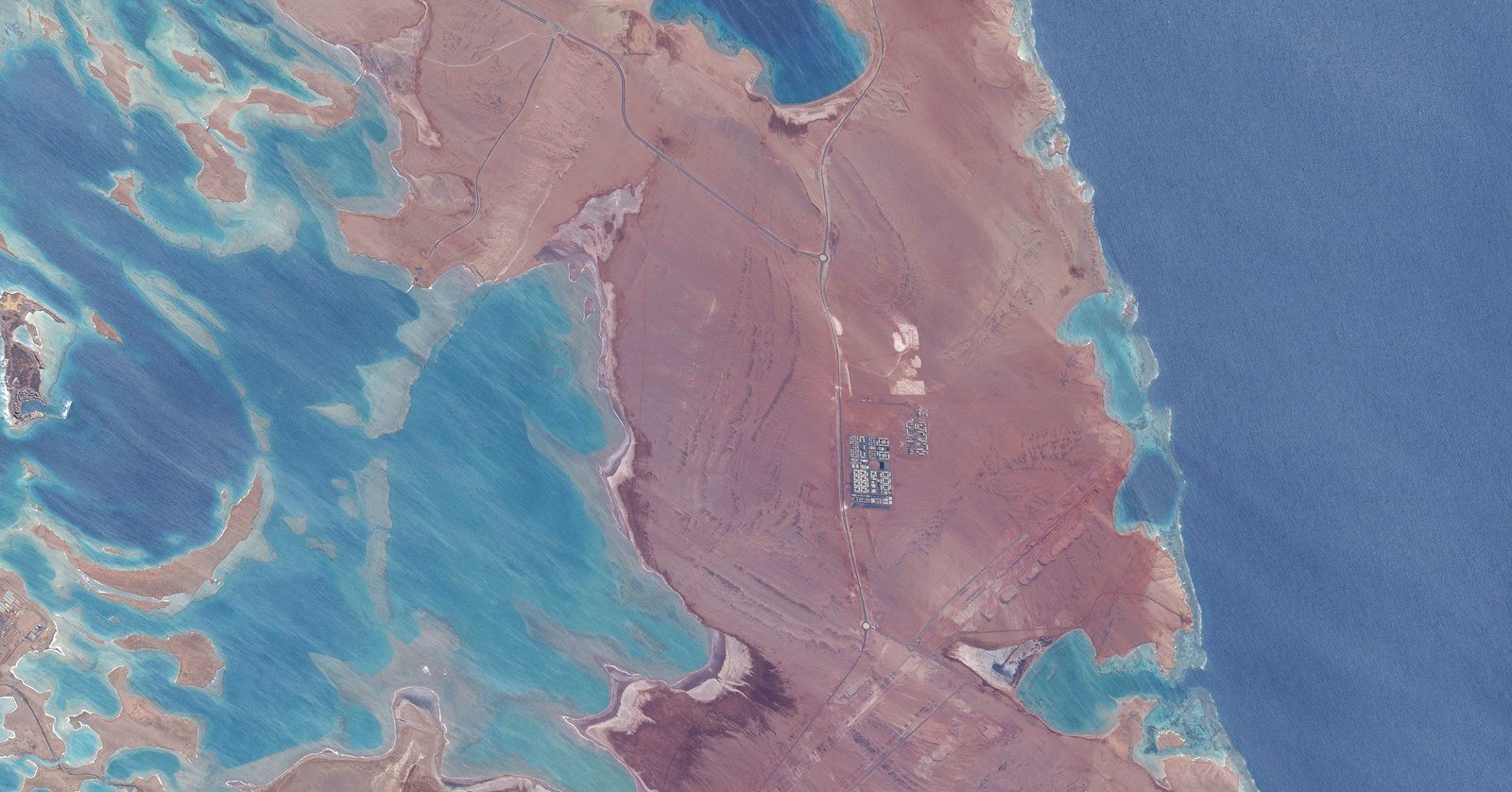
The Gulf of Aqaba coastline near NEOM’s Neom Residential Camp, photographed from the International Space Station on July 22, 2026. Credit: Earth Science and Remote Sensing Unit, NASA Johnson Space Center (public domain).
The Other Projects Around NEOM
NEOM is not The Line — here is how its other named components stand as of 2026.
Oxagon
An automated port and industrial hub on the Red Sea coast. Reported NEOM’s current priority node as of May 2026, home to the NEOM Green Hydrogen Company plant (~90%+ complete, April 2026 reporting) and the $5 billion first-phase DataVolt AI data centre (signed Feb 2025).
Trojena
A year-round ski and mountain-tourism district. Lost its 2029 Asian Winter Games host status in January 2026; its Ski Village steel contract and dams contract were both terminated in March 2026, and the main construction package is being re-tendered.
Sindalah
NEOM’s first completed sub-project, an 840,000 m² Red Sea resort island. Held a VIP launch on October 27, 2024 at a reported cost of roughly $4 billion, but was still not open to general public bookings as of mid-2026.
NEOM Bay Airport
Operational since 2021, providing the primary air access point for engineers, investors and consultants travelling to NEOM’s remote northwest Saudi sites.
How Much Will NEOM and The Line Cost?
| Figure | Scope | Date | Source | Status |
|---|---|---|---|---|
| $500 billion | Full NEOM development | Announced Oct 24, 2017 | MBS, Future Investment Initiative | Original target |
| Up to $8.8 trillion / 2080 | Full NEOM, per leaked internal audit | Audit dated spring 2024; reported March 2025 | Wall Street Journal | Leaked, unconfirmed by NEOM |
| $8 billion writedown | PIF’s megaproject investment portfolio | Disclosed Aug 14, 2025 | PIF financial disclosure, via CNBC | Confirmed |
| $5B+ terminated | Cancelled Line tunnel + Trojena steel + Trojena dams contracts | Terminated Mar 26, 2026 | Contractor disclosures (Eversendai, Hyundai E&C, Webuild) | Confirmed |
| $5 billion (phase 1) | DataVolt AI data centre, Oxagon (1.5GW total) | Signed Feb 10, 2025 | NEOM/SPA official announcement | Confirmed, active |
| ~$4 billion | Sindalah resort (~3x initial budget, per reporting) | Opened Oct 27, 2024 | Industry press (Dezeen and others) | Reported, not itemized by NEOM |
NEOM is funded primarily through Saudi Arabia’s Public Investment Fund (PIF), the kingdom’s sovereign wealth fund, with contractor and joint-venture partners financing their own construction scopes rather than the project as a whole.
Has The Line Been Scaled Back?
The honest answer has two parts that are both true. First: no official Saudi or NEOM statement has ever announced a reduced scope for The Line, and PIF governor Yasir Al-Rumayyan explicitly said in April 2026 that no NEOM projects had been cancelled. Second: the reported April 2024 target cut from 170 km to 2.4 km by 2030 has, in effect, already happened on the ground — roughly 2.4 km is what independent reporting says was actually built before the September 2025 pause, and that pause has since been extended past 2030 per the May 2026 Semafor report. Contracts specifically tied to Line infrastructure (the 12.5 km tunnel package) and to Trojena (steel, dams) were formally terminated in March 2026, which is a harder fact than any leak: a contractor does not disclose a termination to its shareholders unless the contract is actually gone.
What this page will not do is call the project “cancelled.” Nothing in the public record supports that word being applied to NEOM as a whole, and PIF has explicitly rejected it for The Line specifically. What the record does support is that the near-term, 2030-dated version of The Line described in 2021 launch materials is not happening on that timeline, by any reasonable reading of the contract terminations, the funding writedown and the leaked audit together.
2026 Progress Scorecard
| Component | 2026 status | Evidence |
|---|---|---|
| Site preparation / earthworks | Confirmed, halted | ~2.4 km of Line corridor trenched before Sept 2025 pause |
| Foundations | Confirmed, halted | Same ~2.4 km stretch; no reported expansion since the pause |
| Tunnels | Contract cancelled | Hyundai/Samsung/Archirodon 12.5 km tunnel terminated Mar 2026 |
| Rail infrastructure | Not independently verified as built | No confirmed rail construction reported beyond planning |
| Utilities / renewable energy | Active at Oxagon | Green hydrogen plant ~90%+ complete, April 2026 reporting |
| Sindalah resort | Built, not open to the public | VIP opening Oct 2024; still not public as of mid-2026 (AGBI) |
| Trojena ski resort | Contracts terminated, re-tendering | Steel + dams contracts cancelled Mar 2026; lost 2029 Games host Jan 2026 |
| Full 170 km vision | Long-term, paused past 2030 | Semafor, May 22, 2026 |
Why Building The Line Is So Difficult
Even setting the funding and governance questions aside, The Line’s original design was an unusually hard engineering problem. A continuous structure running 170 km through desert terrain has to cross varied ground conditions along its entire length, each requiring its own foundation approach, rather than the single, well-characterized site a normal skyscraper or campus is built on. Concrete curing in a hot desert environment behaves differently than in temperate climates, requiring closer control of pour timing, cooling and logistics — a genuine constraint at any scale, though this page does not have verified figures for exact concrete volumes used to date and will not invent them.
The site’s remoteness compounds ordinary construction logistics: materials, workers and heavy equipment all have to reach a stretch of coastal desert with limited existing infrastructure, which is part of why NEOM built its own airport (2021) before major Line construction began. A citywide high-speed transit spine, water desalination and distribution, and renewable power generation all had to be built essentially from nothing, in parallel with the structure itself, rather than tapped from existing regional grids.
Energy and Water: NEOM’s Infrastructure Backbone
NEOM’s energy strategy centres on Oxagon rather than The Line specifically. The NEOM Green Hydrogen Company — a joint venture of ACWA Power, Air Products and NEOM — was reported roughly 90%+ complete by April 2026, targeting first hydrogen production and export in late 2026 or 2027. Separately, the February 2025 DataVolt agreement adds a 1.5-gigawatt AI data centre campus at Oxagon, with a $5 billion first phase targeting around 300 MW operational by 2028. Both of these are Oxagon projects, not Line infrastructure — a distinction this page keeps deliberately, since NEOM’s own materials sometimes present them under one energy narrative.
Water for the site relies on desalination, standard for large-scale development on the Red Sea coast, alongside planned wastewater recycling. This page does not have verified, dated figures for a NEOM-specific desalination plant’s current capacity or completion status, and will not present an estimate as fact.
Workforce, Land and Human Rights Questions
NEOM’s construction workforce and its effect on the local Huwaitat tribe have drawn sustained, independent scrutiny. Human rights organisation ALQST published a report, “The Dark Side of NEOM,” in February 2023, documenting forced displacement of Huwaitat families from land inside the project’s footprint. Abdul Rahim al-Huwaiti, a Huwaitat tribesman, was killed by Saudi security forces in April 2020 after refusing to leave his family’s land — an incident widely reported at the time (Al Jazeera and others) and cited since as a flashpoint in the displacement dispute. Rights groups, including the Business & Human Rights Resource Centre, have separately reported that dozens of Huwaitat tribe members were arrested for opposing displacement, with several sentenced to death in cases dating to 2020–2023; this page cites those as documented allegations tied to specific reporting dates, not as an independently verified current tally, since Saudi authorities have disputed elements of this coverage.
On working conditions, ITV’s undercover documentary “Kingdom Uncovered,” broadcast October 24, 2024, filmed workers on The Line describing 16-hour shifts across up to 14 consecutive days, unpaid commutes of roughly three hours, and around four hours of sleep per night, with several workplace accidents cited within a single month. Human rights researcher Nicholas McGeehan, interviewed for the documentary, said the reported hours were “way beyond international minimum standards.” A separate, frequently cited figure — roughly 21,000 migrant worker deaths — refers to Vision 2030’s broader construction sector since 2016, compiled from Indian, Bangladeshi and Nepali government data on their nationals’ deaths in Saudi Arabia generally; it is not a NEOM- or Line-specific death toll, and should not be presented as one.
⚠️ Editorial Note on Contested Claims
Displacement, worker-treatment and death-toll figures in this section come from human rights organisations and investigative journalism, not from NEOM or the Saudi government, which have disputed aspects of this reporting in the past. Where sources conflict or a figure cannot be independently re-verified, this page says so rather than presenting one side as settled fact.
Environmental Questions Around The Line
Independent academic research has raised specific, measurable concerns about NEOM’s coastal construction. A sediment-dispersal modelling study led by researchers at UCLouvain, presented at the EGU General Assembly in 2025, found that fine sediment disturbed by NEOM’s coastal development can remain suspended in the water column for up to a month and travel as far as 200 km from its release point — a mechanism that could threaten Gulf of Aqaba and northern Red Sea coral reefs otherwise known for unusual heat resilience. This is the strongest independently sourced environmental evidence available on NEOM’s coastal impact as of this update, and it is a modelling study, not a measured outcome, so it is presented here as such.
How The Line Compares With Other Megaprojects
The Line is unusual even among modern megaprojects for how much of its identity rested on a single geometric claim — a 170 km straight line — rather than a functional description. Saudi Arabia’s own high-speed rail comparisons internationally, like India’s Mumbai–Ahmedabad bullet-train corridor, show a more conventional megaproject pattern: a fixed route between two existing cities, phased station-by-station delivery, and a single primary technical challenge (in that case, elevated viaduct construction) rather than an entirely new city built from nothing. NEOM’s own architectural megaproject peer, the Jeddah Tower, offers a closer regional comparison: another Saudi vertical-scale project that has faced its own multi-year construction pauses, illustrating that funding and logistics — not just novelty of design — are the recurring constraint on the kingdom’s most ambitious builds.
Explore More Timelines
People Also Ask
Frequently Asked Questions
⚠️ Editorial Note
This page separates NEOM/Saudi official statements, contractor disclosures, independent journalism (Bloomberg, Reuters, WSJ, Dezeen, MEED and others) and human-rights reporting, and labels each accordingly. Figures describing leaked audits, reported scope changes or contested human-rights claims are presented as reported, not as confirmed fact, and are updated as official statements or stronger evidence become available. This is not investment, legal or travel advice.
Sources & further reading
Every dated entry above was checked against these references. Last reviewed 15 September 2026.
- NEOM Official Website
- New Civil Engineer - Neom plans for Saudi Arabia's linear city cut from 170km to 2.4km
- Bloomberg - Saudi Arabia Replaces Neom CEO Nadhmi Al-Nasr
- New Civil Engineer - Anticipated cost of Neom gigaproject explodes from $500bn to $8.8 trillion
- Dezeen - Multiple Neom construction contracts cancelled
- Semafor - Saudi's NEOM halts work on The Line until after 2030
- Construction Week - No NEOM projects cancelled, says PIF Governor
- Dezeen - Sindalah opens in Saudi Arabia