Jeddah Tower vs. Burj Khalifa: The 1,000m Megaproject Construction Timeline
Follow Jeddah Tower's construction from its 2013 groundbreaking to its 2026 progress, and compare it with Dubai's completed 828m Burj Khalifa.
Latest Story
For fifteen years, Dubai’s Burj Khalifa has stood alone as the only building on Earth to break 800 meters. Now, on the Red Sea coast, Saudi Arabia is trying to do something no engineer has ever done: put a habitable tower past the one-kilometer mark. The Jeddah Tower, halted for seven years and now climbing again, is the reason the “world’s tallest building” conversation has become interesting again. This is the story of both towers — how one got built, why the other stalled, and what it will actually take to finish it.
🔘 Jeddah Tower Latest Update — August 2026
- Late July 2026: Core construction passes floor 107, roughly 430 meters — about 43% of the planned height. Status: under construction. (Source: Archinect / MEP Middle East / TechEBlog, August 2026 reporting)
- April 2026: The tower is photographed reaching its 100th floor. Status: under construction. (Source: Dezeen, April 23, 2026)
- January 2026: Construction reaches the 80th floor, up from 63 at restart. Status: under construction. (Source: Construction Digital)
- January 2025: Full-scale construction resumes after the seven-year halt, with the tower standing at 63 completed floors. Status: restarted. (Source: Construction Briefing, CNN)
- October 2024: Kingdom Holding Company signs a new construction contract with Saudi Binladin Group, reported at roughly $1.9 billion. Status: contract signed. (Source: CNN, October 3, 2024)
Contractor: Saudi Binladin Group. Developer: Jeddah Economic Company, a Kingdom Holding-led consortium. Next milestone: continued core climb; no official next-floor date has been published. Completion date: not publicly confirmed by the developer — see the completion section below.
Jeddah Tower vs. Burj Khalifa: What’s the Difference?
Burj Khalifa, completed in Dubai in 2010, stands at a confirmed 828 meters and is the tallest completed building on Earth. Jeddah Tower, under construction in Saudi Arabia, is designed to exceed 1,000 meters — a threshold no building has ever reached — but remains unfinished, with construction reaching roughly 430 meters (floor 107) as of late July 2026. Until Jeddah Tower tops out, Burj Khalifa keeps the title.
Jeddah Tower and Burj Khalifa: Key Questions
What to Know Before You Read Further
- Burj Khalifa is finished; Jeddah Tower is not. One is a completed 828m building open since 2010, the other is an active construction site at roughly 430m with no public access.
- Same architect, different firms. Adrian Smith designed Burj Khalifa while at Skidmore, Owings & Merrill (SOM), then designed Jeddah Tower after founding Adrian Smith + Gordon Gill Architecture (AS+GG) in 2006.
- The 2018 halt wasn’t a design or engineering failure. It followed the detention of the project’s key financial backers and contractor leadership during Saudi Arabia’s 2017 anti-corruption campaign.
- The contractor never changed. Saudi Binladin Group built the tower before 2018 and, under a new October 2024 contract, is building it again.
- No official final height has been published. “More than 1,000 meters” is the confirmed design target; a widely cited 1,008-meter figure has circulated in reporting but has not been confirmed by the developer as final.
- Wind, not weight, is the defining engineering problem past 800 meters. Jeddah Tower’s three-lobed, tapering footprint exists specifically to break up wind vortices at extreme height.
- Merdeka 118 (2024) is the world’s second-tallest building at 678.9 meters — it never challenged Burj Khalifa’s title, but it proved the supertall race didn’t end in 2010.
- Jeddah Tower’s foundation is unusually deep: 270 bored piles reaching up to 110 meters into coral-contaminated coastal soil, connected to a 5-meter-thick raft.
- No firm completion date exists. 2028 is a press estimate extrapolated from construction pace, not a developer-confirmed opening date.
Jeddah Tower vs Burj Khalifa Height
Comparing architectural height — base to structural/architectural top, including spires but not antennas, the CTBUH standard.
| Building | City | Country | Height | Status | Year |
|---|---|---|---|---|---|
| Burj Khalifa | Dubai | UAE | 828 m | Completed | 2010 |
| Jeddah Tower | Jeddah | Saudi Arabia | >1,000 m planned (~430 m built) | Under construction | Target ~2028 (unconfirmed) |
| Merdeka 118 | Kuala Lumpur | Malaysia | 678.9 m | Completed | 2024 |
| Shanghai Tower | Shanghai | China | 632 m | Completed | 2015 |
| Taipei 101 | Taipei | Taiwan | 508 m | Completed | 2004 |
Rankings can shift depending on measurement standard — architectural height, roof height, occupied-floor height, or tip height all give different answers. This table uses architectural height throughout.
Height comparisons look simple until you ask which height. The Council on Tall Buildings and Urban Habitat (CTBUH) — the industry’s reference body for skyscraper rankings — recognizes four separate categories: height to architectural top (including spires, the category used above), height to the highest occupied floor, height to the roof, and height to the tip (including antennas). A building can rank differently in each one. The clearest historical example is the 1996-1998 dispute between Chicago’s Sears Tower and Kuala Lumpur’s Petronas Towers: Sears was taller to its roof and highest occupied floor, but Petronas’s spires pushed its architectural-top height higher, and CTBUH awarded it the “world’s tallest” title on that basis — a decision that was argued over for years. When this article compares buildings, it uses architectural height consistently, and calls out the other categories only where they change the picture.
The Race to Build the World’s Tallest Building
How the record moved from New York to Chicago to the Gulf — and why each building mattered beyond its height
The “world’s tallest building” title has changed hands slowly, and each holder solved a different engineering problem. The Empire State Building (1931, New York, 381 meters to roof, 443 meters with its later-added antenna) proved that a steel-framed skyscraper could be built fast — it went up in about 14 months during the Depression — and held the record for 40 years, longer than any other building since. The Willis Tower (opened 1973 as Sears Tower, Chicago, 442 meters) introduced the “bundled tube” structural system, nine framed tubes bundled together, which let architects go taller without a proportionally heavier frame — a structural idea that shaped nearly every supertall building afterward.
The Petronas Towers (1998, Kuala Lumpur, 452 meters to spire) took the record to Asia for the first time and settled nothing about how “tallest” should be measured, as the Sears dispute above shows. Taipei 101 (2004, Taipei, 508 meters) was the first building to seriously address earthquake risk at extreme height, using an 800-tonne steel pendulum tuned mass damper visible through the building’s own facade. Then came Burj Khalifa (2010, Dubai, 828 meters) — a jump of 320 meters over the previous record, the largest single leap in the history of the “world’s tallest” title, built using a structural system (below) that made every subsequent supertall project possible. Merdeka 118 (2024, Kuala Lumpur, 678.9 meters) is the most recent entrant: it didn’t challenge Burj Khalifa, but at second-tallest in the world it confirmed the supertall race didn’t end when Burj Khalifa topped out. Jeddah Tower is the next attempt at the title itself — and the first serious attempt at a full kilometer.
| Building | Height | Location | Year | Significance |
|---|---|---|---|---|
| Empire State Building | 381 m | New York, USA | 1931 | Held the record 40 years; proved rapid steel-frame construction |
| Willis (Sears) Tower | 442 m | Chicago, USA | 1973 | Introduced the bundled-tube structural system |
| Petronas Towers | 452 m | Kuala Lumpur, Malaysia | 1998 | First Asian record holder; sparked the spire-height ranking debate |
| Taipei 101 | 508 m | Taipei, Taiwan | 2004 | Pioneered visible tuned mass damper for seismic/wind control |
| Burj Khalifa | 828 m | Dubai, UAE | 2010 | Largest single height jump in the record’s history; current title-holder |
| Merdeka 118 | 678.9 m | Kuala Lumpur, Malaysia | 2024 | World’s second-tallest; kept the supertall race active post-Burj Khalifa |
| Jeddah Tower | >1,000 m (planned) | Jeddah, Saudi Arabia | Under construction | Attempting the first kilometer-scale building ever built |
Burj Khalifa: How Dubai Built the 828-Meter Tower
Construction began in January 2004 with excavation for the foundation — piling driven deep into Dubai’s soft coastal ground to anchor a tower that would eventually weigh several hundred thousand tonnes. By June 2006 the tower had passed 50 storeys, and the pace of the record itself became a running story: in February 2007 Burj Khalifa passed Taipei 101 to become the tallest structure under construction anywhere in the world; by July 2007 it had passed Toronto’s CN Tower to become the tallest freestanding structure ever built; by April 2008 it had passed the KVLY-TV mast in North Dakota to become the tallest man-made structure of any kind. On January 17, 2009, the final spire section was installed, fixing the tower’s height at 828 meters. Exterior cladding was finished by October 2009, and the building opened to the public on January 4, 2010 — almost exactly six years after excavation began.
What made that possible structurally was engineer Bill Baker’s buttressed core system, developed at SOM: a central hexagonal core braced by three wings arranged in a Y-shaped plan, each wing buttressing the others against wind load. As the tower rises, each wing sets back in a spiraling pattern, which does two things at once — it reduces the building’s cross-section as loads decrease with height, and it continuously changes the shape wind sees as it moves up the tower, disrupting the vortex shedding that causes tall buildings to sway. Concrete was pumped to a then-unprecedented height of 606 meters during construction, requiring a specially formulated high-strength, low-viscosity mix that could still be pumped that far without segregating. Getting people and materials up a structure that size required 57 elevators, including double-deck cars serving sky lobbies at intervals up the tower rather than a single shaft running the full height — the same “elevator relay” approach later supertall buildings, including Jeddah Tower, have had to adopt.
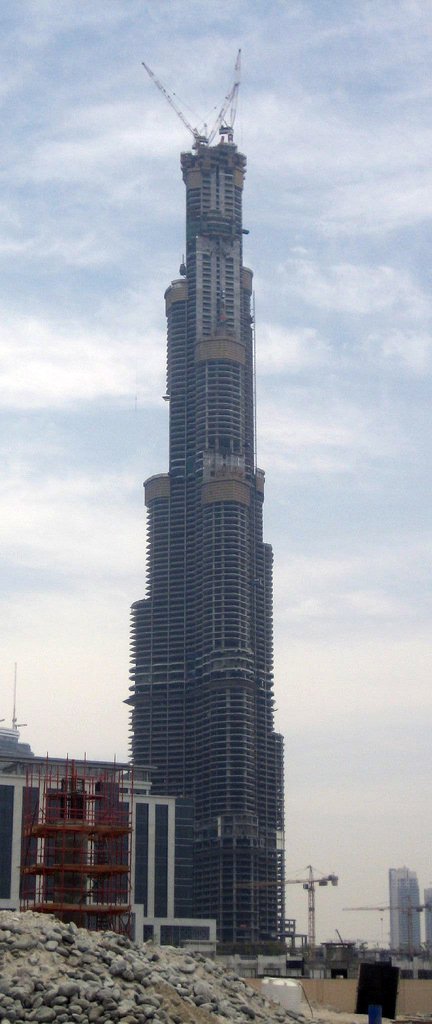
Burj Khalifa during its construction phase, Dubai.
Why Burj Khalifa Changed Skyscraper Engineering
Buttressed core
Three wings bracing a central hexagonal core, setting back in a spiral as the tower rises — the system that made an 828m concrete-and-steel tower structurally viable.
Shape as defense
The continuously changing cross-section confuses vortex shedding, the phenomenon that makes uniform towers sway rhythmically in steady wind.
Concrete pumped to 606m
A custom high-strength mix, engineered for a desert climate, had to remain pumpable across a vertical distance no project had attempted before.
57 elevators, sky-lobby relay
No single shaft could serve the full height efficiently, so passengers transfer between express and local cars at intermediate sky lobbies.
Desert cooling load
Condensate recovery from the building’s own air-conditioning system supplements cooling-tower water — a response to Dubai’s heat and humidity.
Sequencing at scale
Concrete pours, cladding installation, and MEP fit-out had to run in parallel on different floors simultaneously to hit a six-year build schedule.
2000s–2013: The Idea of a 1-Kilometer Tower
Even before Burj Khalifa opened, Saudi developers were discussing a tower that would surpass it. The project took shape as the centerpiece of Jeddah Economic City, a large mixed-use development on Jeddah’s northern coastline, developed by the Jeddah Economic Company (JEC) — a consortium majority-owned by Kingdom Holding Company, the investment firm chaired by Saudi Prince Alwaleed bin Talal. Early announcements described an aspiration to build past one kilometer, but the ambition and the construction schedule were two different things: a public announcement of intent is not the same as a funded, engineered, permitted project, and it took several more years for the tower to move from concept to groundbreaking.
Who Designed Jeddah Tower?
Jeddah Tower is designed by Adrian Smith + Gordon Gill Architecture (AS+GG), a Chicago firm Adrian Smith founded in 2006 after leaving Skidmore, Owings & Merrill (SOM), where he had led the design of Burj Khalifa. This is a distinction worth being precise about: Burj Khalifa and Jeddah Tower were not designed by “the same team” in any simple sense — they were designed by the same lead architect, at two different firms, working with different structural engineers and nearly a decade apart. Gordon Gill is lead architect on the Jeddah project alongside Smith. The design draws visibly on Burj Khalifa’s wind-engineering lessons — a tapering, setback silhouette — while using a different plan geometry suited to Jeddah Tower’s own height target.
2013: Jeddah Tower Construction Begins
Groundbreaking took place in April 2013. Early construction focused on the piece of the project least visible from outside: the foundation. This was not a formality — a tower designed to exceed a kilometer needed a foundation system that had never been built at this scale in this kind of ground, and getting it wrong was not a recoverable mistake once the tower above it existed.
How Do You Build a Foundation for a 1-Kilometer Tower?
Jeddah’s coastal site sits on sandy soil contaminated with coral, which does not bear heavy loads reliably on its own. German specialist contractor Bauer drilled 270 bored concrete piles, each up to 110 meters deep and 1.8 meters in diameter, reaching down to more competent rock. These piles connect to a five-meter-thick reinforced concrete raft that distributes the tower’s enormous vertical load — ultimately several hundred thousand tonnes of concrete and steel — evenly across the pile field, rather than concentrating it at a few points. Groundwater near a coastal site adds corrosion risk to buried steel and concrete over the tower’s intended service life, which is one reason foundation design for a project like this takes years, not months, to finalize before the first pile is even drilled.
The Construction Timeline: Both Towers, Milestone by Milestone
Newest first
Jeddah Tower Passes Floor 107
The core reaches its 107th floor, roughly 430 meters — about 43% of the planned final height. Construction press reports a build pace of approximately one floor every three to four days.
100th Floor Photographed
Construction photography confirms the core has reached its 100th floor, published by architecture outlet Dezeen.
80th Floor Reached
The tower climbs from 63 floors at restart to 80 floors within roughly a year, confirming the post-restart pace is holding.
Full-Scale Construction Resumes
Work resumes at full scale, with the tower standing at 63 completed floors — almost exactly where it stood when construction stopped in January 2018.
New Construction Contract Signed
Kingdom Holding Company signs a new contract with Saudi Binladin Group, reported at approximately $1.9 billion, to complete the tower.
Extended Suspension
The site remains largely inactive for years while ownership, financing and contractor restructuring play out. No fixed restart date exists during this period; each year without a signed contract adds to industry skepticism that the tower would ever be finished.
Construction Halts
Work stops with the tower at approximately its 63rd floor. The halt follows the November 2017 detention of Kingdom Holding chairman Prince Alwaleed bin Talal and Saudi Binladin Group chairman Bakr bin Laden during a kingdom-wide anti-corruption campaign, compounding financial strain the contractor was already carrying from the 2014–2016 oil-price downturn.
Foundation and Early Structure
Bauer completes the 270-pile foundation system; the core and perimeter structure climb steadily using jump-form construction methods over the following four years, reaching roughly a third of the planned height before the halt.
Jeddah Tower Groundbreaking
Construction officially begins on the Jeddah Economic City site, with Adrian Smith + Gordon Gill Architecture’s design targeting a height beyond one kilometer.
Burj Khalifa Opens
The tower opens to the public on January 4, 2010, holding the world’s-tallest title at 828 meters — a record it still holds today.
Burj Khalifa Tops Out at 828m
The final spire section is installed on January 17, 2009, fixing the tower’s architectural height. Exterior cladding is completed by October 2009.
Burj Khalifa Passes Every Height Record
February 2007: passes Taipei 101 as the tallest structure under construction. July 2007: passes the CN Tower as the tallest freestanding structure ever built. April 2008: passes the KVLY-TV mast as the tallest man-made structure of any kind.
Burj Khalifa Construction Begins
Excavation and piling begin in downtown Dubai under developer Emaar Properties, using deep foundation work designed for the site’s soft coastal ground.
2018–2024: Why Jeddah Tower Construction Stalled
Construction was suspended amid Saudi Arabia’s late-2017 anti-corruption campaign, which detained dozens of senior royals and businessmen, including two figures directly tied to this project: Kingdom Holding chairman Prince Alwaleed bin Talal, a lead financial backer of the tower through JEC, and Bakr bin Laden, chairman of Saudi Binladin Group, the main contractor. Bin Laden was reportedly released roughly three years later, in 2021. The detentions landed on top of an already-weakened contractor — Saudi Binladin Group had been under financial strain since the 2014–2016 oil-price downturn slowed government construction payments across the kingdom. The combination of leadership uncertainty at the developer and financial distress at the contractor is what actually stopped work in January 2018, not a single cause; reporting on the halt generally cites both factors together rather than isolating one.
What followed was not a quick fix. Between 2019 and 2023, the project sat in an extended limbo: financing had to be reworked, the contractor relationship had to be re-established, and neither JEC nor Kingdom Holding published a public restart timeline during those years. It took until October 2024 for a new construction contract to be signed — again with Saudi Binladin Group, the same contractor as before the halt — before full-scale work resumed in January 2025.
2024–2026: Jeddah Tower Construction Restarts
The restart is well documented, unlike the halt: Kingdom Holding’s October 2024 contract with Saudi Binladin Group was announced publicly and covered by international press including CNN. Full-scale construction resumed in January 2025 with the tower at 63 floors — essentially the same point it had reached in 2018, meaning seven years produced almost no additional height, only a great deal of institutional repair work behind the scenes. Since then, floor-by-floor progress has been documented repeatedly through 2026: 80 floors by January, 100 by April, 107 by late July. This is a real, ongoing, independently photographed construction restart, not a re-announcement of an old promise.
Who Is Building Jeddah Tower?
Jeddah Economic Company (JEC)
The project entity that owns and finances the tower, majority-controlled by Kingdom Holding Company.
Kingdom Holding Company
Prince Alwaleed bin Talal’s investment firm; signed the October 2024 restart contract.
Adrian Smith + Gordon Gill Architecture
Design firm behind the tower’s form, wind engineering strategy, and interior program.
Saudi Binladin Group
Built the tower before the 2018 halt and, under the 2024 contract, is building it again — the contractor never changed.
How Tall Is Jeddah Tower Now?
As of the most recent confirmed reporting (late July 2026), the tower’s core has reached its 107th floor, at approximately 430 meters — roughly 43% of its planned final height. This is a construction-progress figure reported by architecture and construction press tracking the build, not a figure independently surveyed by AiTimeline; treat it as current-best-available rather than laser-measured fact. It is important not to confuse this current construction height with the tower’s planned final height of more than 1,000 meters — the two numbers describe different things, and conflating them is the single most common error in coverage of this project.
Will Jeddah Tower Really Reach 1,000 Meters?
The tower’s design target has consistently been described as “more than 1,000 meters” since the project was first proposed, and a specific figure of 1,008 meters has circulated widely in press coverage for years. What has never been published is a final, developer-confirmed architectural height — JEC has not issued a definitive number the way, for example, Emaar published Burj Khalifa’s height at opening. Given that the tower is currently under 45% built, and that supertall projects have historically adjusted final specifications during construction, the most accurate statement available in mid-2026 is: the design intent is to exceed one kilometer, construction is currently proceeding toward that goal, and the exact final figure will not be certain until the tower tops out.
How Do You Build a 1-Kilometer Skyscraper?
The engineering problems that don’t exist at 500 meters and become dominant past 800
The dominant load
Wind speed and turbulence increase with height; past 800 meters, wind — not gravity — becomes the load that shapes the structural design.
Compounding vertical load
Every additional floor adds load the floors below must carry, which is why supertall cores taper and thicken toward the base rather than staying uniform.
Transferring the load down
The structure needs a foundation system capable of spreading several hundred thousand tonnes across the ground without excessive settlement over decades.
Concrete and steel at their limits
High-strength, low-viscosity concrete mixes are required simply to remain pumpable across hundreds of vertical meters without segregating.
Elevators become the bottleneck
No single elevator shaft can efficiently serve a kilometer of height; sky-lobby transfer systems, as pioneered at Burj Khalifa, become mandatory rather than optional.
Water and air across extreme heights
Water pressure and air distribution both have to be engineered in zones, since a single system can’t reliably deliver pressure a kilometer up.
Why Wind Is One of the Biggest Problems at 1 Kilometer
Wind speed rises with altitude, and at supertall heights the concern isn’t just steady wind pressure but vortex shedding: as wind flows around a uniform tower, it peels off in alternating swirling eddies on either side, and if that shedding frequency lines up with the building’s natural sway frequency, the motion can amplify rather than damp out. Engineers fight this primarily with shape rather than brute strength — tapering the tower, setting back its profile at intervals, and rounding or notching corners all break up the wind’s path so it can’t organize into a steady shedding pattern. Jeddah Tower’s design uses exactly this strategy: a three-lobed, tapering plan intended to disrupt vortex formation, following the same wind-engineering logic Adrian Smith used at Burj Khalifa. None of this eliminates wind’s effect on the building — occupants at extreme height will always feel some motion in strong wind — it reduces that motion to a level that’s structurally safe and comfortable rather than removing it entirely.
Why Jeddah Tower Has a Different Shape
Jeddah Tower uses a three-lobed, Y-shaped footprint, described by the architects as inspired by the folded fronds of young desert plant growth — a single form at the base that separates into distinct wings as it rises. Functionally, the shape does two jobs: the triangular, tapering wings reduce wind loading through the vortex-disruption mechanism above, and the three-petal layout suits residential and hotel floor plates better than a simple rectangular or circular tower would. Horizontal notches cut into the facade create shadow lines that shield open terraces from direct desert sun. Plans for the tower have long included a sky terrace near the top of the structure, intended as one of the highest observation points ever built into a supertall tower — its exact final floor and public-access details have not been confirmed and will depend on how construction proceeds over the next several years.
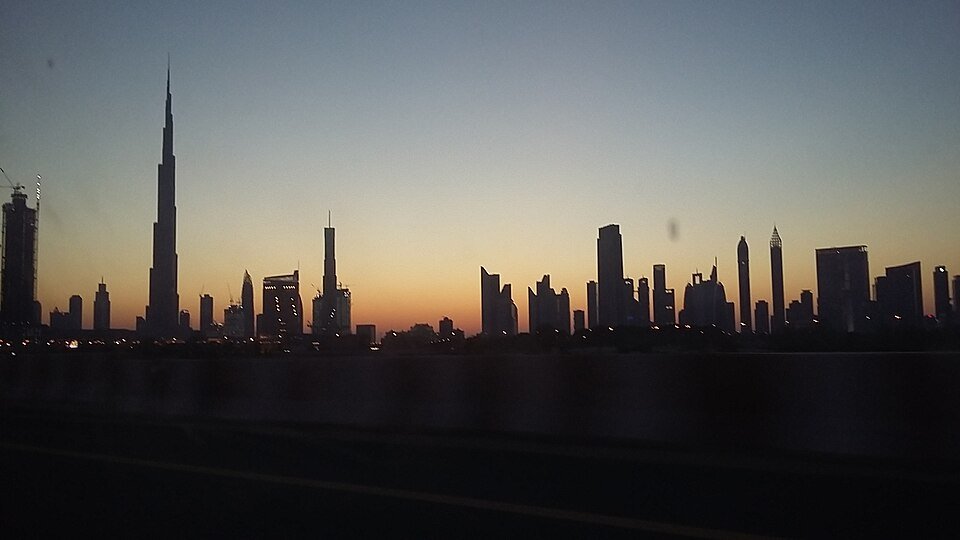
Burj Khalifa remains the tallest completed building on the Dubai and world skyline.
How Will Elevators Work in a 1-Kilometer Tower?
Project reporting has described Jeddah Tower’s vertical transportation plan as roughly 56 elevators, with express cars designed to run at speeds around 12 meters per second — figures that come from construction-industry coverage of the project rather than a formal specification sheet AiTimeline has independently verified, so they should be read as reported rather than certified. What’s structurally certain, because it’s true of every building this tall, is that a single elevator shaft cannot efficiently serve a full kilometer: express elevators will need to run to intermediate sky lobbies, where passengers transfer to local cars for the remaining distance, the same relay system Burj Khalifa uses. At extreme speed and height, cabin pressurization also becomes a real engineering concern, similar in principle to aircraft cabin pressurization, to keep rapid altitude change comfortable for passengers.
How Do You Evacuate a 1-Kilometer Skyscraper?
Supertall buildings are designed around the assumption that a full, single-direction evacuation down one stairwell is not a realistic primary strategy in every emergency scenario. Instead, the standard approach — used at Burj Khalifa and expected at Jeddah Tower — combines fire-resistant compartmentation (so a fire stays contained to its zone rather than spreading vertically), pressurized and protected stairwells, designated refuge floors at intervals where occupants can shelter and await instructions, dedicated fire-service elevators, and independent emergency power and smoke-control systems. AiTimeline has not seen a published, official evacuation-time figure for Jeddah Tower and will not estimate one; any number claiming to state exactly how long a full evacuation would take should be treated skeptically absent a cited engineering source.
How Does Jeddah Tower Handle Earthquakes?
Western Saudi Arabia sits in a region of low-to-moderate seismic activity compared with the Pacific Rim, but supertall structural design still accounts for regional seismic conditions as a matter of course, building in redundancy so that no single structural element is solely responsible for the tower’s stability. The building’s structural system and deep-pile foundation are designed to withstand the seismic conditions specified for the region under the applicable Saudi building code. That is a meaningfully different, and more accurate, claim than saying the building is “earthquake-proof” — no supertall structure anywhere claims that, and none should.
Building a 1-Kilometer Tower in Jeddah’s Climate
Jeddah’s Red Sea coastal climate brings a different set of stresses than Dubai’s: high year-round humidity on top of extreme heat, intense direct solar exposure, and wind-blown dust and sand that accelerate wear on both exterior cladding and mechanical systems. The facade’s notched geometry (above) is a direct response to solar exposure, shading terraces rather than relying purely on glass coatings. Humidity combined with heat also raises corrosion risk for embedded steel reinforcement over a multi-decade service life, which is one reason concrete cover depth and reinforcement protection are treated as long-term durability decisions during design, not just short-term construction specifications.
Jeddah Tower vs Burj Khalifa: Two Different Megaprojects
| Feature | Jeddah Tower | Burj Khalifa |
|---|---|---|
| City | Jeddah | Dubai |
| Country | Saudi Arabia | UAE |
| Planned / actual height | >1,000 m planned | 828 m (final) |
| Status (Aug 2026) | Under construction, ~430 m | Completed |
| Opening | Not yet — no confirmed date | January 4, 2010 |
| Primary structural system | Braced core, three-lobed tapering plan | Buttressed core (Bill Baker, SOM) |
| Architect | Adrian Smith + Gordon Gill Architecture | Adrian Smith at SOM |
| Developer | Jeddah Economic Company | Emaar Properties |
| Main contractor | Saudi Binladin Group | Samsung C&T / Arabtec / BESIX consortium |
| Main purpose | Mixed-use: hotel, offices, apartments | Mixed-use: hotel, offices, residences |
What Is the Tallest Building in the World Right Now?
As of August 2026, Burj Khalifa remains the world’s tallest completed building at 828 meters, a title it has held for more than 15 years. Jeddah Tower is not the world’s tallest building yet — it is the world’s tallest building under construction, at roughly 430 meters and still less than half finished. It will not take the completed-building title unless and until it tops out at a height exceeding 828 meters and formally opens; nothing about its current construction status changes Burj Khalifa’s standing today.
Where Does Merdeka 118 Fit Into the Race?
Kuala Lumpur’s Merdeka 118 reached structural completion in late 2023 and formally opened in January 2024, reaching 678.9 meters — making it the world’s second-tallest building, well ahead of third-place Shanghai Tower at 632 meters. Merdeka 118 never set out to beat Burj Khalifa; it matters here because it shows the supertall race stayed active in the 14 years after Burj Khalifa opened, even without anyone challenging the top spot. Jeddah Tower, if completed at its planned height, would not just take the top spot from Burj Khalifa — it would open a gap to second place larger than the gap that currently exists between first and second.
What Could Come After Jeddah Tower?
No other project currently under active construction is targeting kilometer-scale height. Several kilometer-plus concepts have been proposed or discussed publicly over the past two decades — including earlier Gulf-region proposals that were never approved or funded — but a rendering or announcement is not the same as an approved, financed, under-construction project, and this article won’t list speculative concepts as if they were real timelines. The honest state of the field in 2026 is that Jeddah Tower is the only project actively attempting to build past one kilometer, and whether anything follows it likely depends on whether it succeeds.
Why Build a 1-Kilometer Tower?
Global visibility
A record-holding building draws attention and tourism in a way ordinary mixed-use towers don’t — a documented motivation behind previous “world’s tallest” projects too.
Mixed-use density
Hotel, office, and residential space in one tower anchors the wider Jeddah Economic City development around it.
Vision 2030 context
The tower sits within Saudi Arabia’s broader push, under Vision 2030, to diversify the economy and build globally visible infrastructure beyond oil.
Proving the kilometer is buildable
Succeeding here would be a genuine first in construction history, not just a marketing height record.
What Could Jeddah Tower Mean for Jeddah?
If completed, Jeddah Tower could plausibly draw tourism, generate long-term hospitality and office employment, and give Jeddah a global architectural identity distinct from Riyadh’s or Dubai’s — but these are potential and expected outcomes, not measured ones, since the tower isn’t finished and hasn’t opened. Prior supertall projects, including Burj Khalifa, did generate substantial tourism and real-estate attention for their host cities, which is the basis for these expectations rather than a guarantee specific to this project.
Jeddah Tower and Saudi Arabia’s Megaproject Era
Jeddah Tower is one of several large Saudi infrastructure projects moving forward under Vision 2030, the kingdom’s economic diversification program launched in 2016. It’s worth being precise about the relationship: Vision 2030 is the broader policy context the tower exists within, not the reason the tower was originally proposed — the project predates Vision 2030 by several years. What Vision 2030 has plausibly affected is the political and financial environment around the 2024 restart, at a time when the kingdom has prioritized visible, internationally covered construction projects as part of its broader economic messaging.
Explore More Timelines
The Real Challenge Isn’t Reaching 1,000 Meters
It’s tempting to treat this story as purely a race to a number — will the core reach 1,000 meters or not. But reaching that height is arguably the easier part, in the sense that it’s a known, solvable engineering problem: taller towers than this have been modeled, and the physics of wind, weight, and foundations at this scale is understood, even if it hasn’t been built before. The harder problem is everything that happens after the core tops out. A tower this tall has to be structurally safe across decades of wind loading and thermal cycling, comfortable for people living and working near its top in strong wind, maintainable by crews who can actually reach every mechanical system and piece of facade, economically viable as hotel rooms, offices and apartments that people actually want to occupy at that height, and operationally efficient to run for the decades after opening. Burj Khalifa answered all of those questions at 828 meters. Jeddah Tower is the first real attempt to answer them past 1,000.
Sources & further reading
Every dated entry above was checked against these references. Last reviewed 15 September 2026.
- Council on Tall Buildings and Urban Habitat (CTBUH)
- Wikipedia: Burj Khalifa
- Wikipedia: Jeddah Tower
- CNN — Construction of world's tallest skyscraper resumes
- Dezeen — Jeddah Tower reaches 100th floor
- Adrian Smith + Gordon Gill Architecture — Jeddah Tower
- Thornton Tomasetti — Jeddah Tower (structural engineering)