Fodder Scam: A Timeline of India’s Notorious Corruption Case
Explore the Fodder Scam timeline, from the 1996 CBI probe and Lalu Prasad's resignation to treasury-case convictions and the 2026 Supreme Court order.
Latest Story
In January 1996 a district official in Chaibasa found that about Rs 37.70 crore had been drawn from the treasury for cattle fodder and medicines that never arrived. Within eighteen months the CBI had chargesheeted the Chief Minister of Bihar. This Fodder Scam timeline follows the case from the first warnings in the early 1990s through Lalu Prasad Yadav’s resignation in July 1997, the transfer of the trials to Jharkhand, his five convictions between 2013 and 2022, and the Supreme Court’s order of 14 July 2026 on his bail. It treats each treasury case separately, because the courts did.
Rabri Devi became Chief Minister on 25 July 1997, the day Lalu resigned, not on 5 August. The Supreme Court granted Lalu bail on 13 December 2013, not in October. The landmark “separate offences” ruling is from 8 May 2017; there was no matching 2012 judgment. The Dumka sentence was 14 years in effect: two seven-year terms run one after the other. And the Rs 950 crore figure is an estimate for all 55 cases, not an amount proved against anyone.
💡 Short Answer
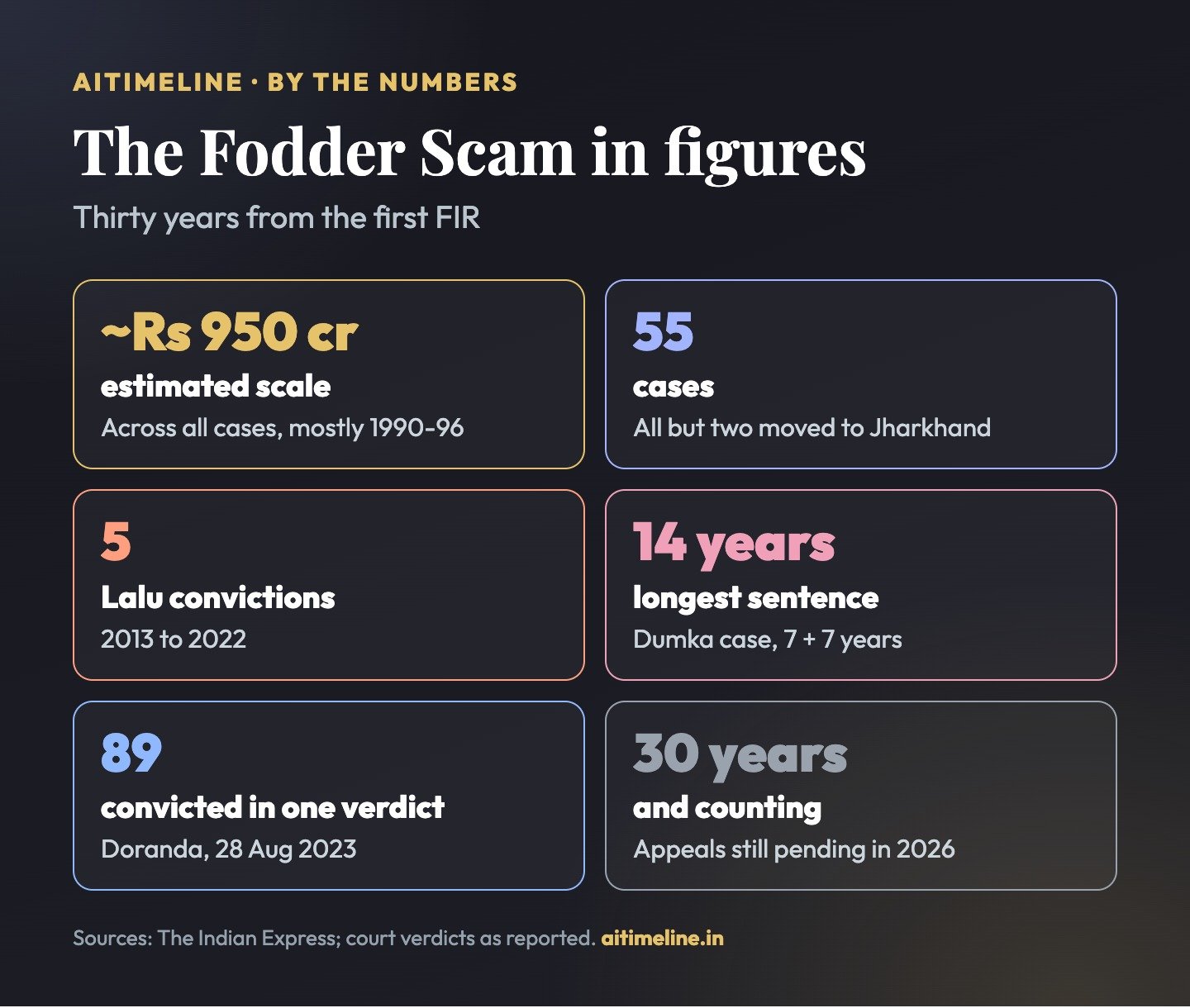
The Fodder Scam was a set of about 55 corruption cases from undivided Bihar in which officials of the Animal Husbandry Department, suppliers and politicians were accused of withdrawing an estimated Rs 950 crore from government treasuries against fake bills, mostly between 1990 and 1996. It surfaced in January 1996, forced Chief Minister Lalu Prasad to resign on 25 July 1997, and led to his conviction in five separate cases between 2013 and 2022. He is on bail while his appeals are pending.
Fodder Scam: Key Questions
The Scam in Ten Points
- The method: fake or inflated bills for fodder, medicines and equipment, paid by district treasuries.
- The scale: an estimated Rs 950 crore across 55 cases, mostly withdrawn from 1990 to 1996.
- The warnings: a 1992 vigilance report, a 1993 Central Vigilance Commission letter and a CAG report tabled in December 1995.
- The discovery: Amit Khare’s Chaibasa findings; first FIR on 24 January 1996.
- The probe: ordered by the Patna High Court on 11 March 1996 and monitored by the courts.
- The resignation: Lalu quit on 25 July 1997; Rabri Devi was sworn in the same day.
- The transfer: most cases moved to Jharkhand on 5 October 2001.
- The convictions: five against Lalu, from 2013 to 2022, plus hundreds of officials and suppliers.
- The 2017 ruling: separate withdrawals are separate offences.
- The status: Lalu is on bail; his convictions stand while appeals are heard.
How the Scam Worked
Money drawn for goods that never reached the cattle.
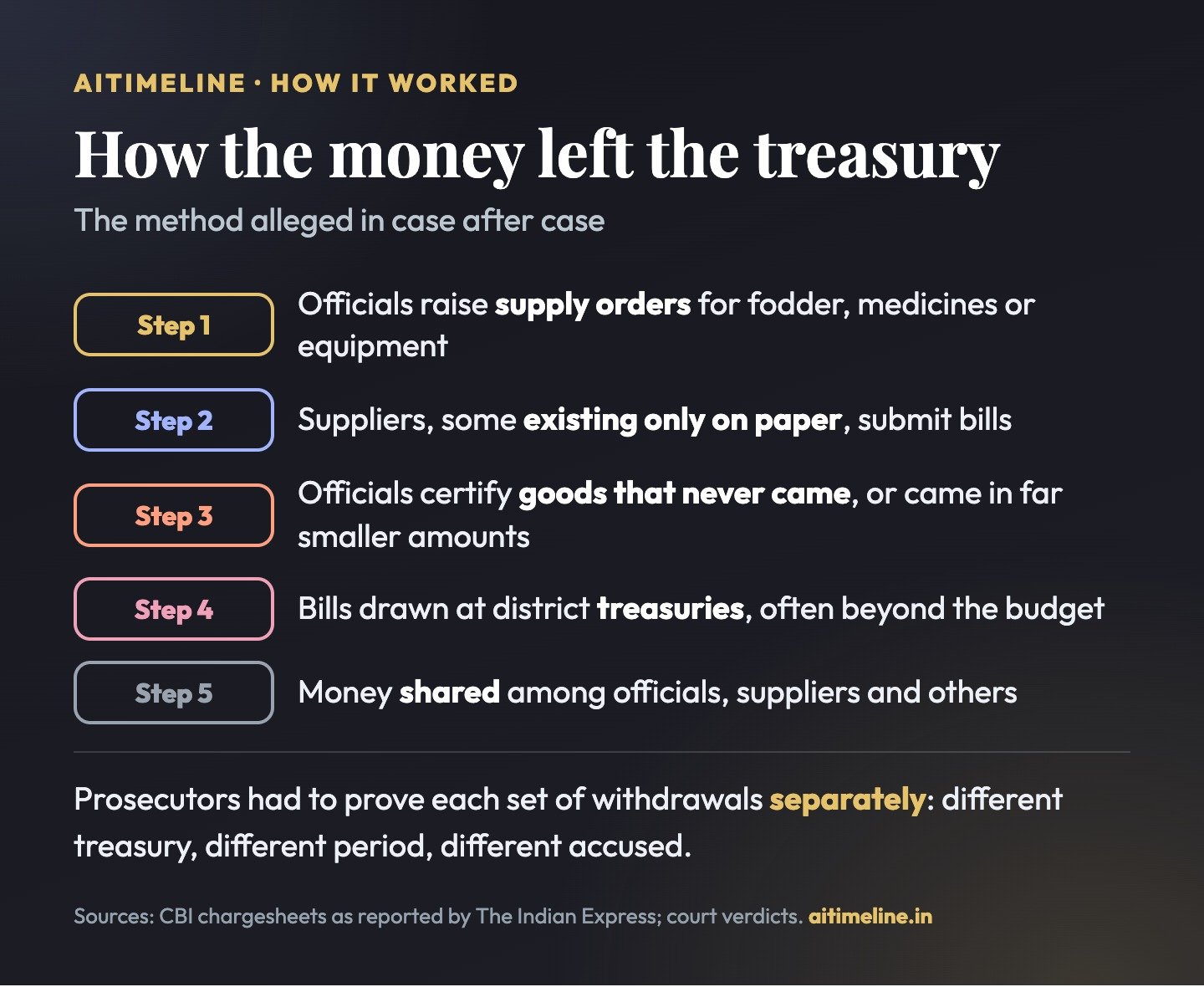
The department. Bihar’s Animal Husbandry Department ran programmes for livestock feed, veterinary medicines and artificial insemination. Its regional offices could raise purchase orders and draw money from the district treasuries in places such as Chaibasa, Deoghar, Dumka and Doranda in Ranchi.
The fraud. According to the CBI, officials, suppliers and treasury staff worked together to draw money on bills for supplies that were never made, or were made in far smaller quantities. Withdrawals often ran far beyond the budget allocated. Some suppliers existed only on paper.
Not only one government. Probes found that leakage from the department went back about 20 years and predated Lalu Prasad. The cases actually prosecuted, though, mostly concern withdrawals made while he was Chief Minister and held the finance portfolio, from 1990 to 1996.
How It Came Out
Warnings from 1992, an audit in 1995, a raid in 1996.
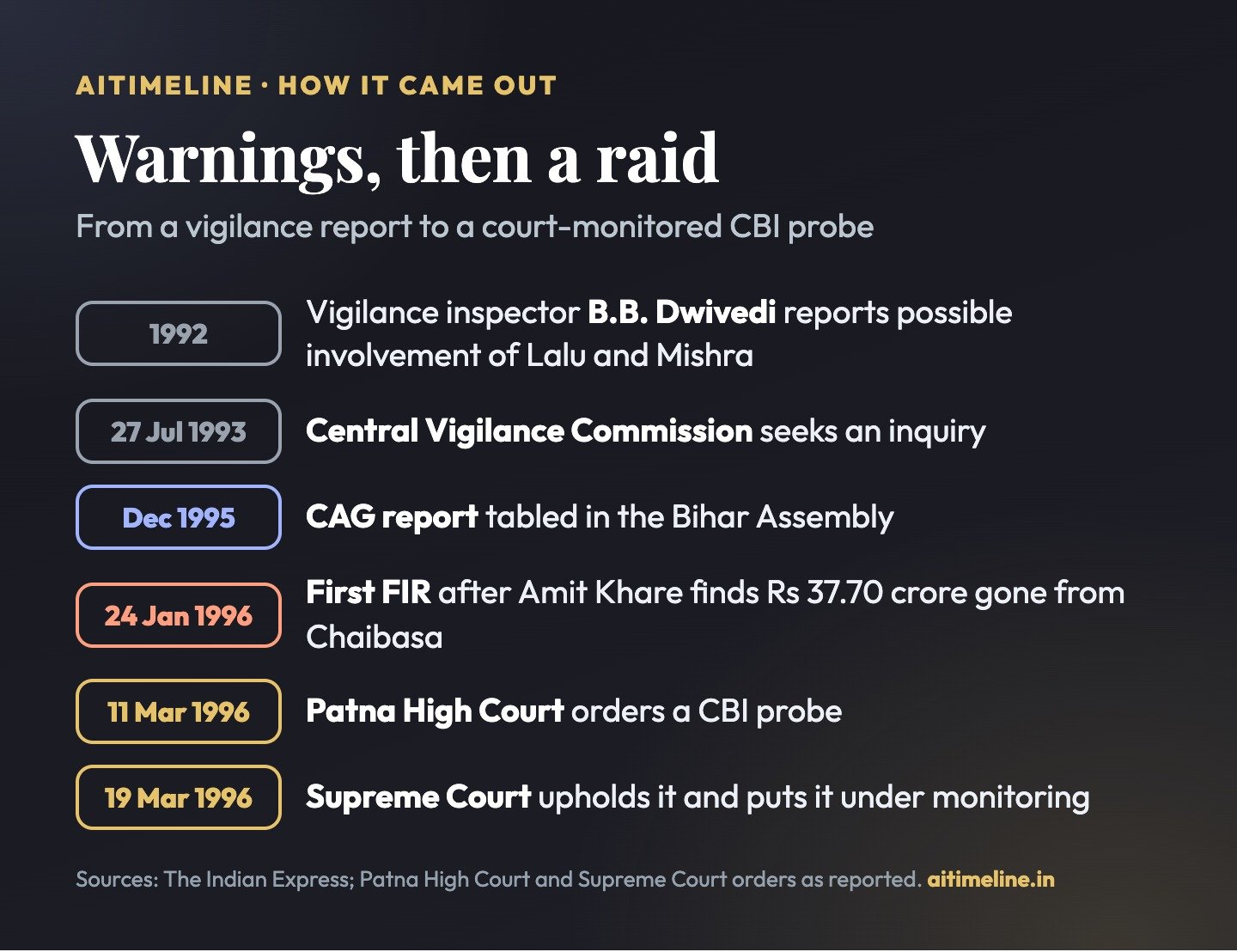
The audit. For years the CAG’s reports on Bihar had not been placed before the Assembly. When Lalu tabled them in the December 1995 winter session, they flagged long-delayed treasury accounts and fraudulent withdrawals by the animal husbandry department.
The raid. In January 1996 West Singhbhum Deputy Commissioner Amit Khare found the Chaibasa withdrawals. The first FIR followed on 24 January and raids on department offices on 27 January turned a paper problem into a national scandal.
The courts step in. Five public-interest petitions, from BJP, Janata Dal and Congress politicians, led the Patna High Court to hand the case to the CBI. The Supreme Court upheld the order eight days later and kept the probe under judicial monitoring.
Fodder Scam Timeline, 1990 to 2026
Newest first. Each entry is tagged by type.
Supreme Court declines to cancel Lalu’s bail in the Deoghar case Higher courts and bail
What happened: The Supreme Court refused to interfere with the Jharkhand High Court order of 12 July 2019 that suspended Lalu Prasad’s sentence and granted him bail in the Deoghar treasury case. It asked the High Court to decide his appeal against conviction, and the CBI’s plea to enhance his sentence, preferably within six months.
The CBI’s argument: Additional Solicitor General S.V. Raju argued that under Section 427 of the Code of Criminal Procedure, a sentence in a later case ordinarily begins only after an earlier one ends, so the High Court was wrong to treat Lalu’s sentences as running together when it found he had served half his term.
Why it matters: The order leaves Lalu on bail but does not acquit him. His conviction stands until the High Court decides the appeal, which has been pending since 2018.
89 convicted, 35 acquitted in a second Doranda treasury case Trial verdict
What happened: A special CBI court in Ranchi convicted 89 of 124 accused and acquitted 35 in a case of fraudulent withdrawals of about Rs 36.59 crore from the Doranda treasury. Lalu Prasad was not an accused in this case. It was described as the last of the major fodder cases transferred to Jharkhand.
Sentencing: Those given terms of up to three years were sentenced with the verdict. On 1 September 2023 the court sentenced the remaining convicts, about 35 of them, to four years’ rigorous imprisonment, with fines reported from Rs 75,000 to Rs 1 crore. Reports differ by one on the exact number.
Why it matters: It showed how far the scam reached beyond politicians: the convicts were mostly veterinary officers, treasury staff and suppliers.
High Court bail in the Doranda case Higher courts and bail
What happened: The Jharkhand High Court suspended Lalu’s five-year sentence in the Doranda case and granted him bail, on the ground that he had served half of it in custody.
What it means: Bail is not acquittal. The conviction stays on record while his appeal is heard.
Five years and a Rs 60 lakh fine in the Doranda case Trial verdict
What happened: The special CBI court sentenced Lalu to five years in prison and fined him Rs 60 lakh. The other 41 convicts awaiting sentence that day got three to five years’ rigorous imprisonment and fines totalling Rs 11.93 crore.
Time already served: His lawyer told reporters that Lalu had already spent about three years and nineteen days in custody across the fodder cases, more than half of the new term.
Fifth conviction: the Doranda treasury case Trial verdict
What happened: Special Judge S.K. Sashi convicted Lalu and 74 others and acquitted 24 in the largest single case against him: the withdrawal of Rs 139.35 crore from the Doranda treasury in Ranchi in 1995-96.
The CBI’s case: Animal husbandry officials and suppliers had used bogus bills for feed, fodder and medicines. The CBI said Rs 182.82 crore was alleged to have been withdrawn and Rs 139.35 crore was found to be actual fraud.
Why it matters: It was his fifth fodder conviction, after Chaibasa (twice), Deoghar and Dumka.
Bail in the Dumka case Higher courts and bail
What happened: The High Court granted Lalu bail in the Dumka treasury case, the one carrying his longest sentence. Like the other orders, it suspended the sentence during the appeal; it did not overturn the conviction.
Bail in the second Chaibasa case Higher courts and bail
What happened: The High Court granted Lalu bail in the second Chaibasa treasury case. He stayed in custody because the Dumka case was still pending a bail decision.
Jagannath Mishra dies Political fallout
What happened: Jagannath Mishra, three times Chief Minister of Bihar and Lalu’s predecessor in the 1980s, died in Delhi.
His fodder record: He was convicted with Lalu in both Chaibasa cases and acquitted in the Deoghar and Dumka cases. The outcomes differed because each case had its own evidence and accused.
Bail in the Deoghar case Higher courts and bail
What happened: The High Court suspended Lalu’s sentence in the Deoghar case and granted him bail, finding that he had served half the term. Two earlier applications had been rejected.
Why it mattered later: The CBI challenged this order in the Supreme Court, arguing the sentences in different cases could not be counted together. That challenge failed on 14 July 2026.
Dumka treasury case: a 14-year sentence Trial verdict
What happened: On 19 March 2018 the court convicted Lalu and 18 others of fraudulent withdrawals of about Rs 3.13 crore from the Dumka treasury. Jagannath Mishra was acquitted in this case. On 24 March Lalu was sentenced to seven years under the Indian Penal Code and seven years under the Prevention of Corruption Act, to run one after the other, and fined Rs 60 lakh.
Read the sentence correctly: It is often reported as “seven years”. The two seven-year terms run consecutively, so the total is 14 years, his longest in any fodder case.
Why it matters: It was his third conviction in less than three months.
Third conviction: the second Chaibasa case Trial verdict
What happened: Lalu was convicted in a second Chaibasa treasury case, involving fraudulent withdrawals of about Rs 33.67 crore, and sentenced to five years. Jagannath Mishra was also convicted and sentenced to five years.
Why separate: The Chaibasa treasury produced more than one case because the withdrawals covered different periods, bills and accused.
Deoghar sentence: three and a half years Trial verdict
What happened: The special CBI court sentenced Lalu to three and a half years’ imprisonment and a total fine of Rs 10 lakh in the Deoghar case.
Note: The brief we started from merged the conviction and the sentence. They were separate: conviction on 23 December 2017, sentence on 6 January 2018.
Second conviction: the Deoghar treasury case Trial verdict
What happened: The court convicted Lalu of conspiracy in the fraudulent withdrawal of Rs 89.27 lakh from the Deoghar treasury between 1990 and 1994. Jagannath Mishra was acquitted in this case.
Why it matters: It was the first verdict after the Supreme Court’s May 2017 ruling revived the conspiracy charge against him in separate cases.
Supreme Court: separate withdrawals are separate offences Higher courts and bail
What happened: The Supreme Court set aside the Jharkhand High Court’s November 2014 orders that had dropped conspiracy charges against Lalu, Jagannath Mishra and others in the remaining cases. The High Court had reasoned that a person could not be tried twice for the same offence.
The ruling: The Court held that withdrawals from different treasuries, in different periods and on different documents, were distinct offences, so a conviction in one case did not bar trial in another.
Why it matters: It sent Lalu back to trial in the Deoghar, Dumka and Doranda cases, which produced four more convictions.
Jharkhand High Court drops conspiracy charges Higher courts and bail
What happened: The High Court dropped the conspiracy charges against Lalu in other fodder cases, holding that he had already been tried and convicted for the same conspiracy in the first Chaibasa case.
What followed: The CBI appealed. The Supreme Court reversed the order in May 2017.
Supreme Court grants Lalu bail Higher courts and bail
What happened: The Supreme Court granted Lalu bail after about two and a half months in custody following the first Chaibasa conviction. His appeal against the conviction continued.
Correction: Some timelines date this bail to October 2013. Reports from the time date it to 13 December 2013.
First conviction and disqualification from the Lok Sabha Trial verdict
What happened: The special CBI court convicted Lalu and 44 others, including Jagannath Mishra and Jagdish Sharma, in the case of Rs 37.70 crore withdrawn from the Chaibasa treasury. On 3 October Lalu was sentenced to five years.
Disqualification: Because of the Supreme Court’s ruling in Lily Thomas v. Union of India on 10 July 2013, which removed the protection for sitting lawmakers, the conviction disqualified Lalu from the Lok Sabha at once and barred him from contesting elections.
Why it matters: Lalu was among the first sitting MPs to lose his seat under the new rule, alongside Congress MP Rasheed Masood, convicted in a separate case the same month.
Charges framed in the Banka-Bhagalpur case Investigation and charges
What happened: Nine years after the chargesheet, a CBI court framed charges against Lalu, Jagannath Mishra, JD(U) MP Jagdish Sharma and 31 others over Rs 46 lakh withdrawn on forged bills from the Banka and Bhagalpur treasuries.
Why it matters: It is one of the two fodder cases that stayed in Bihar after the state was divided. Charges were also framed in the first Chaibasa case in 2012.
Early convictions: 58 sentenced Trial verdict
What happened: A special CBI court convicted 58 people in a fodder case and sentenced them to five to six years each. They included two former regional directors of the animal husbandry department, Junul Bhengraj and Raja Ram, and suppliers.
Why it matters: It showed the cases could produce convictions, years before any politician was convicted.
Lalu and Rabri acquitted in the assets case Trial verdict
What happened: The special court acquitted Lalu Prasad and Rabri Devi of having assets disproportionate to their income. The Income Tax department had alleged personal gains of about Rs 46 lakh.
What it did not decide: This was a separate case about personal wealth. It said nothing about the treasury withdrawals, which were tried case by case.
Trials begin in Ranchi Investigation and charges
What happened: Trials began before special CBI courts in Ranchi. Each case was tried separately on treasury records, supply orders, bills and testimony.
Why so slow: Some cases had more than 100 accused. Several accused died and others turned approver during the trials.
Supreme Court moves most cases to Jharkhand Higher courts and bail
What happened: After Jharkhand was carved out of Bihar, the Supreme Court transferred the fodder cases to the new state, since most of the treasuries involved were now there.
Which treasuries: Chaibasa, Deoghar, Dumka and Doranda went to Jharkhand. All but two of the 55 cases moved; the Patna and Banka-Bhagalpur cases stayed in Bihar.
Assets chargesheet; Lalu back in jail Investigation and charges
What happened: The CBI chargesheeted Lalu in the disproportionate-assets case on 4 April 2000 and named Rabri Devi, by then Chief Minister, for abetment. Both surrendered the next day. Rabri got bail; Lalu was sent to Patna’s Beur jail.
What followed: The Patna High Court granted him provisional bail on 10 May 2000, extended more than 20 times.
CBI registers the assets case Investigation and charges
What happened: The CBI registered a disproportionate-assets case against Lalu, alleging he had gained personally from the scam.
Different case: Legally it was separate from the treasury cases, which is why its acquittal in 2006 changed nothing in them.
Lalu surrenders Political fallout
What happened: Five days after resigning, Lalu surrendered before the court and was taken into judicial custody.
Why it matters: A former Chief Minister going to jail on corruption charges made the scam a national story.
Lalu resigns; Rabri Devi becomes Chief Minister Political fallout
What happened: After a court issued an arrest warrant, Lalu resigned as Chief Minister and named his wife, Rabri Devi, as his successor. She was sworn in the same day, the first woman to be Chief Minister of Bihar.
Correction: Some accounts date her taking charge to 5 August 1997. She was sworn in on 25 July.
The party: Lalu had formed the Rashtriya Janata Dal on 5 July 1997, splitting from the Janata Dal as the case closed in.
CBI chargesheets Lalu Investigation and charges
What happened: The CBI filed chargesheets naming Lalu and 55 others under IPC Sections 420 (cheating) and 120B (criminal conspiracy) and Section 13 of the Prevention of Corruption Act.
The allegation: The chargesheet said Lalu, who held the finance portfolio, knew of “huge and suspicious withdrawals”, gave the alleged kingpin an extension in December 1993 despite objections, and ignored a July 1993 letter from the Central Vigilance Commission seeking an inquiry.
What a chargesheet is: It is the CBI’s case, not a finding. Guilt had to be proved at trial.
Governor sanctions prosecution Investigation and charges
What happened: The CBI formally asked Governor A.R. Kidwai on 10 May 1997 for permission to prosecute the Chief Minister. He granted it on 17 June.
Why it was needed: A sitting Chief Minister could not be prosecuted for offences in office without sanction from the Governor.
Patna High Court orders a CBI probe; Supreme Court agrees Higher courts and bail
What happened: On 11 March 1996 the Patna High Court directed the CBI to investigate. On 19 March the Supreme Court upheld the order and asked a bench of the High Court to monitor the probe.
Who went to court: The petitions, later clubbed, were filed by BJP leaders Sushil Kumar Modi, Ravi Shankar Prasad and Saryu Rai, Janata Dal leader Shivanand Tiwari and Congress leader Prem Chandra Mishra.
Why it matters: Court monitoring took the probe out of the state government’s hands.
Amit Khare finds the Chaibasa withdrawals Scam and exposure
What happened: Deputy Commissioner Amit Khare found that about Rs 37.70 crore had been fraudulently withdrawn from the Chaibasa treasury. The first FIR was registered on 24 January 1996, and the raids on animal husbandry offices that made the scam public were reported on 27 January.
What followed: FIRs followed at police stations across Bihar. The scam came to be described as 55 cases involving an estimated Rs 950 crore.
The CAG report is tabled Scam and exposure
What happened: Lalu, months into his second term, tabled CAG reports that had not been placed before the Assembly for years. They flagged long delays in treasury accounts and fraudulent withdrawals by the animal husbandry department.
Lalu’s response: He ordered a vigilance probe and referred the matter to the Assembly’s Public Accounts Committee.
Warnings that went nowhere Scam and exposure
1992: Vigilance inspector Bidhu Bhushan Dwivedi reported possible involvement of Lalu and his predecessor Jagannath Mishra to Director General G. Narayan. Dwivedi later became a witness in many of the cases.
1993: On 27 July 1993 the Central Vigilance Commission wrote to Bihar seeking an inquiry into the department. In December 1993, the CBI later alleged, Lalu gave the suspected kingpin, regional director Shyam Bihari Sinha, a one-year extension.
Lalu Prasad becomes Chief Minister Scam and exposure
What happened: Lalu Prasad became Chief Minister of Bihar and kept the finance portfolio. He won a second term in 1995.
The period: Most of the withdrawals later prosecuted took place between 1990 and 1996, though probes found the fraud had begun about 20 years earlier.
Lalu Prasad’s Five Convictions
Separate treasury cases, each with its own verdict and sentence.
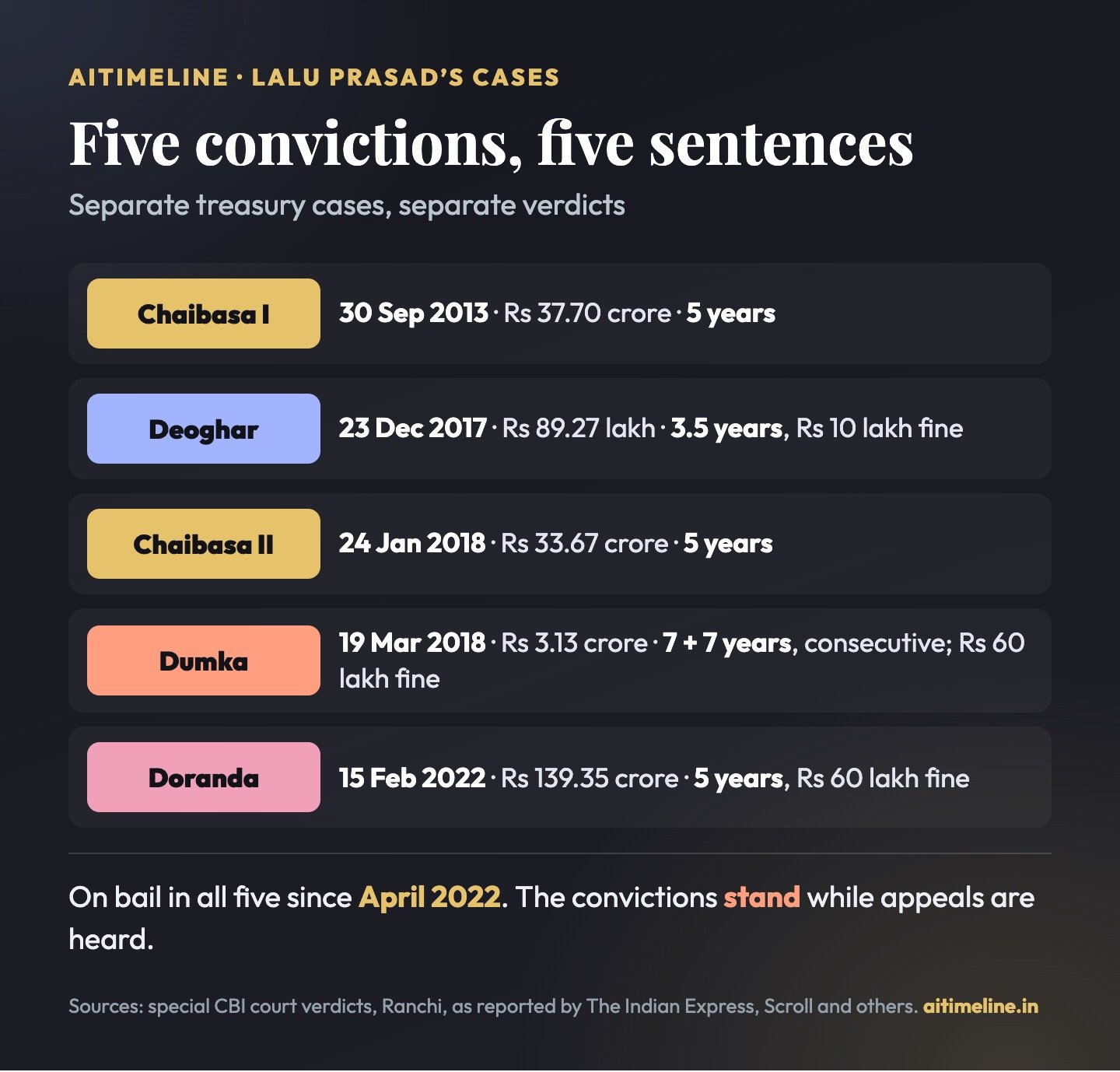
| Treasury case | Amount | Convicted | Sentence | Bail |
|---|---|---|---|---|
| Chaibasa (first) | Rs 37.70 crore | 30 Sep 2013 | 5 years | SC, 13 Dec 2013 |
| Deoghar | Rs 89.27 lakh | 23 Dec 2017 | 3.5 years, Rs 10 lakh (6 Jan 2018) | HC, 12 Jul 2019 |
| Chaibasa (second) | Rs 33.67 crore | 24 Jan 2018 | 5 years | HC, 9 Oct 2020 |
| Dumka | Rs 3.13 crore | 19 Mar 2018 | 7 + 7 years, consecutive; Rs 60 lakh (24 Mar 2018) | HC, 17 Apr 2021 |
| Doranda | Rs 139.35 crore | 15 Feb 2022 | 5 years, Rs 60 lakh (21 Feb 2022) | HC, 22 Apr 2022 |
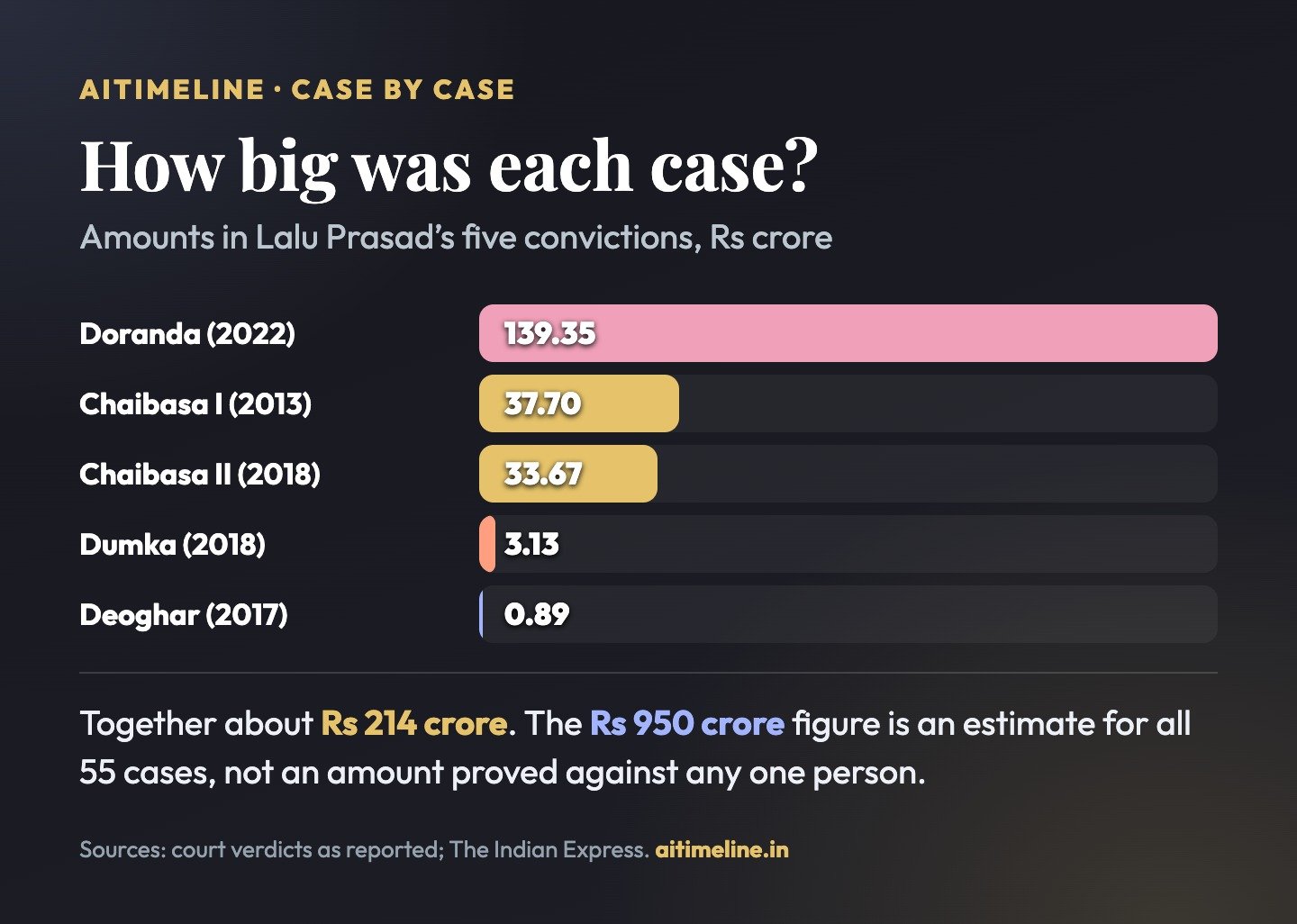
Read the amounts correctly. The five cases add up to about Rs 214 crore. The Rs 950 crore figure is an estimate for the whole scandal and should not be read as an amount proved against Lalu or anyone else.
From Patna to Ranchi
Why most of the trials happened in Jharkhand.
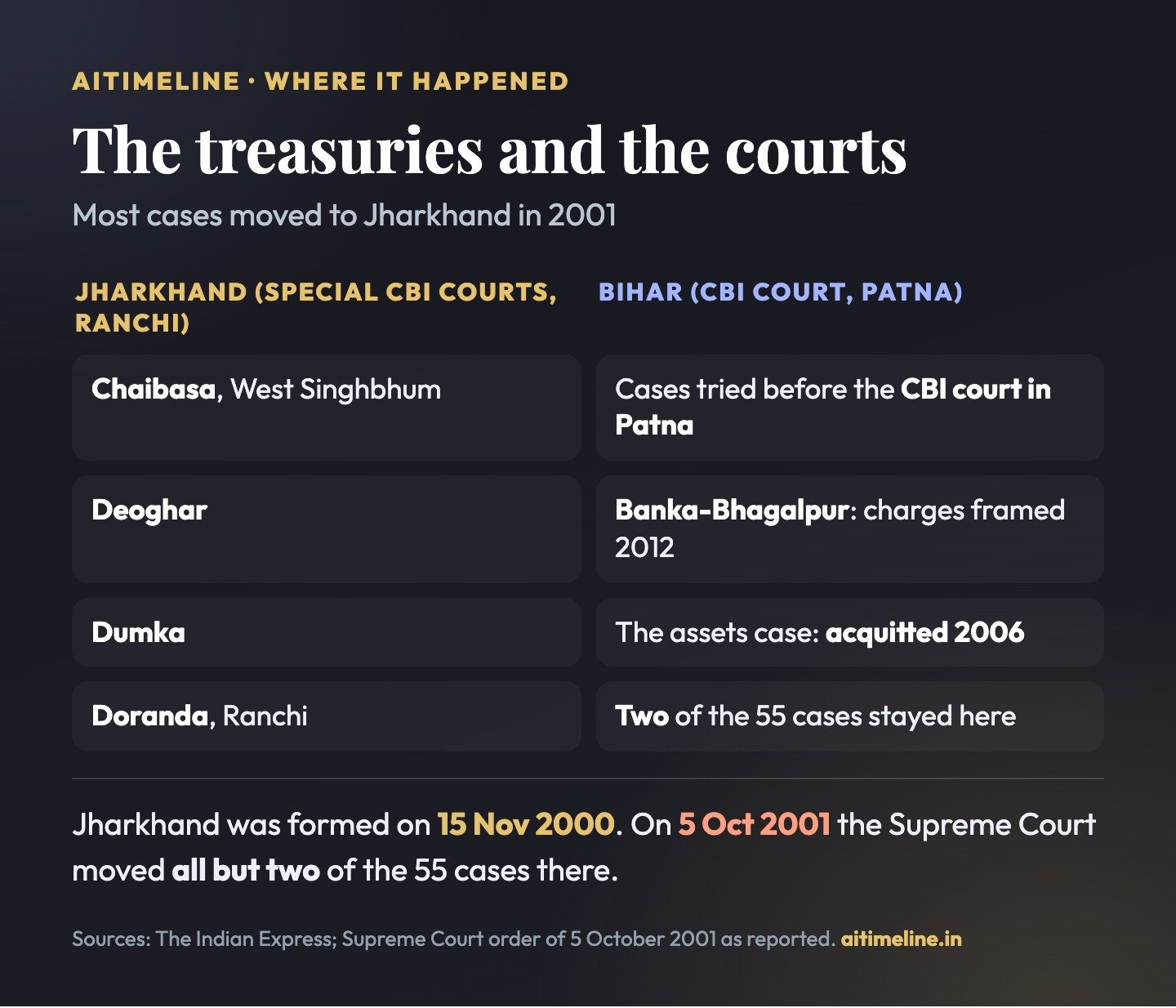
A divided state. When Jharkhand was formed on 15 November 2000, three of the four main treasuries in the scam, Chaibasa, Deoghar and Dumka, along with Doranda in Ranchi, were in the new state. The Supreme Court transferred the cases on 5 October 2001 and trials began in Ranchi in February 2002.
Long trials. Some cases had more than 100 accused and thousands of documents. Accused died, others turned approver, and the first verdict against Lalu took more than eleven years from the trial’s start.
The 2017 Ruling: One Scam, Many Offences
State of Jharkhand through SP, CBI v. Lalu Prasad Yadav, 8 May 2017.
The question. After the first Chaibasa conviction, the Jharkhand High Court in November 2014 dropped the conspiracy charges against Lalu in other cases. Its reasoning was double jeopardy: he had already been tried for the same conspiracy.
The answer. The Supreme Court disagreed. Withdrawals from different treasuries, in different periods, on different documents and with different co-accused were distinct offences, even if they were part of one wider pattern. A conviction in one did not bar trial in another.
The effect. Lalu went back to trial in the Deoghar, Dumka and Doranda cases and was convicted in all three, as well as in the second Chaibasa case. Jagannath Mishra, also restored to trial, was convicted in one and acquitted in two.
Bail and Appeals: Where Things Stand
Convicted five times, on bail in all five cases.
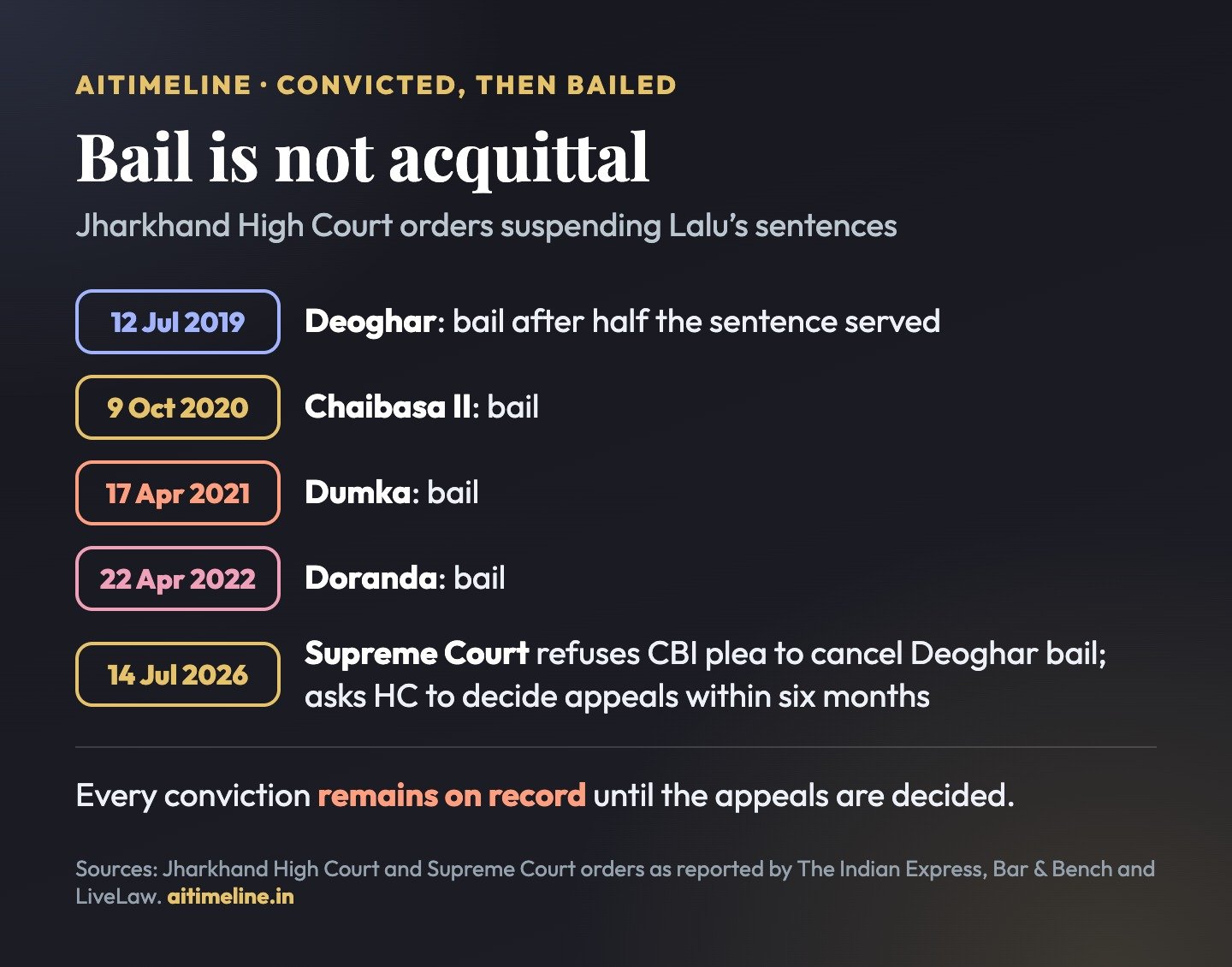
Why bail was granted. In each case the High Court found Lalu had spent at least half his sentence in custody, counting time across the fodder cases, and suspended the rest while his appeal was heard.
The CBI’s challenge. The CBI argued that under Section 427 of the Code of Criminal Procedure a later sentence ordinarily begins only after an earlier one ends, so his custody could not be counted towards several sentences at once. On 14 July 2026 a bench of Justices M.M. Sundresh and P.B. Varale declined to interfere, saying seven years had passed since the Deoghar bail, and asked the High Court to decide the 2018 appeals, and the CBI’s plea to enhance the sentence, preferably within six months.
What it means. Lalu remains convicted and, under the Representation of the People Act, disqualified from contesting elections while the convictions stand. Only a stay or reversal of the convictions on appeal would change that.
Who Was Who
Lalu Prasad Yadav
Held the finance portfolio. Resigned in 1997; convicted in five fodder cases from 2013 to 2022; on bail pending appeal.
Rabri Devi
Sworn in on 25 July 1997. Co-accused only in the assets case, in which she was acquitted in 2006.
Jagannath Mishra
Convicted in both Chaibasa cases, acquitted in Deoghar and Dumka. Died on 19 August 2019.
Amit Khare
Found the Chaibasa withdrawals in January 1996 that triggered the first FIR.
Shyam Bihari Sinha
Regional director described by the CBI as a kingpin; given a service extension in 1993. Died before his trials ended.
U.N. Biswas
Led the investigation through the mid-1990s, when the Union government depended on Lalu’s support.
A.R. Kidwai
Granted sanction to prosecute the Chief Minister on 17 June 1997.
S.K. Sashi
Convicted Lalu and 74 others in the Doranda case in February 2022.
Did You Know?
- Three parties in court: the petitions that led to the CBI probe came from BJP, Congress and Lalu’s own Janata Dal politicians.
- A new party first: Lalu formed the Rashtriya Janata Dal on 5 July 1997, three weeks before he resigned.
- The dairy defence: in the assets case Lalu said his wealth came from cows given at his wedding that had “multiplied”.
- A minister in between: while the trials went on, Lalu was Union Railway Minister from 2004 to 2009.
- Not only politicians: one 2023 verdict alone convicted 89 people, mostly officials and suppliers.
- A 2013 first: his Lok Sabha disqualification followed directly from the Lily Thomas judgment of that July.
Explore More Timelines
People Also Ask
Frequently Asked Questions
Based on court orders and contemporary reporting.
⚠️ Editorial Note: What We Checked
We checked the brief we started from against Indian Express reporting from 2013, 2017, 2018, 2022 and 2026 and other contemporary reports of each verdict. Rabri Devi was sworn in on 25 July 1997, not 5 August. Supreme Court bail after the first conviction came on 13 December 2013, not in October. The “8 May 2012” Supreme Court entry duplicated the 8 May 2017 judgment and was dropped. Deoghar: conviction 23 December 2017, sentence 6 January 2018. Dumka: two consecutive seven-year terms, 14 years in all. The 2023 Doranda verdict was delivered on 28 August, not 29 August. The 2007 convictions: reports do not name the treasury, so we do not. Lalu Prasad denies the charges and his appeals are pending; a conviction under appeal is not final. This article is a historical account and not legal advice.
Related Reading on AiTimeline
Sources & further reading
Every dated entry above was checked against these references. Last reviewed 19 November 2026.
- The Indian Express: Rs 950 crore, 55 cases, 2 former CMs and one fodder scam (explainer, May 2017)
- The Indian Express: Fodder scam timeline, 1996-2013
- The Indian Express: Another conviction for Lalu Prasad Yadav - the fodder scam and previous verdicts (February 2022)
- The Indian Express: Lalu Prasad gets five-year jail term, Rs 60 lakh fine in Doranda treasury case (21 February 2022)
- LiveLaw: Lalu sentenced to 14 years imprisonment in fodder scam (Dumka) case (24 March 2018)
- Bar & Bench: Chaibasa treasury scam - Jharkhand High Court grants Lalu Prasad Yadav bail (9 October 2020)
- The Indian Express: Supreme Court refuses to cancel Lalu Prasad Yadav's bail in Deoghar fodder scam case (14 July 2026)
- Bar & Bench: Supreme Court upholds bail to Lalu Prasad Yadav in Deoghar fodder scam (July 2026)