Shah Bano Case: A Timeline of India’s Landmark Maintenance Law
Explore the Shah Bano case timeline, the 1985 Supreme Court verdict, the 1986 Muslim Women Act, the Danial Latifi judgment and the 2024 ruling.
Latest Story
In April 1978, Shah Bano Begum, then in her early sixties and turned out of her home after more than four decades of marriage, asked a Magistrate in Indore to order her husband to support her. Seven years later the Supreme Court agreed, and a claim for ₹179.20 a month became one of the most argued-over judgments in Indian history. This Shah Bano case timeline follows the dispute from the Magistrate’s court to the 1985 verdict, the 1986 law that tried to reverse it, and the 2001 and 2024 rulings that restored much of what it gave.
The ₹25 maintenance order came in August 1979, not 1978; Shah Bano filed in April 1978 and was divorced on 6 November 1978, while her petition was pending. The 1986 Act was not struck down: the Supreme Court upheld it in 2001 but read it to require provision for the woman’s future. And the judgment did not abolish iddat or Muslim personal law: it interpreted a secular statute that applies to everyone.
💡 Short Answer
The Shah Bano case is Mohd. Ahmed Khan v. Shah Bano Begum, decided by a five-judge Supreme Court bench on 23 April 1985. It held that a divorced Muslim woman who cannot maintain herself can claim maintenance from her former husband under Section 125 CrPC, even after iddat. Parliament responded with the Muslim Women (Protection of Rights on Divorce) Act, 1986. The Court upheld that Act in Danial Latifi (2001) but read it to require provision for her future, and in 2024 confirmed that Section 125 remains available too.
Shah Bano Case: Key Questions
The Case in Ten Points
- The claim: a maintenance petition by a 62-year-old wife, filed in April 1978 before she was divorced.
- The divorce: an irrevocable talaq on 6 November 1978, with ₹3,000 mahr deposited in court.
- The lower courts: ₹25 a month in August 1979, raised to ₹179.20 on 1 July 1980.
- The verdict: five judges, unanimous, 23 April 1985: Section 125 applies whatever the parties’ religion.
- The remark: the Court called Article 44, on a uniform civil code, “a dead letter”.
- The backlash: protests by religious bodies and a Congress by-election loss in December 1985.
- The law: the Muslim Women (Protection of Rights on Divorce) Act, assent 19 May 1986.
- The reading: Danial Latifi (2001) upheld it, but required provision for her future.
- The reaffirmation: Mohd. Abdul Samad (2024): the Act is in addition to Section 125, not instead of it.
- Today: Section 144 of the BNSS carries the general maintenance remedy forward.
Four Milestones, 1985 to 2024
A judgment, a law, a reading of that law, and a reaffirmation.
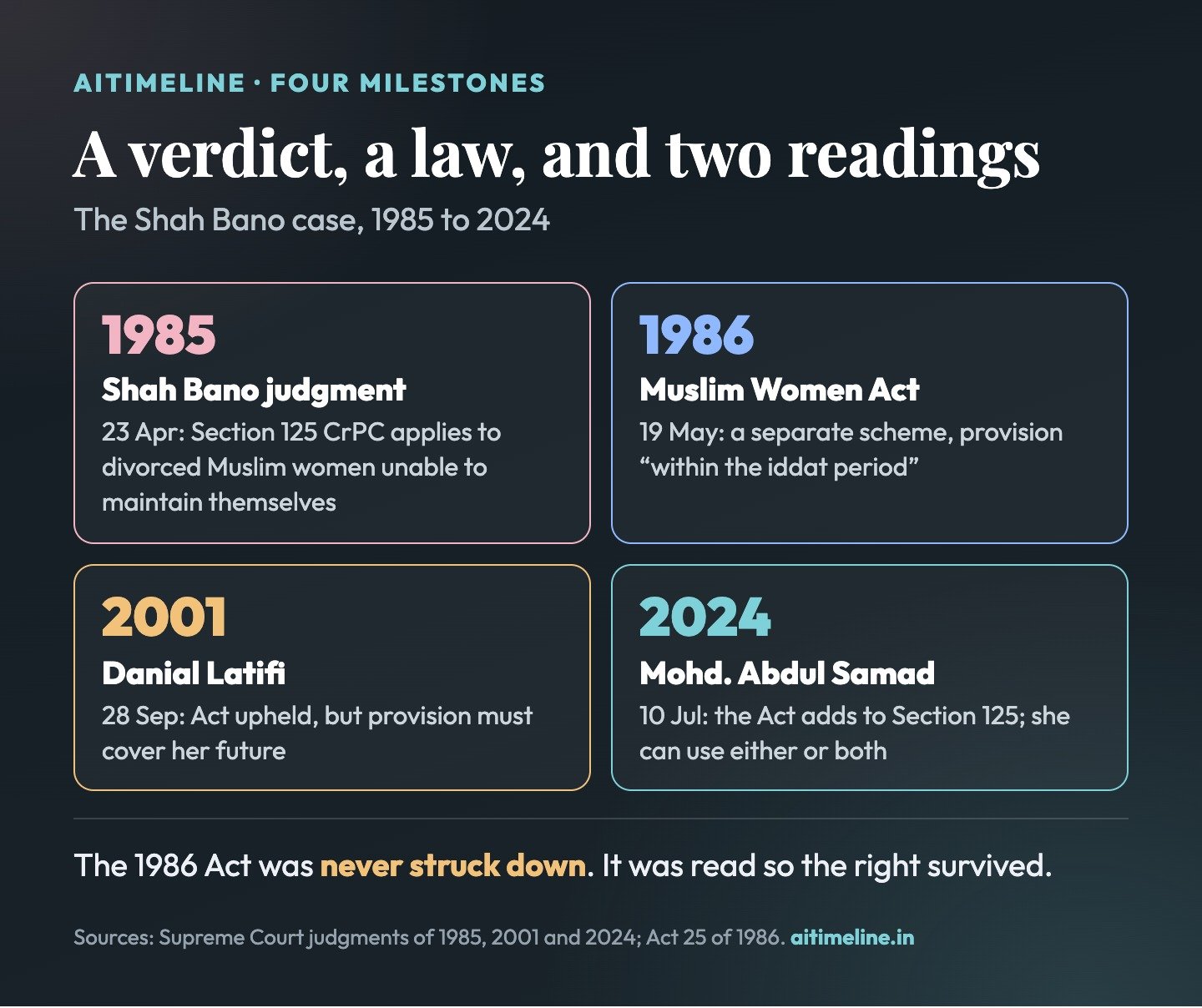
A circle, not a line. Parliament’s 1986 law was widely understood as undoing the 1985 judgment. The Court’s two later rulings did not strike the law down. They read it, and the secular remedy beside it, so that the woman’s right to support survived.
The personal story was overtaken. Shah Bano received a modest monthly allowance, disowned the judgment under pressure within months, and died in 1992. The legal principle outlived her by decades.
What Was Actually at Stake
The sums behind a national controversy, from the 1985 judgment.

A small sum, a large principle. The amount confirmed in 1985 was ₹179.20 a month. The Supreme Court ordered the husband to pay ₹10,000 in costs, more than four years of that allowance.
Why the mahr mattered. Under Section 127(3)(b), a maintenance order could be cancelled if a divorced woman had received the whole sum payable “on divorce” under personal law. Khan argued his ₹3,000 was that sum. The Court held that mahr is a mark of respect for the wife, payable because of the marriage, not on divorce.
Shah Bano Case Timeline, Newest First
Tagged by phase: the dispute, the lower courts, the Supreme Court, Parliament and politics, and the laws that followed.
A film, and a daughter’s objection Later law
What happened: Shah Bano’s daughter, Siddiqua Begum Khan, asked the Madhya Pradesh High Court to stop the release of Haq, a Hindi film inspired by the case, saying it used her mother’s life without the family’s consent and misrepresented it.
The ruling: Justice Pranay Verma dismissed the petition days before the release, noting that the film carried a disclaimer describing it as fiction inspired by the 1985 judgment, and that no violation of privacy or reputation had been shown.
Why it matters: Forty years after the judgment, the case was still contested ground, this time over who gets to tell the story of the woman at its centre.
Mohd. Abdul Samad v. State of Telangana Supreme Court
The dispute: A Family Court in Telangana had ordered Mohd. Abdul Samad to pay his divorced wife ₹20,000 a month as interim maintenance under Section 125 CrPC. The High Court cut it to ₹10,000. He appealed, arguing that the 1986 Act barred a divorced Muslim woman from using Section 125 at all.
The ruling: Both judges wrote separate, concurring opinions and dismissed the appeal. The 1986 Act is “not in derogation of Section 125 of the CrPC but in addition to” it, so a woman divorced under Muslim law can use either law, or both. The same applies to the 2019 law on triple talaq. Any amount paid under the 1986 Act is taken into account under Section 127(3)(b).
Why it matters: It settled a question High Courts had answered differently for decades, and overruled the decisions that had shut divorced Muslim women out of Section 125.
Section 125 becomes Section 144 of the BNSS Later law
What happened: The new criminal procedure code came into force. The maintenance provision for wives, children and parents is now Section 144, and its explanation still treats a divorced woman who has not remarried as a “wife”.
The overlap: The Samad appeal, decided nine days later, had been filed under the old Section 125, so the Court spoke in CrPC terms. The principle carries over to Section 144.
Triple talaq becomes a criminal offence Later law
What happened: Parliament made pronouncing instant triple talaq void and punishable with up to three years in prison. Section 5 gives a woman so divorced a right to a subsistence allowance from her husband.
The link to Shah Bano: Mohammed Ahmed Khan had divorced Shah Bano in exactly this way in 1978. The Samad judgment of 2024 confirmed that this allowance is in addition to, not instead of, Section 125.
Shayara Bano: instant triple talaq set aside Supreme Court
What happened: A Constitution Bench held, by majority, that talaq-e-biddat, or instant triple talaq, was invalid.
The connection: Like Shah Bano, the case began with one woman’s petition and became a national debate about personal law, Parliament and the courts. This time Parliament followed the judgment rather than reversing it.
Danial Latifi: the 1986 Act upheld, and read wide Supreme Court
What happened: Fifteen years after Shah Bano’s own lawyer filed the challenge, a Constitution Bench of Justices G.B. Pattanaik, S. Rajendra Babu, D.P. Mohapatra, Doraiswamy Raju and Shivaraj V. Patil upheld the 1986 Act. Justice Rajendra Babu wrote the judgment.
The key reading: Section 3(1)(a) requires a “reasonable and fair provision and maintenance to be made and paid” within the iddat period. The Court read “within” to mean the husband must make provision for her future during iddat, not merely pay for those three months. His liability “is not confined to iddat period”.
Why it matters: By reading the Act this way, the Court found it did not offend Articles 14, 15 and 21. In practice, it restored much of what the Act had been meant to take away.
The ₹500 cap on maintenance is removed Later law
What happened: Parliament removed the ₹500 monthly ceiling on maintenance under Section 125, leaving the amount to the Magistrate.
The context: Shah Bano had asked for the maximum ₹500 in 1978. She was awarded ₹25, then ₹179.20.
Shah Bano dies The dispute
What happened: Shah Bano Begum died in 1992, reportedly of a brain haemorrhage. She did not live to see the Danial Latifi judgment.
Her legacy: Her name became shorthand for a debate she had not set out to start: about personal law, secular remedies and the Uniform Civil Code.
The Muslim Women (Protection of Rights on Divorce) Act, 1986 Parliament and politics
What it says: Section 3 entitles a divorced Muslim woman to a reasonable and fair provision and maintenance from her former husband, made and paid within the iddat period, plus her mahr and the property given to her. Section 4 makes her relatives, and failing them the State Wakf Board, liable to maintain her afterwards if she cannot maintain herself.
The opt-in: Section 5 lets the two former spouses declare, jointly or separately, that they prefer to be governed by Sections 125 to 128 of the CrPC.
How it was read: The government and its supporters presented it as limiting the husband’s duty to the iddat period. The wording, “within” rather than “for”, would decide its meaning 15 years later.
The Bill is introduced, and a minister quits Parliament and politics
What happened: The Muslim Women (Protection of Rights on Divorce) Bill was taken up in the Lok Sabha on 25 February 1986. With a majority of more than 400 seats, the government had the numbers to pass it.
The resignation: Arif Mohammad Khan, a Minister of State who had defended the judgment in the Lok Sabha the previous August, resigned from the government in protest at the Bill. He later served as Governor of Kerala and of Bihar.
The opposition: Women’s organisations, the Left, the BJP and some Muslim liberals opposed the Bill; the All India Muslim Personal Law Board and others supported it.
A by-election loss in Kishanganj Parliament and politics
What happened: Syed Shahabuddin, a prominent critic of the judgment, won the Kishanganj Lok Sabha by-election in Bihar. The result was widely read as a sign of Muslim anger at the Congress, which had initially backed the verdict.
Why it mattered: Accounts of the period say the result, together with pressure from Congress leaders, pushed the government towards legislation.
Shah Bano disowns the judgment The dispute
What happened: Facing pressure from religious leaders and her community, Shah Bano publicly said she rejected the Supreme Court’s verdict and asked that it be withdrawn, according to accounts of the period.
Why it matters: The woman who had won the case was presented by its opponents as having renounced it. Her own wishes became part of the political argument.
Arif Mohammad Khan defends the verdict in the Lok Sabha Parliament and politics
What happened: Arif Mohammad Khan, a Muslim minister in the Congress government, made a long speech in the Lok Sabha defending the judgment and citing the Quran in its support. He later said he had done so at the Prime Minister’s request.
The other side: Ziaur Rahman Ansari, another minister, attacked the judgment in the same debate. Muslim League MP G.M. Banatwala had moved a private member’s bill to exclude Muslims from Section 125.
The Supreme Court rules for Shah Bano Supreme Court
What happened: A unanimous Constitution Bench of Chief Justice Y.V. Chandrachud and Justices D.A. Desai, O. Chinnappa Reddy, E.S. Venkataramiah and Ranganath Misra dismissed the husband’s appeal and confirmed the High Court’s order. He was ordered to pay her ₹10,000 in costs.
What it held: Section 125 is secular and applies whatever the religion of the parties. A divorced wife who has not remarried and cannot maintain herself can claim maintenance beyond iddat. Mahr is not a sum payable “on divorce” that cancels the order under Section 127(3)(b). And there was “no conflict” with Muslim personal law, citing verses 241 and 242 of the second chapter of the Quran.
The remark: “Article 44 of our Constitution has remained a dead letter,” the Court said, urging Parliament towards a common civil code. The comment did as much as the holding to make the case explosive.
Referred to a larger bench Supreme Court
What happened: A two-judge bench doubted two earlier three-judge rulings, Bai Tahira (1979) and Fuzlunbi (1980), that had applied Section 125 to divorced Muslim women. It sent the appeal to a larger bench.
Who joined: The All India Muslim Personal Law Board and the Jamiat Ulema-e-Hind intervened in support of the husband. Shah Bano was represented by Danial Latifi.
The High Court raises it to ₹179.20 Lower courts
What happened: On Shah Bano’s revision petition, the High Court increased her maintenance to ₹179.20 a month.
What followed: Mohammed Ahmed Khan sought special leave to appeal to the Supreme Court, arguing that he had met every obligation he had under Muslim law.
The Magistrate awards ₹25 a month Lower courts
What happened: The Magistrate directed Khan to pay Shah Bano ₹25 a month, a sum the Supreme Court later called “princely”, with evident irony.
The gap: She had asked for ₹500, the legal maximum, saying he earned about ₹60,000 a year.
Bai Tahira and Fuzlunbi Later law
What happened: In two cases the Supreme Court held that Section 125 applied to divorced Muslim women, and that a sum paid under personal law cancels the order only if it is a reasonable substitute for maintenance.
Why it matters: Shah Bano’s case was the challenge to these rulings. The 1985 Constitution Bench confirmed them.
Divorced by irrevocable talaq The dispute
What happened: While her petition was pending, Khan divorced her by an irrevocable talaq. He argued that she was no longer his wife, that he had paid her ₹200 a month for about two years, and that he had deposited ₹3,000 in court as mahr for the iddat period.
The question it raised: Did divorce, and payment under personal law, end a husband’s duty under Section 125? That became the question the Supreme Court had to answer.
Shah Bano files under Section 125 The dispute
What happened: Shah Bano petitioned the Magistrate for maintenance of ₹500 a month, the most the law then allowed, citing her husband’s professional income of about ₹60,000 a year.
The law she used: Section 125 lets a Magistrate order a man of sufficient means to maintain a wife who cannot maintain herself. Its Explanation (b) counts a divorced woman who has not remarried as a wife.
The new CrPC counts a divorced wife as a wife Later law
What happened: The 1973 Code replaced the 1898 Code. Its maintenance section, Section 125, expressly included a divorced woman who had not remarried within “wife”. Section 127(3)(b) let a husband have the order cancelled if she had received the whole sum payable “on divorce” under personal law.
Why it matters: That pairing of provisions was the legal battleground of the Shah Bano case.
Turned out of the matrimonial home The dispute
What happened: Mohammed Ahmed Khan, a well-known Indore advocate, made Shah Bano leave the marital home. He had taken a second wife years earlier.
The arrangement: He paid her ₹200 a month for about two years, by his own account, before the payments stopped.
The marriage The dispute
What happened: Shah Bano married Mohammed Ahmed Khan, an advocate. They had three sons and two daughters.
Context: Accounts describe them as cousins. Khan later married a second wife, Halima Begum.
What the Supreme Court Held in 1985
Mohd. Ahmed Khan v. Shah Bano Begum, (1985) 2 SCC 556, AIR 1985 SC 945.
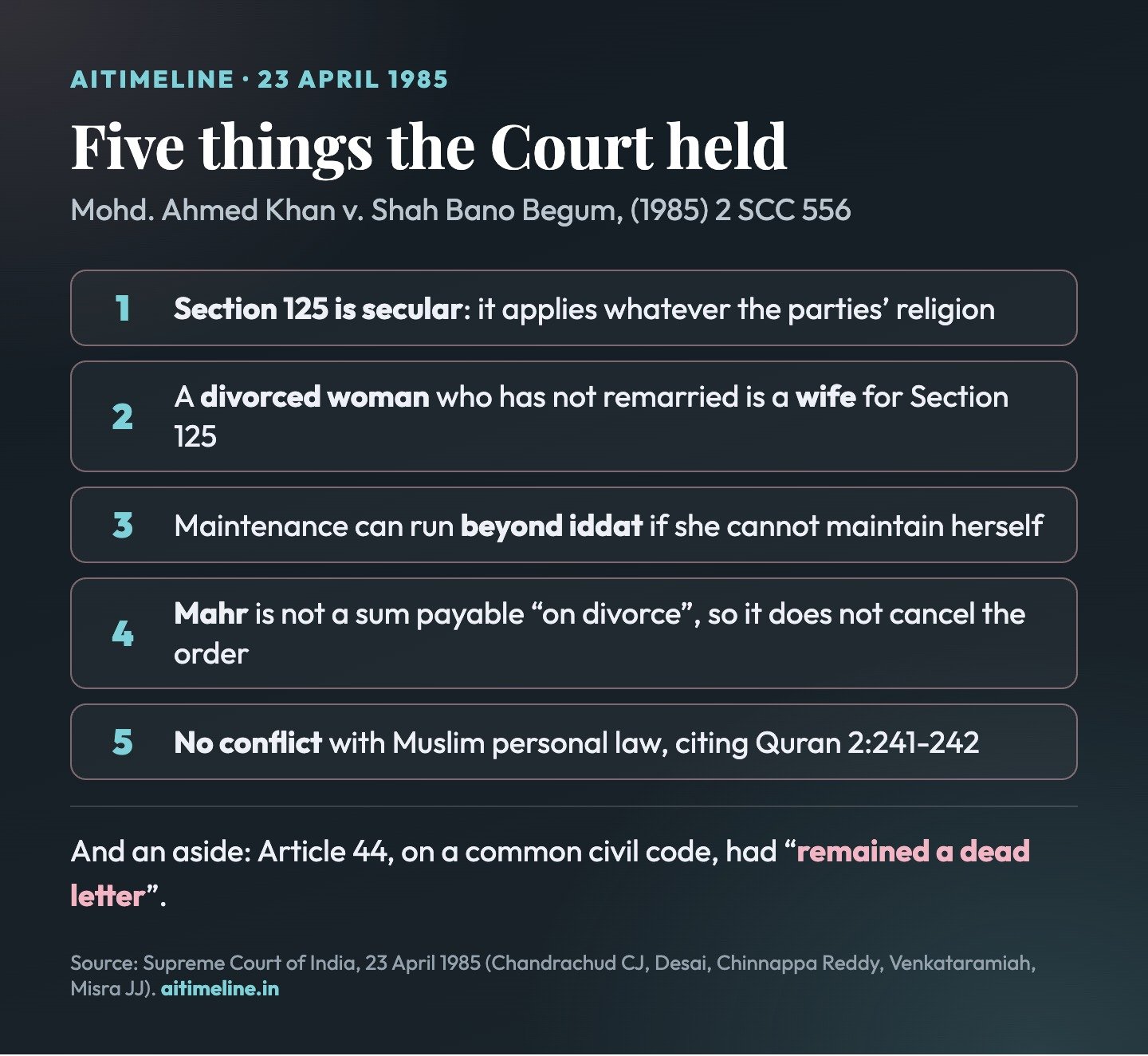
| Husband’s argument | The Court’s answer |
|---|---|
| Divorce ended her status as a wife | Explanation (b) to Section 125 expressly includes a divorced woman who has not remarried |
| Muslim personal law limits his duty to iddat | That rule applies where she can maintain herself; it does not cover destitution |
| Paying mahr cancels the order under Section 127(3)(b) | Mahr is not a sum payable “on divorce” |
| The judgment interferes with religion | No conflict: the Quran itself imposes a duty of provision for divorced wives |
The part that was not needed. The Court added that Article 44 had “remained a dead letter” and that “a common Civil Code will help the cause of national integration”. It was an observation, not a holding, but it turned a maintenance case into a debate about the Uniform Civil Code.
The Court interpreting scripture. Critics objected less to the result than to judges reading the Quran for themselves. The Muslim Personal Law Board, an intervener, would raise the same objection in 2001.
Parliament’s Response: The 1986 Act
Muslim Women (Protection of Rights on Divorce) Act, 1986 (Act 25 of 1986), assent 19 May 1986.

| Question | Section 125 CrPC | 1986 Act |
|---|---|---|
| Who pays | Former husband | Former husband within iddat; then relatives or the Wakf Board |
| Form | Monthly allowance | Provision and maintenance, often a lump sum |
| Limit (until 2001) | ₹500 a month | No ceiling |
| Condition | She cannot maintain herself | Fair provision regardless; Section 4 if she cannot maintain herself |
The politics. The Congress had won more than 400 Lok Sabha seats in 1984 and initially backed the verdict. After protests by religious organisations and a by-election defeat in Kishanganj, the government brought the Bill in February 1986. Arif Mohammad Khan resigned from the ministry in protest.
The fine print. Section 3 spoke of provision “made and paid within the iddat period”. Its supporters took this to mean maintenance only for iddat. The words would be read differently.
Danial Latifi: “Within”, Not “For”
How the Supreme Court saved the 1986 Act by reading it, 28 September 2001.
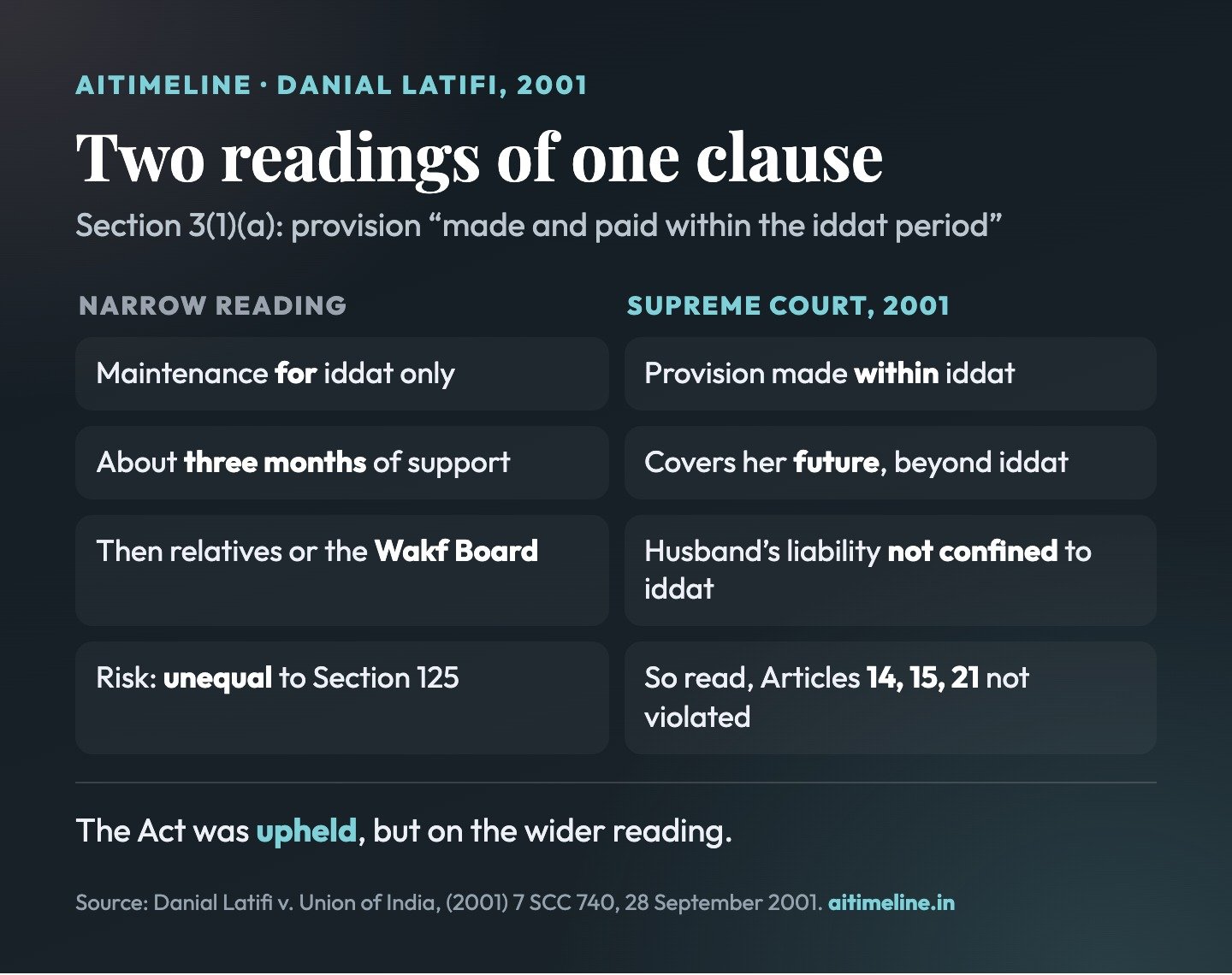
Why the Court did it. If the Act had left divorced Muslim women with less protection than other women under Section 125, the bench reasoned, it would face a serious challenge under Articles 14 and 21. Reading it to require provision for her future avoided that, so the Act stood.
What changed in practice. Courts began ordering substantial lump sums within iddat to provide for a woman’s future. With no ceiling, some women did better under the 1986 Act than under Section 125’s former ₹500 cap.
The Law Today
From Mohd. Abdul Samad (2024) and the BNSS.
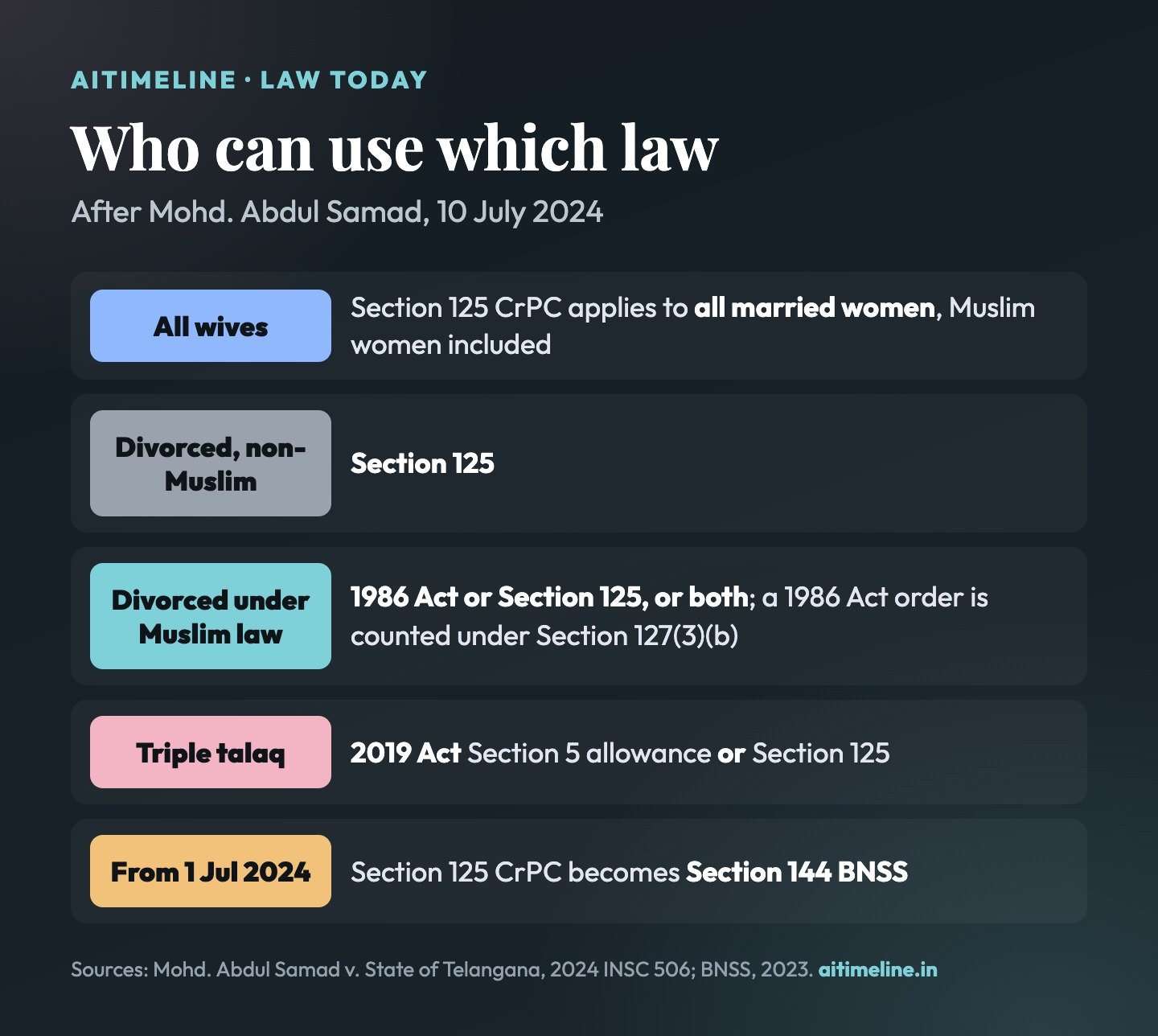
| Issue | Where the law stands |
|---|---|
| Maintenance after divorce | Section 125 CrPC (now BNSS 144) covers a divorced woman who has not remarried and cannot maintain herself |
| Mahr | Does not by itself end the statutory remedy |
| Iddat | Maintenance under Section 125 can continue beyond it |
| 1986 Act | Valid; requires fair provision for her future, made within iddat |
| Choice of remedy | Either law or both, per Mohd. Abdul Samad (2024) |
| Triple talaq | Void and punishable since the 2019 Act; Section 5 allowance is additional |
A settled question, finally. For nearly four decades, High Courts disagreed on whether the 1986 Act shut divorced Muslim women out of Section 125. Samad held that the Act is “not in derogation of Section 125 of the CrPC but in addition to” it, and overruled the decisions that said otherwise.
Law and practice. A legal right does not guarantee payment. Delays in maintenance cases and difficulty enforcing orders remain common complaints for women of every community.
By the Numbers

Who Was Who
Shah Bano Begum
An Indore woman, married in 1932, mother of five, who claimed maintenance at 62. She died in 1992.
Mohammed Ahmed Khan
A well-known Indore advocate who divorced her in 1978 and took the case to the Supreme Court.
Y.V. Chandrachud
Wrote the unanimous 1985 judgment for a five-judge Constitution Bench.
Danial Latifi
Represented Shah Bano in the Supreme Court, then challenged the 1986 Act in Writ Petition 868 of 1986.
Rajiv Gandhi
His government first backed the verdict, then brought the 1986 Act.
Arif Mohammad Khan
Defended the verdict in the Lok Sabha in August 1985 and quit the ministry over the Bill.
Justice S. Rajendra Babu
Wrote Danial Latifi, reading Section 3 to require provision for the woman’s future.
Justices Nagarathna and Masih
Held in separate concurring opinions that the 1986 Act adds to Section 125 rather than replacing it.
Did You Know?
- Not a divorce case at first: she filed for maintenance as a wife; the divorce came seven months later.
- Not the first: two other Muslim women had won Section 125 maintenance in the Supreme Court in 1979 and 1980.
- Costs exceeded the award: the ₹10,000 costs were worth more than four years of her monthly allowance.
- Her lawyer kept going: Danial Latifi challenged the law that followed, and his name is on the 2001 judgment.
- Thirty-nine years later: the Supreme Court in 2024 confirmed the principle it first set out in 1985.
- Still contested: in November 2025 her daughter went to court over a film inspired by the case.
Explore More Timelines
People Also Ask
Frequently Asked Questions
Based on the 1985, 2001 and 2024 Supreme Court judgments and the 1986 Act.
⚠️ Editorial Note: What We Checked
We checked the brief we started from against the three Supreme Court judgments. The Magistrate’s ₹25 order was made in August 1979, not 1978, and the High Court’s order is dated 1 July 1980. The divorce was on 6 November 1978, after she filed. In the 2024 Samad case, the Family Court’s ₹20,000 a month was interim maintenance, which the High Court cut to ₹10,000 before the Supreme Court dismissed the husband’s appeal; and both judges, not only Justice Nagarathna, wrote separate concurring opinions, with Justice Masih writing the lead judgment. The judgment also covered the 2019 triple talaq law. One judgment link in the brief returned an error, so we cite Indian Kanoon instead. Exact dates for the Lok Sabha vote on the 1986 Bill, Arif Mohammad Khan’s resignation and Shah Bano’s public statement in late 1985 are not given where we could not confirm them from records. This article describes court judgments and laws and is not legal advice.
Related Reading on AiTimeline
Sources & further reading
Every dated entry above was checked against these references. Last reviewed 19 November 2026.
- Indian Kanoon: Mohd. Ahmed Khan v. Shah Bano Begum and Others, Supreme Court, 23 April 1985, (1985) 2 SCC 556 (full judgment)
- Indian Kanoon: Danial Latifi and Another v. Union of India, Supreme Court, 28 September 2001, (2001) 7 SCC 740 (full judgment)
- Supreme Court of India: Mohd. Abdul Samad v. State of Telangana, 10 July 2024, 2024 INSC 506 (judgment PDF)
- India Code: The Muslim Women (Protection of Rights on Divorce) Act, 1986 (Act 25 of 1986)
- Rajya Sabha Debates, 8 May 1986: Muslim Women (Protection of Rights on Divorce) Bill (PDF)
- Ministry of Home Affairs: New Criminal Laws (Bharatiya Nyaya Sanhita, Bharatiya Nagarik Suraksha Sanhita, Bharatiya Sakshya Adhiniyam)
- The Indian Express: What is a divorced Muslim woman's right to maintenance under the CrPC? (July 2024)
- Scroll: Madhya Pradesh High Court rejects plea by Shah Bano's daughter against release of film Haq (November 2025)