Sukh Ram Telecom Scam: History, Allegations, and Verdict
Explore the Sukh Ram telecom scam timeline, 1996 CBI raids, ₹3.6 crore cash recovery, ARM and HTL contracts, corruption convictions and legal outcomes.
Latest Story
On 16 August 1996, CBI officers searching the homes of a former Union Communications Minister in New Delhi and Mandi found about ₹3.62 crore in cash in suitcases, bags and boxes. The Sukh Ram telecom scam that followed was never one case. It became three: a telecom equipment purchase from Advanced Radio Masts, a cable contract with Haryana Telecom, and a disproportionate-assets case, each with its own evidence, verdict and appeals. This timeline separates them, from the 1993 ministry order that put tender files on the minister’s desk to his death in 2022.
The High Court did not acquit him in 2011. In the ARM case it set aside only the conspiracy charge and upheld his corruption conviction and three-year sentence. The cable-case conviction was on 17 November 2011, not 18 November, when it was reported. And the 2016 Supreme Court case “Sukh Ram v. State of Himachal Pradesh” is about a different man, a village official accused of forging loan papers, not the former minister.
💡 Short Answer
The Sukh Ram telecom scam refers to corruption cases against Sukh Ram, Minister of State for Communications from 1993 to 1996. CBI searches on 16 August 1996 recovered about ₹3.62 crore in cash. He was convicted in three cases: buying equipment from Advanced Radio Masts at inflated rates (2002, three years), disproportionate assets of ₹4.25 crore (2009, three years) and a ₹3 lakh bribe from Haryana Telecom (2011, five years). He died in 2022 at 94.
Sukh Ram Telecom Scam: Key Questions
The Scandal in Ten Points
- The minister: Sukh Ram ran Communications from January 1993 to May 1996, during a phone-network boom.
- The order: on 16 July 1993 he made every tender file come to him before a purchase order.
- The raids: on 16 August 1996 the CBI found about ₹3.62 crore in cash at his two homes.
- The defence: he called it Congress election money; the party did not claim it and the court rejected it.
- Case one: the Advanced Radio Masts equipment purchase, conviction 5 July 2002.
- Case two: disproportionate assets of ₹4.25 crore, conviction 20 February 2009.
- Case three: a ₹3 lakh bribe from Haryana Telecom, conviction 17 November 2011, five years.
- The appeal: the High Court dropped the conspiracy charge in the ARM case but kept the corruption finding.
- The politics: expelled by the Congress in 1996, he became a kingmaker in Himachal in 1998.
- The end: he died on 11 May 2022 at 94, with no final Supreme Court ruling we could find on his appeals.
One Set of Raids, Three Cases
Why “the Sukh Ram telecom scam” has no single verdict.

Same search, separate trials. His lawyer told the court in 2011 that all the cases “emanated from the same search” in 1996. Each was tried by a different judge, under different sections of the Prevention of Corruption Act, and moved through the appeal courts on its own clock.
Misconduct, assets, bribery. The ARM case was about abuse of office to give a firm an advantage. The assets case was about wealth he could not explain. Only the Haryana Telecom case was about a specific bribe.
What the CBI Found
From the 2009 judgment in the assets case.

“Party fund”. Sukh Ram’s defence was that the money belonged to the Congress, kept in camp offices for elections in Uttar Pradesh and Jammu and Kashmir. A witness told the court that one party general secretary had suggested accepting it as party money, but that the treasurer, Sitaram Kesri, said that was not possible. The judge found no election material in either house and held the cash was his.
Not proof of a specific deal. Cash in a house is not by itself evidence of a particular bribe. The ₹3.62 crore went into the assets case. Only ₹3 lakh was tied by a court to a specific contract.
Sukh Ram Telecom Scam Timeline, Newest First
Tagged by phase: the ministry and its contracts, the CBI investigation, the trial courts, the higher courts, and politics.
Sukh Ram dies at 94 Politics and later life
What happened: Sukh Ram suffered a brain stroke in Manali on 4 May 2022, was taken to the regional hospital in Mandi and airlifted to AIIMS in Delhi on 7 May in a state helicopter. His grandson Aashray Sharma announced his death in the early hours of 11 May. He was 94.
The legal position: Under Section 394 of the CrPC, a criminal appeal generally abates when the appellant dies, though an appeal against a fine survives and a near relative can seek leave to continue an appeal against a prison sentence. His death did not undo convictions already recorded. We found no published final Supreme Court ruling on his remaining appeals before he died.
How he was remembered: In Himachal he was remembered as the “telephone mantri” who brought phone lines to remote hill villages, and nationally as the minister whose homes yielded crores in cash.
Back to the Congress, for a grandson’s ticket Politics and later life
What happened: Sukh Ram and his grandson Aashray Sharma rejoined the Congress ahead of the 2019 Lok Sabha election, and Aashray got the party ticket from Mandi. He lost. At a rally in Mandi, Sukh Ram said he had met his old rival Virbhadra Singh in Delhi and apologised to him.
Why it matters: Twenty-three years after his expulsion, the party that had thrown him out took him back. His son Anil Sharma stayed in the BJP.
Joins the BJP before the Himachal election Politics and later life
What happened: Before the 2017 Himachal Pradesh Assembly election, Sukh Ram joined the BJP with his son Anil Sharma and grandson Aashray. The BJP won nine of the ten seats in Mandi district, a result widely credited in part to his influence.
Context: By then he had been convicted in three corruption cases, but remained a force in Mandi politics.
Supreme Court grants interim bail Higher courts
What happened: Two days after he went to jail, the Supreme Court granted interim bail to Sukh Ram, Runu Ghosh and P. Rama Rao, and issued notice to the CBI with a reply due by 16 January. On 16 January it extended the interim bail.
What it did not do: The interim bail did not set aside the conviction. It allowed the three to stay out of jail while the Court considered their appeals.
Surrender, and Tihar in an ambulance Trial courts
What happened: A day after his lawyer told the court he was in a coma, Sukh Ram surrendered before the trial court, which sent him to Tihar Jail to serve his three-year sentence in the ARM case. He was taken there in a hospital ambulance and soon moved to the ICU of Deen Dayal Upadhyay hospital.
Why it matters: It was the first time in the ARM case that he was in custody to serve a sentence, nearly ten years after the trial court verdict.
Supreme Court: surrender first Higher courts
What happened: The Supreme Court declined to hear the appeals of Sukh Ram, Runu Ghosh and P. Rama Rao until they surrendered before the special CBI judge, as the High Court had ordered.
Correction: The surrender order itself came from the Delhi High Court on 21 December 2011, which told the three to appear before the trial court on 5 January 2012. The Supreme Court refused to step in before they did.
High Court upholds the ARM conviction, minus conspiracy Higher courts
The ruling: In a 120-page judgment, the High Court dismissed Sukh Ram’s appeal against his conviction for criminal misconduct under Section 13(1)(d)(ii) and (iii) read with Section 13(2) of the Prevention of Corruption Act, and upheld his three-year sentence. It allowed his appeal on criminal conspiracy under Section 120B IPC.
The co-accused: Runu Ghosh, a former Deputy Director-General of the Department of Telecommunications, and P. Rama Rao, managing director of Advanced Radio Masts, lost their appeals in full, conspiracy included. Their two-year and three-year sentences stood.
Why it matters: The conspiracy acquittal is sometimes reported as if he was cleared. He was not: the substantive corruption finding against him was upheld.
High Court suspends the five-year sentence Higher courts
What happened: Nine days after the sentence, the High Court suspended it until his appeal was decided and released him on bail, citing his age and illnesses. Conditions included a personal bond and two sureties of ₹10 lakh each and surrender of his passport.
The CBI’s objection: The CBI opposed bail, calling him a habitual offender with two earlier convictions.
Five years in the Haryana Telecom case Trial courts
The sentence: Four years and a ₹1.5 lakh fine for taking a bribe (Section 7, PC Act); five years and ₹1.5 lakh for criminal misconduct (Section 13(1)(d) with 13(2)); three years and ₹1 lakh for conspiracy (Section 120B IPC). The terms run concurrently, so five years in all, with ₹4 lakh in fines.
The reasoning: The judge treated his age, about 84, as a mitigating factor but his two earlier corruption convictions as aggravating, and said a minister who takes bribes damages public trust in the whole government.
Why it matters: It was the heaviest sentence he received, and the first for taking a bribe rather than for misconduct or assets.
Convicted for a ₹3 lakh bribe Trial courts
The case: The CBI said Sukh Ram favoured Haryana Telecom Limited (HTL) with a contract worth about ₹30 crore to supply 3.5 lakh conductor kilometres of Polythene Insulated Jelly Filled (PIJF) cable to the Department of Telecommunications, and took ₹3 lakh from HTL chairman Devinder Singh Choudhary.
What the court found: That he received illegal gratification “as a motive or reward for showing the favour” to HTL, misused his position and conspired with Choudhary. Choudhary died during the trial; the court held his death ended the case against him but did not wipe out the conspiracy.
The defence: His lawyers argued that a minister who handed out such a contract would not have taken a “paltry” ₹3 lakh. The judge called the argument “devoid of merit”: the prosecution’s case was that this was the money recovered, not the whole of it.
Three years for disproportionate assets Trial courts
The sentence: Three years’ imprisonment and a ₹2 lakh fine, with the disproportionate assets of ₹4.25 crore ordered to be forfeited. The CBI had asked for the maximum of seven years.
Afterwards: He appealed to the Delhi High Court and remained out of jail while the appeal was pending.
Convicted in the assets case Trial courts
The finding: Over the check period from 20 June 1991 to 16 August 1996, the court found that Sukh Ram and his wife Ram Devi acquired assets worth ₹4.66 crore while their known income was ₹87.08 lakh and their savings ₹40.27 lakh. Assets of ₹4,25,26,122 were disproportionate and unexplained.
The CBI’s figure: The chargesheet had put the disproportionate assets at ₹5.37 crore. The court accepted a lower figure after its own scrutiny of the items.
The “party money” defence: Sukh Ram said the cash belonged to the Congress, kept in camp offices for elections in Uttar Pradesh and Jammu and Kashmir. The court held the cash was recovered from his house and found no election material there.
First conviction: the ARM equipment case Trial courts
The case: The CBI alleged that the Department of Telecommunications bought radio equipment from Hyderabad-based Advanced Radio Masts at higher rates than other bidders, and that the equipment was inferior. The loss to the exchequer was put at about ₹1.66 crore.
The verdict: Sukh Ram, Runu Ghosh and P. Rama Rao were convicted. Sukh Ram and Rao got three years each, Ghosh two, and each was fined ₹2 lakh.
Why it matters: It was the first conviction of a former Union minister in the telecom cases, six years after the raids.
Chargesheet in the cable case CBI investigation
What happened: The CBI filed its chargesheet in the Haryana Telecom case against Sukh Ram and Devinder Singh Choudhary. Charges were framed four years later, on 1 June 2002.
Why it matters: The trial then took about nine years, a delay the judge cited in 2011 when he weighed the sentence.
Kingmaker in Himachal Politics and later life
What happened: The Himachal Vikas Congress won five seats. Sukh Ram took Mandi Sadar with a margin of over 22,000 votes, the highest in the state, and his party joined a post-poll alliance that made Prem Kumar Dhumal the BJP’s chief minister.
Why it matters: Two years after the cash recovery, voters in Mandi returned him with a record margin, and he became a minister in the new government.
The Himachal Vikas Congress Politics and later life
What happened: Expelled from the Congress, Sukh Ram launched the Himachal Vikas Congress at a one-day convention of supporters. His son Anil Sharma joined him.
What came later: The party merged back into the Congress in 2004, when Sukh Ram returned to the party ahead of the Lok Sabha election.
Chargesheet in the assets case CBI investigation
What happened: The CBI filed its chargesheet under Section 13(2) read with 13(1)(e) of the Prevention of Corruption Act. Listed assets included a house at D-42 Kaushambi, Ghaziabad, a farmhouse in his orchard at Surath, ₹3.62 crore in cash, jewellery, bank balances and imported electronics.
A point of law: Because the chargesheet was filed before the Supreme Court’s April 1998 ruling in the P.V. Narasimha Rao case, which required the Speaker’s permission to prosecute an MP, the trial court later held that no such permission was needed.
Chargesheet in the ARM case CBI investigation
The charge: That the three conspired to approve Advanced Radio Masts’ bid even though its rates were higher than other bidders’, causing a loss to the government.
Why it matters: This was the first of the telecom cases to reach a verdict.
A third case: Haryana Telecom CBI investigation
What happened: The CBI registered a case against Sukh Ram and HTL chairman Devinder Singh Choudhary under the bribery, misconduct and conspiracy provisions.
The link to the raids: The ₹3 lakh the CBI treated as the bribe was among the money recovered in the 1996 searches.
Expelled from the Congress Politics and later life
What happened: The Congress expelled Sukh Ram and his son Anil Sharma, then a Himachal minister, over the telecom scandal. Sukh Ram had won the Mandi Lok Sabha seat in the 1996 election.
His account: He told the court he was a victim of conspiracies by state Congress leaders who saw him as a threat.
Assets case registered CBI investigation
What happened: The CBI registered a disproportionate-assets case covering 20 June 1991, when he was elected to the Lok Sabha, to 16 August 1996, the day of the searches.
Assets examined: Cash, jewellery, bank balances, household goods, the Kaushambi house, the Surath farmhouse and renovations to the family home at Samkhetar, Mandi.
The raids: crores in cash CBI investigation
What was found: The CBI recovered ₹2,45,28,844 in cash from his official residence at 12 Safdarjung Lane in Delhi and ₹1,16,51,520 in 12 boxes from his house at Mandi: about ₹3.62 crore in all, much of it in suitcases and bags.
Why it mattered: It was among the largest cash recoveries from an Indian politician at the time, months after the Hawala diaries case, and it made Sukh Ram the face of corruption in telecom procurement.
His defence: He said the money was Congress election funds. Party leaders did not accept it as party money.
Out of office Ministry and contracts
What happened: His term as Minister of State for Communications ended when the Congress lost the 1996 general election. He was re-elected to the Lok Sabha from Mandi.
Why it matters: He was no longer a minister when the CBI searched his homes three months later, which later shaped legal arguments over sanction to prosecute.
More cable for HTL, against advice Ministry and contracts
What happened: Days before leaving office, Sukh Ram ordered more PIJF cable from Haryana Telecom, overruling a suggestion against it that the Telecom Commission had endorsed.
His reason: That any delay would hold up supplies before the monsoon. In 2011 the court said the reason was “so unreasonable that no prudent person would agree with it”.
A warning note on HTL Ministry and contracts
What happened: An official note described the “precarious” position of HTL and another firm and proposed not to give them orders beyond their capacity. Sukh Ram ordered additional cable from HTL anyway.
Why it matters: The note became the starting point of the prosecution’s case that HTL was his “most favoured vendor”.
Every tender file to the minister Ministry and contracts
What happened: Sukh Ram ordered that, after every tender was finalised and before a purchase order was issued, the file be put up before him.
Why it matters: The CBI used the order to show that procurement decisions, including the ARM purchase, passed through him personally.
Takes charge of Communications Ministry and contracts
What happened: Sukh Ram moved from the planning ministry to become Minister of State for Communications with independent charge, at the start of a rapid expansion of India’s telephone network.
Context: In Himachal he became known as the “telephone mantri” for approving connections within weeks, at a time when a landline could take years.
The Advanced Radio Masts Case
Telecom equipment bought at higher rates; trial verdict 5 July 2002, appeal decided 21 December 2011.
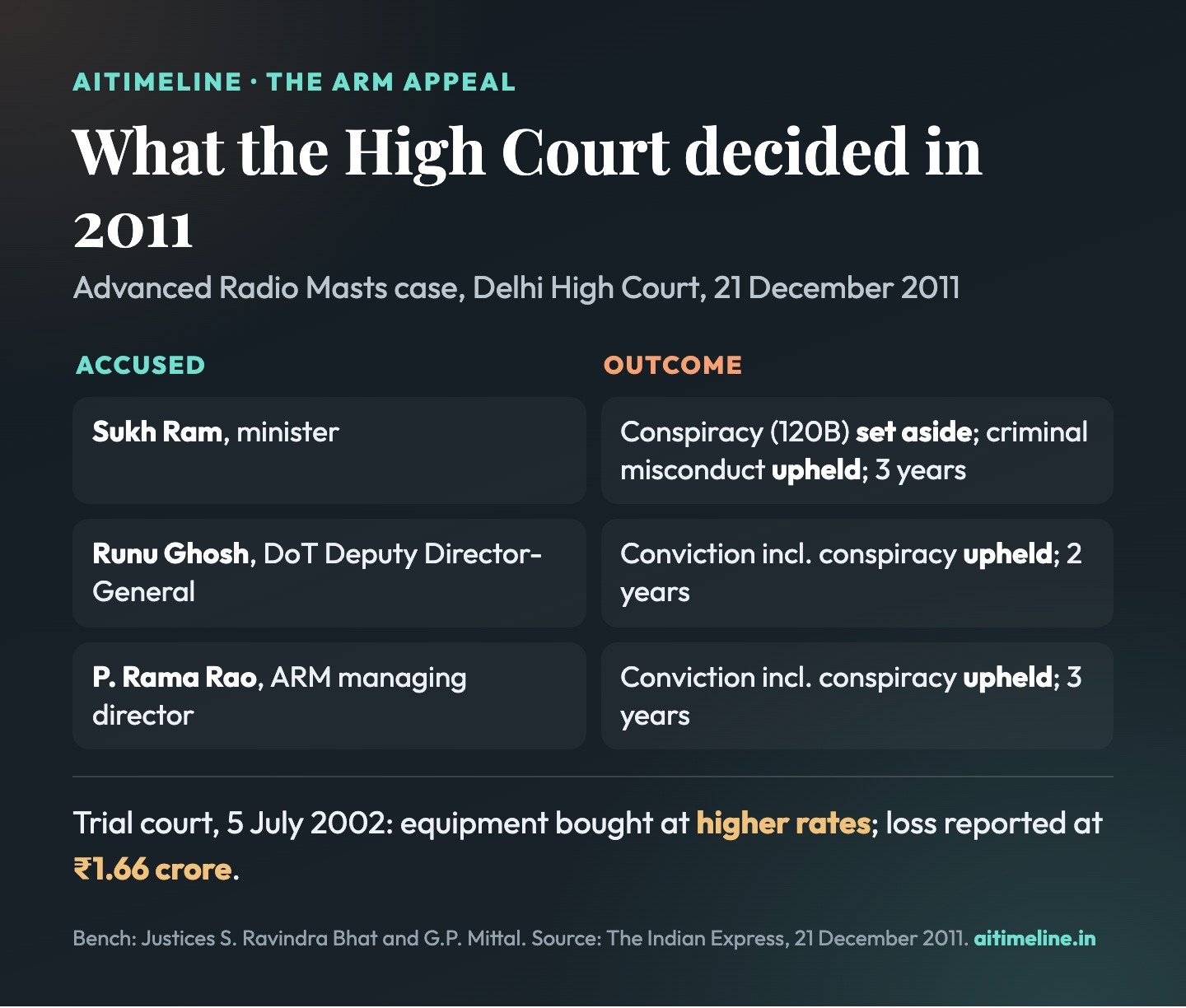
| Charge against Sukh Ram | Trial court, 2002 | High Court, 2011 |
|---|---|---|
| Criminal misconduct, Section 13(1)(d) with 13(2) PC Act | Convicted | Upheld |
| Criminal conspiracy, Section 120B IPC | Convicted | Set aside |
| Sentence | Three years, ₹2 lakh fine | Upheld; surrender ordered |
How a minister can be cleared of conspiracy but not corruption. Conspiracy needs proof of an agreement. Criminal misconduct under Section 13(1)(d) needs proof that a public servant abused his position to obtain a pecuniary advantage for himself or someone else. The High Court found the second proved against Sukh Ram without the first.
The Haryana Telecom Cable Case
A ₹30 crore PIJF cable contract and a ₹3 lakh bribe.

A case built on file notes. The court had no witness to the payment. It inferred the conspiracy from the paper trail: a written warning about HTL, the minister’s orders overruling it, and his stated reason, the monsoon, which the judge called “so unreasonable that no prudent person would agree with it”.
“Most favoured vendor”. The court found that because of HTL chairman Devinder Singh Choudhary’s proximity to Sukh Ram, HTL had become his “most favoured vendor”.
The Disproportionate-Assets Case
CBI v. Sukh Ram, Corruption Case 44/97, decided 20 February 2009.
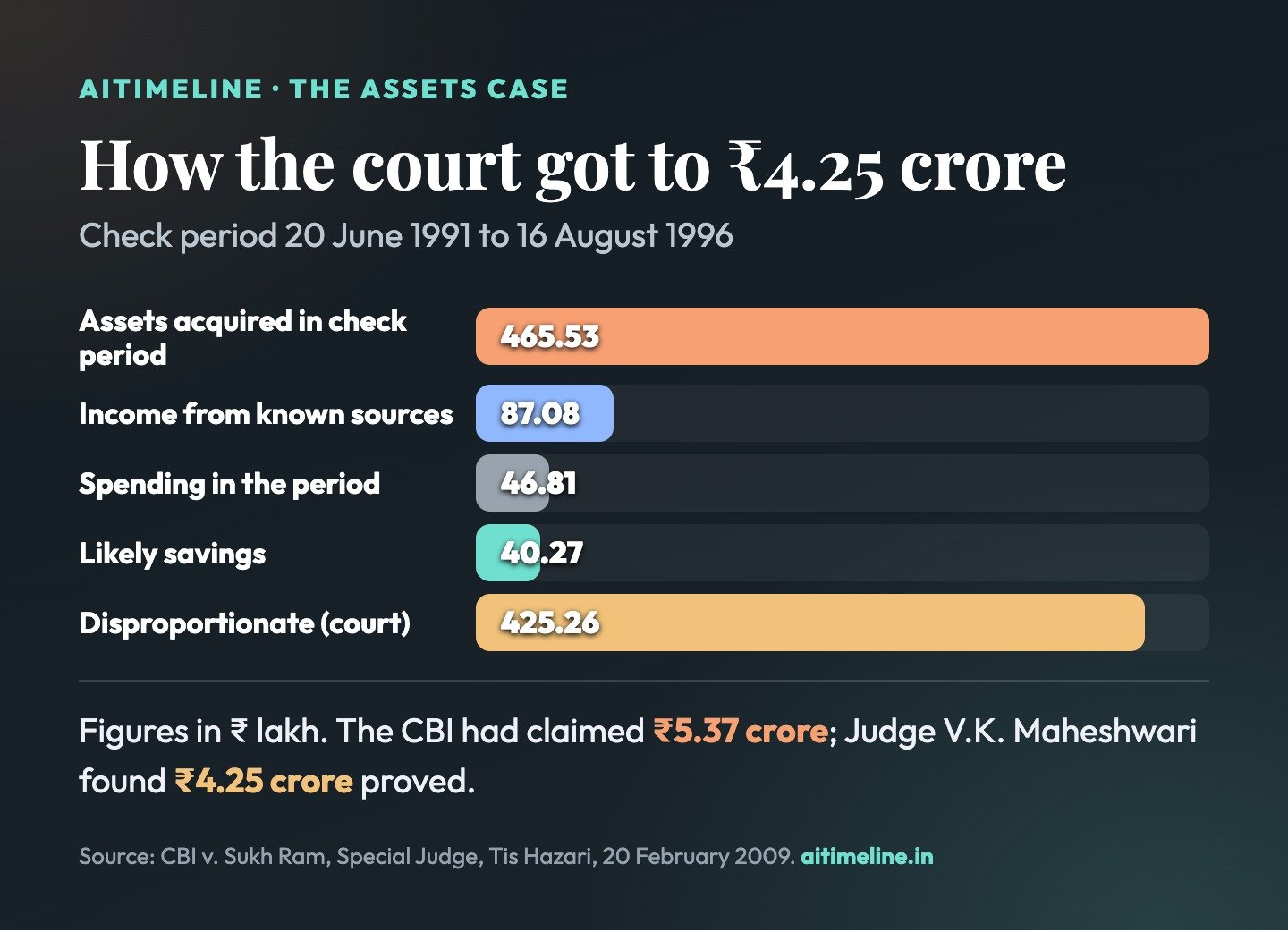
| Item | Court’s figure |
|---|---|
| Assets at start of check period | ₹26,13,010 |
| Assets at end of check period | ₹4,91,65,965 |
| Income from known sources | ₹87,07,928 |
| Expenditure | ₹46,81,095 |
| Disproportionate assets | ₹4,25,26,122 |
The check period. The CBI chose 20 June 1991, when he returned to the Lok Sabha, to 16 August 1996, the day of the searches. It covered his time as Minister of State for Planning from July 1992 and for Communications from January 1993.
January 2012: Five Days to Tihar
What happened after the High Court ordered him to serve his ARM sentence.

Who ordered the surrender? Some accounts say the Supreme Court ordered the surrender. The order came from the Delhi High Court. The Supreme Court’s role on 5 January was to refuse to hear the appeal before the surrender.
The Politics: Expelled, Then a Kingmaker
Mandi stood by him. The Congress expelled Sukh Ram and his son Anil Sharma in 1996. He launched the Himachal Vikas Congress on 6 July 1997, won Mandi Sadar in 1998 by the state’s largest margin, and his party’s five seats helped Prem Kumar Dhumal form the BJP’s first full-term government in the state.
Three switches. He returned to the Congress in 2004, joined the BJP in 2017 and went back to the Congress in 2019. His rivalry with Virbhadra Singh, who beat him to the chief minister’s post in 1983 and 1993, shaped Himachal’s Congress for decades.
By the Numbers
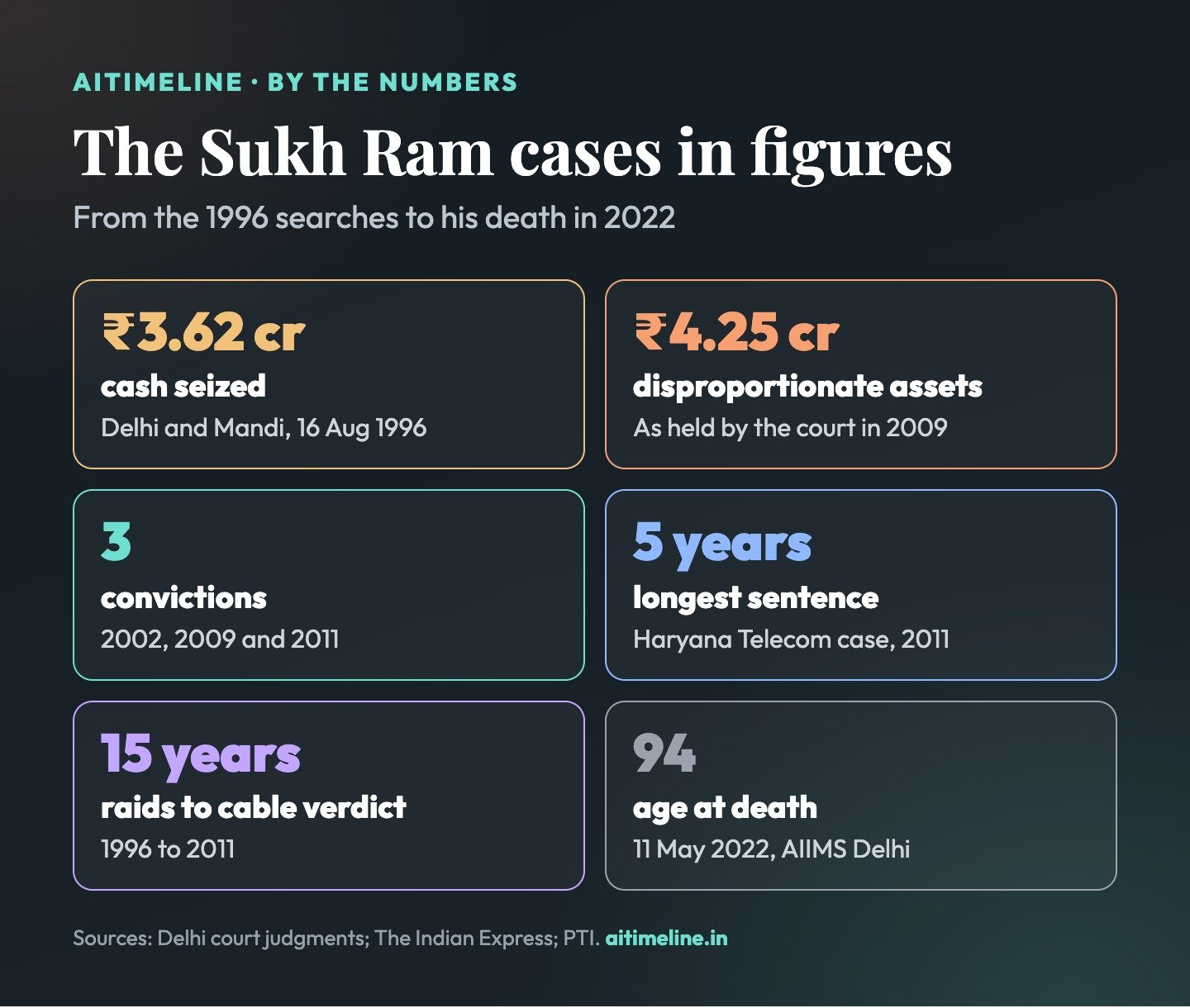
Who Was Who
Sukh Ram
Minister of State for Communications, 1993-96; convicted in three cases; died 11 May 2022, aged 94.
Runu Ghosh
Deputy Director-General, Department of Telecommunications; convicted in the ARM case, two years.
P. Rama Rao
Managing director of Hyderabad-based Advanced Radio Masts; convicted, three years.
Devinder Singh Choudhary
Chairman of Haryana Telecom Limited, Rohtak; co-accused in the cable case; died during the trial.
V.K. Maheshwari
Special Judge, Tis Hazari; convicted him for ₹4.25 crore in disproportionate assets.
R.P. Pandey
Special Judge, Rohini; convicted him in the cable case and imposed five years.
Justices Bhat and Mittal
Upheld the ARM conviction on 21 December 2011 but set aside the conspiracy charge against him.
P.V. Narasimha Rao
Headed the government in which Sukh Ram served as communications minister.
Did You Know?
- He was abroad: by his own account he was in London when the CBI searched his homes.
- Twelve boxes: the Mandi cash was found packed in 12 boxes, according to the seizure list.
- A record win: two years after the raids, Mandi gave him the biggest margin in the 1998 Himachal election.
- Kautilya in court: the judge who sentenced him in 2011 quoted the Arthashastra on punishment.
- A namesake: a 2016 Supreme Court forgery judgment often linked to him concerns a different Sukh Ram.
- Family in politics: his son Anil Sharma and grandson Aashray Sharma both became Himachal politicians.
Explore More Timelines
People Also Ask
Frequently Asked Questions
Based on the 2009 and 2011 trial court records and reports of the appeals.
⚠️ Editorial Note: What We Checked
We checked the brief we started from against the trial court records on Indian Kanoon and contemporary reports. The Haryana Telecom conviction was on 17 November 2011, as the order on sentence records; 18 November is the date of the news reports. The 5 January 2012 surrender was ordered by the Delhi High Court; the Supreme Court refused to hear the appeal until the accused surrendered, then granted interim bail on 9 January. The Supreme Court judgment in Criminal Appeal 224 of 2012, cited in the brief as a 2017 case about the former minister, is dated 25 July 2016 and concerns a different Sukh Ram, a Gram Sewak, so we have left it out of the timeline. The cash figure in the court record is ₹3.62 crore, not ₹3.66 crore. We could not confirm the exact dates of the ARM FIR, the 1996 expulsion or a parliamentary reference in August 1996, so we do not give them. Recovery of cash is not by itself proof of a specific procurement offence. This article describes court records and is not legal advice.
Related Reading on AiTimeline
Sources & further reading
Every dated entry above was checked against these references. Last reviewed 19 November 2026.
- Indian Kanoon: CBI v. Sukh Ram, Special Judge V.K. Maheshwari, Tis Hazari, disproportionate-assets judgment, 20 February 2009 (Corruption Case 44/97)
- Indian Kanoon: CBI v. Sukh Ram, Special Judge R.P. Pandey, Rohini, order on sentence in the Haryana Telecom case, 19 November 2011
- The Indian Express: Former minister Sukhram convicted in 1996 telecom case (18 November 2011)
- The Indian Express: 1996 Telecom scam: HC orders ex-minister Sukhram to serve sentence (21 December 2011)
- Business Standard: Sukhram gets 3 years in jail, fined Rs 2 lakh (25 February 2009)
- Business Standard: SC grants bail to Sukh Ram, two others (9 January 2012)
- The Indian Express: Sukh Ram (1927-2022): The man who rang in telecom revolution, could never wash off scam taint (May 2022)
- Rediff / PTI: Former telecom minister and veteran Congress leader Sukh Ram is dead (11 May 2022)