S.R. Bommai Case: How a Landmark Ruling Changed Indian Governance
Explore the S.R. Bommai case timeline: the 1994 Supreme Court ruling on Article 356, floor tests, President's Rule and Centre-State federalism in India.
Latest Story
On 21 April 1989 the Union government dismissed Karnataka Chief Minister S.R. Bommai, dissolved the state Assembly and imposed President’s Rule, six days before the House was due to meet and test his majority. Five years later, nine Supreme Court judges used his challenge to rewrite the rules on how New Delhi can remove an elected state government. This S.R. Bommai case timeline follows the dispute from the Karnataka crisis to the 1994 judgment and the cases that still rely on it.
The judgment is often summarised wrongly. Justice S. Ratnavel Pandian was not Chief Justice; the Chief Justice, M.N. Venkatachaliah, was not on the bench. The verdict was not unanimous: on Karnataka the split was 5 to 4. And while summaries say the Court struck down the Nagaland proclamation, only the Sawant-Kuldip Singh opinion declared it unconstitutional. We set out each opinion below.
💡 Short Answer
S.R. Bommai v. Union of India (11 March 1994) is the Supreme Court judgment that limited President’s Rule under Article 356. A nine-judge bench held that proclamations can be reviewed by courts, that a ministry’s majority should be tested on the Assembly floor, that an Assembly cannot be dissolved before Parliament approves the proclamation, and that secularism is part of the basic structure.
Bommai Judgment: Key Questions
The Case in Ten Points
- The trigger: 19 letters of withdrawal handed to Karnataka’s Governor on 18 April 1989.
- The retraction: seven of the 19 MLAs said their signatures had been obtained by misrepresentation.
- The dismissal: President’s Rule and dissolution on 21 April 1989, without a floor test.
- The first loss: the Karnataka High Court rejected Bommai’s petition on 4 August 1989.
- The bench: nine judges, six opinions, decided on 11 March 1994.
- Judicial review: proclamations under Article 356 can be challenged in court.
- Floor test: the Assembly, not the Governor, is the place to test a majority.
- No early dissolution: the House can only be suspended until Parliament approves.
- Secularism: part of the basic structure; the 1992 dismissals of three BJP governments were upheld.
- No relief: Karnataka, Meghalaya and Nagaland had held new elections, so nothing was restored.
From a Dismissal to a Doctrine
Four dates across 34 years.

A state crisis. A week of defections, letters and Governor’s reports in April 1989 ended with an elected government gone and its Assembly dissolved.
A national question. By the time the case reached the Supreme Court it had been joined by challenges from five other states, covering both disputed majorities and the dismissals that followed the Babri Masjid demolition.
A lasting rule. The judgment did not restore a single government. Its importance lies in the rules it set for every dismissal since.
The Week That Ended a Government
Karnataka, 15 to 21 April 1989.

Letters, not votes. The Governor’s case rested on a bundle of letters. He did not ask Bommai for his response before reporting to the President, the Supreme Court recorded.
The offer. When seven signatories retracted, the Cabinet called the Assembly for 27 April and Bommai offered to prove his majority there. The Governor answered with a second report alleging horse-trading.
The proclamation. The President acted on 21 April, giving no reasons beyond the Governor’s report and “other information”. Parliament later approved it.
S.R. Bommai Case Timeline, Newest First
Tagged by phase: the Karnataka crisis, the dismissal, the other states in the case, the court battle, and the legacy.
The Article 370 judgment revisits Bommai Legacy
What happened: Upholding the 2019 changes to Jammu and Kashmir’s status, the Supreme Court discussed Bommai at length while deciding what the Union may do on a state’s behalf while President’s Rule is in force.
What it said about Bommai: The Court described Bommai as the case that moved Indian constitutional law away from a centralising reading of Article 356 and towards protecting state legislatures. It also drew on Bommai’s test that the Union’s actions under the provision can be struck down if they are mala fide or based on extraneous grounds.
Why it matters: The ruling did not overturn Bommai. It applied the framework to a different situation, and critics argue it gave the Union more room during President’s Rule than Bommai had suggested.
Maharashtra: the Supreme Court orders a floor test Legacy
What happened: After Devendra Fadnavis was sworn in early on 23 November 2019, the Supreme Court ordered a floor test by 5 pm on 27 November, with an open ballot and live broadcast. Fadnavis resigned on 26 November without facing the vote.
The Bommai link: The order followed the Bommai principle that majority is tested on the floor of the House, not in the Governor’s office or through letters of support.
Karnataka again: a floor test in 24 hours Legacy
What happened: The Governor had given B.S. Yeddyurappa 15 days to prove his majority. The Supreme Court cut that to about a day and ordered a floor test for 4 pm on 19 May 2018. Yeddyurappa resigned before the vote.
The Bommai link: The order turned on the same question as 1989 in the same state: the House, not a Governor’s assessment, decides who has the numbers.
Arunachal Pradesh: a dismissed government is restored Legacy
What happened: The Supreme Court set aside the Governor’s decisions that led to the fall of Nabam Tuki’s Congress government and ordered the position as of 15 December 2015 restored.
The Bommai link: Bommai had said courts can restore a dismissed government. In 1994 the Court declined to do it because new elections had been held. In Arunachal it actually did.
Uttarakhand: a floor test under court supervision Legacy
What happened: President’s Rule was imposed in Uttarakhand on 27 March 2016, a day before Chief Minister Harish Rawat was due to face a floor test. The High Court quashed it on 21 April. The Supreme Court then ordered a floor test on 10 May; the result, announced on 11 May, went to Rawat, and President’s Rule was withdrawn.
The Bommai link: The High Court and the Supreme Court both relied on Bommai: the Assembly, not the Union, should decide whether the ministry had a majority.
S.R. Bommai dies at 84 Legacy
Who he was: Somappa Rayappa Bommai, born on 6 June 1924, was Chief Minister of Karnataka for about eight months in 1988-89. He later served as Union Human Resource Development Minister in the United Front government.
His legacy: He is remembered less for his time in office than for the case that carries his name, which is still cited whenever an elected state government is dismissed or a majority is disputed.
Bihar: an Assembly dissolution is held unconstitutional Legacy
What happened: The Supreme Court held that the dissolution of the Bihar Assembly on 23 May 2005, ordered before any government was formed after the February 2005 election, was unconstitutional. The Governor had reported that MLAs were being lured to form a government.
Why no restoration: Fresh elections were already under way, so the Court did not revive the old Assembly. The reasons, given later, criticised the Governor’s report.
The Bommai link: The Court applied Bommai: a Governor cannot block a claim to form a government on a personal assessment that support was obtained improperly.
Nine judges set limits on Article 356 In court
What happened: A nine-judge bench delivered six opinions. Five judges held the Karnataka proclamation unconstitutional: P.B. Sawant and Kuldip Singh in one opinion, B.P. Jeevan Reddy and S.C. Agrawal in another, and S. Ratnavel Pandian, who agreed with Jeevan Reddy. A.M. Ahmadi, J.S. Verma, Yogeshwar Dayal and K. Ramaswamy treated it as non-justiciable.
Meghalaya and Nagaland: All the opinions found the Meghalaya proclamation invalid or vulnerable. The Sawant-Kuldip Singh opinion also declared the Nagaland proclamation unconstitutional; the Jeevan Reddy-Agrawal opinion disposed of the Nagaland appeals on its reading of Article 74(2).
The relief: None of the dismissed governments came back. Fresh elections had been held, so the Court declared the proclamations invalid but gave no relief, and treated actions taken during President’s Rule as valid.
What the Court laid down In court
Judicial review: A proclamation under Article 356 can be challenged in court. Judges can examine whether there was relevant material for the President’s satisfaction and strike down action that is mala fide or based on wholly irrelevant grounds.
Floor test: Whether a ministry has a majority should ordinarily be tested on the floor of the Assembly, not decided on the Governor’s assessment or a bundle of letters.
Dissolution: Until both Houses of Parliament approve the proclamation, the Assembly may be suspended but not dissolved.
Restoration and secularism: If a proclamation is struck down, courts can restore the ministry and Assembly. Secularism is part of the basic structure, and a state government acting against it can be dismissed.
Three BJP governments dismissed after Ayodhya Other states
What happened: After the Babri Masjid was demolished on 6 December 1992, the Union dismissed the BJP governments of Madhya Pradesh, Rajasthan and Himachal Pradesh on 15 December. The Uttar Pradesh government had already gone on 6 December.
In court: The Madhya Pradesh High Court struck down that state’s proclamation, and the Union appealed. In 1994 the Supreme Court upheld all three proclamations, holding that a government that undermines secularism can be dismissed under Article 356.
Why it matters: These cases made secularism, and not only floor majorities, central to the Bommai judgment.
Meghalaya: a government dismissed before the House could vote Other states
What happened: The Speaker had disqualified five independent MLAs, and the Supreme Court had stayed that order. While the dispute was unresolved, the President issued a proclamation on 11 October 1991, dismissing the Lyngdoh government and dissolving the Assembly.
In 1994: Every opinion found the proclamation invalid or vulnerable. Jeevan Reddy said the Court would have restored the Lyngdoh ministry and the Assembly if elections had not been held.
Karnataka votes again Dismissal
What happened: Seven months after the dismissal, Karnataka held a fresh Assembly election. The Congress won 178 of 224 seats and Veerendra Patil became Chief Minister.
Why it matters: The new Assembly made it impossible to restore the Bommai government, even after the Supreme Court found the dismissal unconstitutional.
Karnataka High Court rejects Bommai’s petition In court
What happened: Bommai and others challenged the proclamation under Article 226. The High Court dismissed the writ petition, accepting the Governor’s reports as relevant material and declining to examine whether they were sufficient.
Next step: Bommai appealed to the Supreme Court, where his case (Civil Appeal 3645 of 1989) was later heard with challenges from Nagaland, Meghalaya and the three states dismissed in December 1992.
President’s Rule is imposed in Karnataka Dismissal
What happened: The President issued a proclamation under Article 356 dismissing the Bommai ministry and dissolving the Assembly. It gave no reasons beyond reciting the Governor’s report and “other information”.
In Parliament: Both Houses of Parliament later approved the proclamation.
The dispute: The Assembly was due to meet on 27 April. Its majority was never tested, which became the heart of the case.
Seven MLAs retract; Bommai offers a floor test Dismissal
What happened: Seven of the 19 legislators wrote to the Governor that their signatures had been obtained by misrepresentation and that they still supported the ministry. The Cabinet decided to convene the Assembly on 27 April, and Bommai and his Law Minister told the Governor, citing the Sarkaria Commission’s advice that majority be tested in the House.
The Governor’s view: Governor P. Venkatasubbaiah sent a second report the same day, saying the seven letters had been obtained under pressure and that horse-trading was going on. He repeated his recommendation for President’s Rule.
The Governor recommends President’s Rule Dismissal
What happened: The Governor reported to the President that the ministry had lost its majority and that no other party could form a government, and recommended action under Article 356.
What he did not do: According to the Supreme Court’s account, the Governor did not ask Bommai for his view after receiving the letters, or before sending the report.
K.R. Molakery’s letters Karnataka crisis
What happened: On 17 April, Janata Dal legislator K.R. Molakery defected and wrote to the Governor withdrawing support. The next day he handed over 19 letters said to be signed by 17 Janata Dal MLAs, one associated independent and one BJP MLA.
Why it mattered: The Governor read the letters as proof that the ministry had lost its majority.
Bommai expands his ministry Karnataka crisis
What happened: Bommai added 13 members to his ministry.
Why it mattered: Those left out had a grievance. Within two days the defections that would bring down the government had begun.
The Janata Dal is formed Karnataka crisis
What happened: The Janata Party and Lok Dal (B) merged to form the Janata Dal. In Karnataka, the Janata legislature party was renamed accordingly.
Why it mattered: The merger brought together groups with different loyalties, and the April 1989 defections came from within the new party.
S.R. Bommai becomes Chief Minister Karnataka crisis
What happened: Ramakrishna Hegde, Chief Minister since 1983, resigned in August 1988. Bommai was chosen leader of the legislature party and sworn in on 30 August 1988.
Context: The Supreme Court’s account dates Hegde’s resignation to 1 August 1988.
Janata Party wins Karnataka Karnataka crisis
What happened: The Janata Party won a majority in the 1985 Assembly election, and Ramakrishna Hegde, who had led a minority government since 1983, became Chief Minister again.
Why it matters: This was the Assembly that would be dissolved in April 1989, with about a year of its five-year term still to run.
What the Supreme Court Held
Seven principles, drawn mainly from the Sawant and Jeevan Reddy opinions.
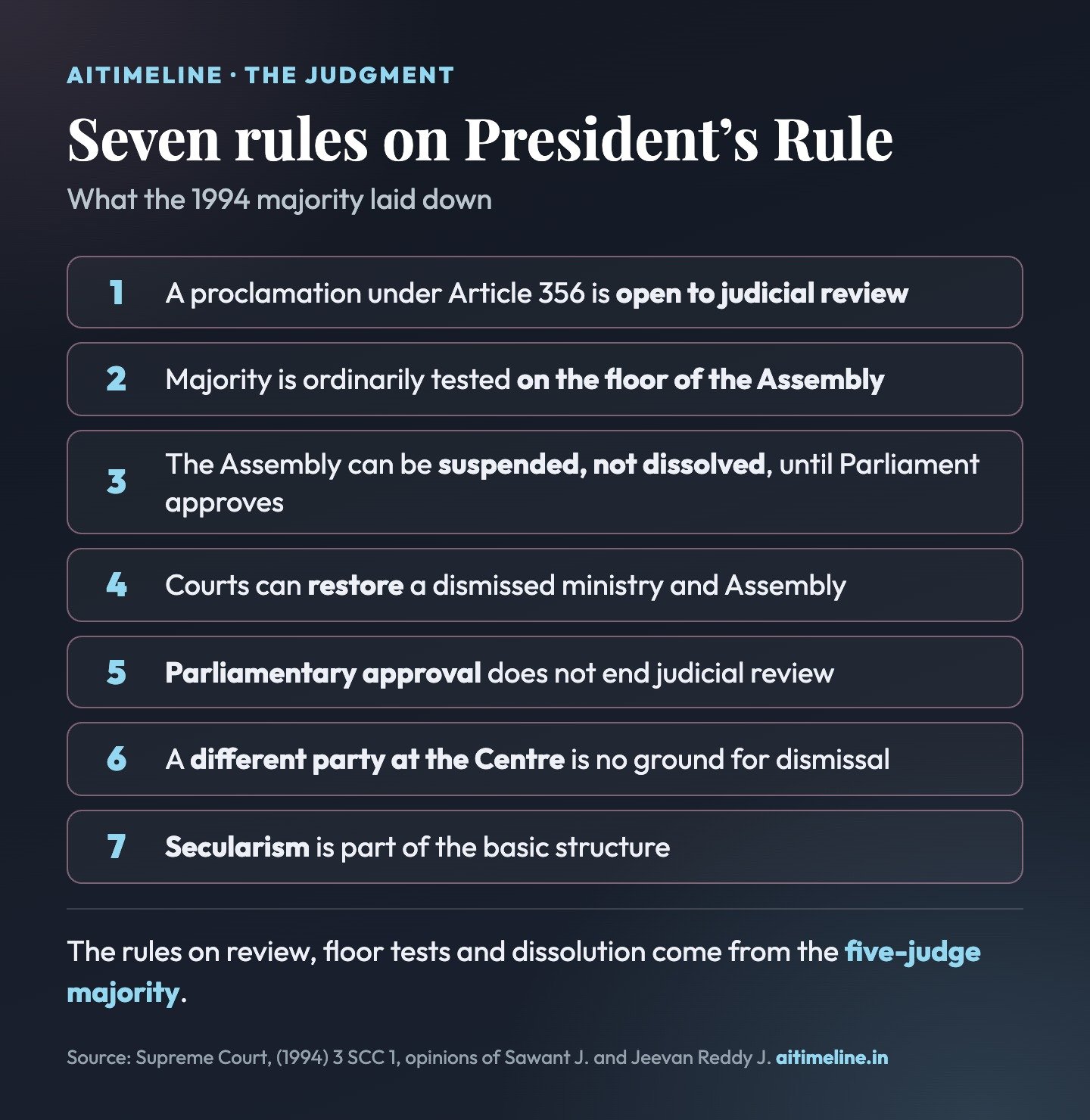
Courts can examine a proclamation
Judges can ask whether there was relevant material for the President’s satisfaction. They do not reweigh the politics, but they can strike down action that is mala fide or based on irrelevant grounds.
The floor test
A disputed majority should be settled by a vote in the House, not by the Governor counting letters.
Suspend first
Until both Houses of Parliament approve the proclamation, the Assembly can only be suspended. Dissolution cannot be undone.
Restoration is possible
If a proclamation is struck down, a court can bring back the ministry and the Assembly, and can stop new elections while the case is heard.
Advice secret, material not
Courts cannot ask what ministers advised the President, but the Union can be made to produce the material behind the advice.
A basic feature
A state government acting against secularism can be dismissed. A political difference with the Centre, or a defeat in a Lok Sabha election, is not enough.
How the Nine Judges Split
Six opinions, two camps on Karnataka.
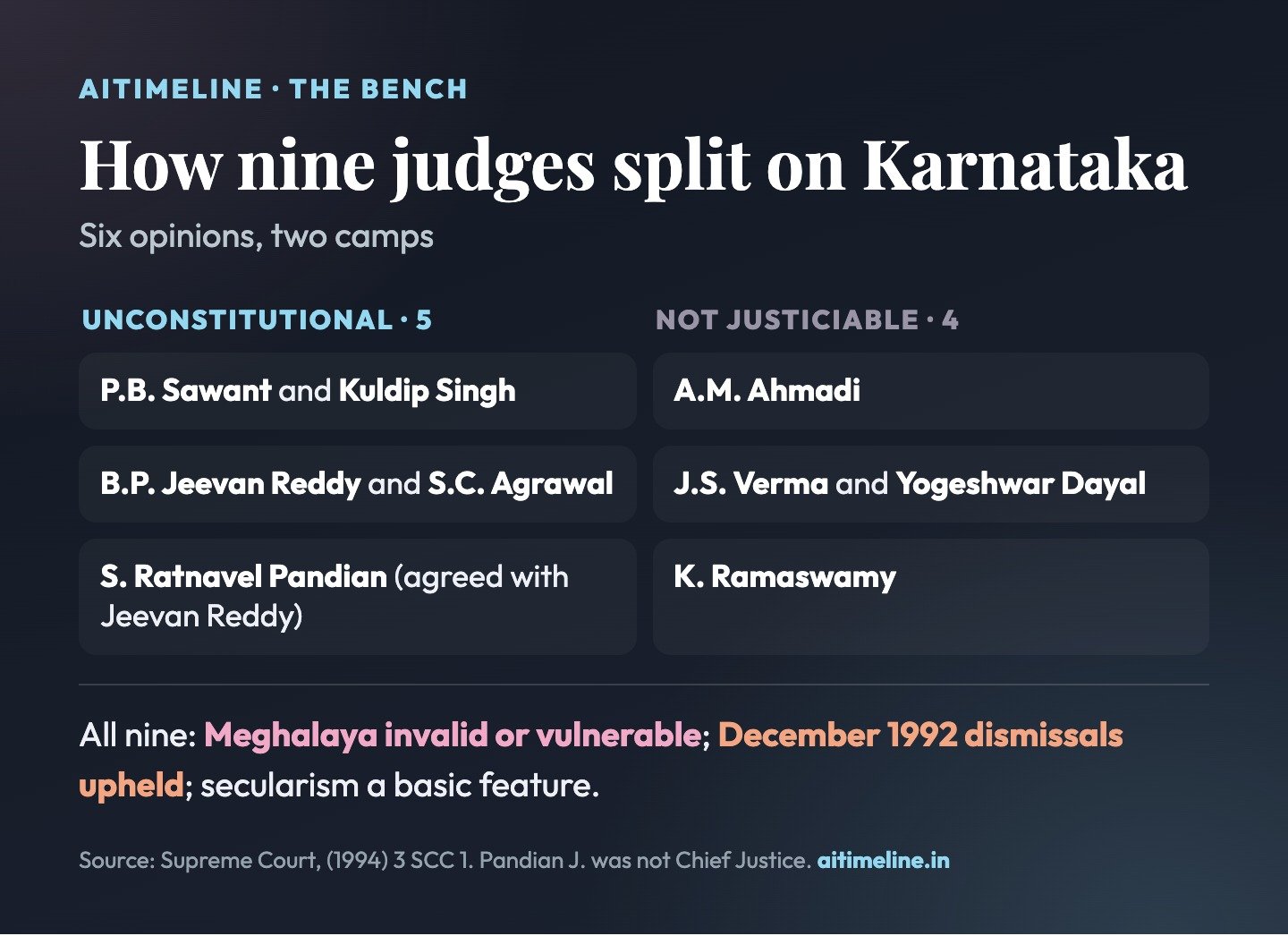
| Opinion | Judges | Karnataka | Nagaland | MP, Rajasthan, HP |
|---|---|---|---|---|
| Sawant | P.B. Sawant, Kuldip Singh | Unconstitutional | Unconstitutional | Upheld |
| Jeevan Reddy | B.P. Jeevan Reddy, S.C. Agrawal | Unconstitutional | Disposed of on Article 74(2) | Upheld |
| Pandian | S. Ratnavel Pandian | Agreed with Jeevan Reddy | Agreed with Jeevan Reddy | Upheld |
| Verma | J.S. Verma, Yogeshwar Dayal | Not justiciable | Not addressed | Not justiciable |
| Ahmadi | A.M. Ahmadi | Not justiciable | Not addressed | Not justiciable |
| Ramaswamy | K. Ramaswamy | Would dismiss Bommai’s appeal | Not addressed | Upheld |
The narrow majority. The rules on review, floor tests and dissolution come from the five-judge majority. The other four took a narrower view of what courts may examine, though Verma and Dayal agreed Meghalaya was justiciable and invalid.
Common ground. All nine accepted that secularism is a basic feature, and none would have reversed the December 1992 dismissals.
The Six-State Verdict
What happened to each proclamation.
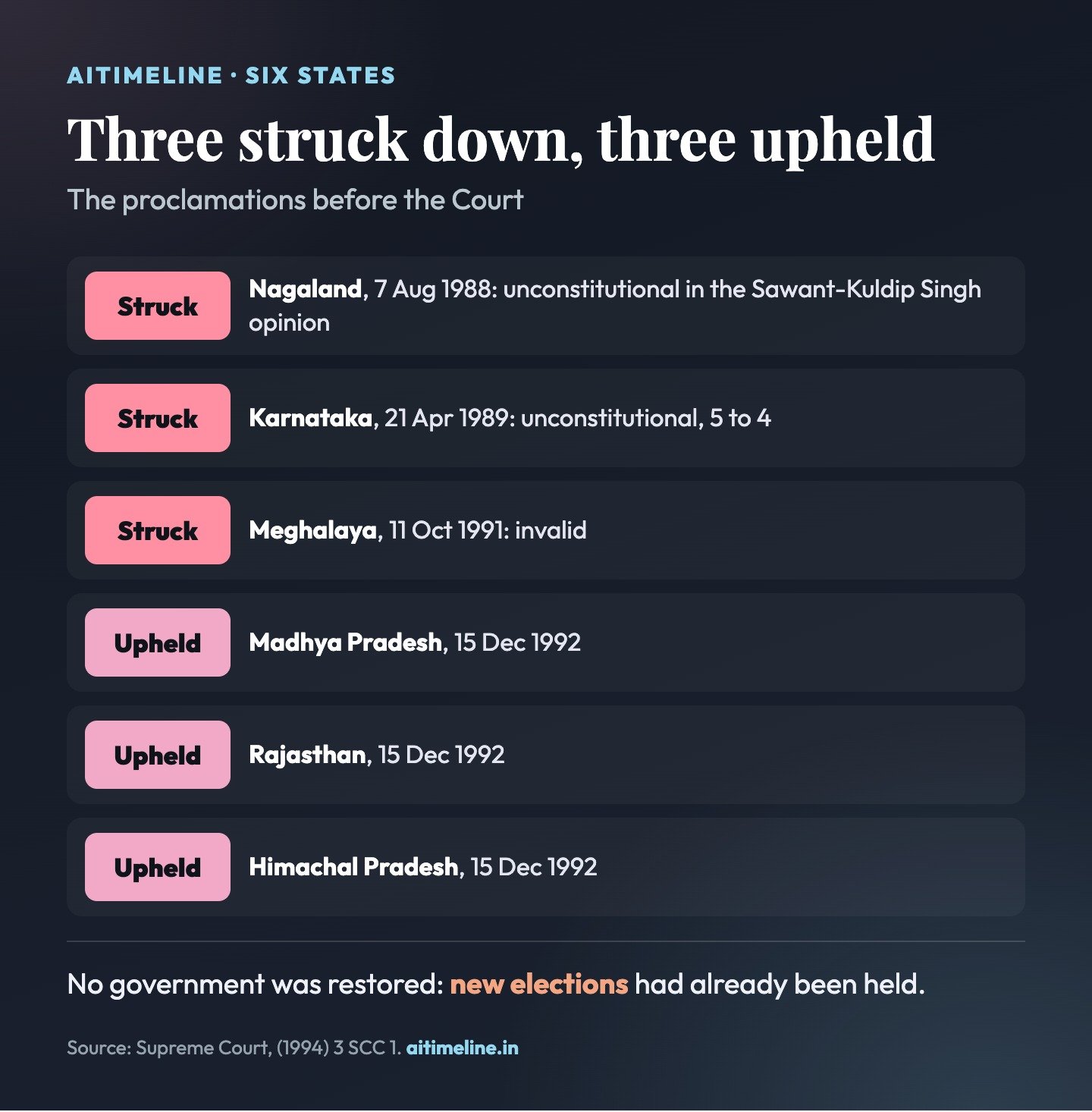
| State | Proclamation | Outcome in 1994 |
|---|---|---|
| Nagaland | 7 August 1988 | Unconstitutional in the Sawant-Kuldip Singh opinion; no relief |
| Karnataka | 21 April 1989 | Unconstitutional, 5 to 4; no relief |
| Meghalaya | 11 October 1991 | Invalid; no relief because elections had been held |
| Madhya Pradesh | 15 December 1992 | Upheld; the High Court’s contrary ruling set aside |
| Rajasthan | 15 December 1992 | Upheld |
| Himachal Pradesh | 15 December 1992 | Upheld |
How Later Courts Used Bommai
From Bihar in 2005 to Jammu and Kashmir in 2023.

| Year | Case or state | How Bommai was used |
|---|---|---|
| 2005-06 | Rameshwar Prasad (Bihar) | Dissolution held unconstitutional; Governor’s report criticised |
| 2016 | Uttarakhand | President’s Rule quashed by the High Court; floor test under Supreme Court supervision |
| 2016 | Nabam Rebia (Arunachal Pradesh) | Dismissed government restored, as Bommai allowed |
| 2018 | Karnataka | 15-day window cut to a floor test the next day |
| 2019 | Maharashtra | Floor test ordered with open ballot and live telecast |
| 2023 | Article 370 (Jammu and Kashmir) | Bommai discussed on the Union’s powers during President’s Rule |
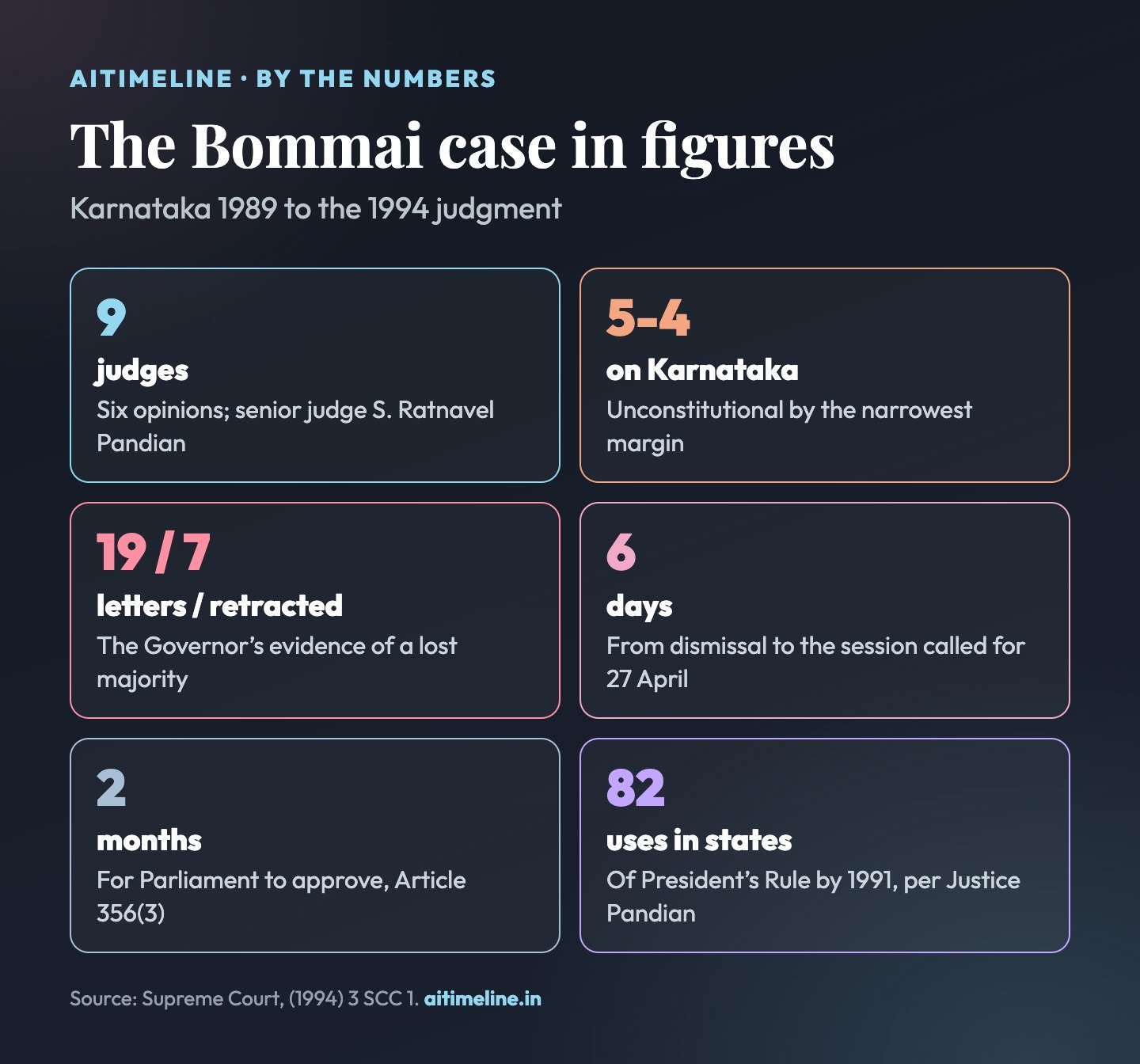
Fewer dismissals. Before 1994, President’s Rule had been used 82 times in states, by the count Justice Pandian cited. It has been used far less since, though it has not disappeared.
The floor test as habit. When a majority is disputed today, the first legal question is usually how soon the House can vote. That is Bommai’s most visible legacy.
By the Numbers
The Constitutional Provisions
| Provision | What it does | Role in Bommai |
|---|---|---|
| Article 355 | Union’s duty to protect states and ensure government under the Constitution | Read as the context for Article 356 |
| Article 356 | President’s Rule on failure of constitutional machinery | The power under review |
| Article 356(3) | Parliament must approve within two months | No dissolution before approval |
| Article 357 | Legislative powers during President’s Rule | Who makes laws while the House is suspended |
| Article 74(2) | Bars inquiry into ministers’ advice to the President | Does not shield the underlying material |
| Article 163 | Council of Ministers aids and advises the Governor | Limits on the Governor’s discretion |
Who Was Who
S.R. Bommai
Janata Dal Chief Minister of Karnataka, 30 August 1988 to 21 April 1989; later Union HRD Minister. Died 10 October 2007.
P. Venkatasubbaiah
Sent reports on 19 and 20 April 1989 recommending President’s Rule.
K.R. Molakery
Janata Dal MLA who withdrew support on 17 April and delivered 19 letters on 18 April.
Rajiv Gandhi
Headed the Union government that advised the proclamation.
P.B. Sawant and B.P. Jeevan Reddy
Wrote the two main opinions that set out the limits on Article 356.
A.M. Ahmadi and J.S. Verma
Both later Chief Justices; held the Karnataka proclamation not justiciable.
Did You Know?
- Six days: the gap between the dismissal and the Assembly session Bommai had called for 27 April 1989.
- Five years: how long the appeal took, from 1989 to March 1994.
- 234 days: how long S.R. Bommai lasted as Chief Minister.
- Father and son: Basavaraj Bommai became Chief Minister of Karnataka in 2021, 32 years after his father’s dismissal.
- Same state, new test: in 2018 the Supreme Court ordered a Karnataka floor test within about a day, on the principle set in Bommai’s case.
- No winners: none of the six governments in the case came back to office as a result of it.
Explore More Timelines
People Also Ask
Frequently Asked Questions
Based on the Supreme Court and Karnataka High Court judgments and later rulings.
⚠️ Editorial Note: What We Corrected
We checked the brief we started from against the 1994 judgment. S. Ratnavel Pandian was a puisne judge, not Chief Justice; Chief Justice M.N. Venkatachaliah was not on the bench. The Karnataka ruling was 5 to 4, with Ahmadi, Verma, Yogeshwar Dayal and Ramaswamy treating it as non-justiciable. Nagaland was declared unconstitutional in the Sawant-Kuldip Singh opinion; the Jeevan Reddy-Agrawal opinion disposed of it on Article 74(2), so we do not present it as a clear majority holding. The defector is named K.R. Molakery in the judgment. The floor-test rule is the normal method for settling a disputed majority, not a formula for every situation. This article explains a court judgment and is not legal advice.
Related Reading on AiTimeline
Sources & further reading
Every dated entry above was checked against these references. Last reviewed 18 November 2026.
- Supreme Court of India: S.R. Bommai and Others v. Union of India and Others, 11 March 1994, (1994) 3 SCC 1 (judgment PDF)
- Indian Kanoon: S.R. Bommai v. Union of India, Supreme Court, 11 March 1994 (full text)
- Indian Kanoon: S.R. Bommai and Others v. Union of India, Karnataka High Court, 4 August 1989, AIR 1990 Kant 5
- Supreme Court of India: In Re: Article 370 of the Constitution, judgment of 11 December 2023
- The Indian Express: What was the Bommai judgment, which the SC relied on in its Article 370 ruling? (12 December 2023)
- The Hindu: What is the S.R. Bommai case, and why is it quoted often? (18 May 2018)
- Wikipedia: S. R. Bommai v. Union of India
- Wikipedia: 1989 Karnataka Legislative Assembly election