Navnirman Movement Gujarat: How a Hostel Food Bill Brought Down a Government
Navnirman Movement Gujarat timeline: from student protests over mess charges to Chimanbhai Patel's resignation, Assembly dissolution and national impact.
Latest Story
In December 1973 engineering students in Morbi and Ahmedabad complained that their hostel mess bills had gone up by a fifth. Eleven weeks later the Chief Minister of Gujarat had resigned, and within another five weeks the state Assembly had been dissolved. This Navnirman Movement Gujarat timeline follows the agitation from the first hostel strike to Chimanbhai Patel’s fall, Morarji Desai’s fast, the June 1975 election that put the opposition in power, and the national crisis that followed it.
The core facts are settled: Chimanbhai Patel resigned on 9 February 1974, President’s Rule followed the same day, and the Assembly was dissolved in mid-March 1974. Some details are not. Accounts put the dissolution on 15 or 16 March and the start of Desai’s fast on 11 or 12 March. Death tolls range from 85 to 104 depending on the source and the period counted. We give each figure with its source.
💡 Short Answer
The Navnirman Andolan was a 1973-74 movement in Gujarat that began with students protesting against a roughly 20% rise in hostel mess bills and grew into a statewide revolt over prices and corruption. It forced Chief Minister Chimanbhai Patel to resign on 9 February 1974 and the Assembly to be dissolved in March 1974. The Congress lost the June 1975 election, and the movement inspired Jayaprakash Narayan’s Bihar campaign.
Navnirman Andolan: Key Questions
The Movement in Ten Points
- The spark: a roughly 20% rise in hostel food fees, tied to the end of subsidised grain.
- The first strikes: Morbi in mid-December and L.D. College, Ahmedabad, on 20 December 1973.
- The turn: 326 students arrested at Gujarat University on 3 January 1974.
- The spread: a unions’ general strike on 10 January and a Gujarat bandh on 25 January.
- The crackdown: curfew in 44 towns; the Army in Ahmedabad on 28 January.
- The fall: Chimanbhai Patel resigned on 9 February 1974.
- The second phase: about 95 MLAs were pushed to resign so the House would be dissolved.
- The fast: Morarji Desai began fasting on 12 March; the Assembly went days later.
- The election: held on 10 June 1975; the Congress lost.
- The ripple: JP took the Gujarat model to Bihar; the Emergency came on 25 June 1975.
From a Mess Bill to a Dissolved Assembly
Four stages in eighteen months.
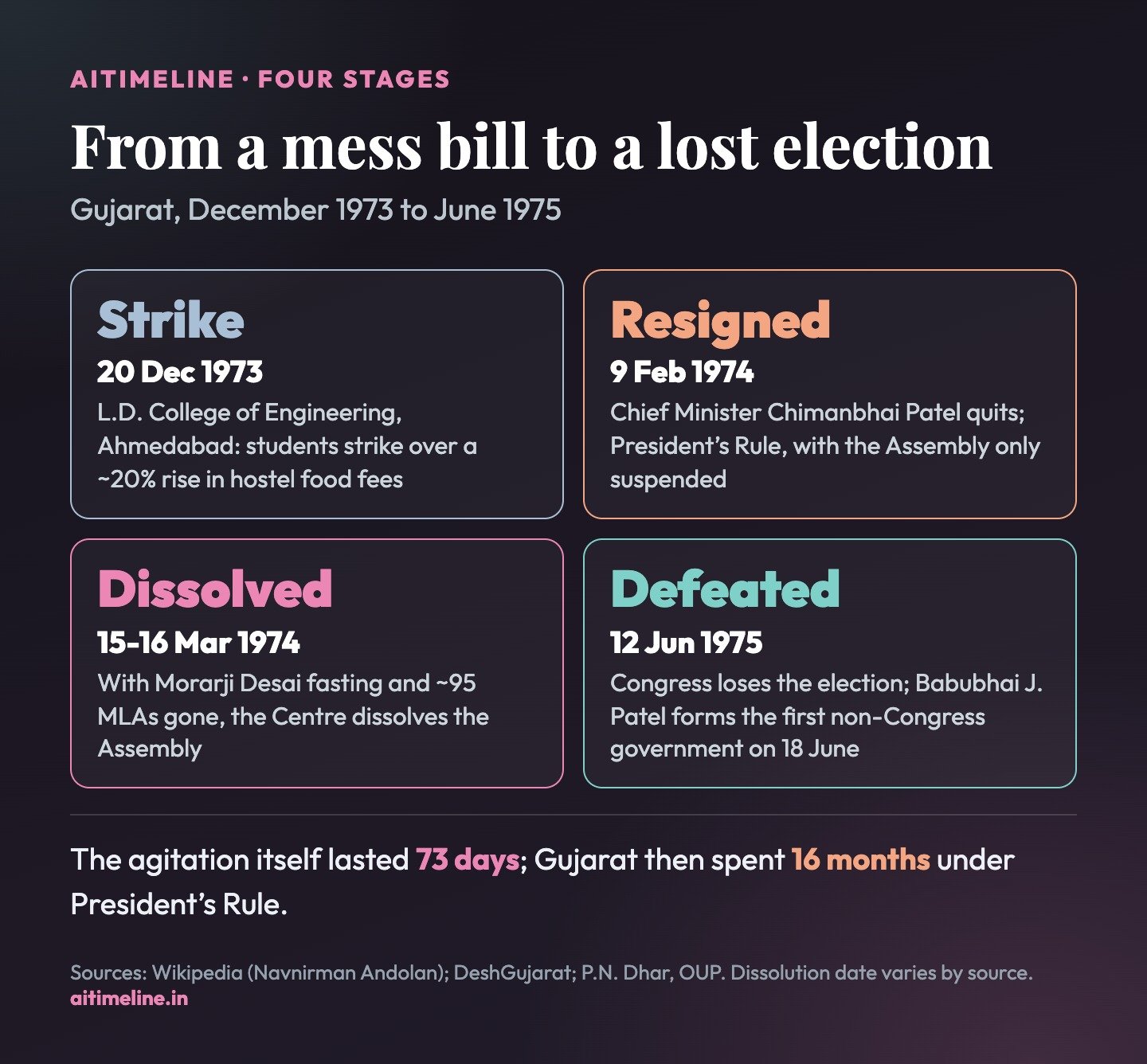
Weeks one to three: a campus fight. The first demands were about food fees, subsidised grain and arrested students. The government did not meet them.
Weeks four to seven: a state in revolt. Unions, teachers, lawyers and traders joined, the demands turned to prices and corruption, and the target became the Chief Minister.
Weeks eight to twelve: the House itself. With Patel gone and the Assembly only suspended, the movement went after the legislators, until the Centre dissolved the House.
Why a Hostel Protest Became a Statewide Movement
Five grievances that fed each other.
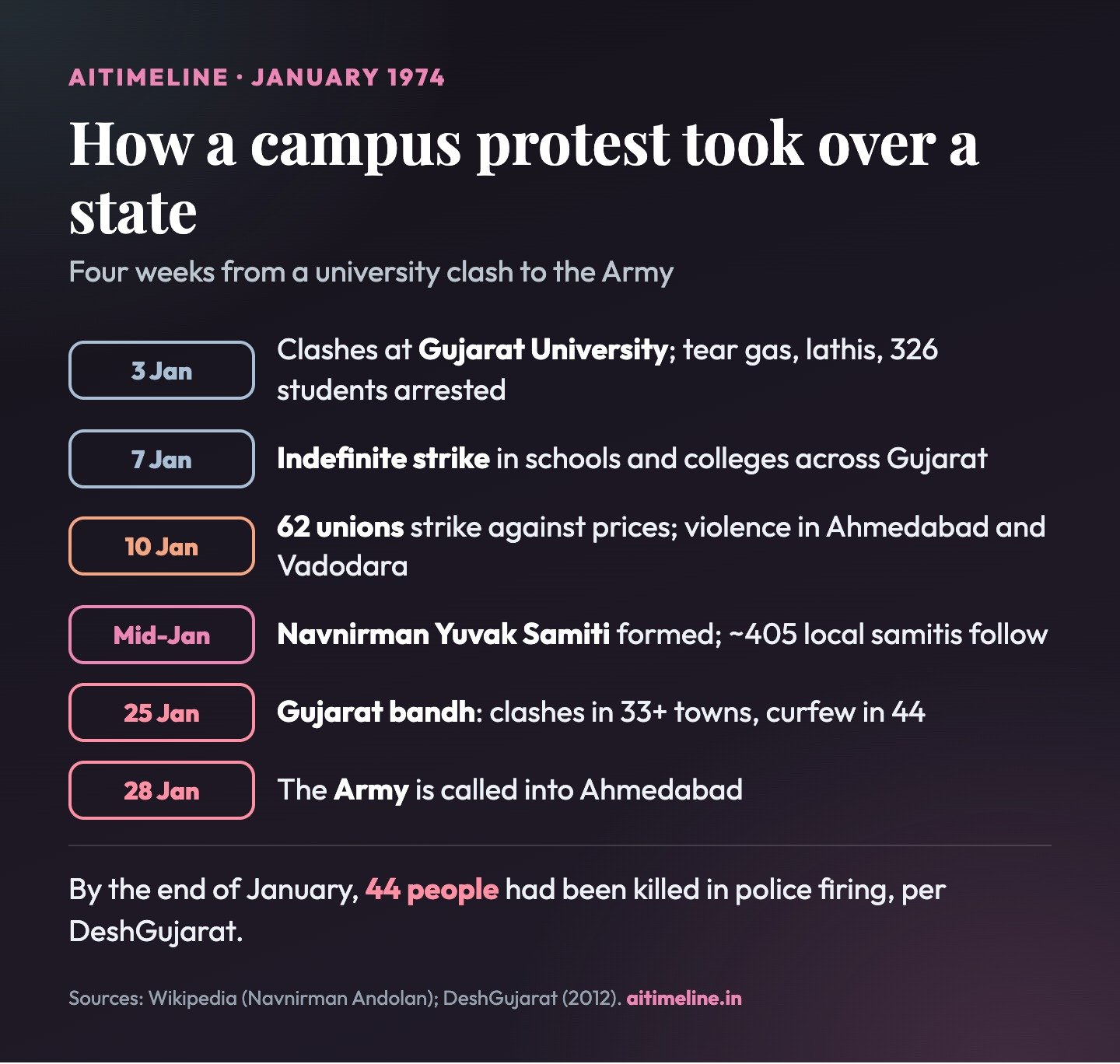
Drought and shortages
Gujarat had drought years in 1972-74. Grain and edible-oil prices rose sharply and the urban middle class felt it daily.
The mess bill
About a 20% rise in hostel food fees after subsidised foodgrains were withdrawn.
Allegations against the government
Protesters accused Chimanbhai Patel’s government of corruption and of favouring traders. He denied it, and no court tested the claims.
Arrests and firing
The 3 January arrests, MISA warrants and police firing turned a fee protest into a protest against the state.
A divided Congress
Patel had taken power after an internal fight. By 13 January, 23 Congress MLAs wanted him out, and in February four ministers turned on him.
Hundreds of samitis
No one leader: the Navnirman Yuvak Samiti and hundreds of local groups made the movement hard to bargain with.
Navnirman Movement Timeline, Newest First
Tagged by phase: campus protests, the statewide agitation, the Chief Minister’s fall, the fight for dissolution, and the election and national impact.
The national Emergency is declared Election and national impact
What happened: Prime Minister Indira Gandhi’s government declared a national Emergency on 25 June 1975, suspending civil liberties and censoring the press. Opposition leaders, Morarji Desai and Jayaprakash Narayan among them, were arrested.
How Gujarat fits: The Navnirman movement was one of several 1974-75 challenges to the Congress, alongside the Bihar movement, the May 1974 railway strike and the Allahabad High Court judgment. It was part of the background, not the single cause.
In Gujarat: Babubhai Patel’s opposition government, a week old, stayed in office during the Emergency until it lost a vote in March 1976 and President’s Rule returned.
Babubhai J. Patel forms Gujarat’s first non-Congress government Election and national impact
What happened: Babubhai Jashbhai Patel, a Congress (O) leader, was sworn in as Chief Minister at the head of the Janata Morcha, an alliance of the Congress (O), the Jana Sangh, the Socialists and the Bharatiya Lok Dal, with outside help from Chimanbhai Patel’s new party.
Why it matters: It was the first non-Congress government in Gujarat. President’s Rule, imposed on 9 February 1974, ended the same day.
What followed: The government lasted about nine months. The Janata Morcha model fed into the Janata Party, which won the 1977 general election and made Morarji Desai Prime Minister.
Congress loses Gujarat on the day of the Allahabad verdict Election and national impact
What happened: Results of the Assembly election were declared. The Congress won 75 seats and lost power. The Janata Morcha won 86 to 88 seats, depending on the source, and Chimanbhai Patel’s Kisan Mazdoor Lok Paksha 11 or 12.
The coincidence: On the same day the Allahabad High Court set aside Indira Gandhi’s 1971 Lok Sabha election for electoral malpractice. The two blows landed together.
Caution: The vote also reflected the Congress split, the drought and ordinary party competition. It was not a referendum on the agitation alone.
Gujarat votes after 16 months of President’s Rule Election and national impact
What happened: Gujarat went to the polls for a new Assembly. Some summaries give 9 June; the polling date in the main accounts is 10 June 1975.
Who stood: The Congress against the Janata Morcha; Chimanbhai Patel, expelled from the Congress, led his own Kisan Mazdoor Lok Paksha.
Why it matters: This was the election the Navnirman movement had demanded since February 1974.
Morarji Desai fasts again, this time for an election date Election and national impact
What happened: A year after the dissolution there was still no election and Gujarat was still under President’s Rule. On 6 March 1975 Desai walked to the Raj Bhavan in Ahmedabad with a memorandum carrying about 5.5 lakh signatures. On 7 April he began an indefinite fast at his Delhi residence.
The outcome: On 13 April, according to a DeshGujarat account, Indira Gandhi announced that Gujarat would vote in June. In a Lok Sabha statement she said the prime consideration had been to save Desai’s life.
Why it matters: It was Desai’s second fast over Gujarat in 13 months, and the second time the Centre gave way.
Bihar students gherao the Assembly Election and national impact
What happened: The Bihar Chhatra Sangharsh Samiti called a gherao of the Bihar Legislative Assembly during the budget session. Roads were blocked and government property damaged, and police firing in Patna killed students.
The Gujarat link: Bihar’s protests had begun before Gujarat’s ended, but the fall of the Gujarat government gave them a model. Jayaprakash Narayan agreed to lead the Bihar movement on 30 March 1974.
The difference: Indira Gandhi did not replace Bihar’s Chief Minister, Abdul Ghafoor, or dissolve that Assembly. She would not repeat what she had conceded in Gujarat.
The Gujarat Assembly is dissolved Assembly dissolution
What happened: With Morarji Desai’s fast in its fourth or fifth day, the Centre dissolved the suspended Assembly. P.N. Dhar, then in Indira Gandhi’s secretariat, and DeshGujarat give 15 March; Wikipedia and several retellings give 16 March.
The result: The movement had won both its political demands: the Chief Minister was gone and so was the House. Desai ended his fast. President’s Rule continued, now with no Assembly at all.
What it ended: The agitation wound down. The broad coalition that had sustained it, of students, teachers, lawyers, traders, employees and opposition parties, had no common programme beyond these two demands.
Morarji Desai begins an indefinite fast Assembly dissolution
What happened: Morarji Desai, the Congress (O) leader and a former Deputy Prime Minister, began an indefinite fast at the Gujarat Vidyapith in Ahmedabad. He demanded an end to the violence and the dissolution of the Assembly.
Why it worked: Desai was 78. His death during a fast in his home state would have been a political disaster for the Centre, and Dhar wrote that the government was “fearful of the consequences”.
Why it matters: His intervention made the agitation a national political crisis and handed the opposition the credit for the final concession.
Students force legislators to resign, one by one Assembly dissolution
What happened: With the Chief Minister gone but the Assembly only suspended, crowds went to the homes of Congress MLAs and demanded their resignations. On 15 February, 15 Congress (O), four Congress (R) and three Jana Sangh MLAs resigned.
The Speaker: After a writ petition in the High Court on 24 February against the Speaker for not accepting resignations, he accepted 18 the next day.
The count: By early March about 95 MLAs, more than half the 168-member House, had resigned. In Delhi, 214 Gujarati students were arrested and jailed for a week, and on 5 March more than 500 held a silent 30 km march.
The Army is called out again Assembly dissolution
What happened: As the campaign against legislators turned violent in places, the Army was again called in to help the civil administration, according to DeshGujarat’s chronology.
Why it matters: It showed that the Chief Minister’s resignation had not ended the unrest. P.N. Dhar wrote that the post-resignation phase alone saw 95 deaths and 933 people injured.
Chimanbhai Patel resigns; President’s Rule is imposed Chief Minister falls
What happened: After Indira Gandhi asked him to step down, Chimanbhai Patel announced his resignation at a press conference. President’s Rule was imposed under Article 356 the same day.
The catch: The proclamation kept the Assembly in suspended animation, so the Congress majority could in principle form a new government. That is why the agitation continued.
Why it matters: It was the first time a street movement had forced a Chief Minister with a large majority out of office in independent India.
Four ministers turn on the Chief Minister Chief Minister falls
What happened: On 7 February four ministers, Amul Desai, Divyakant Nanavati, Amarsinh Chaudhary and Navinchandra Ravani, gave Chimanbhai Patel a 15-point charge-sheet and asked him to quit within 48 hours. He dropped them from the ministry.
The next day: On 8 February government employees announced a strike from 11 February.
Why it matters: The split showed the Chief Minister had lost his own party as well as the streets. On 13 January, 23 Congress MLAs had already sought his removal, and Ratubhai Adani took 38 MLAs’ signatures to Delhi.
Army in Ahmedabad; MISA warrants for leaders Statewide agitation
What happened: The Army was called in to restore order in Ahmedabad on 28 January. The next day the Police Commissioner issued warrants under the Maintenance of Internal Security Act against student and union leaders, several of whom went into hiding.
The court: About three days later the Gujarat High Court gave the leaders interim relief, telling the Police Commissioner not to arrest them before the next hearing.
Toll: By the end of January, 44 people had been killed in police firing, according to DeshGujarat.
A Gujarat bandh shuts the state Statewide agitation
What happened: A statewide bandh shut Gujarat and was followed by clashes between police and crowds in at least 33 towns. Curfew was imposed in 44 towns. DeshGujarat says the bandh held in all 16 districts.
Who joined: Students were now joined by doctors, lawyers, teachers and a large part of the urban middle class. Congress (O), Swatantra and the Jana Sangh ran protests of their own.
The violence: Looting, arson and stone-pelting went alongside non-violent methods. Of 137 protest programmes counted by one study, 110 were non-violent.
The Navnirman Yuvak Samiti is formed Statewide agitation
What happened: By mid-January students, lawyers and professors had formed a lead committee, which became the Navnirman Yuvak Samiti. Independent Navnirman samitis sprang up across the state; DeshGujarat counts 405.
The name: Navnirman means reconstruction or regeneration. The goal widened from mess bills to prices, corruption and the government itself.
Exact date: Some retellings give 11 January; the sources we checked say only mid-January.
Workers’ general strike turns violent Statewide agitation
What happened: The 14th August Shramjivi Samiti, formed from 62 private and government employee unions, called a general strike against inflation and corruption. It turned violent in Ahmedabad and Vadodara for two days.
Who joined: Middle-class residents and some factory workers joined, and ration shops were attacked. The Gujarat University Area Teachers’ Association backed the protests.
Why it matters: This was the day the student agitation became a citizens’ movement.
Indefinite strike in schools and colleges Campus protests
What happened: After the Chief Minister did not meet their demands, students called a three-day bandh of schools and colleges, then an indefinite strike from 7 January.
The demands: Lower food fees, a return of subsidised foodgrains, release and treatment of arrested students, and action on police brutality.
Clashes at Gujarat University; 326 students arrested Campus protests
What happened: A strike at Gujarat University ended in clashes. Police fired tear gas and baton-charged students, and 326 were arrested that night.
Brief claims: Some retellings place a police raid on the L.D. College hostel on 2 January. The sources we checked describe the 3 January clash at Gujarat University instead.
Why it matters: The arrests turned a fee protest into a protest against the police.
L.D. College of Engineering students strike over a 20% mess hike Campus protests
What happened: Students of the L.D. College of Engineering in Ahmedabad went on strike against a 20% increase in hostel food fees.
Why the bill rose: The increase was linked to the withdrawal of subsidised foodgrains for hostels, at a time of drought and rising prices.
Why the date matters: Wikipedia counts the movement from this day. Other accounts start with the earlier Morbi protest.
Morbi Engineering College protest over food fees Campus protests
What happened: Students at the Morbi engineering college protested against a rise in mess food fees and damaged furniture in the mechanical engineering department and laboratory.
The response: Forty students were suspended and the college was closed indefinitely.
Why it matters: DeshGujarat says the Navnirman agitation started at Morbi; Wikipedia treats it as the prelude to the L.D. College strike.
Chimanbhai Patel becomes Chief Minister Campus protests
What happened: After a struggle inside the state Congress, Chimanbhai Patel replaced Ghanshyam Oza, who had been Chief Minister since 17 March 1972.
The context: The Congress had won 140 of 168 seats in 1972. Patel faced allegations of corruption and of favouring traders, which he denied. Those allegations were never tested in court.
The economy: Drought, high prices of grain and edible oil, and shortages hit the urban middle class hard.
How Chimanbhai Patel Fell
Pressure from the streets, from his party and from Delhi.
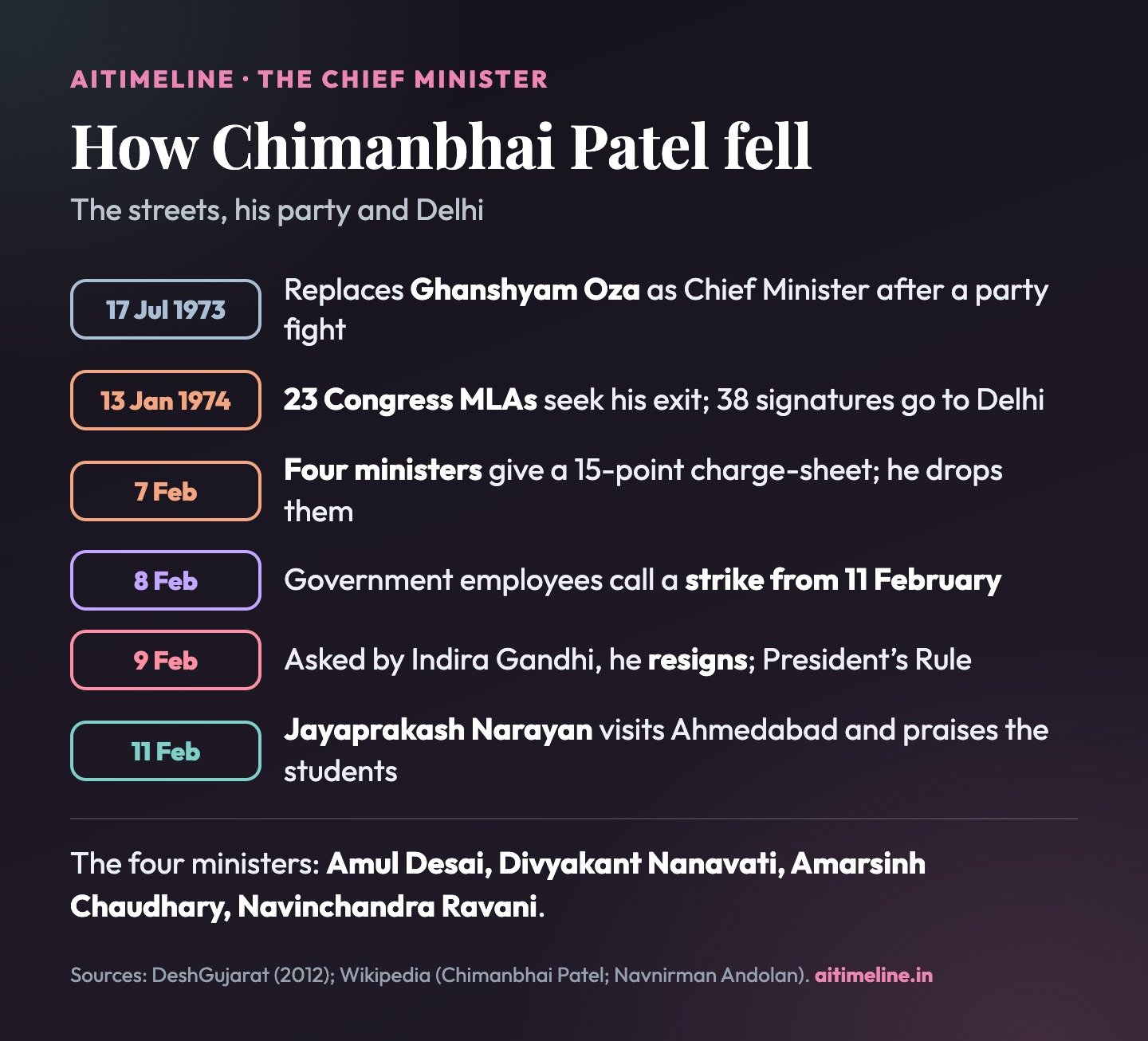
A Chief Minister with enemies at home. Patel had won the post in a struggle inside the Congress, and his rivals did not forgive him. As the streets filled, Congress MLAs lobbied Delhi for his removal.
The cabinet revolt. On 7 February four ministers handed him a 15-point charge-sheet and a 48-hour deadline. He dismissed them, but the split was now public.
Delhi decides. Indira Gandhi asked him to resign. He did so on 9 February, 207 days after taking office.
The Fight to Dissolve the Assembly
Why the resignation was not enough.
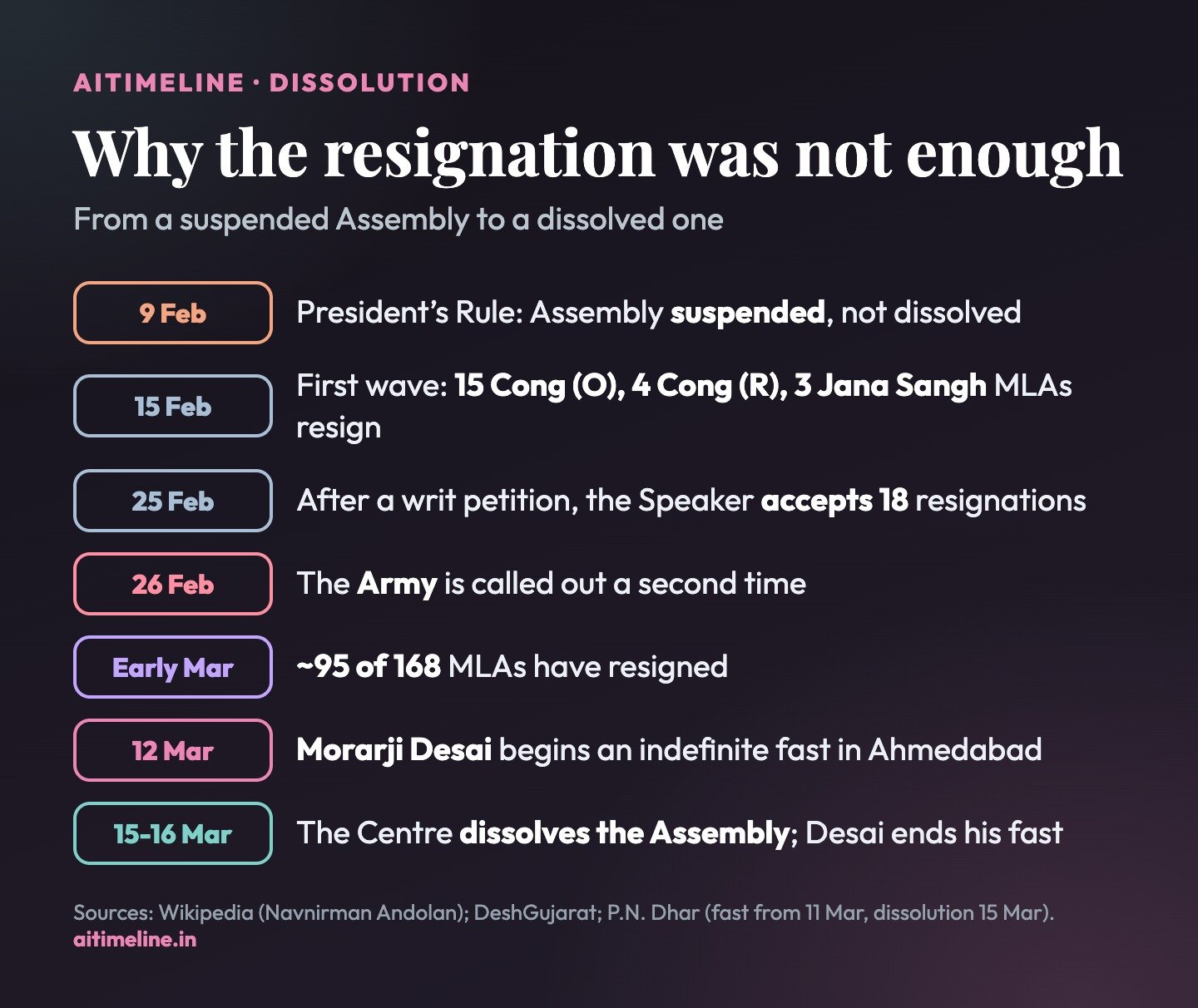
9 February vs Mid-March 1974
A suspended House. President’s Rule with the Assembly in suspended animation meant the Congress majority could later return to office. The protesters wanted the House gone.
Resignations by pressure. Crowds went to MLAs’ homes. Some resigned out of conviction, many under duress; by early March about 95 had gone.
The fast. Morarji Desai, 78, began fasting in Ahmedabad. P.N. Dhar wrote that the Centre, “fearful of the consequences”, dissolved the Assembly. Dhar also wrote that “nobody shed a tear for the demise of the rule of law and constitutional means of changing governments”.
Deaths, Injuries and Arrests
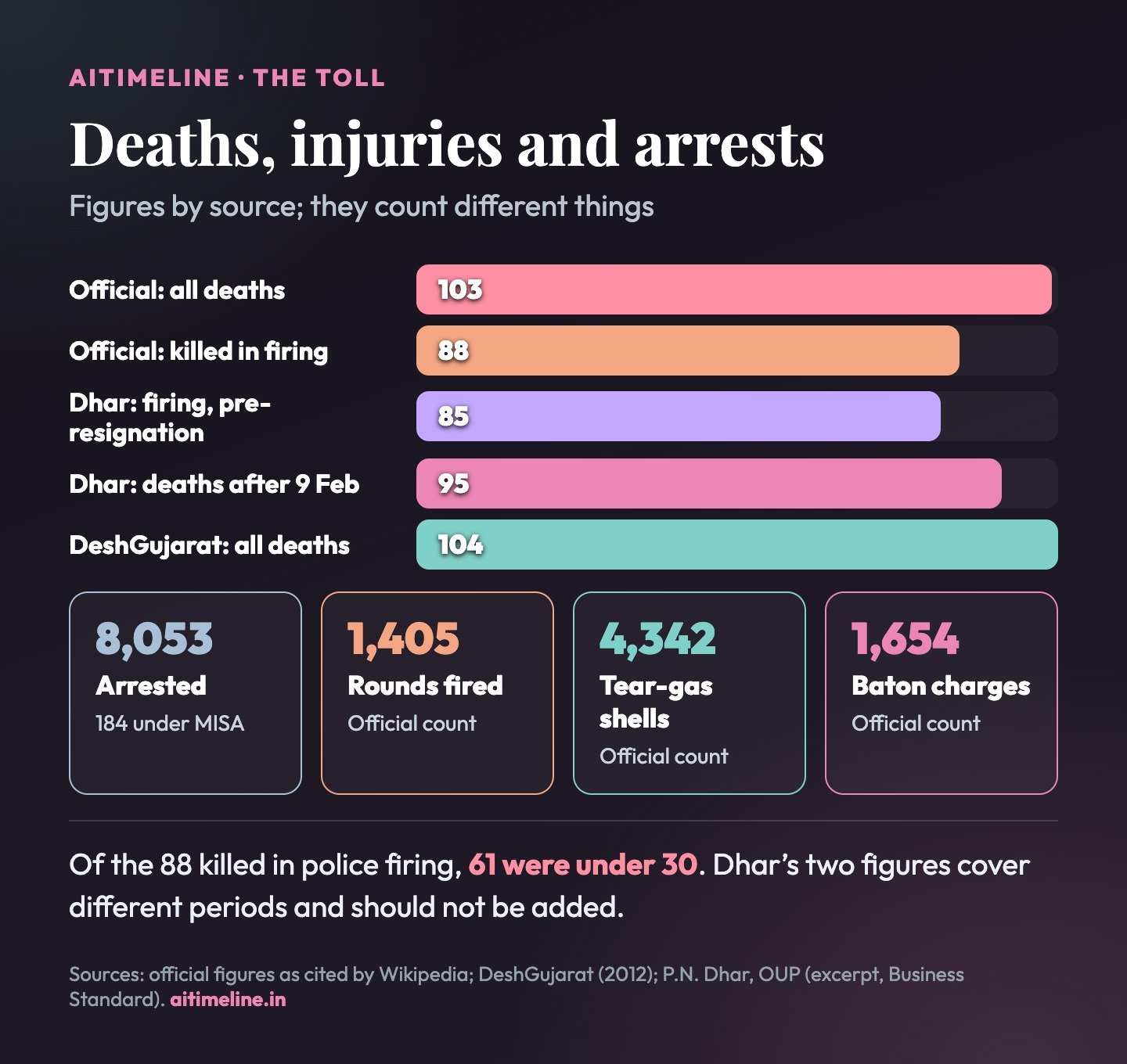
Figures differ by source and by period; do not add them together.
| Source | Figure | What it counts |
|---|---|---|
| Official figures (via Wikipedia) | 103 dead; 88 in police firing | The whole 73-day agitation |
| Official figures (via Wikipedia) | 310 injured; other estimates 1,000-3,000 | Injuries |
| Official figures (via Wikipedia) | 8,053 arrested; 184 under MISA | Arrests |
| DeshGujarat (2012) | 104 dead; 310 injured | The whole agitation |
| DeshGujarat (2012) | 44 killed in firing | To the end of January 1974 |
| P.N. Dhar | 85 killed in police firings | Before the resignation |
| P.N. Dhar | 95 deaths, 933 injured | After 9 February, in the push for dissolution |
Why the numbers differ. Some count only deaths in police firing, some all deaths; some stop at the resignation, some at the dissolution. Dhar’s two figures cannot simply be added to give a total.
Who died. Of the 88 killed in police firing in the official count, 61 were under 30.
Who Took Part
A coalition with two shared demands and little else in common.
| Group | Role |
|---|---|
| College students | Started the protests over mess fees; formed the samitis |
| Navnirman Yuvak Samiti | Lead committee from mid-January 1974; hundreds of local samitis |
| Teachers and lawyers | Helped form the lead committee; the Gujarat University Area Teachers’ Association backed the protests |
| 14th August Shramjivi Samiti | 62 unions; general strike on 10 January 1974 |
| Government employees | Called a strike from 11 February 1974 |
| Opposition parties | Congress (O), Jana Sangh, Swatantra: protests and the dissolution demand |
| ABVP | RSS-linked student group; took part; its share of the leadership is disputed |
| Morarji Desai | Fasted for dissolution in March 1974 and for elections in April 1975 |
| Jayaprakash Narayan | Visited on 11 February 1974; not an organiser; took the model to Bihar |
The ABVP question. P.N. Dhar wrote that the ABVP “had played an important role”, and Wikipedia notes the agitation helped local RSS and ABVP figures, among them Narendra Modi, enter politics. Later claims that the ABVP started or led the whole movement are not supported by the early accounts, which describe a non-party student revolt joined by many groups.
The 1975 Election and Its Timing
A year of President’s Rule, a second fast, and a result on a fateful day.
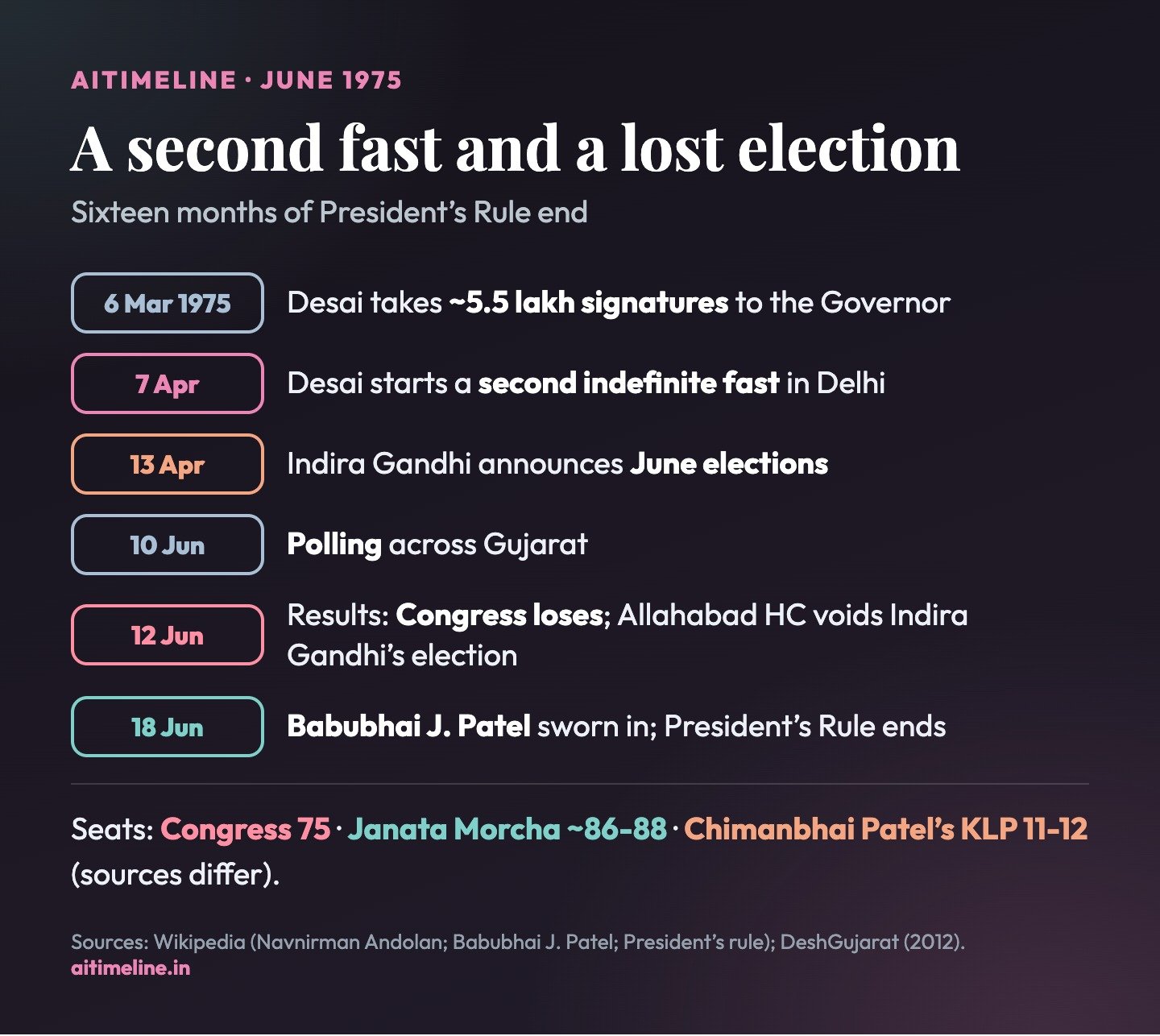
A long wait. The Assembly was dissolved in March 1974, but no election was called for a year. Desai fasted again in April 1975 and the Centre gave way.
The result. The Congress won 75 seats and lost. The Janata Morcha formed the government with help from Chimanbhai Patel’s new party, a sign of how quickly alliances shifted.
The date. Results came on 12 June 1975, the day the Allahabad High Court voided Indira Gandhi’s election. The Emergency followed on 25 June.
Legacy and National Impact
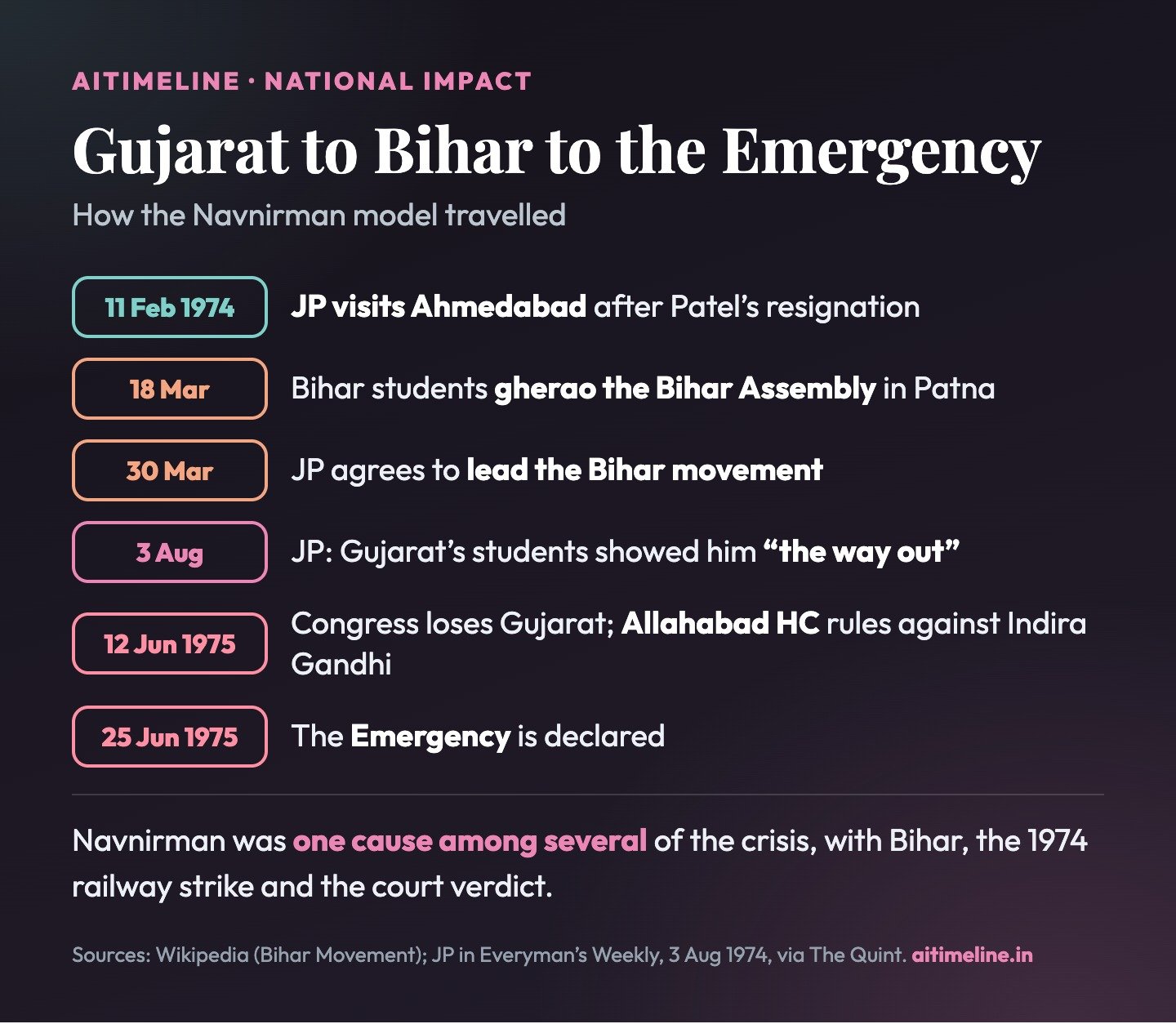
From Ahmedabad’s hostels to Patna and New Delhi.
A government brought down by protest
Often described as the first time a street movement forced out a state government in independent India.
A model for Bihar
JP said Gujarat showed him “the way out”. Bihar’s movement grew into his call for total revolution.
The first non-Congress government
The Janata Morcha took power in 1975, a forerunner of the Janata Party of 1977.
A generation of activists
Student activists and RSS and ABVP workers of 1974, Narendra Modi among them, went on into politics.
An uneasy precedent
Critics, P.N. Dhar among them, argued that forcing elected legislators out by pressure undermined constitutional ways of changing governments.
Part of the background
One of several 1974-75 challenges that preceded the Emergency, not its single cause.
Established, Disputed and Misreported
- Chimanbhai Patel resigned on 9 February 1974.
- President’s Rule ran from 9 February 1974 to 18 June 1975.
- The Assembly was dissolved in mid-March 1974.
- Polling was on 10 June 1975; results on 12 June.
- Dissolution on 15 or 16 March; fast from 11 or 12 March.
- The total death toll.
- The ABVP’s share of the leadership.
- The corruption allegations, never tested in court.
- That polling was on 9 June 1975.
- That JP led the Gujarat movement.
- That the Assembly was dissolved when Patel resigned.
- That Navnirman alone caused the Emergency.
Key People
Chimanbhai Patel
Congress Chief Minister from 17 July 1973 to 9 February 1974; later founded the Kisan Mazdoor Lok Paksha; Chief Minister again 1990-94.
Morarji Desai
Congress (O) leader whose fasts in March 1974 and April 1975 won the dissolution and the election; Prime Minister in 1977.
Jayaprakash Narayan
Visited Ahmedabad on 11 February 1974; led the Bihar movement from March 1974.
Indira Gandhi
Asked Patel to resign, accepted the dissolution and later the election; refused to repeat the concessions in Bihar.
Babubhai J. Patel
Headed the Janata Morcha government from 18 June 1975 until March 1976.
Ghanshyam Oza
Chief Minister from 17 March 1972 until Patel replaced him on 17 July 1973.
Did You Know?
- 73 days: the length of the agitation, by Wikipedia’s count, from 20 December 1973 to 16 March 1974.
- 207 days: how long Chimanbhai Patel lasted as Chief Minister in 1973-74.
- 405 samitis: local Navnirman committees across the state, by DeshGujarat’s count.
- 110 of 137: protest programmes that were non-violent, in one study’s count.
- Mock everything: protesters held mock Assemblies, mock elections, mock trials and even a mock cricket match against politicians.
- 16 months: how long Gujarat was under President’s Rule before the 1975 election.
Explore More Timelines
People Also Ask
Frequently Asked Questions
Based on P.N. Dhar’s account, contemporary chronologies and published studies.
⚠️ Editorial Note: What We Corrected and What We Could Not Confirm
We checked the brief we started from against the available accounts. Polling in the 1975 election was on 10 June, not 9 June; results came on 12 June. The Assembly had 168 seats when elected in 1972; some accounts say 95 of 167 MLAs resigned. On 7 February 1974, four ministers gave Chimanbhai Patel a charge-sheet and he dropped them. We could not confirm the brief’s report that Education Minister Maganbhai Barot resigned on 8 February, a police raid on the L.D. College hostel on 2 January, the founding of the Navnirman Yuvak Samiti on exactly 11 January, or a government employees’ strike on 1 March, so they are left out or flagged. We could not locate the 2025 academic paper the brief cited, so we do not rely on it. The dissolution date (15 or 16 March) and the start of Desai’s fast (11 or 12 March) differ between sources, and we give both. The corruption allegations against the Patel government were never tested in court.
Related Reading on AiTimeline
Sources & further reading
Every dated entry above was checked against these references. Last reviewed 18 November 2026.
- P.N. Dhar, Indira Gandhi, the Emergency and Indian Democracy (Oxford University Press), excerpt: The Nav-Nirman Movement, Business Standard (19 February 2000)
- Dawn E. Jones and Rodney W. Jones: The Scholars' Rebellion: Educational Interests and Agitational Politics in Gujarat, The Journal of Asian Studies (1977)
- DeshGujarat: When do voters of Gujarat change the government they elected, part two (11 December 2012)
- The Quint: How Gujarat Protests of the '70s Changed Indian Politics Forever (26 August 2015)
- Wikipedia: Navnirman Andolan
- Wikipedia: Bihar Movement
- Wikipedia: Babubhai J. Patel