The Kohinoor Diamond: A Complete History, Empire by Empire
The label beside the display case at the Tower of London is smaller than most visitors expect. It names the stone, gives its weight, and notes, in a few careful sentences, that its early history is recorded in the historical chronicles of the Mughal court and that it passed through the hands of Persian, Afghan and Sikh rulers before entering the Royal Collection in 1849. People lean in to read it twice. Behind the glass, set into a platinum crown that has not been worn since 1937, the Kohinoor itself is smaller and less flashy than the legend around it — a pale, oval-cut diamond that photographs less dramatically than it sits in the imagination of anyone who has heard its name before.
That gap between the object and its reputation is, in miniature, the whole story of the Kohinoor. Few gemstones on Earth carry as much accumulated meaning: to different audiences at different times it has stood for Mughal splendour, Persian conquest, Sikh sovereignty, British imperial power, and, in modern India, an unresolved question about what empires take and what, if anything, they owe back. This guide traces that journey as carefully as the historical record allows — separating what chronicles and treaties actually document from what later storytelling added, and what remains, to this day, a live diplomatic and legal question rather than a settled one.
The Kohinoor Diamond from Golconda through the Mughal, Persian, Afghan and Sikh empires to the Treaty of Lahore - documented history separated from legend.
Latest Story
The Kohinoor Diamond — from the Persian Koh-i-Noor, meaning “Mountain of Light” — is a 105.6-carat diamond now set in a crown held in the British Royal Collection at the Tower of London. It is widely associated with the Golconda diamond fields of south-central India, historically the world’s most famous source of large, exceptionally pure diamonds before the 18th century. Its documented ownership record runs through the Mughal Empire, Persia’s Afsharid dynasty, the Afghan Durrani Empire and the Sikh Empire before its 1849 transfer to the British Crown under the Treaty of Lahore. What makes it famous is not only its size and history but its unusually well-documented chain of powerful owners; what makes its ownership contested is that its final transfer took place at the end of a war, between an occupying power and a child ruler, a historical fact around which India, Pakistan, Afghanistan and the United Kingdom continue to hold different positions today.
🧠 AI Overview Summary
The Kohinoor is a 105.6-carat diamond, likely from India’s Golconda region, with a documented ownership history running through the Mughal, Persian, Afghan and Sikh empires before its 1849 transfer to the British Crown under the Treaty of Lahore, following the Second Anglo-Sikh War. It was recut in 1852 and today sits in a crown at the Tower of London. Its early pre-Mughal history includes elements of legend as well as documented record. The Government of India has stated it continues to seek the diamond’s return through amicable means; the UK has not returned it, and the matter remains a live diplomatic and historical discussion rather than a resolved one.
The Kohinoor: Who, What, Why, When, Where, How
What This Guide Covers
- The Kohinoor’s documented ownership record is unusually detailed from the Mughal era onward, though its earlier, pre-16th-century history involves more legend and scholarly inference than firm documentation.
- It is widely associated with the Golconda diamond fields, historically the world’s leading source of large, exceptionally pure diamonds before Brazilian and later South African discoveries.
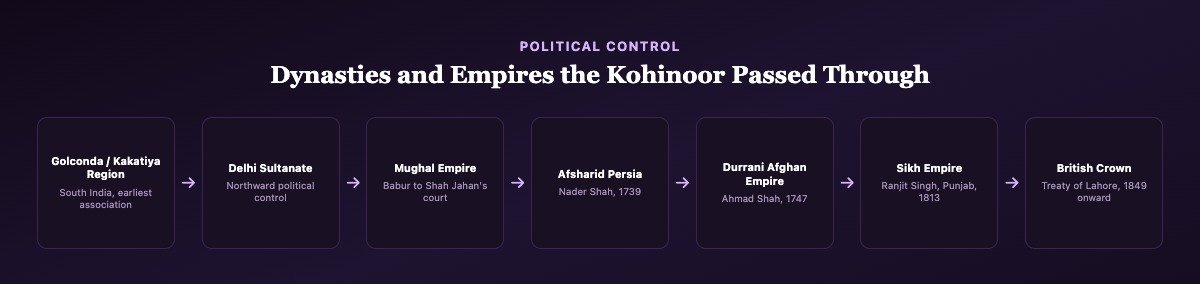
- The stone passed through the Mughal, Afsharid Persian, Durrani Afghan and Sikh empires before its 1849 transfer to the British Crown.
- Its transfer to Britain was formalised under the Treaty of Lahore, signed after the Second Anglo-Sikh War by a regency governing the ten-year-old Maharaja Duleep Singh.
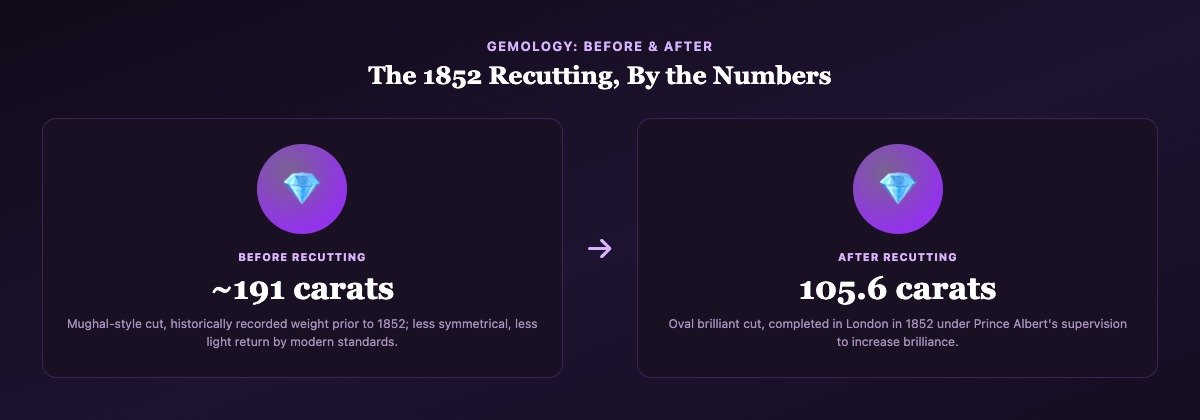
- The diamond was recut in London in 1852, reducing its weight from roughly 191 to 105.6 carats to improve its brilliance.
- It has been set into three different royal crowns since 1902 and has not been worn since 1937.
- The Government of India has publicly stated it continues to seek the diamond’s return through amicable means, a position reaffirmed in Parliament and public statements.
- Pakistan and, at times, Afghanistan have also raised historical claims to the diamond, reflecting its passage through territory now within their modern borders.
- The United Kingdom has not agreed to return the diamond; UK and museum institutional positions generally cite the terms of the 1849 treaty and the non-retroactive nature of later international heritage law.
- The 2023 coronation of Queen Camilla notably did not use the Kohinoor crown, a widely reported decision that renewed public discussion of the stone’s history.
What the Kohinoor Diamond Actually Is
Its physical characteristics, its name, and why Golconda diamonds became legendary in the first place.
The Kohinoor is, physically, a colourless to near-colourless diamond, currently cut as an oval brilliant weighing 105.6 metric carats, set at the front of a platinum crown held by the Royal Collection Trust. Its name comes from Persian, koh (mountain) and noor (light), commonly rendered in English as “Mountain of Light” — a name historically associated with the Persian-influenced courts that used the stone from at least the mid-18th century onward, though, as later sections explain, the exact origin of the specific name is itself part legend.
The diamond is widely believed by gemologists and historians to originate from the Golconda region, near present-day Hyderabad in south-central India. Golconda was not a single mine but a historic diamond-trading and cutting centre that gave its name to diamonds recovered from a cluster of alluvial mining sites in the surrounding Krishna River basin, worked from at least the medieval period until the fields’ commercial decline in the 18th century. Golconda diamonds are prized in gemological literature for their exceptional chemical purity (very low nitrogen content, in gemological terms classified as Type IIa), which produces unusually high transparency and a distinctive brilliance compared with diamonds from most other historical sources. Famous stones associated with the Golconda fields, alongside the Kohinoor, include the Hope Diamond, the Regent Diamond and the Darya-i-Noor.
The Kohinoor became famous for the combination of its size, its purity, and, above all, its documented passage through an unusually long and unbroken chain of powerful rulers across several empires — a chain of custody that is itself part of why the stone carries so much symbolic weight, distinct from its purely physical qualities as a gem.
📜 History Insight
The Kohinoor’s recorded journey spans multiple dynasties, empires and political systems over several centuries. Few individual objects offer as continuous a documentary thread connecting the Delhi Sultanate era, the Mughal Empire, Safavid-successor Persia, the Durrani Afghan Empire, the Sikh Empire and the British Empire — which is part of why historians treat it as a genuinely significant historical source object, not only a valuable gem.
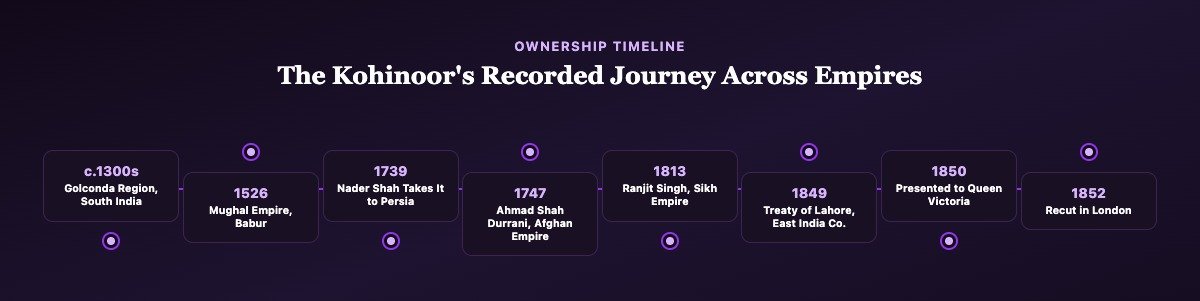
A Complete Timeline: From Golconda to the Tower of London
Historical background, political context and evidence for each period — with legend and disputed claims clearly identified as such.
Possible Origins in the Golconda Region
Historical background: Popular tradition associates the diamond’s earliest known existence with the Kakatiya dynasty, which ruled the Golconda region of present-day Telangana until its fall to the Delhi Sultanate’s forces in the early 14th century.
Political context: The Delhi Sultanate’s southward military campaigns during this period brought Kakatiya territory, including its diamond-producing region, under northern Indian political control for the first time.
Ownership and evidence: No contemporary 14th-century document specifically names or describes “the Kohinoor” by that identity; this earliest chapter rests on later tradition and inference rather than a documented contemporary record, and historians treat it with appropriate caution.
Current relevance: This is the point at which most popular accounts begin the Kohinoor’s story, though historians including Dalrymple and Anand’s widely cited 2017 history of the diamond caution that firm documentary evidence only becomes available from the Mughal period onward.
Babur and the Founding of Mughal Rule
Historical background: Babur’s victory at the First Battle of Panipat in 1526 established Mughal rule in northern India. Babur’s own memoir, the Baburnama, describes an exceptionally large diamond taken as war booty around this period.
Political context: The diamond described in the Baburnama is said to have come from the family of Raja Vikramaditya of Gwalior, part of the wider transfer of wealth that accompanied the Delhi Sultanate’s fall to Mughal forces.
Ownership and evidence: Many popular histories identify the Baburnama stone with the modern Kohinoor. This identification is a scholarly interpretation, not a certainty: some historians argue the description is too imprecise to confirm it is the same stone later known by that name.
Current relevance: This entry is frequently cited as the diamond’s first solid documentary appearance, though readers should understand it as a plausible, widely repeated scholarly identification rather than a proven one.
Shah Jahan’s Court and the Peacock Throne
Historical background: During Shah Jahan’s reign, the Mughal treasury held numerous large diamonds, and the emperor commissioned the ornate, jewel-encrusted Peacock Throne, widely celebrated in Mughal-era court chronicles as an extraordinary display of imperial wealth.
Political context: The throne became a symbol of Mughal power at its territorial and economic height, and its later fate, plundered and dismantled after 1739, became entangled with the diamond’s own story.
Ownership and evidence: Popular accounts often describe the Kohinoor as set into the Peacock Throne itself. Historians including Dalrymple and Anand have argued that surviving Mughal-era records are ambiguous on this specific point, and that the Kohinoor may have been kept and worn separately from the throne rather than mounted on it.
Current relevance: This is one of the clearest examples in the Kohinoor’s history of a widely repeated popular association that leading historians now treat as unconfirmed rather than established.
Nader Shah’s Invasion and the Name “Koh-i-Noor”
Historical background: The Persian ruler Nader Shah invaded Delhi in 1739, defeated Mughal emperor Muhammad Shah, and departed with an immense quantity of treasure, documented in both Mughal and Persian court records as one of the largest single transfers of wealth in the region’s history.
Political context: This invasion marked a decisive blow to Mughal imperial authority and power, from which the empire’s central control over northern India never fully recovered.
Ownership and evidence: The often-told story that Nader Shah discovered the diamond hidden in Muhammad Shah’s turban, and exclaimed “Koh-i-Noor!” upon seeing it, is a popular anecdote repeated in many later accounts; most historians treat this specific “turban” story as legend rather than a documented event, while agreeing the diamond did leave Delhi with Nader Shah’s treasure and that the Persian name dates broadly to this period.
Current relevance: This is the point at which the diamond’s now-famous name enters the historical record, even though the specific origin story attached to it is not considered reliably documented.
Ahmad Shah Durrani and the Afghan Empire
Historical background: Following Nader Shah’s assassination in 1747, one of his military commanders, Ahmad Shah Durrani, founded the Durrani Empire in Afghanistan and, according to historical accounts, came to possess the diamond during the succession struggles that followed Nader Shah’s death.
Political context: The Durrani Empire became the dominant power in Afghanistan and parts of northern India and Punjab for several decades, with the diamond remaining part of its royal treasury through multiple rulers.
Ownership and evidence: The diamond’s presence in the Durrani treasury through the late 18th century is reasonably well documented in Afghan and regional historical sources, including its role during subsequent Durrani succession conflicts.
Current relevance: This period is one basis for modern Afghan historical interest in the diamond’s story, alongside Pakistan’s and India’s, reflecting the stone’s passage through territory in all three modern nations.
Maharaja Ranjit Singh and the Sikh Empire
Historical background: Maharaja Ranjit Singh, founder of the Sikh Empire based in Lahore, obtained the diamond in 1813 from the exiled Durrani ruler Shah Shuja Durrani, who had sought refuge and Ranjit Singh’s protection.
Political context: The transfer is documented as taking place under negotiation and, according to most accounts, some degree of pressure, as part of the political relationship between the powerful Sikh Empire and the weakened, exiled Afghan ruler.
Ownership and evidence: Ranjit Singh’s possession of the diamond from 1813 onward is well documented in Sikh court records and contemporary European travellers’ accounts, several of whom described seeing him wear it.
Current relevance: This marks the diamond’s arrival at Lahore, the city and treasury from which it would later pass to British hands, and is the last major transfer before its documented departure from Indian political control.
Ranjit Singh’s Death and a Disputed Will
Historical background: Ranjit Singh died in 1839. Some historical accounts state he expressed a wish, on his deathbed, for the diamond to be donated to the Jagannath Temple in Puri, Odisha.
Political context: The Sikh Empire entered a period of political instability and succession disputes following his death, a period during which the diamond remained in the Lahore treasury.
Ownership and evidence: Whether Ranjit Singh’s temple bequest was formally carried out, legally binding, or genuinely his final wish is disputed among historians; the diamond in any case remained in the Sikh state treasury at Lahore rather than being transferred to the temple.
Current relevance: This episode is frequently cited in discussions of the diamond’s “intended” destination, though it should be understood as a disputed historical account rather than a documented, executed transfer.
The Treaty of Lahore and East India Company Acquisition
Historical background: The Second Anglo-Sikh War ended in British victory and the annexation of the Punjab. The Treaty of Lahore, signed on 29 March 1849, formalised the terms, including a clause requiring the surrender of the Kohinoor to the Queen of England.
Political context: The treaty was signed on behalf of Maharaja Duleep Singh, who was ten years old at the time, by a regency council operating under British political authority following the military defeat of the Sikh Empire.
Ownership and evidence: The treaty text itself is a documented, archived historical record; its terms, and the circumstances of a child ruler under an occupying power’s political control, are also documented facts, which is why this transfer is treated differently in public discussion from earlier ones in the diamond’s history.
Current relevance: This 1849 transfer is the specific, formally documented legal basis for British possession of the diamond, and it is the central historical fact underlying subsequent restitution discussions.
Presentation to Queen Victoria
Historical background: The diamond was transported to Britain aboard HMS Medea and formally presented to Queen Victoria on 3 July 1850 by representatives of the East India Company, in accordance with the Treaty of Lahore’s terms.
Political context: The presentation was framed at the time, in British accounts, as a gift symbolising the East India Company’s authority over its new Punjab territories, following the treaty’s formal transfer clause.
Ownership and evidence: The date, ship and ceremony are documented in East India Company and royal household records; the diamond formally entered the British Royal Collection at this point.
Current relevance: This is the formal moment the diamond became, and has since remained, the property of the British Crown, distinct from the earlier 1849 treaty that legally authorised the transfer.
The Great Exhibition
Historical background: The Kohinoor was publicly displayed at the Great Exhibition of 1851 in London’s Crystal Palace, one of the exhibition’s most anticipated attractions, drawing enormous public curiosity.
Political context: Its display was part of a broader Victorian celebration of British industrial and imperial reach, presenting objects and materials from across the Empire to a domestic and international audience.
Ownership and evidence: Contemporary press accounts and exhibition records document widespread public disappointment with the diamond’s appearance, as its old Mughal-style cut did not reflect light in the manner Victorian audiences expected of a “brilliant” diamond.
Current relevance: This documented public reaction is the direct reason the decision was made to recut the stone the following year.
The Re-cutting of the Diamond
Historical background: Following the Great Exhibition’s reception, Prince Albert commissioned a re-cutting of the diamond, carried out in 1852 by the Amsterdam firm Coster Diamonds under the technical supervision of a specialist brought to London for the purpose.
Political context: The recutting was a private royal decision rather than a matter of state policy, reflecting Victorian aesthetic preferences for symmetrical, light-maximising cuts over the older Mughal style.
Ownership and evidence: The process is well documented, including contemporary accounts noting the significant reduction in weight, from a historically recorded pre-cut weight of roughly 191 carats to the current 105.6-carat oval brilliant cut.
Current relevance: This recutting permanently altered the stone’s appearance from its original Mughal-era form, meaning the Kohinoor seen today looks substantially different from the diamond described in earlier historical accounts.
Queen Alexandra’s Coronation Crown
Historical background: The Kohinoor was set into a new crown made for Queen Alexandra, consort of King Edward VII, for their 1902 coronation, the first of three royal crowns it has occupied.
Political context: By this point the diamond was firmly established as a centrepiece of British royal ceremonial regalia, worn exclusively by queens consort rather than reigning monarchs, a practice that has continued since.
Ownership and evidence: Royal Collection Trust and Historic Royal Palaces records document the crown’s creation and the diamond’s setting in detail.
Current relevance: This establishes the pattern, continued in 1911 and 1937, of the Kohinoor being reset for each new queen consort’s coronation rather than remaining in a single fixed setting.
Queen Mary’s Crown
Historical background: The diamond was moved into a newly made crown for Queen Mary, consort of King George V, for the 1911 coronation, continuing the established pattern.
Political context: This coronation took place while India remained under direct British Crown rule, following the transfer of governance from the East India Company to the Crown in 1858.
Ownership and evidence: Queen Mary’s Crown, and the Kohinoor’s setting within it, is documented in Royal Collection Trust archives and remains part of the Crown Jewels collection today, though the diamond itself was later moved again.
Current relevance: Queen Mary’s Crown, minus the Kohinoor, was itself reset and worn again at the 2023 coronation, discussed later in this timeline.
The Crown of Queen Elizabeth The Queen Mother
Historical background: The diamond was set into a new platinum crown made for Queen Elizabeth, consort of King George VI (later known as The Queen Mother), for the 1937 coronation.
Political context: This is, as of 2026, the last time the Kohinoor has been worn in a public coronation ceremony; the crown has been displayed, but not worn, since The Queen Mother’s death in 2002.
Ownership and evidence: This crown, with the Kohinoor still set in its front cross, is the one currently on public display at the Tower of London.
Current relevance: This remains the diamond’s current setting, making 1937 the most recent year the stone changed its physical mounting.
Indian Independence and Early Requests
Historical background: India gained independence from British rule in 1947. In the years that followed, informal and formal requests for the diamond’s return began to be raised by Indian officials and public figures.
Political context: These early requests occurred alongside the broader, complex process of decolonisation and the division of colonial-era assets between newly independent India, Pakistan and Britain.
Ownership and evidence: No formal treaty or binding legal claim was established at this stage; these were diplomatic and public expressions of interest rather than legal proceedings.
Current relevance: This marks the start of a now nearly 80-year-long, still-unresolved diplomatic conversation about the diamond’s status.
International Restitution Debates Widen
Historical background: Through the 1970s, Pakistan formally raised a claim to the diamond, notably referenced in a 1976 exchange involving Pakistani officials, on the basis that Lahore, the city from which the diamond was taken in 1849, is now within Pakistan.
Political context: This period saw a broader international wave of decolonisation-era heritage and restitution discussions, as newly independent nations across Asia and Africa began raising questions about colonial-era acquisitions in Western museums and royal collections.
Ownership and evidence: The UK’s response at the time, and consistently since, has been not to agree to return the diamond, generally citing the terms of the 1849 treaty as the basis of its legal title.
Current relevance: This period established the pattern of multiple nations, not only India, raising historical interest in or claims to the diamond — a genuinely multi-sided modern discussion rather than a two-party dispute.
UNESCO and Cultural Heritage Discussions
Historical background: Broader international discussions around cultural heritage restitution, informed by the 1970 UNESCO Convention on illicit trafficking of cultural property, continued to reference the Kohinoor as a prominent example in academic and public debate, though the diamond’s 1849 transfer predates that convention.
Political context: Museum ethics and colonial-era acquisition debates gained wider international attention during this period, affecting institutions well beyond the Kohinoor specifically.
Ownership and evidence: Legal scholars generally note that the 1970 UNESCO Convention is not retroactive and does not, by itself, create a binding legal obligation regarding objects acquired before it came into force.
Current relevance: This is why the Kohinoor question is frequently described by legal historians as a diplomatic and ethical matter more than a straightforward legal one under current international law.
A Government of India Clarification
Historical background: During 2016 Supreme Court of India proceedings related to a public-interest petition, India’s Solicitor General made a statement characterising the diamond’s 1849 transfer as having been given, rather than seized, which drew significant public and media reaction in India.
Political context: The statement was widely reported as inconsistent with the government’s broader public position, prompting the Ministry of Culture to issue a clarification shortly afterward.
Ownership and evidence: The Government of India subsequently clarified that it would continue to make efforts to bring back the Kohinoor “in an amicable manner,” a position it has reiterated in Parliament and public statements since.
Current relevance: This episode is a clear, well-documented example of the diamond’s history intersecting directly with active Indian legal and political processes, distinct from the earlier historical chapters of the story.
A Coronation Without the Kohinoor
Historical background: Following Queen Elizabeth II’s death in 2022, preparations began for the coronation of King Charles III and Queen Camilla in May 2023.
Political context: Queen Camilla wore a reset version of Queen Mary’s Crown at the ceremony, using the Cullinan III, IV and V diamonds rather than the Kohinoor, a substitution widely reported in British and Indian press as a notable, if not officially explained in detail, departure from precedent.
Ownership and evidence: Buckingham Palace’s official statements focused on sustainability and reuse of existing royal jewels rather than directly addressing the Kohinoor’s continued absence from ceremonial use; media commentary connected the choice to the diamond’s ongoing sensitivity, though this specific motivation was not officially confirmed by the Palace.
Current relevance: The Kohinoor remains on public display at the Tower of London rather than in ceremonial use, continuing its 1937 setting.
Where Things Stand Today
Historical background: As of 2026, the Kohinoor remains part of the British Crown Jewels on display at the Tower of London, with no change in its legal ownership or display status.
Political context: The Government of India has continued to reiterate, including in parliamentary responses, that it seeks the diamond’s return through amicable means, without indicating any change in approach toward litigation or unilateral demands.
Ownership and evidence: No new legal ruling, treaty amendment, or bilateral agreement affecting the diamond’s status has been reported by official sources as of this writing.
Current relevance: The Kohinoor remains a live, ongoing subject of museum-ethics scholarship, heritage-law academic discussion, and periodic diplomatic and media attention rather than a closed historical chapter.
💡 Did You Know?
- The Kohinoor originally weighed far more before being recut to approximately 105.6 carats after arriving in Britain — the 1852 recutting removed roughly 45 percent of its historically recorded weight.
- By long-standing royal tradition, the Kohinoor has been worn only by queens consort, never by a reigning king or queen, a pattern some historians connect to older superstitions surrounding the stone.
- The diamond’s public debut at Britain’s 1851 Great Exhibition was, by contemporary accounts, something of a disappointment — its old-style cut looked dull under exhibition lighting compared with modern brilliant-cut diamonds.
Key Terms in the Kohinoor’s History
Precise definitions for the vocabulary used throughout this guide.
Golconda
A historic diamond-trading and cutting centre near present-day Hyderabad, giving its name to diamonds recovered from surrounding mines, prized for exceptional purity and clarity.
Kakatiya Dynasty
A dynasty that ruled the Golconda region of present-day Telangana until the early 14th century, popularly, though not firmly documented, associated with the diamond’s earliest origins.
Delhi Sultanate
A series of Muslim dynasties that ruled large parts of northern and, at times, southern India from 1206 to 1526, preceding the Mughal Empire.
Mughal Empire
A powerful empire ruling most of the Indian subcontinent from 1526 to the mid-1800s, under whose emperors the Kohinoor’s documented history substantially begins.
Peacock Throne
An ornate, jewel-encrusted throne commissioned by Mughal emperor Shah Jahan, popularly but not conclusively associated with the Kohinoor in historical scholarship.
Treaty of Lahore
The March 1849 treaty ending the Second Anglo-Sikh War, signed by a regency governing the young Maharaja Duleep Singh, which formally transferred the Kohinoor to the British Crown.
East India Company
A British trading company that gained increasing political and military control over large parts of India from the 18th century, and which formally facilitated the diamond’s 1850 presentation to Queen Victoria.
Carat
The standard unit of weight for gemstones, equal to 200 milligrams; the Kohinoor’s weight changed from a historically recorded figure of roughly 191 carats to 105.6 carats after its 1852 recutting.
Brilliant Cut
A diamond-cutting style using precisely angled facets to maximise light reflection and sparkle, the style applied to the Kohinoor in its 1852 recutting, replacing its earlier Mughal-style cut.
Colonial Acquisition
The general historical process by which colonial powers obtained objects, territory or wealth from colonised regions, a category into which historians place the Kohinoor’s 1849 transfer, alongside its specific documented treaty context.
Museum Ethics
The field of professional and academic standards governing how museums acquire, display and interpret objects, particularly those obtained during the colonial era, increasingly incorporating provenance transparency.
Cultural Restitution
The practice or principle of returning cultural or historical objects to their community, nation or people of origin, a live area of international museum policy and diplomatic discussion that the Kohinoor is frequently cited within.
International Heritage Law
The body of international agreements, most notably the 1970 UNESCO Convention, governing the trade and return of cultural property; generally not retroactive to acquisitions made before an agreement’s entry into force.
Five Things Worth Understanding Properly
Evergreen explainers that go one level deeper than the glossary above.
How the Kohinoor Got Its Name
“Koh-i-Noor” is Persian for “Mountain of Light,” a name historically associated with the Persian-influenced courts of the mid-18th century. The specific, often-told story — that Persian ruler Nader Shah discovered the diamond hidden inside defeated Mughal emperor Muhammad Shah’s turban and exclaimed the name upon seeing it — is a popular anecdote repeated across many later retellings, but most historians treat this particular version of events as legend layered onto a real historical episode, rather than a documented fact. What is documented is that the diamond left Delhi as part of Nader Shah’s immense 1739 treasure haul, and that the Persian name for it dates broadly to this period of Persian court usage.
Why the Diamond Was Recut
The Kohinoor’s original Mughal-era cut prioritised weight retention and traditional Indian faceting styles over the symmetrical light-maximising approach that had become fashionable in 19th-century European gem-cutting. When the diamond was publicly displayed at the 1851 Great Exhibition, contemporary press accounts documented public disappointment: under exhibition lighting, the old cut appeared comparatively dull. Prince Albert subsequently commissioned Amsterdam firm Coster Diamonds to recut the stone in 1852, a process that reduced its weight from a historically recorded figure of roughly 191 carats to its current 105.6-carat oval brilliant cut, permanently altering both its appearance and its historical form.
The Treaty of Lahore Explained
The Treaty of Lahore, signed on 29 March 1849, formally ended the Second Anglo-Sikh War and annexed the Punjab to territories controlled by the East India Company. Its terms included a specific clause requiring the surrender of the Kohinoor to the Queen of England. The treaty was signed on behalf of the Sikh Empire by a regency council governing Maharaja Duleep Singh, who was ten years old at the time, following the Sikh Empire’s military defeat. These are documented historical facts, distinct from any characterisation of the transfer’s fairness; the treaty’s legal terms and the political circumstances surrounding its signing are both part of the historical record and are frequently discussed together in modern analysis.
Golconda Diamonds and Their Global Importance
Before large diamond deposits were discovered in Brazil (18th century) and South Africa (19th century), the Golconda region of India was, for centuries, the world’s principal known source of diamonds, particularly large, exceptionally pure stones. Golconda diamonds are gemologically distinguished by their very low nitrogen content (Type IIa classification), producing unusual transparency and a characteristic bright, sometimes bluish-white brilliance. Besides the Kohinoor, other historically significant diamonds associated with Golconda include the Hope Diamond, the Regent Diamond and the Darya-i-Noor, now respectively held in the United States, France and Iran, illustrating how widely Golconda’s historic output was dispersed across later empires and collections.
Why Ownership Remains Contested
The core of the modern dispute is not usually about whether the 1849 transfer happened, or under what treaty terms — both are well documented. The disagreement concerns how that transfer should be judged today: whether a treaty signed by a child ruler’s regency, under an occupying power’s political and military authority following a war, should carry the same legal and moral weight as an ordinary voluntary exchange between equal parties. India’s government position, reiterated since the 2016 clarification, is to seek return through amicable diplomatic means. The UK’s position has consistently been not to return the diamond, generally on the basis of the treaty’s legal terms and the non-retroactive scope of modern international heritage law. Pakistan and, at times, Afghanistan have also raised historical interest in the stone, reflecting its documented passage through territory in both modern countries. No court or international body has issued a binding ruling on the matter as of this writing.
🌍 Diplomacy Insight
Questions surrounding ownership involve history, international law, diplomacy and cultural heritage rather than a single historical event. The Kohinoor discussion is better understood as an ongoing, multi-sided diplomatic and academic conversation, involving India, Pakistan, Afghanistan, the UK and international heritage-law scholarship, than as a single unresolved court case awaiting a verdict.
The Kohinoor by the Numbers: Comparisons
Weight changes, ownership record, and how official positions differ.
| Measurement | Before 1852 Recutting | After 1852 Recutting (Current) |
|---|---|---|
| Weight | Approximately 191 carats (historically recorded) | 105.6 carats |
| Cut style | Mughal-era style, weight-retaining | Oval brilliant cut |
| Light performance | Reported as comparatively dull under exhibition lighting | Designed to maximise brilliance |
| Cut by | Unknown/historical Mughal-era lapidaries | Coster Diamonds, under Prince Albert’s commission |
| Diamond | Approx. Weight | Current Location |
|---|---|---|
| Kohinoor | 105.6 carats | Tower of London, UK |
| Hope Diamond | ~45.5 carats | Smithsonian, USA |
| Regent Diamond | ~140.6 carats | Louvre, France |
| Darya-i-Noor | ~182 carats (estimated) | National Treasury, Iran |
| Orlov Diamond | ~189.6 carats | Kremlin Diamond Fund, Russia |
| Period | Ruler / Power | How Acquired |
|---|---|---|
| c.1300s (traditional) | Kakatiya dynasty | Regional rule over Golconda; earliest association, not firmly documented |
| 1526 onward | Mughal Empire | Conquest of Delhi Sultanate territory (identification debated) |
| 1739 | Nader Shah (Persia) | Invasion and sack of Delhi |
| 1747 | Ahmad Shah Durrani (Afghanistan) | Succession following Nader Shah’s assassination |
| 1813 | Ranjit Singh (Sikh Empire) | Negotiated transfer from exiled Shah Shuja Durrani |
| 1849 | British Crown | Treaty of Lahore, following military defeat of the Sikh Empire |
| Party | Official / Documented Position |
|---|---|
| Government of India | States it continues to seek the diamond’s return through amicable means, a position reiterated since a 2016 clarification. |
| United Kingdom / Royal Collection Trust | Has not agreed to return the diamond; generally cites the Treaty of Lahore’s terms as the legal basis for ownership. |
| Pakistan | Has, at times including a formal 1970s exchange, raised historical interest based on Lahore’s location within modern Pakistan. |
| Afghanistan | Has, at times, referenced the diamond’s Durrani-era history in the context of national heritage discussions. |
| International heritage law | The 1970 UNESCO Convention is not retroactive and does not, on its own, create a binding obligation for pre-1970 acquisitions. |
💎 Gemology Insight
The diamond’s appearance changed significantly after it was recut in 1852. Visitors familiar only with historical illustrations or descriptions of the “original” Kohinoor are, in effect, picturing a different-looking object from the one on display at the Tower of London today — the same stone, but a substantially different cut, shape and light performance.
Timeline Summary
Every milestone from this guide’s history section, condensed into one table.
| Year | Event | Historical Importance |
|---|---|---|
| c.1300s | Traditional association with Golconda / Kakatiya dynasty | Earliest, least firmly documented chapter |
| 1526 | Babur’s Baburnama describes a large diamond | First plausible, debated textual identification |
| 1628-1658 | Shah Jahan’s court and the Peacock Throne | Popular but historically contested association |
| 1739 | Nader Shah invades Delhi; name recorded | Diamond leaves India; “Koh-i-Noor” name emerges |
| 1747 | Ahmad Shah Durrani, Afghan Empire | Diamond enters Durrani royal treasury |
| 1813 | Ranjit Singh, Sikh Empire | Diamond arrives at Lahore |
| 1839 | Ranjit Singh’s death; disputed will | Contested Jagannath Temple bequest claim |
| 1849 | Treaty of Lahore | Formal, documented transfer to British Crown |
| 1850 | Presented to Queen Victoria | Diamond formally enters Royal Collection |
| 1851 | Great Exhibition | Public underwhelm prompts recutting decision |
| 1852 | Diamond recut | Weight reduced from ~191 to 105.6 carats |
| 1902 / 1911 / 1937 | Set into three coronation crowns | Established as royal ceremonial regalia |
| 1947 | Indian independence | Early informal requests for return begin |
| 1970s | Pakistan raises a formal claim | Confirms multi-national dimension of the debate |
| 2000s | UNESCO heritage discussions | Clarifies non-retroactive scope of heritage law |
| 2016 | Government of India clarification | Formalises India’s “amicable means” position |
| 2023 | Coronation without the Kohinoor | Notable, unexplained departure from precedent |
| 2026 | Current state | Diamond remains on display; discussion ongoing |
Who’s Who in the Kohinoor’s History
The dynasties, rulers and institutions named throughout this guide.
Golconda
The historic diamond-trading region near Hyderabad widely, though not conclusively, associated with the Kohinoor’s origin.
Kakatiya Dynasty
Ruled the Golconda region until the early 14th century; popularly linked to the diamond’s earliest, least-documented chapter.
Delhi Sultanate
Ruled large parts of India from 1206 to 1526, preceding Mughal control of the region associated with the diamond’s origin.
Mughal Empire
Ruled most of the Indian subcontinent from 1526; the diamond’s documented history substantially begins under Mughal rule.
Babur
Founder of the Mughal Empire, whose memoir the Baburnama contains a widely discussed, though disputed, early description of a large diamond.
Shah Jahan
Mughal emperor who commissioned the Peacock Throne, popularly but not conclusively linked to the Kohinoor by historians.
Nader Shah
Persian ruler whose 1739 invasion of Delhi is documented as the point the diamond left India and gained the “Koh-i-Noor” name.
Maharaja Ranjit Singh
Founder of the Sikh Empire, who obtained the diamond in 1813 and whose Lahore treasury held it until 1849.
Maharaja Duleep Singh
The ten-year-old Sikh ruler on whose behalf a regency signed the 1849 Treaty of Lahore, transferring the diamond to the British Crown.
East India Company
The British company whose forces defeated the Sikh Empire and which formally facilitated the diamond’s 1850 presentation to Queen Victoria.
Queen Victoria
The British monarch to whom the diamond was formally presented in 1850, after whom its entry into the Royal Collection is dated.
Tower of London
The historic fortress and palace where the British Crown Jewels, including the Kohinoor, are held and publicly displayed today.
British Crown Jewels
The working and ceremonial regalia of the British monarchy, held in trust rather than as personal property, of which the Kohinoor’s crown is part.
🔎 Future Watch
Developments worth watching come directly from official channels: Royal Collection Trust and Historic Royal Palaces exhibition updates, Government of India parliamentary statements and Ministry of Culture positions, peer-reviewed academic historical research, and any formal heritage-law or diplomatic developments reported by primary sources. This guide avoids speculating about outcomes beyond what these sources have actually stated.
Common Myths vs. Historical Evidence
What is documented, versus what is widely repeated but not firmly established.
✅ Documented Evidence
- The diamond’s presence in the Mughal, Persian, Afghan and Sikh treasuries from the 18th century onward is well documented across multiple independent sources.
- The Treaty of Lahore’s text, date and terms, including the Kohinoor clause, are archived, documented historical records.
- The 1852 recutting, including the weight change from roughly 191 to 105.6 carats, is documented in contemporary accounts and Royal Collection records.
- The Government of India’s post-2016 “amicable means” position is a documented, officially stated diplomatic position.
❌ Legend or Disputed Claim
- The specific story of Nader Shah finding the diamond hidden in a turban and exclaiming “Koh-i-Noor!” is popular legend, not a documented event.
- The diamond’s setting into Shah Jahan’s Peacock Throne is a widely repeated popular claim that leading historians consider unconfirmed.
- Claims that the diamond carries a supernatural “curse” are folklore repeated in popular media, with no documented scholarly historical basis.
- Any claim that a single, agreed legal ruling has settled the diamond’s ownership dispute is inaccurate; no such binding ruling exists as of this writing.
💡 Interesting Facts
- The Kohinoor is classified by gemologists as a Type IIa diamond, an exceptionally pure category with very low nitrogen content, a hallmark of historic Golconda stones.
- Several other world-famous diamonds, including the Hope Diamond and the Regent Diamond, are also believed to originate from the same historic Golconda mining region as the Kohinoor.
- The Kohinoor has occupied three different British royal crowns since 1902, but has not been worn in a public ceremony since 1937.
Explore More Timelines
People Also Ask
Frequently Asked Questions
Eighty questions covering the gemstone, the history, the empires, and the modern debate.
Why the Kohinoor Diamond Remains One of History’s Most Discussed Treasures
The Kohinoor is far more than a gemstone. Across roughly seven centuries of association with the Indian subcontinent and Central Asia, it has represented Mughal artistic and imperial splendour, Persian and Afghan conquest, Sikh sovereignty, and, since 1849, British imperial power and, later, the complexities of a post-colonial world working out what it owes its former subjects. Few individual objects carry so many overlapping layers of political change, artistic craftsmanship, dynastic memory and diplomatic significance in one physical form.
Historians continue to debate parts of its early history — whether the diamond described in the Baburnama is truly the same stone, whether it was ever actually set into the Peacock Throne, how much of the Nader Shah naming story is fact versus embellishment. These are genuine, open scholarly questions, not settled facts dressed up as uncertain ones. Modern discussion, meanwhile, focuses less on those older uncertainties and more on documented, comparatively recent history: the specific terms of the 1849 Treaty of Lahore, the circumstances of a child ruler’s regency signing it, and what museum ethics, international heritage law and diplomacy should make of that history today.
Readers who want to understand the Kohinoor properly should consult primary historical records, museum archives and scholarly research directly — the Royal Collection Trust’s own published material, peer-reviewed histories such as Dalrymple and Anand’s, and official Government of India statements — rather than relying on any single retelling, including this one, as the final word. The diamond’s remarkable journey is documented well enough to be told honestly, with its genuine uncertainties left honestly uncertain.
⚠️ Editorial Note: Sources & E-E-A-T
Government documents: Treaty of Lahore text, Government of India Ministry of Culture and Parliament statements. Academic books: peer-reviewed histories, notably Dalrymple and Anand’s “Kohinoor” (2017). Museum archives: Royal Collection Trust and Historic Royal Palaces records. Historical chronicles: Mughal-era court records including the Baburnama, read alongside modern historical analysis. Independent scholarship: gemological and historical research kept distinct from political claims and popular legend throughout this guide. This article is educational content; it does not take a position on unresolved ownership questions.
Sources & further reading
Every dated entry above was checked against these references. Last reviewed 15 September 2026.