Shayara Bano Case: Triple Talaq Verdict and the 2019 Law
A sourced timeline of the Shayara Bano case: her 2016 Supreme Court petition, the 3:2 triple talaq judgment of 22 August 2017, and the 2019 Act that made
Latest Story
The Shayara Bano case began in 2016, when a woman from Kashipur in Uttarakhand asked India’s Supreme Court to rule on instant triple talaq, the pronouncement of talaq three times to end a Muslim marriage at once. On 22 August 2017 a five-judge Constitution Bench set aside talaq-e-biddat by a 3:2 majority. That judgment and the 2019 law are separate steps: the Court set the practice aside, and Parliament later passed the Muslim Women (Protection of Rights on Marriage) Act, 2019, which made it void and illegal and added a criminal penalty. Read the Court’s own judgment of 22 August 2017 and the government’s explainer on the 2019 Act; this page links each step to its source.
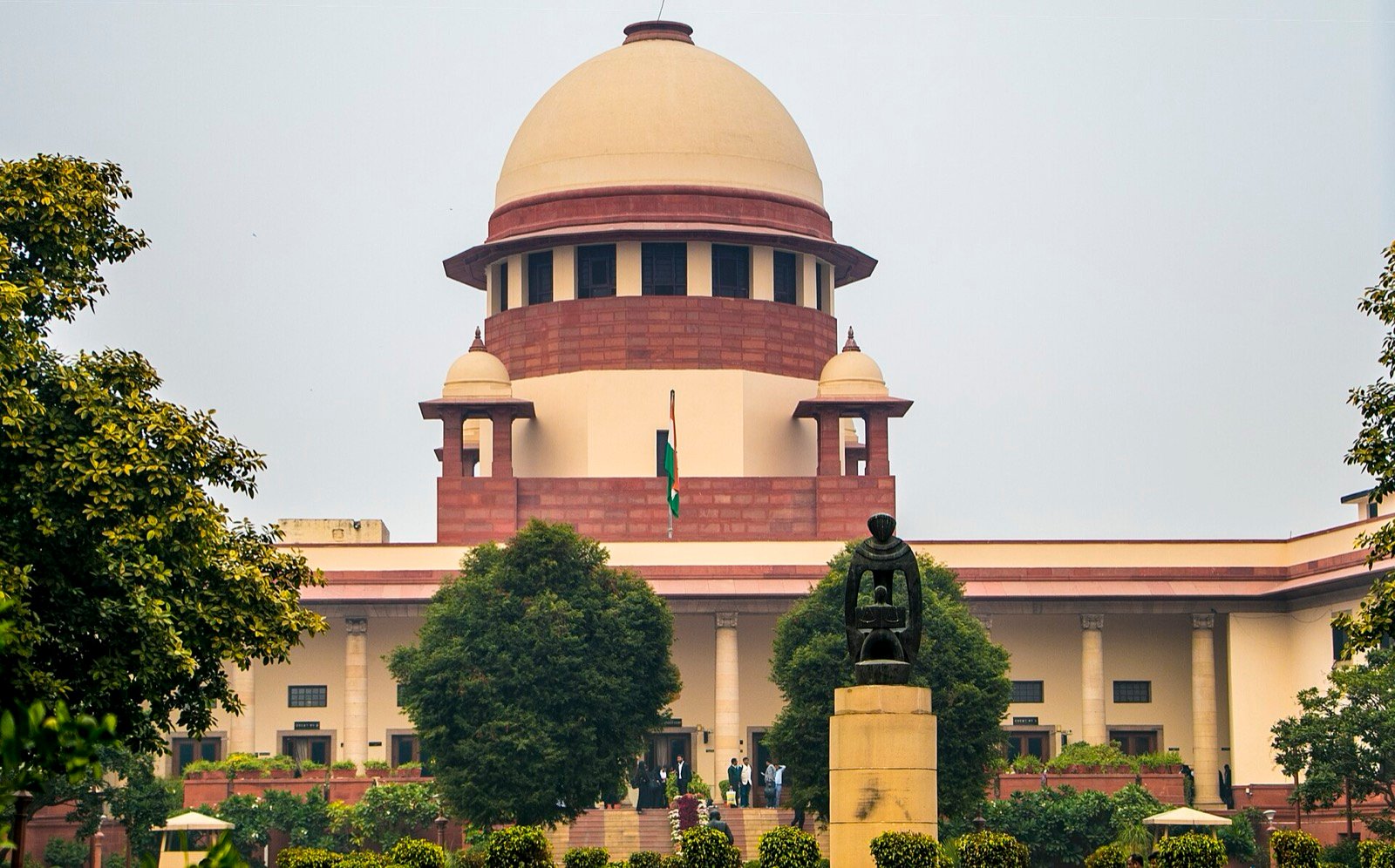
Status: the Supreme Court’s judgment of 22 August 2017 and the Muslim Women (Protection of Rights on Marriage) Act, 2019 are both in force. The criminal penalty in the Act is under challenge in the Supreme Court (Supreme Court Observer).
- 2017 judgment: set aside instant triple talaq by 3:2; settled law.
- 2019 Act: void and illegal, up to three years’ imprisonment; challenge pending, FIR data sought on 29 January 2025.
- Next update: if the Supreme Court hears or decides the challenge to the 2019 Act.
💡 Short Answer
Shayara Bano’s 2016 petition led the Supreme Court, on 22 August 2017, to set aside instant triple talaq by a 3:2 majority. Parliament then passed the Muslim Women (Protection of Rights on Marriage) Act, 2019, which received assent on 31 July 2019, makes the practice void and illegal and provides up to three years’ imprisonment. The judgment and the Act are different steps, and the Act’s criminal penalty is still being challenged.
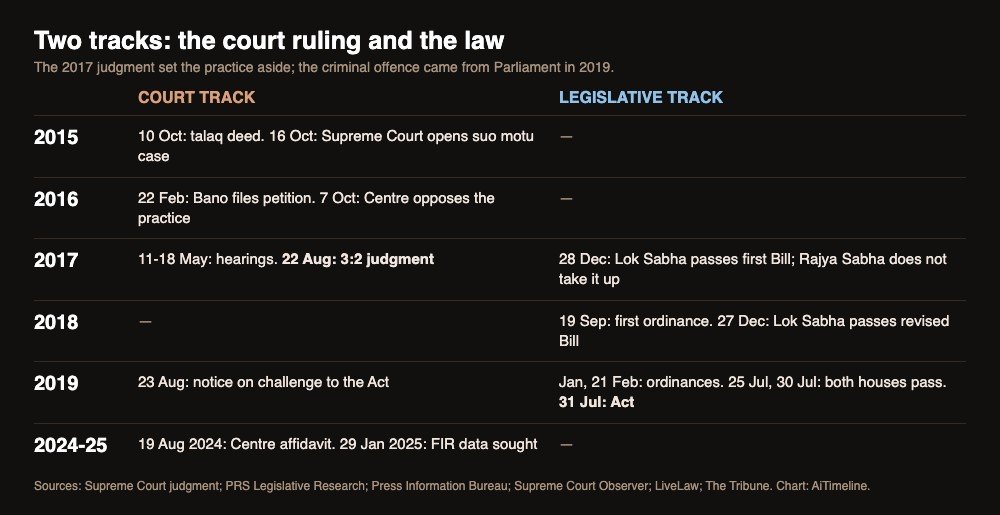
The 2017 Judgment and the 2019 Law Are Different Things
The Court set the practice aside; Parliament created the offence.
| Question | 2017 judgment (22 Aug 2017) | 2019 Act (31 Jul 2019) |
|---|---|---|
| What it is | A Supreme Court order, by 3:2, setting aside talaq-e-biddat | A statute passed by Parliament |
| Legal effect | Practice set aside; no statutory offence created | Instant talaq void and illegal; pronouncing it is an offence |
| Penalty | None created by the Court | Up to three years’ imprisonment and a fine |
| Wife’s remedies | Not specified in the order | Subsistence allowance and custody of minor children, set by a Magistrate |
| Who decided | Five-judge Constitution Bench | Lok Sabha (25 Jul 2019) and Rajya Sabha (30 Jul 2019, 99 to 84) |
| Status in 2026 | Settled law | In force; its criminal penalty is challenged in the Supreme Court |
Setting aside a practice and creating a statutory offence are different legal steps. The 2017 order contains no penalty. Two of the five judges would instead have left the remedy to Parliament and directed the Union to consider legislation. Parliament acted over the next two years through a Bill, three ordinances and, finally, the 2019 Act (Press Information Bureau; PRS Legislative Research).
Shayara Bano Case: Key Questions
The Shayara Bano Case in Nine Points
- Trigger: a talaqnama dated 10 October 2015, according to the judgment.
- Petition: Writ Petition (C) 118 of 2016, filed in February 2016.
- Verdict: 22 August 2017, 3:2, talaq-e-biddat set aside.
- Different reasoning: two judges relied on Article 14, one on the Quran.
- Dissent: two judges left reform to Parliament and injuncted the practice for six months.
- Legislation: a 2017 Bill, three ordinances, then the 2019 Act.
- Act: void and illegal, up to three years’ imprisonment, assent 31 July 2019.
- Not decided: polygamy and nikah halala were not resolved by the 22 August order.
- Today: the Act’s criminal penalty is under challenge.
Shayara Bano Case Timeline, Latest First
From the 2025 hearing on the 2019 Act back to the 1937 Shariat Act. Each entry is tagged and ends with why it matters.
2025
Supreme Court asks the Centre for FIR data; the challenge to the 2019 Act stays pending Latest
The 2019 Act has itself been challenged. Petitions from Samastha Kerala Jamiathul Ulema, Jamiat Ulama-i-Hind and Amir Rashadi Madani were filed in August 2019, and on 23 August 2019 the Supreme Court issued notice to the Union (Supreme Court Observer). Petitioners argue the practice was already void after 2017, so criminal penalties were unnecessary, and that the law targets Muslim husbands on grounds of religion (Article 15). In an affidavit reported on 19 August 2024 the Centre defended the Act, calling triple talaq “fatal” to the institution of marriage and saying the 2017 judgment had not been a sufficient deterrent (The Tribune).
On 29 January 2025 a bench of Chief Justice Sanjiv Khanna and Justice Sanjay Kumar asked the Union for the number of FIRs under Sections 3 and 4 of the Act, the number of cases still pending, and figures for rural areas (LiveLaw). We found no ruling on the challenge and no published FIR count as of 28 October 2026; the case remains listed as pending.
Shayara Bano joins the BJP in Uttarakhand Background
Shayara Bano joined the Bharatiya Janata Party in Uttarakhand in October 2020, reported on 11 October as having happened the previous Saturday; she said she had not joined to seek a party ticket (Madhyamam). The 2017 judgment does not depend on her later politics; we include it only as a dated fact about the petitioner.
2019
The Muslim Women (Protection of Rights on Marriage) Act, 2019 receives assent Legislation
The Act declares any talaq pronounced by a Muslim husband in the form of talaq-e-biddat, or any similar instant and irrevocable form, void and illegal. A husband faces up to three years’ imprisonment and a fine. The offence is cognizable only if information is given by the married woman or a person related to her by blood or marriage; the Magistrate may compound it at the woman’s request; and bail can be granted only after hearing the woman. She may seek subsistence allowance for herself and dependent children, and custody of minor children, as fixed by the Magistrate (Press Information Bureau; PRS Legislative Research). The Act is deemed in force from 19 September 2018, the date of the first ordinance.
2019
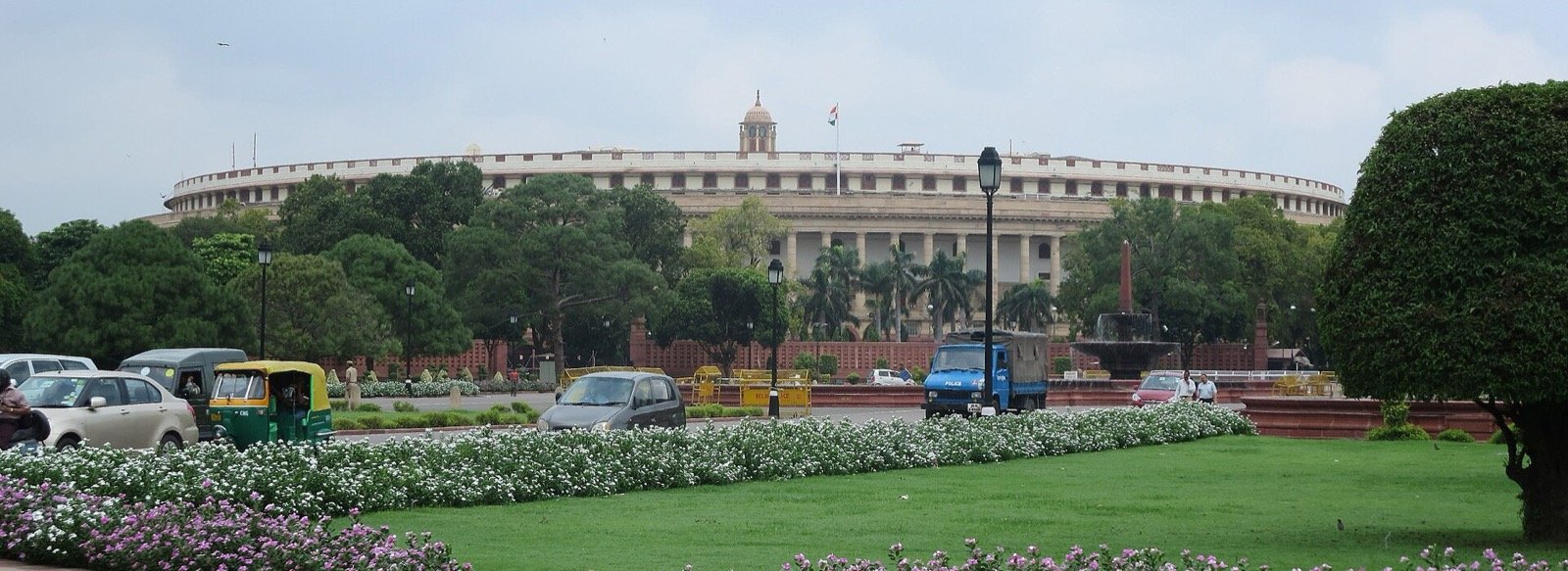
Rajya Sabha passes the Bill 99 to 84 Legislation
The Rajya Sabha passed the Bill with 99 votes in favour and 84 against. It rejected the opposition’s demand to refer the Bill to a select committee (The Leaflet). The Biju Janata Dal backed the Bill, while JD(U) and the AIADMK walked out (Scroll.in). Critics argued the offence should have remained civil; supporters said criminal penalties were needed because the 2017 ruling alone had not stopped the practice.
2019
Lok Sabha passes the Bill Legislation
After about five hours of debate the Lok Sabha carried the motion to consider the Bill 303 to 82 on 25 July, and Speaker Om Birla declared it passed on a voice vote (LiveLaw). The Bill was to replace the February ordinance. It changed contentious provisions of the 2017 Bill, which had made the offence cognizable for anyone to report, non-bailable and non-compoundable. Introducing it, Law Minister Ravi Shankar Prasad said 345 cases of triple talaq had been reported after the August 2017 verdict, a government claim we could not independently verify.
2019
Third ordinance is promulgated Legislation
The Muslim Women (Protection of Rights on Marriage) Second Ordinance, 2019 was promulgated on 21 February 2019, the third ordinance on the subject; PRS notes similar ordinances in September 2018 and January 2019, and that this one took effect from the date of the first (PRS Legislative Research; The Leaflet). It restated the offence, the penalty, the bail and compounding rules, and the allowance and custody provisions.
Second ordinance after the winter session Legislation
After the Rajya Sabha did not clear the revised Bill in the winter session, the government re-promulgated the ordinance in January 2019; reports differ on whether the date was 10 or 12 January (The Leaflet). Ordinances are temporary and must be placed before Parliament.
2018
Lok Sabha passes a revised Bill; Rajya Sabha does not Legislation
The revised Bill, introduced on 17 December 2018 to replace the ordinance, was passed by the Lok Sabha in the winter session, on 27 December (ETV Bharat chronology). The opposition stalled it in the Rajya Sabha on 31 December, and it lapsed when the 16th Lok Sabha was dissolved (LiveLaw).
2018
First ordinance makes instant triple talaq a criminal offence Legislation
The government promulgated the first ordinance on 19 September 2018, after the 2017 Bill had stalled in the Rajya Sabha. Some outlets give 18 or 20 September; the official factsheet and PRS use 19 September, which is also the date from which the 2019 Act is deemed to apply (Press Information Bureau; PRS Legislative Research).
2017
Lok Sabha passes the first Bill; it is not taken up in the Rajya Sabha Legislation
The Lok Sabha passed the 2017 Bill on 28 December by voice vote. As drafted it made the offence cognizable on anyone’s complaint, non-bailable and non-compoundable (LiveLaw). The Rajya Sabha did not take it up because the opposition wanted it sent to a select committee, and the session ended with the Bill stuck (Udayavani).
2017
Supreme Court sets aside talaq-e-biddat by 3:2 Court
The Court’s order was one line: “In view of the different opinions recorded, by a majority of 3:2 the practice of ‘talaq-e-biddat’ – triple talaq is set aside” (Supreme Court judgment). The five judges did not agree on why.
The majority. Justices Rohinton Fali Nariman and Uday Umesh Lalit held that the 1937 Act, insofar as it recognises and enforces triple talaq, is a “law in force” under Article 13(1) and void to that extent, because the practice is manifestly arbitrary and violates Article 14; they did not need to decide the discrimination argument. Justice Kurian Joseph agreed in a separate opinion, reasoning that the practice has no sanction in the Quran and so cannot be protected as religion (Supreme Court Observer).
The dissent. Chief Justice J.S. Khehar and Justice S. Abdul Nazeer concluded that the petitioners’ challenge must fail “on the judicial front”, treating the practice as a matter of faith for Parliament rather than the Court to change. But because all sides called it arbitrary and gender discriminatory, they used Article 142 to direct the Union to consider legislation and, until then, to injunct Muslim husbands from pronouncing talaq-e-biddat for six months, continuing if the legislative process began (paragraphs 197–200 of the judgment).
The ruling covered instant triple talaq only. Bano’s petition had also raised polygamy and nikah halala, which this order did not decide.
2017
Constitution Bench hears the case over a week Court
Hearings began on 11 May, when the Court said it would examine whether the practice is fundamental to Islam. On 15 May the Centre said it would bring a new law if triple talaq was struck down. On 16 May the AIMPLB argued that matters of faith cannot be tested on constitutional morality. The bench reserved its verdict on 18 May (Onmanorama). In an affidavit the AIMPLB also undertook to advise those performing nikah to counsel grooms not to pronounce three talaqs at once (judgment, para 198).
2017
The Court calls the issues “very important” and sets a Constitution Bench Court
On 30 March the Supreme Court said the questions were important enough for a Constitution Bench and fixed 11 May for hearing (Onmanorama; Supreme Court Observer). On 27 March the AIMPLB had argued the pleas were not maintainable.
2017
Court says a five-judge bench will be formed Court
On 16 February the Court said a five-judge Constitution Bench would be set up and asked the AIMPLB, the Union and women’s groups for written submissions; other pleas had been tagged with the main case two days earlier (Supreme Court Observer; Onmanorama).
2016
Allahabad High Court judge criticises triple talaq, but does not rule Court
A single judge of the Allahabad High Court, Justice Suneet Kumar, called triple talaq “cruel” and said personal laws cannot claim supremacy over rights granted by the Constitution. Many outlets reported that he had declared it unconstitutional; Scroll.in noted that the court did not rule because the matter was already before the Supreme Court, and the AIMPLB said “this is not a judgment, just an observation” (Scroll.in).
2016
The Centre tells the Supreme Court the practice should be tested on gender justice Court
The government told the Supreme Court that the practice’s validity should be judged by gender-justice standards and that triple talaq, polygamy and nikah halala were not essential Islamic practices (Scroll.in; Onmanorama).
2016
Shayara Bano files her Supreme Court petition Court
Shayara Bano filed a writ petition in the Supreme Court challenging talaq-e-biddat, polygamy and nikah halala, and seeking a declaration that her husband’s talaq was void (Supreme Court Observer; judgment). It was heard together with other petitions and the Court’s own suo motu case.
2015
Supreme Court registers its own case on Muslim women’s rights Court
A two-judge bench of Justices Anil Dave and Adarsh Kumar Goel asked the Chief Justice to constitute a bench to examine gender discrimination suffered by Muslim women, and the matter was registered as a suo motu public interest case, arising while it was dealing with a Hindu succession matter (ETV Bharat chronology; Legally India). It was later heard with Shayara Bano’s petition.
2015
Rizwan Ahmad pronounces talaq; the “deed of divorce” is dated 10 October Court
According to the judgment, Rizwan Ahmad’s talaqnama dated 10 October 2015 recorded that he had said “talak, talak, talak” before two witnesses and that there was no longer a marriage (Supreme Court judgment). The couple were married on 11 April 2001 and had two children. The husband’s account, recorded in the judgment, is that she left the matrimonial home in April 2015 and he had filed for restitution of conjugal rights; Bano’s petition alleged dowry demands and cruelty. Those are the parties’ competing accounts, not findings.
Parliament overrides the Shah Bano ruling Background
In Mohd. Ahmed Khan v. Shah Bano Begum (23 April 1985) the Supreme Court granted a divorced Muslim woman maintenance; in 1986 Parliament passed the Muslim Women (Protection of Rights on Divorce) Act in response (Wikipedia). The episode is the usual background for debates about courts, Parliament and Muslim personal law.
Muslim Personal Law (Shariat) Application Act Background
The Act provides for the application of Muslim personal law to specified matters. In Shayara Bano the question was whether it recognised and enforced triple talaq so that the practice could be tested against the Constitution; Justices Nariman and Lalit held that, to that extent, Section 2 of the Act is void (Supreme Court judgment).
How the Five Judges Split
Three judges set the practice aside, for different reasons; two dissented.
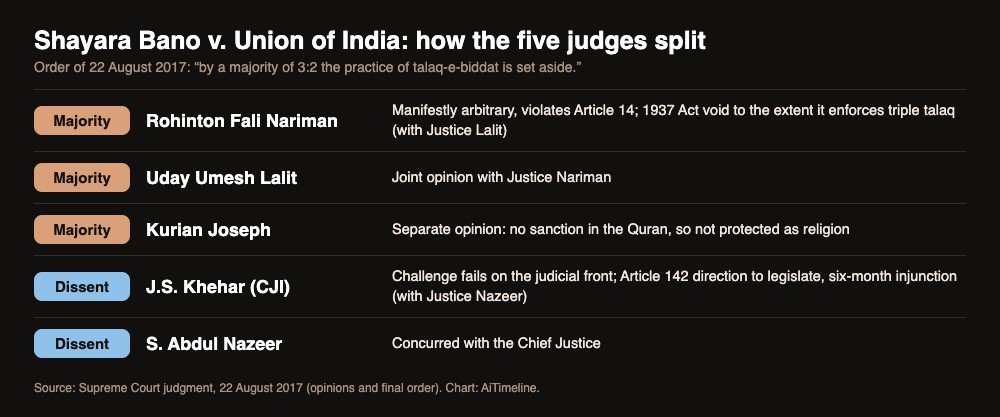
The order of the Court is a single line, but the judgment runs to hundreds of pages. Justices Nariman and Lalit rested on Article 14 and the narrower ground of manifest arbitrariness; Justice Kurian Joseph rested on the Quran. The dissenting Chief Justice and Justice Nazeer held that the challenge failed on the judicial front but still used Article 142 to direct the Union to consider legislation (paragraphs 197–200). Readers should not treat “3:2” as meaning that three judges gave one reason.
What Is Triple Talaq?
In the form challenged in this case, triple talaq, or talaq-e-biddat, refers to a husband pronouncing talaq three times in a single sitting, or in an equivalent form, so that the divorce is instant and irrevocable. The Supreme Court case concerned that instant form, not every form of divorce under Muslim law. The 2019 Act defines it in the same way: talaq-e-biddat or any similar form having the effect of instantaneous and irrevocable divorce (PRS Legislative Research).
The 1937 Shariat Act is part of the legal background; the Court had to decide whether it recognised and enforced the practice. Justices Nariman and Lalit held that, to that extent, Section 2 of the 1937 Act is void (judgment).
Why Did Shayara Bano Challenge Triple Talaq?
According to the judgment, her husband’s deed of divorce dated 10 October 2015 recorded that he had said “talak, talak, talak” before two witnesses (judgment). Bano asked for a declaration that the talaq was void and challenged the practice, with polygamy and nikah halala, as violating equality and dignity. The husband’s account, recorded in the same judgment, differs on the circumstances of the separation.
The Union of India took a position against the practice, the AIMPLB defended it as a matter of faith beyond judicial review, and women’s groups supported the petitioners. The judges disagreed on the legal route, but a majority set aside the practice.
What the 2019 Act Provides
The 2019 Act kept the three-year penalty but added safeguards compared with the 2017 Bill.
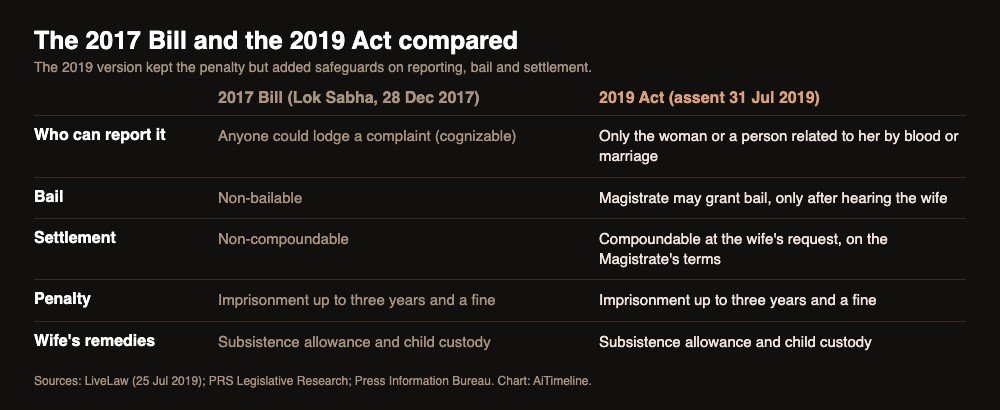
The Act declares talaq-e-biddat void and illegal. The offence is cognizable only on information from the married woman or a person related to her by blood or marriage; it can be compounded at her request, and bail is granted only after the Magistrate hears her. She may seek subsistence allowance and custody of minor children (Press Information Bureau; PRS Legislative Research). These provisions have been debated: supporters say criminal law deters the practice; petitioners in the Supreme Court say the practice was already void after 2017 and that criminal penalties are unnecessary and unequal (The Tribune).
What Happens Next?
1. The challenge to the Act. The petitions, filed in 2019, remain pending; the Court asked the Union for FIR data on 29 January 2025 (LiveLaw). We found no final ruling.
2. The data. The number of FIRs and pending cases under Sections 3 and 4, once published, will show how the Act works in practice.
3. The settled part. No petition seeks to revive instant triple talaq; reports say the petitioners do not defend it (Supreme Court Observer).
Key People and Parties
Shayara Bano
From Kashipur, Uttarakhand. Her Writ Petition (C) 118 of 2016 sought a declaration that the talaq of 10 October 2015 was void, and challenged talaq-e-biddat, polygamy and nikah halala.
J.S. Khehar
Wrote the dissent with Justice Nazeer: the challenge failed on the judicial front, but he directed the Union to consider legislation and injuncted the practice for six months.
R.F. Nariman and U.U. Lalit
Held that talaq-e-biddat is manifestly arbitrary and violates Article 14, and that the 1937 Act is void to the extent it enforces it.
Kurian Joseph
Concurred in a separate opinion, reasoning that the practice has no sanction in the Quran.
AIMPLB
The All India Muslim Personal Law Board argued matters of faith cannot be tested on constitutional morality; it undertook to advise against pronouncing three talaqs at once.
Ravi Shankar Prasad
Law Minister who introduced the 2019 Bill; the Centre defended the Act in a 2024 affidavit.
Explore More Timelines
People Also Ask
Frequently Asked Questions About the Shayara Bano Case
A Case About Where Reform Comes From
The Shayara Bano case turned one woman’s divorce into a constitutional question and ended with a split bench setting aside instant triple talaq. Its timeline shows reform in stages: a petition, a divided judgment, political debate and a statute. The defining milestone is 22 August 2017; the 2019 Act then gave the framework a statutory form, and that Act is the part still being tested.
Related AiTimeline Stories
⚠️ Editorial Note
Last updated 28 October 2026. This article keeps the Supreme Court’s 2017 judgment and the 2019 Act separate, and covers instant triple talaq only. Allegations are attributed to the parties. We checked the source brief against the judgment and corrected it: the talaq deed is dated 10 October 2015 and the marriage 11 April 2001 (one reference gives 2002); the 8 December 2016 Allahabad High Court remarks were an observation, not a ruling; there were three ordinances (not two) between September 2018 and February 2019; the first Bill passed the Lok Sabha on 28 December 2017 and the revised Bill on 27 December 2018; the dissenting judges directed legislation and a six-month injunction; and the vague “2015 scrutiny” entry is replaced by the Court’s 16 October 2015 suo motu order. This is a general explainer and not legal advice.
Sources & further reading
Every dated entry above was checked against these references. Last reviewed 28 October 2026.
- Supreme Court of India: Shayara Bano v. Union of India, judgment of 22 August 2017 (PDF)
- Supreme Court Observer: Shayara Bano v. Union of India (triple talaq) plain-English summary of the judgment
- Supreme Court Observer: Triple Talaq case timeline
- Press Information Bureau: The Muslim Women (Protection of Rights on Marriage) Act, 2019
- PRS Legislative Research: The Muslim Women (Protection of Rights on Marriage) Second Ordinance, 2019 (27 February 2019)
- LiveLaw: Triple Talaq Bill passed by Lok Sabha (25 July 2019)
- Supreme Court Observer: Criminalisation of Triple Talaq, case background (WP (C) 994/2019)
- LiveLaw: Supreme Court asks Union for data on cases under the Muslim Women Act (29 January 2025)
- The Tribune: Triple talaq fatal to institution of marriage, Centre tells Supreme Court (19 August 2024)
- Scroll.in: Allahabad High Court judge calls triple talaq cruel, but does not rule (8 December 2016)