Hathras Stampede: Causes, Accountability, and Aftermath Timeline
A dated record of the 2024 Hathras stampede: the crowd-management failures, the SIT and judicial commission findings, the chargesheet against 11 accused
Latest Story
On 2 July 2024, a stampede at a religious gathering (satsang) in Phulrai village, Hathras district, Uttar Pradesh, killed 121 people and injured many others. An event permitted for around 80,000 people reportedly drew several times that number. A judicial commission later identified serious lapses by organisers and local authorities and said a conspiracy could not be ruled out. In August 2025, a court framed charges against 11 accused, and the Hathras stampede trial remains ongoing, with the preacher who led the gathering never named as an accused.
💡 Short Answer
A stampede at a satsang near Hathras on 2 July 2024 killed 121 people after a crowd of roughly 2.5-3 lakh, several times the permitted 80,000, surged at once onto an unbarricaded, muddy slope. A judicial commission blamed organisers and administrative lapses, and could not rule out a conspiracy. A sessions court framed charges against 11 accused on 6 August 2025; the trial is ongoing in 2026, and the preacher who led the gathering, Suraj Pal Singh (Bhole Baba), was never named as an accused.
Hathras Stampede: Key Questions
The Hathras Stampede Case in Nine Points
- 2 July 2024: a crush at a satsang near Phulrai village, Hathras, killed 121 people, most of them women.
- Crowd size: organisers sought permission for 80,000; roughly 2.5-3 lakh people reportedly attended.
- FIR: registered the same day against chief organiser Devprakash Madhukar and unnamed others; Bhole Baba was not named.
- SIT: found organisers primarily responsible and flagged administrative lapses; six local officials were suspended on 9 July 2024.
- Chargesheet: filed in October 2024 against 11 people; roughly 3,200 pages; Bhole Baba not named.
- Judicial commission: led by retired judge Brijesh Kumar Srivastava, reported serious lapses and said a conspiracy could not be ruled out; reports describe it as not finding Bhole Baba directly responsible.
- Charges framed: against all 11 accused on 6 August 2025; trial began 18 August 2025 with 676 listed witnesses.
- Compensation: Rs 2 lakh per deceased victim’s family, Rs 50,000 per injured person, announced by the Uttar Pradesh government.
- Status, 2026: trial ongoing, most listed witnesses not yet examined, all 11 accused on bail, no verdict delivered.
Where the Hathras stampede case stands
- Trial: ongoing. A sessions court framed charges against all 11 accused on 6 August 2025, and the trial opened on 18 August 2025 with 676 listed prosecution witnesses.
- Pace: reporting around the case’s two-year mark (2 July 2026) said only 30 of 676 witnesses had completed testimony, leaving 646 still to be examined — a figure we could not independently re-verify beyond early-2026 reporting.
- Bail: all 11 accused were reported out on bail as the trial proceeded.
- Bhole Baba: never named as an accused in the FIR or chargesheet. Reports describe the judicial commission as not finding him directly responsible, though victims’ families have voiced disappointment with that finding.
- Verdict: none delivered. Check the Hathras sessions court record for the latest hearing date and witness count.
The story in six pictures
What Happened at Hathras
A satsang that outgrew its own permission.
The gathering on 2 July 2024
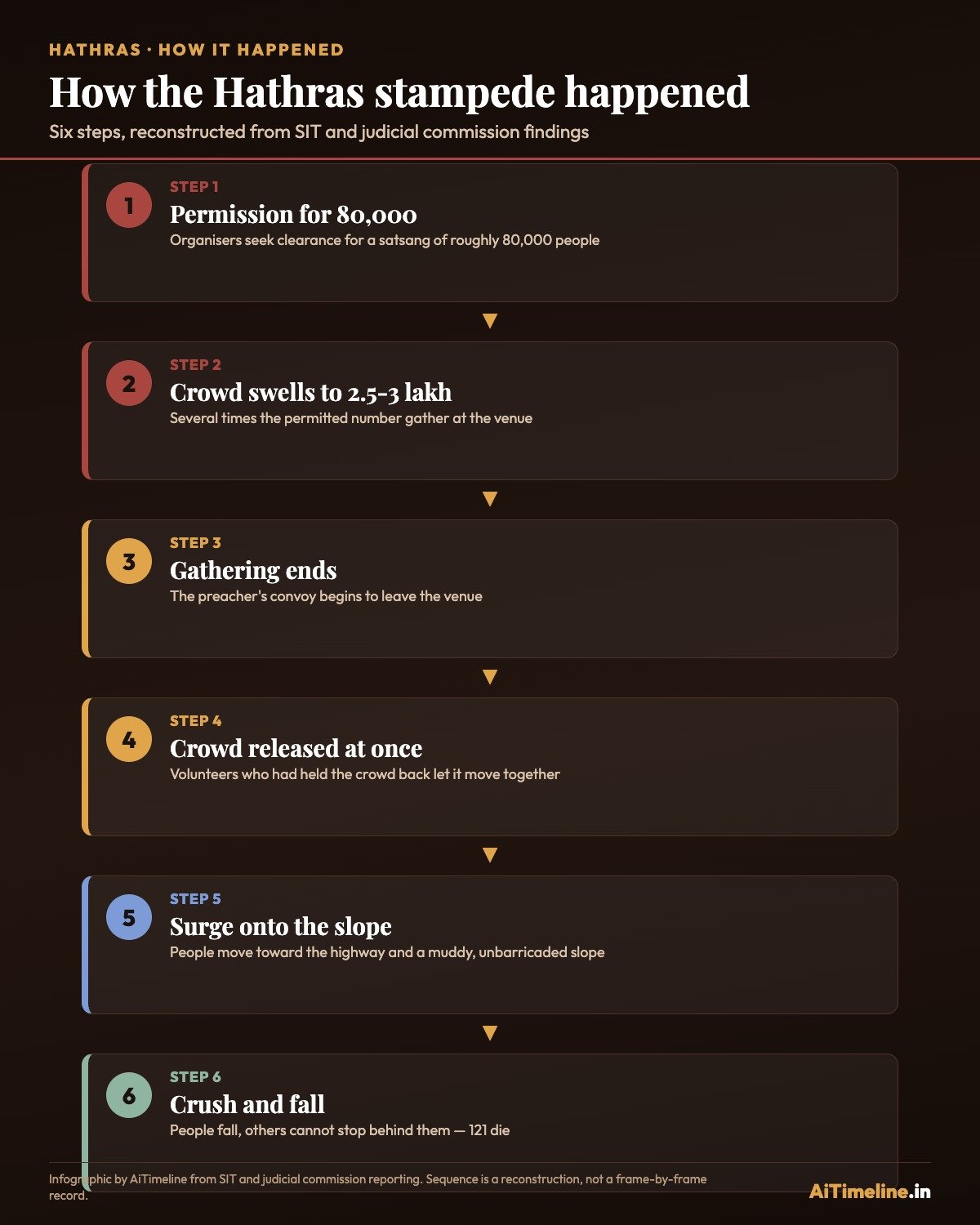
Thousands of devotees attended a satsang led by preacher Suraj Pal Singh, popularly known as Bhole Baba, at a site near Phulrai village in the Sikandra Rao area of Hathras district, Uttar Pradesh. When the gathering ended and the preacher was leaving, a massive crowd began moving at once. People fell near a sloping, muddy area beside the road. Others behind them could not stop or move around the fallen people. The resulting crush killed 121 people, many of them women, and injured others.
A crowd several times the permitted size
The scale of the gathering was central to every investigation that followed. Organisers had reportedly sought permission for around 80,000 attendees, while the actual crowd was estimated at approximately 2.5-3 lakh (250,000-300,000) — a gap that both the SIT and the judicial commission treated as the starting point for everything that went wrong.
How to read this record
Entries below are colour-coded into four tracks: the stampede and victims, the investigation and administrative action, the courts and trial, and accountability and public debate. Being charged is not the same as being convicted; all 11 accused are presumed innocent unless and until a court decides otherwise. For another case where investigators, a judicial inquiry and a criminal trial all ran in parallel, see our Bulldozer Demolitions Judgment timeline.
How Did the Stampede Happen?
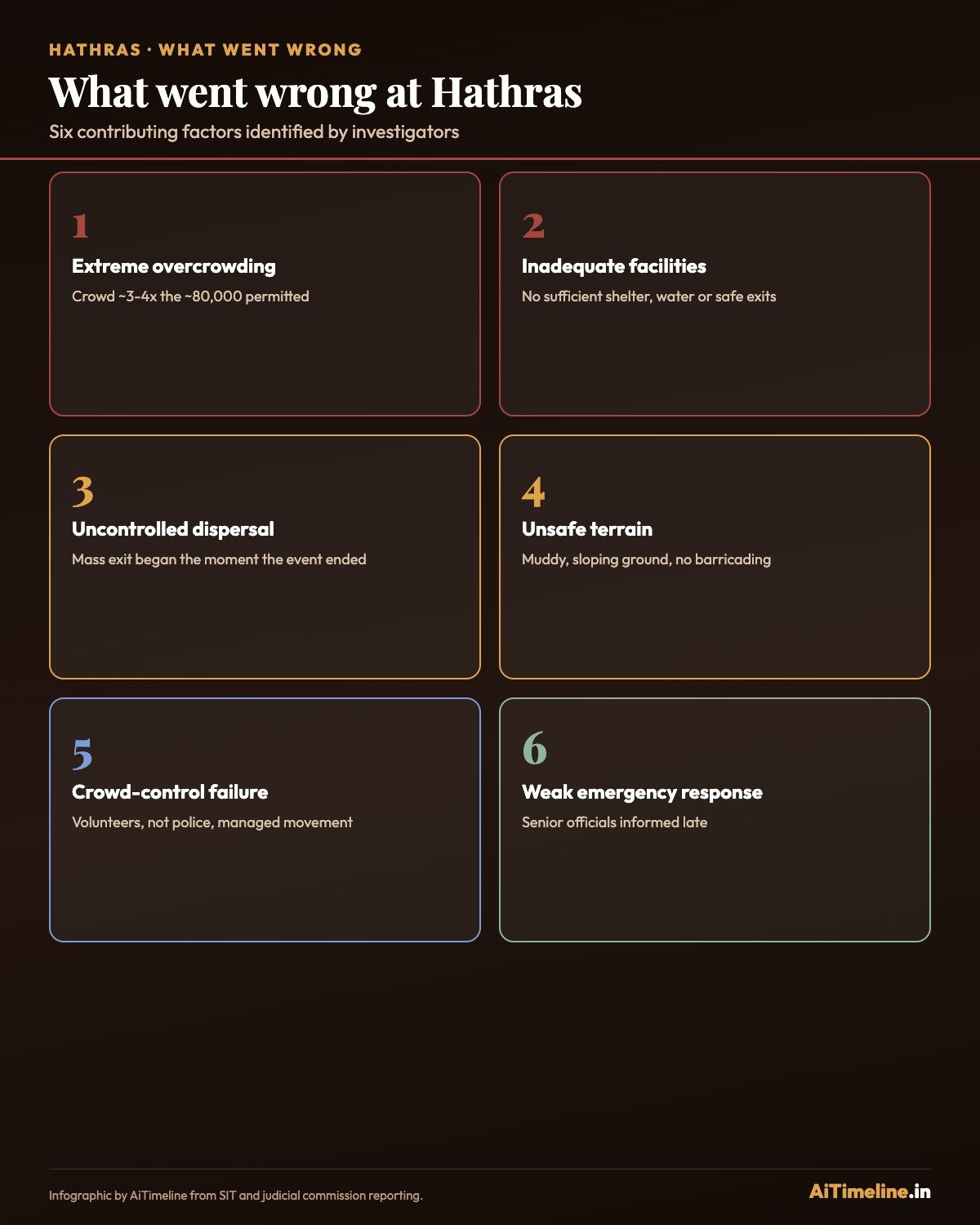
Six contributing factors, as described by the SIT and the judicial commission.
| Factor | What investigators found |
|---|---|
| Extreme overcrowding | The crowd was reportedly 3-4 times the roughly 80,000 stated in the permission application |
| Inadequate facilities | The venue lacked sufficient shelter, ventilation, drinking-water arrangements and safe movement routes for a crowd of this size |
| Uncontrolled dispersal | Large numbers of people began leaving together immediately after the programme ended |
| Unsafe ground conditions | A sloping area beside the highway was muddy and slippery, and lacked adequate barricading |
| Crowd-control failures | Organisers’ own volunteers controlled movement; police and administration played a largely passive role in the arrangements |
| Weak emergency coordination | Senior officials were reportedly informed late, and communication between deployed personnel was inadequate |
The judicial commission discussed the possibility that some devotees tried to collect dust from the preacher’s path as he left, but it did not establish this as the definitive cause. It separately ruled out organisers’ own claim that a toxic spray in the crowd triggered the crush.
Investigation: Who Was Held Responsible?
Three parallel processes: the police, the SIT, and the judicial commission.
Four stages shaped the response to the stampede. Each is described below as it appears in the record; allegations in a chargesheet are not findings of guilt, and a commission’s recommendation to investigate further is not a finding that something occurred.
| Stage | Who | Position |
|---|---|---|
| 1. First FIR | Local police, 2 Jul 2024 | Named chief organiser Devprakash Madhukar and unidentified organisers/sevadars; culpable homicide not amounting to murder, wrongful restraint, causing disappearance of evidence; did not name Bhole Baba |
| 2. SIT findings | Special Investigation Team, Jul 2024 | Permission granted without adequate site inspection; organisers under-prepared for the real crowd; officials failed to assess the scale; six officials suspended 9 Jul 2024 |
| 3. Police chargesheet | Hathras Police, Oct 2024 | ~3,200 pages against 11 people led by Madhukar; records allegations, not a finding of guilt; Bhole Baba not named |
| 4. Judicial commission | Justice Brijesh Kumar Srivastava panel, Mar 2025 | Serious lapses in permission, planning and coordination; conspiracy “cannot be ruled out,” recommends further SIT probe; reports describe no direct role found for Bhole Baba |
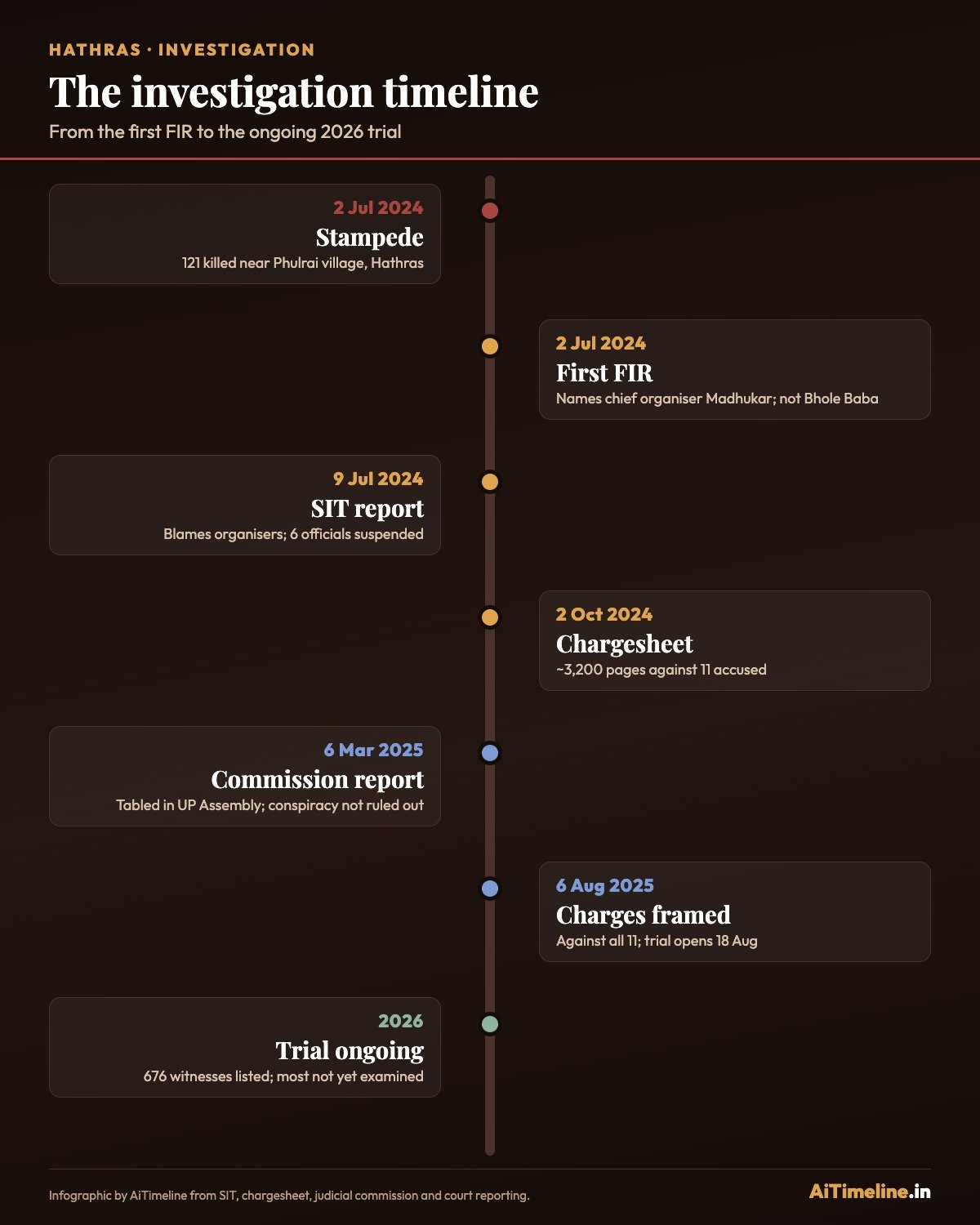
Hathras Stampede Timeline, 2024 to 2026, Latest First
Entries are colour-coded by track. Allegations are labelled as such.
Two-year mark: trial still at an early evidentiary stage Accountability and public debate
What was reported: Coverage marking two years since the stampede said only 30 of the 676 listed prosecution witnesses had completed testimony, leaving 646 still to be examined, and that all 11 accused remained out on bail.
Caveat: We could not independently re-verify court proceedings after early 2026; treat this specific witness count as reported by the source cited rather than independently confirmed by us.
17th prosecution witness completes testimony Courts, trial and bail
What happened: A woman sub-inspector, the 17th prosecution witness, completed her testimony, continuing the slow pace of evidence recording.
Head constable’s testimony and cross-examination completed Courts, trial and bail
What happened: Testimony and cross-examination of a head constable attached to the Local Intelligence Unit were completed as prosecution evidence continued.
Court records a police sub-inspector’s statement Courts, trial and bail
What happened: A local court recorded the statement of a police sub-inspector as prosecution evidence continued, part of the early stage of witness examination.
Trial proceedings begin; 676 witnesses listed Courts, trial and bail
What happened: Trial proceedings were scheduled to commence, with the prosecution listing 676 witnesses for examination.
Sessions court frames charges against all 11 accused Courts, trial and bail
What happened: A sessions court framed charges against all 11 accused named in the police chargesheet, moving the case from the investigation stage to trial. The trial was scheduled to begin on 18 August.
Caveat: Being charged is not a finding of guilt; the prosecution must still prove the charges at trial.
Judicial commission report tabled in the UP Assembly Courts, trial and bail
What it found: The commission, which had submitted its findings to the state government in February 2025, was tabled in the UP Assembly around 5-6 March 2025. It found serious lapses in permission procedures, crowd planning and coordination between organisers and local police and administration.
On Bhole Baba: Multiple reports describe the commission as not finding a direct role for the preacher in causing the stampede, framed in press coverage as a ‘clean chit’ on that specific question; it placed primary responsibility on the organisers and administrative lapses.
On conspiracy: It said the possibility of a conspiracy, including one aimed at discrediting the state government, could not be ruled out, and recommended the SIT investigate that angle further. It separately ruled out the organisers’ claim that a toxic spray caused the crush.
Police file a roughly 3,200-page chargesheet against 11 Investigation and administrative action
What happened: Hathras police filed a chargesheet of approximately 3,200 pages naming 11 people, led by chief organiser Devprakash Madhukar. Suraj Pal Singh (Bhole Baba) was not named.
Caveat: A chargesheet records the investigating agency’s allegations. It is not a finding of guilt.
SIT report lands; six officials suspended Investigation and administrative action
What happened: The state-appointed SIT submitted its preliminary findings, concluding that permission for the event had been granted without an adequate site inspection and that organisers had not planned for a crowd far larger than permitted. The same day, the Uttar Pradesh government suspended six local officials, including the sub-divisional magistrate, the circle officer and the station house officer.
Police arrest the chief organiser and others linked to the event Investigation and administrative action
What happened: Police arrested chief organiser Devprakash Madhukar and other people linked to the event’s organisation in the days immediately after the stampede.
Death toll confirmed at 121; judicial inquiry announced The stampede and the victims
What happened: The death toll was confirmed at 121. The Uttar Pradesh government announced a judicial inquiry and constituted a three-member commission headed by retired Allahabad High Court judge Brijesh Kumar Srivastava. The first FIR, filed a day earlier, had not named Bhole Baba as an accused.
A crush at a satsang near Phulrai village kills 121 people The stampede and the victims
What happened: Thousands of devotees attended a satsang led by preacher Suraj Pal Singh near Phulrai village. As the gathering ended and the preacher’s convoy began leaving, a large section of the crowd surged at once. People fell on a sloping, muddy stretch of ground beside the highway, and those behind them could not stop or move around the fallen, resulting in a fatal crush.
Scale: Organisers had sought permission for roughly 80,000 attendees; reports and later investigations put the actual crowd at approximately 2.5-3 lakh people.
The 11 Accused: What the Chargesheet Alleges
A chargesheet records allegations. None of the 11 has been convicted.
| Accused | Role in chargesheet | Status |
|---|---|---|
| Devprakash Madhukar | Named as chief organiser | Charged 6 Aug 2025; on bail; trial ongoing |
| Mukesh Kumar | Named in chargesheet | Charged 6 Aug 2025; on bail; trial ongoing |
| Manju Yadav | Named in chargesheet | Charged 6 Aug 2025; on bail; trial ongoing |
| Manju Devi | Named in chargesheet | Charged 6 Aug 2025; on bail; trial ongoing |
| Ram Ladete | Named in chargesheet | Charged 6 Aug 2025; on bail; trial ongoing |
| Upendra Singh Yadav | Named in chargesheet | Charged 6 Aug 2025; on bail; trial ongoing |
| Megh Singh | Named in chargesheet | Charged 6 Aug 2025; on bail; trial ongoing |
| Sanju Kumar | Named in chargesheet | Charged 6 Aug 2025; on bail; trial ongoing |
| Ram Prakash Shakya | Named in chargesheet | Charged 6 Aug 2025; on bail; trial ongoing |
| Durvesh Kumar | Named in chargesheet | Charged 6 Aug 2025; on bail; trial ongoing |
| Dalveer Singh | Named in chargesheet | Charged 6 Aug 2025; on bail; trial ongoing |
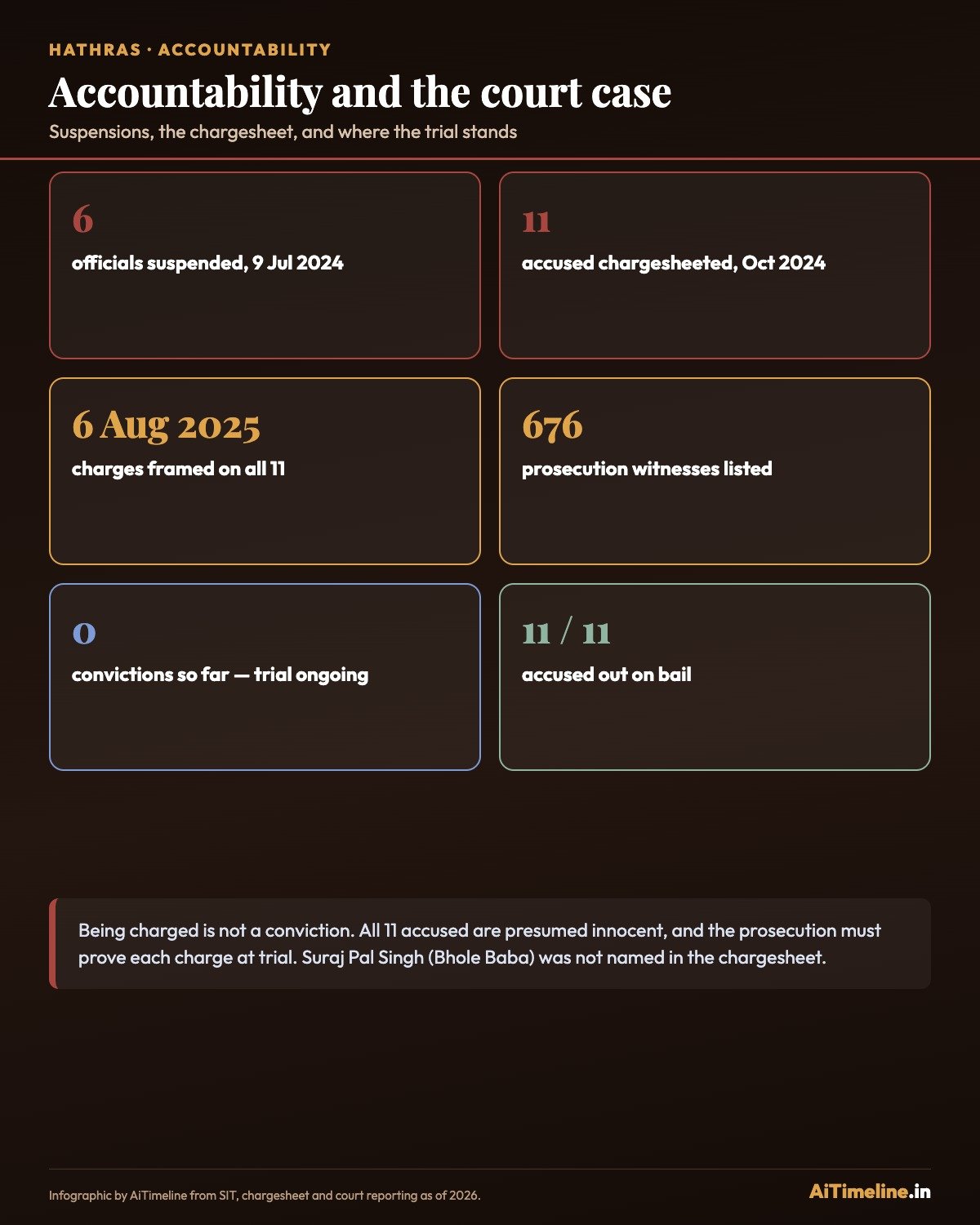
Being charged is not a conviction. The accused are entitled to the presumption of innocence, and the prosecution must prove each charge at trial. Suraj Pal Singh (Bhole Baba) was not among the 11 named in the police chargesheet.
Accountability: What the Investigations Exposed
Failures at more than one level.
Crowd and venue management
The crowd reportedly exceeded the permitted number by several times over; venue facilities and exits were inadequate for actual attendance; volunteers controlled movement without sufficient coordination with police; the judicial commission criticised organisers’ handling of the crowd and their response after the incident.
Permission and oversight
Permission was reportedly granted without a proper site inspection; officials did not adequately assess likely attendance and risk; the crowd-management plan and emergency communication were insufficient; senior officials were reportedly informed late about the disaster.
Structural gaps
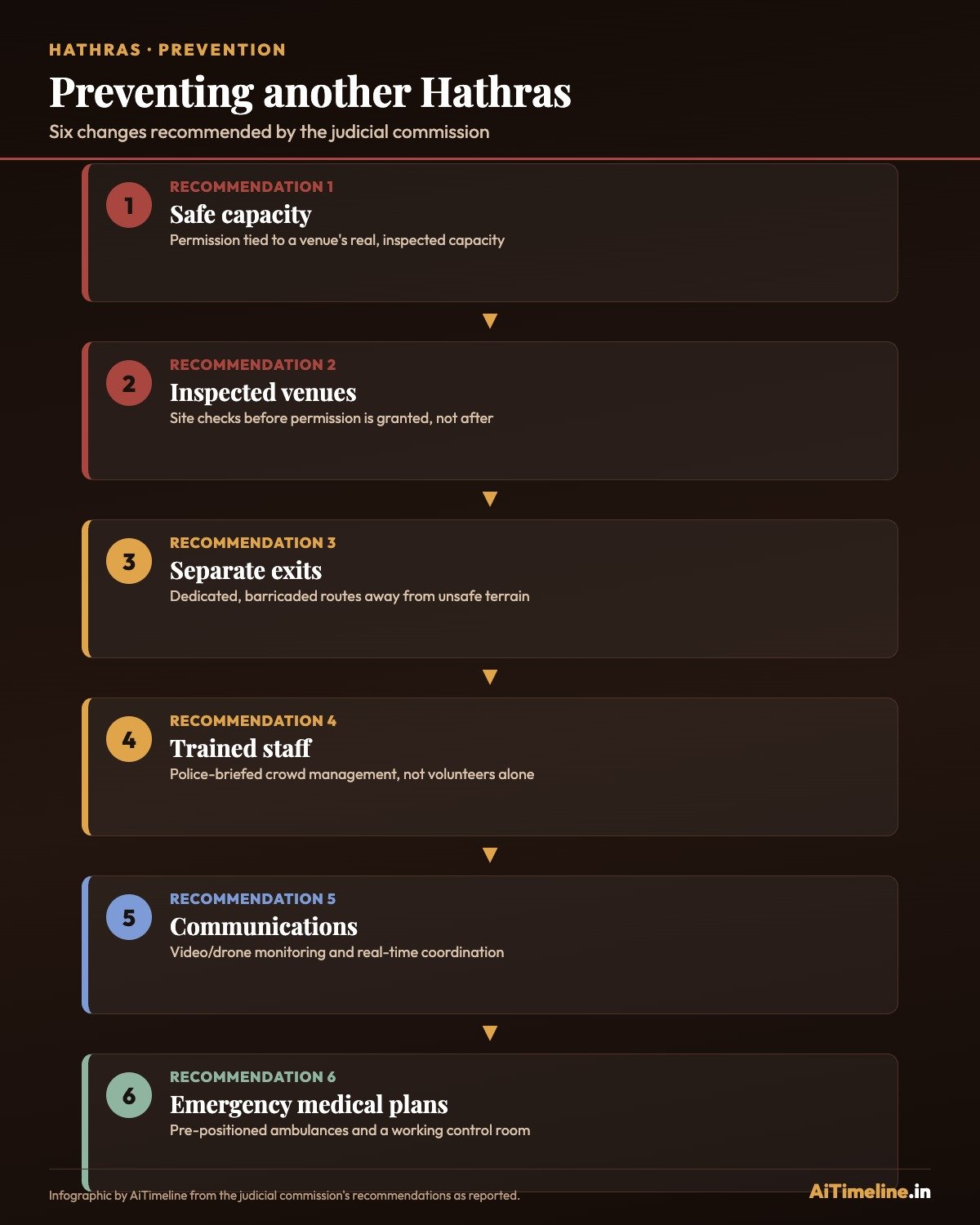
The judicial commission recommended stronger procedures for event permissions, advance planning, police briefings, video and drone monitoring, communication equipment and improved emergency-service coordination — pointing to gaps that extend beyond this one event.
Aftermath: Compensation and Recommendations
Government compensation
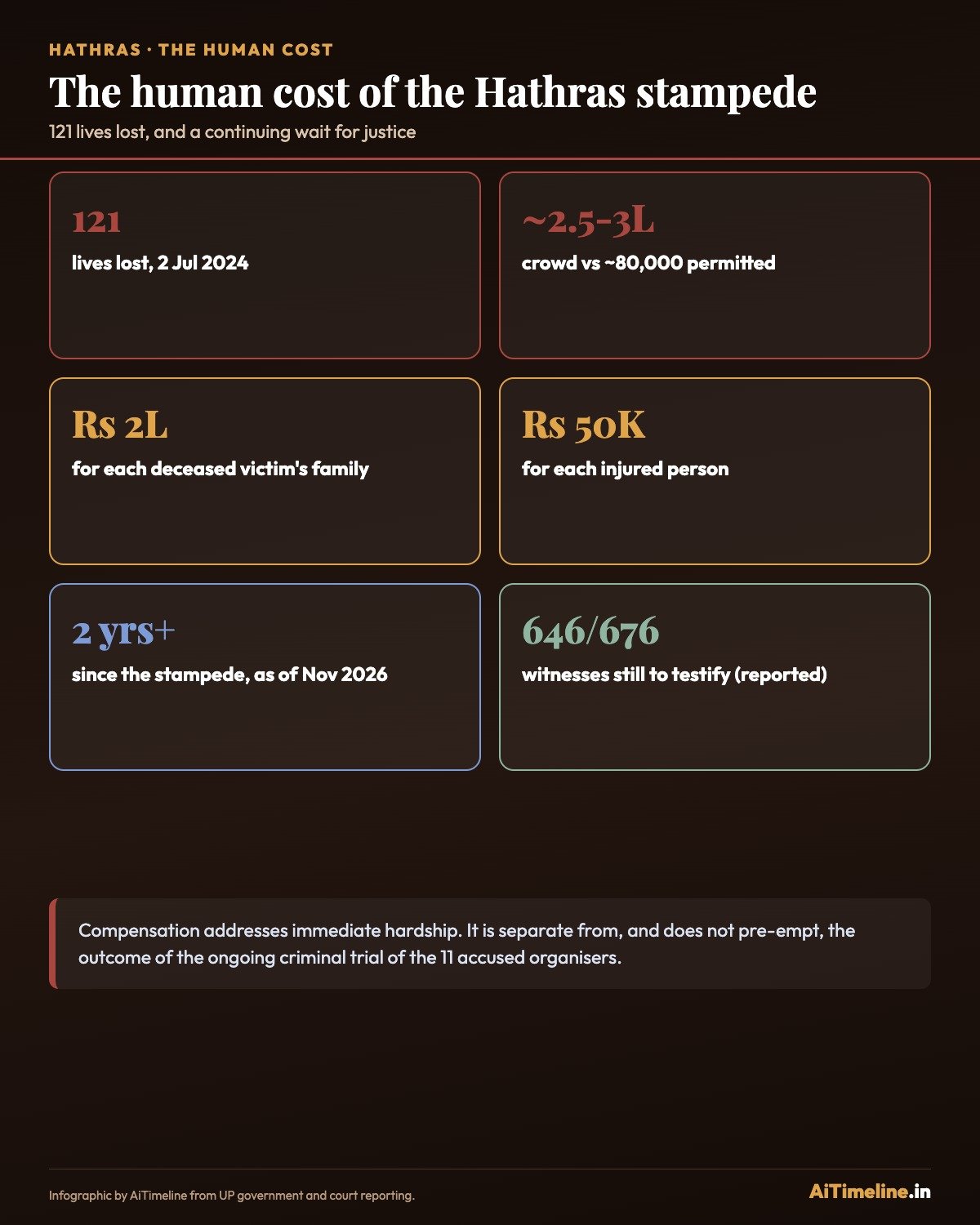
- Rs 2 lakh to the family of each deceased victim.
- Rs 50,000 to each injured person.
- Support for affected children’s education and care under the Chief Minister’s Bal Seva Yojana.
Judicial commission’s recommendations
- Event permission applications submitted well in advance, with venue inspections beforehand.
- Crowd estimates independently assessed, not accepted at face value.
- Advance police briefings, video and drone monitoring of large gatherings.
- Better communication equipment and ambulance/control-room coordination.
- Consideration of legislation addressing exploitation linked to such gatherings.
121 lives were lost, and the families of victims still await a judicial determination of responsibility beyond the ongoing trial of 11 organisers. The compensation announced addresses immediate hardship; it is separate from, and does not pre-empt, the outcome of the criminal case.
The Justice Question: Why the Case Remains Unresolved
The framing of charges in August 2025 was an important legal step, but it was not the end of the case. The prosecution listed 676 witnesses; reporting around the case’s two-year mark said only 30 had completed testimony, leaving 646 still to be examined, with all 11 accused out on bail. This means the criminal trial remains a long way from a final verdict. Bail is not an acquittal, and the charges are not proof of guilt. The court must examine the evidence, hear the defence, and decide whether the accused are legally responsible.
The case also raises a wider question that outlasts any one verdict: when a public event attracts far more people than its permitted capacity, who is responsible for ensuring that the venue, crowd controls and emergency systems are actually safe?
On the record
- 121 people died in the 2 Jul 2024 stampede near Hathras.
- The crowd (~2.5-3 lakh) far exceeded the permitted ~80,000.
- Six local officials were suspended; 11 people were chargesheeted.
- Charges were framed against all 11 on 6 Aug 2025.
- Compensation of Rs 2 lakh / Rs 50,000 was announced.
Not proved or not found
- That a specific conspiracy caused the stampede (recommended for further probe, not confirmed).
- Guilt of any of the 11 accused — the trial is ongoing.
- A direct causal role for Bhole Baba, per reported commission findings.
- That dust-collection by devotees was the definitive trigger.
Open on 3 Nov 2026
- When the trial will conclude, given 646 of 676 witnesses still pending as of mid-2026 reporting.
- Whether any new permission/crowd-safety legislation the commission recommended is enacted.
- Whether victims’ families get a judicial finding of responsibility beyond compensation.
The Bigger Picture: Lessons From Hathras
Six risks that combined into one disaster
- Crowd size without capacity planning can overwhelm even a large venue.
- Poor exit design can turn an ordinary dispersal into a dangerous crowd surge.
- Unclear control between organisers and police can delay intervention.
- Unsafe terrain and weather conditions can make a crowd surge more deadly.
- Delayed emergency communication can cost valuable time during rescue.
- Slow trials can prolong uncertainty for victims’ families and survivors.
The Hathras stampede was not simply a case of too many people gathering in one place. It exposed how several risks can combine, and why crowd safety has to be treated as a public responsibility, not left entirely to event organisers or volunteers. For how a different kind of public-safety failure played out in court, see our Balasore train accident timeline.
Explore More Timelines
People Also Ask
Hathras Stampede: Frequently Asked Questions
Conclusion: Who Answers for Hathras?
The Hathras stampede is not simply a story of a crowd that grew too large. It is a story of a permission process that did not check the numbers it was given, a crowd-control plan handed almost entirely to organisers, and a criminal trial that, two years on, has barely begun to hear its witnesses.
The judicial commission drew a distinction worth keeping in mind: that mismanagement and overcrowding caused the deaths does not, by itself, settle who should be criminally responsible, or resolve whether a conspiracy played any part. For the victims’ families, compensation has arrived; a judicial finding on responsibility has not. For organisers of future large gatherings, the lesson is that a permission filed for 80,000 and a crowd of 2.5-3 lakh are not a rounding error — they are the gap in which a disaster like this happens.
Related AiTimeline Stories
⚠️ Editorial Note
Last updated 3 November 2026. This is a developing criminal case; all 11 accused are presumed innocent unless and until a court decides otherwise, and allegations in the FIR, SIT report and chargesheet are labelled as allegations. Coverage of the judicial commission’s findings on Suraj Pal Singh (Bhole Baba) varies in emphasis between outlets; we describe it as a reported “clean chit” on direct responsibility rather than a court verdict, since we could not open the commission’s full report directly. Witness-count and hearing details for 2026 follow the source cited in this article and could not be independently re-verified by us beyond early-2026 reporting; check the Hathras sessions court record for the current status. Casualty and crowd-size figures (121 dead, ~80,000 permitted vs ~2.5-3 lakh attending) follow SIT and judicial-commission reporting as cited.
Sources & further reading
Every dated entry above was checked against these references. Last reviewed 3 November 2026.
- Hathras stampede: Bhole Baba gets clean chit, SIT blames organisers
- Hathras stampede: judicial commission says conspiracy cannot be ruled out
- SIT probing Hathras stampede submits report to UP government
- Hathras stampede: UP govt suspends 6 officials, SIT says conspiracy angle cannot be negated
- Hathras stampede: UP police file 3,200-page chargesheet
- Hathras stampede case: charges framed against all 11 accused
- Judicial panel blames UP police and organisers for Hathras stampede
- Hathras stampede case: testimony of key witness completed, next hearing Jan 22