India-Russia Oil Timeline 2022–2026: U.S. Pressure, Sanctions & Russia’s Supply Crisis
India's Russian oil imports through 2026: Moscow's draft forecast shows output at a 17-year low even as crude exports rise, amid US tariffs and sanctions.
Latest Story
India needs roughly five million barrels of crude oil a day, and it imports the great majority of that. Russia can supply a meaningful slice of it at a price cheaper than the Gulf or West Africa. Washington wants that trade to shrink, because every discounted barrel Moscow sells still turns into rupees, dollars and, eventually, war-financing revenue. None of those three facts has changed since 2022. What has changed, repeatedly, is the pressure applied to the middle of that triangle: tariffs that rose to 50% and then fell to 10%, US Treasury sanctions on Russia’s two largest oil companies, a phone call India says never happened, and an import share that collapsed to 23% in January 2026 before climbing back to a record 55% by July. This is not a story with a finish line. It is a live negotiation between India’s energy security, Russia’s need for buyers, and America’s sanctions strategy — and the numbers below show that negotiation moving, sometimes month to month, in real time.
The production/export figures above come from a draft Russian government forecast obtained by Reuters, expected to be finalized at the end of September 2026 — not a final government target. Last fact-checked: September 1, 2026, against US Treasury/OFAC notices, the EU Finance Committee’s price-cap updates, India’s Petroleum Planning & Analysis Cell (PPAC), Kpler shipment tracking and Reuters. See the Sources & Methodology section for the full list.
🧠 India and Russian Oil — Quick Answer
India buys Russian crude because it is usually cheaper than Middle Eastern or African alternatives, and because a country that imports most of its oil has strong incentive to buy wherever the price and terms work. Russia sells to India at a discount because Western sanctions closed off its traditional European buyers, and India (with China) is now one of the few markets large enough to absorb the volume. Russian oil has supplied as little as 23% and as much as 55% of India’s crude imports at different points in 2026 alone — the share moves with sanctions enforcement, tariff diplomacy and global supply shocks, not a fixed policy. The United States has not sanctioned India itself for buying Russian oil; it has used tariffs as leverage (a 50% tariff on Indian goods in August 2025, cut to 10% after a February 2026 trade deal) and imposed direct OFAC sanctions on Rosneft and Lukoil, which forced Indian refiners to route around those two specific companies. A Senate bill passed in August 2026 could authorize tariffs up to 100% if India remains among the top buyers of Russian crude, but it has not yet become law. Cutting off Russian oil entirely would likely raise India’s freight and crude-acquisition costs, though retail fuel prices in India are set more by taxes and government pricing policy than by the crude price alone, so the effect on pump prices would be smaller and slower than the effect on the country’s import bill. A new twist emerged September 1, 2026: a draft Russian government forecast obtained by Reuters projects 2026 oil production falling to a 17-year low even as crude exports rise — because refinery disruption inside Russia means less crude gets processed at home, leaving more available to ship abroad. See the Russian Oil Paradox section below.
India & Russian Oil: Key Questions
What to Know
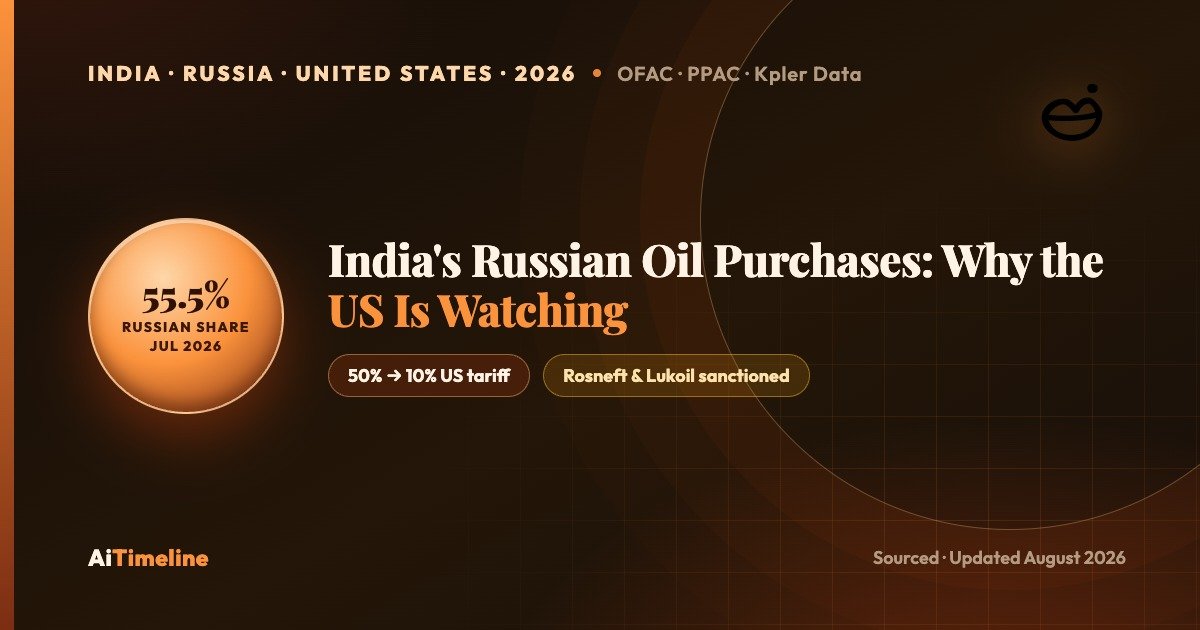
- Russia’s share of India’s oil imports is genuinely volatile, not a fixed number. It ranged from 23.4% (January 2026) to a record 55.5% (July 2026) inside a single year — anyone quoting one figure as “the” number is compressing a moving target.
- Tariffs and sanctions are different tools and India has faced both, at different times, for related but distinct reasons. A 25%-plus-25% US tariff (2025) was trade leverage tied to Russian oil purchases; the October 2025 OFAC action against Rosneft and Lukoil was a direct sanctions designation of two Russian companies, not of India.
- The US tariff rate has already been cut once, from 50% to 10%, after a February 2, 2026 Trump-Modi trade agreement — but a new Senate bill threatens tariffs up to 100% if India stays among the top Russian-crude buyers.
- India has never publicly committed, in its own official language, to stop buying Russian oil — even when President Trump said Modi had personally assured him it would. India’s Ministry of External Affairs has repeatedly said its energy policy is guided by “the interests of Indian consumers,” not by a specific pledge.
- Reliance Industries and Nayara Energy carry the most direct sanctions exposure among Indian refiners: Reliance had a long-term supply deal with Rosneft, and Nayara is 49.13%-owned by Rosneft, which also drew separate EU sanctions on Nayara’s own refinery in July 2025.
- The Russian oil discount to India has narrowed sharply since 2022 — from roughly $10–13 a barrel in the war’s first year to about $3–6 a barrel more recently — because freight, insurance and sanctions-compliance costs eat into the headline price cut.
- A cheaper crude barrel does not translate one-for-one into cheaper petrol at Indian pumps. Excise duty, state VAT, marketing margins and the rupee’s exchange rate all sit between the crude price and the retail price, and none of those move automatically with Russian discounts.
- China, not India, remains the single largest buyer of Russian crude oil overall — about 50% of Russia’s crude exports versus India’s roughly 36% by mid-2026 — even in months when India’s own import share hits a record. China has been actively increasing its own Russian purchases through August 2026, directly competing with Indian refiners for the same barrels.
- Russia’s own draft 2026 government forecast, obtained by Reuters, shows a paradox: oil production falling to a 17-year low (494.2 million tonnes) while crude exports rise (to 244.7 million tonnes) — because refinery disruption leaves less crude processed at home, not because Russia is producing more. Refined-product exports fall sharply in the same forecast, the opposite direction from crude.
- 2026’s Middle East supply shock is part of why Russian imports rebounded. The US-Israel conflict with Iran and disruption around the Strait of Hormuz pushed up the cost of alternative Gulf crude in the first half of 2026, making discounted Russian barrels relatively more attractive again.
- The G7/EU price cap on Russian oil is not a blanket ban — it restricts Western shipping, insurance and financing services for cargoes sold above $44.10/barrel (as of February 2026), and Russia has simply built a “shadow fleet” that avoids needing those services at all.
Russia’s 2026 Oil Paradox: Less Production, More Crude Exports
A September 1, 2026 draft Russian government forecast, obtained by Reuters, adds a new supply-side dimension to India’s Russian-oil story — not yet finalized, but consistent with what refinery-tracking data already showed through the summer.
How Can Russia Export More Crude If It’s Producing Less?
Production is not refining. Getting crude oil out of the ground (production) and turning that crude into petrol, diesel, jet fuel and other usable products (refining) are two separate industrial processes. A refinery outage does not automatically destroy the crude oil itself — it can instead leave that crude sitting unprocessed, available to be stored, redirected or exported as raw crude rather than refined at home. ANALYSIS: That is the mechanical explanation behind the paradox: Russia’s refineries, not its oil fields, are the part of the system under the most acute pressure in 2026.
Why Russian Oil Production Is Falling
The draft forecast attributes the production decline to a combination of pressures, not one single cause: continued Western sanctions and EU import restrictions that constrain markets and financing; export bottlenecks; and — the factor that has intensified sharply in 2026 — Ukrainian drone strikes on Russian refineries, which Reuters cites as a primary driver of the latest downward revision. ANALYSIS: It would overstate the evidence to attribute the entire production decline to drone strikes alone; refinery attacks explain the export-mix shift (more crude, less refined product) more directly than they explain the underlying crude-production number itself, which also reflects sanctions, financing and infrastructure constraints built up over several years of war.
Russia’s Refinery Squeeze
Independent refinery-tracking data corroborates the same picture the draft forecast implies: Russian refinery throughput in June and July 2026 was among the lowest recorded in roughly two decades, with forecasts putting July–December runs around 4 million barrels a day — nearly 30% below the 2016–2023 seasonal average of about 5.7 million bpd. Reuters has separately reported Russian gasoline output falling well short of domestic demand through late August 2026, though the precise shortfall figure varies by source and this article does not hang its argument on one exact percentage. Russia has not banned crude exports — it remains one of the world’s largest oil exporters — but it has restricted some gasoline and diesel exports at various points in 2026 to protect domestic fuel supply; readers should treat any specific restriction’s current scope and dates as time-sensitive and check the latest reporting before relying on it.
| Metric | 2026 draft forecast / situation | What it means |
|---|---|---|
| Russian oil production | 494.2 million tonnes / 9.88 million bpd | Lowest annual output since 2009 |
| Crude exports | 244.7 million tonnes | Up from 230.8 million tonnes in 2025 |
| Oil-product exports | 98.5 million tonnes | Down sharply from 125.8 million tonnes in 2025 |
| Russian refining | Under severe disruption | Refinery strikes and outages have reduced fuel production; runs near 20-year lows |
| Domestic fuel market | Under pressure | Reuters has reported gasoline supply strain and periodic export restrictions |
| India + China | Major crude destinations | Additional unrefined barrels are moving mainly toward these two Asian buyers |
Russia’s Production & Export Forecast, 2025–2029
2025 is the forecast’s reference actual; 2026–2029 are draft figures, not finalized government targets — expect revision at the end of September 2026.
| Year | Crude production | Status |
|---|---|---|
| 2025 | 511.4 million tonnes | Reference figure in the draft forecast |
| 2026 | 494.2 million tonnes | Draft forecast — lowest since 2009 |
| 2027 | 500 million tonnes | Draft forecast — partial recovery, still ~16Mt below the May 2026 outlook |
| 2028 | 505.0 million tonnes | Draft forecast — still below 2025 |
| 2029 | 505.0 million tonnes | Draft forecast — still below 2025 |
| Year | Crude exports | Oil-product exports |
|---|---|---|
| 2025 | 230.8 million tonnes | 125.8 million tonnes |
| 2026 | 244.7 million tonnes | 98.5 million tonnes |
| 2027 | 232.5 million tonnes | 113.1 million tonnes |
| 2028–2029 | 216.6 million tonnes | Not disclosed in the draft summary reviewed |
The 2026 export bump looks temporary, not a new trend: the draft forecast has crude exports falling back to 232.5 million tonnes in 2027 and 216.6 million tonnes in 2028–29 — below even 2025’s level. The real question for India is not just “can we buy more Russian crude in 2026?” but what happens to availability after this year’s temporary bump fades.
India’s Strange New Role: Both Sides of Russia’s Oil Trade
For India, the refinery squeeze creates an unusual short-term window: Russian crude may become more available precisely because Russia’s own refining system is under pressure, not because Russia has more oil to sell overall. ANALYSIS: That does not make India’s Russian supply permanently safer — Moscow’s own draft forecast shows crude exports falling again after 2026, China is competing harder for the same barrels (it increased its own Russian purchases through August 2026, one reason India’s share pulled back from July’s record), and Middle East supply risk around the Strait of Hormuz has made alternative Gulf crude less predictable at the same time. See our Strait of Hormuz timeline for that separate but related supply risk. India may therefore be receiving more Russian crude today while facing a more complicated supply picture in 2027 and beyond. This article does not claim any specific Indian-refined fuel is being resold back to Russia — that would require shipment-level evidence this piece does not have — only that Russia’s own refining shortfall and India’s refining capacity sit on opposite sides of the same disrupted system.
What This Means for Russia’s Export Revenue
More export volume does not automatically mean more revenue for Russia. Revenue depends on price multiplied by volume, minus discounts, freight and sanctions-compliance costs. If Russia has to redirect more barrels toward a narrower pool of willing buyers (mainly India and China), those buyers may gain some negotiating leverage on price — though if global crude supply tightens for other reasons (e.g., a Hormuz disruption), that leverage could shrink again. This article does not predict which direction the discount moves next; both forces are live at the same time.
⚠️ What This Section Does Not Claim
It does not say Russia’s oil industry has collapsed, that Russia is running out of oil, or that 9.88 million bpd is a near-zero production level — Russia remains one of the world’s largest oil producers even at a 17-year low. It does not say Russian refining capacity has been permanently destroyed, or that all Russian refineries are offline. It does not say India is guaranteed more Russian crude going forward, or that every extra barrel exported goes to India specifically. And it treats every 2026–2029 figure above as a draft forecast, not a final government target, pending the end-of-September 2026 finalization.
Why 2022 Changed India’s Oil Sourcing
Before Russia’s full-scale invasion of Ukraine in February 2022, Russian crude was a rounding error in India’s import basket — under 2%, dwarfed by Iraq, Saudi Arabia, the UAE and Nigeria. That changed within weeks, for reasons that are commercial as much as political.
What the West did: The US, EU and UK cut off major Russian banks from parts of the global financial system, and European buyers — historically Russia’s largest oil customers — began voluntarily and then formally stepping back from Russian crude. The EU eventually banned most seaborne imports of Russian crude outright (effective December 2022) and refined products (February 2023).
What that did to Russian oil: Losing its biggest buyers overnight left Russia with tankers of crude and nowhere obvious to sell them. To keep production and revenue flowing, Russian sellers began offering steep discounts — reportedly $10–35 a barrel below Brent in the first chaotic months — to any buyer willing to take the cargo, the shipping arrangement and the reputational exposure.
What India did: Indian refiners, who import the large majority of their crude and had no formal sanctions obligation to avoid Russian oil, started buying. FACT: India’s Russian oil imports rose from a negligible share in early 2022 to becoming its largest single crude supplier by early 2023. ANALYSIS: This was not simply a political alignment with Moscow — India continued buying far larger total volumes from the Gulf and Africa throughout this period, and Indian officials consistently framed the shift as an economic decision available to any buyer, not a strategic pivot away from other suppliers.
This is the founding fact of everything that follows: 2022 didn’t create a “Russia problem” for India so much as it created a discounted-crude opportunity that India, like several other large importers, took.
Why Does India Buy Russian Oil?
Eight separate reasons, each doing different work — not one single motive.
The Discount
Russian Urals crude has traded below Brent throughout the war, though the gap has narrowed from roughly $10–13/barrel in 2022–23 to about $3–6/barrel more recently as freight and compliance costs eat into the headline discount.
Displaced Volume
Europe’s exit from Russian crude freed up large volumes that needed a new home. India, with substantial refining capacity, was one of the few markets able to absorb it at scale.
Margin, Not Just Price
Indian refiners are optimized to process a range of crude grades; a cheaper input barrel that still yields a good product slate (petrol, diesel, jet fuel) directly improves refining margins.
Import Dependence
India imports the large majority of the crude oil it refines, per the Petroleum Planning & Analysis Cell. A country that dependent has structural reasons to keep every viable supplier option open.
Over 40 Suppliers
Indian refiners now source crude from more than 40 countries, per petroleum ministry officials — Russia is a large single-country supplier, but the basket itself has arguably become more diversified since 2022, not less.
Independent Foreign Policy
ANALYSIS: India’s government has repeatedly framed energy sourcing as a sovereign decision distinct from its foreign-policy alignment with any single power — a position consistent with India’s decades-long non-aligned tradition.
Complex Refineries
Reliance’s Jamnagar complex and several state refineries have the technical complexity to process heavier, sourer crude grades like Urals efficiently — not every refinery worldwide can do that as cheaply.
Every Buyer Compares
Crude procurement is a spot-and-contract market; refiners globally, including in Europe via refined-product loopholes, compare landed cost across every available grade each month, not just Russian versus non-Russian.
Why Does Russia Sell to India at a Discount?
Direct answer: Russia discounts its crude to India because losing its main European buyers left it needing new large-volume customers fast, and revenue from selling at a discount is far better than revenue from oil that stays in the ground or in an unsold tanker.
Russia’s oil sector still needs to fund the federal budget, including a war effort, so keeping production and exports flowing matters more than holding out for a higher price from a shrunken pool of buyers. India and China together became the two markets large enough to absorb what Europe no longer would. ANALYSIS: This does not mean Russia has unlimited pricing power or an unlimited discount to offer — the size of the discount has shrunk over time as Moscow’s own logistics costs (a self-funded “shadow fleet” of tankers, alternative insurers, more complex payment routes) have risen, and as India and China have gained leverage as two of the only major buyers left, giving them room to negotiate harder. Russia also has to balance discount size against its own budget math: sell too cheap and the volume gain doesn’t offset the lost revenue per barrel.
Why Is Washington Pressuring India?
US policy has moved through several distinct phases since 2022 — not one consistent stance.
Direct answer: The US wants to reduce the revenue flowing to Russia to fund its war in Ukraine, and views India’s role as the largest single buyer of seaborne Russian crude in 2023–24 as undercutting that goal, even though India itself has not been found to violate any specific US sanction.
The core US argument, restated by successive officials, is that price-cap compliance and sanctions on named entities are meant to work together: keep Russian oil flowing (to avoid a global price spike) while capping how much money Moscow makes per barrel. When large buyers like India and China purchase well above the price cap or route around sanctioned entities, Washington argues the mechanism loses its bite. ANALYSIS: US pressure on India has not been a single consistent policy — it swung from largely rhetorical concern in 2022–24, to an aggressive tariff campaign in mid-2025 (with officials like trade adviser Peter Navarro calling India a “laundromat for the Kremlin”), to a negotiated tariff rollback in February 2026, to a renewed legislative threat in August 2026. Each phase reflects a different mix of sanctions-enforcement logic, trade leverage and domestic US politics, not a fixed doctrine.
Sanctions vs Tariffs: What Is the Difference?
These get conflated constantly in headlines — they are legally and practically different tools.
| Term | What it does | Who it targets | Applied to India/Russian oil? |
|---|---|---|---|
| Sanction (OFAC designation) | Freezes US-linked assets and blocks US persons/entities from transacting with the designated party | Specific individuals, companies or vessels | Yes — Rosneft and Lukoil designated Oct 22, 2025, not India itself |
| Secondary sanction | Can penalize a third party (e.g., an Indian bank or refiner) for transacting with an already-sanctioned entity | Non-US entities dealing with sanctioned parties | Risk exists for entities still dealing with Rosneft/Lukoil after wind-down deadlines; no major Indian entity has been designated on this basis as of Aug 2026 |
| Tariff | A tax on imported goods, paid by the importer | A country’s exports as a whole, or specific product categories | Yes — a 50% tariff on many Indian goods in Aug 2025, cut to 10% in Feb 2026, with a further hike to as much as 100% authorized (not yet imposed) under a Senate bill passed Aug 2026 |
| Price cap | Bars Western shipping/insurance/financing services for oil sold above a set price | Any seller/buyer using those specific Western services | Indirectly relevant — India says its declared purchase prices comply; much of the trade now avoids Western services entirely via a non-Western “shadow fleet” |
| Trade tariff vs sanctions waiver | A tariff can be lowered by negotiation; a sanctions waiver is a specific, time-limited legal exemption from an OFAC rule | Different legal instruments entirely | India’s Feb 2026 tariff cut was a negotiated trade deal, not a sanctions waiver — no OFAC waiver covering India’s Russian-oil purchases as a whole exists |
In plain terms: a tariff is a tax Washington can raise or lower on India’s exports as leverage. A sanction is a legal designation of a specific entity that blocks US-linked dealings with it. Trump himself has, at times, used the word “sanctions” loosely to describe tariff actions against India — which is imprecise; the tariffs imposed on India in 2025 were tariffs, under trade law authority, not an OFAC sanctions designation of India.
Does India Violate US Sanctions by Buying Russian Oil?
✅ What Is Legally Clear
- India, as a sovereign state, is not automatically bound by US sanctions law simply because it buys oil from a country the US has sanctioned.
- Buying Russian crude itself is not a US sanctions violation for India in the way that transacting with a specifically designated entity (like Rosneft or Lukoil, post-October 2025) can be.
- India has stated its purchases are conducted within the G7 price-cap framework and through legal commercial channels.
❌ Where Real Exposure Exists
- Specific transactions involving Rosneft, Lukoil or their sanctioned subsidiaries after the November 21, 2025 wind-down deadline can create genuine US sanctions exposure for the counterparty.
- Banks, insurers, shippers or refiners with US-dollar clearing exposure or US operations face real compliance risk if they deal with a designated entity or vessel.
- This is why Reliance said in November 2025 it was halting Russian crude at its export-linked refining unit — a direct, company-level compliance response, not a government mandate.
ANALYSIS: The accurate framing is narrower than either “India is breaking sanctions” or “India is completely in the clear.” It is: India’s sovereign import policy is not itself sanctioned, but specific companies, vessels, banks and transactions connected to a small number of now-designated Russian entities carry real, individually assessed legal risk under US jurisdiction — which is exactly why Indian refiners’ behavior changed sharply after the October 2025 OFAC action, even though no equivalent change followed purely rhetorical pressure in earlier years.
The Russian Oil Price Cap, Explained
What it is: A price ceiling on Russian seaborne crude, introduced by the G7, EU and Australia on December 5, 2022, initially set at $60/barrel.
Who introduced it and why: The coalition wanted to let Russian oil keep flowing globally — to avoid a supply shock that would spike prices for everyone — while limiting how much revenue Russia earned per barrel.
How it works: The cap does not ban anyone from buying Russian oil at any price. Instead, it bars Western companies from providing shipping, insurance, flagging or financing services for any cargo sold above the cap. A buyer paying above the cap simply cannot use Western-linked services for that shipment.
What’s changed since 2022: The cap has been revised downward and made dynamic. It moved to roughly $47.60/barrel under a later sanctions package, then to $44.10/barrel effective February 1, 2026, under a new EU/G7 mechanism that automatically resets the cap to 15% below the rolling 22-week average Urals price.
Current status: Russia’s President Vladimir Putin extended a standing ban on Russian companies complying with any price-cap-linked contract terms through the end of 2027 — meaning Moscow has effectively told its exporters not to use price-cap-compliant Western shipping/insurance at all, and to rely instead on its own tanker fleet and non-Western insurers. ANALYSIS: This is the mechanism’s real limitation — it constrains access to Western services, not the sale itself, so a seller and buyer willing to arrange non-Western shipping and insurance can trade above the cap without directly breaching it, which is exactly what much of the Russia-India-China trade now does.
India’s Refiners — Who Actually Buys Russian Oil?
Not every Indian refiner follows the same policy or carries the same exposure.
Indian Oil Corporation (IOCL)
India’s largest refiner by volume; a regular, large-scale buyer of Russian crude on the spot market. Was the largest single buyer among state refiners in January 2026 at roughly 0.47 million barrels/day.
Bharat Petroleum (BPCL)
A regular but comparatively smaller Russian-crude buyer among the state refiners — around 0.20 million barrels/day in January 2026, per trade data.
Hindustan Petroleum (HPCL)
Also buys Russian crude on the spot market alongside IOCL and BPCL; specific 2026 monthly volumes for HPCL were not independently confirmed for this article and are not stated here to avoid overclaiming precision.
Reliance Industries
Ran a long-term supply arrangement with Rosneft (reportedly around 500,000 barrels/day). After the October 2025 OFAC sanctions on Rosneft, Reliance said (Nov 20, 2025) it halted Russian crude at its export-oriented Jamnagar unit; it disputed a January 2026 report claiming Russian tankers were again headed to Jamnagar, calling it “blatantly untrue.”
Nayara Energy
49.13%-owned by Rosneft (the rest split between Kesani Enterprises and public shareholders). Its Vadinar refinery in Gujarat was itself named in the EU’s 18th sanctions package on July 18, 2025 — the first time an Indian refinery, not just a Russian company, was directly targeted by a Western sanctions package. India’s government formally rejected the EU’s authority to sanction an Indian-registered company.
Mangalore Refinery (MRPL)
An ONGC-group refiner that has historically taken smaller, spot-market volumes of Russian crude when discounts are attractive; specific verified 2026 purchase figures for MRPL were not available for this article.
Russian Crude Grades India Refines
Urals is the workhorse grade — a medium-sour blend from Russia’s western pipeline network, historically Europe’s default import and now the bulk of what reaches India via the Baltic and Black Sea. It suits India’s larger, more complex refineries, which are built to process sourer, heavier crude at a cost advantage over simpler refineries limited to light, sweet grades.
ESPO (Eastern Siberia-Pacific Ocean) is a lighter, sweeter grade shipped from Russia’s Pacific coast, traditionally favored by Chinese buyers because of shorter shipping distances; it appears in India’s import mix in smaller volumes than Urals.
How Does Russian Oil Reach India?
Most Russian crude bound for India loads from Baltic Sea ports (like Primorsk and Ust-Luga) or Black Sea ports (like Novorossiysk), then sails around Europe and through the Suez Canal, or occasionally around the Cape of Good Hope, before discharging at Indian ports including Sikka, Vadinar, Paradip and Mundra — a journey of three to four weeks, far longer than the traditional one-to-two-week run from the Gulf. That extra distance is itself a real cost: more freight days, more tanker time, all of which narrows the effective discount by the time the oil is actually landed and refined. Since the 2022 sanctions, much of this trade has shifted onto a non-Western “shadow fleet” of tankers with opaque ownership and non-Western insurance, specifically to avoid needing price-cap-compliant Western shipping and insurance services at all. This article does not detail specific vessel-level evasion tactics; the point relevant to readers is simply that shipping distance and structure are a real part of why the delivered Russian barrel costs more than the wellhead discount alone suggests.
Why Russian Oil Can Be Cheaper — and Why That Isn’t the Same as Cheap Petrol
| Cost component | Effect on the Russian-oil “discount” |
|---|---|
| Global benchmark (Brent) | Starting reference price; Urals trades at a spread below it |
| Headline discount | Roughly $10–13/barrel in 2022–23, narrowed to about $3–6/barrel more recently |
| Extra freight (longer voyage) | Erodes several dollars of the headline discount before the oil even reaches port |
| Non-Western insurance/financing | Adds cost versus standard Western-market insurance, though usually still cheaper than losing access to the cargo entirely |
| Sanctions-compliance overhead | Extra due diligence, documentation and counterparty risk for refiners and banks |
| Refining margin | The actual profit refiners capture after processing — not passed through automatically to consumers |
ANALYSIS: “Cheap Russian oil” describes the price a refiner pays for crude. “Cheap petrol” would require that saving to flow, largely untaxed and unmarked-up, all the way to the pump — which is not how India’s fuel-pricing system works, as the next section explains.
Does Russian Oil Lower Petrol Prices in India?
Direct answer: not directly, and not proportionally. India’s retail petrol and diesel prices are set by oil-marketing companies based on a formula that includes the international benchmark price, the rupee-dollar exchange rate, central excise duty, state-level VAT (which varies by state), dealer commission and marketing costs — and excise/VAT alone typically account for a large share of the pump price. A few dollars of savings per barrel on the crude India refines does not automatically show up as a few rupees off at the pump, because taxes are a fixed or near-fixed component set by government policy, not a percentage that shrinks when the input cost falls.
What discounted crude does do: It can improve refiners’ margins and reduce India’s overall crude import bill (a macro, government-finance-level benefit), and in periods of high global crude prices, it can help cushion how much retail prices would otherwise have to rise. But it is a stretch, not supported by how pricing actually works, to promise Indian consumers directly cheaper fuel purely because of the Russian-oil discount — and this article does not make that promise.
India’s Energy Security: Why It Can’t Replace Russian Oil Overnight
India imports the large majority of the crude oil it refines and consumes roughly 5.5 million barrels a day, a figure that keeps growing with the economy. FACT: Indian refiners now source from more than 40 countries, and roughly 70% of India’s crude imports are now routed outside the Strait of Hormuz chokepoint, according to India’s Press Information Bureau — a deliberate diversification effort predating the current Russia dynamic. ANALYSIS: Even so, replacing a supplier providing 30–55% of imports in a given month is not something that can happen in weeks. Middle Eastern producers (Saudi Arabia, Iraq, UAE) and US crude are the most realistic substitutes, but shifting that much volume quickly would mean re-negotiating contracts, competing with other large buyers (especially China) for the same barrels, and likely paying more per barrel in a tighter market — exactly the kind of disruption 2026’s Middle East supply shock already demonstrated in miniature.
What Happens If India Stops Buying Russian Oil?
Three scenarios, clearly labeled as scenarios — not predictions of what will happen.
Global Oil Market Impact
Brent crude traded around $91–92/barrel on September 1, 2026, up from roughly $88/barrel in mid-August, elevated by renewed US-Iran hostilities and disruption around the Strait of Hormuz, and by Russian refinery disruption tightening the global fuel-products market even as OPEC+ has been restoring crude production. Forecasts for the rest of 2026 diverge meaningfully — J.P. Morgan projected Brent averaging around $86/barrel in Q3 2026, while the US Energy Information Administration’s own outlook was notably lower, illustrating genuine forecaster uncertainty rather than a consensus price. Higher Brent matters for India specifically because oil is dollar-priced: a higher benchmark plus any rupee weakness compounds the pressure on India’s import bill, regardless of how much of that oil is Russian. ANALYSIS: If India were to sharply cut Russian purchases, the barrels would not simply disappear — they would likely redirect toward China or other buyers willing to absorb the discount, which could widen the Russian discount further (more supply chasing fewer buyers) while pushing up demand, and price, for the Middle Eastern and African grades India would buy instead. None of this is a fixed prediction; it depends heavily on OPEC+ output decisions, the length of any Middle East disruption, and how much of India’s demand shifts rather than shrinks.
What This Means for an Indian Household
Direct vs Indirect Effects
- Petrol/diesel (direct, but muted): Crude cost is one input among several taxes and margins; a Russian-oil disruption is more likely to slow a price cut than to trigger a sharp price rise, barring a much larger global crude spike.
- LPG and cooking fuel (indirect): Priced off a different mix of benchmarks and government subsidy decisions; not directly tied to the Russian crude discount.
- Transport and logistics costs (indirect): Diesel-heavy freight costs would be more sensitive to a genuine crude-price spike than to the India-Russia discount specifically.
- Inflation and the rupee (macro, indirect): A larger import bill (if Russian discounts shrink or disappear) widens the current account deficit and can pressure the rupee, which in turn affects the cost of everything India imports, including crude itself — a feedback loop, not a one-time effect.
- Airfares and aviation turbine fuel (indirect): Jet fuel tracks global crude and refining margins; airlines historically pass cost swings through to fares with a lag.
The India-US Relationship: More Than Oil
Russian oil is one flashpoint inside a much larger relationship that includes defence cooperation, technology partnerships (including semiconductors and AI), Indo-Pacific strategic coordination aimed partly at balancing China, and a growing trade and investment relationship that, under the February 2026 deal, includes India’s pledge to buy more than $500 billion in US energy, technology, agriculture and other goods over time. ANALYSIS: Framing this purely as “India versus America” misses that both governments have strong incentives to manage the oil dispute without letting it derail the broader relationship — which is consistent with the pattern of tariffs rising, then being negotiated back down, rather than an outright rupture.
The India-Russia Relationship
India’s relationship with Russia predates the Ukraine war by decades, rooted in a Soviet-era defence and diplomatic partnership that still shapes India’s military hardware today, alongside a growing but still modest direct trade relationship beyond oil. ANALYSIS: Energy purchases since 2022 have deepened the economic dimension of that relationship considerably, but describing India as simply “pro-Russia” overstates it — India has continued significant defence and trade engagement with the US and Europe simultaneously, consistent with a strategic-autonomy approach rather than a bloc alignment with Moscow.
Russia-China-India Oil Dynamics
China vs India: Buyers of Russian Crude
ANALYSIS: China consistently takes the larger overall share of Russia’s crude exports, giving it more bargaining leverage on price than India in most periods. The two countries increasingly compete for the same discounted barrels, and August 2026 shows that competition in real time: as China stepped up its own buying and Russia’s exportable crude tightened, India’s volumes eased back from July’s record even before any change in India’s own policy or demand. This is the same dynamic Russia’s draft 2026 forecast implies at the national level — a limited, changing pool of exportable crude, with India and China both drawing from it.
India’s Russian Oil Purchases: The Full Timeline
Reverse chronological. Every entry is dated and sourced; see the Sources & Methodology box for citations.
Draft Russian Forecast: Oil Output Falls to 17-Year Low, but Crude Exports Rise
What happened: A draft Russian government forecast obtained by Reuters projected 2026 crude oil production at 494.2 million tonnes (9.88 million bpd), Russia’s lowest since 2009, down 17.2 million tonnes from 2025. The same draft raised the crude-export forecast to 244.7 million tonnes (from 230.8Mt in 2025) while cutting the oil-product export forecast to 98.5 million tonnes (from 125.8Mt) — a sign that Ukrainian refinery strikes are leaving more raw crude, and less refined fuel, available to export.
Why it mattered: It reframed the India-Russia oil story from a purely political question (“will US pressure force India to buy less?”) to a supply-side one: how much Russian crude will actually be available, and for how long, given the forecast also shows exports falling back again after 2026.
India’s Russian Crude Imports Pull Back From July’s Record as China Buys More
What happened: India’s Russian crude imports eased to roughly 2.1 million bpd in August 2026, down from July’s record 2.6–2.8 million bpd, with Russia’s share of India’s total crude imports falling to roughly 40–44% (Kpler), still India’s largest single supplier.
Why it mattered: Analysts attributed the pullback to refinery maintenance in India, some normalization after two exceptionally strong months, tighter Russian export availability amid the refinery disruption above, and China increasing its own Russian purchases — direct competition for the same barrels.
US Senate Passes Bill Authorizing Tariffs Up to 100% on Top Russian-Oil Buyers
What happened: The US Senate passed the Sanctioning Russia and Iran Act of 2026 with bipartisan support; Section 113 would let the president impose tariffs up to 100% on the top five buyers of Russian crude or gas — the bill’s sponsors name China, India, Slovakia, Hungary and Azerbaijan — 30 days after the law takes effect.
India’s response: India’s trade research body GTRI warned the bill could expose Indian exports to steep new tariffs; formal government comment on the bill itself was measured, consistent with India’s pattern of not publicly conceding ground on Russian oil.
Market impact: Reignited tariff-risk pricing in Indian export sectors; the bill still requires House passage and a presidential decision on rate and timing, so no tariff increase has actually taken effect from it.
India’s Russian Crude Imports Hit a Record 55.5% Share
What happened: Russian crude accounted for a record 55.5% of India’s crude imports in July 2026 — about 2.8 million barrels/day — per Kpler ship-tracking data, up from 2.7 mbpd in June.
Why it mattered: Coincided with Ukrainian drone strikes on Russian refineries and renewed Houthi threats to Red Sea shipping from Saudi Arabia, which analysts said made discounted Russian crude relatively more attractive to Indian refiners despite tariff risk.
Iran Conflict Intensifies India-China Competition for Russian Barrels
What happened: Escalation between the US/Israel and Iran, and resulting disruption around the Strait of Hormuz, pushed India and China into sharper competition for discounted Russian crude as an alternative to costlier or riskier Gulf supply.
Trump-Modi Trade Deal Cuts Tariffs From 50% to 18%
What happened: President Trump announced a trade agreement under which the US lowered tariffs on India from 50% to 18%, saying Modi had agreed to stop buying Russian oil and to purchase over $500 billion in US energy, technology and agricultural goods.
India’s response: India’s own public statements were notably less absolute than Trump’s characterization; officials did not confirm a specific commitment to fully halt Russian purchases in the same language Trump used.
Market impact: India’s Russian crude imports had already fallen to around 1.04 million bpd that month, down sharply from 1.84 mbpd in November 2025.
Supreme Court Ruling Replaces IEEPA Tariffs With Section 122 Baseline
What happened: A US Supreme Court ruling on the legal basis for the earlier IEEPA-based tariffs led to their replacement with a 10% Section 122 baseline tariff on Indian goods, effective February 24, 2026 — separate from sector-specific tariffs (steel, aluminum, pharmaceuticals) that remained in place.
Only Three Refiners Bought Russian Crude as Imports Hit a New Low
What happened: India’s Russian crude imports averaged around 1.2 million bpd, a 35% drop from November 2025; only three refiners — IOCL (~0.47 mbpd), Nayara (~0.44 mbpd) and BPCL (~0.20 mbpd) — were confirmed active buyers, with Reliance sitting out entirely, expecting no deliveries that month.
Why it mattered: Refiners pulled back ahead of EU sanctions taking effect January 21, 2026, and amid broader India-US trade negotiations.
Russian Oil Imports Fall to Lowest Level Since Early 2023
What happened: India’s Russian oil imports dropped about 22% month-on-month to 1.38 million bpd, cutting Russia’s share of India’s crude imports to 27.4% — the lowest since January 2023. Imports briefly fell as low as 712,000 bpd in the second week of December before a partial rebound.
India’s response: Reliance stopped receiving Rosneft crude in the final ten days of December; state refiners continued buying from non-sanctioned suppliers instead.
Reliance Halts Russian Crude at Export-Linked Jamnagar Unit
What happened: The November 21, 2025 OFAC wind-down deadline for Rosneft/Lukoil-linked transactions passed; Reliance Industries, previously Rosneft’s largest single offtake customer under a long-term deal, said it halted use of Russian crude at its export-oriented refining segment to comply with US sanctions.
US Treasury Sanctions Rosneft and Lukoil
What happened: OFAC designated Rosneft, Lukoil and their global subsidiaries under Executive Order 14024 — the first direct US sanctions on Russia’s two largest oil companies since the war began. The UK sanctioned both companies October 15, and the EU adopted its 19th sanctions package October 23.
Why it mattered: This was a genuine sanctions designation, distinct from the tariffs imposed months earlier — it created real, individually assessed legal exposure for any entity, Indian or otherwise, still transacting with these two companies after the wind-down window.
India’s response: Indian refiners began reviewing and winding down direct Rosneft/Lukoil dealings ahead of the November 21 deadline.
Trump Says Modi Personally Assured Him India Would Stop Buying Russian Oil; MEA Contradicts
What happened: Trump told reporters Modi had assured him India would stop buying Russian oil. India’s Ministry of External Affairs said it was “not aware of any conversation” between the two leaders on the date in question, and did not confirm any such commitment.
Why it mattered: A clear example of the gap between Trump’s public characterizations of India’s position and India’s own, consistently more guarded, official statements.
Trump Raises Tariffs on India to 50%, Citing Russian Oil
What happened: Trump issued an executive order adding a 25% tariff (effective August 27) on top of an earlier 25% reciprocal tariff (effective August 7), taking the cumulative additional US tariff on many Indian goods to 50% — explicitly linked to India’s “indirect importation of Russian oil.”
India’s response: India called the tariffs “unjustified and unreasonable” and vowed to protect its “national interests and economic security.” Indian refiners reportedly planned to increase, not decrease, Russian purchases by 150,000–300,000 bpd in September.
US officials: White House trade adviser Peter Navarro called India the “Maharaja of tariffs” and a “laundromat for the Kremlin,” and later said he’d been “firebombed by the Indian continent on the internet” over the backlash to his remarks.
EU Sanctions Nayara Energy’s Vadinar Refinery Directly
What happened: The EU’s 18th sanctions package designated Nayara Energy’s Vadinar refinery in Gujarat — 49.13%-owned by Rosneft — citing its role as the “biggest Rosneft refinery in India.” This isolated Nayara from European distillate export markets.
India’s response: India’s Ministry of External Affairs rejected the EU’s sanctions on an Indian-registered company as outside the EU’s jurisdiction.
India Becomes the Largest Buyer of Seaborne Russian Crude
What happened: By January 2023, India had surpassed China and the EU to become the single largest buyer of seaborne Russian crude, at over 1.6 million bpd, displacing Iraq and Saudi Arabia as Russia’s position atop India’s supplier list solidified.
Market impact: ICRA estimated India saved roughly $4.9–5.1 billion in the 2022–23 fiscal year from the discount versus non-Russian alternatives.
G7 and EU Impose the $60/Barrel Price Cap
What happened: The G7, EU and Australia introduced a $60/barrel price cap on seaborne Russian crude, barring Western shipping, insurance and financing services for cargoes sold above that price, alongside the EU’s own ban on most seaborne Russian crude imports taking effect the same day.
India Begins Ramping Up Discounted Russian Crude Purchases
What happened: As Western buyers stepped back from Russian crude following the February 24, 2022 invasion of Ukraine, Russia began offering steep discounts; Indian refiners, led by state-owned companies, began buying at volumes far above pre-war levels within weeks.
India’s Russian Oil Imports by Year
Annual figures are approximate averages compiled from multiple trackers; see the Data & Methodology note below for why exact figures vary by source.
| Year | Russian share of India’s crude imports (approx.) | Major development | Source basis |
|---|---|---|---|
| 2021 (pre-war) | <2% | Russia a minor supplier; Iraq, Saudi Arabia, UAE dominant | PPAC historical data |
| 2022 | ~20% (rising sharply through the year) | Invasion of Ukraine; India begins large-scale discounted purchases from March | Kpler/Reuters aggregation |
| 2023 | ~33% (India becomes top single supplier) | India surpasses China/EU as largest buyer of seaborne Russian crude by January | Kpler/Reuters aggregation |
| 2024 | ~35–38% | Discount narrows; purchasing pattern stabilizes at high share | Kpler/Reuters aggregation |
| 2025 | Highly volatile: record highs mid-year, falling to 27.4% by December | EU sanctions on Nayara (Jul); US tariffs to 50% (Aug); OFAC sanctions Rosneft/Lukoil (Oct) | PPAC, Kpler, OFAC records |
| 2026 (YTD) | 23.4% (Jan) to 55.5% (Jul), easing to ~40–44% (Aug) — the widest swing on record | Trump-Modi tariff deal (Feb); Iran/Hormuz disruption (Apr); record imports (Jul); Senate tariff bill (Aug); Russia’s draft forecast reveals a production/export paradox (Sep 1) | Kpler, official May 2026 data (40.5% by volume), Reuters (Sep 1 draft forecast) |
India’s Russian Oil Imports — Monthly Trend, 2025–2026
| Month | Approx. volume | Approx. share | Note |
|---|---|---|---|
| Nov 2025 | 1.84 million bpd | — | Pre-sanctions peak, just before the OFAC action |
| Dec 2025 | 1.38 million bpd | 27.4% | Lowest share since Jan 2023; dipped to 712,000 bpd mid-month |
| Jan 2026 | ~1.2 million bpd | 23.4% | Only 3 refiners confirmed active buyers |
| Feb 2026 | ~1.04 million bpd | — | Coincides with the Trump-Modi trade deal announcement |
| May 2026 | — | 40.5% by volume / 42.6% by value | Official Indian government data cited in press reporting |
| Jun 2026 | 2.7 million bpd | — | +34% month-on-month per Kpler |
| Jul 2026 | 2.8 million bpd | 55.5% (record) | Kpler ship-tracking; coincides with Red Sea and Russian-refinery disruptions |
| Early Aug 2026 | — | ~48% (cited in Senate-bill coverage) | Ahead of the Senate’s Aug 8 vote on the Sanctioning Russia and Iran Act |
| Aug 2026 (full month) | ~2.1 million bpd | ~40–44% | Pulled back from July’s record on refinery maintenance, normalization, tighter Russian export availability and rising Chinese competition — still India’s #1 supplier (Kpler) |
Shipping-tracking estimates (Kpler, Vortexa) are based on vessel movements and can differ from official customs/trade data, which is compiled later and on a different reporting cycle. Neither is “wrong” — they measure related but distinct things.
🔍 Why the Numbers Don’t Always Match — Data & Methodology
Readers will find different Russian-oil figures for India across different reputable outlets, sometimes for the same month. This happens for real, explainable reasons: ship-tracking data (Kpler, Vortexa) counts cargoes as they’re loaded or as they arrive, which can put a shipment in a different month than customs data does; official Indian trade statistics (PPAC, Ministry of Commerce) are compiled and released with a lag and sometimes measure value rather than volume, or vice versa; and calendar-year figures should never be compared directly against India’s April-March fiscal-year figures without adjustment. Where this article cites a range (for example, “40.5% by volume, 42.6% by value” for May 2026) rather than one number, that reflects the source measuring two genuinely different things, not an error to be resolved by picking one.
Explore More Timelines
People Also Ask
Frequently Asked Questions
Read Next on AiTimeline
⚠️ Sources & Data Methodology
This page draws on: the Press Information Bureau, Government of India (crude-import diversification data); the European Commission’s price-cap mechanism updates; law-firm sanctions memos summarizing the October 2025 OFAC designation of Rosneft and Lukoil; Reuters’ September 1, 2026 report on a draft Russian government oil-production and export forecast (production/export figures for 2025–2029, expected to be finalized end of September 2026); and further reporting from Bloomberg, CBS News, CNBC, Business Standard, Deccan Herald, Tribune India, ThePrint and OilPrice.com, cited by name and date throughout. Ship-tracking figures are attributed to Kpler where used. All figures are dated at the point they were reported; where sources disagreed, or where a figure is a draft/forecast rather than a final one, this article says so explicitly rather than presenting it as settled. Correction policy: factual errors reported to AiTimeline’s editorial desk will be corrected promptly with the update date revised. Author: AiTimeline Editorial Desk. Fact-checked and last verified: September 1, 2026.
Sources & further reading
Every dated entry above was checked against these references. Last reviewed 15 September 2026.
- Press Information Bureau, Government of India - crude import diversification
- European Commission - Russian oil price cap dynamic mechanism
- Sullivan & Cromwell - US sanctions on Rosneft and Lukoil (Oct 2025)
- CBS News - Trump-Modi trade deal, Feb 2026
- ThePrint - Indian refiners weaning off Russian crude, Jan 2026
- ThePrint - Russia's share hits record high in July 2026