Houthi Movement: Origins, Evolution and Regional Impact
Explore the Houthi movement's origins, rise in Yemen, Iran ties, the Saudi conflict, Red Sea attacks and regional impact through November 2026.
Latest Story
The Houthi movement, formally Ansar Allah, began as a Zaydi revival network in Saada, in northern Yemen. It fought six wars against the Yemeni government between 2004 and 2010, took the capital Sana’a in September 2014, and in March 2015 faced a Saudi-led military campaign. From late 2023 it attacked shipping in the Red Sea, and in 2026 the Iran war pulled it into a new confrontation with Saudi Arabia on Yemen’s west coast. We follow each phase and mark where our sources differ or could not be checked.
Three phases, not one story. The 2004 to 2010 Saada wars were a domestic insurgency. The 2015 Saudi intervention was a war over who governs Yemen. The Red Sea campaign from 2023 was a regional and maritime confrontation, and the 2026 fighting is a Saudi-Houthi front inside the Iran war. Religious roots in the 1980s and 1990s and the armed insurgency from 2004 are also different dates.
💡 Short Answer
The Houthis are a Zaydi Shia movement from Saada, in northern Yemen, that grew from a 1980s and 1990s religious revival into an armed force after 2004. They took Sana’a in 2014, survived a Saudi-led war, attacked Red Sea shipping from 2023, and in September 2026 captured Mocha and the Bab el-Mandeb coast. On 25 November 2026 they threatened Saudi Red Sea ports.
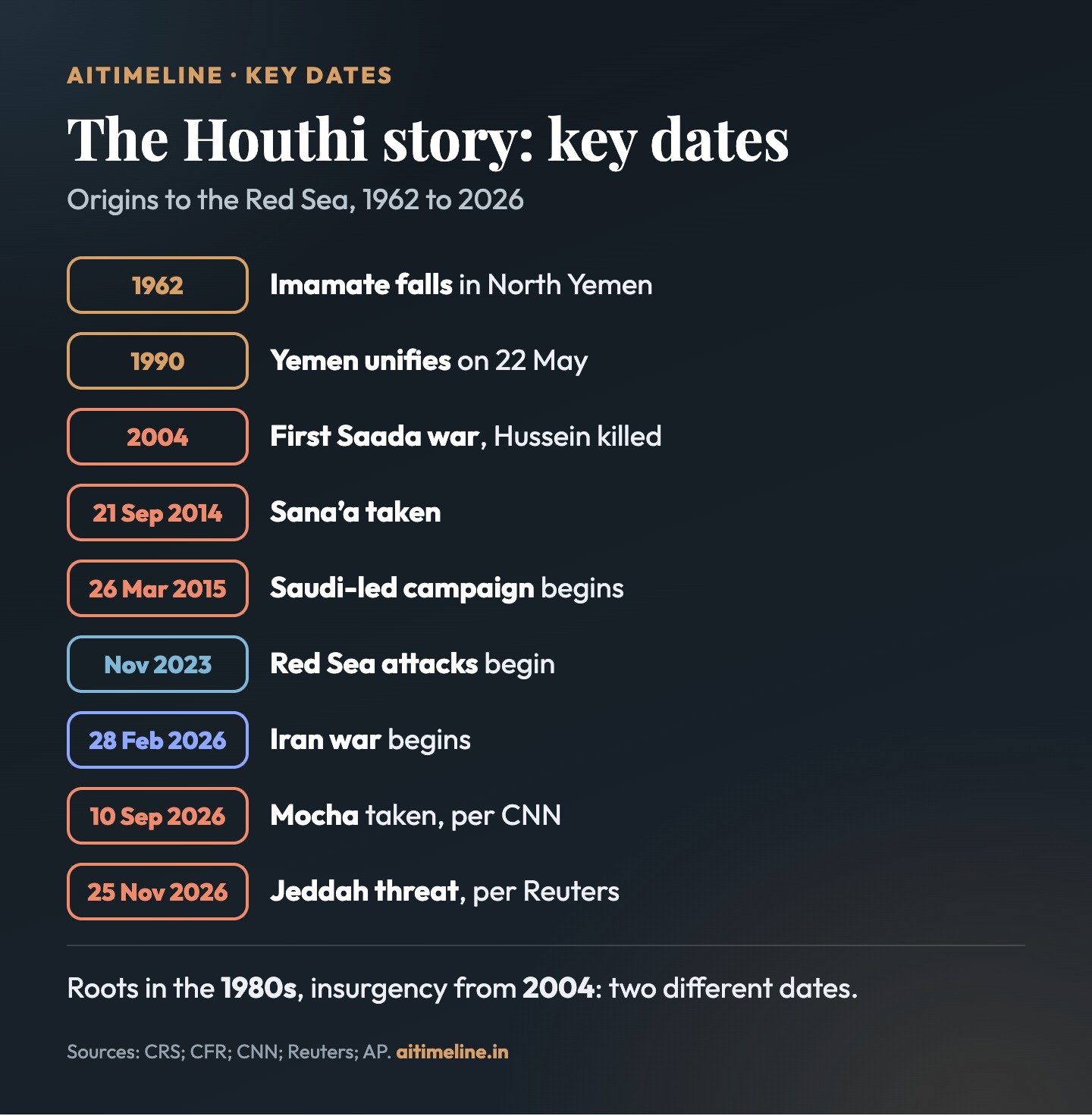
The Lead Picture: Key Dates, 1962 to 2026
Nine dates in order.
Houthi Movement: Key Questions
What the Record Shows
- Roots and insurgency differ: the religious revival dates to the 1980s and 1990s, the armed insurgency to 2004.
- Six wars: the Saada wars ran from 2004 to 2010 and ended in a ceasefire in February 2010.
- 2014 and 2015: they took Sana’a on 21 September 2014, and the Saudi-led intervention began on 26 March 2015.
- Zaydi, not Twelver: Zaydism differs from Iran’s majority Shia tradition.
- Iran’s role is documented but limited: assistance and influence, not command, according to the CRS.
- Red Sea campaign: more than 100 commercial vessels were attacked between November 2023 and mid-2025, per Al Jazeera.
- 2026 is a new phase: the Iran war, a 20 July embargo on Saudi shipping and the September coastal advance.
- Territory is fluid: Mocha has changed hands in reports, and front-line claims often cannot be verified.
- Civilians bear the cost: 22.3 million Yemenis need aid, according to the UN 2026 plan.
Autumn 2026: Eleven Weeks of Escalation
From the September offensive to the Jeddah threat.
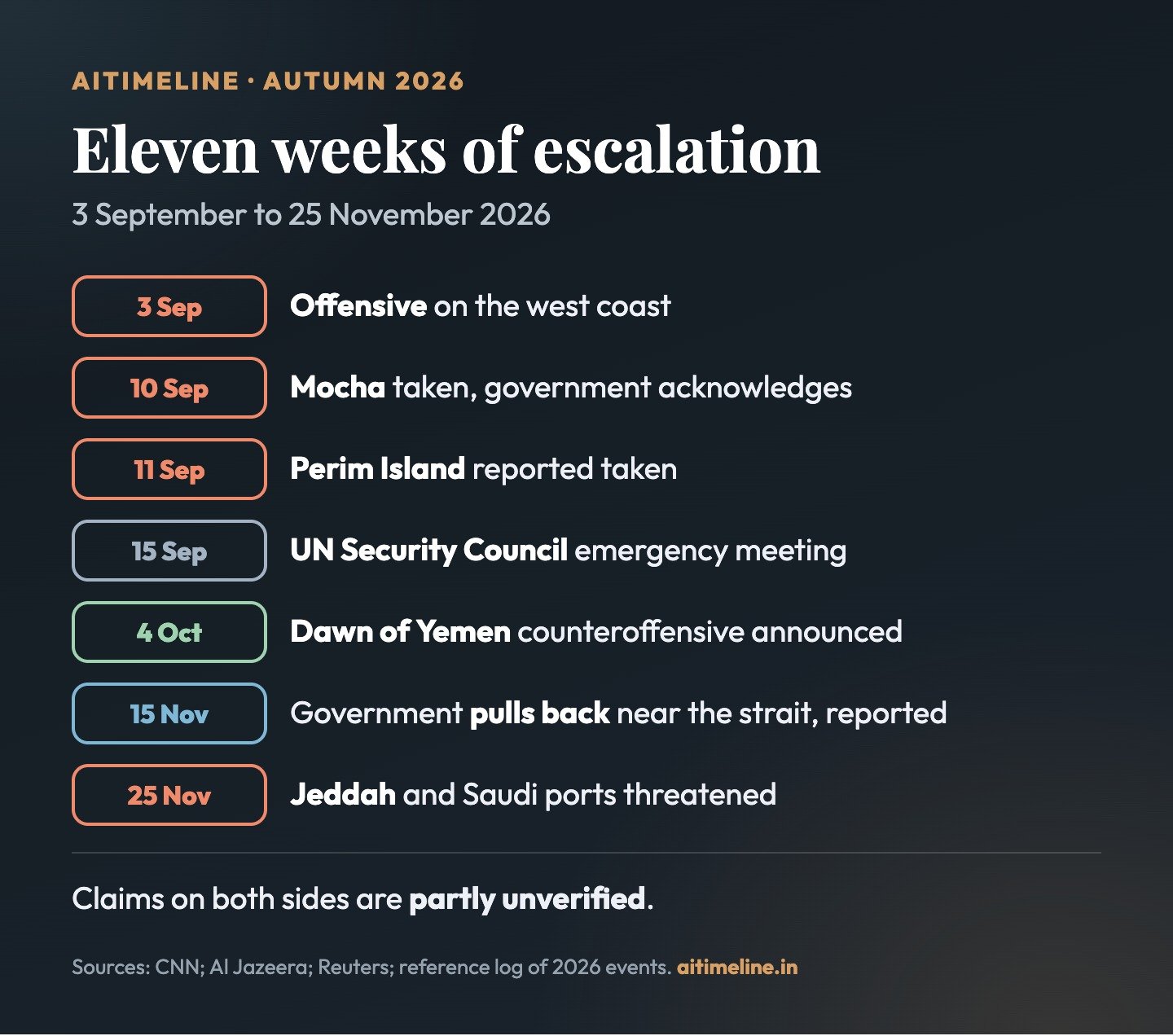
Most of this sequence is reported by wire services and by the parties themselves. We separate what was acknowledged by both sides, such as the loss of Mocha on 10 September, from claims that only one side made, such as the government’s early October gains and the Houthis’ denials.
Timeline: The Houthi Movement, 1962 to 2026
Newest first. Labels mark origins, the Saada wars, takeover and war, the Red Sea campaign and the 2026 escalation.
Houthis threaten Jeddah and Saudi Red Sea ports Escalation 2026
The threat: Reuters reported that the Houthis said Jeddah and all other Saudi ports on the Red Sea coast would be targeted if Saudi Arabia carried out its threats to attack Yemen’s port of Hodeidah. The statement, issued by Houthi spokesperson Yahya Saree, urged port workers and people nearby to evacuate and told shipping companies to withdraw their vessels.
The trigger: On Tuesday 24 November a Houthi drone struck the tallest tower in Riyadh and injured at least 11 people, according to Saudi authorities. After the Houthi statement the Saudi-led coalition said it targeted operational capabilities at Hodeidah and destroyed targets in Saada and Amran. Hodeidah is the main entry point for food and supplies into Houthi-held northern Yemen.
Government forces pull back near Bab el-Mandeb Escalation 2026
The withdrawal: A running log of the conflict records that on 15 November government-aligned forces withdrew from positions near the Bab el-Mandeb Strait to defend Aden after Houthi fighters cut a coastal supply route. On 24 November government forces said Houthi forces had reached within 60 km of Aden and were preparing to attack.
Also that week: The same log records that the UN Security Council unanimously extended Yemen sanctions for another year on 14 November, and that the UK froze Houthi assets and sanctioned four senior officials on 24 November.
Government counteroffensive: Dawn of Yemen Escalation 2026
The announcement: Rashad al-Alimi, chairman of the Presidential Leadership Council, announced a government operation called Dawn of Yemen on Sunday 4 October. He said it aims to retake all remaining Houthi-held territory, including Sana’a.
The claims: Government forces said they had seized positions near Bab el-Mandeb and the Dhubab area, and that Mocha had fallen after reaching its outskirts on 5 October with heavy Saudi air support. A Houthi spokesman said the group remained in control of its gains and called the reports fabricated heroics. Al Jazeera said it could not independently verify the full extent of the government’s gains.
UN Security Council warns of escalation at Bab el-Mandeb Escalation 2026
The briefing: At an emergency meeting on 15 September, UN officials said the situation around Bab el-Mandeb had become increasingly volatile and that fighting had intensified along Yemen’s west coast. Press accounts say Khiari stressed that navigation rights in the Red Sea and the strait must be respected under international law, including Security Council resolution 2722.
Shipping at that point: The Conversation reported on 16 September that Red Sea shipping appeared to be continuing largely unaffected, even as markets worried about the strait. The Houthis said their direct targets were Saudi vessels and Saudi oil.
Houthis take Mocha and Perim Island Escalation 2026
Mocha: CNN reported that the Houthis captured the port town of Mocha on Thursday 10 September. Until that morning it had been held by the National Resistance Forces, a Saudi-backed group commanded by Tareq Saleh, and the government later acknowledged the loss. The port director said more than 25 Houthi rockets had hit the harbour in the weeks before.
Perim and the coast: On 11 September CNN cited two Yemeni government sources saying the Houthis captured Perim Island (Mayyun) in the Bab el-Mandeb Strait. Al Jazeera described the takeover of Yemen’s entire Red Sea coastline as complete, leaving Houthi forces about 20 km from the African coast. The IOM said more than 2,000 people had fled to Djibouti in 24 hours.
Washington: CNN, citing Axios, reported that Saudi Crown Prince Mohammed bin Salman spoke twice to President Trump on 10 September and urged US strikes on the Houthis. Trump did not agree, according to one source.
Houthis declare a maritime embargo on Saudi Arabia Escalation 2026
The announcement: The Houthis announced a maritime embargo against Saudi Arabia, effective immediately, in retaliation for what they called a blockade of Yemen and a recent attack on Sanaa International Airport. A Houthi media official said the Bab el-Mandeb strait would be closed in response.
The setting: Saudi Arabia was already under pressure because it uses its East-West Pipeline to the Red Sea as an alternative to the Strait of Hormuz, which Iran has held in its grip since the US and Israel attacked Iran on 28 February. AP noted that few details were given and that it was unclear whether the Houthis would resume attacks at their earlier scale.
The Iran war opens a wider front, but the Houthis hold back Escalation 2026
The war: The US and Israel attacked Iran on 28 February 2026. The CRS says maritime transit through the Red Sea had not returned to pre-crisis levels even before then, and that disruption in the Strait of Hormuz raised the importance of the Red Sea corridor for energy markets.
The Houthis’ choice: As of May the CRS said the Houthis had carried out limited attacks on Israel in late March and early April but had not resumed strikes on vessels, nor claimed attacks on US targets or neighbouring Arab states. After an April US-Iran ceasefire, Abdul-Malik al-Houthi said on 10 April the group would join an escalating course if the enemies resumed escalation against Iran.
Saudi Arabia reshapes the anti-Houthi camp Escalation 2026
The STC offensive: In December 2025 forces aligned with the Southern Transitional Council moved to assert security control across southern and eastern Yemen, with reported UAE support. Saudi Arabia intervened militarily, striking STC positions, and the CRS says the STC was dissolved and the Presidential Leadership Council reshuffled.
The aftermath: UAE forces left Yemen. The reference log records that STC chairman Aidarus al-Zubaidi was expelled from the council on 7 January and that the STC’s dissolution was announced on 9 January, though an STC spokesperson denied it. The CRS says Saudi Arabia is now the government’s principal sponsor, and the same month the World Food Programme ceased operations in Houthi-held areas.
Attacks on ships resume, then pause again Red Sea campaign
The pattern: The Houthis resumed attacks on some non-US ships in July 2025 and kept firing at Israel. The CRS counts 220 missile and drone attacks on Israel between August 2024 and August 2025. Israel expanded its strikes in Yemen, destroying port, airport, military and electricity infrastructure and killing the Houthi government’s prime minister and other officials.
The pause: After the October 2025 Israel-Hamas ceasefire the Houthis suspended their attacks, while signalling they could resume if war returned to Gaza. Damage to ports from Israeli strikes has affected imports into Houthi-held areas.
Operation Rough Rider and the Oman understanding Red Sea campaign
The campaign: On 15 March 2025 US forces began a campaign of strikes on Houthi targets, called Operation Rough Rider, to compel an end to Houthi maritime attacks. In March the administration also redesignated the Houthis a Foreign Terrorist Organization. The CRS says the campaign degraded but did not eliminate their missile and drone capacity.
The deal: The campaign ended under an Oman-brokered understanding announced in May, under which the Houthis reportedly agreed to stop targeting US vessels and the United States reportedly agreed to stop its strikes. The CRS words this cautiously, citing media accounts.
Houthi drone reaches Tel Aviv, Israel strikes Hodeidah Red Sea campaign
The strikes: In July 2024 the Houthis claimed a drone attack on Tel Aviv, and Israel responded with strikes on Houthi-controlled infrastructure in Hodeidah. The exchange showed that the movement’s operations had moved beyond Yemen’s internal war and the nearby shipping lanes.
The scale: Over the following year the Houthis carried out hundreds of attacks on Israel in all, which the CRS counts at 220 missile and drone attacks between August 2024 and August 2025.
Naval escort missions, US and UK strikes and the IMF count Red Sea campaign
The response: The United States announced Operation Prosperity Guardian in December 2023 to protect commercial shipping, and the US and UK struck Houthi targets in Yemen on 11 and 12 January 2024. UN Security Council resolution 2722 demanded that the Houthis stop attacks. Carriers began routing ships around the Cape of Good Hope.
The cost: The IMF found that Suez Canal trade volume fell roughly 50% year on year in the first two months of 2024, with Cape of Good Hope transits up an estimated 74%. Our related Suez story carries the IMF figures in full.
Gaza war and the seizure of the Galaxy Leader Red Sea campaign
The turn: After Hamas-led attacks on Israel on 7 October 2023 the Houthis began targeting Israel and commercial ships passing through Bab el-Mandeb, saying the attacks were in support of Palestinians. On 19 November they seized the vessel Galaxy Leader, which had a multinational crew.
The reach: Al Jazeera counts more than 100 commercial vessels attacked between November 2023 and mid-2025. The campaign turned the Red Sea into a global security issue and made the Houthis a regional actor far beyond Saada.
Truce, council and Saudi-Houthi talks Takeover and war
2022: A UN-brokered truce began on 2 April 2022 and a Presidential Leadership Council took over from President Hadi on 7 April. The formal truce was not renewed after 2 October, but the CRS says the uneasy truce froze conflict lines and ended coalition strikes on the Houthis.
2023: Saudi Arabia and Iran agreed in March 2023 to restore relations, Saudi officials visited Sana’a in April, and Houthi representatives went to Riyadh in September. The CRS says Saudi-Houthi talks continued, but no roadmap steps were implemented.
Hodeidah, the Stockholm Agreement and Marib Takeover and war
Stockholm: A coalition-backed advance on Houthi-held Hodeidah was halted in 2018 amid worsening humanitarian conditions. On 13 December 2018 the parties agreed in Stockholm to a ceasefire in Hodeidah, force redeployments and prisoner exchanges, with UN monitoring. Implementation stalled repeatedly.
Marib: In 2021 the Houthis pushed towards Marib, the government’s energy-rich stronghold, causing displacement and renewing fears of a larger emergency. In 2026 the UN Security Council ended the UN mission set up under the Hodeidah agreement, according to the CRS.
Saudi intervention, and Saleh’s death Takeover and war
2015: A Saudi-led coalition began a military campaign against the Houthis on 26 March 2015, after Hadi and his interim leaders fled and requested help. The United States gave logistics, intelligence and advice. The war became an internationalised conflict, and civilian casualties and infrastructure damage mounted.
2016 and 2017: The Houthis and former president Saleh’s party formed a Supreme Political Council in Sana’a in 2016. The alliance collapsed in December 2017 when Saleh moved to break away and was killed on 4 December, which strengthened the Houthis’ hold on the capital.
Houthi forces take Sana’a Takeover and war
The seizure: Houthi fighters entered Sana’a on 21 September 2014 after protests against a fuel-subsidy cut and clashes with rival forces. They took government institutions and military positions, and the transitional government lost effective control of the capital. An alliance with former president Saleh and sections of the army helped.
The aftermath: In January 2015 the Houthis seized the presidential palace and Hadi resigned, then withdrew his resignation after reaching Aden in February. The CFR noted in early 2015 that the group was a capable military force but not experienced in governing.
Uprising, transition and a failed national dialogue Takeover and war
2011 and 2012: Protests in 2011 weakened President Ali Abdullah Saleh. Under a Gulf Cooperation Council deal he agreed in November 2011 to hand over power, and Abd-Rabbu Mansour Hadi became president in February 2012. The Houthis joined the broader anti-government coalition.
2013 and 2014: A UN-backed National Dialogue Conference discussed a new constitution, federalism and regional autonomy. The Houthis rejected parts of the proposed federal arrangement, which they said would disadvantage their strongholds, and kept expanding on the ground.
The sixth war and the Saudi border Saada wars
The war: The sixth round began in August 2009 and spread towards the Saudi border. Saudi Arabia became directly involved after Houthi fighters crossed into Saudi territory, and Saudi forces launched operations against them.
The result: A ceasefire followed in February 2010. By then the Houthis had survived six rounds, gained military experience and consolidated their base in Saada.
The first five Saada wars Saada wars
The first war: The relationship between Hussein al-Houthi and President Saleh’s government broke down. In June 2004 security forces launched an operation against the movement after an attempt to arrest him, and Hussein was killed in September 2004. His supporters became known as the Houthis.
The next four: Rounds followed between 2005 and 2008 with temporary arrangements in between. Start and end dates for each round vary between sources, so we do not print exact dates. His brother Abdul-Malik al-Houthi became the principal leader.
From religious teaching to a political slogan Origins
The shift: Hussein al-Houthi’s speeches criticised corruption and the government’s relationship with the United States. After the invasion of Iraq in 2003 the CFR says he shifted the movement towards political activism and opposed the US invasion, which challenged Saleh.
The slogan: The group adopted a slogan calling for death to America and Israel and a curse upon the Jews. It remains central to Houthi identity and controversial internationally, and the CRS says the group espouses anti-American, anti-Zionist and anti-Jewish beliefs.
A Zaydi revival in Saada Origins
Roots: The CFR says the Houthis’ roots lie in a movement that began in northern Yemen in the late 1980s to protect and revive Zaydi religious and cultural traditions. Zaydis felt pressure from Salafi institutes that settled in their areas with state support and felt politically excluded.
The Believing Youth: The brief dates the Believing Youth network to 1986, but Wikipedia dates its founding to 1992, so sources disagree. It ran school clubs and summer camps. The brief also says Hussein al-Houthi was elected to parliament in 1993 through the Hizb al-Haqq party, which we could not confirm in the sources we opened.
The Imamate falls and Yemen is unified Origins
1962: A republican revolution in September 1962 overthrew the Zaydi Imamate in North Yemen, triggering a civil war in which Egypt and Saudi Arabia backed opposing sides. Some Zaydi religious circles felt marginalised afterwards.
1990 and 1994: North and South Yemen unified on 22 May 1990 with Saleh as president, but unification did not end regional inequality or disputes over resources. The CRS notes north-south tensions recurred, and a civil war in 1994 left Saleh’s government dominant and more centralised.
Yemen’s Red Sea Coast, as Reported in November 2026
A dated snapshot, not a map of record.
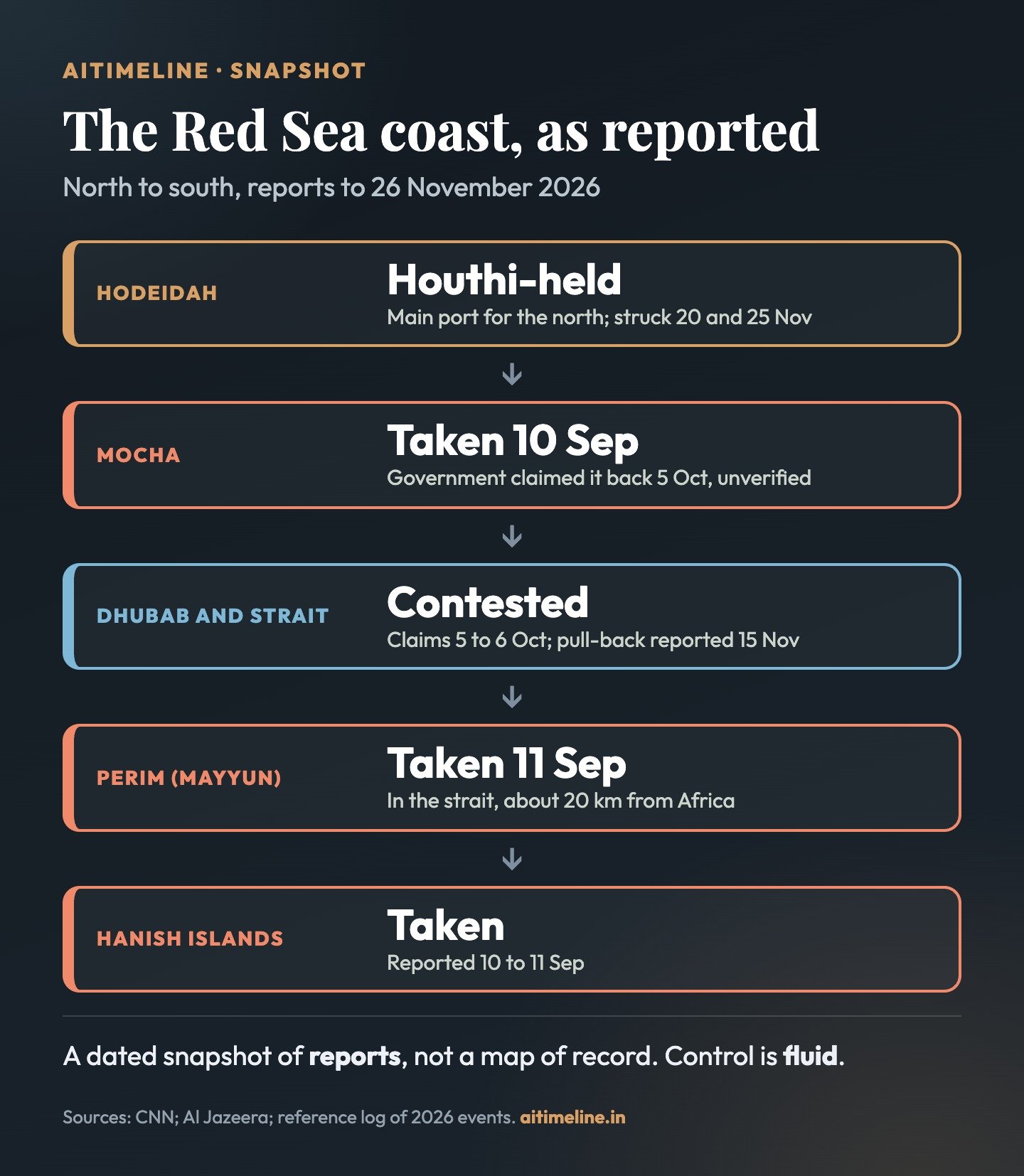
Control of this strip changed several times in two months, and each side’s claims are partly unverifiable. Al Jazeera said the Houthis held the whole coast on 13 September, the government claimed Mocha and Dhubab on 5 and 6 October, and a reference log records a government withdrawal from positions near the strait on 15 November. Treat the picture as the latest reported state, not a settled map.
Three Phases of One Conflict
Different causes, different opponents.
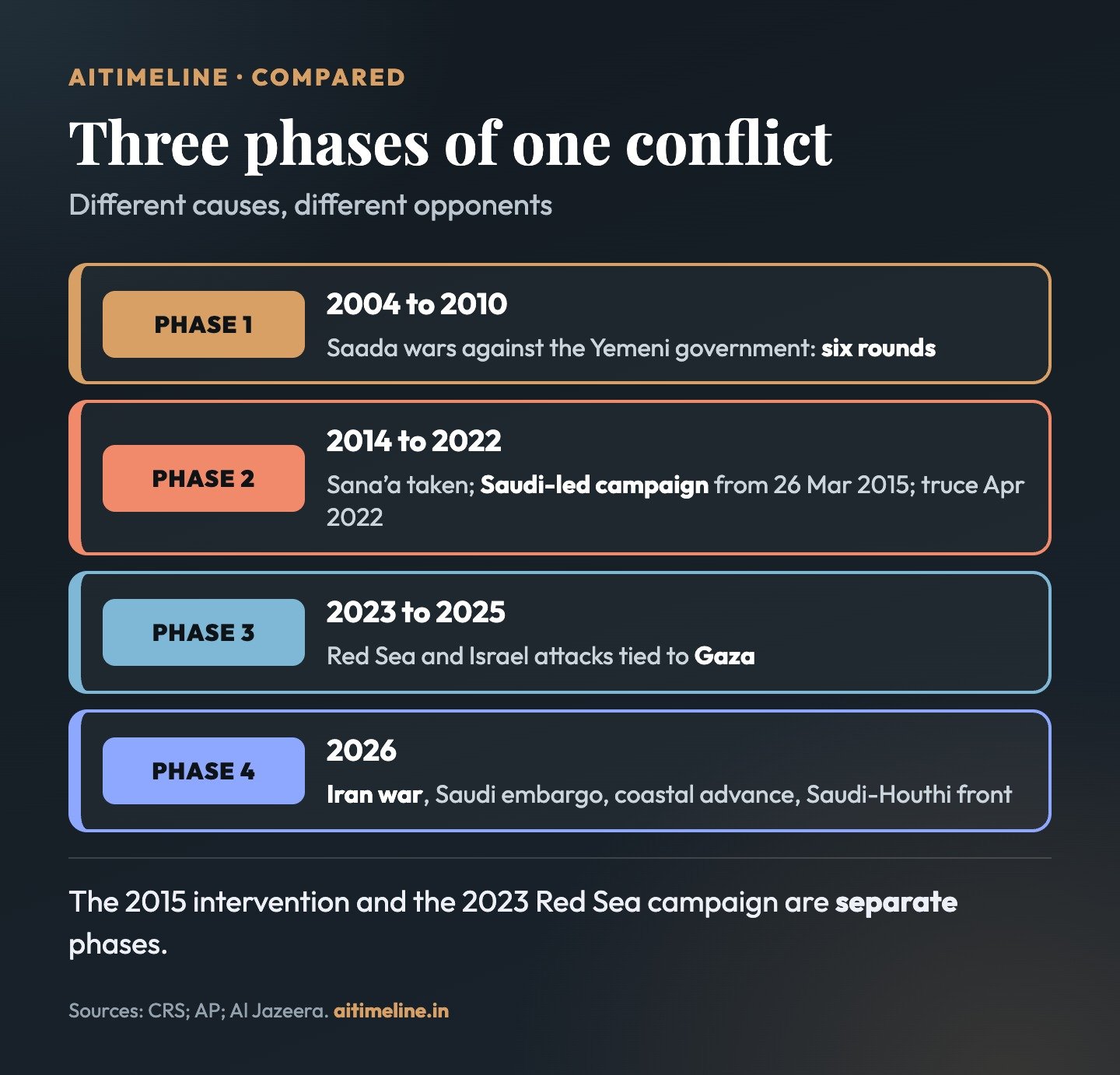
The 2015 intervention and the 2023 Red Sea campaign are separate phases. The first was a war over Yemen’s government, the second a regional and maritime confrontation tied to Gaza, and the 2026 fighting links Yemen’s front lines to the war on Iran.
The Red Sea Campaign in Numbers
Ships, trade and the chokepoint.
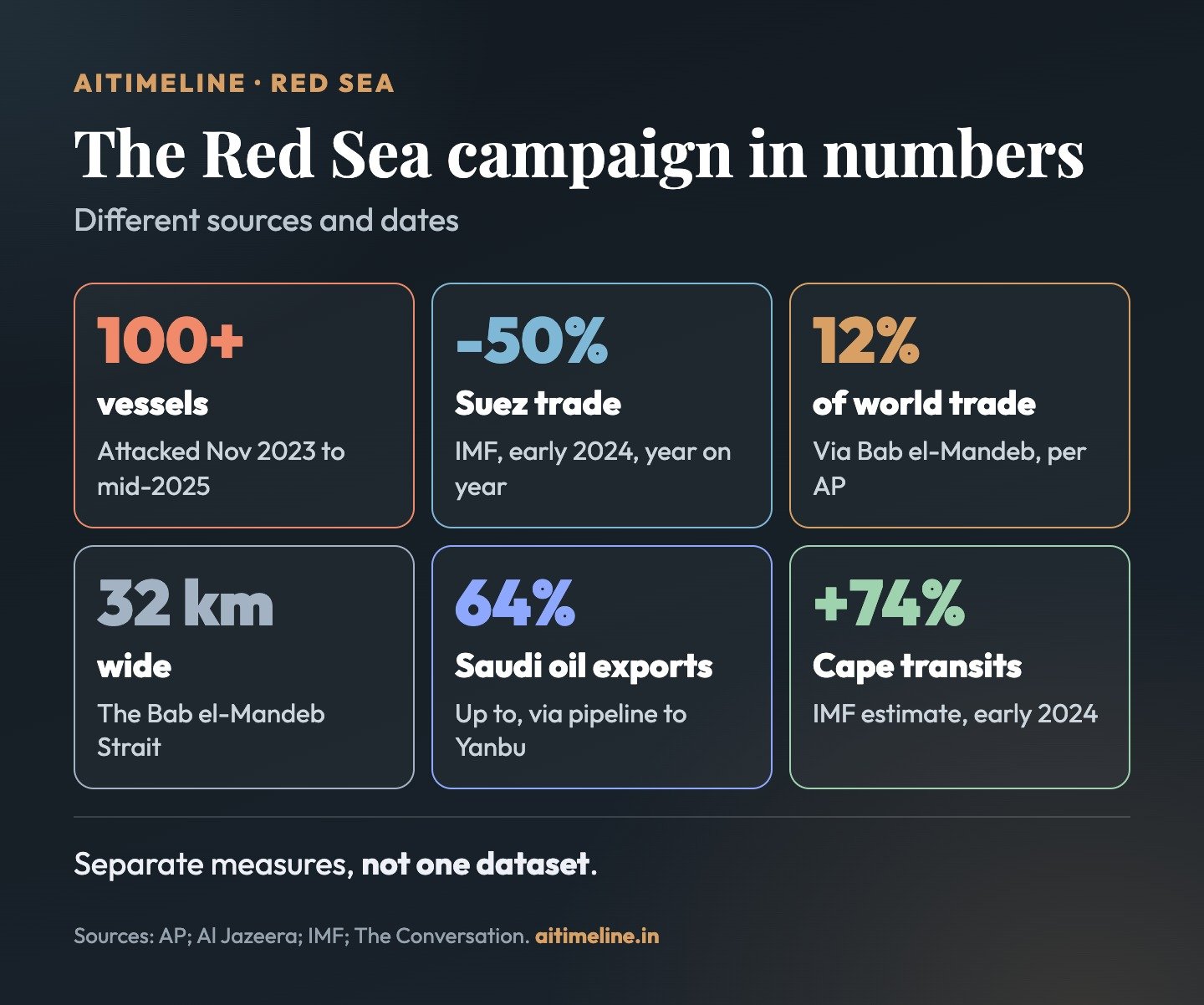
These are separate measures from different sources and dates, not one dataset. Bab el-Mandeb is less critical to oil than Hormuz, CNN notes, but its importance has grown because Saudi Arabia has leaned on its Red Sea export route.
Iran and the Houthis: Documented and Claimed
What the sources say, and what they do not.
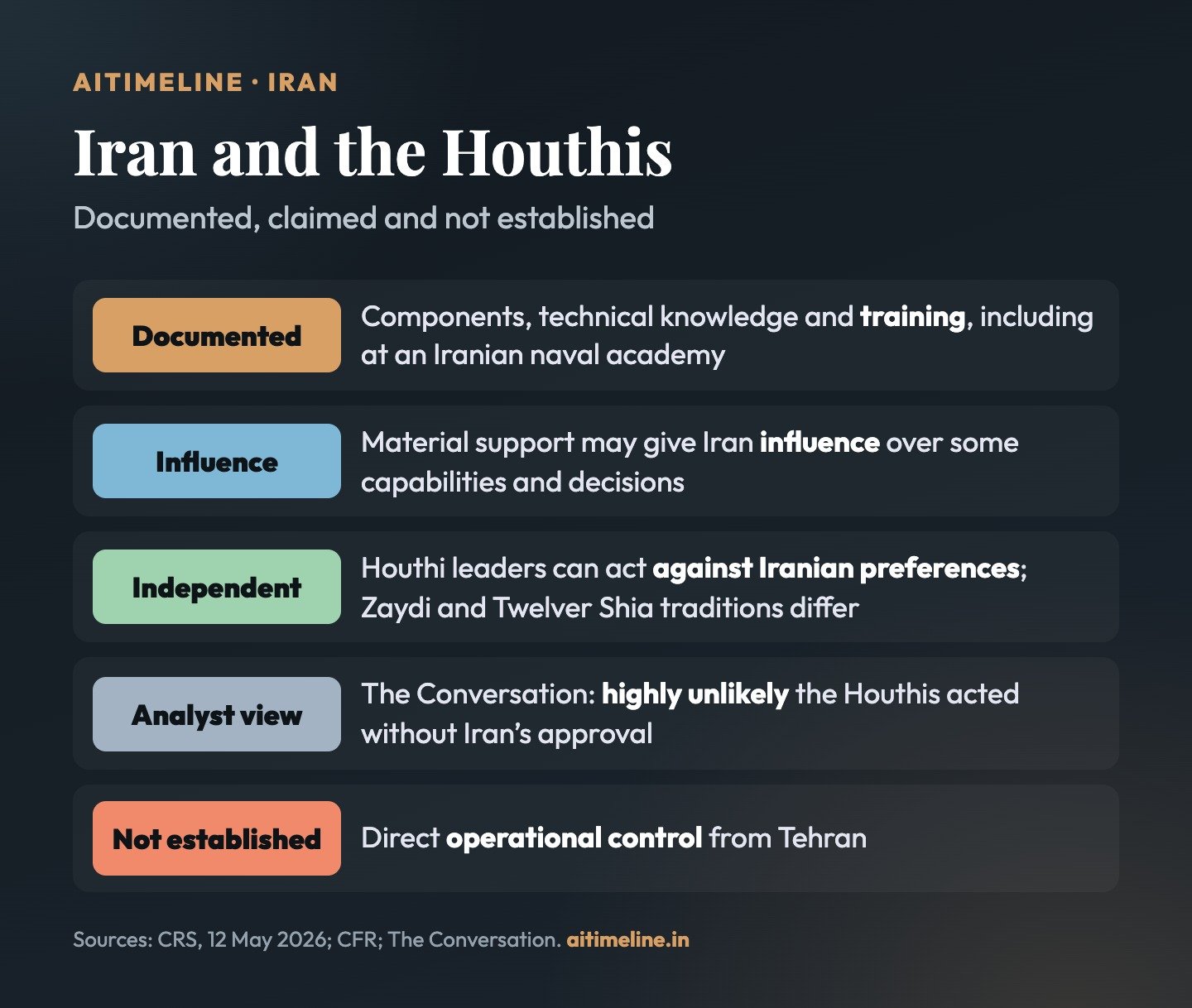
We separate documented support from claims of control. The CRS records Iranian components and training and notes Houthis trained at an Iranian naval academy, while also saying the Houthis can act independently and against Iranian preferences. The Conversation argued it was highly unlikely the Houthis acted in September without Iran’s approval, which is an analyst’s judgement and not a documented fact.
The Humanitarian Cost
Figures from the UN 2026 plan, as cited by the CRS.
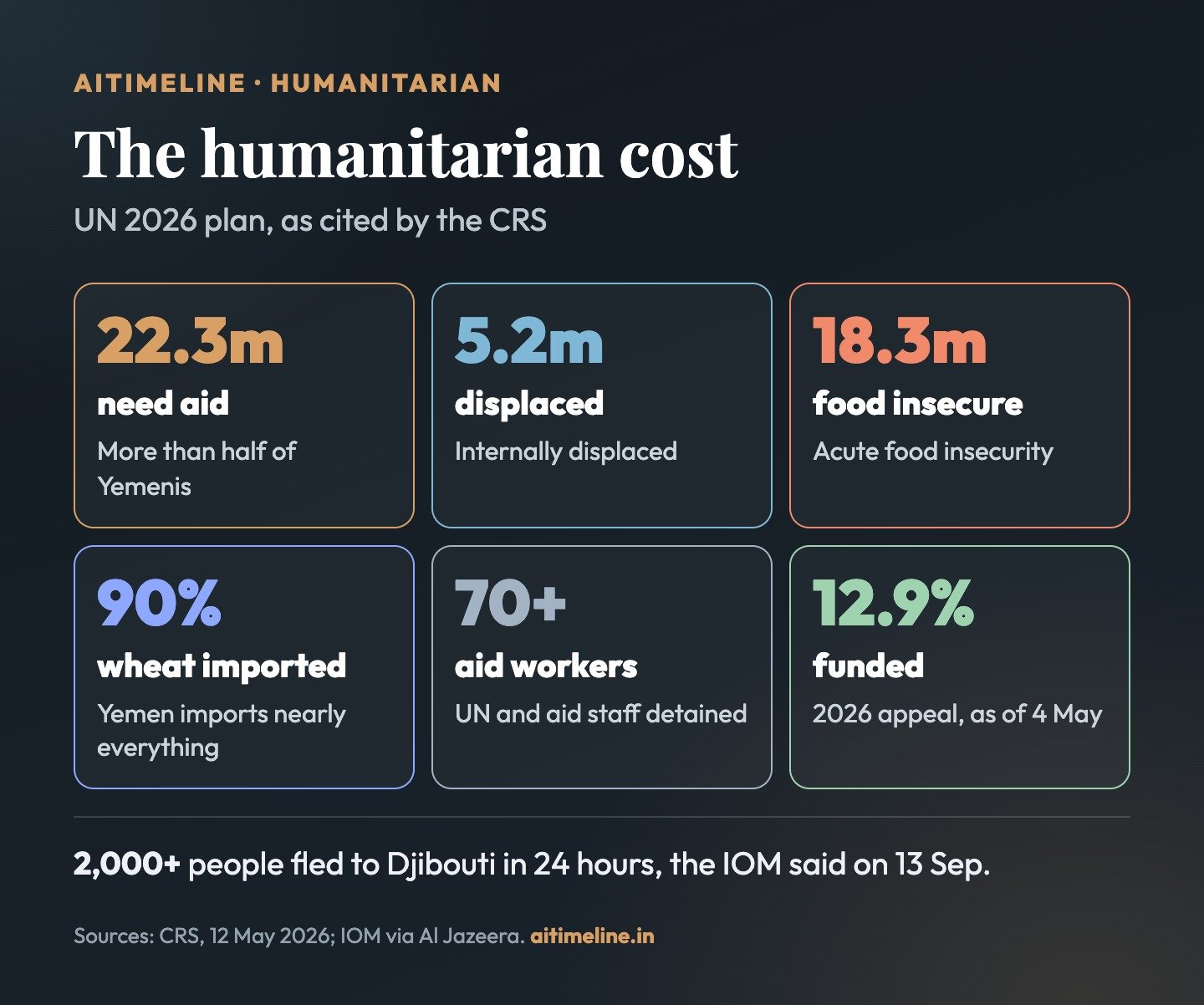
Years of fighting have damaged infrastructure and the economy, and the 2026 escalation adds new pressure. Aid access is limited in Houthi-held areas, where the CRS says more than 70 UN and aid workers are detained, and in government areas the WFP has cut the number of people it feeds from 3.4 million to 1.7 million.
Source Gaps and Corrections
| Claim in the brief | What we found | Status |
|---|---|---|
| Timeline ends with a Nov 2026 Saudi-port threat, no Iran war | The US-Israel attack on Iran on 28 Feb 2026 and the 20 Jul embargo are central context in CRS, AP and CNN | Added |
| Believing Youth founded 1986 | Wikipedia gives 1992; sources disagree | Hedged |
| Hussein al-Houthi elected 1993 via Hizb al-Haqq | Not confirmed in the pages we opened | As reported |
| Reuters: Iranian weapons and advice aided the Mocha advance | Reuters returned an access error; CNN and Al Jazeera do not say this | Dropped |
| UN briefing 15 Sep: shipping appeared unaffected | UN page blocked; The Conversation of 16 Sep says shipping was largely unaffected | Attributed |
| Commons Library 5 Oct; Reuters 17 Sep analysis; MEI; Sana’a Center | Pages returned access errors | Not used |
| Government retakes positions near Bab el-Mandeb, 6 Oct | Confirmed as claims; Al Jazeera could not verify them, and a log records a 15 Nov withdrawal | Hedged |
| Riyadh tower drone strike injured 11; Jeddah threat | Confirmed in Reuters wire copy; injury figure is from Saudi authorities | Confirmed |
| Shipping attacks paused January 2025 | CRS says attacks ran to December 2024, then paused in early 2025 | Adjusted |
Conclusion: From Saada to the Strait
The Houthi story is one of political transformation. A religious revival in a marginal northern province became an armed movement through the Saada wars, a governing authority after 2014, and a regional actor whose attacks on shipping drew in navies and markets. Its reach in 2026 depends on the Iran war and on a fragmented anti-Houthi camp.
What we could not settle is how much Iran directs its choices, who holds Mocha at any given moment, and several dates from the early years. The consequences fall hardest on ordinary Yemenis, and no comprehensive settlement had been reached by 28 November 2026.
Explore More Timelines
People Also Ask
Frequently Asked Questions
⚠️ Editorial Note
This page draws on the US Congressional Research Service (February and May 2026), CNN, Al Jazeera, AP, Reuters wire copy, The Conversation and a running reference log of 2026 events. Several pages named in the brief returned access errors, so we do not rely on them. Casualty figures and battlefield claims come from the parties involved and are attributed. This article is editorial journalism, not a forecast, and it does not take a side in the conflict.
Related Stories
Sources & further reading
Every dated entry above was checked against these references. Last reviewed 28 November 2026.
- US Congressional Research Service: Yemen: In Brief (12 May 2026)
- US Congressional Research Service: Yemen: Conflict, Red Sea Security, and U.S. Policy (20 February 2026)
- CNN: Iranian allies captured a strategic Red Sea island (10 September 2026)
- Al Jazeera: Red Sea nations watch as Houthis seize Bab al-Mandeb strait (13 September 2026)
- Al Jazeera: Yemen forces claim key gains near Bab al-Mandeb (6 October 2026)
- AP via PBS: Houthis announce a maritime embargo against Saudi Arabia (20 July 2026)
- Reuters via Internazionale: Houthis threaten to target Jeddah and other Saudi Red Sea ports (25 November 2026)
- Council on Foreign Relations: Who Are Yemen's Houthis?