National Science Day: Raman Effect Discovery Timeline in India
Discover how C.V. Raman and K.S. Krishnan found the Raman Effect in 1928, won the 1930 Nobel Prize and inspired India's National Science Day.
Latest Story
National Science Day falls on 28 February because of a question about the colour of the sea. In 1921 C.V. Raman looked at the Mediterranean from the deck of the SS Narkunda and doubted the textbook answer. Seven years later, in Calcutta, he and K.S. Krishnan showed that a small part of scattered light changes colour. That is the Raman Effect. Raman won the 1930 Nobel Prize in Physics, and India now marks the discovery each year. We follow the story from his birth in 1888 to National Science Day 2026, and mark where sources differ.
The discovery was a process, and Krishnan was central to it. The Nobel Prize went to Raman alone, but Wikipedia says Krishnan first noted the new scattering on 7 January 1928 and co-authored the main 1928 papers. The 28 February date marks the day the two obtained spectra of the modified light.
💡 Short Answer
National Science Day is celebrated on 28 February to mark the discovery of the Raman Effect, which PIB dates to 28 February 1928. C.V. Raman and K.S. Krishnan found that a small share of light scattered by molecules changes colour. Nature printed their letter on 31 March 1928, Raman won the 1930 Nobel Prize in Physics, and India held its first National Science Day on 28 February 1987.
The Lead Picture: From a Blue Sea to a Nobel Prize
Ten dates, 1888 to 1987.

Raman Effect: Key Questions
What the Record Shows
- The sea started it: the 1921 voyage on the SS Narkunda turned Raman to light scattering, seven years before the effect.
- A process, not a moment: hints appear from 1923, Krishnan saw a glow on 7 January 1928, and spectra followed on 28 February.
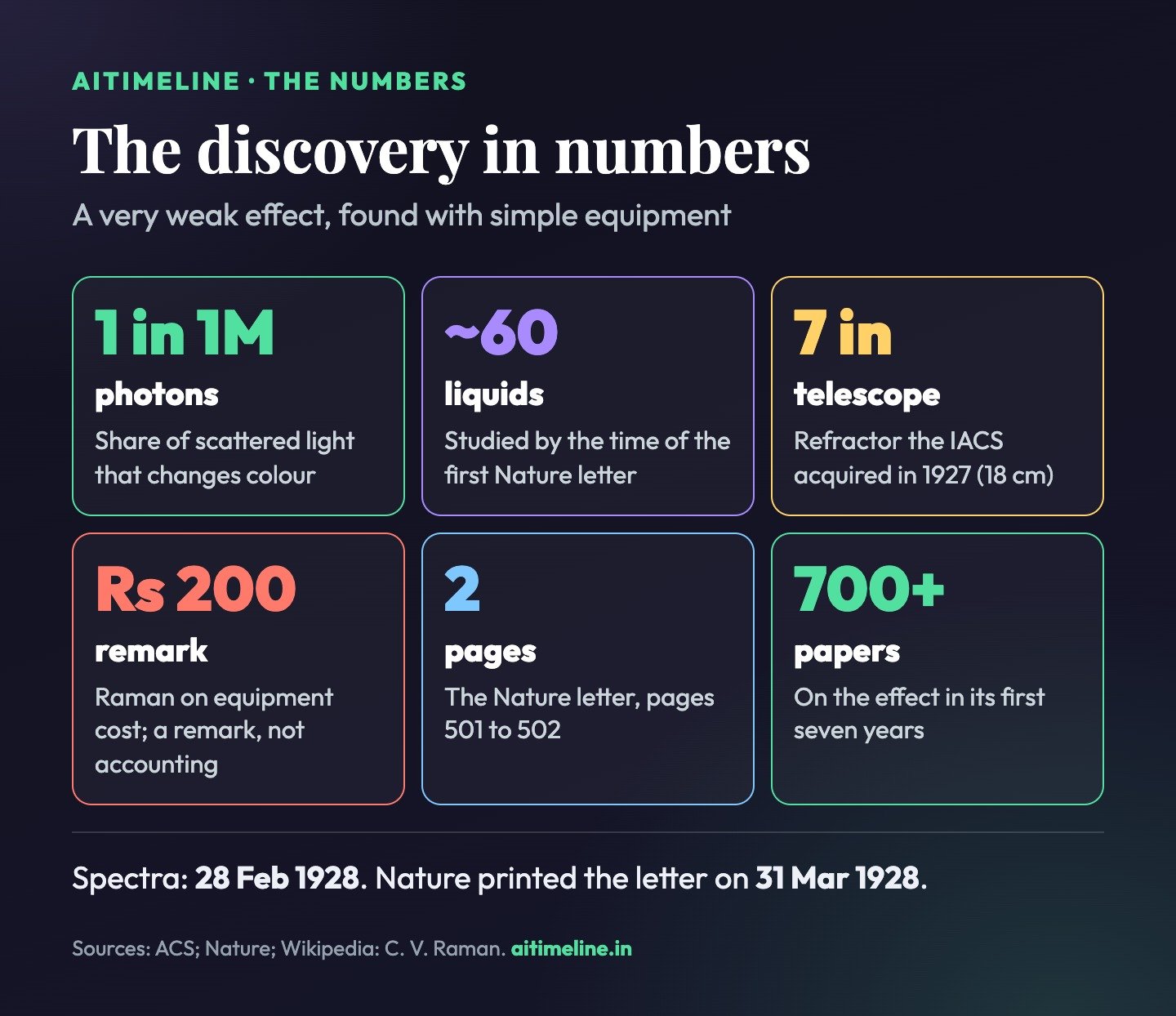
- Very weak: about one in a million scattered photons shows the shift, so stronger light sources mattered.
- Simple equipment: a seven-inch telescope, sunlight, then mercury arc lamps and a quartz spectrograph.
- Published fast: the Bangalore lecture came on 16 March and the Nature letter on 31 March 1928.
- Nobel to one: the 1930 prize went to Raman alone; Krishnan was not nominated.
- Not alone in 1928: Landsberg and Mandelstam saw it in crystals, but the Nobel Committee proposed only Raman.
- Day versus discovery: the day was designated in 1986 and first observed in 1987.
- Source differences: the knighthood year, the Academy’s founding year and exact IISc dates differ by source, so we give both or the years only.
Timeline: The Raman Effect and National Science Day, 1888 to 2026
Newest first. Labels mark life events, science, honours, institutions and the national day.
National Science Day 2026: ‘Women in Science: Catalysing Viksit Bharat’ National Day
The theme: India observed National Science Day on 28 February 2026 under the theme ‘Women in Science: Catalysing Viksit Bharat’. The ISRO U R Rao Satellite Centre says the day is celebrated to mark Raman’s discovery of 1928.
What happened: A PIB release says the day was marked with lectures, exhibitions, demonstrations and public outreach, including a programme in Delhi by CSIR-IGIB. The next observance falls on 28 February 2027.
The Raman Effect becomes an International Historic Chemical Landmark Honour
The designation: The American Chemical Society and the Indian Association for the Cultivation of Science dedicated the Raman Effect as an International Historic Chemical Landmark on 15 December 1998, at the IACS campus in Jadavpur.
The plaque: The plaque says Raman discovered at the institute in 1928 that a fraction of light scattered by a liquid is of a different colour from the beam entering it.
The first National Science Day National Day
The day: India celebrated the first National Science Day on 28 February 1987, a year after the Government of India accepted the proposal to designate the date.
The idea: PIB says theme-based science communication activities are carried out across the country on the day.
NCSTC asks for a National Science Day National Day
The request: In 1986 the National Council for Science and Technology Communication asked the Government of India to designate 28 February as National Science Day. The government accepted the request.
Source: This is stated in the PIB explainer on National Science Day. The year is the year of designation, and the first observance followed in 1987.
Raman dies in Bangalore at 82 Life
The end: C.V. Raman died on 21 November 1970 in Bangalore, according to Wikipedia. He had been working at the Raman Research Institute, which he founded in 1948.
Where it stands: The discovery that bears his name outlived him in laboratories across the world. We could not confirm further details of his death from the sources we read.
Bharat Ratna Honour
The award: Raman received the Bharat Ratna in 1954, alongside C. Rajagopalachari and Sarvepalli Radhakrishnan, according to Wikipedia.
Other honours: He had already won the Matteucci Medal (1928), the Nobel Prize (1930) and the Royal Society’s Hughes Medal (1930). Wikipedia also lists the Franklin Medal in 1941.
Raman Research Institute Institution
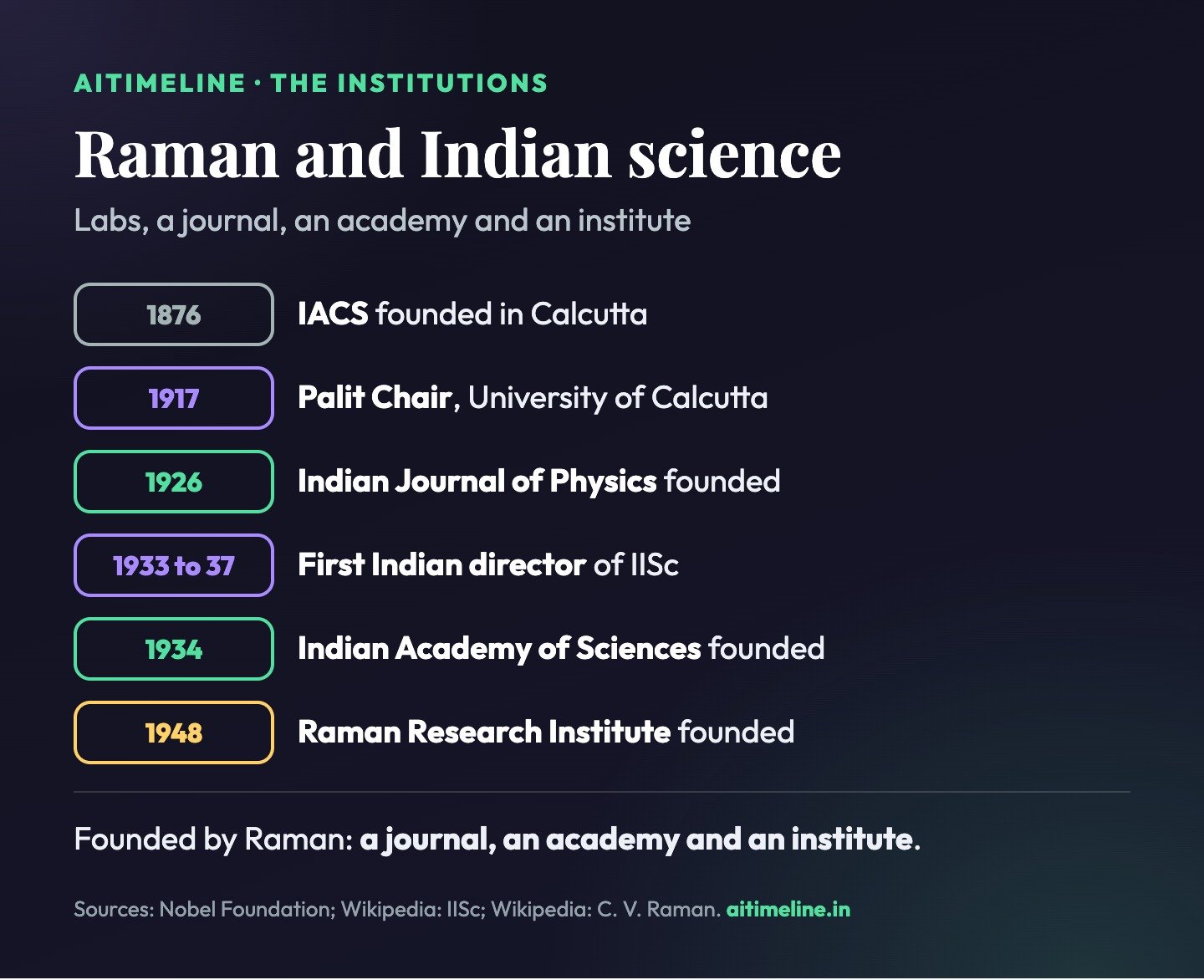
The institute: After leaving IISc, Raman founded the Raman Research Institute in Bangalore in 1948. It began as a private institution owned by Raman and became autonomous in 1972, with funding from the Department of Science and Technology.
Why it matters: It gave him a base for independent work on optics, crystals and colour perception for the rest of his life, as the Nobel Foundation’s biography and the institute’s own history describe.
The Indian Academy of Sciences Institution
The founding: Raman founded the Indian Academy of Sciences in Bangalore in 1934 and served as its president from the start, according to the Nobel Foundation. It also publishes the Proceedings that carried much of his work.
A date conflict: Wikipedia’s article on Raman says he founded the Academy in 1933. The Academy’s own article gives 1934, which we use.
The first Indian director of the Indian Institute of Science Institution
The move: Raman moved to Bangalore in 1933 as the first Indian director of the Indian Institute of Science. Wikipedia’s list of directors gives 1933 to 1937, and the Nobel Foundation says he stayed as professor until 1948.
What we could not check: The brief gives exact dates in March 1933 and July 1937. We could not read the IISc source for those, so we give the years only.
The Nobel Prize in Physics goes to Raman alone Honour
The citation: Raman received the 1930 Nobel Prize in Physics ‘for his work on the scattering of light and for the discovery of the effect named after him’. He was the first Asian to receive a Nobel Prize in the sciences, Wikipedia says.
Who else was considered: Wikipedia reports that Landsberg and Mandelstam in Moscow were nominated too, but the Nobel Committee proposed only Raman. Krishnan was not nominated, although he co-authored the main 1928 papers.
Knighted as Sir C.V. Raman Honour
The honour: The Nobel Foundation’s biography says Raman was knighted in 1929. Wikipedia says approval for the 1929 Birthday Honours was delayed, and that the Viceroy, Lord Irwin, conferred the knighthood at a special ceremony in New Delhi.
Date conflict: Wikipedia dates the knighthood to 1930 in one place. We give both years and treat 1929 as the honours year.
Nature publishes ‘A New Type of Secondary Radiation’ Science
The letter: Nature carries the letter, by C.V. Raman and K.S. Krishnan, with a publication date of 31 March 1928. It argues that light scattered by dust-free liquids and gases carries a modified radiation of degraded frequency.
The Indian record: The ACS says Raman’s quantitative results were also published in the Indian Journal of Physics. The ACS adds that the study covered roughly 60 liquids, all showing the same effect.
Raman announces the ‘new radiation’ in Bangalore Science
The lecture: Raman described the discovery to the South Indian Science Association on 16 March 1928. The ACS quotes his opening words: ‘I propose this evening to speak to you on a new kind of radiation or light emission from atoms and molecules.’
The apparatus: The ACS says the precise measurements shown in that lecture came from a quartz spectrograph, courtesy of the IACS.
The spectra: the day India now celebrates Science
What happened: According to Wikipedia, on 28 February 1928 Raman and Krishnan obtained spectra of the modified scattering, separate from the incident light, with a spectrograph Raman had devised. The same day Raman announced the result to the press.
Why it was different: Raman and Krishnan showed that a small part of scattered light changed colour. Most of the scattered light keeps the colour of the incident beam, which is Rayleigh scattering. The altered part carries information about the molecules.
Krishnan sees it first Science
The first sighting: Wikipedia, citing a 2018 history paper by Rajinder Singh, says Krishnan began the experiment in early January 1928. On 7 January he noticed that every pure liquid he used gave a polarised glow in visible light.
What followed: Raman was astonished that he had never seen it. That night the two named it ‘modified scattering’, in contrast with the unmodified scattering Compton had seen in X-rays.
Compton’s Nobel Prize points the way Science
The prompt: Wikipedia says the news of Arthur Compton’s Nobel Prize in December 1927 excited Raman. He told Krishnan that if the effect held for X-rays it should hold for light, and that an optical analogue of the Compton effect had to exist.
The background: Compton had shown in 1923 that electromagnetic waves can behave as particles. Raman had sided against him in a 1924 debate, according to Wikipedia.
A seven-inch telescope concentrates the light Science
The instrument: The ACS says the IACS acquired a seven-inch (18 cm) refracting telescope in 1927. It let Raman condense sunlight into a stronger source.
What came next: By early 1928 mercury arc lamps were commercially available, and Raman switched to them. He also replaced visual observation with a pocket spectroscope and then a quartz spectrograph.
Faint hints of a second colour Science
What they saw: Wikipedia says Raman’s experiments in 1923 hinted at extra rays when sunlight passed through violet glass into some liquids and solids. K.R. Ramanathan believed it was a trace of fluorescence.
Krishnan’s note: In 1925 K.S. Krishnan, a new research associate, wrote about the possible extra scattering and called it ‘feeble fluorescence’. Attempts to explain it failed for the next two years.
The sea voyage that started the question Science
The observation: On the return voyage in 1921, Raman became fascinated by the deep blue colour of the Mediterranean. He doubted Lord Rayleigh’s explanation that the sea merely reflected the sky, according to the ACS.
The follow-up: When the ship docked at Bombay he finished a short article, ‘The colour of the sea’, which Nature published in November 1921. In 1922 he argued the blue came from molecular scattering by the water itself.
Raman becomes Palit Professor Life
The chair: In 1917 Raman became the first Palit Professor of Physics at the University of Calcutta, appointed by Ashutosh Mukherjee, according to Wikipedia. He left the finance service to take it.
The lab: He kept working at the IACS, which let him carry out his research on acoustics and optics.
A civil servant who did physics after office hours Life
The job: After his master’s degree, Raman joined the Indian Finance Department in 1907 as an Assistant Accountant General in Calcutta. The Nobel Foundation says the duties of the office took most of his time.
The lab: He found time for experiments at the IACS, which Mahendralal Sircar founded in 1876 as India’s first research institute, according to Wikipedia.
A gold medal in physics at Presidency College Life
The record: The Nobel Foundation says Raman entered Presidency College in 1902, passed his BA in 1904 in first place with the gold medal in physics, and took his MA in 1907 with the highest distinctions.
The interests: His earliest research was in optics and acoustics. The ACS says he studied the vibrations of the violin, the veena and the tabla.
Born in Tiruchirappalli Life
The family: Chandrasekhara Venkata Raman was born on 7 November 1888 in Tiruchirappalli. His father, R. Chandrasekhara Iyer, was a lecturer in mathematics and physics, so Raman grew up in an academic home.
Later years: Wikipedia says the family moved to Visakhapatnam when his father took a college post there.
How the Raman Effect Works
What happens to a photon that hits a molecule.
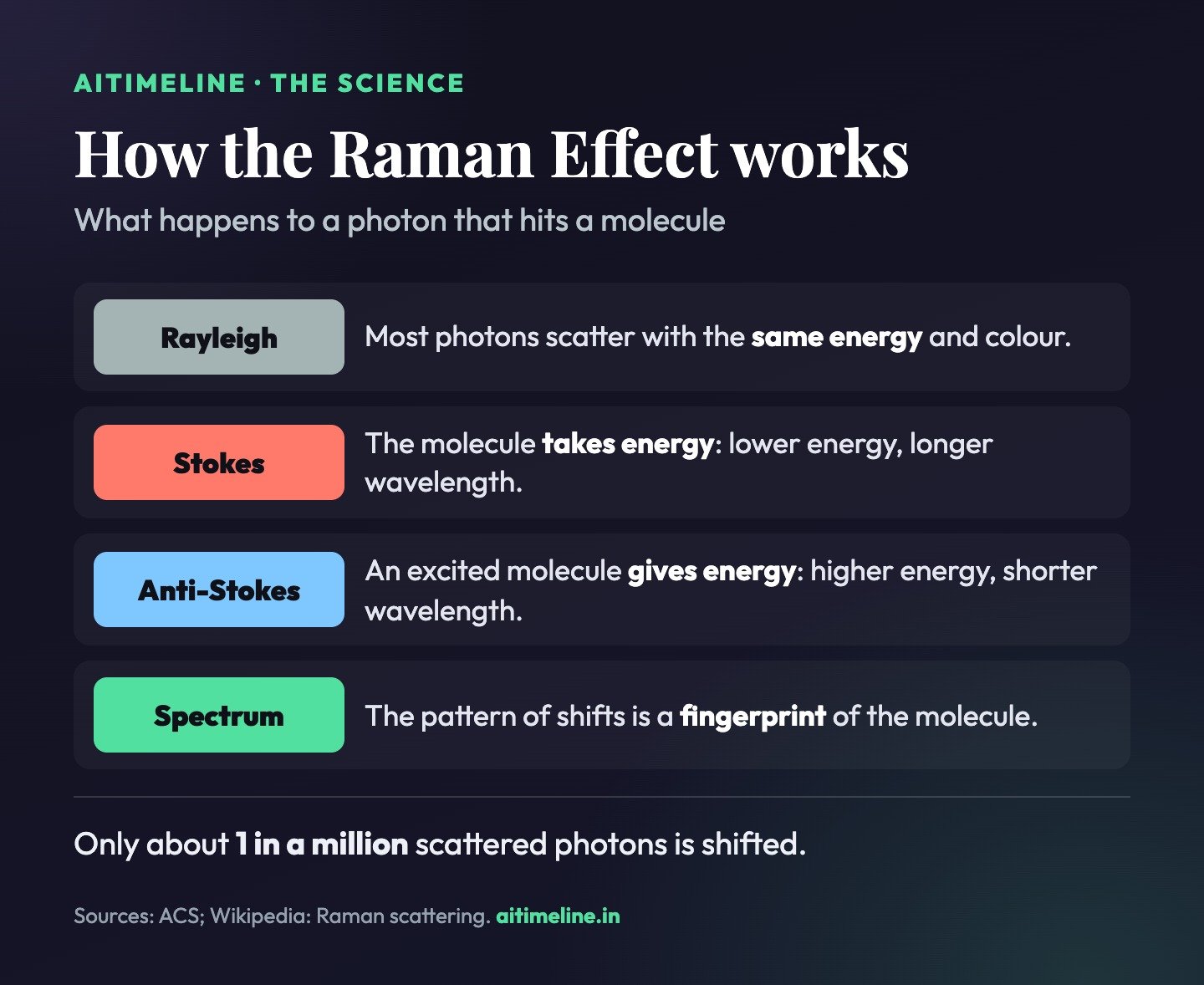
Most scattered light keeps the colour of the incident beam. That is Rayleigh scattering, the same process Lord Rayleigh used to explain the blue of the sky. In the early experiments, the ACS says, the incident violet light was isolated with a violet filter and the changed light was picked out with a green filter. A small part of the light had traded energy with the molecules, and that part carried the molecule’s signature.
Who Made the Discovery
Calcutta and Moscow, 1928.
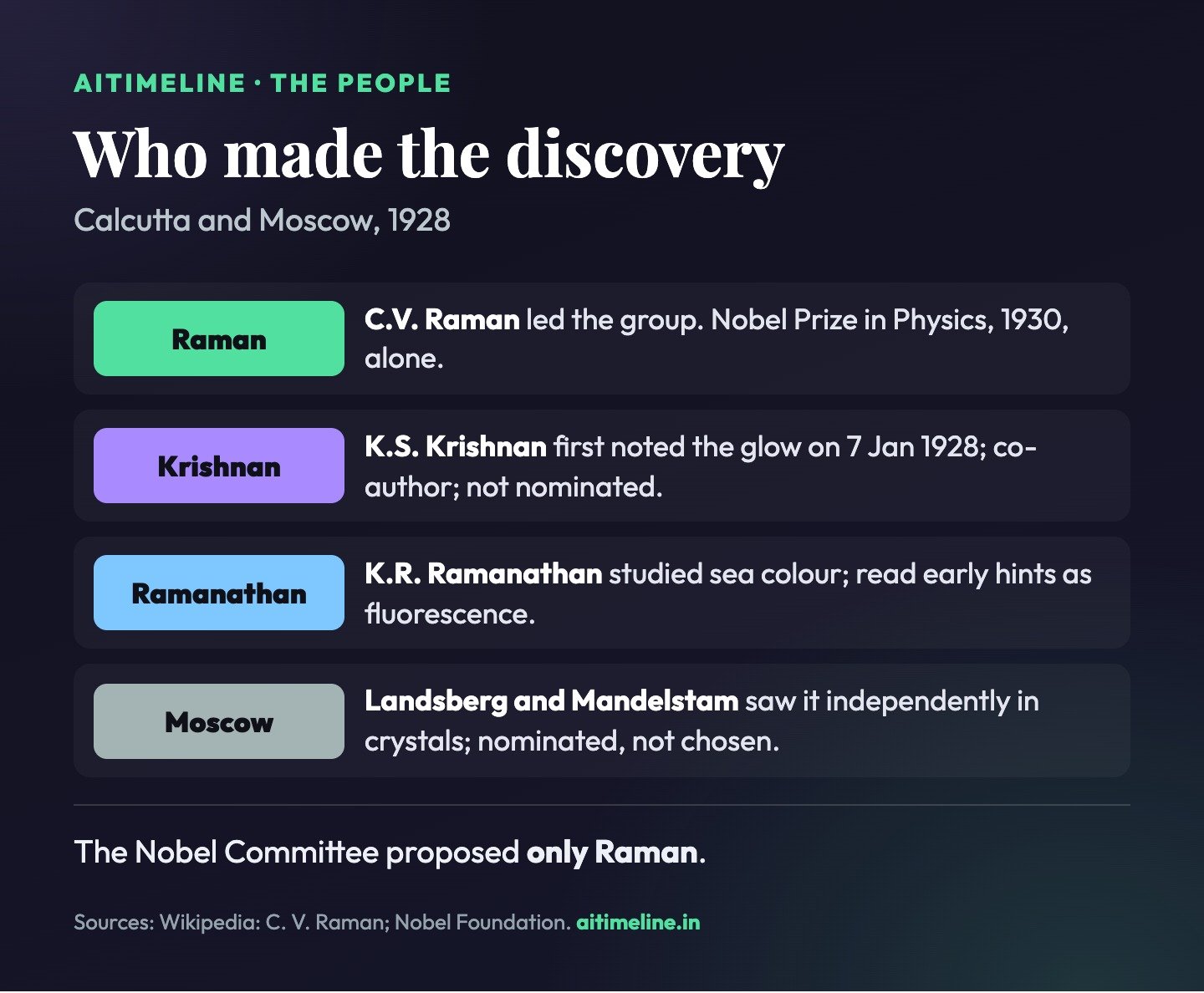
The Nobel Committee, according to Wikipedia, preferred Raman because he and Krishnan had shown the effect in solids, liquids and gases, while the Russians had observed it in crystals and cited Raman’s article. Wikipedia also says Raman later admitted Krishnan was a co-discoverer, and that their relationship soured. We have not checked the primary sources behind that account.
The Discovery in Numbers
A very weak effect, found with simple equipment.
Where Raman Spectroscopy Is Used
From chemistry labs to cultural heritage.

The ACS says that by the late 1930s the Raman Effect was the main method of nondestructive chemical analysis, that infrared spectroscopy overtook it after the Second World War, and that the laser revived it from the 1960s. Medical uses are mostly at the research stage. Raman spectroscopy is not a replacement for other methods, and its suitability depends on the sample, the equipment and the question asked.
Raman and Indian Science
A journal, an academy and an institute.
National Science Day, 1928 to 2026
From a discovery to a national observance.

Source Gaps and Corrections
| Claim in earlier summaries | What we found | Status |
|---|---|---|
| Discovered on a single day, 28 Feb 1928 | Krishnan first saw the glow on 7 Jan 1928; spectra followed on 28 Feb | Both given |
| Krishnan’s note in 1924 | Wikipedia’s reference is a 1925 paper | Restated |
| Ramanathan saw it in 1923 | Raman’s 1923 experiments hinted at it; Ramanathan read it as fluorescence | Restated |
| Knighted in 1929 | Nobel Foundation says 1929; Wikipedia also gives 1930 for the ceremony | Both given |
| IISc director from 31 Mar 1933 to 19 Jul 1937 | Wikipedia lists 1933 to 1937; exact days not confirmed | Years only |
| Academy founded in 1934 | Academy article says 1934; Raman article says 1933 | 1934 used |
| Among the first Bharat Ratna recipients | Wikipedia says 1954, with Rajagopalachari and Radhakrishnan | Reworded |
| Raman alone discovered the effect | Krishnan co-authored the papers; Landsberg and Mandelstam saw it independently | Qualified |
| 2026 theme spelled ‘Catalysing’ | URSC spells it so; PIB says ‘Catalyzing’ | Both noted |
Conclusion: One Question About the Sea
The story of the Raman Effect is a reminder that large discoveries can begin with a small doubt. A question about the colour of the sea led to years of measurements at the IACS, and then to a faint shifted line that chemists still use.
What we could not settle from our sources is the exact days of Raman’s IISc directorship, the full text of the 1928 Nature letter beyond its opening and the primary record behind the Raman and Krishnan dispute. We have marked each. Readers who need exact wording should consult the Nobel Foundation biography, the ACS landmark page and the Nature letter itself.
Explore More Timelines
People Also Ask
Frequently Asked Questions
⚠️ Editorial Note
This page draws on the Nobel Foundation’s biography of Raman, the American Chemical Society’s landmark page, the Nature letter of 31 March 1928, PIB and URSC pages on National Science Day, and Wikipedia’s articles on Raman, Raman scattering, Raman spectroscopy and the Indian Institute of Science. Sources differ on the knighthood year and the Academy’s founding year, and we give both. We could not read the Nature letter beyond its opening or the IISc source for the directorship dates. Wikipedia’s account of Raman and Krishnan’s relationship is reported, not independently confirmed. This is editorial history, not scientific or professional advice.
Related Stories
Sources & further reading
Every dated entry above was checked against these references. Last reviewed 27 November 2026.
- Press Information Bureau: National Science Day (28 February), explainer
- Press Information Bureau: National Science Day 2026 celebrations
- ISRO U R Rao Satellite Centre: National Science Day 2026
- Nobel Prize: Chandrasekhara Venkata Raman, biographical
- American Chemical Society: C.V. Raman and the Raman Effect, International Historic Chemical Landmark
- Nature: A New Type of Secondary Radiation, 31 March 1928
- Wikipedia: C. V. Raman
- Wikipedia: Indian Institute of Science