Martyrs’ Day (India): The Gandhi Assassination Investigation
Explore the Gandhi assassination investigation: the 1948 conspiracy, Red Fort trial, Kapur Commission, the 2018 Supreme Court order and Martyrs' Day.
Latest Story
The Gandhi assassination investigation began with a crime scene, but it did not end there. Gandhi was shot at Birla House on 30 January 1948 by Nathuram Godse, ten days after a bomb had gone off near the same prayer meeting. A Special Court at the Red Fort tried nine accused, the Punjab High Court heard the appeals, and Godse and Apte were hanged on 15 November 1949. Later a commission of inquiry and the Supreme Court looked again. We follow the case from the 1944 Panchgani incident to the Court’s order of 28 March 2018, and mark where sources differ.
A commission of inquiry is not a criminal court. The Kapur Commission said in 1969 that the facts were ‘destructive of any theory other than the conspiracy to murder by Savarkar and his group’. But Savarkar had been acquitted in 1949, and in 2018 the Supreme Court held that the remark ‘does not in any way interfere with the acquittal’.
💡 Short Answer
Mahatma Gandhi was shot dead by Nathuram Godse at Birla House, New Delhi, on 30 January 1948. A Special Court at the Red Fort sentenced Godse and Narayan Apte to death on 10 February 1949, and the High Court upheld that on 21 June 1949. They were hanged at Ambala on 15 November 1949. The Kapur Commission reported in 1969, and on 28 March 2018 the Supreme Court refused to reopen the case.
The Lead Picture: From Birla House to the Supreme Court
Ten dates, 20 January 1948 to 28 March 2018.
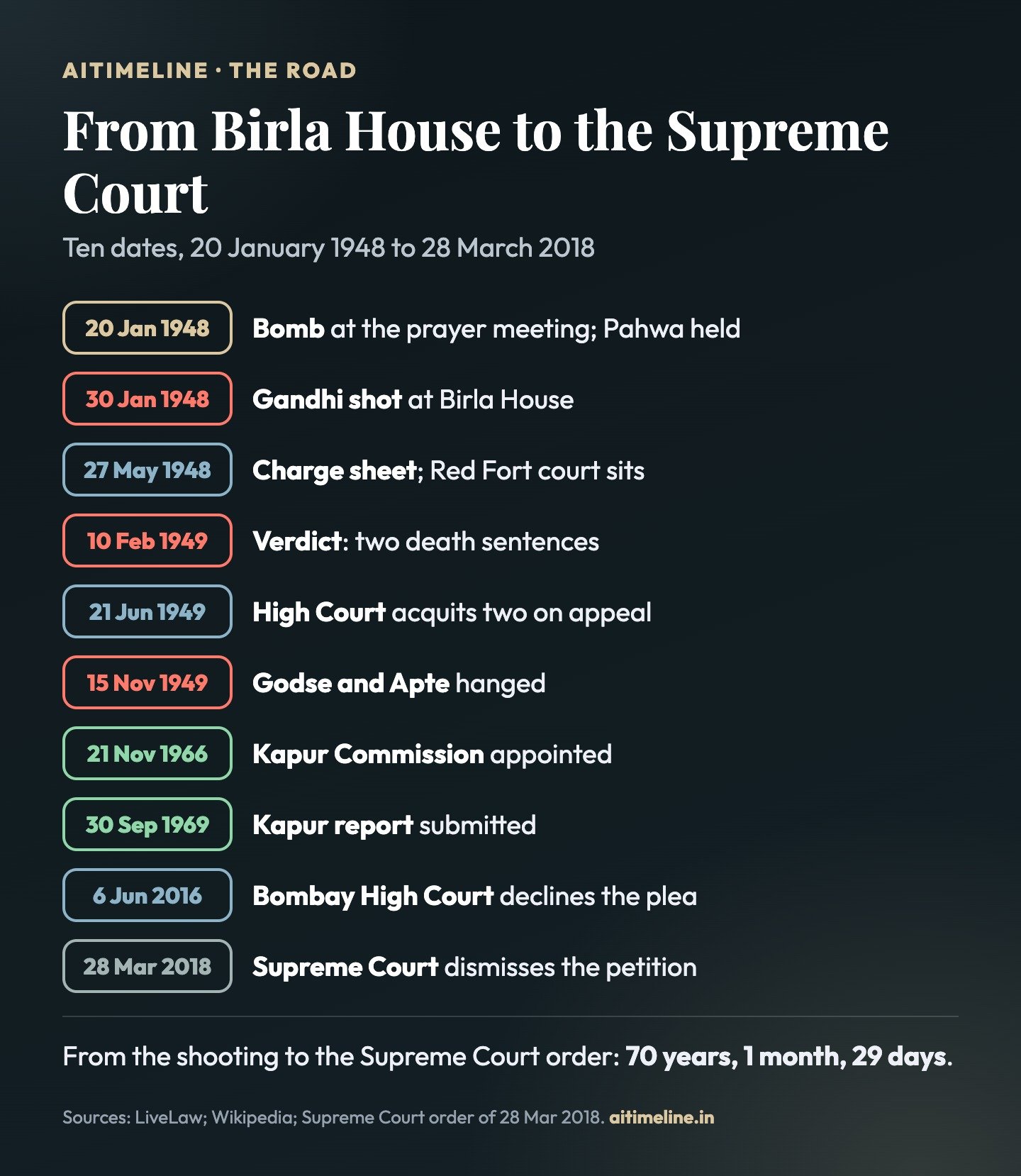
Gandhi Assassination Investigation: Key Questions
What the Record Shows
- Ten days apart: a bomb on 20 January 1948 and the shooting on 30 January happened at the same prayer ground.
- One shooter, a wider plot: the Supreme Court recorded Godse as sole assailant; the High Court found a conspiracy.
- Nine tried: seven were convicted at trial, one was acquitted and one was the approver.
- 149 prosecution witnesses: the defence called none, and the judgment ran to 110 pages.
- Two cleared on appeal: Kistaiya and Parchure were acquitted on 21 June 1949.
- The approver’s limits: Savarkar was acquitted because the case against him rested on Badge’s evidence alone.
- A commission cannot convict: the Kapur finding did not overturn the acquittal, the Supreme Court held.
- Source differences: the trial start (27 May or 22 June 1948) and the lesser sentences differ by source, so we give both.
Timeline: The Gandhi Assassination Investigation, 1944 to 2019
Newest first. Labels mark context, inquiries, events and court rulings.
Martyrs’ Day: two minutes of silence every year Context
The observance: 30 January is observed in India as Martyrs’ Day, or Shaheed Diwas, on the anniversary of Gandhi’s death. Tributes are paid at Raj Ghat, and a two-minute silence is observed at 11 am.
What we could not confirm: The two-minute silence at 11 am is attributed to Ministry of Home Affairs instructions. We did not locate the circular itself. We also found no pending court case or official move to reopen the investigation.
Supreme Court dismisses the review petition Court
What was reported: News reports in March 2019 said the Supreme Court found no grounds to recall its 2018 order and dismissed the review petition against the refusal to order a fresh inquiry.
Source caution: We rely on press reports of the review order, not the order itself, so we give no further detail.
Supreme Court refuses to reopen the case Court
The petition: Dr Pankaj Kumudchandra Phadnis asked the Court to look again at the assassination. He raised a ‘fourth bullet’ theory and asked for the Kapur Commission’s finding on Savarkar to be reviewed or a new commission set up.
The ruling: The Court said it was not satisfied that new research into a long-concluded matter justified restarting a criminal investigation. It recorded that six eyewitnesses named Godse as the sole shooter, that three shots hit the body and that no fourth spent bullet or cartridge was found. It dismissed the petition.
On the Kapur finding: The Court held that the commission’s remark about Savarkar and his group ‘does not in any way interfere with the acquittal’ and cannot overturn the criminal court’s finding. It declined to examine whether the remark was fair.
The Court appoints an amicus curiae Court
The step: Senior advocate Amarendra Sharan was appointed amicus curiae to examine the record, including exhibits held at the National Museum. Press reports of the appointment date from early October 2017.
His conclusion: Reports say he told the Court there was no evidence that anyone other than Godse killed Gandhi and no need for a fresh investigation. The Court later thanked him for having ‘painstakingly examined the entire record’.
Bombay High Court declines the petition Court
The petition: Phadnis first went to the Bombay High Court in 2016. It declined to enter the two questions he raised: whether four bullets were fired, and whether the Kapur Commission report should be reopened after 46 years.
Date caution: Press reports date the dismissal to 6 June 2016. The Supreme Court order records only that the High Court declined to entertain the petition.
The Kapur Commission submits its report Inquiry
Security failures: The commission took three years. It strongly criticised those responsible for Gandhi’s security for negligence, and examined statements recorded by Bombay police in March 1948 that had not been produced in court.
The Savarkar finding: It concluded that the facts taken together were ‘destructive of any theory other than the conspiracy to murder by Savarkar and his group’. Savarkar had been acquitted in 1949 and had died in 1966.
Legal effect: A commission of inquiry has no power to convict. In 2018 the Supreme Court held the finding did not overturn the acquittal.
A one-man commission under Justice Kapur is appointed Inquiry
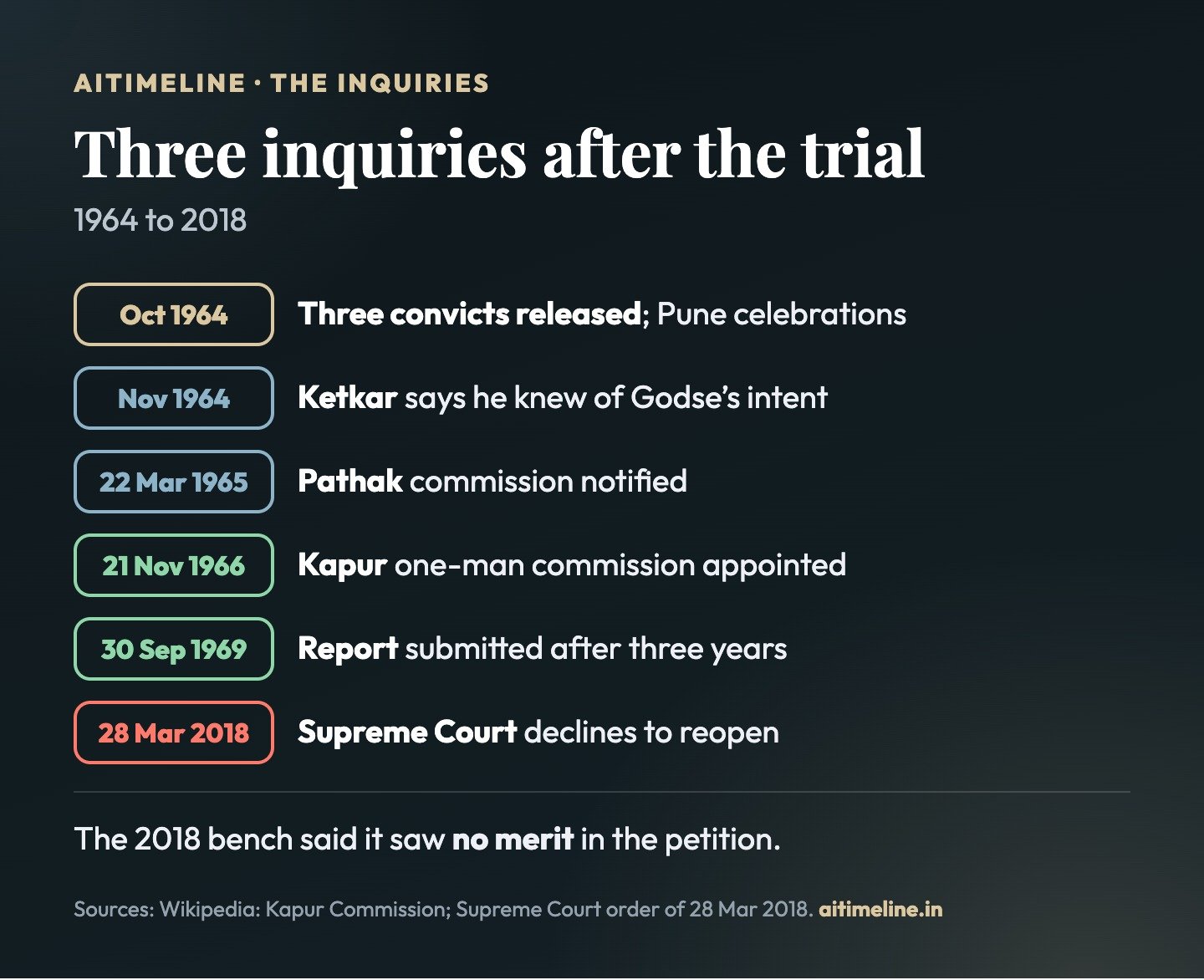
The mandate: Justice Jivanlal Kapur, a Supreme Court judge, was appointed on 21 November 1966. The terms of reference asked whether Gajanan Vishwanath Ketkar and others had prior information of the plot, whether it was passed to the authorities, and what was done about it.
Date caution: Wikipedia gives 21 November 1966 for Kapur’s appointment. The 2018 Supreme Court order says only that the commission was set up after Ketkar’s statement.
A first inquiry under Gopal Swarup Pathak is notified Inquiry
The background: Public anger followed the October 1964 releases and Ketkar’s remarks. Under pressure from members of Parliament, Home Minister Gulzarilal Nanda set up an inquiry headed by Gopal Swarup Pathak, notified on 22 March 1965.
What changed: Pathak later became a Union minister and then governor of Mysore, and the inquiry passed to Justice Kapur in 1966.
Releases in Pune and Ketkar’s remarks Context
The releases: Vishnu Karkare, Madanlal Pahwa and Gopal Godse were released in October 1964 after serving their sentences, and the releases were celebrated in Pune.
Ketkar’s statement: Ketkar, a grandson of Bal Gangadhar Tilak, said at a function that Nathuram Godse had told him of his intent to kill Gandhi about six months before the assassination, and that he had passed the information on. A public outcry followed in Parliament and the Maharashtra Assembly.
Godse and Apte are hanged at Ambala Jail Court
The execution: Nathuram Godse and Narayan Apte were hanged at Ambala Jail on 15 November 1949.
Clemency: Wikipedia records that Gandhi’s sons Manilal and Ramdas pleaded for clemency and were turned down by Prime Minister Nehru, Deputy Prime Minister Patel and Governor-General Rajagopalachari. We could not confirm the details of the mercy petitions from a primary source.
The High Court at Shimla upholds most convictions Court
The appeals: All the convicted men appealed on 2 May 1949. Godse argued his own appeal, contesting the conspiracy charge rather than the fact that he fired the shots.
The outcome: On 21 June 1949 the bench upheld the convictions of five accused and acquitted Shankar Kistaiya, for want of enough material to prove conspiracy, and Dattatraya Parchure, because the evidence against him was unreliable and a retracted confession was held involuntary.
Conspiracy finding: The court noted that a conspiracy to murder Gandhi did exist, with Apte and Godse as its chief organisers.
The Special Court delivers its judgment Court
The sentences: Nathuram Godse and Narayan Apte were sentenced to death. Karkare, Pahwa, Gopal Godse, Kistaiya and Parchure received prison terms. LiveLaw lists life imprisonment for all five; the Supreme Court’s 2018 order counts four life terms and one of seven years.
Savarkar: V.D. Savarkar was acquitted. The court said the case against him rested on the approver’s evidence alone and that it would be ‘unsafe to base any conclusions’ on it.
Police criticism: Justice Bhandari later noted that the Special Judge’s observations against the Delhi Police were unwarranted.
Evidence closes after 149 prosecution witnesses Court
The evidence: Evidence ended on 6 November 1948. The prosecution called 149 witnesses and the defence called none, according to LiveLaw and Wikipedia.
Date caution: Wikipedia dates the start of the trial to 27 May 1948, while LiveLaw’s key facts give 27 May as the charge sheet date and 22 June as the start of the trial. We give both.
Badge is pardoned and the trial begins Court
The approver: Digambar Badge, alleged to be an active participant in the plot, was tendered a pardon on 21 June 1948 and turned approver. His evidence became central to the prosecution’s account of the conspiracy.
Why it mattered: An approver is an accused person pardoned on condition of giving evidence against others. The court treated his testimony with caution, and it was the reason Savarkar was acquitted.
The charge sheet is filed and the Red Fort court sits Court
The court: A Special Court was constituted on 4 May 1948 under the Bombay Public Security Measures Act, 1947, sitting at the Red Fort. Atma Charan presided.
The charges: The charge sheet of 27 May 1948 named 11 accused, of whom three were absconding. Offences included murder, conspiracy, and offences under the Explosive Substances Act and the Arms Act.
Arrests widen the case beyond Godse Inquiry
The arrests: In the weeks after the killing, police arrested other men alleged to be involved, identified as members of the Hindu Mahasabha, and also arrested V.D. Savarkar, then 65, accusing him of being the mastermind.
The evidence: The case rested on the recovered pistol, the eyewitnesses, the 20 January bombing and Badge’s account of meetings and movements. We have not given a precise arrest date for each suspect because the sources we read do not agree.
Nehru addresses the nation: ‘The light has gone out’ Event
The announcement: All India Radio announced Gandhi’s death at about 6 pm. That evening Prime Minister Jawaharlal Nehru broadcast to the nation.
The words: ‘The light has gone out of our lives and there is darkness everywhere.’ We quote the line as it is widely cited; we did not check it against a recording.
Three shots at the prayer meeting Event
The shooting: As Gandhi walked to the prayer ground, supported by his grandnieces Manu and Abha, Nathuram Godse stepped forward and fired three shots at close range. The Supreme Court later recorded that the Beretta pistol held a magazine of seven cartridges and was recovered with four live rounds.
The seizure: Godse was seized at the spot. Herbert Reiner Jr., a young vice-consul at the American embassy, is widely reported to have grabbed him, though accounts of his role differ.
Time caution: LiveLaw gives the FIR time as 5.17 pm. The Supreme Court order says the FIR was registered at 5.45 pm.
A bomb explodes near the prayer meeting Event
The attempt: On 20 January 1948 a bomb was exploded near Gandhi’s prayer meeting. The plan, according to Wikipedia, was to throw a second grenade once the crowd had scattered, but Digambar Badge lost his nerve and ran.
The arrest: Madanlal Pahwa, a Punjabi refugee, was the only plotter caught. Gandhi was unhurt.
Gandhi fasts, and the plotters start planning Context
The fast: On 13 January 1948 Gandhi began a fast to press the government to release Pakistan’s share of the partition funds, which had been held back. The government reversed its decision.
The plot: Wikipedia says Godse and his colleagues began planning the killing the same day, and that Godse and Apte bought a Beretta M1934. That is the narrative in this source; it is not a court finding.
An earlier attempt at Panchgani Context
The earlier incident: Wikipedia records that in May 1944 Godse led a group of 15 to 20 young men who rushed at Gandhi during a prayer meeting at Panchgani, and were stopped by the crowd. He was released because Gandhi declined to press charges.
Source caution: This account comes from one reference source, and is background rather than part of the 1948 trial record we cite.
Ten Days Apart: The Warning and the Killing
Birla House, 20 and 30 January 1948.
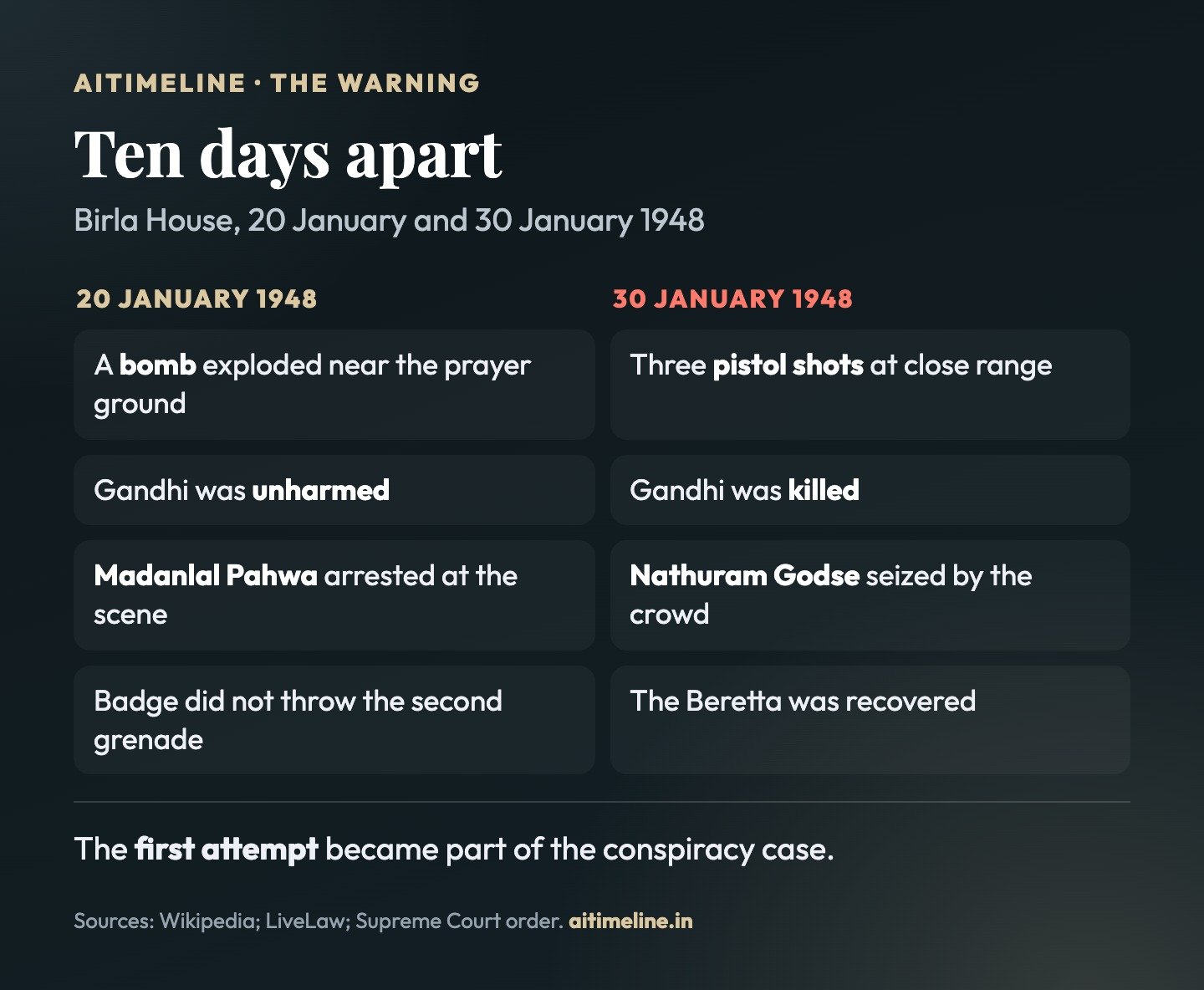
The 20 January bomb matters because it shows the plot did not begin on 30 January. According to Wikipedia, the plan was to throw a second grenade once the crowd had scattered, but Digambar Badge lost his nerve and ran. Madanlal Pahwa was the only one caught. The Kapur Commission later strongly criticised those responsible for Gandhi’s security for negligence.
The Red Fort Trial in Numbers
The Crown v. Nathuram Vinayak Godse and Others.
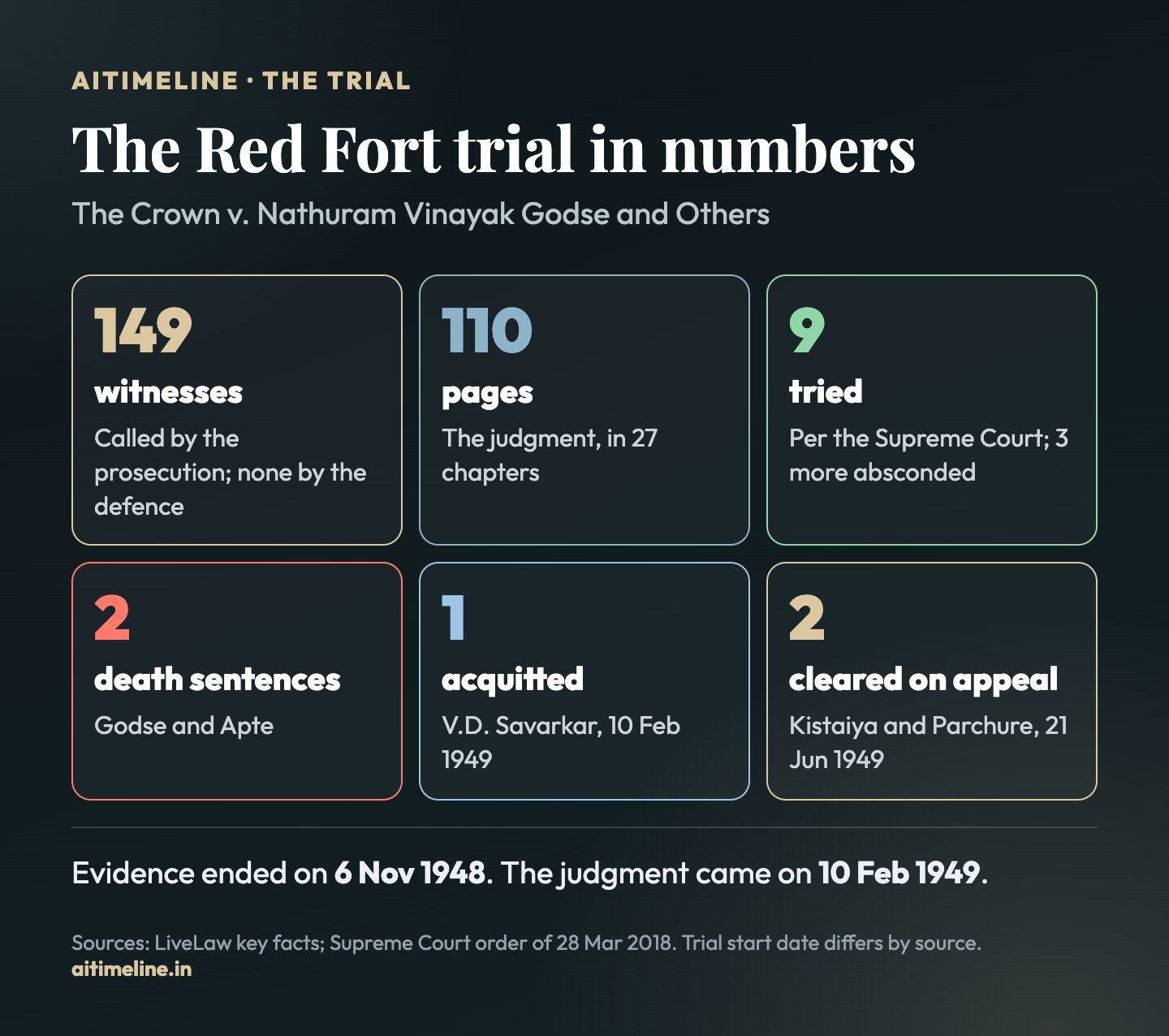
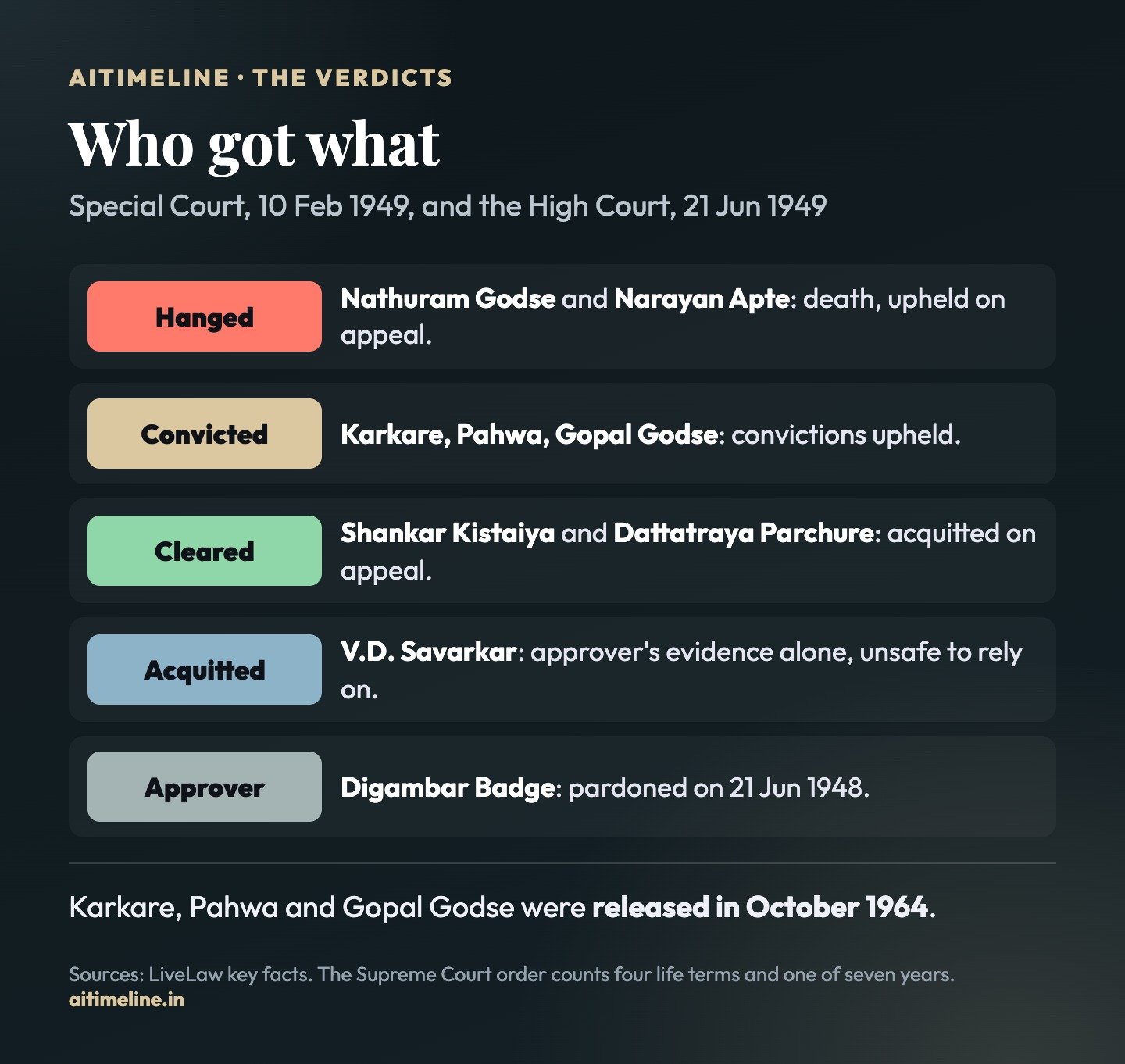
The Special Court judged each accused on the evidence against them. In Savarkar’s case it said the prosecution rested on the approver’s evidence alone and that it was ‘unsafe to base any conclusions’ on it. In the High Court, Kistaiya and Parchure were acquitted for want of reliable evidence, while the conspiracy finding for the rest stood.
The Evidence: Three Shots, One Assailant
As the Supreme Court recorded it in 2018.
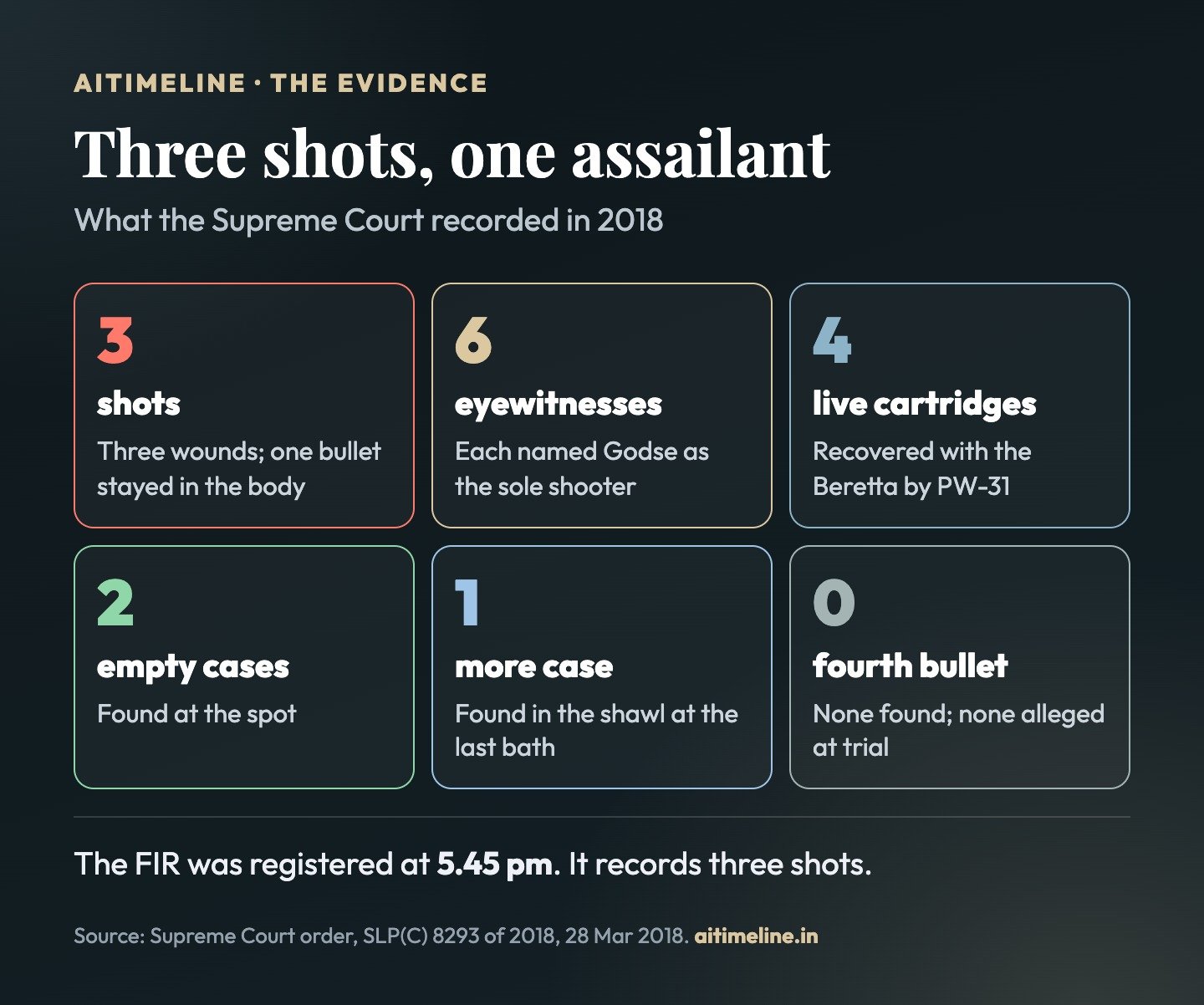
The Court listed six eyewitnesses, including PW-31 Amar Nath, PW-32 Nandlal Mehta and PW-34 Ratan Singh. Each said three shots were fired by Godse. It noted that no one on either side had suggested four bullets or a second assailant, and that the amicus had checked the original photograph at the museum.
Three Inquiries After the Trial
1964 to 2018.
Criminal Court or Commission of Inquiry?
Why the 1969 report did not change the 1949 verdict.
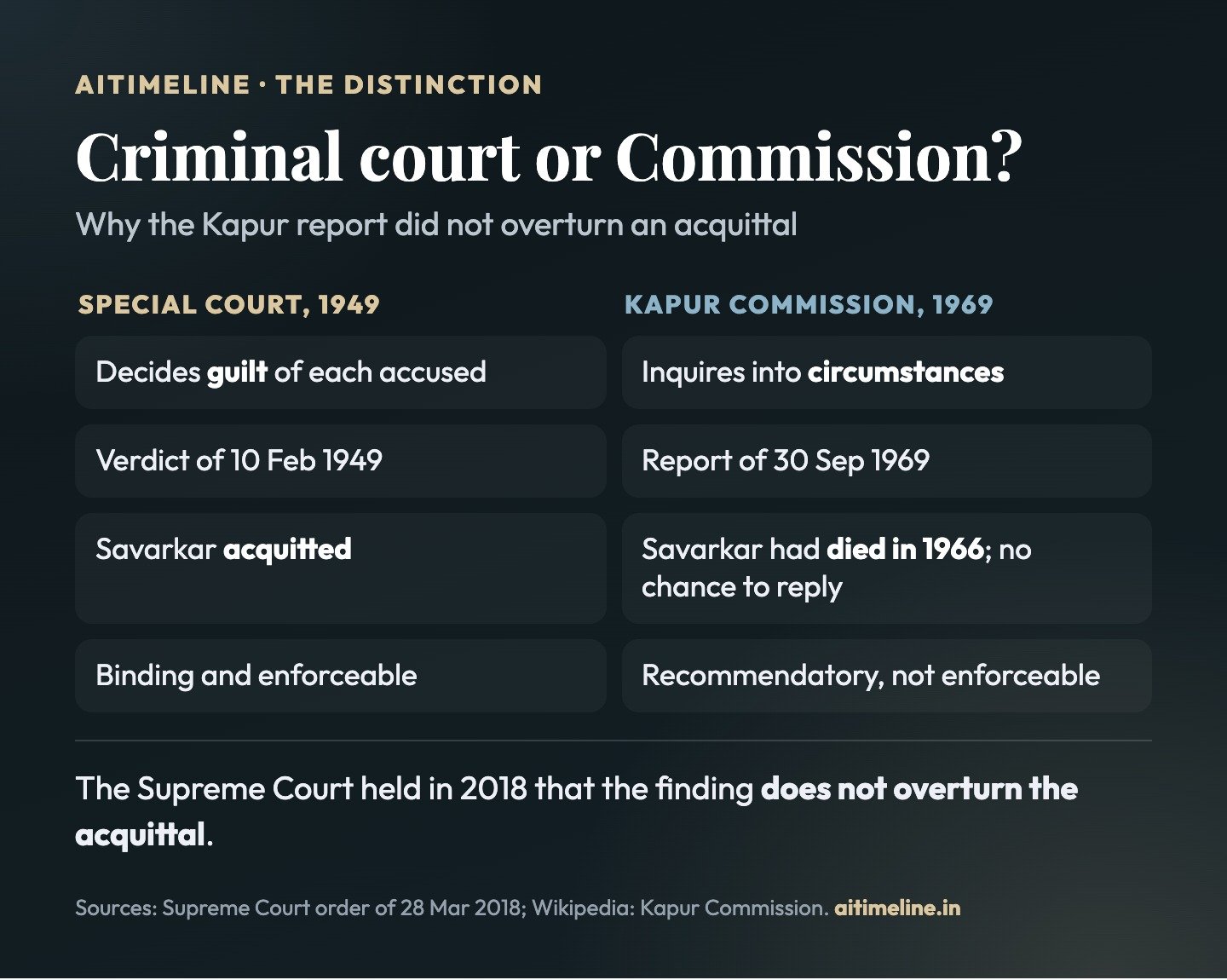
The Supreme Court relied on its own Constitution Bench ruling in Ram Kishan Dalmia v. Justice S.R. Tendolkar, which said a commission ‘has no power of adjudication’. It added that it was ‘not inclined to enter into the correctness or fairness’ of the finding, which it said would only fan fresh controversy.
Source Gaps and Corrections
| Claim in earlier summaries | What we found | Status |
|---|---|---|
| Trial began 27 May 1948 | 27 May was the charge sheet; LiveLaw says trial began 22 June | Both given |
| Kapur Commission began 1960s generally | Pathak inquiry 22 Mar 1965; Kapur appointed 21 Nov 1966 | Restated |
| Supreme Court: Godse fired 3 shots | Confirmed in the 28 Mar 2018 order | Confirmed |
| Five others got prison terms | LiveLaw says life for all; Supreme Court counts four life, one seven years | Both given |
| Shooting at 5.17 pm | FIR time 5.17 (LiveLaw) but 5.45 pm (Supreme Court) | Hedged |
| MHA two-minute silence at 11 am | Circular not located | Attributed only |
| Sentences passed 8 Nov 1949 (Wikipedia) | Special Court sentenced on 10 Feb 1949 | Not used |
Conclusion: What the Process Shows
The Gandhi assassination investigation is remembered for the loss, but the record also shows a process: a bomb that failed, a killing that did not, a trial that heard 149 witnesses, an appeal that cleared two accused and an inquiry that asked a different question from the court’s.
What we could not settle from our sources is the exact start of the trial, the exact sentences of the five lesser convicts and the text of the Home Ministry’s silence circular. We have marked each. Readers who need exact wording should consult the 2018 order and the judgments themselves.
Explore More Timelines
People Also Ask
Frequently Asked Questions
⚠️ Editorial Note
This page draws on the Supreme Court’s order of 28 March 2018, LiveLaw’s key facts on the case, Wikipedia’s accounts of the assassination and the Kapur Commission, and press reports. Sources differ on the start of the trial, on the sentences of the five lesser convicts and on the time of the FIR, and we give both versions. We quote Nehru’s line as widely cited and did not check a recording. We did not read the Kapur report in full or locate the Home Ministry circular on the silence. This article is editorial history, not legal advice.
Related Stories
Sources & further reading
Every dated entry above was checked against these references. Last reviewed 27 November 2026.
- Supreme Court of India: Order in Phadnis v. Union of India, SLP (C) 8293 of 2018, 28 March 2018
- LiveLaw: Mahatma Gandhi Assassination Case: Key Facts
- Wikipedia: Assassination of Mahatma Gandhi
- Wikipedia: Kapur Commission
- Business Standard (IANS): Gandhi assassination: SC seeks counsel's opinion on new probe
- Scroll.in: Gandhi's assassination: Supreme Court dismisses plea asking to reopen investigation