US Fifth Fleet in Bahrain: A Timeline of America’s Gulf Naval Headquarters
Explore the US Fifth Fleet's history in Bahrain, from the 1948 naval presence and 1995 reactivation to the 2026 Iran attacks and base disruption.
Latest Story
The US Fifth Fleet has commanded American naval operations in the Persian Gulf, Red Sea and Arabian Sea from Bahrain since it was reactivated on 1 July 1995. Behind it is a US naval presence on the island that goes back to 1948. On 28 February 2026, at the start of the war with Iran, missiles and drones hit Naval Support Activity (NSA) Bahrain, the base that houses the Fifth Fleet and US Naval Forces Central Command (NAVCENT). The Navy now says it will not be returning to the base at full strength soon.
The fleet is not the base. The Fifth Fleet is a command of ships that rotate in from other fleets; NSA Bahrain is the shore base that supports it. The base was heavily damaged, but no source says the fleet itself was destroyed. And the later attacks are not all on the base: the 17 November 2026 drone attack was aimed at a radar at Isa Air Base, a different site.
💡 Short Answer
The US Fifth Fleet, reactivated on 1 July 1995, runs US naval operations across about 2.5 million square miles of water from Naval Support Activity Bahrain, where the Navy has been present since 1948. Iranian missiles and drones struck the base on 28 February 2026. On 31 August 2026 the Navy’s top officer said the service is “not getting back in there anytime soon.” Damage is put at about $400 million, and supplies now route through Diego Garcia.
The Fleet, the Command and the Base
Three names that are often used as if they meant one thing.
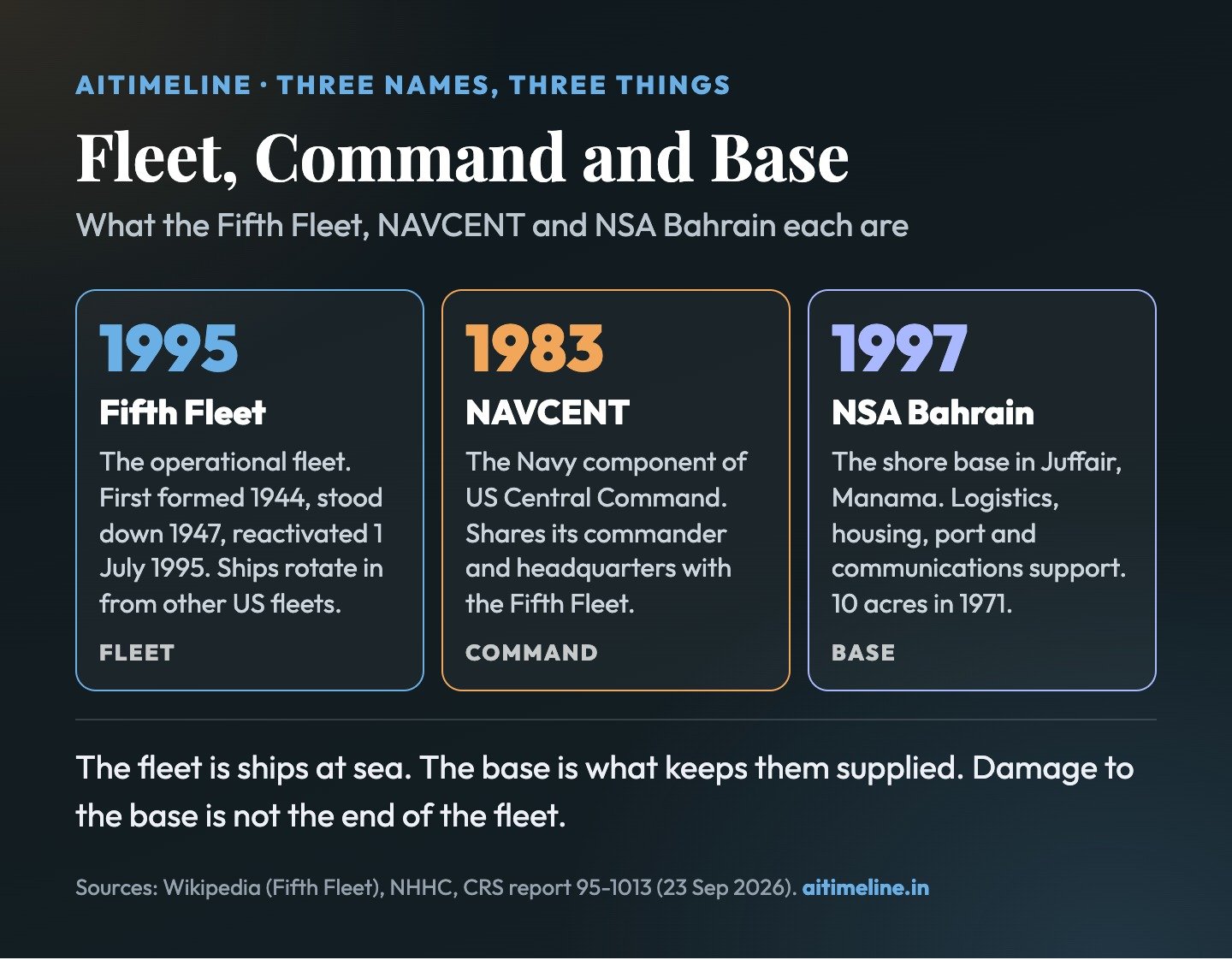
The Fifth Fleet is not a collection of ships permanently parked in Bahrain. It directs naval forces deployed or assigned to its area, including carriers and destroyers that rotate in from the Pacific and Atlantic fleets. Bahrain provides the headquarters, housing, port facilities, supply and communications that keep them working.
The Congressional Research Service says Bahrain has hosted a US naval command headquarters since 1948 and that NSA Bahrain has long been the logistics hub for NAVCENT’s area. The base had around 8,300 service members, civilians and family members associated with it, according to the Navy’s website as cited by CBS.
US Fifth Fleet in Bahrain: Key Questions
What to Know About the Fifth Fleet and Bahrain
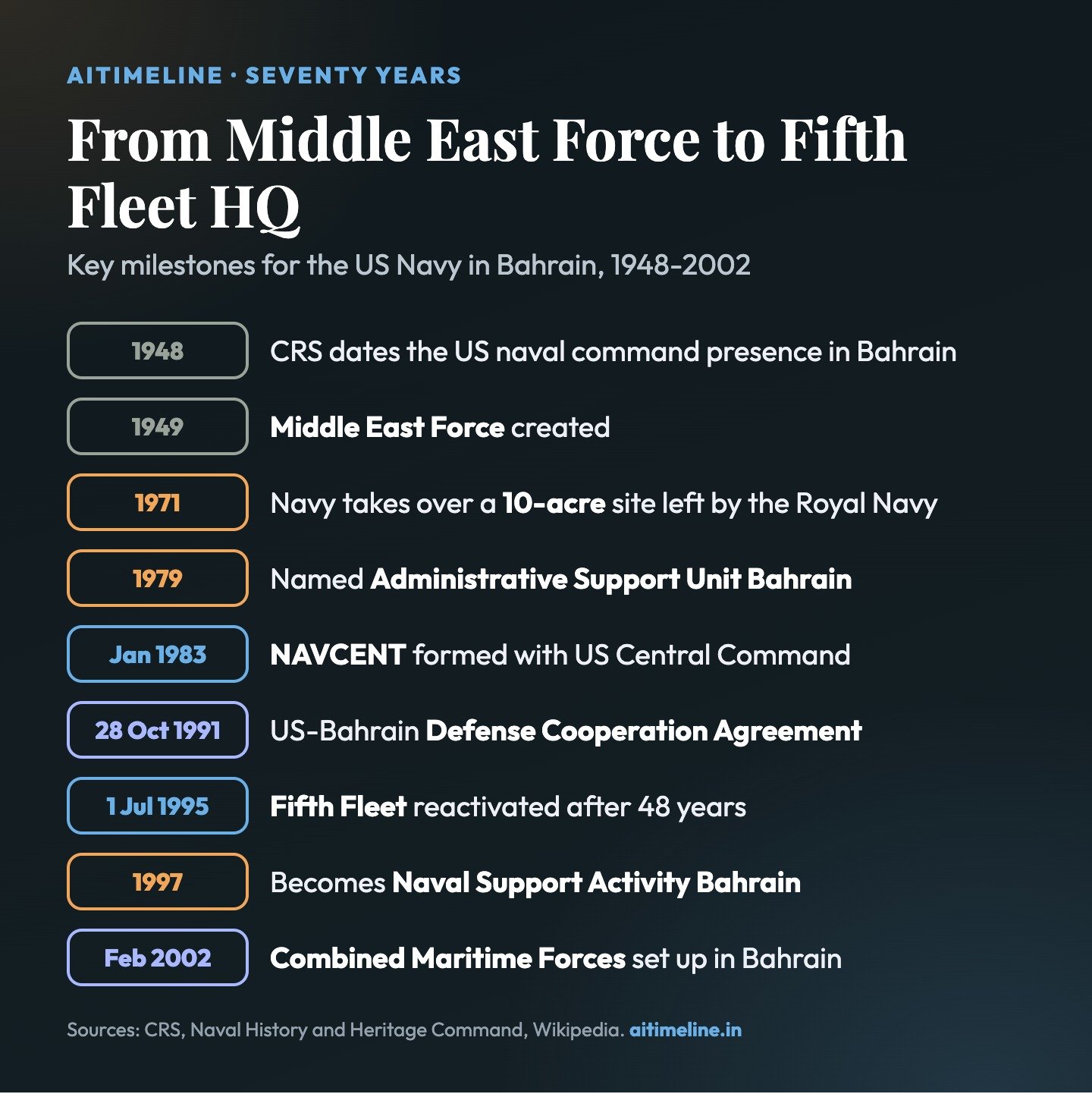
- 1948-49: a US naval command presence begins in Bahrain; the Middle East Force is created.
- 1971: the Navy takes over a 10-acre site vacated by the Royal Navy; it is named ASU Bahrain in 1979, not 1971.
- 1 July 1995: the Fifth Fleet is reactivated after 48 years and based in Bahrain.
- 1997: the base becomes Naval Support Activity Bahrain.
- February 2002: the Combined Maritime Forces is set up in Bahrain.
- 28 February 2026: Iran strikes the base at the start of the war; no US military deaths are reported.
- Summer 2026: reporting shows the damage was far greater than first admitted; supplies shift to Diego Garcia.
- 31 August 2026: the Navy’s top officer says the Navy is not returning anytime soon.
- November 2026: drone attacks on a separate US radar site in Bahrain continue; no final decision on the base has been announced.
Timeline: The US Fifth Fleet in Bahrain, 1944-2026
Newest first. Labels mark presence, command, attacks, logistics and reporting.
Iran fires drones at a US radar in Bahrain, its third attack in days Attack
What happened: The Revolutionary Guards said a drone barrage targeted a US radar installation at Isa Air Base in Bahrain. Bahrain said its air defences intercepted the attack and sent an alert to residents. The US military said the drones were intercepted without damage to US equipment or injury to American personnel.
Context: The AP described it as Iran’s third attack on US targets in Bahrain within days, after a roughly two-month lull. It came as the USS Theodore Roosevelt carrier strike group arrived in the region, adding a third carrier.
Why it matters: This was a different Bahraini military site, not a new hit on the Fifth Fleet base. It shows US-linked sites on the island are still in range while the base itself stays out of full use.
AP analysis: Iran hit radars and air defences first Reporting
What it found: The AP found that Iran opened the war with accurate attacks on the systems meant to detect and stop incoming strikes, then widened its targets to aircraft and buildings. It said enclosures protecting US radar systems at Naval Support Activity Bahrain and Camp Arifjan in Kuwait were destroyed within the first two days.
Earlier reporting: A Washington Post satellite analysis in May reported that Iranian strikes had damaged or destroyed at least 228 structures and pieces of equipment at 15 US bases since 28 February, with the heaviest damage in Kuwait and Bahrain.
Why it matters: Blinding radar and communications can cut a base’s value even when most buildings still stand.
Congressional Research Service assesses the damage and the future Reporting
What it says: Bahrain has hosted a US naval command headquarters since 1948, and NSA Bahrain has long been the logistics hub for NAVCENT’s area. Iranian missiles and drones got through Bahraini airspace and damaged the command headquarters, two satellite communications terminals, warehouses and a dozen other buildings.
The numbers: The report says damage is estimated at no less than $400 million, and that through August Bahrain was Iran’s fourth most targeted country after the UAE, Kuwait and Saudi Arabia.
The open question: It says it remains uncertain when, if at all, NSA Bahrain will return to its pre-war operating level.
CBS: families evacuated late and ‘scale’ of attacks surprised officials Reporting
What happened: CBS reported that Iran targeted the Navy’s Middle East headquarters on the war’s first day, before all military families had been moved out. Some families waited about a week or more to reach safety, and missiles and drones kept coming for several days.
What officials said: Three sources told CBS that the scale and length of the attacks appeared to surprise the US government. A US official said the military had expected some retaliation and had even emptied the headquarters buildings, but ‘we weren’t expecting that.’
Human cost: The Navy has helped evacuate about 1,450 service members and families, and many are paying for two households. No military personnel were killed.
Acting Navy Secretary: Iran ‘blew the hell out of Bahrain’ Reporting
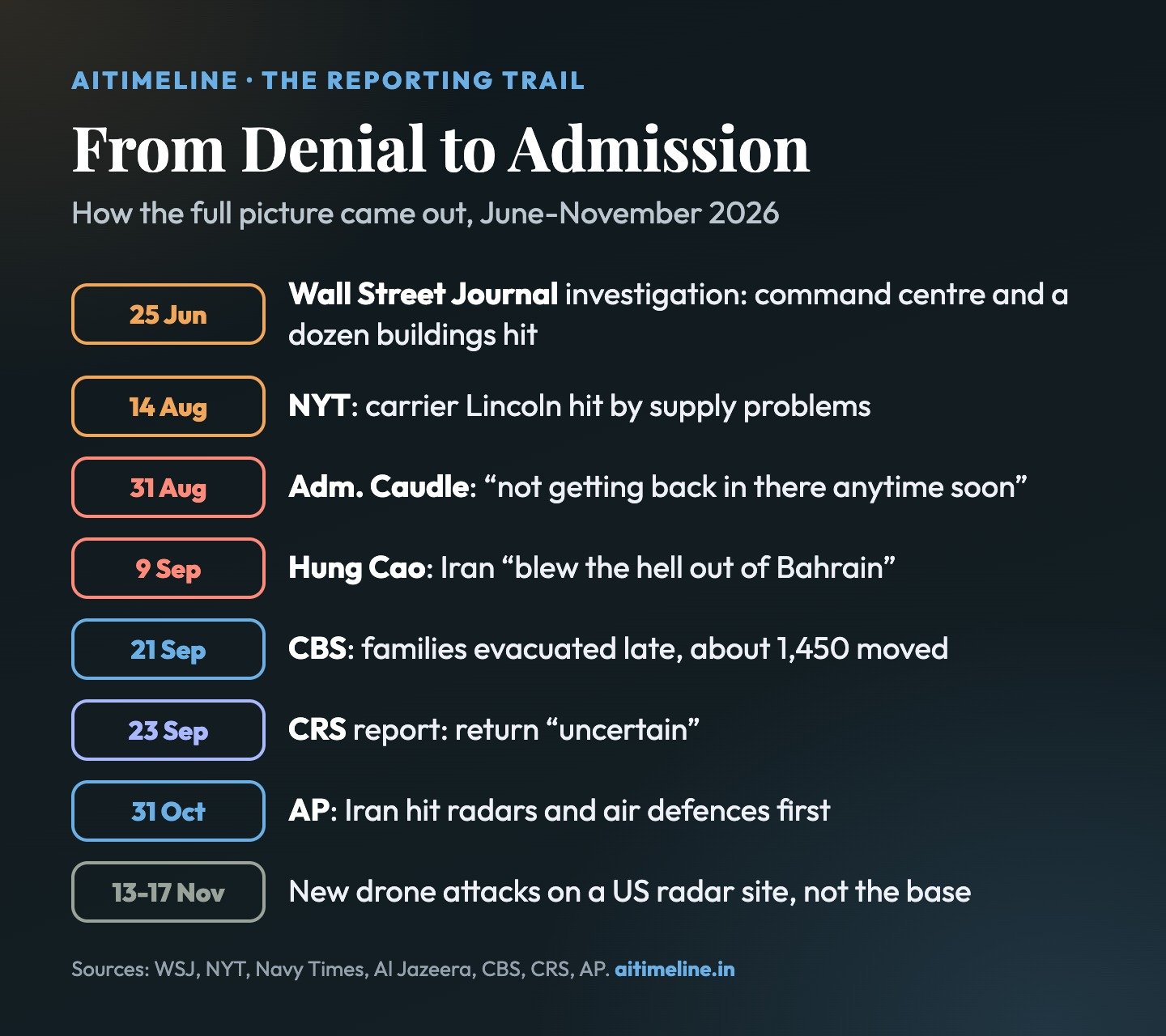
What he said: In an interview with The Epoch Times on Wednesday 9 September, acting Navy Secretary Hung Cao said Iran’s retaliatory attacks ‘blew the hell out of Bahrain.’ Al Jazeera called it a rare official admission of the damage.
What was decided: Cao said a task force was looking at what to do with the base, including whether to repair it. He said the damage also left the USS Abraham Lincoln with ‘no place for them to pull in.’
Reaction: Iran’s foreign minister, Abbas Araghchi, welcomed the ‘candor’ and said Iran’s forces did blow the hell out of the Fifth Fleet headquarters.
Navy’s top officer: ‘We’re not getting back in there anytime soon’ Logistics
What happened: At a town hall on Monday 31 August, Chief of Naval Operations Adm. Daryl Caudle was asked by a displaced sailor about retrieving belongings. He said the Navy would not be using NSA Bahrain for the foreseeable future: ‘I just want to be completely honest with that.’
Other details: The Navy Times reported that the Pentagon had at first said there were no fatalities and no major effect on operations. A Wall Street Journal investigation put the possible rebuilding cost at roughly $400 million. Fifth Fleet commander Vice Adm. Curt Renshaw said the Navy was ‘making it up as we go because nothing is conceived to go on this length of time.’
Supply chain shifts to Diego Garcia and the carrier feels it Logistics
What happened: The New York Times reported that damage to the Bahrain base helped cause food and supply problems aboard the carrier USS Abraham Lincoln. The Navy moved to Naval Support Facility Diego Garcia, an Indian Ocean atoll about 2,200 miles away.
How big a change: According to a Pentagon Inspector General report cited by CBS, the longer route meant logistics cycles of 14 to 18 days, against 5 to 7 days from Bahrain. A sailor on a littoral combat ship told Military Times that food had to be ordered 30 days ahead.
Wall Street Journal investigation finds extensive damage Reporting
What it found: Using satellite imagery, social media footage and interviews with service members, the WSJ concluded that Iranian strikes caused extensive damage the Pentagon had not acknowledged. The command centre and at least a dozen other buildings were hit hard.
Why it matters: It was the first detailed public account of how badly the base was hit, months after the Pentagon said the strikes had not significantly affected operations.
Families and personnel leave Bahrain Presence
What happened: The administration issued an Authorized Departure and then an Ordered Departure for military forces, diplomats, other non-emergency staff and their dependents. Many evacuees left belongings behind and did not know when they could return.
The base’s status: An unnamed US official told reporters NSA Bahrain ‘was nearly destroyed,’ and some sailors were evacuated to Florida, according to CRS.
Iran strikes the Fifth Fleet headquarters Attack
What happened: After US and Israeli strikes on Iran, Iranian missiles and one-way attack drones hit Naval Support Activity Bahrain. Reports describe damage to a radar facility, the command headquarters, two AN/GSC-52B satellite communications terminals, warehouses and other buildings.
Immediate response: The Pentagon at first reported no fatalities and said the strikes had not significantly affected operations. Bahrain said a missile attack had targeted the Fifth Fleet headquarters.
Why it matters: The attack ended the idea that a forward headquarters beside the Gulf was safely out of range.
Navy cuts base staff to ‘mission critical’ levels Presence
What happened: Fox News reported on 26 February that the Navy had reduced staff at NSA Bahrain to ‘mission critical’ levels ahead of possible strikes on Iran. Wikipedia, citing that report, says the on-base population fell below 100 people.
Why it matters: CBS later reported that the headquarters buildings had been emptied, but that families living nearby had not yet been ordered out.
C-SIPA: a new security pact, and a renewed basing deal Command
What happened: The 1991 Defense Cooperation Agreement, signed on 28 October 1991, was renewed in 2017 for 15 years. Under it Bahrain gives the US access, basing and overflight rights. In September 2023 the two countries signed the Comprehensive Security Integration and Prosperity Agreement (C-SIPA).
Status of forces: A status-of-forces agreement has been in place since 1971. It gives the US criminal jurisdiction over US service members in Bahrain.
A five-year, $580 million expansion nearly doubles the base Presence
What happened: The Navy began a five-year, $580 million project to expand NSA Bahrain, proposing to roughly double the size of the 62-acre facility. Phases covered a new perimeter wall and gate, port operations and small-craft basin, barracks, a dining facility and a flyover bridge to the Mina Salman port.
Iraq war makes Bahrain the main regional base Presence
What happened: NSA Bahrain was the primary regional base for Navy and Marine Corps activity supporting the invasion and occupation of Iraq, after supporting operations in Afghanistan. Its facilities began expanding once the war started.
Combined Maritime Forces is set up in Bahrain Command
What happened: The Combined Maritime Forces (CMF), a multinational partnership for maritime security, was established in February 2002 and is led by the NAVCENT/Fifth Fleet commander. It deals with threats such as piracy, terrorism and smuggling at sea.
The base becomes Naval Support Activity Bahrain Presence
What happened: In 1997 the base expanded under the Military Construction Program and became known as Naval Support Activity Bahrain. The Naval History and Heritage Command gives 1997 as the date.
The Fifth Fleet is reactivated Command
What happened: The US Fifth Fleet, created in 1944 and stood down in 1947, was reactivated on 1 July 1995 after 48 years. Its commander also leads NAVCENT, and it reports to US Central Command.
Why Bahrain: Bahrain, which already hosted the Navy’s regional support base, became its headquarters.
Gulf War, a basing deal and a new name for the base Command
What happened: During the Gulf War the amphibious ship USS Tripoli was repaired in Bahrain after an Iraqi mine strike on 18 February 1991. On 28 October 1991 the US and Bahrain signed a Defense Cooperation Agreement. In 1992 the Navy renamed the site Administrative Support Unit Southwest Asia to reflect its wider role.
US Naval Forces Central Command (NAVCENT) is formed Command
What happened: NAVCENT was set up in 1983 as the Navy component of the new US Central Command. Its commander would later also become commander of the Fifth Fleet.
The Navy takes over a 10-acre Royal Navy site Presence
What happened: When Britain’s permanent naval presence ended with Bahrain’s independence in 1971, the US Navy moved onto a 10-acre shore facility the Royal Navy had occupied (HMS Jufair). Eight years later, in 1979, it was named Administrative Support Unit Bahrain.
A US naval command presence begins; Middle East Force created Presence
What happened: The Congressional Research Service dates the US naval command presence in Bahrain to 1948. In 1949 the Navy set up the Middle East Force, a small command whose ships and shore support were based in Bahrain. It later grew into NAVCENT and the Fifth Fleet.
Earlier roots: US ships had used Britain’s HMS Juffair base in Bahrain during the Second World War.
The first Fifth Fleet: a Pacific fleet, not a Gulf one Presence
What happened: The first Fifth Fleet was created on 26 April 1944 under Adm. Raymond Spruance and fought in the Marianas, at Iwo Jima and at Okinawa. It was stood down in January 1947.
Why Bahrain, and What the Fifth Fleet Covers
A small island beside the world’s main oil chokepoint.
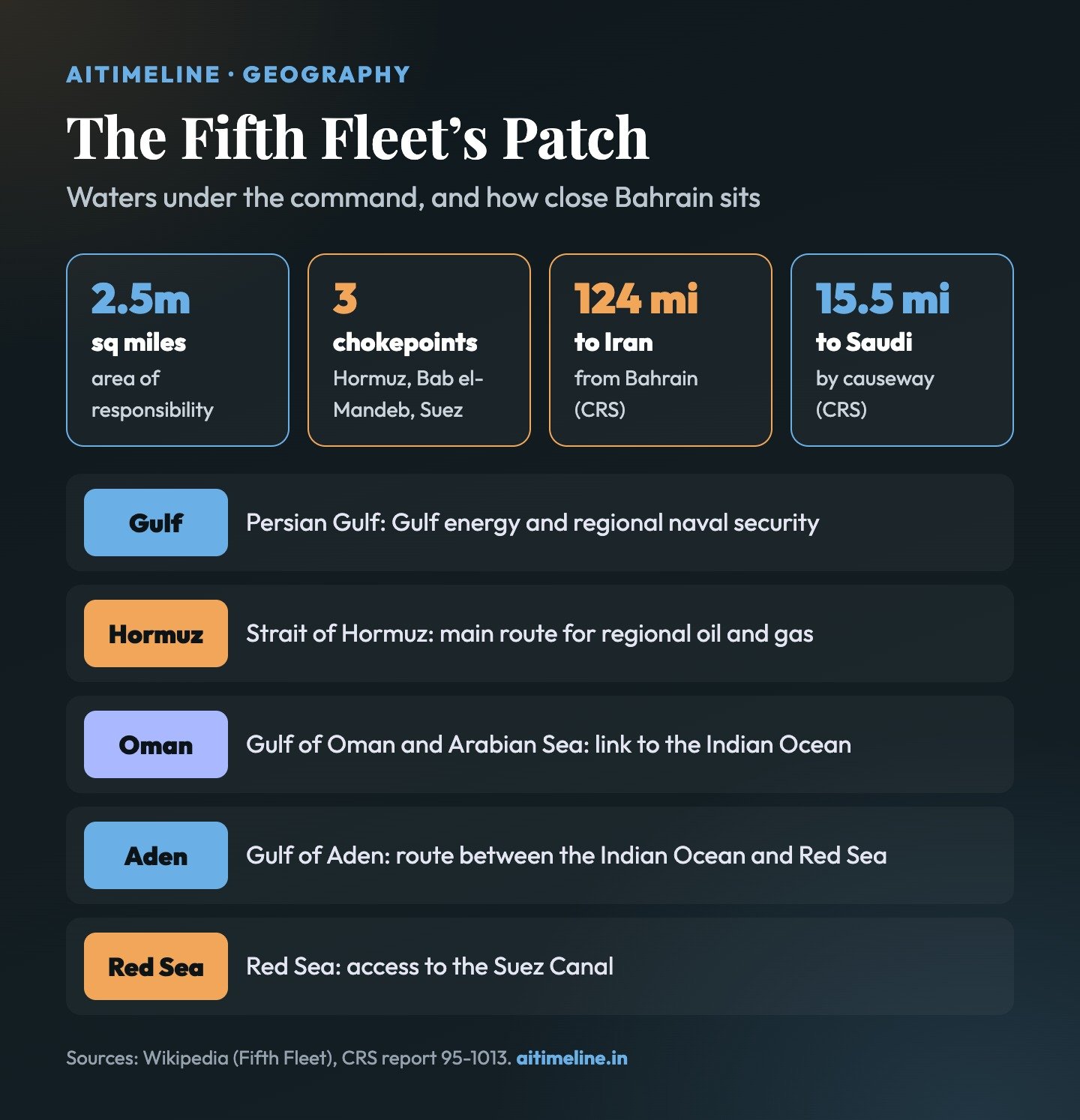
Bahrain is a small island kingdom linked to Saudi Arabia by a causeway, about 15.5 miles away, and about 124 miles from Iran, which once claimed it, the CRS notes. That position gives it quick access to the Strait of Hormuz and the sea lanes beyond. The same closeness is what made it exposed when war came.
Three further things made Bahrain suitable: a British-era port site the US could take over in 1971, a government willing to host a US command, and a formal Defense Cooperation Agreement dating from 28 October 1991 and renewed in 2017.
| Maritime area | Why it matters |
|---|---|
| Persian Gulf | Gulf energy facilities and regional naval security |
| Strait of Hormuz | Main route for the region’s oil and gas exports |
| Gulf of Oman and Arabian Sea | Link between the Gulf and the Indian Ocean |
| Gulf of Aden | Route between the Indian Ocean and the Red Sea |
| Red Sea | Access to the Suez Canal and Mediterranean trade |
What Was Hit on 28 February 2026
Reported damage, and what officials said at the time.
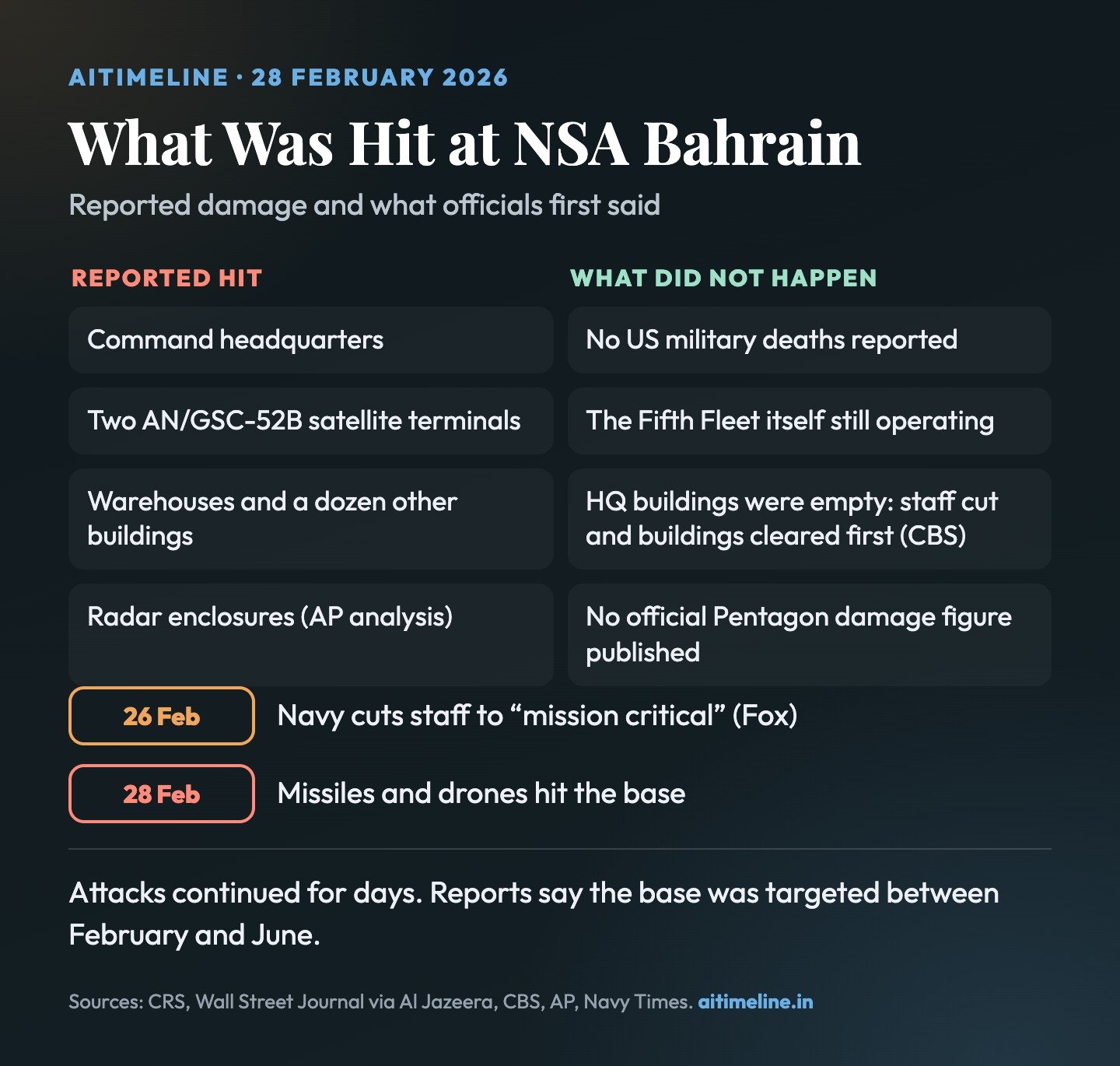
The Navy had cut staffing at the base two days before the war and emptied the headquarters buildings, CBS reported. That helped avoid deaths. It could not protect the equipment, and the attacks went on for days. CBS said families living nearby had not been ordered out when the first missiles arrived.
The Pentagon first said the strikes had not significantly affected operations. Months later, reporting from the Wall Street Journal and others showed otherwise, and in September the acting Navy Secretary himself said Iran’s attacks “blew the hell out of Bahrain.”
The Logistics Problem: Bahrain vs Diego Garcia
The real cost of losing a supply hub.
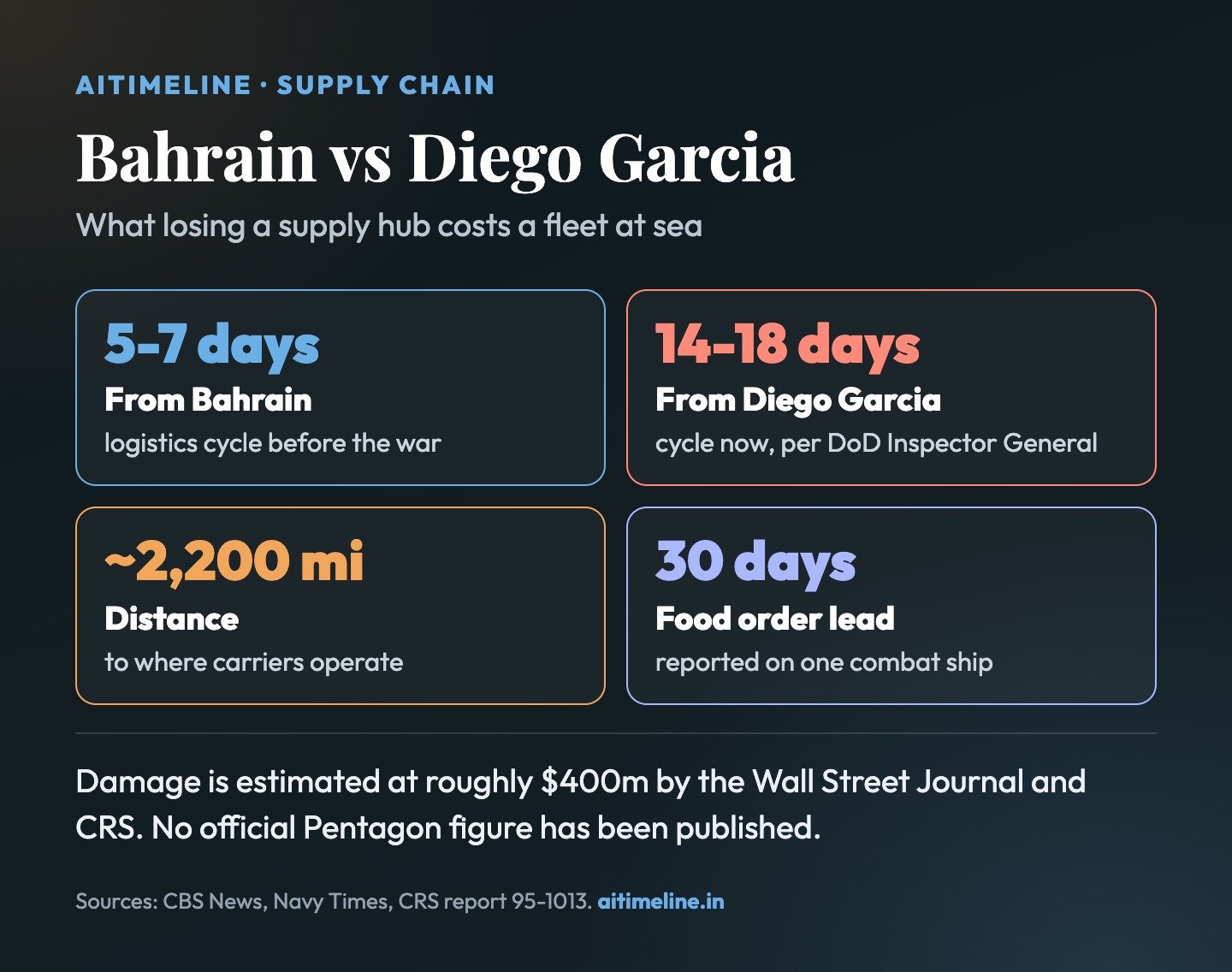
Retired Navy Capt. John Cordle wrote that moving supply hubs from hundreds of miles away to thousands would be a major limit on future maritime operations. The Navy says it has since set up a working logistics process, and Adm. Caudle said “there was some early learning” in getting it in place.
From Denial to Admission: How the Story Came Out
What Is Confirmed and What Is Not
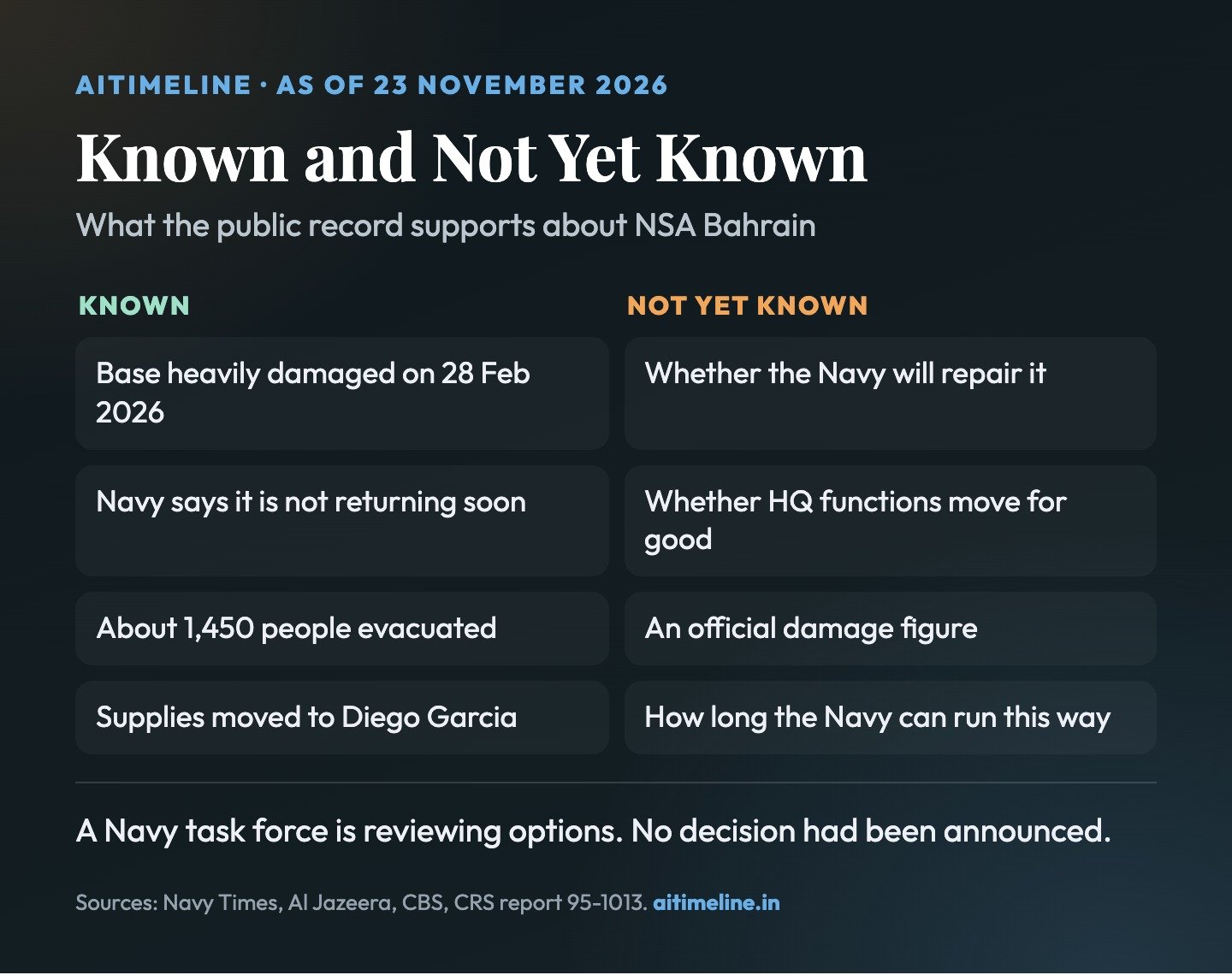
The Navy had given no final answer on rebuilding or moving the headquarters when this page was updated. A June 2026 report said Washington was considering relocating some assets from the island, but we found no confirmed destination. A former Navy vice admiral quoted in the press said he expected the US not to leave Bahrain entirely.
Key Facts at a Glance
| Question | Answer |
|---|---|
| US naval command presence in Bahrain | Since 1948 (CRS) |
| Middle East Force created | 1949 |
| Navy takes over 10-acre site | 1971 |
| Named ASU Bahrain | 1979 |
| NAVCENT formed | January 1983 |
| Defense Cooperation Agreement | 28 October 1991; renewed 2017 |
| Fifth Fleet reactivated | 1 July 1995 |
| Named NSA Bahrain | 1997 |
| Combined Maritime Forces | February 2002 |
| Iranian strike on base | 28 February 2026 |
| Navy: not returning soon | 31 August 2026 |
| Latest CRS report | 23 September 2026 |
What Comes Next
The Fifth Fleet’s mission in the Gulf has not gone away. The question is where its headquarters and supply base will be. The Navy could repair NSA Bahrain, spread functions across several sites, or lean more on Diego Garcia and other facilities. The CRS notes that Congress, which funds construction at the base each year, may be asked to pay for a major rebuild or a move.
Iran’s attacks on Bahrain appear designed, the CRS says, at least in part to force the US and Bahrain to reconsider their defence ties. Whether they succeed will depend on decisions that had not been announced by 23 November 2026.
Explore More Timelines
People Also Ask
Frequently Asked Questions
⚠️ Editorial Note
Dates and figures follow the Naval History and Heritage Command, the Congressional Research Service (report 95-1013, 23 September 2026), the Navy Times, Al Jazeera, CBS News and the AP. Damage estimates are press and CRS figures, not an official Pentagon number. Claims by Iran and the US military about the November attacks are reported as claims and were not independently verified. Details may change.
Related Stories
Sources & further reading
Every dated entry above was checked against these references. Last reviewed 23 November 2026.
- Naval History and Heritage Command: Naval Support Activity Bahrain
- Congressional Research Service: Bahrain: Issues for U.S. Policy (95-1013, updated 23 September 2026)
- Navy Times: Navy not returning to damaged Bahrain base 'anytime soon,' top officer says (1 September 2026)
- Al Jazeera: 'Blew the hell out of it': How Iran damaged US bases in Bahrain, Jordan (11 September 2026)
- CBS News: Iran's attacks on Bahrain and the evacuation of Navy families (21 September 2026)
- Al Jazeera: Bahrain thwarts drone attack; Iran claims targeting US radar (17 November 2026)
- Associated Press via KSL: A 2-month lull ends with Iran's third strike on US targets in Bahrain (17 November 2026)
- Associated Press: Iran targeted US air defenses, then hit aircraft and buildings on Mideast bases, AP analysis finds (31 October 2026)
- Wikipedia: United States Fifth Fleet
- Wikipedia: Naval Support Activity Bahrain