IPL Auction Economics: How It Revolutionised Cricket Finance
Explore how IPL auctions transformed cricket finance, from MS Dhoni's 2008 signing to record player prices, media rights and franchise economics.
Latest Story
IPL auction economics is the study of how the Indian Premier League turned cricketers into priced assets: eight franchises bought for about US$723.59 million in 2008, MS Dhoni bought for US$1.5 million days later, and Rishabh Pant bought for ₹27 crore in 2024. But the auction is only the visible part. Media rights worth ₹48,390.32 crore for 2023 to 2027, franchise fees and sponsorship fund it. This page traces each step, separates what is a bid from what is a salary, and flags what we could not verify.
Cameron Green was bought for ₹25.2 crore but is paid ₹18 crore. From the December 2025 mini auction, pay to overseas players is capped at ₹18 crore and the excess goes to the BCCI for player welfare. Franchise fees, media rights and salaries are separate flows, and this page keeps them apart.
💡 Short Answer
The IPL auction lets franchises bid for players within a fixed purse and squad limits. Prices have risen from US$1.5 million for Dhoni in 2008 to ₹27 crore for Rishabh Pant in 2024. The auction sits inside a larger system: media rights worth ₹48,390.32 crore for 2023 to 2027, franchise fees of ₹12,715 crore for the two newest teams, and a salary cap of ₹146 crore in 2025. Since December 2025 overseas pay is capped at ₹18 crore.
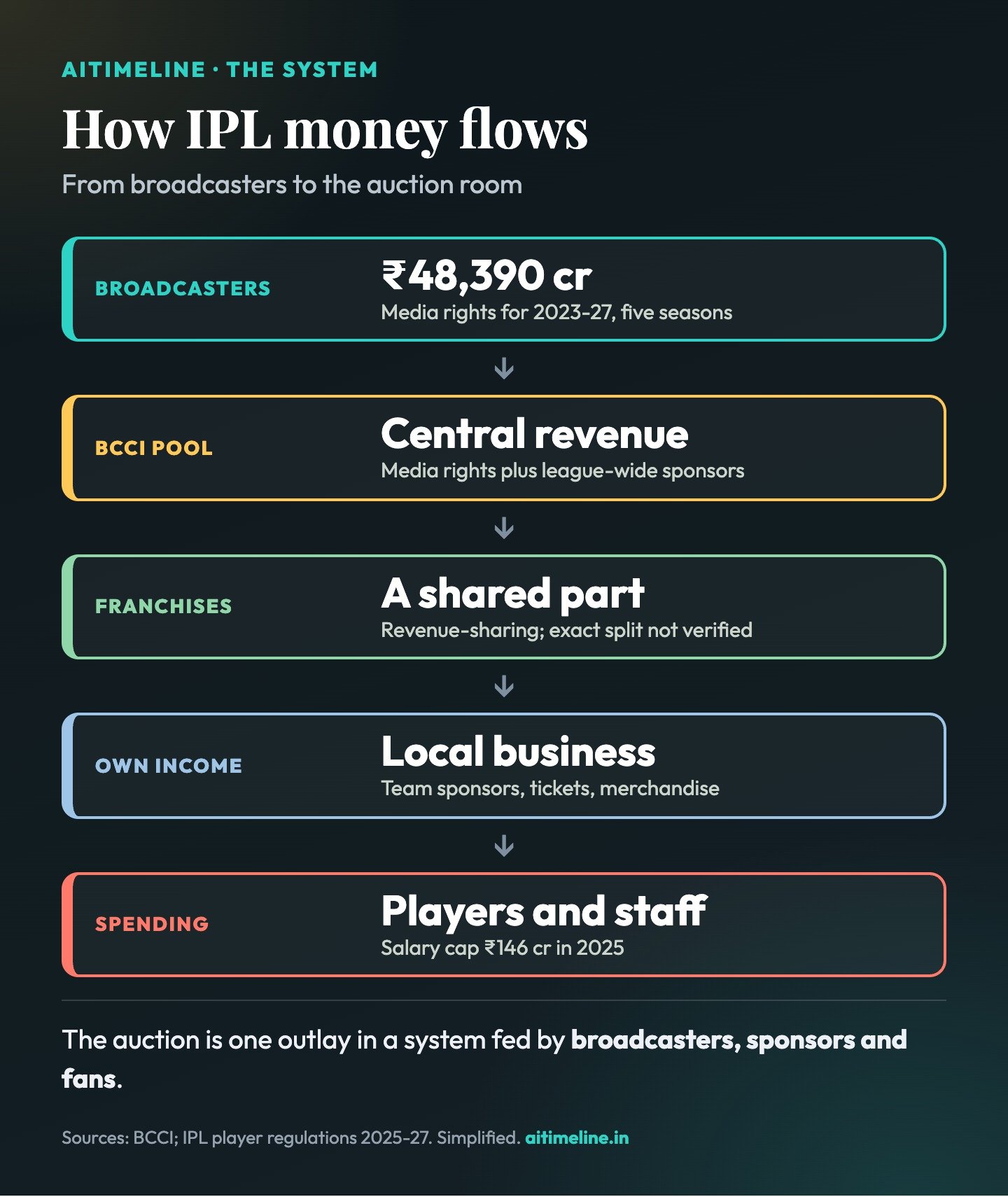
The Lead Picture: How IPL Money Flows
Broadcasters and sponsors fund the league; the auction is one place where franchises spend.
IPL Auction Economics: Key Questions
What Eighteen Years of Auctions Show
- Franchise fees came first: eight teams sold for about US$723.59 million in January 2008, before any player was bought.
- The first star price was modest: Dhoni cost US$1.5 million, about a third of a franchise’s reported purse.
- Media rights drive the economy: the price per season rose from about ₹820 crore (Sony) to ₹3,270 crore (Star, 2018) to about ₹9,680 crore (2023 to 2027).
- The record is ₹27 crore: Pant in 2024, ahead of Iyer and Green.
- A bid is not a salary: overseas pay has been capped at ₹18 crore since December 2025.
- The purse keeps growing: ₹100 crore in 2024, ₹120 crore in 2025, about ₹125 crore in 2026.
- Match fees are new: ₹7.5 lakh per match for each playing member from 2025.
- Profit is not proven: we found no audited figures for all franchises, so we do not claim they are profitable.
Timeline: How IPL Auction Economics Evolved, 2007 to 2026
Newest first. Labels mark auctions, deals, rules, records and context.
The record still stands: Rishabh Pant at ₹27 crore Context
The position: The highest price ever paid at an IPL auction is still the ₹27 crore Lucknow Super Giants paid for Rishabh Pant in November 2024. The most recent auction, the Abu Dhabi mini auction of 16 December 2025, peaked at ₹25.2 crore for Cameron Green, third on the all-time list.
What we could not confirm: We found no announcement of the date of the next auction. The 2026 auction purse was ₹125 crore per franchise, according to ESPN’s coverage of the Abu Dhabi event.
Abu Dhabi mini auction: Cameron Green costs ₹25.2 crore, but is paid ₹18 crore Auction
The bid: Kolkata Knight Riders bought Australian all-rounder Cameron Green for ₹25.2 crore, the highest price of the auction and the third-highest ever, behind Rishabh Pant and Shreyas Iyer. KKR also paid ₹18 crore for Sri Lankan pacer Matheesha Pathirana.
The new cap: Under a new rule for overseas players, the pay credited to Green is capped at ₹18 crore (about A$3 million of the A$4.27 million bid), and the excess goes to the BCCI for player welfare, according to Cricket Australia’s report and Sportskeeda. The bid still counted against KKR’s purse.
The totals: ESPNcricinfo reported 29 overseas players bought for ₹128.05 crore and 48 Indians for ₹87.40 crore: 77 players and about ₹215.45 crore in all.
Jeddah mega auction: Rishabh Pant becomes the ₹27 crore record Auction
The bids: Lucknow Super Giants bought Rishabh Pant for ₹27 crore, ahead of Shreyas Iyer, who went to Punjab Kings for ₹26.75 crore. Both exceeded Mitchell Starc’s earlier record of ₹24.75 crore.
The scale: The official IPL record lists 182 players sold, 62 of them overseas, for ₹639.15 crore. Because it was a mega auction, every franchise had to rebuild a squad around a limited number of retentions.
New player regulations for 2025 to 2027: ₹120 crore purse and a match fee Rules
The money: The auction purse for 2025 was set at ₹120 crore per franchise. The total salary-cap structure, which includes auction purse, incremental performance pay and match fees, is ₹146 crore in 2025, ₹151 crore in 2026 and ₹157 crore in 2027.
The new fee: Each playing member of a team, including the Impact Player, gets a match fee of ₹7.5 lakh on top of the contracted amount, so part of a player’s income now depends on playing.
Mitchell Starc is bought for ₹24.75 crore Auction
The bid: Kolkata Knight Riders paid ₹24.75 crore for the Australian fast bowler Mitchell Starc, breaking the record that Sam Curran had set a year earlier. Pat Cummins had gone to Sunrisers Hyderabad for ₹20.5 crore earlier in the same auction.
Why it matters: A specialist fast bowler, rather than an all-rounder or a batter, now held the top price.
Sam Curran costs Punjab Kings ₹18.5 crore Auction
The bid: Punjab Kings paid ₹18.5 crore for the England all-rounder Sam Curran at the mini auction held before the 2023 season, then the most expensive player in auction history.
The signal: A player’s price tracked his recent international form and his flexibility with bat and ball.
Media rights for 2023 to 2027 sell for ₹48,390.32 crore Deal
The result: The BCCI announced a cumulative value of ₹48,390.32 crore. Disney Star won Indian television rights for ₹23,575 crore and Viacom18 won Indian digital rights for ₹20,500 crore. Viacom18 also took a 98-match non-exclusive package (₹3,258 crore) and the rest-of-world rights (₹1,058 crore, with Times Internet), according to press reports of the auction.
The comparison: The previous five-year deal, signed in 2017, was ₹16,347.5 crore. That makes the 2022 sale about three times as large, and about ₹118 crore a match on our arithmetic.
The mega auction brings Ishan Kishan at ₹15.25 crore Auction
The bid: Mumbai Indians bought Ishan Kishan for ₹15.25 crore, the highest price at the 2022 mega auction. It was the first auction for ten teams.
The context: Chennai Super Kings paid ₹14 crore for Deepak Chahar in the same auction, showing how heavily Indian domestic talent was now priced.
Two new franchises sell for more than ₹12,700 crore Deal
The bids: RPSG Group won Lucknow with a bid of ₹7,090 crore. CVC Capital Partners won Ahmedabad (later named Gujarat Titans) with ₹5,625 crore. Adani Group’s bid was ₹5,100 crore. Together, the two winning bids were ₹12,715 crore.
What it shows: The fees were paid for the right to run a team, not for players. They show how much an IPL franchise itself was worth before a single ball was bowled.
Chris Morris costs Rajasthan Royals ₹16.25 crore Auction
The bid: The South African all-rounder Chris Morris became the most expensive player in auction history at that point, bought for ₹16.25 crore.
Why it matters: He passed Yuvraj Singh’s ₹16 crore, a mark that had stood since December 2014.
The pandemic moves the IPL to the UAE Context
What happened: The COVID-19 pandemic disrupted the calendar, and the 2020 season was played in the United Arab Emirates instead of India.
Why it matters here: The league kept its television and sponsorship business running without stadium crowds, which showed how much of the IPL’s income came from broadcasting.
Star India wins the 2018 to 2022 media rights for ₹16,347.5 crore Deal
The deal: Star India made a single consolidated bid of ₹16,347.5 crore for television and digital rights worldwide, beating Sony. That is about ₹3,270 crore a season.
The jump: The earlier arrangement, dating to 2009, was worth about ₹820 crore a season, so the cost of a season of IPL rights roughly quadrupled.
Ben Stokes is bought for ₹14.5 crore Auction
The bid: The England all-rounder Ben Stokes went to Rising Pune Supergiant for ₹14.5 crore.
The follow-up: A year later Stokes went to Rajasthan Royals for ₹12.5 crore at the 2018 mega auction, which also brought back the Right to Match option.
Shane Watson goes to Royal Challengers for ₹9.5 crore Auction
The bid: Shane Watson was the biggest buy of the 2016 auction at ₹9.5 crore.
The context: It was a modest price by later standards, a sign of how fast prices rose between 2016 and 2024.
Yuvraj Singh sets a ₹16 crore record for Delhi Daredevils Auction
The bid: Delhi Daredevils paid ₹16 crore for Yuvraj Singh for the 2015 season, two crore more than Royal Challengers Bangalore had paid for him in February 2014.
The lesson: A record bid is a franchise’s willingness to invest, not a guarantee of equivalent returns on the field.
Ravindra Jadeja costs Chennai US$2 million after a tie-break Auction
The bid: Chennai Super Kings acquired Ravindra Jadeja for about US$2 million after a tie-break involving a silent bid.
The signal: Franchises were paying a premium for players who could contribute in several roles.
The 2011 mega auction: Gautam Gambhir for US$2.4 million Auction
The bid: Kolkata Knight Riders bought Gautam Gambhir for US$2.4 million, the top price of the auction.
The meaning: Franchises were willing to pay heavily for leadership and performance, and a player’s IPL price began to differ from his standing in international cricket.
Pune and Kochi are sold for US$370 million and US$333 million Deal
The bids: Sahara Adventure Sports won Pune for about US$370 million and Rendezvous Sports World won Kochi for about US$333 million.
The sign: It was the second proof, after 2008, that franchise rights themselves were valuable assets.
Sony’s media deal is restated at ₹820 crore a season Deal
The figure: Sony’s arrangement is cited in later reports as worth about ₹8,200 crore for the ten seasons through 2017, which is ₹820 crore a season.
The caveat: The Competition Commission of India’s order documents an original January 2008 bid of about US$1.026 billion. We could not reconcile that with the later rupee figure, and the 2009 restructuring is the likely cause.
The first player auction: MS Dhoni for US$1.5 million Auction
The auction: Eight franchises, each with a purse reported at about US$5 million, bid for Indian and overseas cricketers. Chennai Super Kings bought MS Dhoni for US$1.5 million, the headline purchase.
The model: The auction replaced board contracts with a market process, and the first IPL match followed on 18 April 2008.
Eight franchises are sold for about US$723.59 million Deal
The bids: The combined winning bids were about US$723.59 million, well above the combined base price of US$400 million. Mumbai Indians were the highest at about US$111.9 million, followed by Royal Challengers Bangalore at US$111.6 million.
What it shows: These were franchise-rights bids, not player salaries. Investors were willing to pay for access to a new property before it had a season.
The BCCI announces the Indian Premier League Context
The idea: The BCCI announced the IPL in 2007 after the growing popularity of Twenty20 cricket and the emergence of a rival franchise-based league.
The structure: Teams would be businesses, players would be recruited through a market-based process and the league would sell its media rights centrally.
What a Franchise Cost
Fees for the right to run a team, not for players.
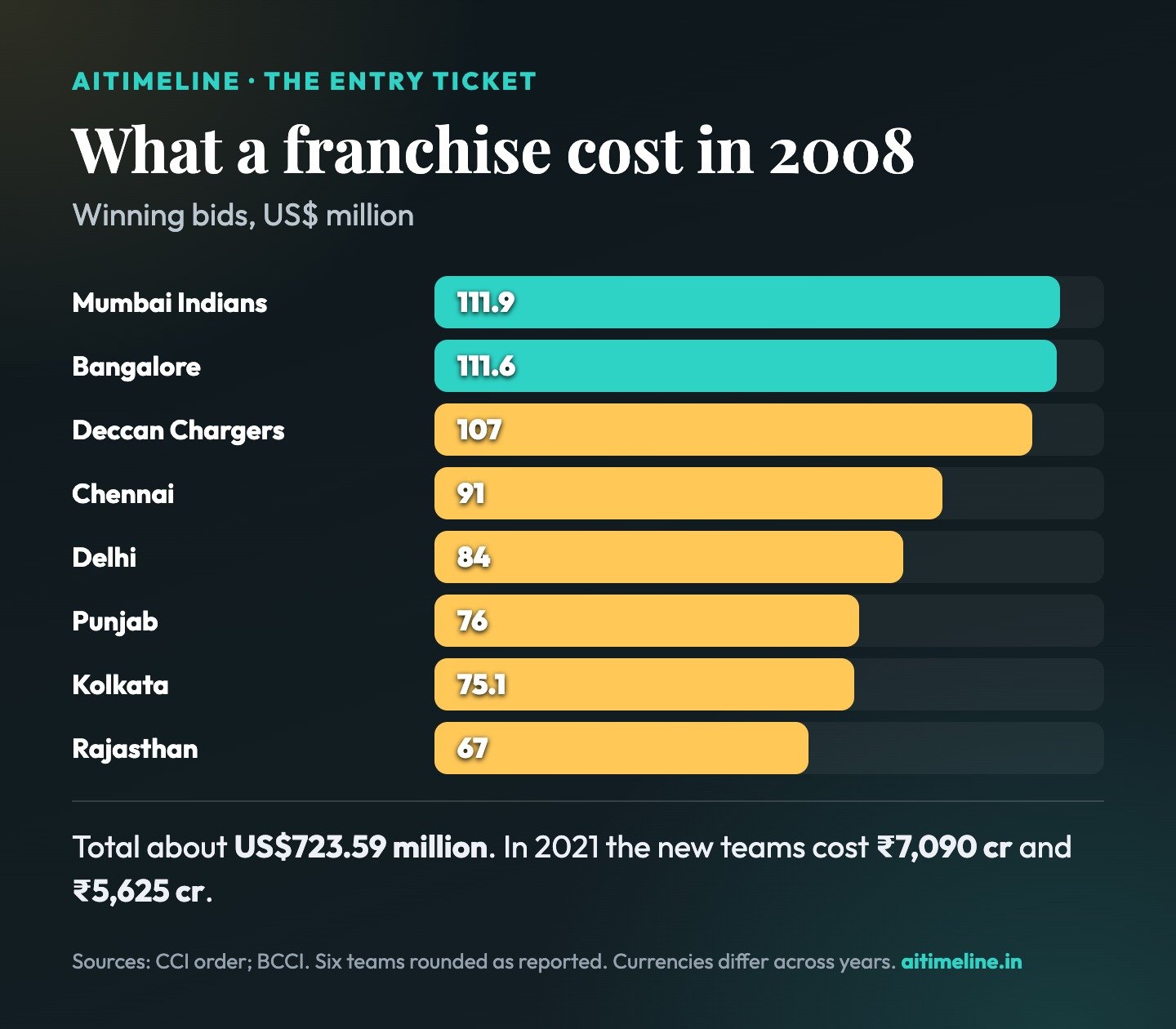
The 2008 bids were in US dollars, and the 2021 bids for Lucknow (₹7,090 crore) and Ahmedabad (₹5,625 crore) were in rupees. They should not be compared directly. What they share is that the money buys the right to run a team in a league whose media rights the BCCI controls.
Media Rights: The Engine
Per-season value, then the 2023 to 2027 packages.
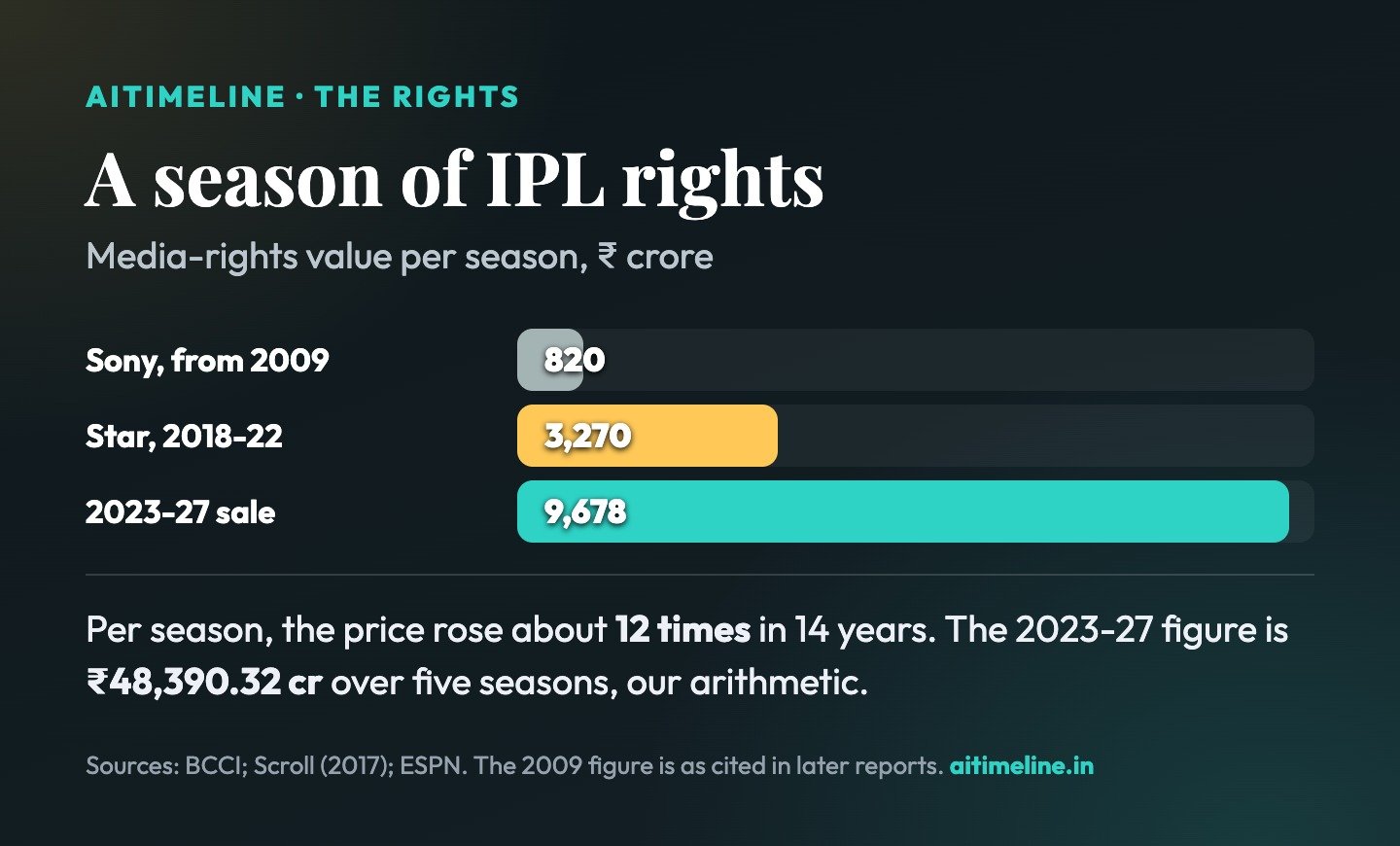

Television and digital rights were sold separately in 2022, and digital rights were worth almost as much as television. The 2009 per-season figure is taken from later reports, and the Competition Commission of India’s order records a different original 2008 bid of about US$1.026 billion, so we treat the early numbers as indicative.
How an Auction Actually Works
Five steps, inside a budget.
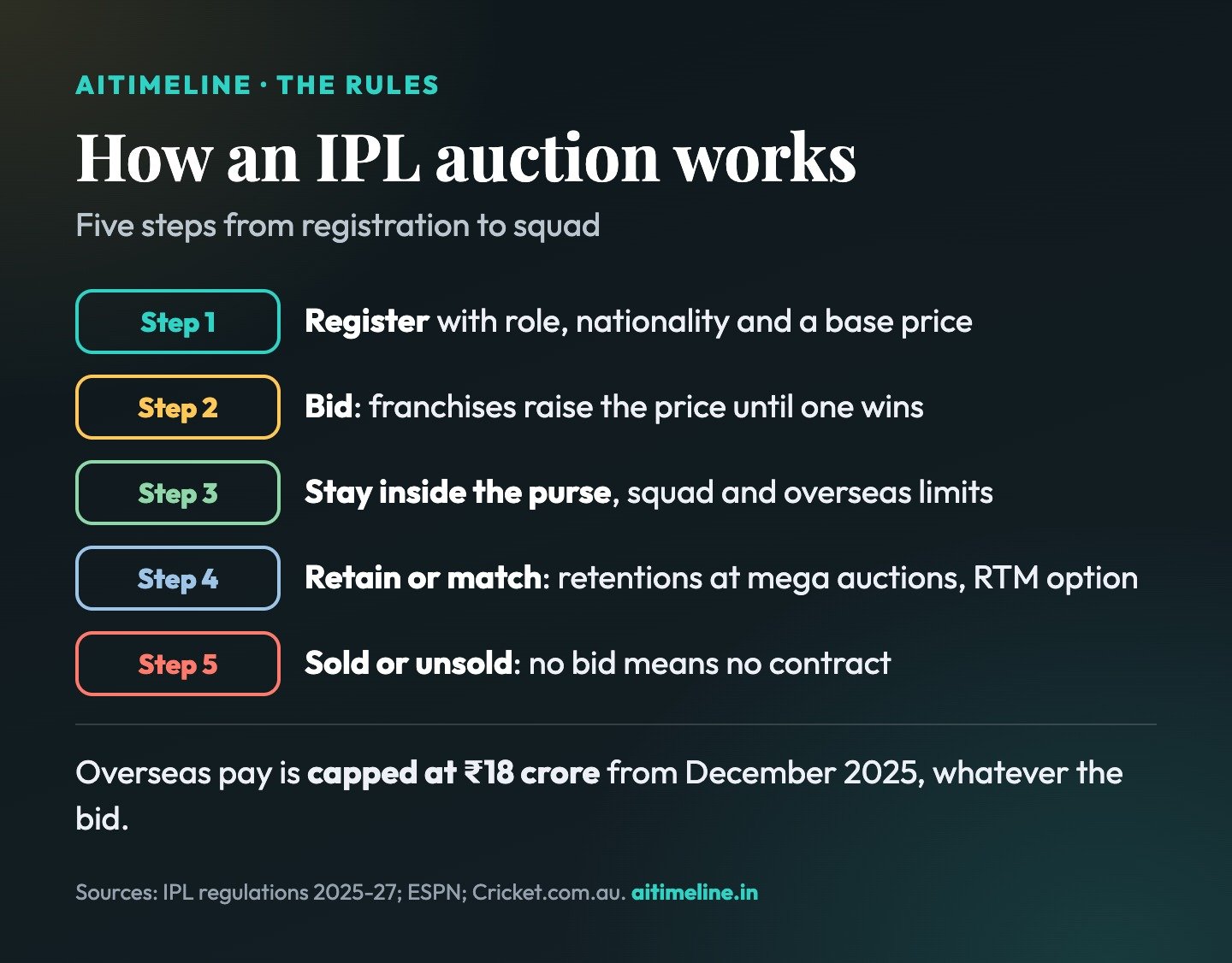
Spending too much on a few stars can leave too little for the rest of the squad. That is the trade-off the purse creates. Mega auctions follow retentions and rebuild squads; mini auctions fill gaps. The Right to Match was introduced in 2018.
| Feature | Mega auction | Mini auction |
|---|---|---|
| Purpose | Rebuild squads | Fill gaps |
| Retentions | Limited, under cycle rules | Squads mostly continue |
| Latest example | Jeddah, Nov 2024: 182 sold, ₹639.15 cr | Abu Dhabi, Dec 2025: 77 sold, about ₹215.45 cr |
| Top price | Pant, ₹27 crore | Green, ₹25.2 crore (pay ₹18 cr) |
The Purse and the Salary Cap
What a franchise can spend, and what players are paid.
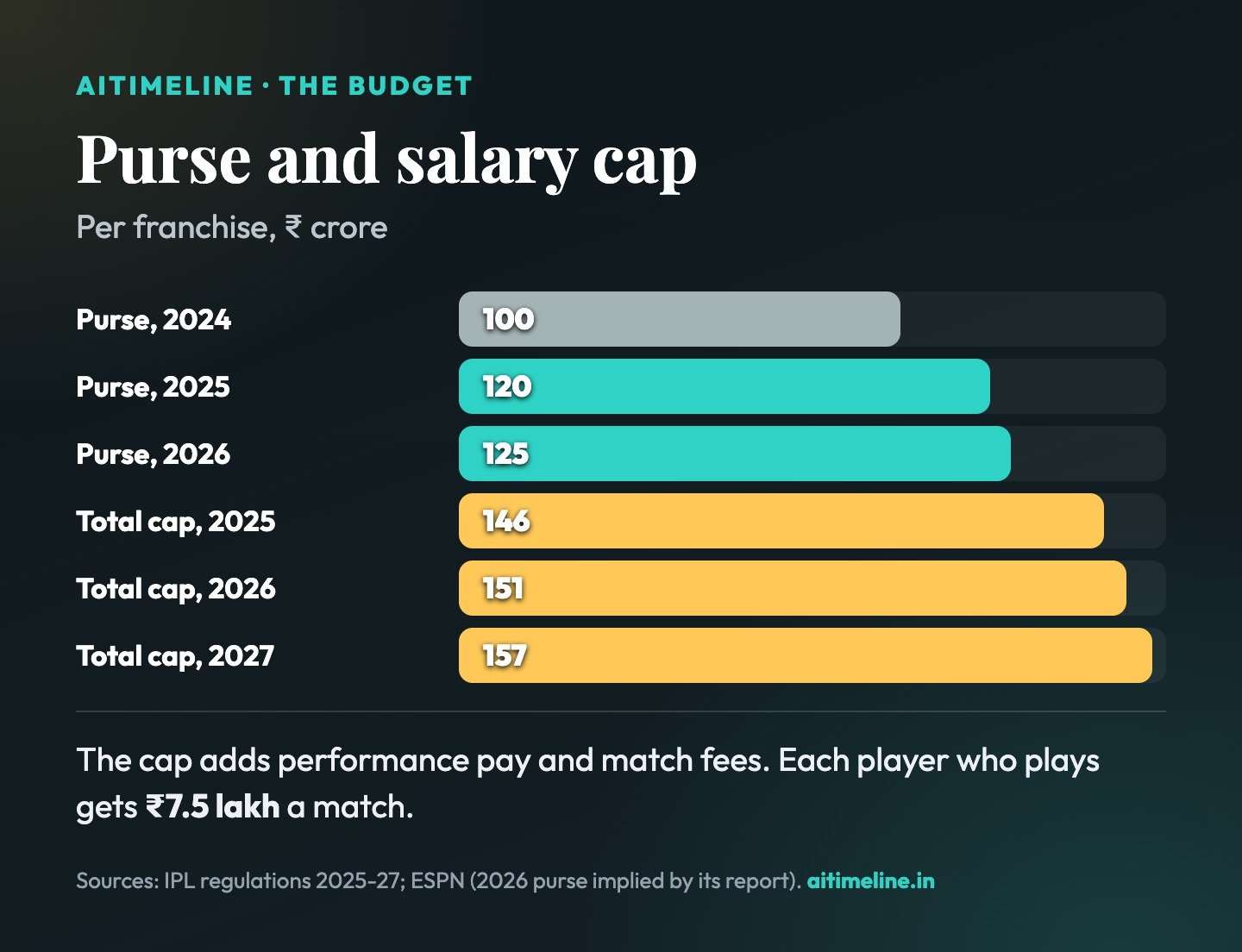
The September 2024 regulations set the purse and the cap for the 2025 to 2027 cycle and introduced the ₹7.5 lakh match fee, paid to each playing member including the Impact Player. The 2026 purse of about ₹125 crore is implied by ESPN’s coverage of the Abu Dhabi auction and we did not find the regulation text for it.
The Price Ladder: Record Auction Buys
Selected headline prices, not every year’s top purchase.
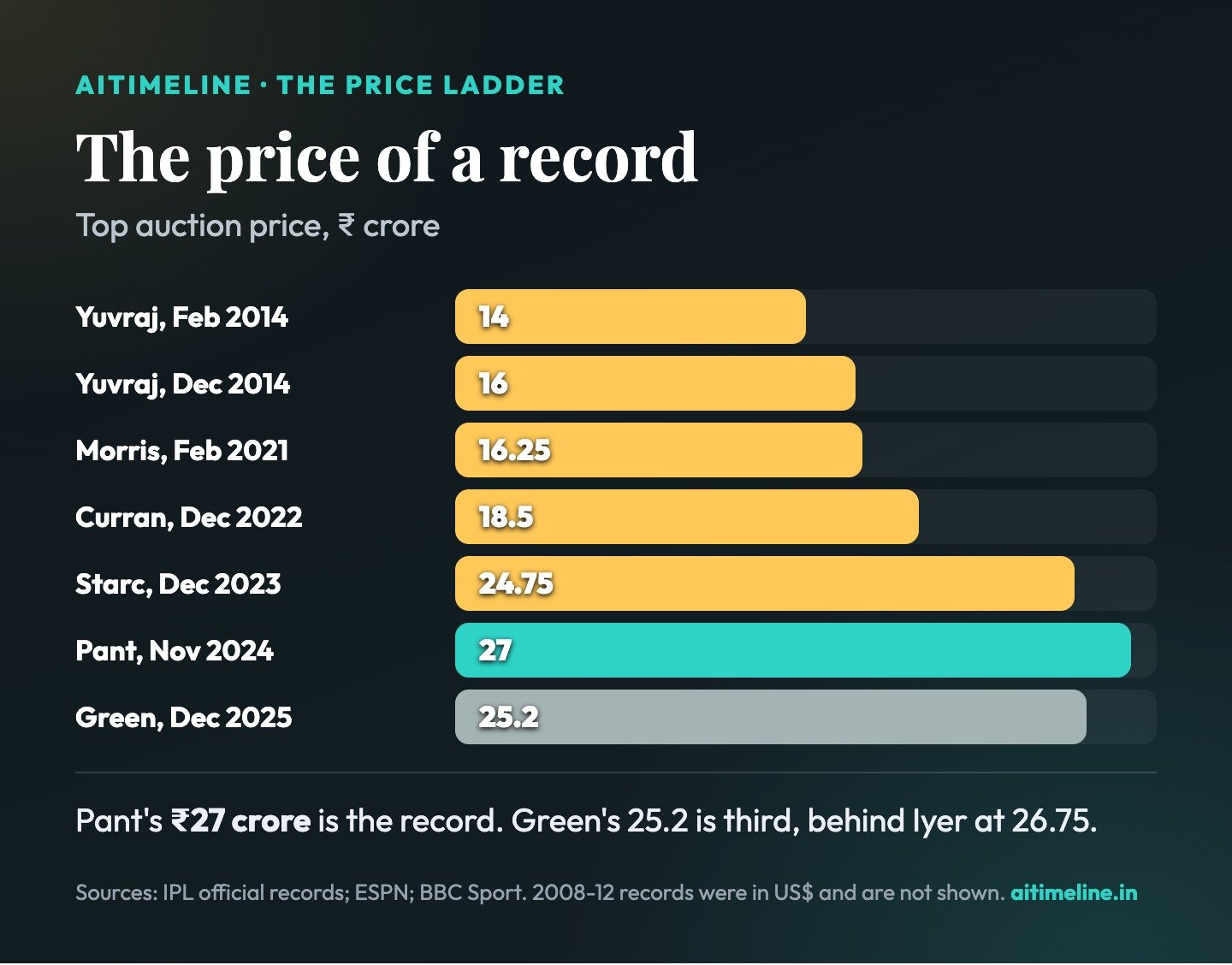
| Auction | Player | Franchise | Price |
|---|---|---|---|
| Feb 2008 | MS Dhoni | Chennai Super Kings | US$1.5 million |
| Jan 2011 | Gautam Gambhir | Kolkata Knight Riders | US$2.4 million |
| Feb 2012 | Ravindra Jadeja | Chennai Super Kings | US$2 million |
| Feb 2014 | Yuvraj Singh | Royal Challengers Bangalore | ₹14 crore |
| Dec 2014 | Yuvraj Singh | Delhi Daredevils | ₹16 crore |
| Feb 2021 | Chris Morris | Rajasthan Royals | ₹16.25 crore |
| Dec 2022 | Sam Curran | Punjab Kings | ₹18.5 crore |
| Dec 2023 | Mitchell Starc | Kolkata Knight Riders | ₹24.75 crore |
| Nov 2024 | Rishabh Pant | Lucknow Super Giants | ₹27 crore |
| Dec 2025 | Cameron Green | Kolkata Knight Riders | ₹25.2 crore (pay ₹18 cr) |
Dollar prices stay in their original currency. Green’s price is third overall, not a record.
How Franchises Earn, and How Players Earn
The auction price is one of several income streams on both sides.
Central pool share
A portion of league-wide media-rights and sponsorship income is distributed to franchises under the BCCI’s arrangements. The exact split is not verified here.
Team sponsors
Jersey, sleeve and training-kit partners, official team partners and digital campaigns. A popular team with a large fan base can attract more valuable deals.
Tickets and merchandise
Home-match ticketing, hospitality packages, jerseys and licensed products. A strong local following makes match-day income important.
Contract and match fee
The auction price, subject to the overseas cap, plus a ₹7.5 lakh match fee for each match played from 2025.
Endorsements
Brand deals and appearances, which can rise with IPL exposure. These sit outside the league’s contracts.
Other leagues
Franchise T20 competitions in several countries give specialists more places to earn, which has made scheduling harder.
Risks and Limits of the Auction Model
An expensive player may not deliver. Injury, form, pitch conditions and team balance all matter, and a heavy signing can strain a purse.
Prices reflect scarcity. A player may cost a lot because several franchises need the same skill, not because the price measures his overall ability.
Revenue is not profit. Franchises carry the original fee, salaries, staff, travel and marketing. We found no audited figures for every team, so we make no claim that they are profitable.
Key Terms
| Term | Meaning | Example |
|---|---|---|
| Base price | Where bidding starts | Not a contract value |
| Purse | Auction budget per franchise | ₹120 crore in 2025 |
| Salary cap | Total player payments | ₹146 crore in 2025 |
| Retention | Keeping players before a mega auction | Cycle rules apply |
| RTM | Right to Match a winning bid | Introduced 2018 |
| Impact Player | Extra player a team may use | Paid ₹7.5 lakh a match |
Conclusion: The Auction Is the Visible Part
The IPL turned cricket talent into a priced market. The auction is its most visible mechanism, but the larger business rests on media rights, franchise fees and sponsorship, and the biggest jump in value was not a player’s price but the sale of the broadcast rights.
The record has risen from US$1.5 million to ₹27 crore, and the rules have changed with it: a bigger purse, a salary cap, a match fee and, from December 2025, a cap on what overseas stars are paid. What the figures do not show is who profits, because we found no audited numbers for every franchise.
Explore More Timelines
People Also Ask
Frequently Asked Questions
⚠️ Editorial Note
Figures come from the BCCI, the IPL’s official auction records and regulations, the Competition Commission of India, ESPN, Cricket.com.au and Scroll. We corrected details found in earlier summaries: the 2022 franchise fees were ₹7,090 crore (Lucknow) and ₹5,625 crore (Ahmedabad), not two equal figures; the ₹16 crore Yuvraj bid was at the December 2014 auction, not 2015; Cameron Green’s ₹25.2 crore bid is not his pay, which is capped at ₹18 crore; and we dropped a 2013 entry that described no event. The 2009 media-rights figure and the BCCI revenue share could not be verified from a primary document. This article is editorial information, not investment or betting advice.
Related Stories
Sources & further reading
Every dated entry above was checked against these references. Last reviewed 27 November 2026.
- BCCI: Successful bidders for IPL media rights 2023-2027
- IPL: Governing Council announces TATA IPL player regulations 2025-27
- IPL official auction record: 2025 sold players
- IPL official auction record: 2026 sold players
- BCCI: Successful bidders for two new IPL franchises (October 2021)
- Competition Commission of India: IPL media rights order
- Competition Commission of India: IPL franchise rights order
- ESPN: KKR buy Cameron Green for INR 25.20 crore at the IPL 2026 auction
- Cricket.com.au: No pay hike for Cameron Green despite record IPL auction bid
- Scroll: Star India bags global IPL media rights for Rs 16,347.50 crore (September 2017)