White House vs. Press: A Timeline of Presidential Battles With Journalists
Trump told CNN's Kristen Holmes to 'be quiet' on Aug 17, 2026. See the full history of presidents vs. the press, from FDR's radio to Nixon to today.
Latest Story
A reporter asks a question. A president decides whether to answer it, deflect it, or attack the person who asked. That small exchange, repeated tens of thousands of times since George Washington first met with newspapermen, is one of the oldest tests of how power in the United States actually behaves once it’s asked something it doesn’t want to answer. On August 17, 2026, that test played out again in the Oval Office, when President Trump told CNN senior White House correspondent Kristen Holmes to “be quiet” after she pressed him on North Korea and read him a rival senator’s criticism of a top aide — and the White House’s own rapid-response account followed up by attacking Holmes personally, including a reference to her children. CNN called the response “beneath the office.” The exchange took nine minutes to end and generated a week of coverage. But it is not a new story. It is the newest entry in a relationship that has run through newspapers, radio, television, cable news, the internet and now social media, each new technology changing who holds the advantage when a president and a reporter disagree in public. This article traces that relationship from the earliest presidencies through 2026, and places the Holmes exchange inside it — as current news, not as the whole story.
🧠 AI Overview Summary
On August 17, 2026, President Trump repeatedly told CNN’s Kristen Holmes to “be quiet” in the Oval Office after she asked about North Korea and read him Sen. Jon Ossoff’s remarks about aide Natalie Harp. The White House Rapid Response account then attacked Holmes personally on X, including a line about her children; CNN called the response “beneath the office.” The clash is the latest chapter in a much older pattern: presidents have contested press coverage since Washington, through Nixon’s Watergate-era hostility, Reagan’s photo-op strategy, Trump’s first-term Jim Acosta credential fight, and the 2025 White House takeover of the press pool from the White House Correspondents’ Association. What changed by 2026 is speed and reach: a White House social account can now counter-attack an individual reporter directly, in public, within the hour.
The Holmes Incident and Its History: Key Questions
What to Know About the White House–Press Relationship
- The Aug. 17, 2026 clash involved two separate questions — one on Sen. Jon Ossoff’s remarks about aide Natalie Harp, one on North Korea and military exercises — not a single exchange, per contemporaneous reporting from CNN, Fox News, The Washington Post and entertainment-trade outlets present or briefed.
- The White House’s personal attack on Holmes, including a line about her children, came from the Rapid Response account, not from Trump directly or from the press secretary’s podium.
- CNN publicly defended Holmes, calling her one of the network’s most respected correspondents and calling the personal attacks “beneath the office.”
- Presidential conflict with the press is not new. Every technological shift — radio, television, 24-hour cable, the internet, social media — changed the balance of power between the presidency and reporters covering it.
- Nixon’s hostility toward the press is historically distinct from Watergate itself: investigative reporting was one input among sources, congressional hearings, court rulings and FBI evidence that together forced his resignation.
- CNN’s 1980 launch created 24-hour political coverage, a structural change that made the White House press relationship a nonstop cycle rather than a once-a-day newspaper deadline.
- Trump’s first term produced two major credentialing disputes — Jim Acosta (2018, reversed by a federal judge on due-process grounds) and Kaitlan Collins (2018, reversed after a White House Correspondents’ Association protest).
- In February 2025, the White House took control of the press pool from the WHCA for the first time in decades, a structural change the WHCA called an erosion of press independence.
- A federal judge ordered AP’s Oval Office access restored on First Amendment grounds in April 2025; an appeals court later stayed that ruling, finding restricted presidential spaces are not a public forum.
- The First Amendment protects criticism of the press, including harsh criticism from officials; it does not by itself guarantee any reporter physical access to the Oval Office, Air Force One or a press pool seat.
August 17, 2026: What Happened, In Order
Separating the two questions, the response, and the White House follow-up
The exchange took place during an otherwise unrelated Oval Office event honoring a teenage lifeguard, Ryder Williams. Speaking about North Korea, Trump told the room, “Kim Jong-un has always treated me with great respect. I understand him, he understands me.” Holmes then asked whether Kim had specifically requested that the United States scale back joint military exercises with South Korea, due to begin the following day. Trump’s first response was directed at the setting, not the question: “Quiet. You’re very disrespectful in front of this young man, okay?” When he asked which outlet she was with and she said CNN, he continued: “Fake news. You’re a loud, boisterous person. You’re faking news! Be quiet, be quiet, be quiet… you’re a fake reporter and you report fake news.”
Earlier in the same availability, Holmes had separately asked Trump to respond to remarks Georgia Sen. Jon Ossoff made over the weekend, suggesting Trump would rather build a White House ballroom and travel with executive assistant Natalie Harp than attend to his duties. Trump responded to that question by calling Ossoff a “Pee-Wee Herman” look-alike. Multiple outlets, including CNN’s own reporting on the Ossoff-Harp dispute, treat the ballroom/Harp exchange and the North Korea exchange as two distinct moments within the same press availability, not one continuous confrontation.
After the availability ended, the White House’s Rapid Response account posted on X that Holmes was “a disgraceful, humiliating embarrassment to her alleged profession,” called the outlet’s staff “the lowest of the low,” and added: “Someday, your children will come across your disgusting and inhumane question. They will be sickened and embarrassed.” CNN issued a statement in response: “Kristen Holmes is one of the most respected and accomplished journalists covering the White House. This afternoon, she did her job and asked the President of the United States a tough, relevant, and newsworthy question on behalf of the American people. Public officials are free to challenge reporting they disagree with, but personal attacks on journalists for asking questions are beneath the office and inconsistent with the principles of a free press. We stand firmly behind Kristen and reject these attacks in the strongest possible terms.”
Key Facts Table
The Aug. 17, 2026 incident against six earlier flashpoints in White House–press history
| Date | President | Reporter / Outlet | What Happened | Why It Mattered |
|---|---|---|---|---|
| Aug 17, 2026 | Trump | Kristen Holmes, CNN | Told to “be quiet”; WH Rapid Response attacked her personally, invoking her children | First major 2026 case of an official WH account, not just the president, personally targeting a named reporter’s family |
| Feb 25, 2025 | Trump | Press pool / WHCA | White House took control of selecting the press pool from the WHCA | Ended decades of journalist-run pool selection; WHCA called it an erosion of independence |
| Nov 16, 2018 | Trump | Jim Acosta, CNN | Federal judge ordered Acosta’s suspended hard pass restored | First modern court ruling on due process in White House credentialing |
| May 2018 | Trump | Kaitlan Collins, CNN | Barred from a Rose Garden event after questions on Michael Cohen/Kim summit | WHCA protest led to restored access within days |
| Jun 17, 1972–Aug 9, 1974 | Nixon | Woodward & Bernstein, Washington Post | Watergate reporting, alongside FBI, courts and Congress, contributed to Nixon’s resignation | Defined modern adversarial investigative journalism of the presidency |
| Jan 25, 1961 | Kennedy | White House press corps | First fully live televised presidential press conference | Television became a direct channel between president and public, alongside print |
| Mar 12, 1933 | F. D. Roosevelt | National radio audience | First “fireside chat” radio address | First technology letting a president bypass newspaper editors entirely |
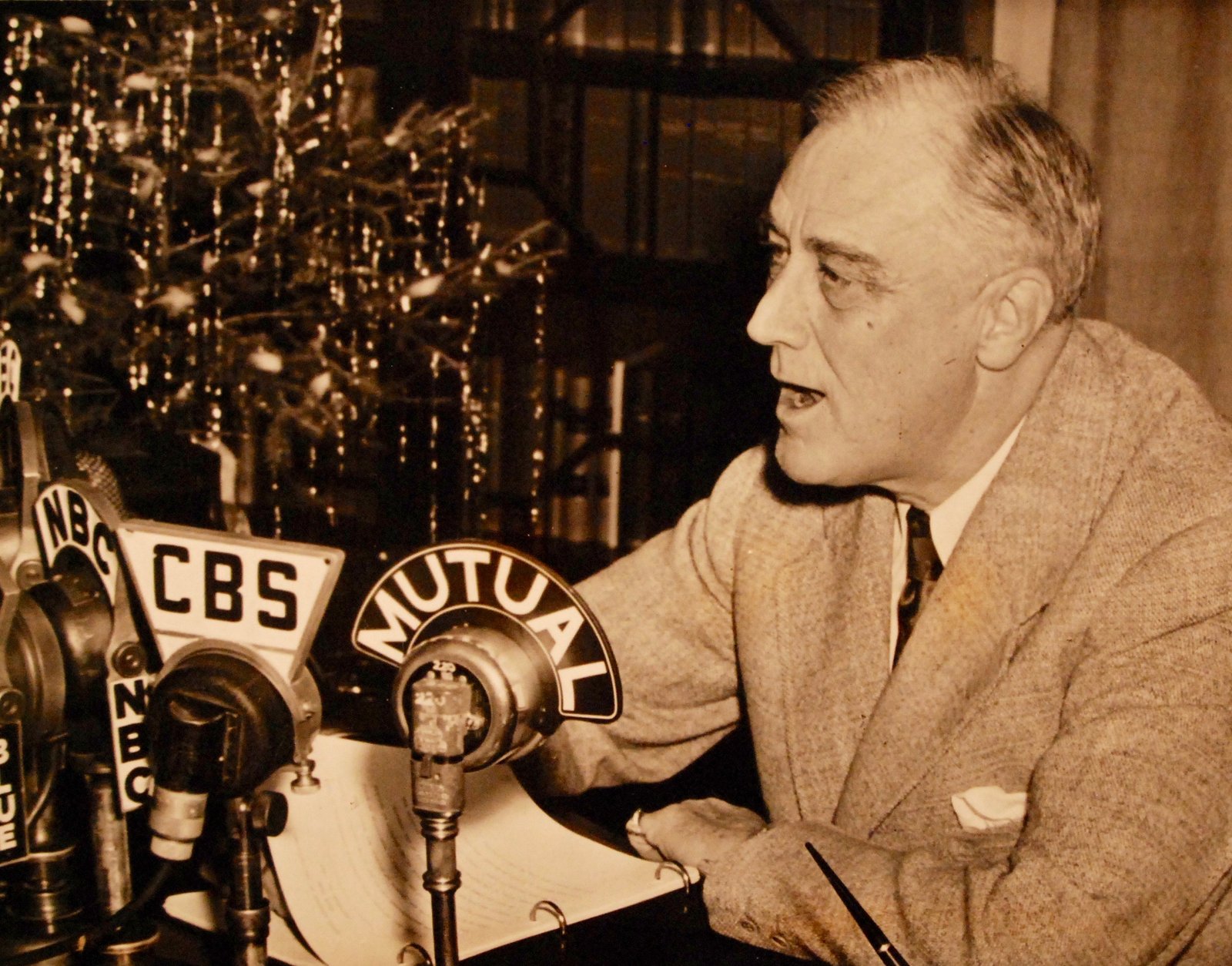
FDR’s fireside chats, begun in 1933, let a president speak to the public directly over radio for the first time — without a newspaper editor between them. U.S. Navy photo, public domain / Wikimedia Commons.
How the Presidency and the Press Evolved: Newspaper to Social Media
The technological thread connecting Washington to the 2026 Oval Office
The Early Republic: A Partisan Press, Not a Neutral One
The adversarial relationship between the presidency and reporters did not begin with television or cable news; it began with newspapers that were, by modern standards, openly partisan. George Washington’s administration was covered by papers aligned with competing factions inside his own cabinet, and by his second term Washington was privately complaining about press attacks that read as personal to him, even as he avoided public retaliation. Thomas Jefferson, who had subsidized a friendly newspaper as vice president, became a target of hostile press coverage as president and later wrote that he found newspapers so unreliable he’d “believe nothing” in them — a sentiment that reads strikingly close to modern “fake news” rhetoric, though Jefferson made it in private correspondence, not from the presidency’s own communications operation. Andrew Jackson took the relationship further, cultivating a network of loyal partisan newspapers (the “Kitchen Cabinet” press) to advance his agenda directly, an early precursor to a White House trying to control its own narrative rather than relying on independent coverage. Abraham Lincoln, governing through the Civil War, tolerated hostile Northern newspapers but also had the War Department seize telegraph lines and, in isolated cases, editors, testing the outer limit of wartime press control in ways that would be unconstitutional in peacetime.
FDR and Radio: The First Bypass Technology
Franklin D. Roosevelt’s first fireside chat aired March 12, 1933, eight days after his inauguration, addressing the banking crisis directly to a national radio audience. Over the next eleven years he delivered roughly 30 of these addresses. Radio mattered because it was the first communications technology that let a president speak to tens of millions of Americans without a newspaper editor, headline writer or wire-service reporter standing between the message and the audience. FDR still held regular, often freewheeling press conferences with print reporters — he did not abandon the reporter relationship — but radio gave the presidency, for the first time, a direct channel of its own. That structural fact, a president with a communications channel independent of the press corps, is the direct ancestor of every later bypass technology, up to and including a 2026 White House X account.
Kennedy and Live Television
John F. Kennedy held the first fully live, unedited televised presidential press conference on January 25, 1961, broadcast from the State Department auditorium and watched by an estimated 65 million Americans. Live television changed press conferences in two ways at once: it let the public watch the president answer, or fail to answer, a hostile question in real time, and it made the president’s poise under questioning itself a form of political performance, not just the words in the transcript. Television did not replace print correspondents, but it added a second audience — the viewing public, watching the questioning live — that the president now had to answer to directly, not just through the next morning’s headline.
Nixon: Hostility, Watergate and the Limits of the “Journalists Toppled a President” Story
Richard Nixon’s relationship with the press was openly adversarial; his administration kept an internal “enemies list” that included journalists, and Vice President Spiro Agnew gave speeches in 1969 attacking network news commentators as an unelected “small and unrepresentative group” shaping public opinion — rhetoric that, structurally, previews later “fake news” and “enemy of the people” framing even though the specific phrases differ. The Pentagon Papers, published by The New York Times and The Washington Post in 1971 over the administration’s objection (and after a Supreme Court ruling against prior restraint in New York Times Co. v. United States), had already established that this White House would fight publication in court, not just rhetorically. Watergate reporting by Bob Woodward and Carl Bernstein at The Washington Post, beginning after the June 17, 1972 break-in, is often shorthanded as “the press brought down a president.” That overstates the newspaper’s role in isolation: Woodward and Bernstein’s reporting relied on a confidential FBI source (revealed in 2005 as W. Mark Felt, the bureau’s associate director) and ran alongside a Senate Watergate Committee investigation, a special prosecutor’s office, federal court proceedings and, ultimately, a unanimous Supreme Court order (United States v. Nixon, 1974) forcing Nixon to turn over White House tape recordings. Nixon resigned August 9, 1974, facing near-certain impeachment and removal by Congress. The accurate framing is that investigative journalism surfaced facts that congressional, judicial and law-enforcement institutions then independently corroborated and acted on — not that reporters alone removed a president.
Reagan: Managing the Picture, Not Just the Words
Ronald Reagan’s White House, under communications aides including Michael Deaver, pioneered a strategy of controlling the visual backdrop of every presidential appearance — a technique built for television, where a strong image could outlast whatever a reporter’s actual story said. Reagan held fewer formal press conferences than several predecessors but was frequently accessible in shorter, more controlled settings; the strategic insight of his press operation was that television made the picture, not just the transcript, the unit of coverage that stuck with voters.
Clinton and the Arrival of 24-Hour Cable
By the time Bill Clinton took office in 1993, CNN (launched 1980) had matured into a genuine 24-hour political news operation, and the 1991 Gulf War had already demonstrated cable’s ability to cover a story continuously rather than once a day, the so-called “CNN effect.” The Clinton White House operated under a fundamentally different rhythm than any predecessor: a scandal, most visibly the 1998 Monica Lewinsky story and subsequent impeachment, could now dominate a live, rolling news cycle for months rather than surfacing in a finite run of newspaper articles. That constant-cycle pressure, not any single Clinton-era confrontation, is the era’s structural legacy for the modern White House press relationship.
George W. Bush: War Reporting and Embedded Journalism
After the September 11, 2001 attacks, the Bush White House operated in a media environment defined first by national-unity coverage, then by the contested 2003 Iraq War. The Pentagon’s embedded-journalist program placed roughly 600 reporters directly with military units during the invasion, giving the public an unprecedented ground-level view of combat while also raising, throughout the war, recurring questions about how close physical and logistical dependence on a military unit could shape a reporter’s coverage of it. The Bush press operation is also remembered for the 2005-2006 controversy over administration officials paying commentators to promote policies without disclosure, and for tension over access during Hurricane Katrina coverage in 2005 — both examples of press-access friction distinct from, and in addition to, the war-reporting relationship.
Obama: The First Digital-Native White House, With Its Own Press-Freedom Record
Barack Obama’s White House built the first genuinely digital-era communications operation, including its own video production and direct social media accounts that let it publish content the traditional press corps had no editorial role in. Press-freedom groups nonetheless criticized the Obama Justice Department for secretly subpoenaing Associated Press phone records in 2013 in a leak investigation, and separately for naming Fox News reporter James Rosen a “co-conspirator” in a 2013 search warrant application tied to another leak case — both cited by the Reporters Committee for Freedom of the Press as record-setting uses of leak investigations against journalists’ own sourcing, complicating any narrative that press-White House tension began in 2017.
Trump’s First Term: Credentialing Fights and “Fake News” as a Governing Vocabulary
Donald Trump began using “fake news” as a rhetorical label for unfavorable coverage during the 2016 campaign and continued it as president, most visibly telling CNN’s Jim Acosta “you are fake news” at a January 11, 2017 press conference while declining to take his question. That framing set the tone for two credentialing disputes covered in depth below: the November 2018 suspension and court-ordered restoration of Acosta’s hard pass, and the May 2018 barring of Kaitlan Collins from a Rose Garden event.
Biden: Fewer Confrontations, Different Press-Freedom Questions
Joe Biden’s White House was less defined by public shouting matches with reporters than either Trump term, but it was not free of press tension. Biden held fewer solo press conferences in his first year than recent predecessors, drawing criticism from press-freedom advocates and the WHCA. Coverage of his age and mental acuity became a flashpoint after his halting June 2024 debate performance, with some outlets and media critics later arguing the White House press corps had underplayed the story beforehand. The administration’s classified-documents matter, examined in a 2024 special counsel report, and its shifting public messaging on the withdrawal from Afghanistan and the Israel-Gaza war, each drew sustained scrutiny from White House correspondents across outlets, including CNN.
Trump’s Second Term: Structural Change to Who Gets In the Room
Trump’s return to office in January 2025 brought a more structural shift than his first term’s individual confrontations. In February 2025, the White House ended the decades-old arrangement under which the White House Correspondents’ Association selected the small rotating press pool with access to tightly confined spaces like the Oval Office and Air Force One, taking that authority for itself; the WHCA called it a move that “tears at the independence of a free press.” The same period saw the Associated Press barred from Oval Office and Air Force One access after it continued using “Gulf of Mexico” alongside the administration’s preferred “Gulf of America.” A federal judge, Trevor McFadden, ruled in April 2025 that barring AP over its wording violated the First Amendment because the government cannot open access to some journalists while excluding others “because of their viewpoints” — a ruling a federal appeals court later stayed, on the reasoning that the Oval Office and Air Force One are “restricted presidential spaces,” not public forums the First Amendment requires be opened viewpoint-neutrally. By 2026, this structural authority over access, combined with a rapid-response social media operation that can respond to a single reporter’s question within the hour, is the backdrop against which the Kristen Holmes exchange took place.
Historical Comparison: How Each Era Shifted the Balance
Medium, presidential advantage, and press advantage, era by era
| Era | Main Medium | President’s Communication Advantage | Press’s Advantage |
|---|---|---|---|
| 1789–1900 | Partisan newspapers | Could subsidize or cultivate friendly papers | No White House press office to manage message; papers set their own agenda |
| 1933–1960 | Radio | Direct national audience, unedited, live | Print still broke news between broadcasts; no video record of delivery |
| 1961–1979 | Broadcast television | Controlled visual setting; performance under pressure became an asset | Public could watch a president dodge a question live, in real time |
| 1980–1995 | 24-hour cable (CNN) | More airtime to fill meant more direct access opportunities | Continuous coverage cycle made stories harder to bury or outlast |
| 1996–2008 | Cable + early internet | Message discipline across many more outlets | Wire services and cable broke stories faster than a daily news cycle allowed |
| 2009–2016 | Social media (official accounts) | First direct-to-public channel bypassing all press entirely | Reporters could fact-check official posts publicly, in real time |
| 2017–2024 | Personal presidential social media | Could set the day’s story before any outlet published one | Individual posts became citable, quotable primary sources instantly |
| 2025–2026 | Institutional rapid-response accounts | Whole communications office, not just the president, can counter-attack a single reporter within the hour | Clips of confrontations go viral independent of any outlet’s own distribution |
Master Timeline: White House vs. Press, 1933–2026
Verified milestones, newest first
Trump Tells CNN’s Kristen Holmes to “Be Quiet”; WH Rapid Response Attacks Her Personally
What happened: After Holmes asked about North Korea and Sen. Jon Ossoff’s remarks on aide Natalie Harp, Trump told her repeatedly to be quiet and called her “a fake reporter.” The White House’s Rapid Response account then attacked her personally, including a line about her children. CNN publicly defended her.
Judge Orders AP’s Oval Office Access Restored on First Amendment Grounds
What happened: Judge Trevor McFadden ruled the White House could not bar the Associated Press over its continued use of “Gulf of Mexico,” writing that once the government opens access to some journalists it “cannot then shut those doors to other journalists because of their viewpoints.” An appeals court panel later stayed the ruling, finding the Oval Office and Air Force One are not First Amendment public forums.
White House Takes Control of the Press Pool From the WHCA
What happened: For the first time in decades, the White House itself, not the WHCA, began deciding which outlets fill the small rotating pool with access to the Oval Office and Air Force One. WHCA president Eugene Daniels called it a move that “tears at the independence of a free press.”
Federal Judge Orders Jim Acosta’s Press Pass Restored
What happened: Judge Timothy J. Kelly granted CNN’s request for a temporary restraining order, finding the White House had violated Acosta’s Fifth Amendment due-process rights by suspending his credential without adequate notice or process. The ruling turned on due process, not directly on the First Amendment.
White House Suspends Jim Acosta’s Hard Pass
What happened: After a contentious question-and-answer exchange in which a White House intern attempted to take Acosta’s microphone, then-press secretary Sarah Huckabee Sanders announced his credential was revoked, citing Acosta’s conduct. CNN sued the next week; the suspension lasted roughly two weeks before the court order above.
Kaitlan Collins Barred From a Rose Garden Event
What happened: The White House barred then-CNN reporter Kaitlan Collins from an open press event after officials objected to questions she’d asked about Michael Cohen and the upcoming Kim Jong Un summit during an earlier, separate photo spray. The WHCA protested the move as a violation of open-press norms; the White House restored her access days later.
President-Elect Trump Tells Acosta “You Are Fake News”
What happened: At his first press conference since winning the election, Trump refused to take a question from Acosta, telling him “You are fake news” — an early, widely covered use of the phrase that became a recurring feature of his relationship with the press.
DOJ Secretly Subpoenas AP Phone Records; Names Fox Reporter a “Co-Conspirator”
What happened: In separate leak investigations, the Justice Department secretly obtained records of more than 20 AP phone lines and, in a warrant application, named Fox News reporter James Rosen a possible “co-conspirator” for soliciting classified information. Press-freedom groups called both record-setting intrusions into newsgathering.
Pentagon’s Embedded-Journalist Program Begins Ahead of the Iraq Invasion
What happened: The Bush administration placed roughly 600 journalists directly with military units for the Iraq invasion, giving unprecedented ground-level access while raising lasting questions about how dependence on a unit’s protection could shape coverage.
Lewinsky Scandal Saturates the 24-Hour Cable Cycle
What happened: The Monica Lewinsky story and subsequent impeachment proceedings became the first major presidential scandal covered by a mature, always-on cable news environment, keeping the story continuously live for months rather than in a finite run of newspaper cycles.
Gulf War Coverage Creates the “CNN Effect”
What happened: CNN’s live, continuous coverage of the 1991 Gulf War, including reporters broadcasting from Baghdad during bombing, demonstrated cable news’s ability to shape real-time public and even policymaker perception of an unfolding event — a phenomenon researchers later termed the “CNN effect.”
CNN Launches, Creating 24-Hour Political News
What happened: Ted Turner launched the Cable News Network as the first all-news, 24-hour television channel, fundamentally changing the White House press cycle from a once-a-day newspaper deadline into a continuous news operation.
Nixon Resigns Following Watergate
What happened: Nixon resigned facing near-certain impeachment, after Washington Post reporting, a Senate committee investigation, a special prosecutor and a unanimous Supreme Court order (United States v. Nixon) together established his role in the cover-up.
Watergate Break-In; Woodward and Bernstein’s Reporting Begins
What happened: Five men were arrested breaking into the Democratic National Committee’s Watergate offices. Post reporters Bob Woodward and Carl Bernstein, aided by a confidential FBI source later revealed as Mark Felt, began the reporting that ran alongside the institutional investigations that ultimately forced Nixon’s resignation.
Kennedy Holds the First Live Televised Presidential Press Conference
What happened: An estimated 65 million Americans watched Kennedy take live, unedited questions from reporters, establishing television as a direct venue for real-time presidential accountability.
FDR Delivers the First Fireside Chat
What happened: Roosevelt addressed the banking crisis directly to a national radio audience, the first time a president could reach the public at scale without a newspaper editor as intermediary.
CNN and the White House: A Short History
From a single Atlanta studio to the network at the center of a 2026 controversy
Kristen Holmes / Rapid Response Incident
Latest flashpoint in CNN’s coverage of a Trump White House; CNN publicly defended its correspondent.
Acosta and Collins Credentialing Disputes
Two separate access fights, both ultimately reversed, defined CNN’s first-term Trump coverage.
Gulf War Coverage Establishes CNN as a Wartime News Authority
Live Baghdad coverage made CNN a default destination during fast-moving national-security stories, including White House ones.
CNN Launches in Atlanta
Ted Turner’s all-news channel created the 24-hour political news cycle that every subsequent White House has had to operate inside.
Trump and CNN: The Conflict Timeline
From “fake news” in 2017 to the Rapid Response account in 2026
“You Are Fake News”
President-elect Trump refuses Jim Acosta’s question at his first post-election press conference, an early use of the phrase that came to define the relationship.
Kaitlan Collins Barred
Collins is excluded from a Rose Garden event over prior questions; restored after a WHCA protest.
Acosta Credential Suspended, Then Restored
A contentious exchange leads to a two-week suspension of Acosta’s hard pass; a federal judge orders it restored on due-process grounds.
Press Pool Taken Over; AP Barred, Then Partly Restored
The White House takes control of the press pool and bars the AP over word choice; a judge orders access restored, then a stay follows on appeal.
Acosta Leaves CNN
Jim Acosta departs CNN for an independent Substack show after a schedule change, ending his run as the network’s most visible Trump-era correspondent.
Kristen Holmes / Rapid Response
Trump tells Holmes to “be quiet”; the White House’s own account personally attacks her afterward.
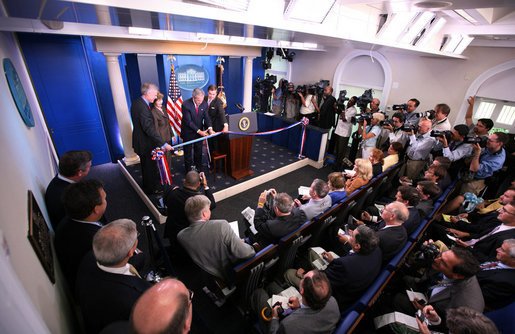
The James S. Brady Press Briefing Room, the White House’s main venue for on-camera press briefings, shown after its 2007 renovation. White House photo by Eric Draper, public domain / Wikimedia Commons.
Jim Acosta: The 2018 Credential Fight, in Full
What the lawsuit actually decided
On November 7, 2018, during a post-midterms press conference, Jim Acosta questioned Trump about the migrant caravan and Russia investigation; when a White House intern attempted to take the microphone from him, Acosta briefly held onto it while continuing to speak. That evening, then-press secretary Sarah Huckabee Sanders announced Acosta’s White House hard pass was suspended, initially citing his physical conduct toward the intern — a characterization Acosta and CNN disputed, pointing to video showing no forceful contact. CNN sued the administration on November 13, 2018, arguing the suspension violated Acosta’s First and Fifth Amendment rights.
On November 16, 2018, Judge Timothy J. Kelly of the U.S. District Court for the District of Columbia granted a temporary restraining order requiring the White House to restore Acosta’s credential. Kelly’s ruling rested on the Fifth Amendment’s due-process clause — finding the White House had revoked Acosta’s access without adequate advance notice or a chance to respond — rather than on the First Amendment directly, a distinction often lost in summary coverage. The administration restored the pass rather than litigate further, and a broader legal fight over the underlying constitutional questions never reached a final judgment. Acosta remained CNN’s chief White House correspondent through the rest of Trump’s first term and much of the Biden administration before leaving the network in January 2025 for an independent Substack show, telling viewers to “hold power to account.”
Kaitlan Collins: Access, Restored Under Pressure
A shorter dispute, resolved through professional-association pressure rather than a lawsuit
In May 2018, then-CNN reporter Kaitlan Collins covered an Oval Office photo spray in which she asked Trump about his then-personal attorney Michael Cohen and the upcoming Kim Jong Un summit — questions the White House later said were “inappropriate” for the setting. Officials subsequently barred Collins from a separate, open Rose Garden press event later that day. The White House Correspondents’ Association, along with rival networks, publicly protested the move as a breach of open-press access norms regardless of any outlet’s specific coverage choices. The White House restored Collins’s access within days. Collins went on to anchor CNN’s The Source and to interview Trump directly during the 2024 campaign and his second term, illustrating that a credentialing dispute did not translate into a permanent block on access or on-air opportunity.
Who Is Kristen Holmes?
A factual profile, without speculation about her personally
Kristen Holmes is CNN’s senior White House correspondent, a role in which she covers the presidency day to day, including Oval Office availabilities, press briefings and presidential travel. She was present at the August 17, 2026 event in a routine reporting capacity, covering a scheduled Oval Office appearance, and asked two on-the-record questions relevant to that day’s news: one on Sen. Ossoff’s remarks about a senior aide, and one on U.S.-North Korea/South Korea military policy, itself a legitimate national-security question given exercises scheduled to begin the next day. Her role and her question are a matter of public record; her personal life, including her children, is not a legitimate subject of coverage and this article does not repeat the White House’s language about them beyond quoting it as part of the documented record above.
What Is the White House Rapid Response Account?
A newer piece of the communications operation, distinct from the press secretary’s podium
The Rapid Response account is an official White House-affiliated social media account, run as part of the second-term Trump communications operation, built to respond to press coverage and individual reporters’ questions in real time, directly on social platforms, rather than exclusively through the press secretary’s on-camera briefings. Structurally, it represents a change from earlier eras’ communications offices: statements attacking a specific reporter by name, as happened to Holmes on August 17, 2026, previously would typically have come from the press secretary at a podium, subject to the normal give-and-take of a televised briefing, or not been made in an official capacity at all. A rapid-response social account can publish that kind of statement instantly, without a briefing-room exchange, and it reaches an audience that overlaps with but is distinct from the audience watching a televised briefing. Available reporting does not indicate the account operates under a different chain of approval than other official White House communications, but its speed and directness toward individual journalists, rather than toward outlets or coverage broadly, is what most differentiates it from prior White House press operations.
The White House Press Corps, Explained
Pool, briefing room, credentials and access
The White House press corps is the body of journalists regularly credentialed to cover the presidency, ranging from wire services and major networks to smaller and niche outlets. Because spaces like the Oval Office, the president’s motorcade and Air Force One are physically too small for every credentialed journalist, a rotating “pool” of a handful of reporters and photographers covers those events and shares their notes and footage with the full press corps — a system historically organized by the White House Correspondents’ Association until the Trump administration took over pool selection in February 2025. The James S. Brady Press Briefing Room hosts the more widely attended on-camera briefings, where the press secretary takes questions from a larger group. Access to the White House complex itself requires a “hard pass,” a Secret Service-issued credential subject to a background check and renewal; access to a specific event, by contrast, is a discretionary invitation the White House can extend or withhold event by event, which is the level at which most modern access disputes, including the Acosta and Collins cases, actually occur.
What Does a White House Press Secretary Do?
The traditional buffer between the president and the press corps
The White House press secretary is the president’s official spokesperson to the press corps, responsible for the daily on-camera briefing, coordinating logistics for press coverage of presidential events, and serving as the primary point of contact between reporters and the West Wing’s communications staff. Historically, the press secretary’s briefing has functioned as a buffer: a venue where adversarial questioning happens in a structured, recorded, on-the-record setting, with norms (a designated questioner order, follow-ups, a defined start and end) that constrain how confrontational an exchange can become. When a president personally engages reporters directly, as in the Holmes exchange, or when an account like Rapid Response responds outside the briefing room entirely, that traditional buffer is bypassed — the exchange happens without the structure, timing and shared norms of a formal briefing.
The First Amendment and White House Reporters
What it protects, and what it does not guarantee
The First Amendment’s press clause protects journalists from government censorship and retaliation for what they publish; it protects Kristen Holmes’s right to ask her question and CNN’s right to publish its statement defending her, and it protects the White House’s own right to criticize her question, however harshly, since criticism of the press by officials is itself protected speech, not a constitutional violation. What the First Amendment does not do, on its own, is guarantee any individual reporter physical access to a discretionary, non-public space like the Oval Office, a presidential motorcade or Air Force One. Courts have instead relied on other legal theories to constrain how the White House can regulate access once it has been granted: the 2018 Acosta ruling turned on Fifth Amendment due process (the government must give notice and a chance to respond before revoking an already-granted credential), while the 2025 AP ruling turned on a First Amendment viewpoint-discrimination theory (the government cannot open a space to some journalists while excluding others specifically because of the opinions or word choices in their coverage) — a theory a federal appeals court panel disagreed with on appeal, finding the Oval Office and Air Force One are “restricted presidential spaces,” not public forums subject to that standard. As of August 2026, that appellate question remains legally live rather than definitively settled by the Supreme Court.
Does the White House Have to Give Every Reporter Unlimited Access?
Distinguishing constitutional protection from physical access, credentialing and pool assignments
No. The White House has substantial discretion over who it invites into small, non-public spaces, and no reporter has a constitutional right to a seat in the press pool, a question at a specific briefing, or entry to the Oval Office. What the law does constrain, per the rulings above, is how that discretion is exercised once access has already been extended to some journalists: revoking an existing hard pass requires due process, and (per the now-stayed 2025 ruling) excluding a specific outlet because of its viewpoint may raise a separate constitutional problem, even though physical access itself isn’t a guaranteed right. Security screening, space constraints and logistics are legitimate, viewpoint-neutral reasons the White House can and does cite to limit numbers; the legal disputes above have all turned on whether a specific access decision was actually about logistics, or about retaliating against coverage the White House disliked.
Why Social Media Changed the White House–Press Relationship
From a newsroom-mediated cycle to a direct, public, instant one
Traditional Cycle
- Reporter asks a question at a briefing or availability.
- The reporter’s newsroom edits, verifies and contextualizes the exchange.
- The story publishes, typically hours later, with the White House’s response included.
2026 Social-Media Cycle
- Reporter asks a question, on camera, in the Oval Office.
- The president responds directly, on camera, in real time.
- A White House account posts its own reaction within the hour, outside any newsroom’s editorial process.
- The reporter or their outlet responds publicly.
- Video clips of the exchange circulate on social platforms independent of any single outlet’s own distribution.
- Supporters and critics of each side react and amplify their preferred clip.
- The original policy question — in this case, U.S.-South Korea military exercises and North Korea — can get lost beneath the personal conflict that follows it.
The structural change isn’t that presidents dislike tough questions — they always have. It’s that a president and an entire White House communications operation can now respond to one reporter, by name, in public, before that reporter’s own newsroom has finished its story.
Trump vs. CNN: What’s Documented and What’s Interpretation
Separating fact, claim, and opinion
| Statement | Category | Basis |
|---|---|---|
| Trump told Holmes to “be quiet” and called her “a fake reporter” | Fact | Directly quoted, on camera, corroborated across multiple outlets present or reviewing footage |
| The White House Rapid Response account called Holmes a “disgraceful, humiliating embarrassment” and referenced her children | Fact | Published statement on an official White House-affiliated account |
| CNN said the personal attacks were “beneath the office” | Opinion (CNN’s), reported as fact that CNN said it | CNN’s own published statement |
| The exchange reflects a broader pattern of presidential-press conflict | Analysis | This article’s synthesis of the documented historical record above |
| The 2025 White House press-pool takeover “tears at the independence of a free press” | Claim (WHCA’s) | WHCA’s own public statement, not a court finding |
| A presidential insult of a reporter is a First Amendment violation | Not supported | Criticism by officials is itself protected speech; see First Amendment section above |
Explore More Timelines
Frequently Asked Questions: The 2026 Incident
Direct answers, 40-80 words each
Full FAQ: History, Law, and the 2026 Incident
30-plus direct-answer questions
Related AiTimeline Coverage
More U.S. politics and media-history timelines
⚠️ How We Built This Timeline
Current-event details (the August 17, 2026 exchange, the Rapid Response statement, CNN’s response) were checked against contemporaneous reporting from multiple outlets present at or briefed on the event, including CNN’s own account, and against the Washington Post, Fox News, Variety, The Wrap, Mediaite and Deadline. Historical claims (Nixon, Watergate, FDR, Kennedy, CNN’s founding, the Acosta and Collins disputes, the 2025 AP/press-pool rulings) were checked against court records, official statements and established reference sources. This article separates fact, claim, opinion and analysis throughout, and does not present interpretation as documented fact. It is editorial and AI-assisted, compiled from publicly available sources, and may contain inaccuracies; corrections are welcome.
Sources & further reading
Every dated entry above was checked against these references. Last reviewed 15 September 2026.
- CNN: Who is Natalie Harp? Ossoff ignites personal feud over Trump's aide
- Washington Post: White House attacks CNN reporter after Trump clash, invoking her children
- Fox News: CNN defends reporter Kristen Holmes after White House personal attacks
- NPR: Judge orders White House to give AP access to Oval Office
- White House Correspondents' Association: Statement on WH announcement on press pool
- Variety: Jim Acosta to exit CNN to pursue new ventures
- White House Correspondents' Association — Official Site
- Reporters Committee for Freedom of the Press