France’s Under-15 Social Media Ban: What the Law Said, and Why the Constitutional Council Struck It Down
France's under-15 social media ban passed Parliament in July 2026, then was struck down by the Constitutional Council on Aug 14. Full timeline.
Latest Story
For a few weeks this summer, French parents got a straightforward answer to a question that governments across Europe have been dodging for years: at what age can a child legally open a TikTok account? The answer, as of July 21, was fifteen. Then, on August 14, nine judges on the Conseil constitutionnel decided the answer wasn’t legal after all, and the question is open again.
That reversal is the actual story, and it’s more interesting than either “France bans social media” or “France backs down.” Parliament passed the France social media ban under 15 with the kind of majority — 243 to 2 in the Senate — that rarely comes with real teeth attached, because by the time both chambers voted, a joint committee had already quietly stripped out the part that would have forced platforms to actually check anyone’s age. Then the body France set up specifically to catch constitutional overreach agreed with the law’s critics that an outright ban, with no exception for a mature 14-year-old or a permissive parent, went further than protecting children required.
What’s left is a French government publicly committed to restricting under-15 social media access, an EU that isn’t sure the idea is legal for a single member state to pursue alone, and a rewrite due by spring 2027 that has to satisfy both.
🧠 France Social Media Ban Under 15: 60-Second Explanation
France’s Parliament adopted a law on July 21, 2026 banning social media access for anyone under 15, with no parental-consent exception, targeting a September 1, 2026 start. On August 14, 2026, France’s Constitutional Council struck down the core provision as a disproportionate restriction on free expression with inadequate privacy safeguards. As of publication, no under-15 social media ban is in force in France. President Macron has ordered Prime Minister Sebastien Lecornu to draft a legally sound replacement, targeted for spring 2027. What remains uncertain: whether any age-verification method exists that satisfies both French privacy regulators and the EU’s Digital Services Act.
⚠️ Editorial Note, Methodology and Scope
This article states the legal status of France’s under-15 social media law as of August 2026, labeled proposed, passed, struck down, or in force where applicable — this is a live legal process, not a settled one, and the status box below is updated as it changes. Every date, vote count and quoted statement is checked against the Conseil constitutionnel’s official decision, the Assemblee nationale and Senat’s own legislative records, and independently corroborated news reporting. Where a detail (such as exact platform coverage) was never resolved in the final legal text, this article says so rather than guessing. Nothing here is legal advice; for a specific situation, consult a licensed French legal professional.
France Social Media Ban Under 15: Key Questions
One-Minute Summary
- France’s Parliament adopted a law banning social media for under-15s on July 21, 2026 (Senate 243-2, National Assembly 279-81).
- A joint committee removed Arcom’s age-verification enforcement power from the bill on July 20, 2026, before the vote even happened.
- La France Insoumise deputies referred the law to the Conseil constitutionnel on July 23, 2026, citing freedom of expression and privacy.
- The Conseil constitutionnel struck down Article 1 — the core ban — on August 14, 2026, in decision n. 2026-911 DC.
- No under-15 social media ban is currently in force in France.
- A separate, earlier 2023 law requiring parental consent for under-15 accounts remains on the books, weakly enforced.
- The European Commission had already flagged the bill as potentially incompatible with the EU Digital Services Act on July 6, 2026.
- Macron has tasked PM Sebastien Lecornu with a constitutionally compliant rewrite, targeted for before spring 2027.
- Australia’s comparable under-16 ban, in force since December 10, 2025, kept its enforcement mechanism and penalties intact — the clearest point of contrast with France’s attempt.
What the Record Actually Shows
- The ban is not currently law: it passed Parliament, then was struck down by France’s Constitutional Council 24 days later, before ever taking effect.
- Its enforcement mechanism was already gone before the court ruling: a joint parliamentary committee removed Arcom’s power to compel platforms to build age-verification systems on July 20, 2026 — one day before the final vote.
- The Council didn’t reject child protection as a goal: it explicitly validated that objective, and objected specifically to a blanket, unconditional ban with no parental-consent exception and no service-by-service risk distinction.
- This is a different law from France’s 2023 “digital majority” statute: that earlier law is consent-based and still (weakly) in force; the 2026 attempt was an outright ban and was struck down.
- The EU flagged concerns before the French court did: the European Commission’s July 6, 2026 “detailed opinion” under EU technical-regulation notification rules already extended France’s mandatory standstill period, independent of the constitutional ruling.
- No platform is named in the final legal text: Article 1 used a generic “online social network service” definition, not a list of apps — earlier draft versions naming TikTok, Instagram, Snapchat and Facebook did not survive to the final text.
- Australia’s comparable law shows what enforceability looks like: its under-16 ban kept named platforms, real penalties (up to AU$50 million) and a functioning regulator, resulting in millions of account removals within days — France’s law lost both its enforcement teeth and its constitutional standing before implementation.
- A revised French bill is coming, but not soon: Macron’s spring 2027 target means this remains unresolved through most of the rest of 2026.
- Nothing in the struck-down law targeted children with penalties: draft enforcement provisions, where they existed, targeted platforms only.
- This is a live legal process: check the “last updated” date at the top of this article before treating any status claim in it as current.
Is France’s Under-15 Social Media Ban Actually Law?
The full legal process, stage by stage, with dates and institutions.
No — not currently. The bill’s official title is “Proposition de loi visant a proteger les mineurs des risques auxquels les expose l’utilisation des reseaux sociaux” — “Bill to protect minors from the risks to which the use of social networks exposes them” — Assemblee nationale text no. 2107, 17th legislature. It has not been promulgated (published in the Journal Officiel) in its adopted form, because the Conseil constitutionnel found part of it unconstitutional before promulgation. That’s the normal French process for a law like this: a priori review, before a law takes effect, not after.
| Stage | Date | Institution | Status |
|---|---|---|---|
| EU technical-regulation opinion | July 6, 2026 | European Commission (TRIS / Directive 2015/1535) | Bill flagged as potentially incompatible with the Digital Services Act; standstill extended to Aug 10, 2026 |
| Joint committee finalizes text | July 20, 2026 | Assemblee nationale + Senat (commission mixte paritaire) | Removed Arcom’s platform-compulsion/verification-build power |
| Senate vote | July 21, 2026 | Senat | Adopted, 243-2 |
| National Assembly vote | July 21-22, 2026 | Assemblee nationale | Adopted, 279-81 — bill definitively passed by Parliament |
| Constitutional referral | July 23, 2026 | La France Insoumise deputies (60-member threshold) | Referred to Conseil constitutionnel |
| Constitutional Council ruling | August 14, 2026 | Conseil constitutionnel | Decision n. 2026-911 DC — Article 1 censured |
| Government rewrite ordered | August 14, 2026 | Macron → PM Sebastien Lecornu | Revised bill targeted for spring 2027 |
What Did Article 1 Actually Say?
The single sentence at the center of the ruling.
The final adopted text was stripped down to one operative rule: access to an online social network service provided by an online platform is prohibited for minors under fifteen years old. It listed exemptions for online encyclopedias, educational or scientific directories, and open-source software development platforms — but named no specific commercial platform, such as TikTok or Instagram, anywhere in the text. That vagueness is part of what the Constitutional Council objected to: the ban would have applied to numerous online communication services without distinguishing between a platform’s actual risk profile, content moderation practices, or specific features.
Why the Constitutional Council Struck It Down
Decision n. 2026-911 DC, issued August 14, 2026.
The Council found Article 1 unconstitutional on two connected grounds.
⚖️ Ground 1: Disproportionate Restriction
- Freedom of expression and communication is protected under Article 11 of the 1789 Declaration of the Rights of Man.
- The Council accepted protecting minors as a legitimate constitutional objective.
- But found a blanket, unconditional ban — applied identically regardless of maturity or family circumstances — “neither appropriate, necessary, nor proportionate” to that objective.
🔒 Ground 2: Inadequate Privacy Safeguards
- Right to privacy is protected under Article 2 of the same Declaration.
- Because the ban implied every user, not just minors, would need some way to prove they’re over 15, the Council found the law lacked sufficient legal safeguards for how that verification would work.
- No specific guardrails on data retention, verifier accountability or handling of failed checks were built into the text.
💡 What the Council Validated, Not Just What It Rejected
The Council explicitly validated the legislator’s intention and the constitutional requirement to protect children’s best interests. It did not rule that protecting minors online is illegitimate — it ruled that this specific mechanism, an unconditional ban with no individualized assessment, went further than the goal required. That distinction matters for what a replacement law needs to do differently.
📋 Same-Day Context
The same sitting of the Conseil constitutionnel also upheld France’s assisted-dying law in a separate ruling — a reminder that this was a routine constitutional-review sitting doing exactly what the Council exists to do, not a special intervention against Macron’s agenda specifically.
What Does “Under 15” Mean, and Which Platforms Were Covered?
The law never named a single app.
The struck-down text applied to “minors under fifteen years old” — anyone who has not yet turned 15 — with no separate treatment for a 13-year-old versus a 14-year-old. It applied to “an online social network service” as a category, not a named list. Earlier committee drafts and secondary reporting referenced Instagram, TikTok, Snapchat and Facebook by name, with YouTube and WhatsApp treated differently for their “social” features versus their core service — but that platform-specific framing came from earlier drafts, not the final Article 1 language, and is now moot.
| Platform | Covered under struck-down Article 1? | Basis | Current status |
|---|---|---|---|
| TikTok | Likely, under generic definition | No platform named in final text | Not restricted — provision voided |
| Likely, under generic definition | Same | Not restricted — provision voided | |
| Snapchat | Likely, under generic definition | Same | Not restricted — provision voided |
| Likely, under generic definition | Same | Not restricted — provision voided | |
| YouTube | Not yet clear under the current framework | Earlier drafts distinguished “social” features from core video service; never resolved | Not restricted |
| X | Likely, under generic definition | Same as TikTok | Not restricted — provision voided |
| Discord | Not yet clear under the current framework | No specific reporting found | Not restricted |
| Not yet clear under the current framework | Earlier drafts suggested only “social” functions might apply, not the core app | Not restricted | |
| Telegram | Not yet clear under the current framework | No specific reporting found | Not restricted |
| Twitch | Not yet clear under the current framework | No specific reporting found | Not restricted |
| Not yet clear under the current framework | No specific reporting found | Not restricted | |
| BeReal | Not yet clear under the current framework | No specific reporting found | Not restricted |
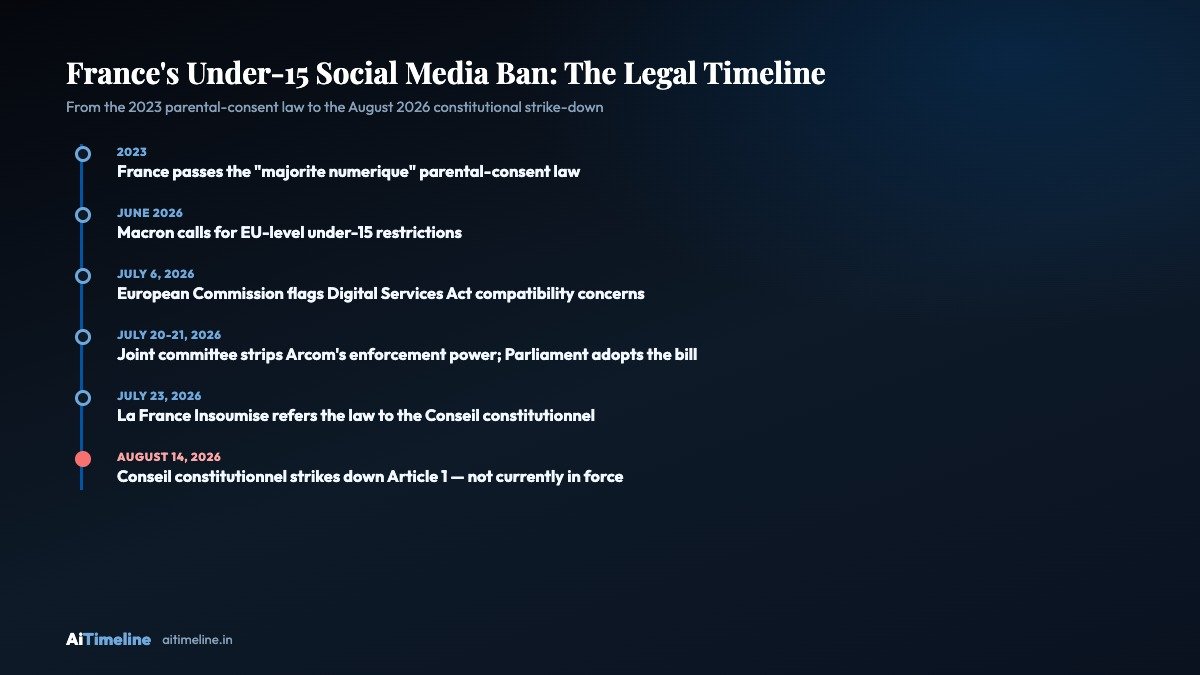
France’s under-15 social media ban: legal-process timeline, July-August 2026. Graphic: AiTimeline.
Why France Is Doing This
The political trigger, and the research behind the concern.
The immediate political trigger was a fatal stabbing at a school in eastern France, after which Macron said in June 2026 he would push for EU-level under-15 restrictions. That sits on top of a longer-running set of concerns cited by French officials and child-safety advocates: cyberbullying, sleep disruption, addictive algorithmic design, exposure to harmful or sexualized content, and body-image pressure, particularly for adolescent girls.
⚖️ Correlation, Not Proven Causation
These are genuine, researched associations in adolescent-mental-health literature — but the causal question, whether social media causes the harms attributed to it versus correlating with them versus being one factor among several including pre-existing vulnerability, remains actively debated among researchers. The Constitutional Council’s ruling didn’t dispute the underlying concern; it accepted child protection as a legitimate goal and objected specifically to the disproportionate mechanism chosen to pursue it.
The Other Side: Children’s Rights
What a blanket ban restricts alongside whatever it prevents.
The UN Convention on the Rights of the Child recognizes children’s rights to freedom of expression, access to information, and participation — rights a blanket platform ban necessarily restricts. That tension is exactly what the Constitutional Council’s ruling turned on: it’s not that protecting minors is illegitimate, but that a single age cutoff applied without regard for a specific minor’s maturity, family circumstances, or a service’s actual risk profile oversteps what’s proportionate. Digital-rights advocates have also raised a related, second-order concern: platforms hosting LGBTQ+ youth support communities, exam-stress peer groups, or hobby and interest communities often function as genuine social lifelines for teenagers, and a blunt age cutoff doesn’t distinguish those from purely entertainment-driven use.
The Privacy Problem With Age Verification
How would France verify a child’s age?
Any workable age gate requires some way to determine a user is under 15 — meaning either the platform, or a third party it trusts, has to know something about that user’s age it doesn’t currently need to know. No age-verification method is currently mandated in France for this purpose: the July 20, 2026 joint committee removed the clause that would have let Arcom compel platforms to build verification systems, before the law even passed.
CNIL, France’s data-protection regulator, has for years advocated a “double anonymity” model: a certified third party confirms a user’s age to a platform without revealing their identity, so the platform never sees identity documents directly. The European Commission is separately developing an EU-wide age-verification approach using cryptographic “zero-knowledge proofs,” tied to the EU digital identity wallet expected to roll out from late 2026 — a possible future technical path, not a current one.
The technical tradeoffs are real regardless of which method wins: identity-document checks are accurate but privacy-invasive; facial age estimation is less invasive but has known false-positive and false-negative rates precisely at the 13-16 boundary, the hardest age range to estimate visually; and self-declaration, the current de facto standard on most platforms, verifies nothing at all.
Can Parents Allow a Child Under 15 to Use Social Media?
Two different French laws, not one.
Under the law that was just struck down: no — it had no parental-consent exception, which the Constitutional Council flagged as part of the disproportionality problem. That’s a different model from France’s existing, separate 2023 law (part of the broader “majorite numerique” — digital majority — framework), which requires platforms to obtain parental consent before an under-15 can open an account, rather than banning access outright. That 2023 law remains technically in force, but its rollout has been hampered by similar technical and EU-regulatory friction, and enforcement has been limited in practice. Don’t confuse the two: one is a consent-based framework (2023, still standing, weakly enforced); the other was an unconditional ban (2026, struck down before taking effect).
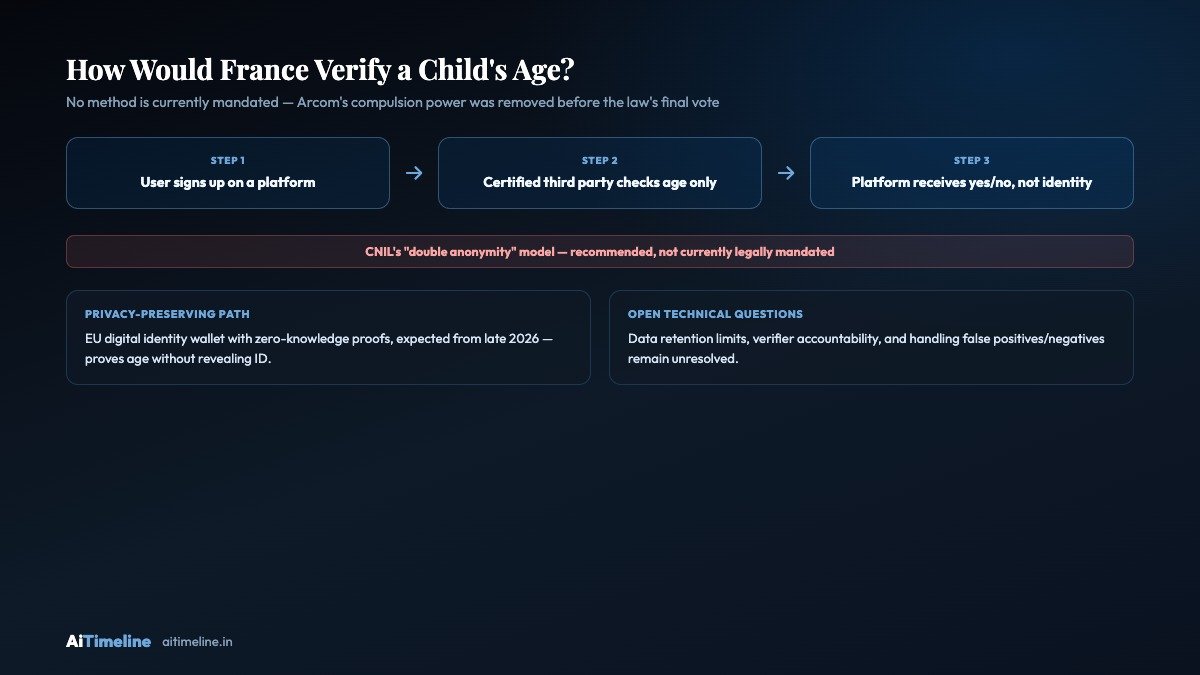
Age-verification approaches under discussion for France’s social media law. Graphic: AiTimeline.
France vs. the Rest of Europe
An EU single-market problem, not just a French one.
No other EU member state currently has an equivalent under-15 blanket social-media ban in force. The European Commission’s July 6, 2026 “detailed opinion” — issued under the EU’s technical-regulations notification procedure, Directive 2015/1535 — said the French bill, as drafted, risked conflicting with the Digital Services Act, and that opinion alone extended France’s mandatory pre-implementation standstill period to August 10, 2026, independent of anything the Conseil constitutionnel later did. That’s a structural tension worth naming plainly: the DSA is built around harmonized rules for how platforms operate across the EU’s single market, and a single member state imposing its own stricter access rule creates exactly the kind of fragmentation the DSA was designed to prevent. Other European countries, including Spain, Italy, Belgium and Germany, have discussed similar restrictions, but none has passed comparable legislation as of this writing.
France vs. Australia
The clearest global comparison point.
| Dimension | France (struck-down 2026 law) | Australia |
|---|---|---|
| Minimum age | Under 15 | Under 16 |
| Legal status | Struck down before taking effect | In force since Dec 10, 2025 |
| Platforms named | None (generic definition) | 10 named: Instagram, TikTok, Facebook, Snapchat, YouTube, X, Reddit, Twitch, Threads, Kick |
| Parental consent exception | None (part of why it was struck down) | None |
| Enforcement body | Would have been Arcom (power removed pre-vote) | eSafety Commissioner |
| Penalties | Unspecified/removed before final vote | Up to AU$50 million (~US$33 million) per platform |
| Age assurance | Unmandated | Platform-level “reasonable steps,” no single mandated method |
| Result so far | N/A — not in force | ~4.7 million under-16 accounts removed within days |
💡 The Real Difference Is Enforceability
Australia’s law kept real penalties and a regulator with teeth attached all the way through implementation. France’s law had that removed by its own Parliament three days before the vote that passed it, then lost the rest to the Constitutional Council.
Who Is Responsible — Parents, Platforms or Government?
Where the obligation currently sits.
Parents
By default, under general French parental-authority principles and the still-standing 2023 consent law — with no additional government-mandated technical enforcement layer right now.
Platforms
No France-specific under-15 legal obligation beyond what already applies under the EU Digital Services Act’s general risk-mitigation duties for Very Large Online Platforms (45M+ EU monthly users).
French Government
Has stated intent to shift more responsibility onto platforms via a future law — as of publication, hasn’t yet done so in a form that survived constitutional review.
EU Regulators
The European Commission’s role so far has been procedural (the TRIS notification check), not substantive enforcement — it hasn’t ruled the concept illegal, only flagged compatibility risk with the DSA.
Enforcement, Penalties, and Arcom/CNIL’s Roles
What authority currently exists, and what doesn’t.
With Article 1 voided, there is currently no French-specific enforcement mechanism, penalty structure, or active Arcom mandate tied to this particular law. Arcom’s broader existing authority — including its established age-verification framework for pornographic sites — was the model some earlier drafts referenced for social media, but the compulsion power specific to this bill was removed before the final vote. CNIL’s role remains advisory and standard-setting (its recommendations for age verification, its “double anonymity” model) rather than an active enforcement one for this specific measure, since the measure isn’t in force. No penalties — for platforms, parents, or children — currently apply. Nothing in any reporting reviewed for this article suggests children themselves would face penalties even under the struck-down version; enforcement, where it existed in draft form, targeted platforms only.
Schools: A Separate, Distinct Rule
Don’t confuse this with the phone-in-schools policy.
France’s mobile-phone-in-schools policy is a different, already-active measure: phones have been restricted in French middle schools (college) since the 2025 school year under the “portable en pause” program, extending to high schools (lycee) starting the 2026 school year. That policy sits in the same broader legislative package as the social-media bill in some reporting, but it is legally and procedurally distinct — it was not part of what the Constitutional Council struck down, and it remains in effect independent of the social-media law’s status.
Does a Social-Media Age Ban Work? — AiTimeline Analysis
Labeled analysis, not reported fact.
- An age ban without reliable verification is a symbolic ban. France’s own Parliament removed the verification-enforcement mechanism before passing the law — meaning even had it survived the Constitutional Council, its practical bite was already in question.
- The France/Australia contrast suggests enforceability, not the age threshold, is the harder problem. Australia kept penalties and a named-platform list through to implementation; France didn’t, and that gap shows up as measurably different real-world outcomes.
- Parental-consent models and outright bans solve different problems. France’s 2023 law and its 2026 attempt aren’t two versions of the same policy — the Council’s objection to the absence of a consent-style exception suggests any replacement will likely move back toward a hybrid model.
- A national rule inside a single-market EU creates real friction, independent of national politics. The European Commission’s TRIS intervention happened before the Constitutional Council ever got involved.
- Children who lose access to mainstream platforms don’t stop going online — they migrate. Whether to less-regulated or less-moderated alternatives is a genuine open question the current debate hasn’t addressed with evidence either way.
- The “child safety or platform accountability” framing may be a false choice. The ruling suggests the two goals require different legal tools: child-safety objectives can survive constitutional review; blunt platform-access bans, as drafted here, did not.
- A spring 2027 timeline means this remains unresolved through most of 2026. Any parent, journalist, or platform compliance team treating “France’s ban” as settled policy right now is working from outdated information.
- Macron owning this as a signature final-term measure raises the stakes of getting the rewrite right. A second constitutional failure would be a much bigger story than the first.
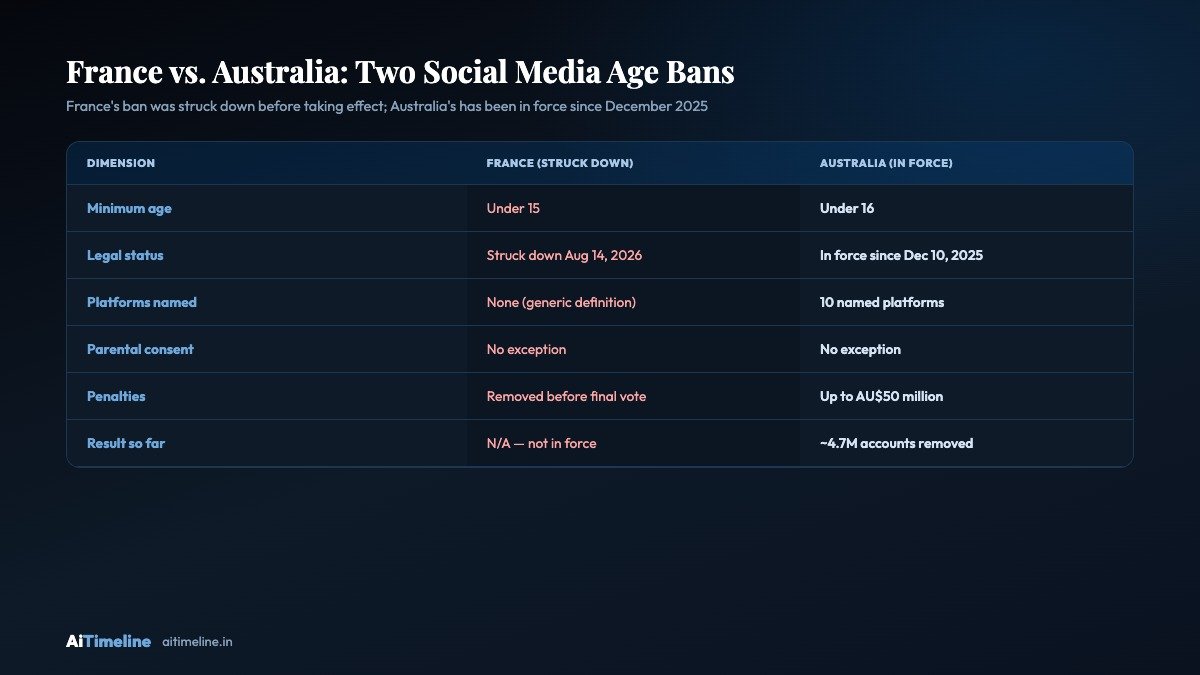
France’s struck-down under-15 law compared to Australia’s in-force under-16 ban. Graphic: AiTimeline.
What French Parents Should Know
Direct answers to the practical questions.
| Question | Current answer |
|---|---|
| Can a 14-year-old use Instagram right now? | Yes, legally, as of publication — no under-15 ban is in force |
| Can a parent give permission? | Moot for the struck-down law; the 2023 consent framework technically still applies but is weakly enforced |
| Will platforms verify age? | Not under any current legal mandate |
| Can children bypass restrictions? | No restrictions currently exist to bypass |
| Will WhatsApp be affected? | Unclear even under the struck-down draft; currently not restricted |
| What happens to existing accounts? | Nothing — the account-closure requirement was voided with Article 1 |
| When does any rule start? | No confirmed date; a rewrite is targeted for before spring 2027 |
| Can children appeal an age decision? | No age-decision process currently exists to appeal |
⚠️ On Bypassing Age Gates
Even had the law survived, age gates on consumer platforms face a well-documented enforcement gap: shared family devices, false birthdates at signup, and migration to platforms outside a given country’s jurisdiction all blunt age-based restrictions in practice, as seen in early data from Australia’s rollout despite its stronger enforcement design. The point for policymakers is that verification design, not the headline age, determines whether a law like this actually changes youth behavior — this article does not detail bypass methods.
The Full Timeline: From 2023 to the August 2026 Ruling
Reverse-chronological. Each entry states what happened and the primary source.
Aug 14
Conseil Constitutionnel Strikes Down Article 1
What happened: France’s Conseil constitutionnel ruled the blanket under-15 social media ban unconstitutional, finding it “neither appropriate, necessary, nor proportionate” to the goal of protecting minors, and citing inadequate privacy safeguards around the age verification it implied.
Why it matters: This is the single most important fact in this story — as of this ruling, no under-15 social media ban is in force in France.
Response: Macron tasked Prime Minister Sebastien Lecornu with preparing a legally robust replacement, taking the ruling and EU law into account, targeted for before spring 2027.
Jul 23
La France Insoumise Refers the Law to the Constitutional Council
What happened: LFI deputies, using the minimum 60-member parliamentary threshold, referred the newly adopted law to the Conseil constitutionnel, arguing it violated freedom of expression and communication as well as the right to privacy.
Why it matters: This referral triggered the mandatory pre-promulgation constitutional review that ultimately struck the law down three weeks later.
Jul 21
Parliament Definitively Adopts the Ban
What happened: The Senate adopted the bill 243-2, and the National Assembly followed with a 279-81 vote, giving the ban a large majority in both chambers.
Why it matters: This made France the first EU country to pass a blanket social-media age ban — for 24 days, until the constitutional ruling.
Jul 20
Joint Committee Removes the Enforcement Mechanism
What happened: The commission mixte paritaire (joint parliamentary committee) finalized the bill text, eliminating the mechanism that would have let Arcom compel platforms to build age-verification systems and enforce a blacklist, leaving Article 1 as a bare prohibition.
Why it matters: The law’s practical enforceability was already in question one day before it passed, independent of the later constitutional ruling.
Jul 6
European Commission Flags EU Law Compatibility Concerns
What happened: The European Commission issued a “detailed opinion” under the EU’s technical-regulations notification procedure (Directive 2015/1535 / TRIS), stating the bill, as drafted, risked conflicting with the Digital Services Act.
Why it matters: The opinion alone extended France’s mandatory pre-implementation standstill period to August 10, 2026 — meaning the law could not legally have taken effect on its planned September 1 date regardless of the later constitutional ruling.
Jun
Macron Calls for EU-Level Under-15 Restrictions
What happened: Following a fatal stabbing at a school in eastern France, President Macron said he would push for EU-level regulation banning social media access for all under-15s.
Why it matters: This set the political mandate and urgency behind the bill’s rapid progress through Parliament over the following weeks.
France’s Earlier “Majorite Numerique” Law
What happened: France passed an earlier law requiring platforms to obtain parental consent before an under-15 could open a social media account — a consent-based framework, distinct from the 2026 attempt’s outright ban.
Why it matters: This law remains technically in force today, but its rollout has been hampered by technical and EU-regulatory friction similar to what the 2026 law later faced, and enforcement has been limited in practice. Don’t confuse this consent-based law with the 2026 ban that was struck down.
Explore More Timelines
People Also Ask
Frequently Asked Questions
⚠️ How We Fact-Checked This Timeline
Every date and vote count in this article is cross-checked against the Conseil constitutionnel’s official decision page for n. 2026-911 DC, the Assemblee nationale and Senat’s own legislative dossiers, and at least two independent news sources per claim. Where a detail, such as exact platform coverage, was reported inconsistently across sources or never resolved in the final legal text, we say so explicitly rather than guessing. This page will be updated if a revised bill changes any of the facts above — check the “last updated” date at the top before treating any status claim as current.
Sources & further reading
Every dated entry above was checked against these references. Last reviewed 15 September 2026.
- Conseil constitutionnel, Decision n. 2026-911 DC (14 August 2026)
- Conseil constitutionnel, press release for Decision n. 2026-911 DC
- Assemblee nationale, legislative dossier: Proteger les mineurs des risques lies aux reseaux sociaux
- Senat, legislative dossier on the social media minors bill
- France 24: France's constitutional authority strikes down social media ban for under-15s
- Le Club des Juristes: LFI saisit le Conseil constitutionnel
- eSafety Commissioner / NPR: Australia's under-16 social media ban